
Helping as a Personal Journey Chapter 1 See
- Slides: 10
Helping as a Personal Journey Chapter 1 See yourself as a Helper Beginning of a learning process that will take years. You will face self doubt, personal prejudice, feelings of attraction, repulsion and frustration.
Helping as a Personal Journey Chapter 1 Become a reflective practitioner Reflection to overcome challenges and enhance learning Reflection when helping clients with different backgrounds Reflection to accommodate new self awareness Ask for supervision Develop a support group of fellow learners Become a Client Keep a journal
Helping as a Personal Journey Chapter 1 Become a reflective practitioner Reflection on your attitudes about helping Do: Stop and reflect- read and complete the exercise on pages 6 -8 - Questions 1, 2 & 4 (do not do three…yet)
Helping as a Personal Journey Chapter 1 What are Perry’s three stages of helper development? The Dualistic or Right/Wrong Stage- is characterized by the belief that a helper’s responses to a client are either right or wrong The Multiplistic Stage- when you discover that there are several right answers to the same client statement (accompanied by the feeling of being overwhelmed) The Relativistic Stage- you recognize that although many types of responses may be appropriate, depending on circumstances, some are relatively better than others.
Helping as a Personal Journey Chapter 1 The Development of Expertise Read pages 11 -12 Reflect on Guild terminology in your small group
Core Values in Interpersonal Helping Carl Rogers Vulnerability- persons in a state of anxiety Genuineness- listener freely and deeply themselves, awareness of their effect on others Unconditional Positive Regard- balancing conditional regard of others, “prizing” the other to facilitate growth Accurate Empathy- reflecting of the person’s inner world, as if it were our own, and checking that understanding Courage to Confront- drawing out painful realities http: //www. youtube. com/watch? v=l 7 AWnf. FRc 7 g p. 19 -21
The Nuts and Bolts of Helping Chapter 2 What is helping? A broad term that includes all activates we use to assist another person, whether we have a therapeutic relationship or not What is Interviewing? information gathering process
The Nuts and Bolts of Helping Chapter 2 What is counselling? Process of helping clients deal with developmental/transitional problems What is psychotherapy? Is helping that relies on formalized diagnosis, emphasizes pathology and is more concerned with treating mental disorders
Helping Process & Relationship Small group: In-class Presentations on Chapters 2 -4 1. 2. 3. 4. 5. Stages of the Helping Process (p. 40) Therapeutic Relationship (p. 54 - 61) Self Disclosure (p. 61 -64) Helping Faux Pas (p. 65 -68) Transference & Counter-transference (p. 68 -74)
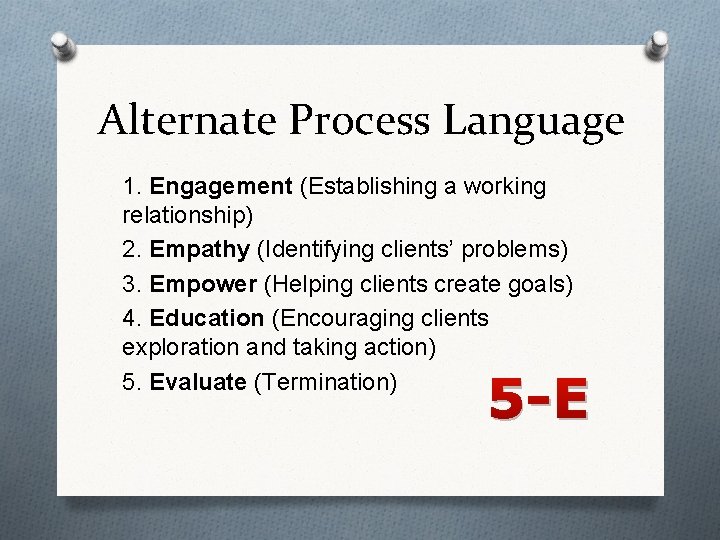
Alternate Process Language 1. Engagement (Establishing a working relationship) 2. Empathy (Identifying clients’ problems) 3. Empower (Helping clients create goals) 4. Education (Encouraging clients exploration and taking action) 5. Evaluate (Termination) 5 -E