
Help needed for the Art Science Day at
- Slides: 85
Help needed for the Art & Science Day at the Chester Street Elementary school 110 Chester St, Kingston 12 - 3: 30 on Tuesday, March 22.
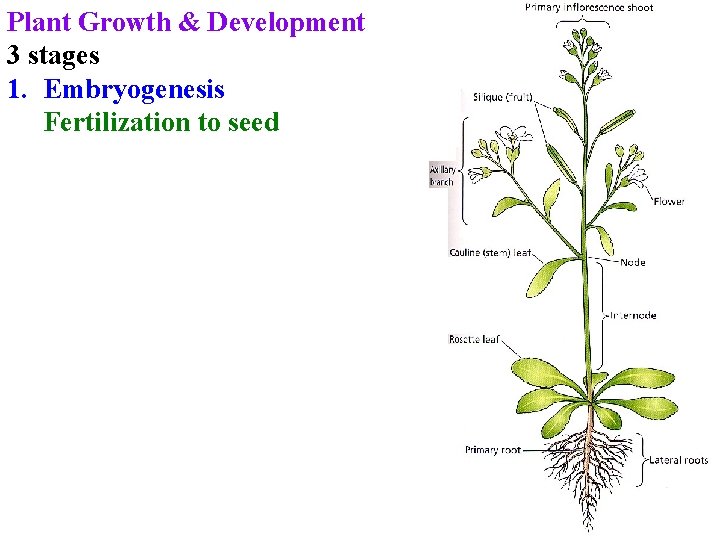
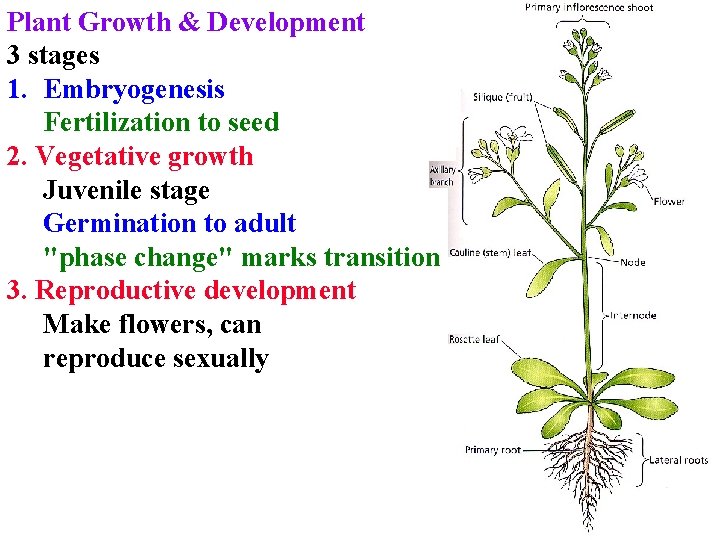
Plant Growth & Development 3 stages 1. Embryogenesis Fertilization to seed
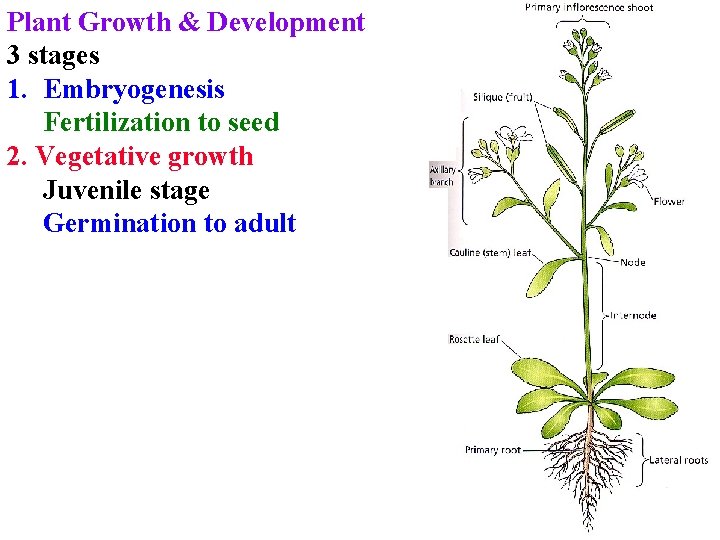
Plant Growth & Development 3 stages 1. Embryogenesis Fertilization to seed 2. Vegetative growth Juvenile stage Germination to adult
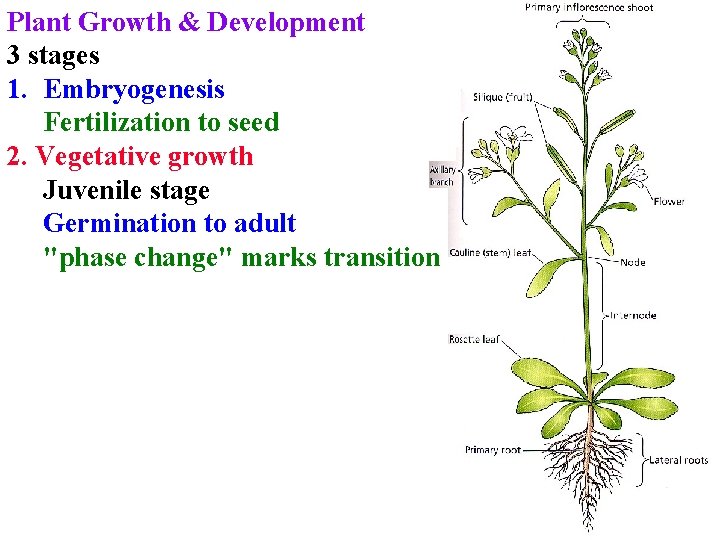
Plant Growth & Development 3 stages 1. Embryogenesis Fertilization to seed 2. Vegetative growth Juvenile stage Germination to adult "phase change" marks transition
Plant Growth & Development 3 stages 1. Embryogenesis Fertilization to seed 2. Vegetative growth Juvenile stage Germination to adult "phase change" marks transition 3. Reproductive development Make flowers, can reproduce sexually
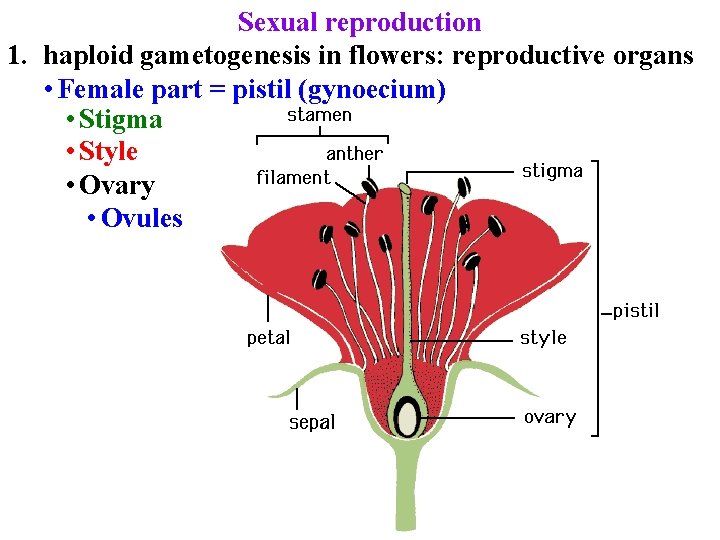
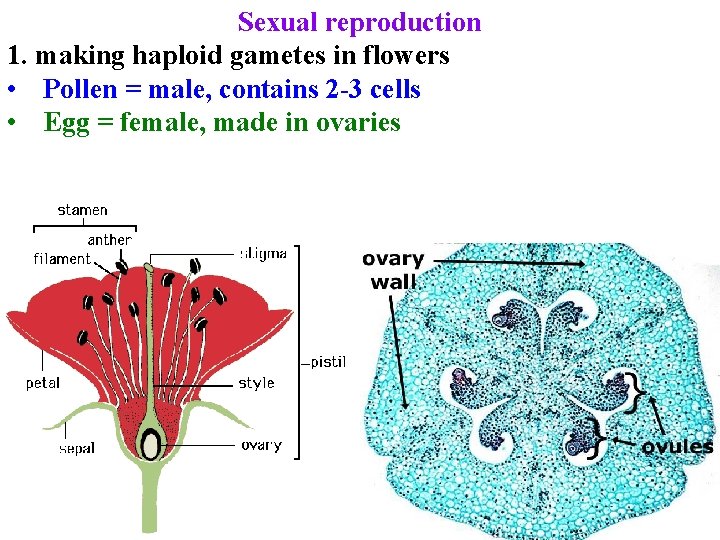
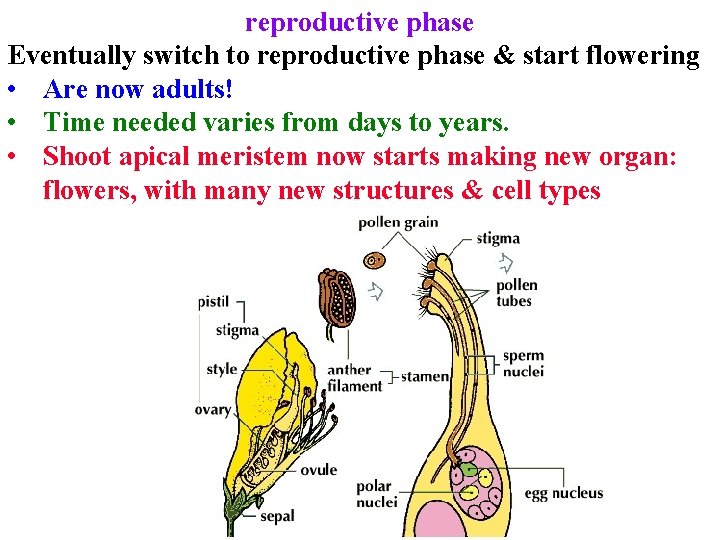
Sexual reproduction 1. haploid gametogenesis in flowers: reproductive organs • Female part = pistil (gynoecium) • Stigma • Style • Ovary • Ovules
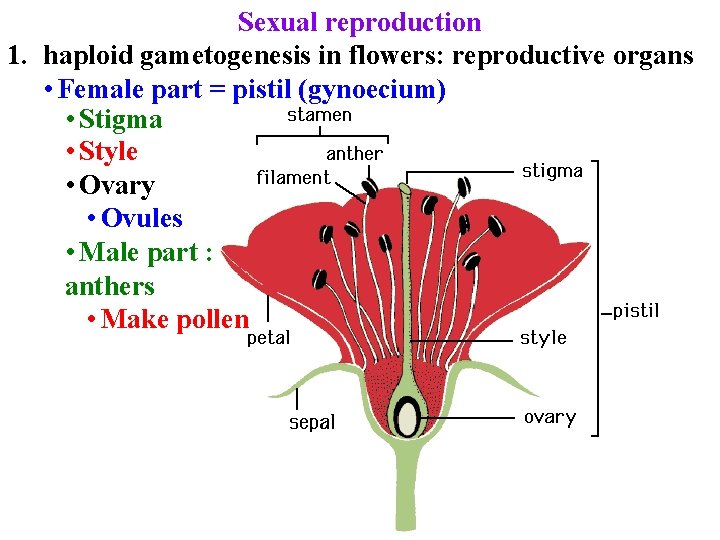
Sexual reproduction 1. haploid gametogenesis in flowers: reproductive organs • Female part = pistil (gynoecium) • Stigma • Style • Ovary • Ovules • Male part : anthers • Make pollen
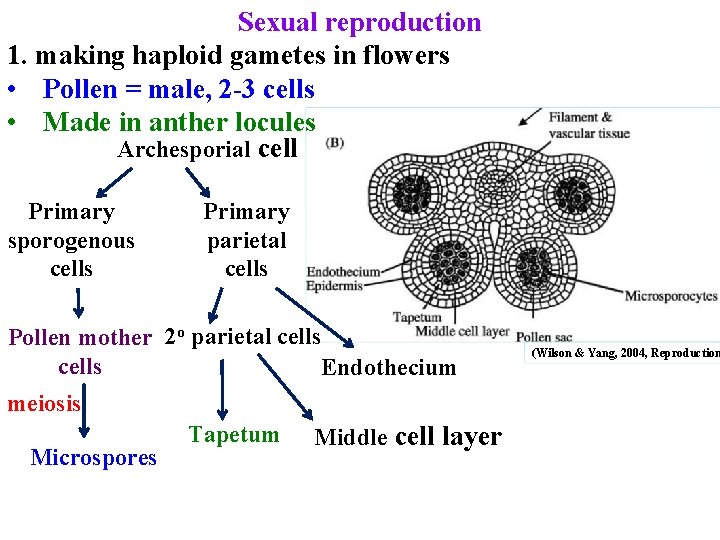
Sexual reproduction 1. making haploid gametes in flowers • Pollen = male, 2 -3 cells • Made in anther locules Archesporial cell Primary sporogenous cells Primary parietal cells Pollen mother 2 o parietal cells Endothecium meiosis Microspores Tapetum Middle cell layer (Wilson & Yang, 2004, Reproduction
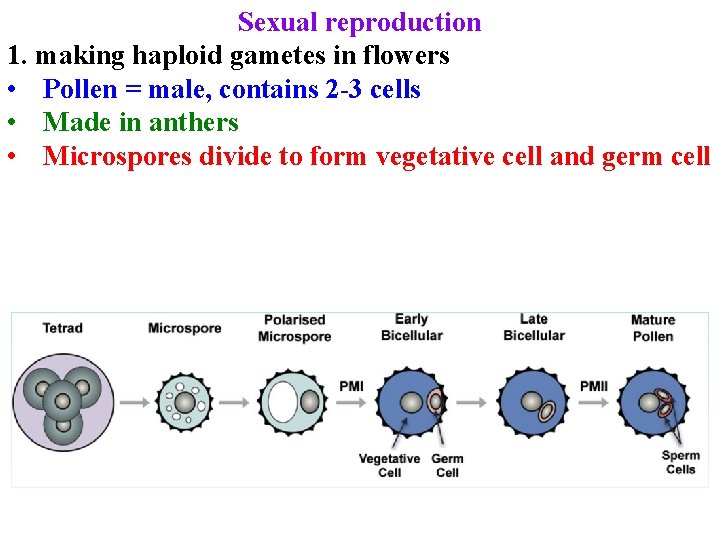
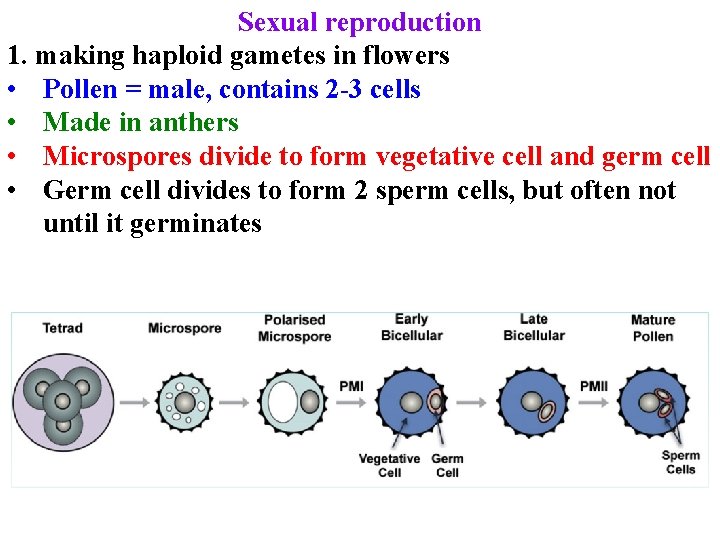
Sexual reproduction 1. making haploid gametes in flowers • Pollen = male, contains 2 -3 cells • Made in anthers • Microspores divide to form vegetative cell and germ cell
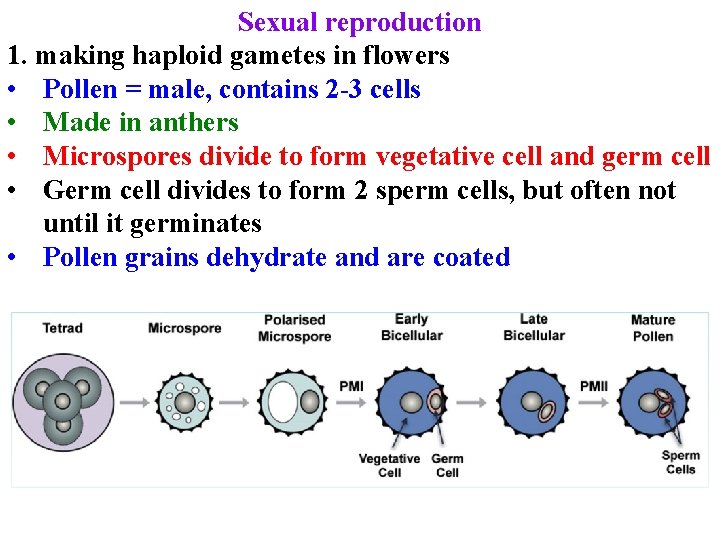
Sexual reproduction 1. making haploid gametes in flowers • Pollen = male, contains 2 -3 cells • Made in anthers • Microspores divide to form vegetative cell and germ cell • Germ cell divides to form 2 sperm cells, but often not until it germinates
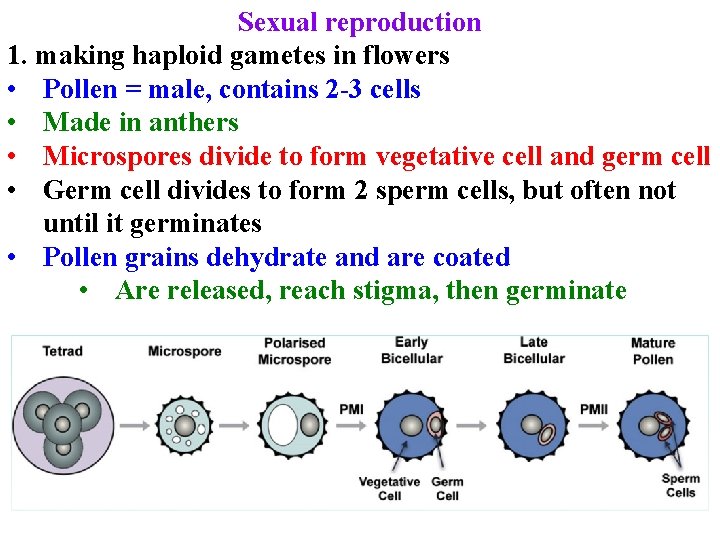
Sexual reproduction 1. making haploid gametes in flowers • Pollen = male, contains 2 -3 cells • Made in anthers • Microspores divide to form vegetative cell and germ cell • Germ cell divides to form 2 sperm cells, but often not until it germinates • Pollen grains dehydrate and are coated
Sexual reproduction 1. making haploid gametes in flowers • Pollen = male, contains 2 -3 cells • Made in anthers • Microspores divide to form vegetative cell and germ cell • Germ cell divides to form 2 sperm cells, but often not until it germinates • Pollen grains dehydrate and are coated • Are released, reach stigma, then germinate
Sexual reproduction 1. making haploid gametes in flowers • Pollen = male, contains 2 -3 cells • Egg = female, made in ovaries
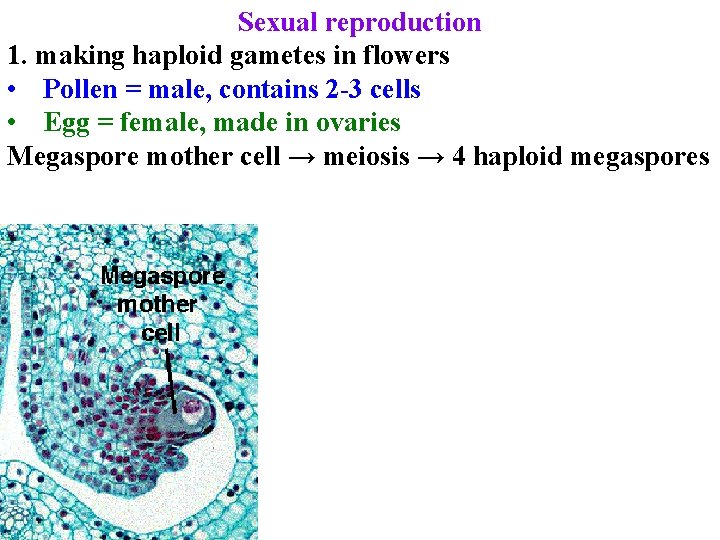
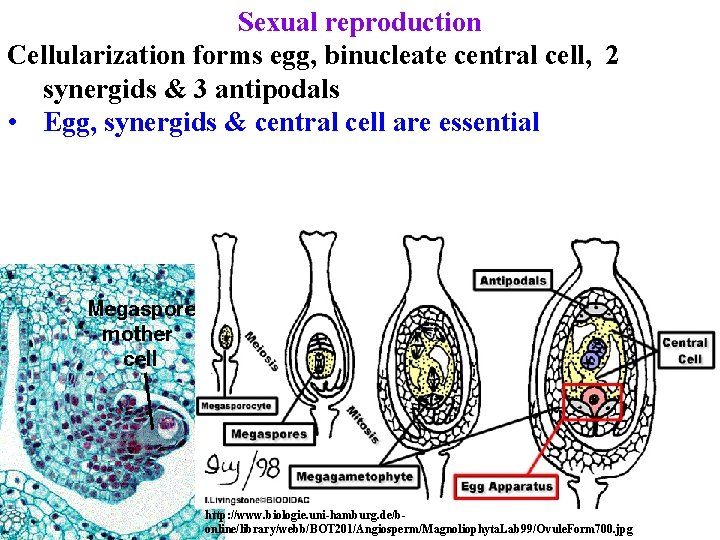
Sexual reproduction 1. making haploid gametes in flowers • Pollen = male, contains 2 -3 cells • Egg = female, made in ovaries Megaspore mother cell → meiosis → 4 haploid megaspores
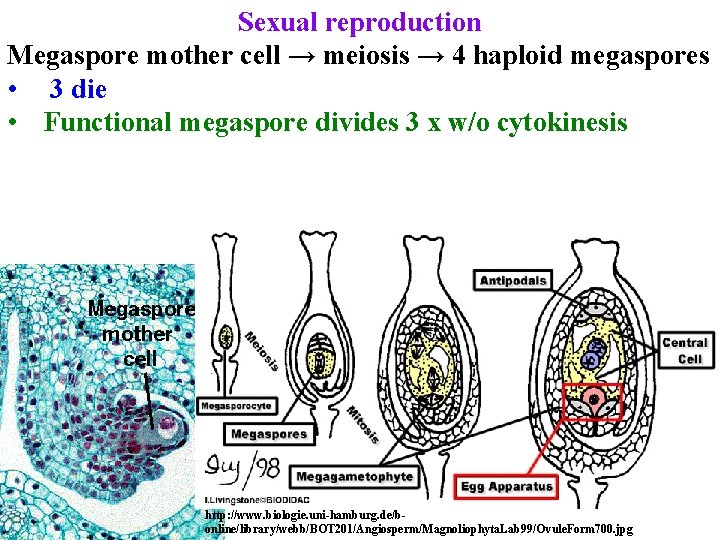
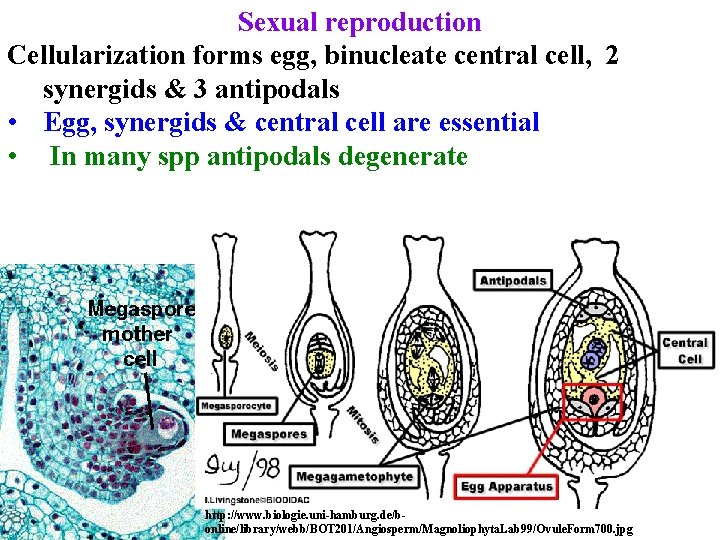
Sexual reproduction Megaspore mother cell → meiosis → 4 haploid megaspores • 3 die • Functional megaspore divides 3 x w/o cytokinesis http: //www. biologie. uni-hamburg. de/bonline/library/webb/BOT 201/Angiosperm/Magnoliophyta. Lab 99/Ovule. Form 700. jpg
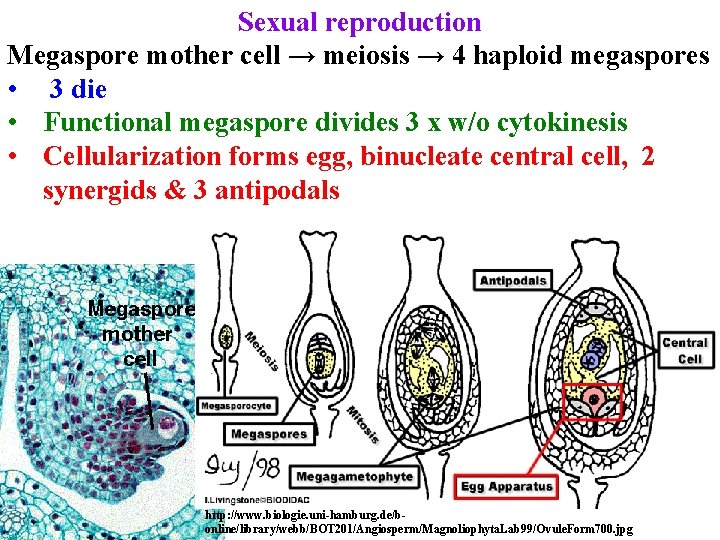
Sexual reproduction Megaspore mother cell → meiosis → 4 haploid megaspores • 3 die • Functional megaspore divides 3 x w/o cytokinesis • Cellularization forms egg, binucleate central cell, 2 synergids & 3 antipodals http: //www. biologie. uni-hamburg. de/bonline/library/webb/BOT 201/Angiosperm/Magnoliophyta. Lab 99/Ovule. Form 700. jpg
Sexual reproduction Cellularization forms egg, binucleate central cell, 2 synergids & 3 antipodals • Egg, synergids & central cell are essential http: //www. biologie. uni-hamburg. de/bonline/library/webb/BOT 201/Angiosperm/Magnoliophyta. Lab 99/Ovule. Form 700. jpg
Sexual reproduction Cellularization forms egg, binucleate central cell, 2 synergids & 3 antipodals • Egg, synergids & central cell are essential • In many spp antipodals degenerate http: //www. biologie. uni-hamburg. de/bonline/library/webb/BOT 201/Angiosperm/Magnoliophyta. Lab 99/Ovule. Form 700. jpg
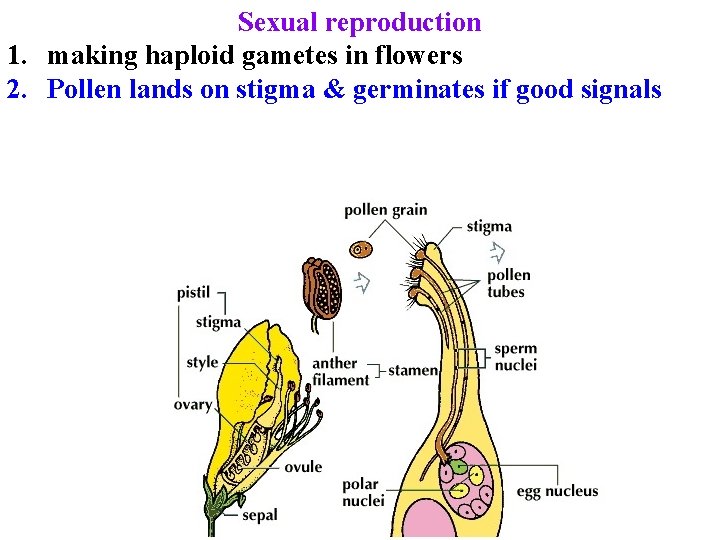
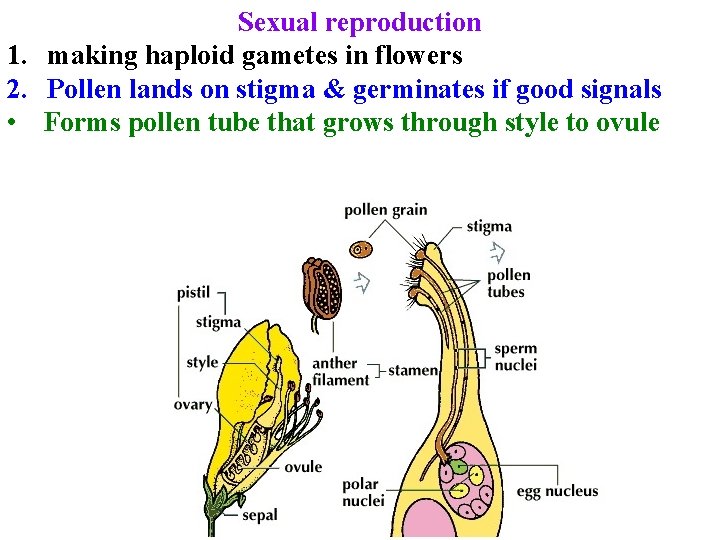
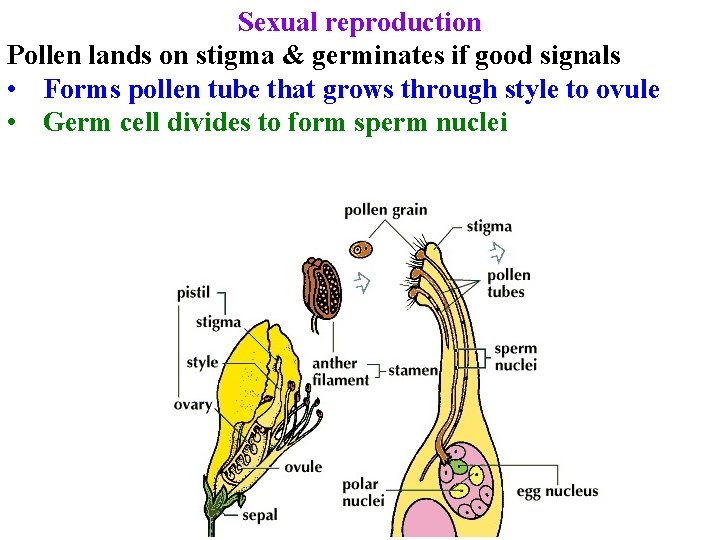
Sexual reproduction 1. making haploid gametes in flowers 2. Pollen lands on stigma & germinates if good signals
Sexual reproduction 1. making haploid gametes in flowers 2. Pollen lands on stigma & germinates if good signals • Forms pollen tube that grows through style to ovule
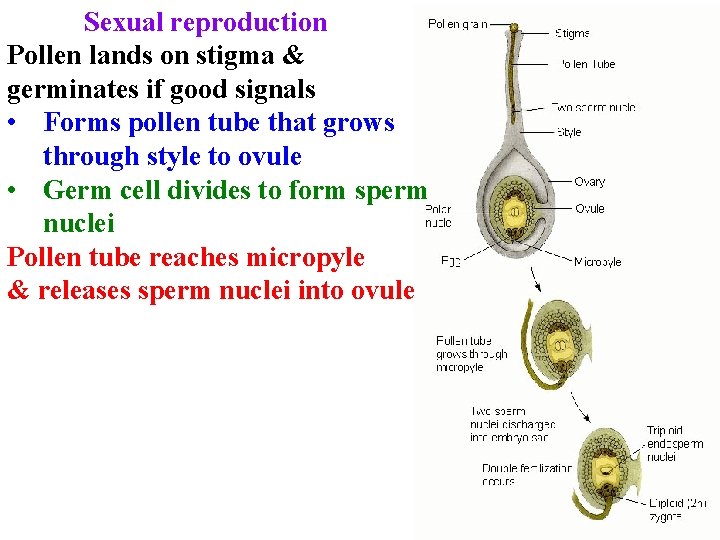
Sexual reproduction Pollen lands on stigma & germinates if good signals • Forms pollen tube that grows through style to ovule • Germ cell divides to form sperm nuclei
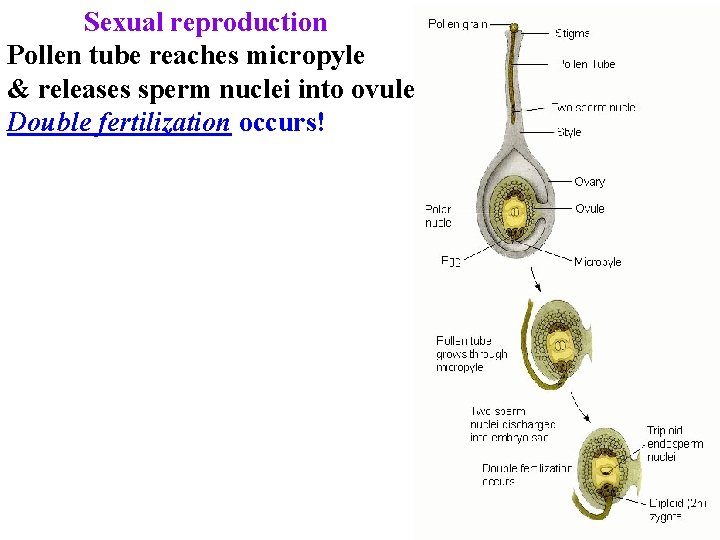
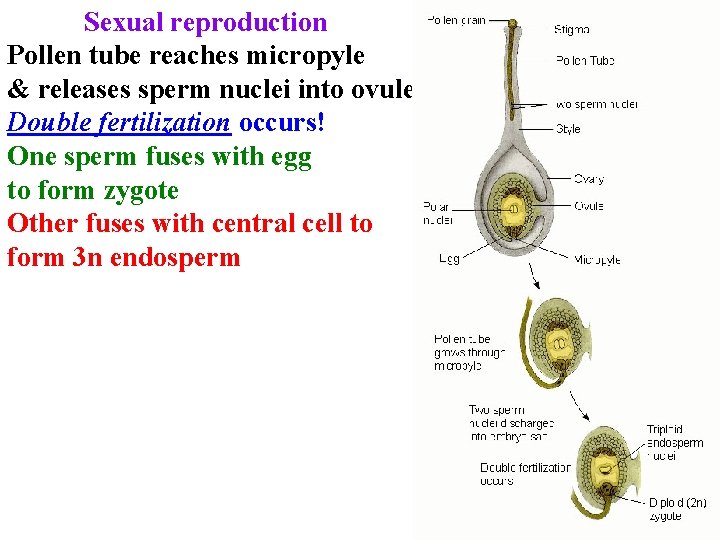
Sexual reproduction Pollen lands on stigma & germinates if good signals • Forms pollen tube that grows through style to ovule • Germ cell divides to form sperm nuclei Pollen tube reaches micropyle & releases sperm nuclei into ovule
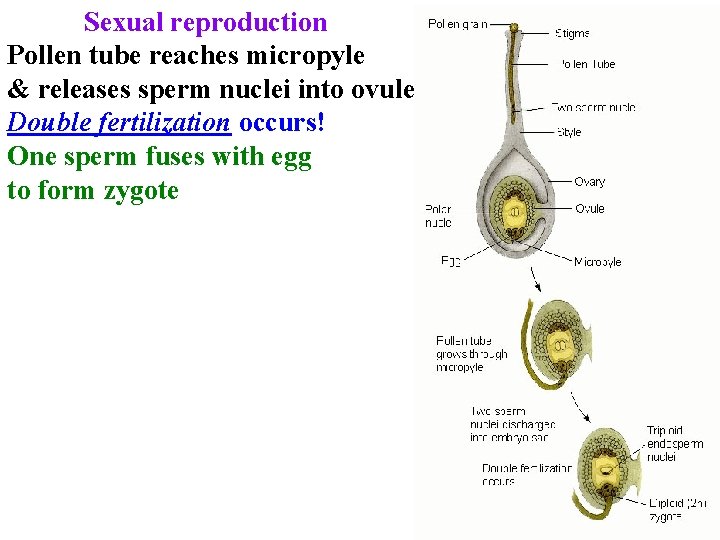
Sexual reproduction Pollen tube reaches micropyle & releases sperm nuclei into ovule Double fertilization occurs!
Sexual reproduction Pollen tube reaches micropyle & releases sperm nuclei into ovule Double fertilization occurs! One sperm fuses with egg to form zygote
Sexual reproduction Pollen tube reaches micropyle & releases sperm nuclei into ovule Double fertilization occurs! One sperm fuses with egg to form zygote Other fuses with central cell to form 3 n endosperm
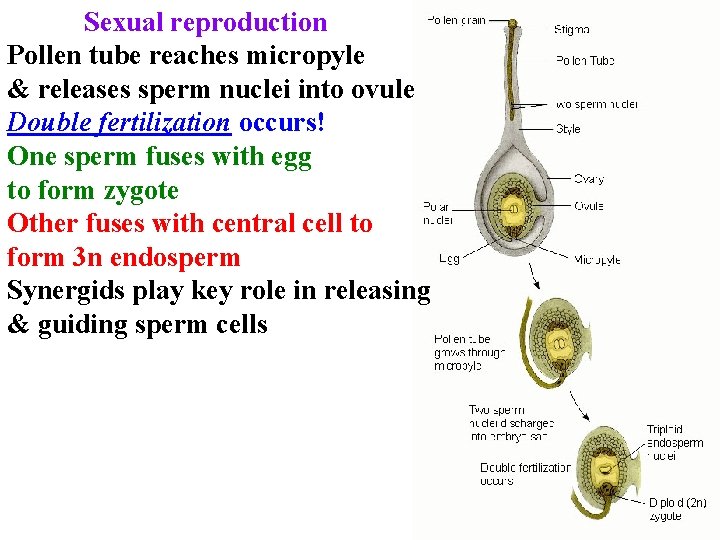
Sexual reproduction Pollen tube reaches micropyle & releases sperm nuclei into ovule Double fertilization occurs! One sperm fuses with egg to form zygote Other fuses with central cell to form 3 n endosperm Synergids play key role in releasing & guiding sperm cells
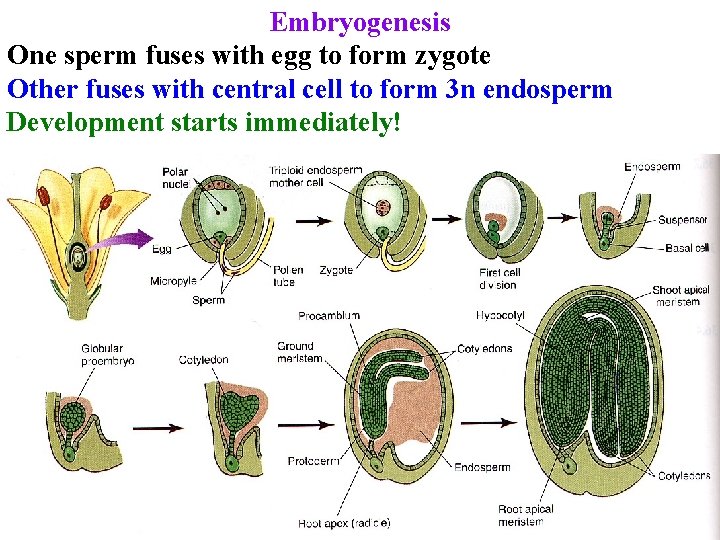
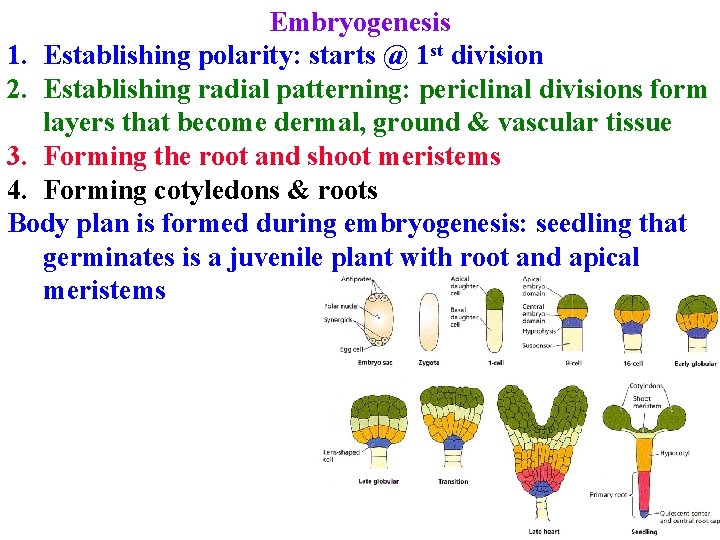
Embryogenesis One sperm fuses with egg to form zygote Other fuses with central cell to form 3 n endosperm Development starts immediately!
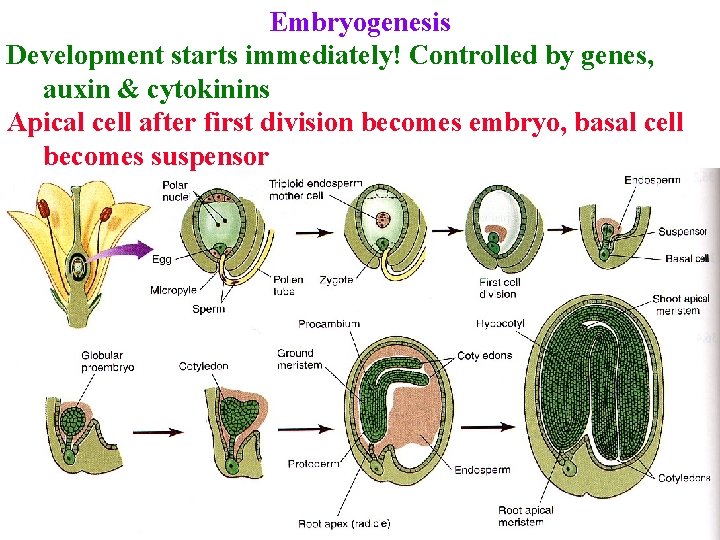
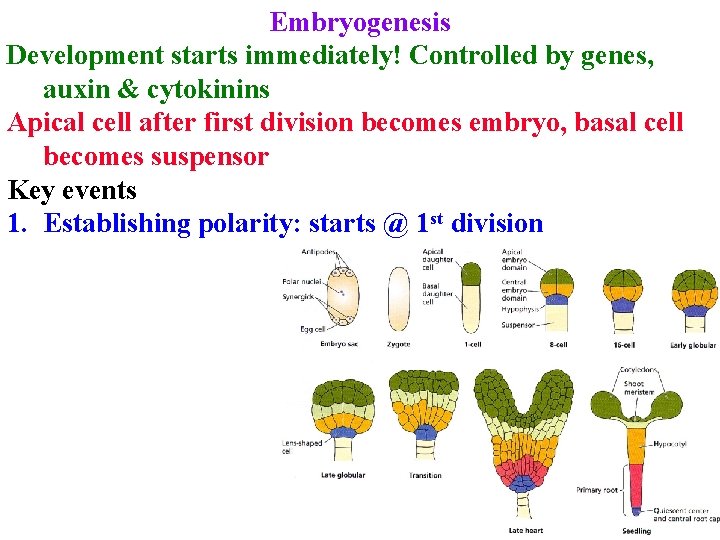
Embryogenesis Development starts immediately! Controlled by genes, auxin & cytokinins Apical cell after first division becomes embryo, basal cell becomes suspensor
Embryogenesis Development starts immediately! Controlled by genes, auxin & cytokinins Apical cell after first division becomes embryo, basal cell becomes suspensor Key events 1. Establishing polarity: starts @ 1 st division
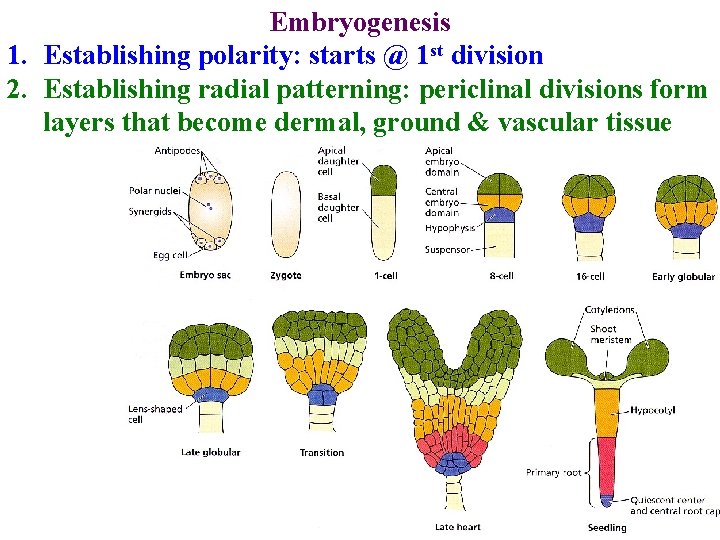
Embryogenesis 1. Establishing polarity: starts @ 1 st division 2. Establishing radial patterning: periclinal divisions form layers that become dermal, ground & vascular tissue
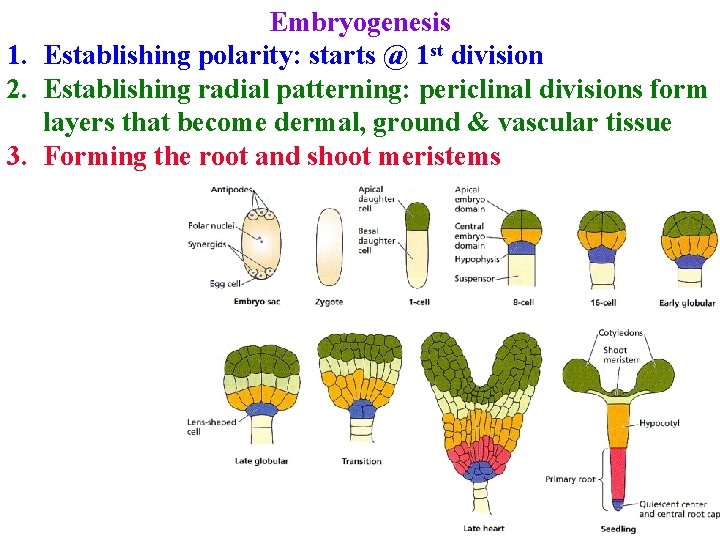
Embryogenesis 1. Establishing polarity: starts @ 1 st division 2. Establishing radial patterning: periclinal divisions form layers that become dermal, ground & vascular tissue 3. Forming the root and shoot meristems
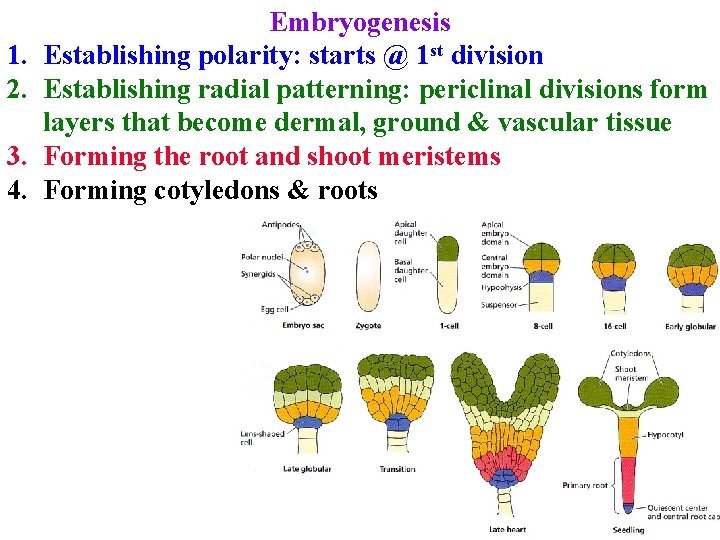
1. 2. 3. 4. Embryogenesis Establishing polarity: starts @ 1 st division Establishing radial patterning: periclinal divisions form layers that become dermal, ground & vascular tissue Forming the root and shoot meristems Forming cotyledons & roots
Embryogenesis 1. Establishing polarity: starts @ 1 st division 2. Establishing radial patterning: periclinal divisions form layers that become dermal, ground & vascular tissue 3. Forming the root and shoot meristems 4. Forming cotyledons & roots Body plan is formed during embryogenesis: seedling that germinates is a juvenile plant with root and apical meristems
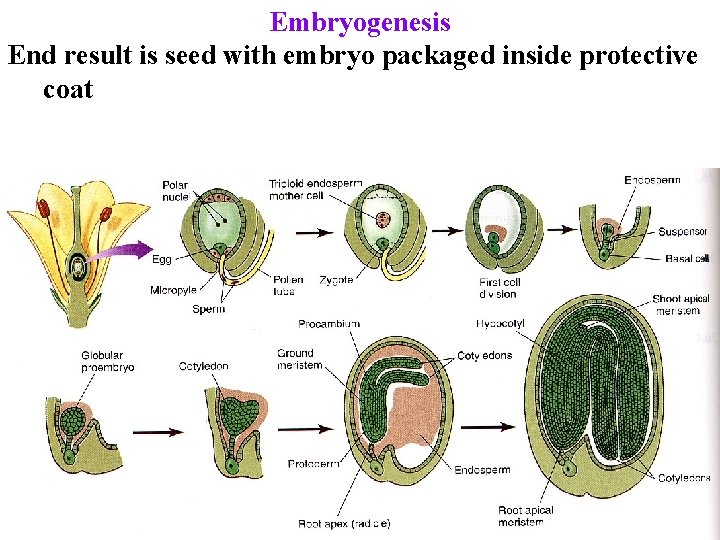
Embryogenesis End result is seed with embryo packaged inside protective coat
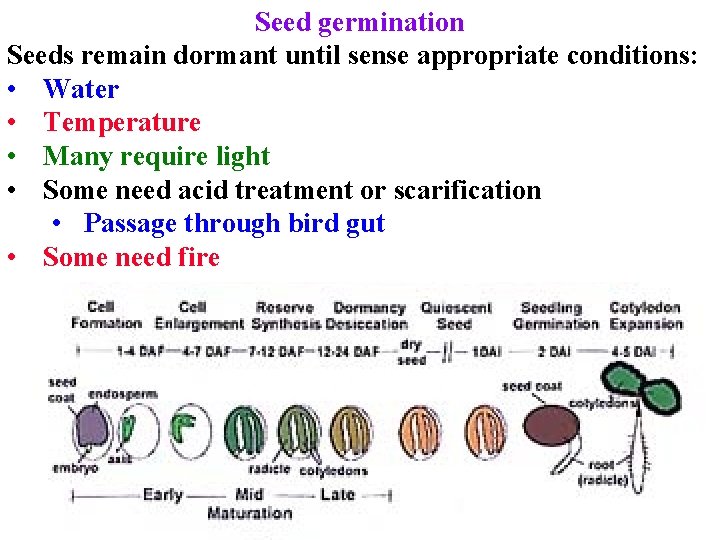
Seed germination Seeds remain dormant until sense appropriate conditions: • Water • Temperature • Many require light • Some need acid treatment or scarification • Passage through bird gut • Some need fire
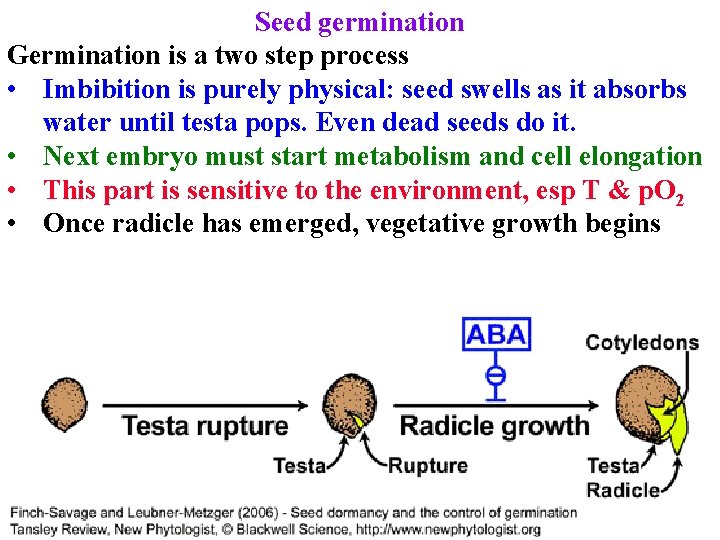
Seed germination Germination is a two step process • Imbibition is purely physical: seed swells as it absorbs water until testa pops. Even dead seeds do it. • Next embryo must start metabolism and cell elongation • This part is sensitive to the environment, esp T & p. O 2 • Once radicle has emerged, vegetative growth begins
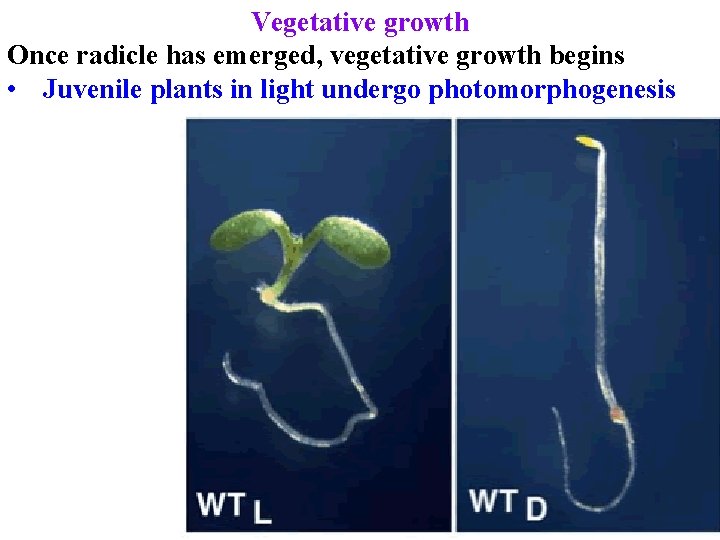
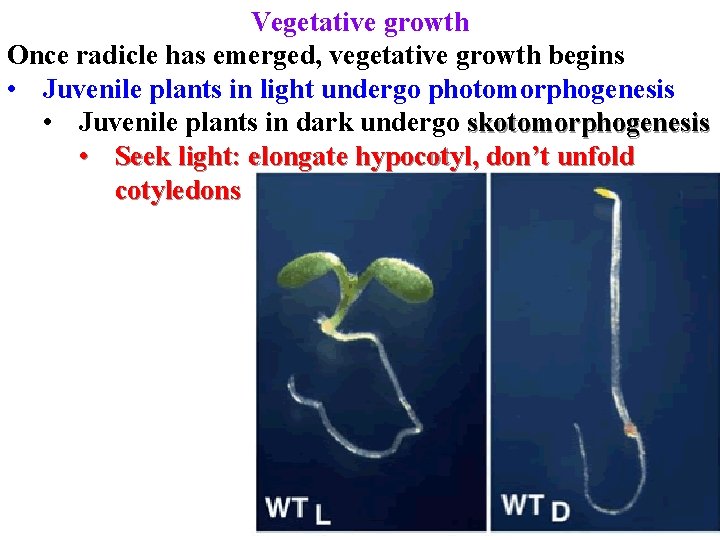
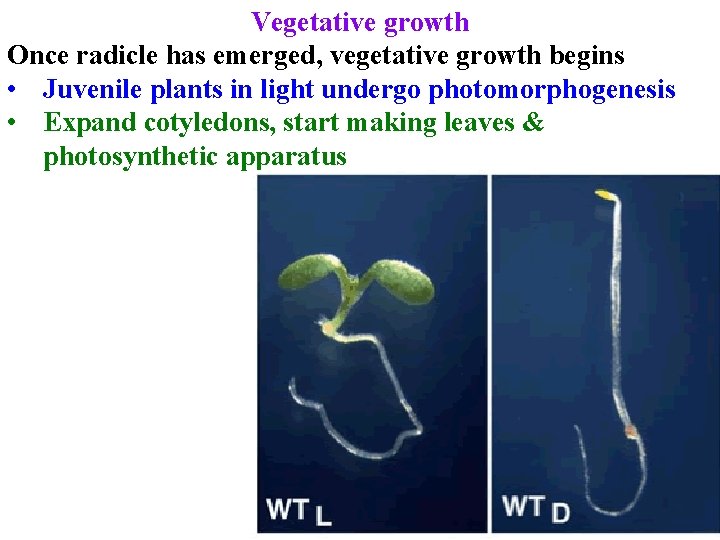
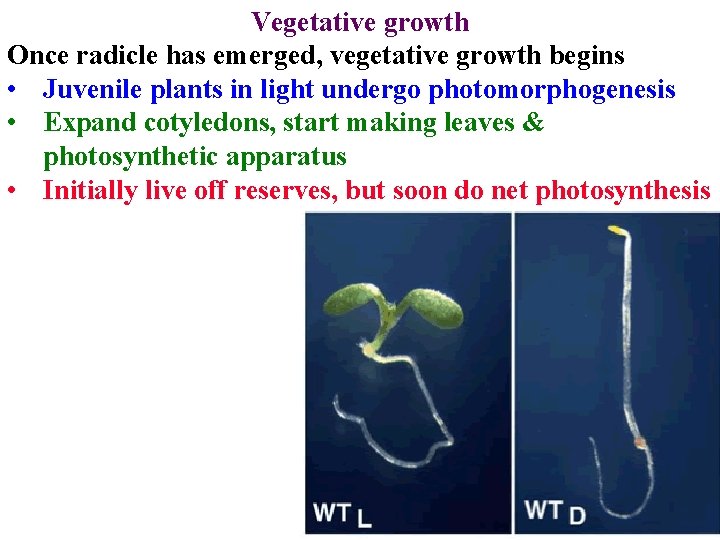
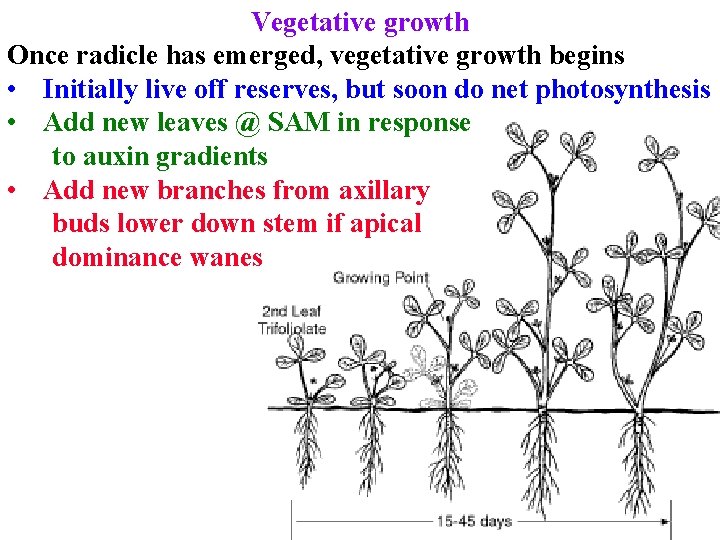
Vegetative growth Once radicle has emerged, vegetative growth begins • Juvenile plants in light undergo photomorphogenesis
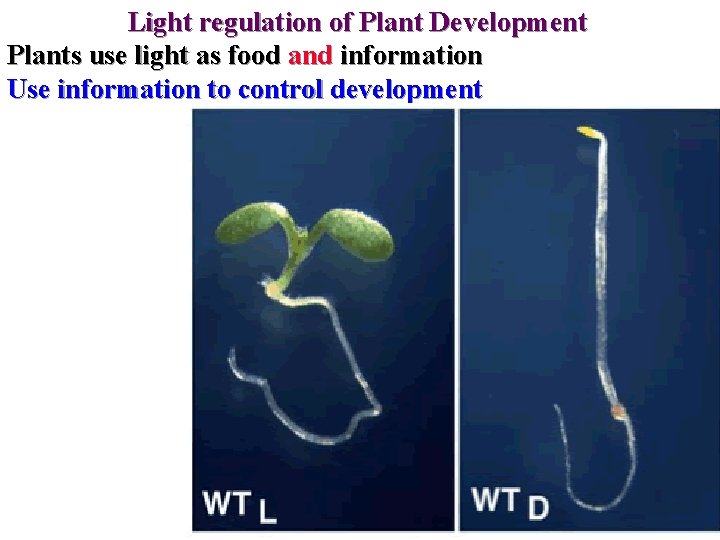
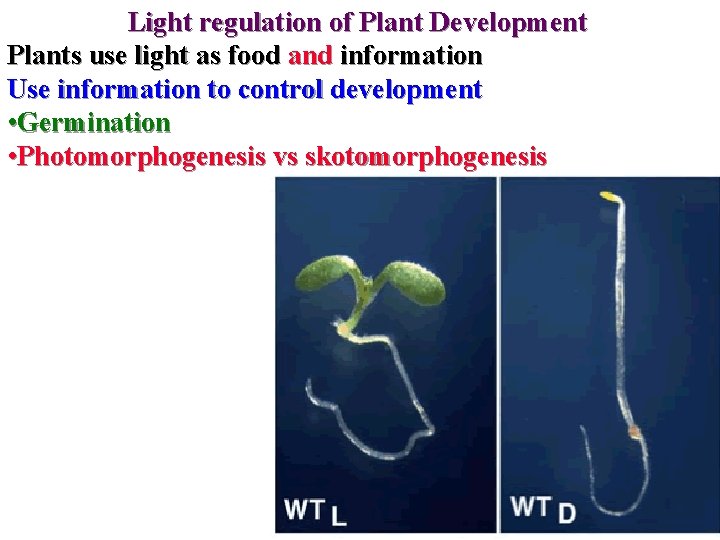
Vegetative growth Once radicle has emerged, vegetative growth begins • Juvenile plants in light undergo photomorphogenesis • Juvenile plants in dark undergo skotomorphogenesis • Seek light: elongate hypocotyl, don’t unfold cotyledons
Vegetative growth Once radicle has emerged, vegetative growth begins • Juvenile plants in light undergo photomorphogenesis • Expand cotyledons, start making leaves & photosynthetic apparatus
Vegetative growth Once radicle has emerged, vegetative growth begins • Juvenile plants in light undergo photomorphogenesis • Expand cotyledons, start making leaves & photosynthetic apparatus • Initially live off reserves, but soon do net photosynthesis
Vegetative growth Once radicle has emerged, vegetative growth begins • Initially live off reserves, but soon do net photosynthesis • Add new leaves @ SAM in response to auxin gradients • Add new branches from axillary buds lower down stem if apical dominance wanes
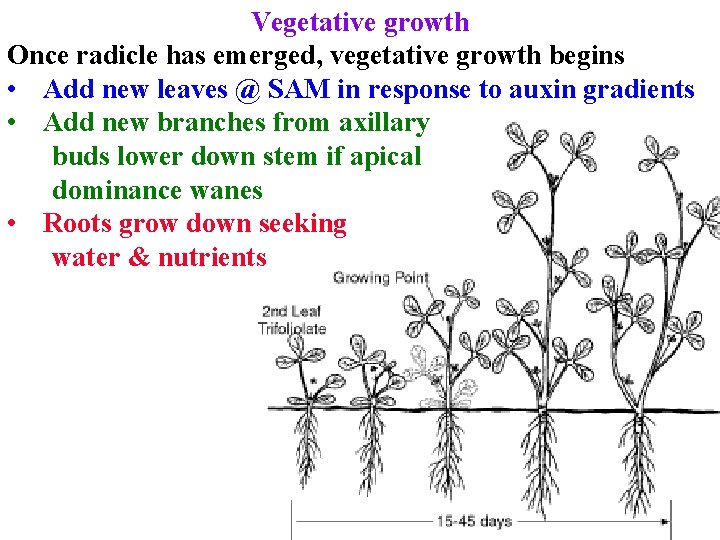
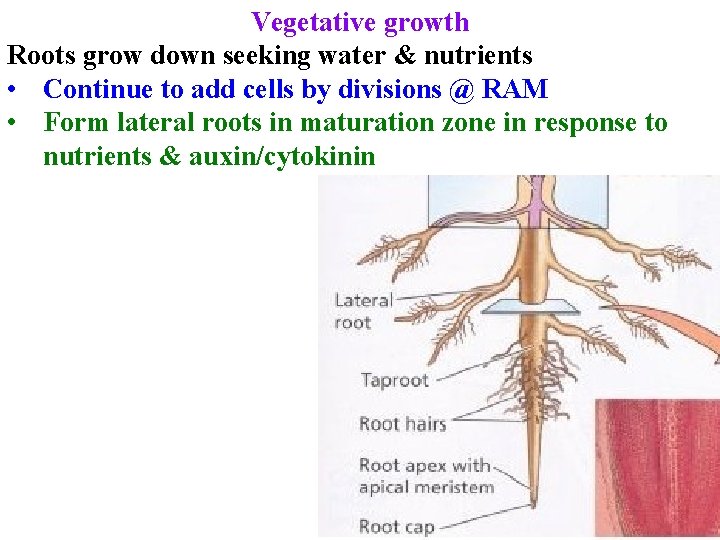
Vegetative growth Once radicle has emerged, vegetative growth begins • Add new leaves @ SAM in response to auxin gradients • Add new branches from axillary buds lower down stem if apical dominance wanes • Roots grow down seeking water & nutrients
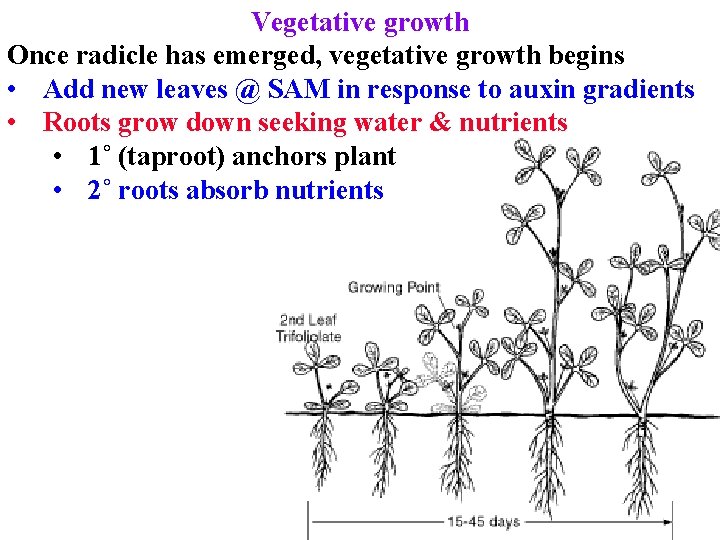
Vegetative growth Once radicle has emerged, vegetative growth begins • Add new leaves @ SAM in response to auxin gradients • Roots grow down seeking water & nutrients • 1˚ (taproot) anchors plant • 2˚ roots absorb nutrients
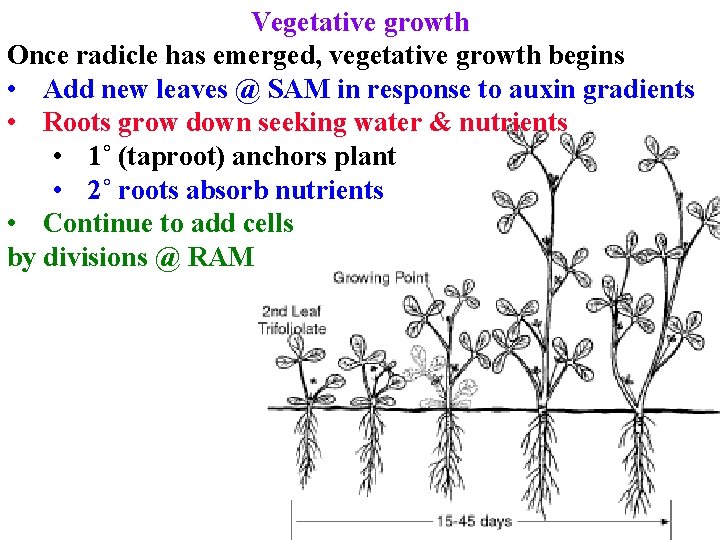
Vegetative growth Once radicle has emerged, vegetative growth begins • Add new leaves @ SAM in response to auxin gradients • Roots grow down seeking water & nutrients • 1˚ (taproot) anchors plant • 2˚ roots absorb nutrients • Continue to add cells by divisions @ RAM
Vegetative growth Roots grow down seeking water & nutrients • Continue to add cells by divisions @ RAM • Form lateral roots in maturation zone in response to nutrients & auxin/cytokinin
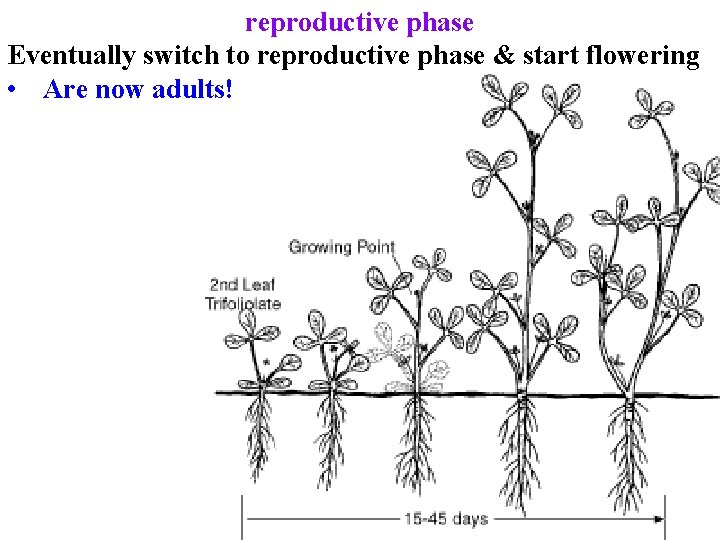
reproductive phase Eventually switch to reproductive phase & start flowering • Are now adults!
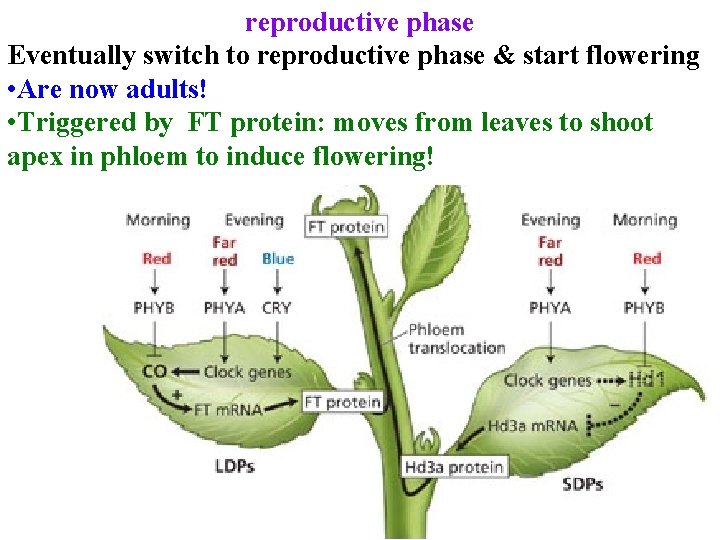
reproductive phase Eventually switch to reproductive phase & start flowering • Are now adults! • Triggered by FT protein: moves from leaves to shoot apex in phloem to induce flowering!
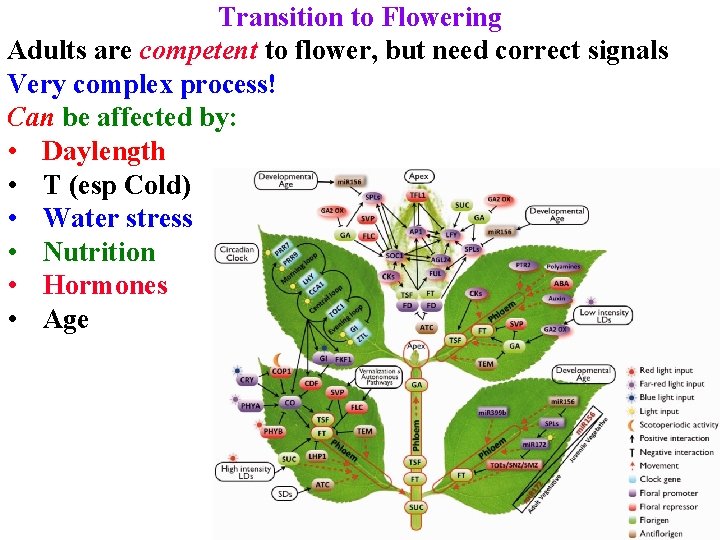
Transition to Flowering Adults are competent to flower, but need correct signals Very complex process! Can be affected by: • Daylength • T (esp Cold) • Water stress • Nutrition • Hormones • Age
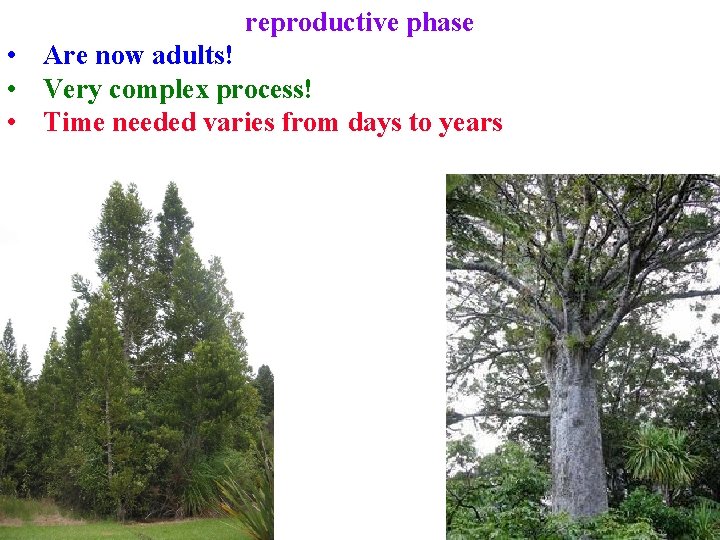
reproductive phase • Are now adults! • Very complex process! • Time needed varies from days to years
reproductive phase Eventually switch to reproductive phase & start flowering • Are now adults! • Time needed varies from days to years. • Shoot apical meristem now starts making new organ: flowers, with many new structures & cell types
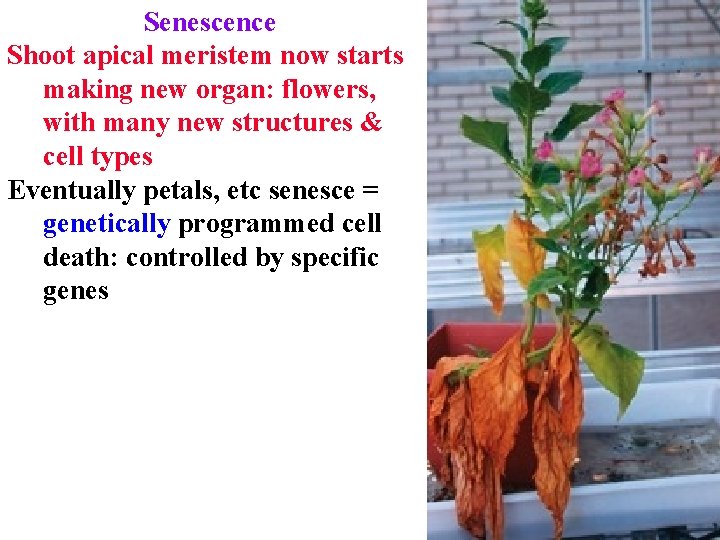
Senescence Shoot apical meristem now starts making new organ: flowers, with many new structures & cell types Eventually petals, etc senesce = genetically programmed cell death: controlled by specific genes
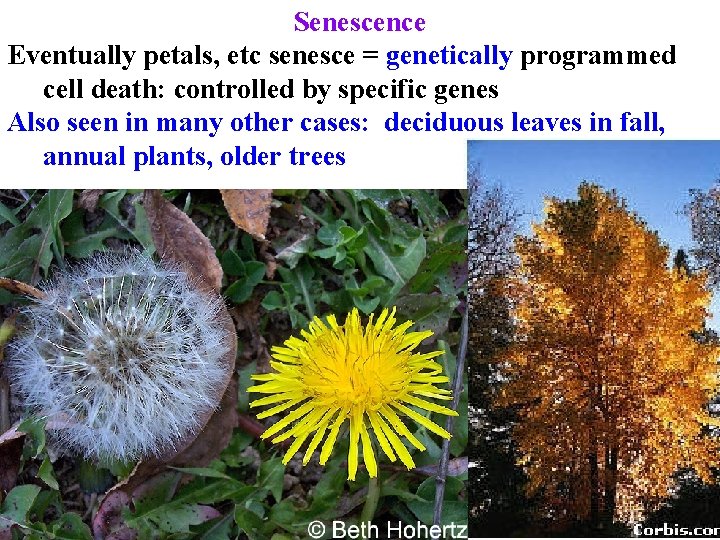
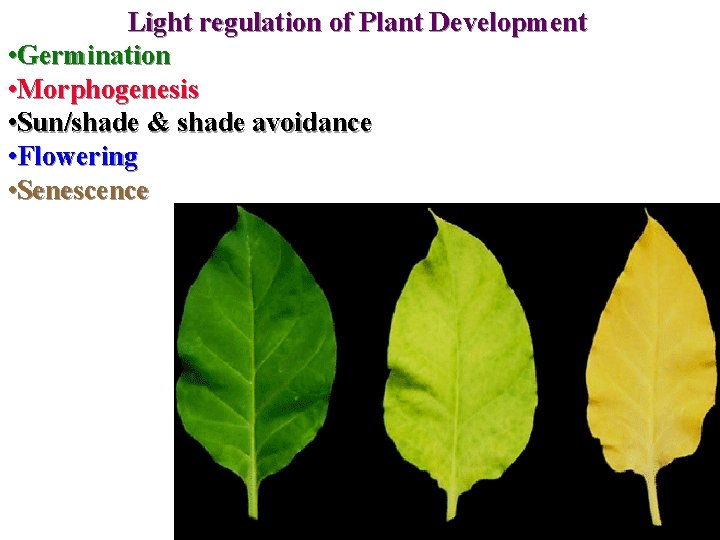
Senescence Eventually petals, etc senesce = genetically programmed cell death: controlled by specific genes Also seen in many other cases: deciduous leaves in fall, annual plants, older trees
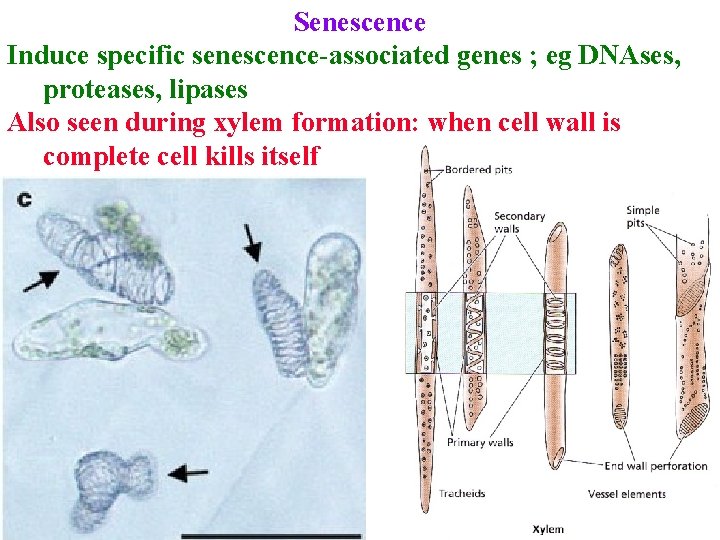
Senescence Induce specific senescence-associated genes ; eg DNAses, proteases, lipases Also seen during xylem formation: when cell wall is complete cell kills itself
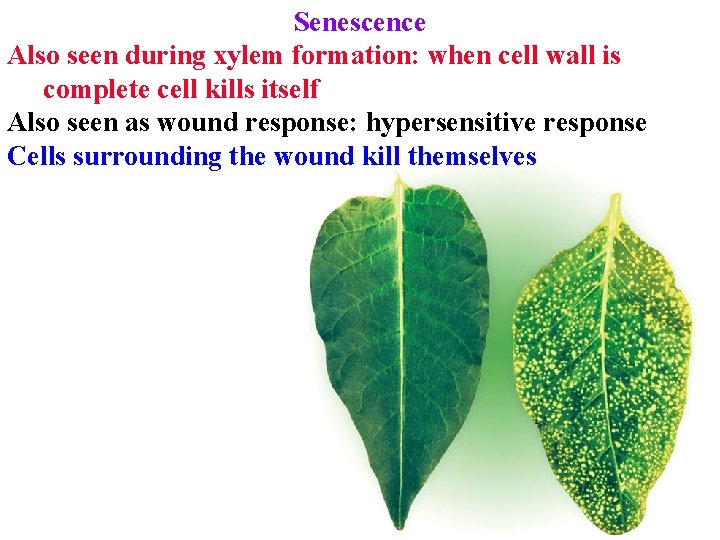
Senescence Also seen during xylem formation: when cell wall is complete cell kills itself Also seen as wound response: hypersensitive response Cells surrounding the wound kill themselves
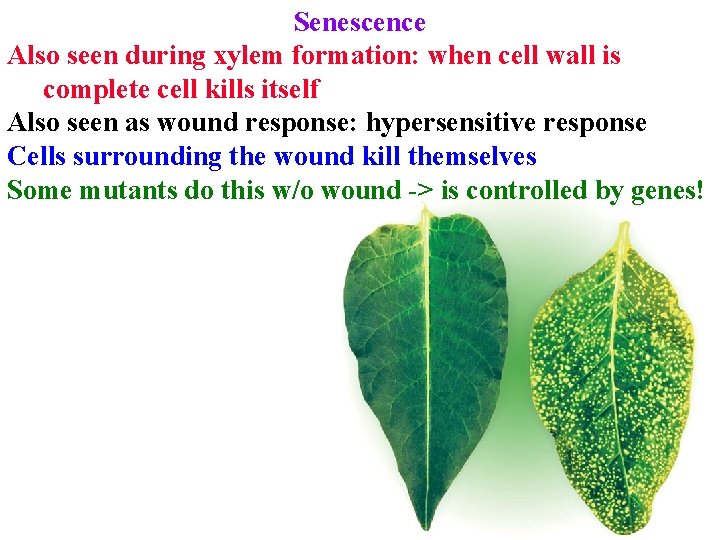
Senescence Also seen during xylem formation: when cell wall is complete cell kills itself Also seen as wound response: hypersensitive response Cells surrounding the wound kill themselves Some mutants do this w/o wound -> is controlled by genes!
Light regulation of Plant Development Plants use light as food and information Use information to control development
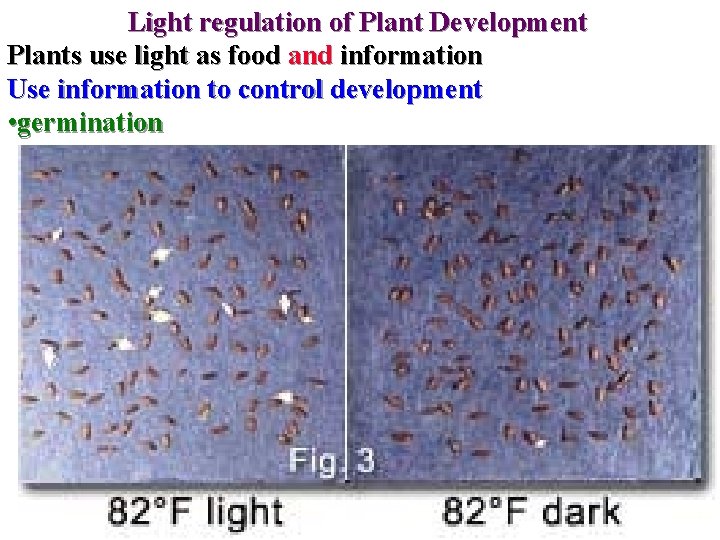
Light regulation of Plant Development Plants use light as food and information Use information to control development • germination
Light regulation of Plant Development Plants use light as food and information Use information to control development • Germination • Photomorphogenesis vs skotomorphogenesis
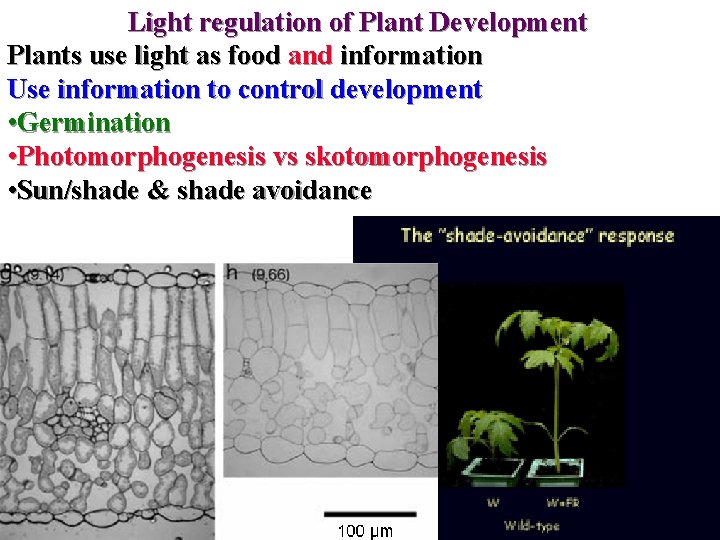
Light regulation of Plant Development Plants use light as food and information Use information to control development • Germination • Photomorphogenesis vs skotomorphogenesis • Sun/shade & shade avoidance
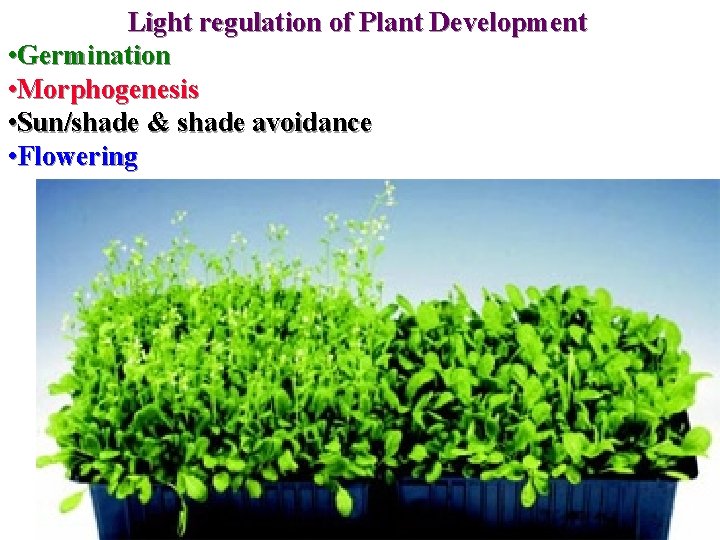
Light regulation of Plant Development • Germination • Morphogenesis • Sun/shade & shade avoidance • Flowering
Light regulation of Plant Development • Germination • Morphogenesis • Sun/shade & shade avoidance • Flowering • Senescence
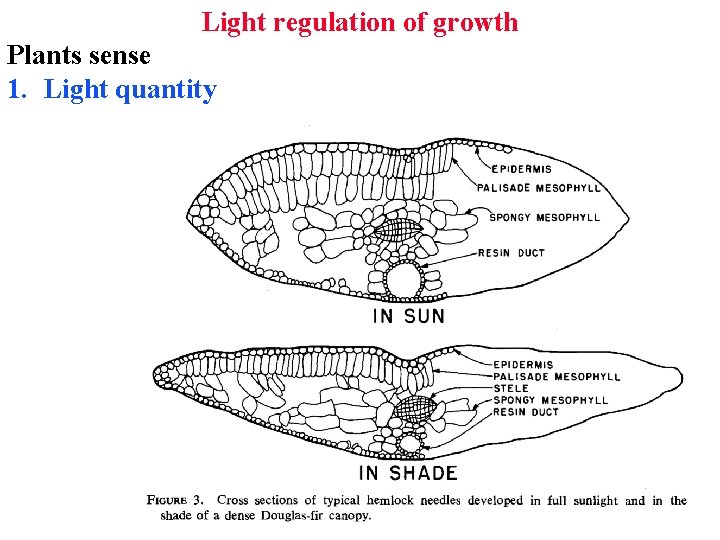
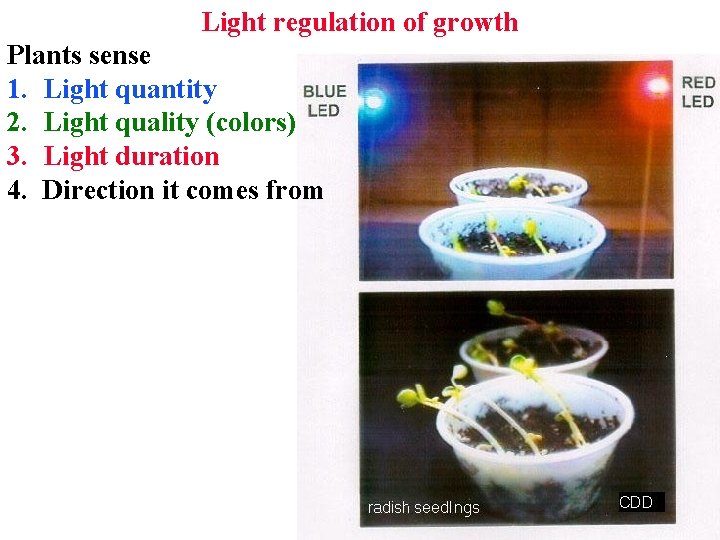
Light regulation of growth Plants sense 1. Light quantity
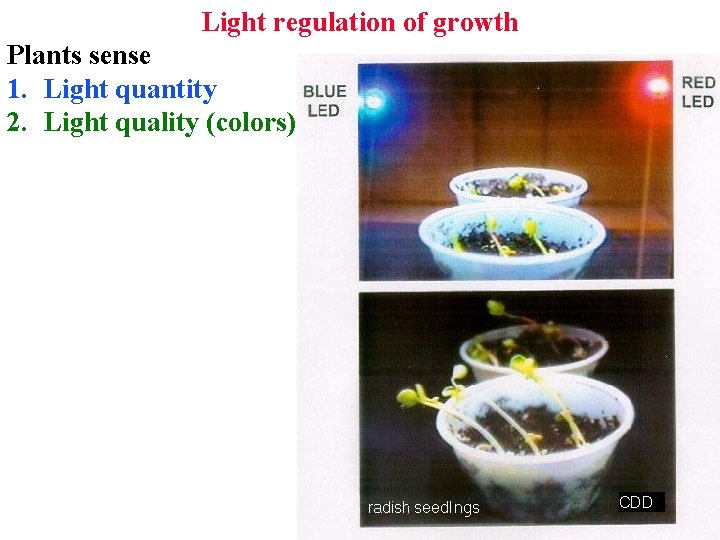
Light regulation of growth Plants sense 1. Light quantity 2. Light quality (colors)
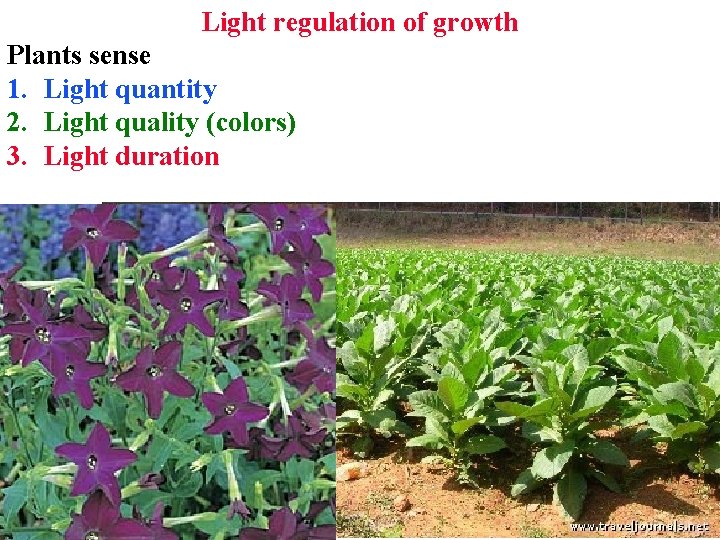
Light regulation of growth Plants sense 1. Light quantity 2. Light quality (colors) 3. Light duration
Light regulation of growth Plants sense 1. Light quantity 2. Light quality (colors) 3. Light duration 4. Direction it comes from
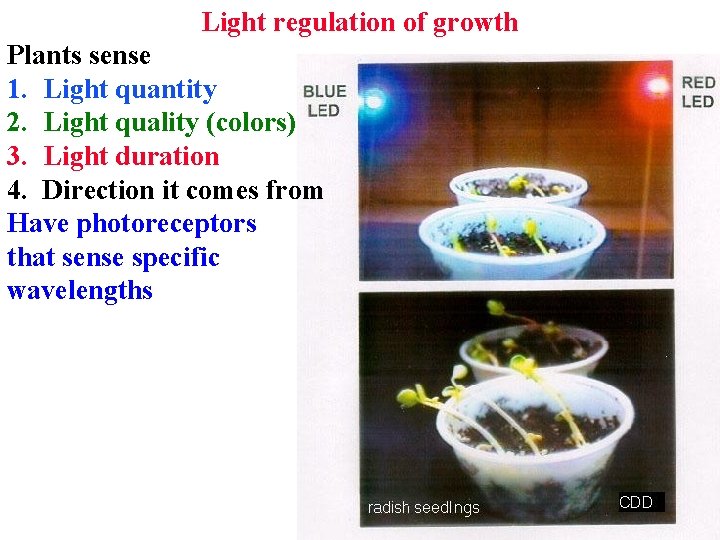
Light regulation of growth Plants sense 1. Light quantity 2. Light quality (colors) 3. Light duration 4. Direction it comes from Have photoreceptors that sense specific wavelengths
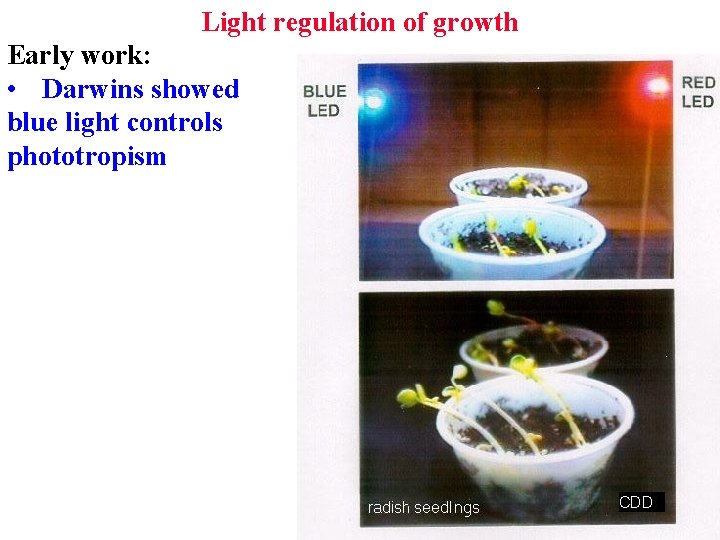
Light regulation of growth Early work: • Darwins showed blue light controls phototropism
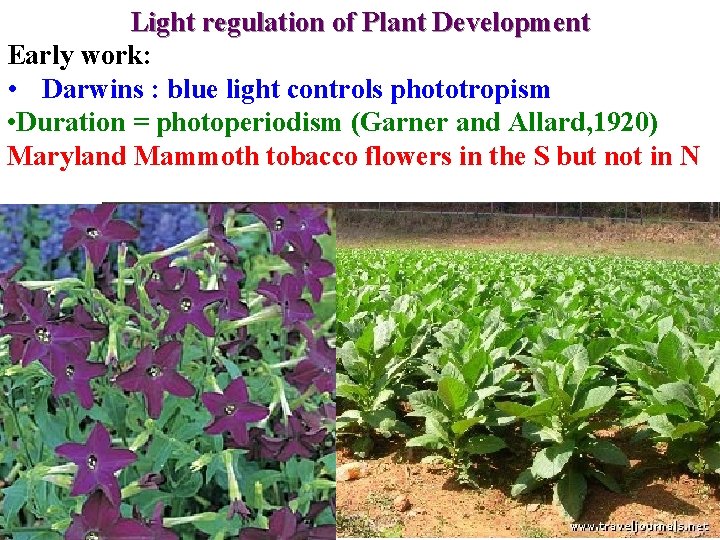
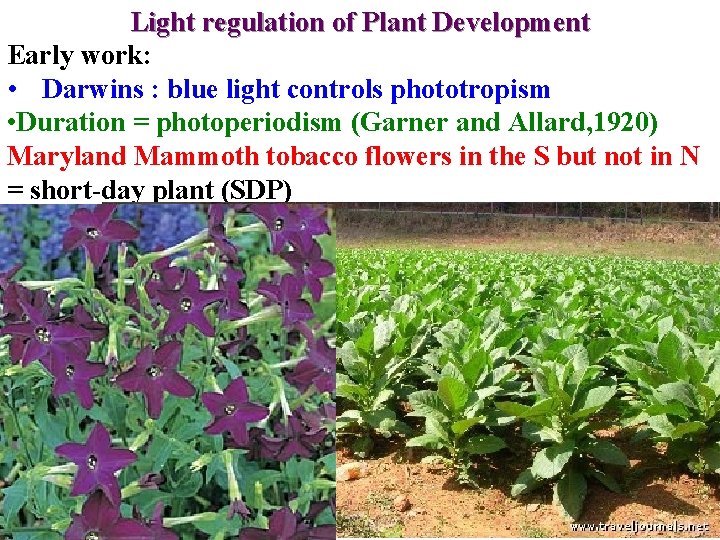
Light regulation of Plant Development Early work: • Darwins : blue light controls phototropism • Duration = photoperiodism (Garner and Allard, 1920) Maryland Mammoth tobacco flowers in the S but not in N
Light regulation of Plant Development Early work: • Darwins : blue light controls phototropism • Duration = photoperiodism (Garner and Allard, 1920) Maryland Mammoth tobacco flowers in the S but not in N = short-day plant (SDP)
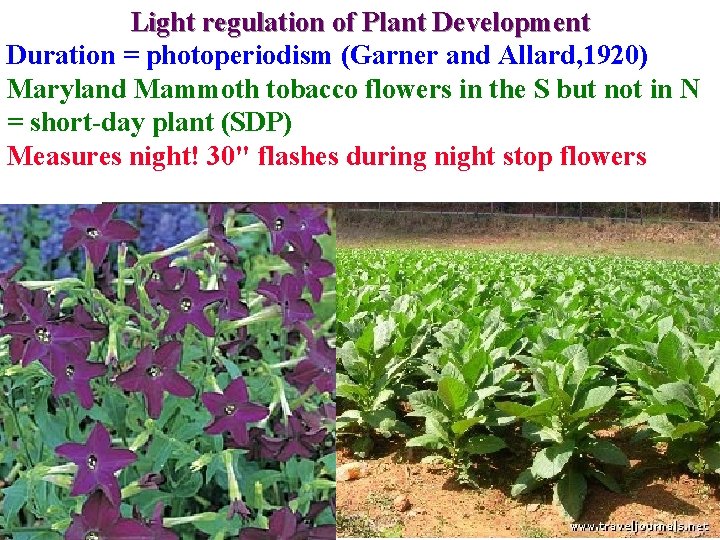
Light regulation of Plant Development Duration = photoperiodism (Garner and Allard, 1920) Maryland Mammoth tobacco flowers in the S but not in N = short-day plant (SDP) Measures night! 30" flashes during night stop flowers
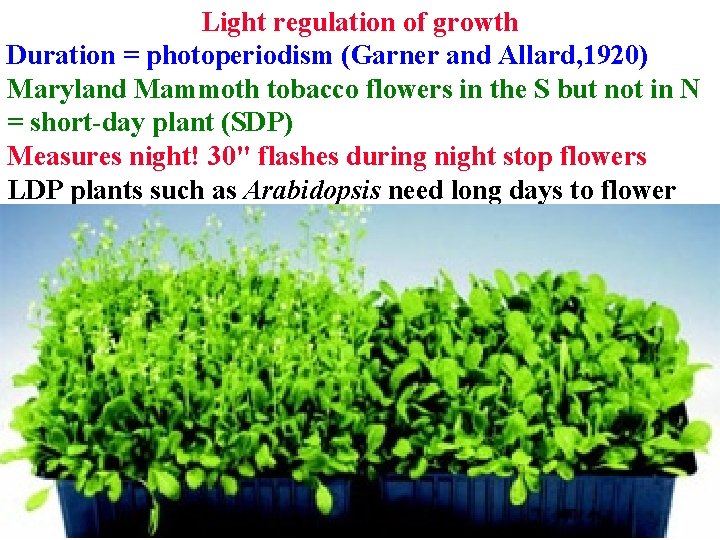
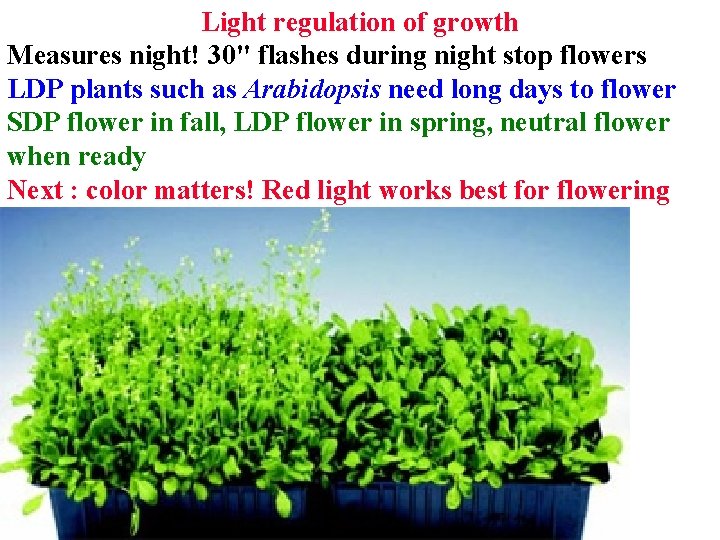
Light regulation of growth Duration = photoperiodism (Garner and Allard, 1920) Maryland Mammoth tobacco flowers in the S but not in N = short-day plant (SDP) Measures night! 30" flashes during night stop flowers LDP plants such as Arabidopsis need long days to flower
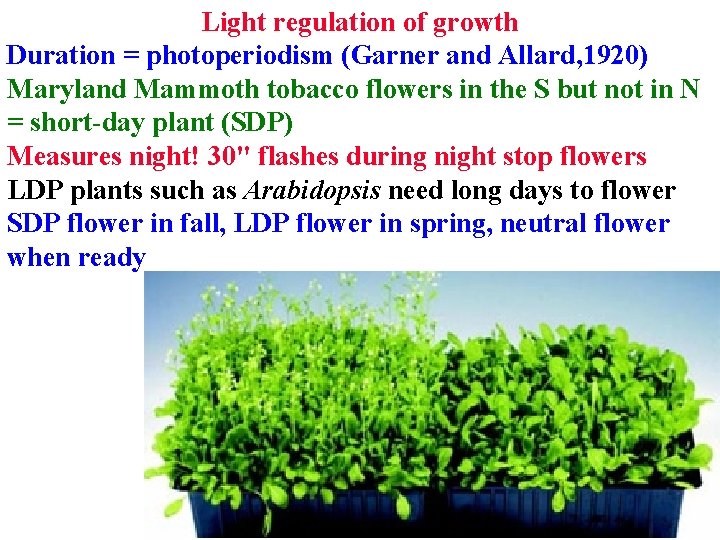
Light regulation of growth Duration = photoperiodism (Garner and Allard, 1920) Maryland Mammoth tobacco flowers in the S but not in N = short-day plant (SDP) Measures night! 30" flashes during night stop flowers LDP plants such as Arabidopsis need long days to flower SDP flower in fall, LDP flower in spring, neutral flower when ready
Light regulation of growth Measures night! 30" flashes during night stop flowers LDP plants such as Arabidopsis need long days to flower SDP flower in fall, LDP flower in spring, neutral flower when ready Next : color matters! Red light works best for flowering
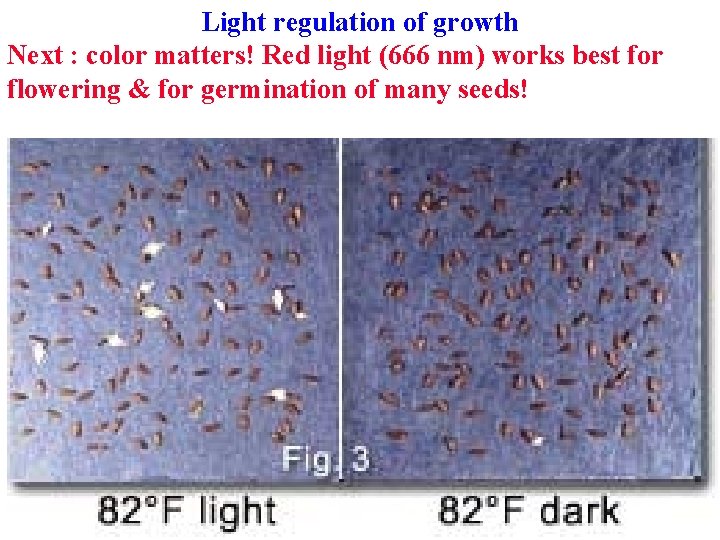
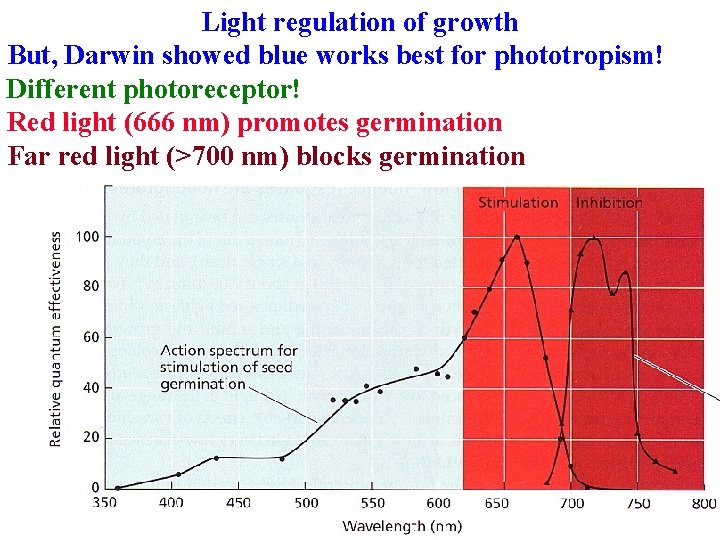
Light regulation of growth Next : color matters! Red light (666 nm) works best for flowering & for germination of many seeds!
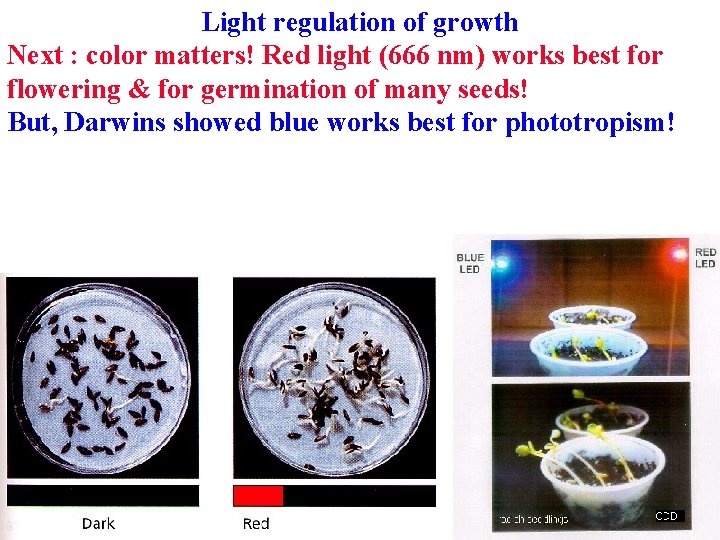
Light regulation of growth Next : color matters! Red light (666 nm) works best for flowering & for germination of many seeds! But, Darwins showed blue works best for phototropism!
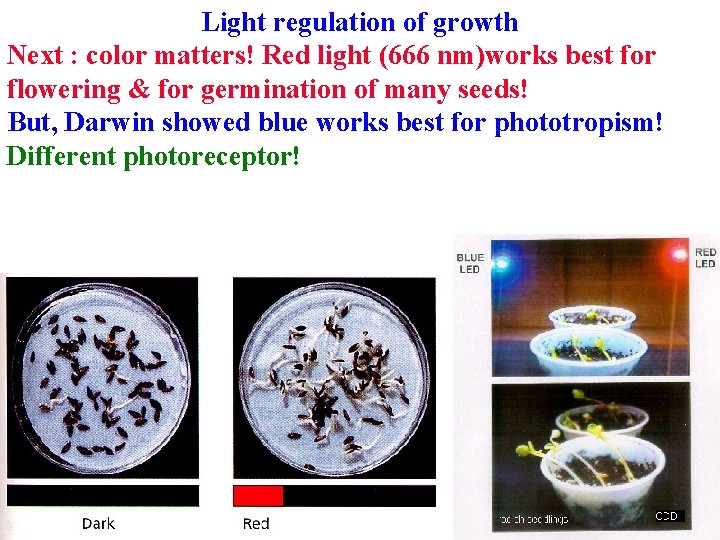
Light regulation of growth Next : color matters! Red light (666 nm)works best for flowering & for germination of many seeds! But, Darwin showed blue works best for phototropism! Different photoreceptor!
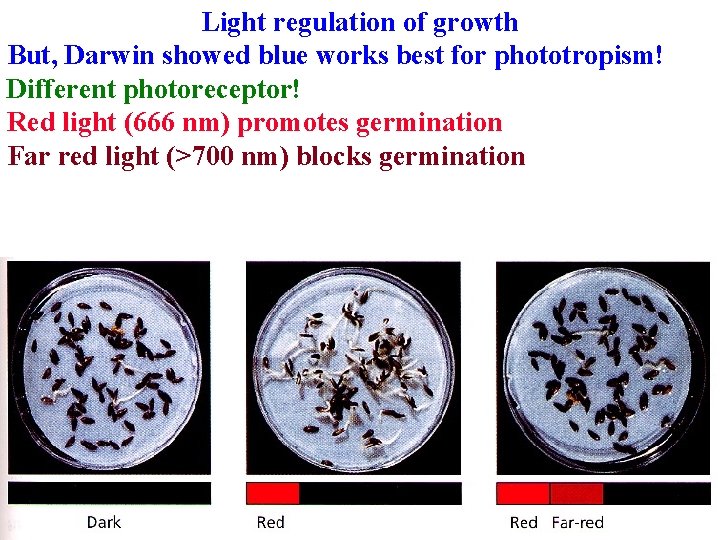
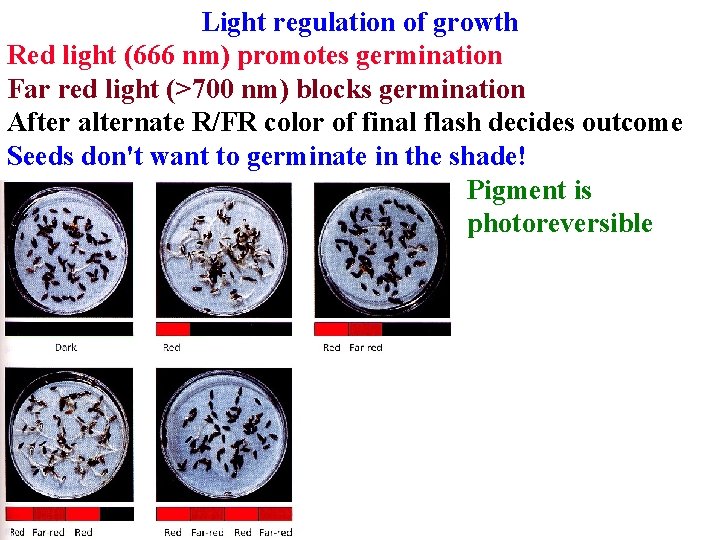
Light regulation of growth But, Darwin showed blue works best for phototropism! Different photoreceptor! Red light (666 nm) promotes germination Far red light (>700 nm) blocks germination
Light regulation of growth But, Darwin showed blue works best for phototropism! Different photoreceptor! Red light (666 nm) promotes germination Far red light (>700 nm) blocks germination
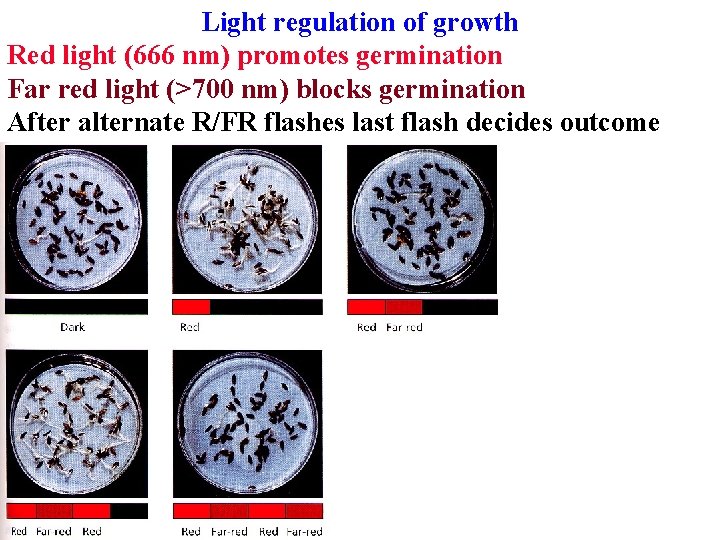
Light regulation of growth Red light (666 nm) promotes germination Far red light (>700 nm) blocks germination After alternate R/FR flashes last flash decides outcome
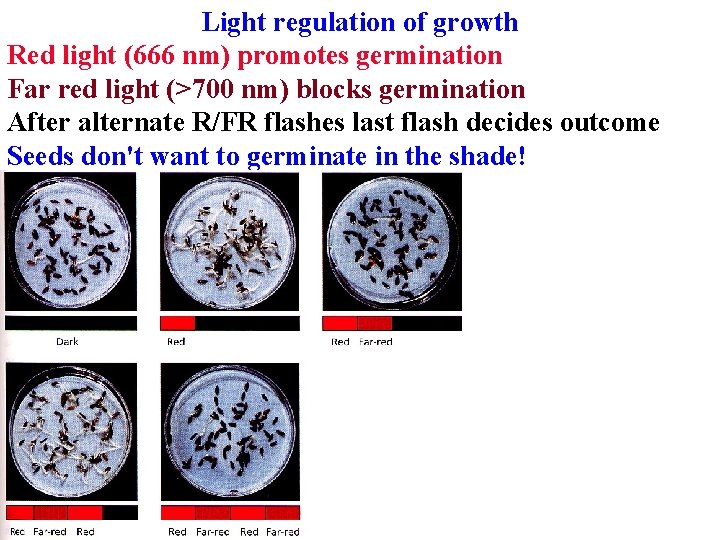
Light regulation of growth Red light (666 nm) promotes germination Far red light (>700 nm) blocks germination After alternate R/FR flashes last flash decides outcome Seeds don't want to germinate in the shade!
Light regulation of growth Red light (666 nm) promotes germination Far red light (>700 nm) blocks germination After alternate R/FR color of final flash decides outcome Seeds don't want to germinate in the shade! Pigment is photoreversible
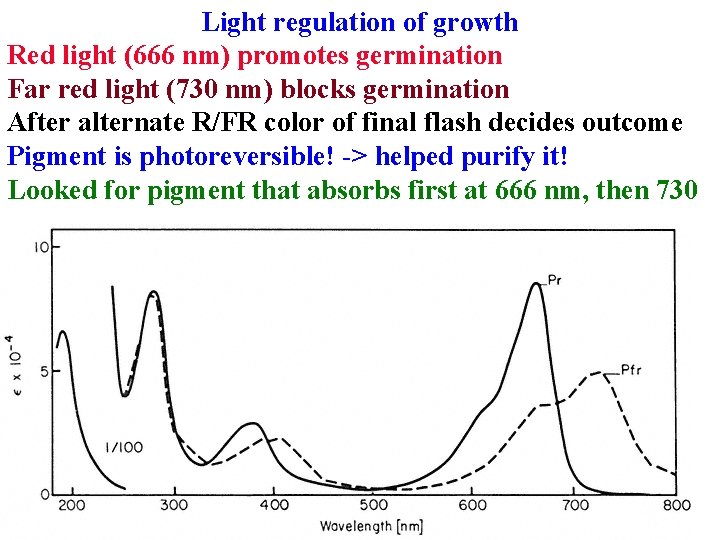
Light regulation of growth Red light (666 nm) promotes germination Far red light (730 nm) blocks germination After alternate R/FR color of final flash decides outcome Pigment is photoreversible! -> helped purify it! Looked for pigment that absorbs first at 666 nm, then 730
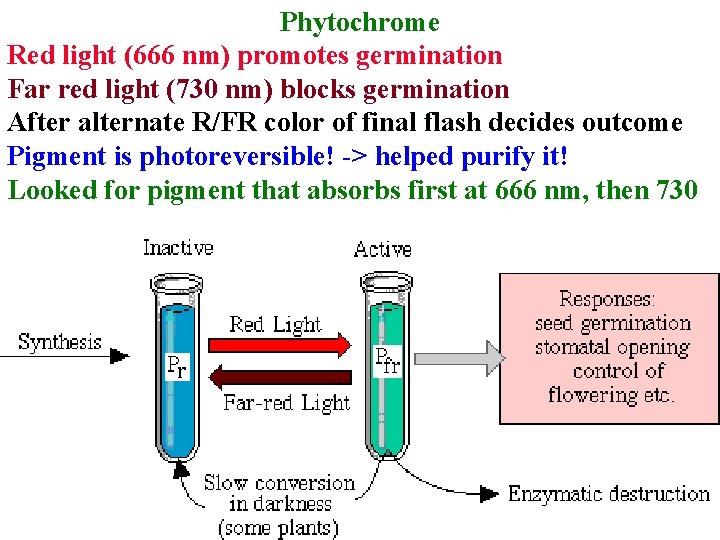
Phytochrome Red light (666 nm) promotes germination Far red light (730 nm) blocks germination After alternate R/FR color of final flash decides outcome Pigment is photoreversible! -> helped purify it! Looked for pigment that absorbs first at 666 nm, then 730
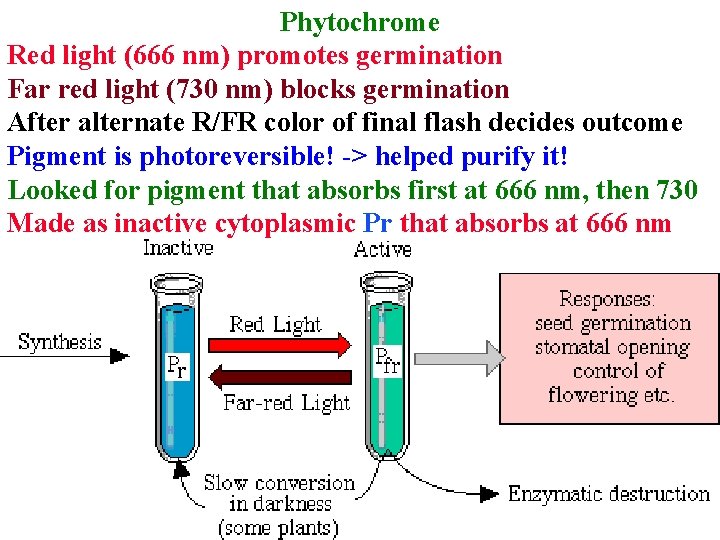
Phytochrome Red light (666 nm) promotes germination Far red light (730 nm) blocks germination After alternate R/FR color of final flash decides outcome Pigment is photoreversible! -> helped purify it! Looked for pigment that absorbs first at 666 nm, then 730 Made as inactive cytoplasmic Pr that absorbs at 666 nm
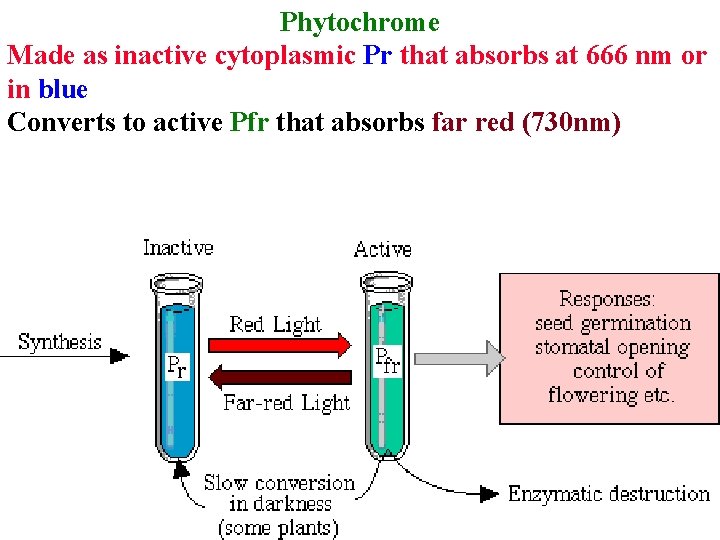
Phytochrome Made as inactive cytoplasmic Pr that absorbs at 666 nm or in blue Converts to active Pfr that absorbs far red (730 nm)