
Help Lesson 1 Ohms Law Equation The relationship


- Slides: 26
Help Lesson 1: Ohm’s Law Equation �The relationship between voltage, amperage, and resistance can be expressed in a simple equation. This equation is known as Ohm’s law. �Ohm’s law is represented by the equation where volts = current × resistance. �This equation often simplified into the expression V = I × R where V = Volts, I = Current, and R = Resistance. �Each quantity is expressed in units. V is expressed in volts. I is expressed in amps, and R is expressed in ohms. Information Next
Lesson 2: Solving for I �In many situations the voltage is nearly constant. �Taking voltage (V) readings is easy because these readings can be taken with the circuit energized and ready to use. �Using simple algebraic concepts Ohm’s law can be rearranged so we can solve for resistance (R) or current (I). �I can be calculated using the formula I = V ÷ R. Next
Lesson 3: Calculating I �It is often practical to calculate I using Ohm’s law. �In order to calculate I, V and R must be known. �V is determined to be 12 volts using a voltmeter. �R is determined to be 3 ohms using an Ohm meter. �I can be calculated using the formula I = V ÷ R. �Rewritten for this case the formula is I = 12 ÷ 3. �I is 4 amps. Next
Lesson 4: Solving for R �Using simple algebraic concepts Ohm’s law can be rearranged so we can solve for resistance (R). This is another case of rearranging the formula for Ohm’s law using simple algebraic principals. �To solve for resistance use the formula: R = V ÷ I Next
Lesson 5: Calculating R �It is often practical to calculate R using Ohm’s law. �In order to calculate R, V and I must be known. �V is determined to be 12 volts using a voltmeter. �I is determined to be 2 amps using an Ohm meter. �I can be calculated using the formula R = V ÷ I. �Rewritten for this case the formula is R = 12 ÷ 6. �R is 2 ohms. Next
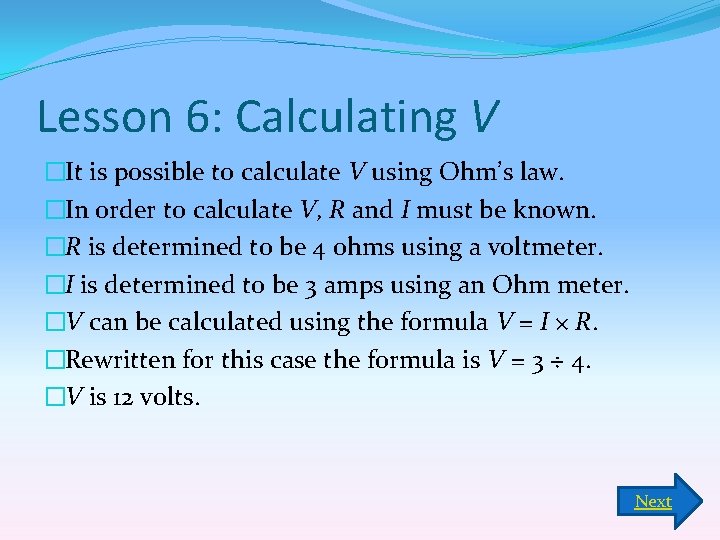
Lesson 6: Calculating V �It is possible to calculate V using Ohm’s law. �In order to calculate V, R and I must be known. �R is determined to be 4 ohms using a voltmeter. �I is determined to be 3 amps using an Ohm meter. �V can be calculated using the formula V = I × R. �Rewritten for this case the formula is V = 3 ÷ 4. �V is 12 volts. Next
Help Learn Each Lesson Answer Each Question �Read each lesson. �When you are done click the next arrow to move on. �Press the help button if you need help. �Each question must be answered correctly to continue to the next lesson. �You will be given more information if you fail to answer each question correctly. Back
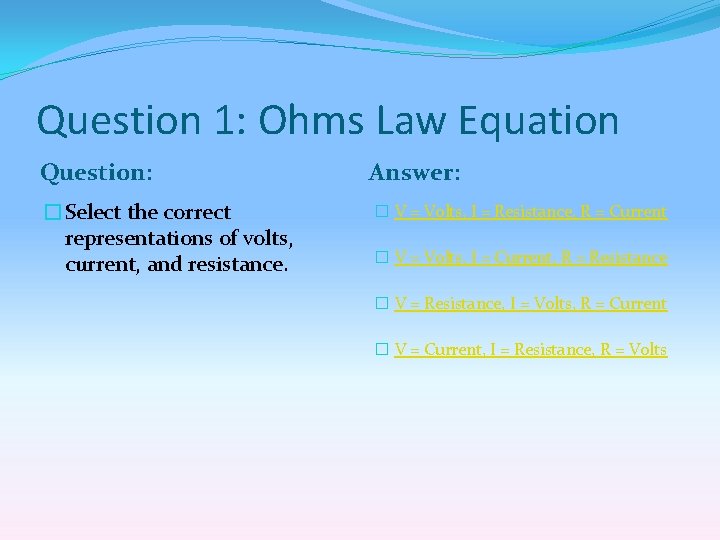
Question 1: Ohms Law Equation Question: Answer: �Select the correct representations of volts, current, and resistance. � V = Volts, I = Resistance, R = Current � V = Volts, I = Current, R = Resistance � V = Resistance, I = Volts, R = Current � V = Current, I = Resistance, R = Volts
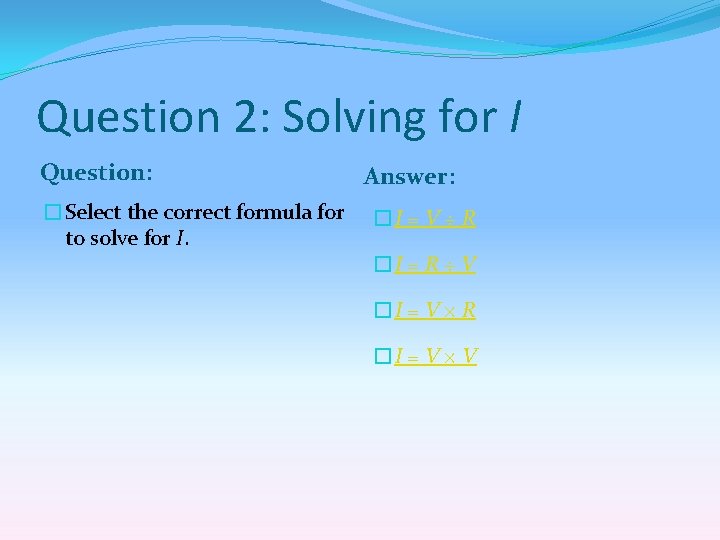
Question 2: Solving for I Question: �Select the correct formula for to solve for I. Answer: �I = V ÷ R �I = R ÷ V �I = V × R �I = V × V
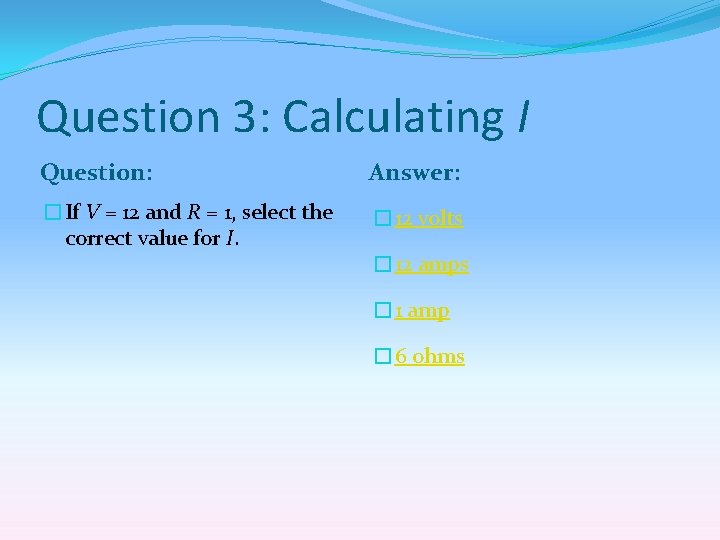
Question 3: Calculating I Question: Answer: �If V = 12 and R = 1, select the correct value for I. � 12 volts � 12 amps � 1 amp � 6 ohms
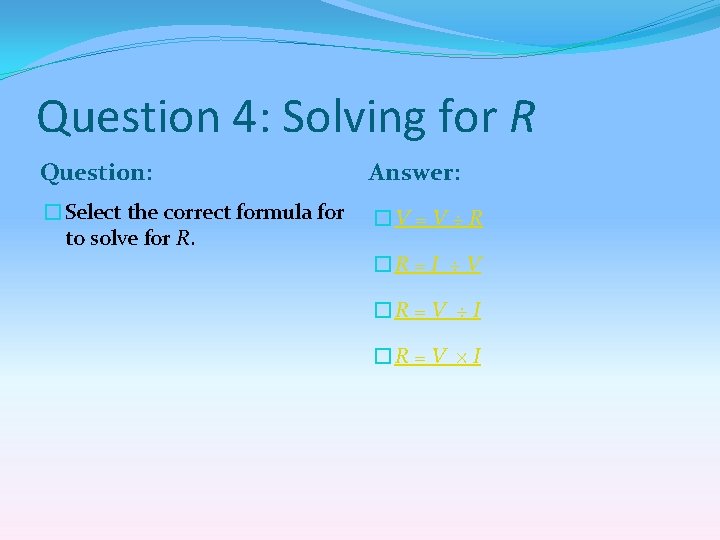
Question 4: Solving for R Question: Answer: �Select the correct formula for to solve for R. �V = V ÷ R �R = I ÷ V �R = V ÷ I �R = V × I
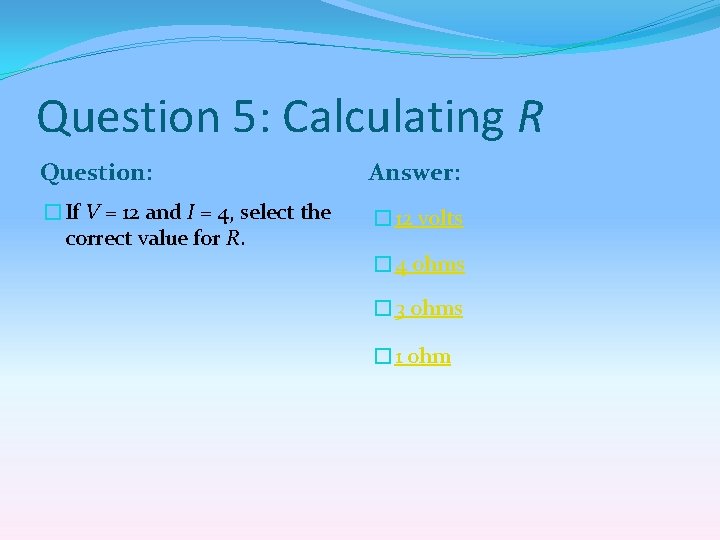
Question 5: Calculating R Question: Answer: �If V = 12 and I = 4, select the correct value for R. � 12 volts � 4 ohms � 3 ohms � 1 ohm
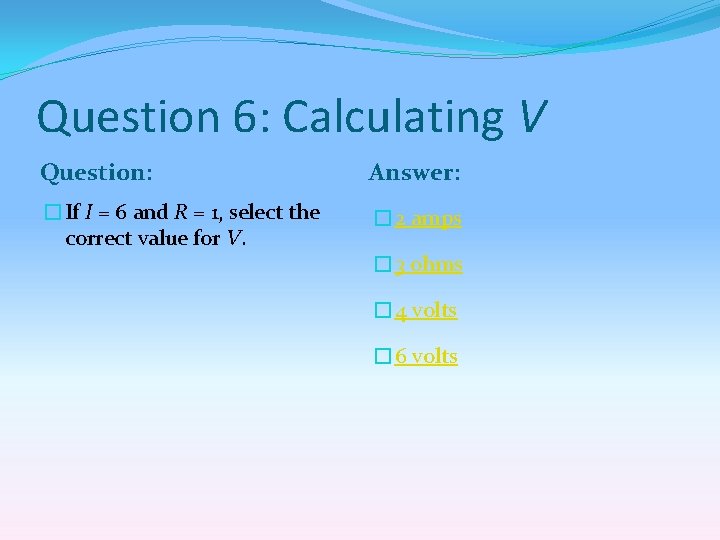
Question 6: Calculating V Question: Answer: �If I = 6 and R = 1, select the correct value for V. � 2 amps � 3 ohms � 4 volts � 6 volts
Question 1: Correct ! �Please press the next arrow to continue Next
Question 2: Correct ! �Please press the next arrow to continue Next
Question 3: Correct ! �Please press the next arrow to continue Next
Question 4: Correct ! �Please press the next arrow to continue Next
Question 5: Correct ! �Please press the next arrow to continue Next
Question 6: Correct ! �You have completed the Ohm’s law lesson. Restart
Question 1: Incorrect ! �This equation often simplified into the expression V = I × R where V = Volts, I = Current, and R = Resistance. �Remember, V = Volts. �R = Resistance �I = Current which does not start with I, but is the only one that does not match. Retry
Question 2: Incorrect ! �Using simple algebraic concepts Ohm’s law can be rearranged so we can solve for resistance (R) or current (I). �I can be calculated using the formula I = V ÷ R. Retry
Question 3: Incorrect ! �I can be calculated using the formula I = V ÷ R. Retry
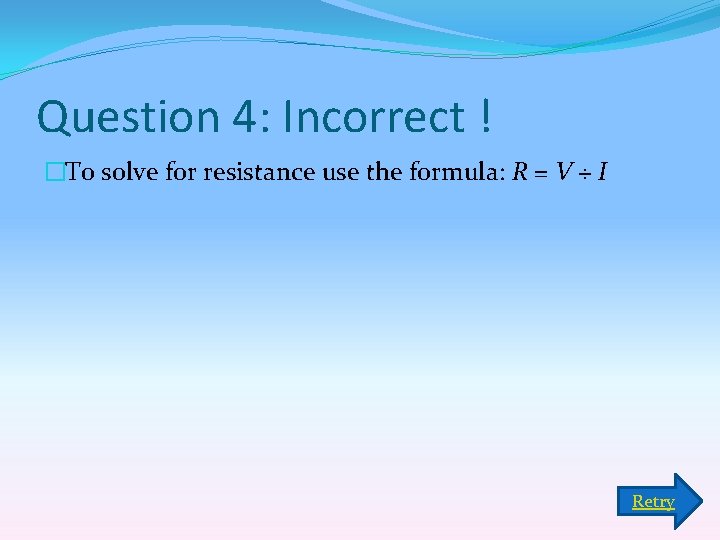
Question 4: Incorrect ! �To solve for resistance use the formula: R = V ÷ I Retry
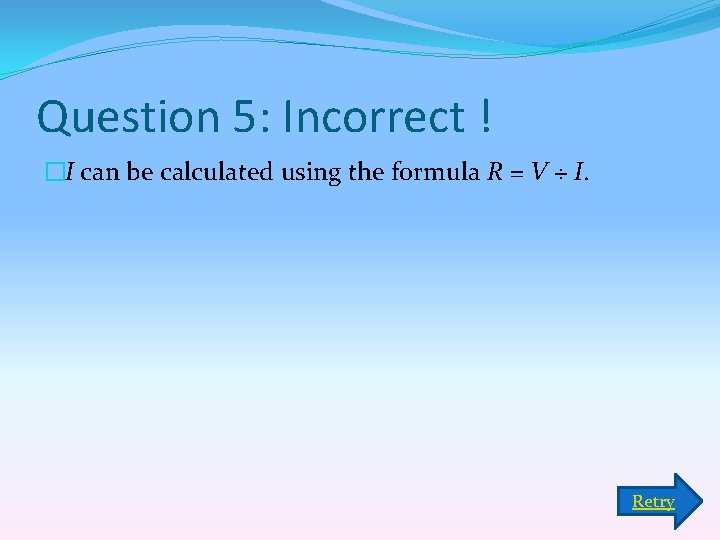
Question 5: Incorrect ! �I can be calculated using the formula R = V ÷ I. Retry
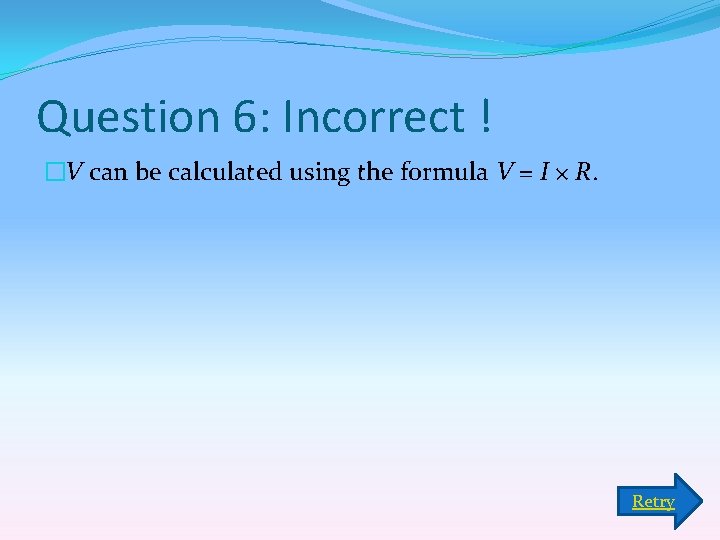
Question 6: Incorrect ! �V can be calculated using the formula V = I × R. Retry
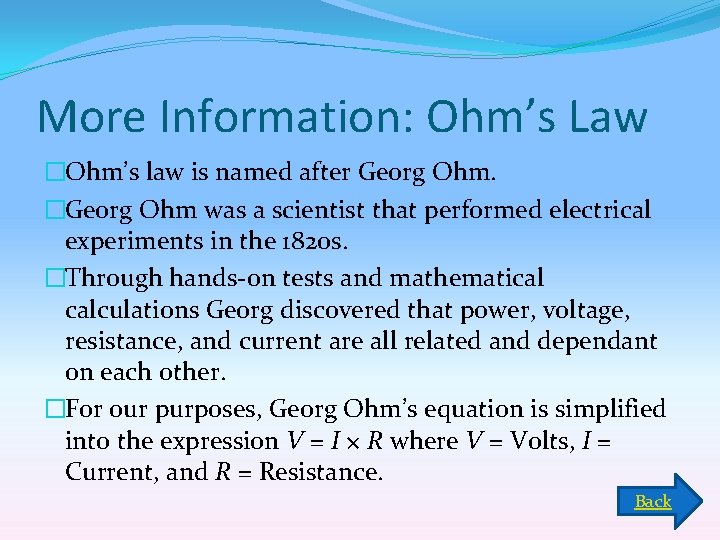
More Information: Ohm’s Law �Ohm’s law is named after Georg Ohm. �Georg Ohm was a scientist that performed electrical experiments in the 1820 s. �Through hands-on tests and mathematical calculations Georg discovered that power, voltage, resistance, and current are all related and dependant on each other. �For our purposes, Georg Ohm’s equation is simplified into the expression V = I × R where V = Volts, I = Current, and R = Resistance. Back