
HELMINTHOLOGY Helminthology it is the science that deals
- Slides: 37
HELMINTHOLOGY Helminthology it is the science that deals with study of the helminths. Helminths are a Greek means that are all worms that live as parasite.
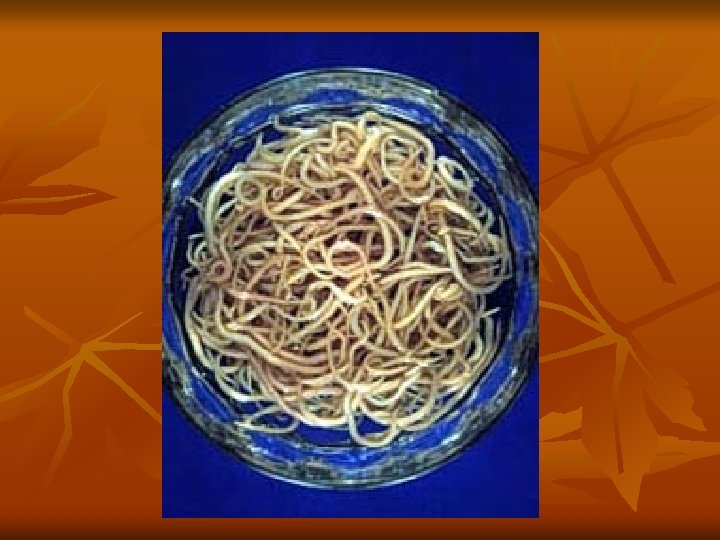
General character of helminths 1. All are multicellular bilateral symmetrical animal. 2. Very few worms cause infection are potential dangerous. 3. The ability of parasite to produce clinical manifestation usually associated with: A. Number of the parasites
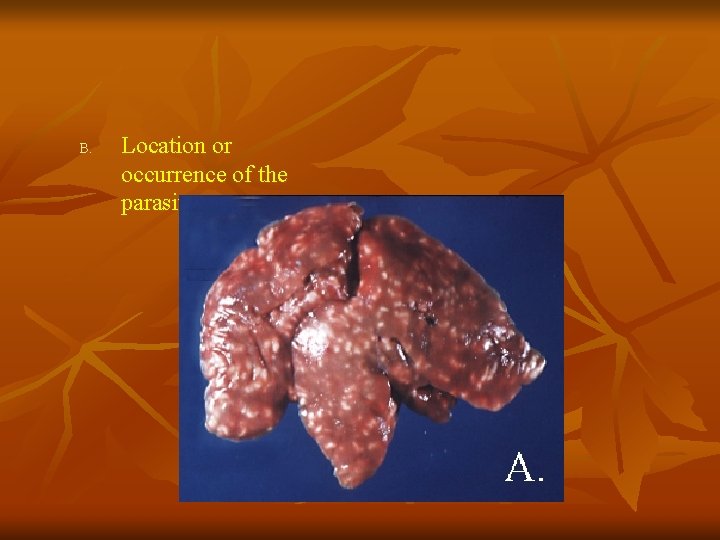
B. Location or occurrence of the parasite
C. D. Reinfection The host immunity 4. Unlike protozoa, most helminths are unable to multiply within the host ( fertilization may occur within the host but multiplication and formation of embryo occur out side the host so usually is light infection).
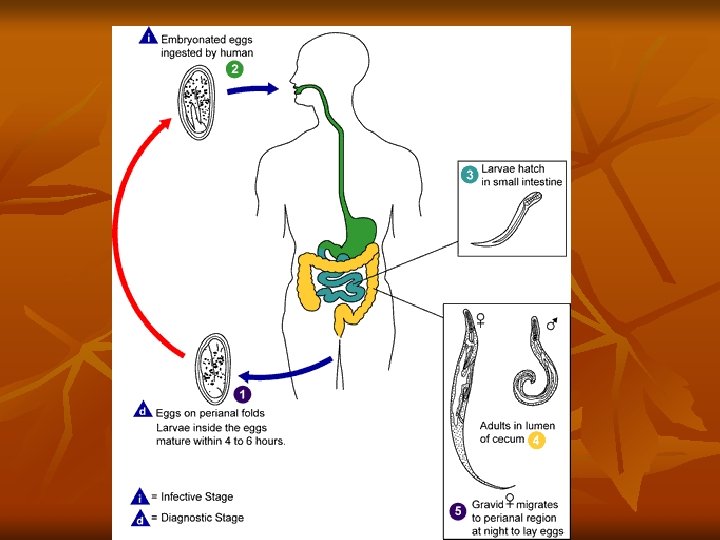
5. Many helminths have limited distributions because: A. B. C. They require optically climate. Presence of reservoir or vector (stable). (So the infection may refer to certain area in the world). 6. The majority of helminths are transmitted through : A. B. C. Contamination of environment as contaminated food. Skin penetration. Arthropod bits (insects). 7. Types of life cycle : A. In some helminths the life cycle is direct In direct life cycle it is relatively simple, involving only one host and a brief period of development of an infective transfer stage (Ex. Enterobius vermicularis).
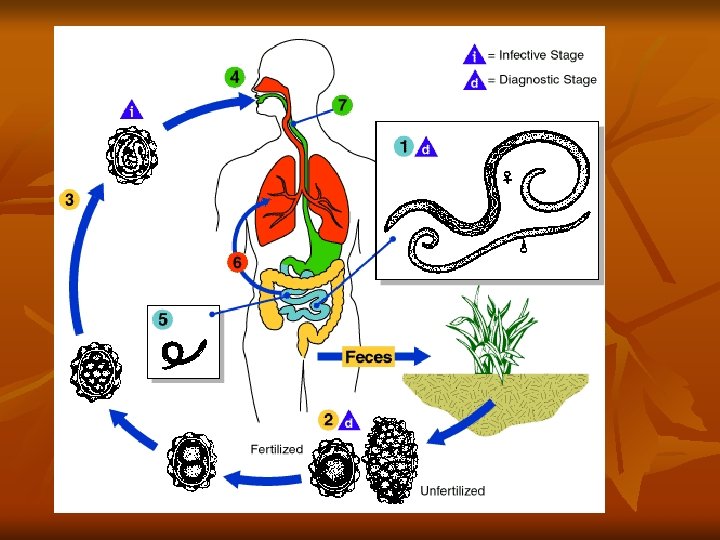
In a group referred to soil transmitted helminths the life cycle involve only one host man, but the infective transfer stage larvae remaining in the egg that require period of development in the soil and the soil function as intermediate host Example: Ascaris lumbricoides Trichuris trichura
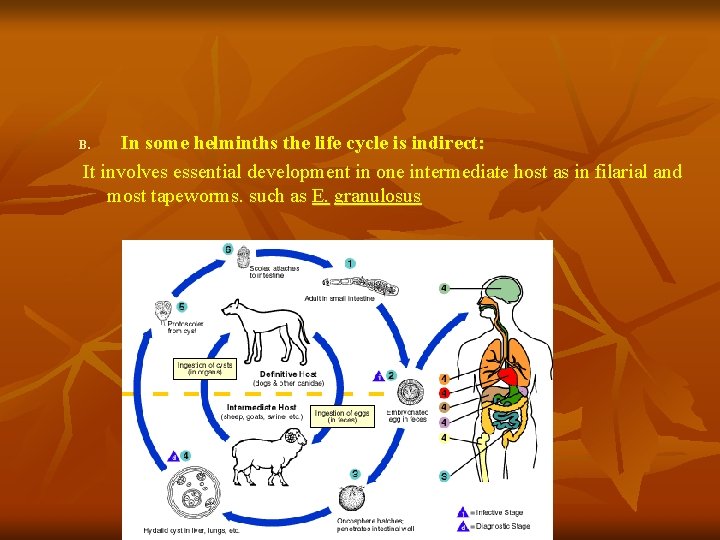
In some helminths the life cycle is indirect: It involves essential development in one intermediate host as in filarial and most tapeworms. such as E. granulosus B.
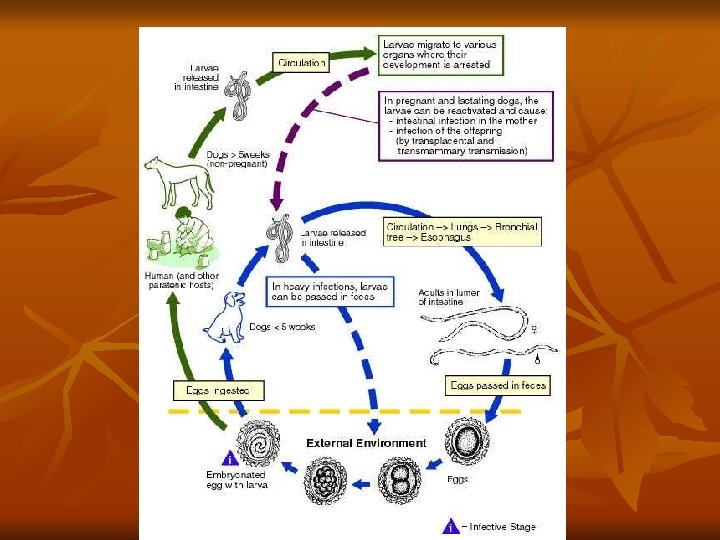
often in two intermediate hosts are in most trematodes the first is being snail or other molluscan and the second an animal or plant that eaten by people (such as larval of lung flukes in fish or other on aquatic vegetation). C. In addition to above certain nematodes, cestodes and trematodes include in their life cycle a special kind of transmission known as paratenesis involving paratenic host. As in the case of T. canis
In prey-predator relationship paratenic host acquire the larval stage after it has developed to infection stage in soil or intermediate host and provide for: Ø protection and the Ø Availability to its final host. v The example of paratenesic was coined seen in the enzootic cycle of toxocara canis a cause of visceral larva migrant v
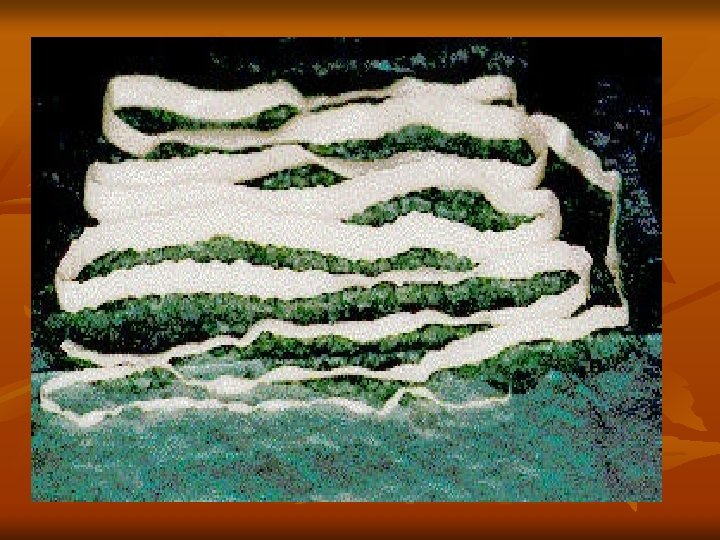
8. They obtained their nourishment from host : n n n Tissue known: tissue parasite. Intestinal content known: Intestinal parasite. By absorption of predigested nutrition as in tapeworms through their body wall as the worm that have no digestive system. As in Cestods
9. They are parasites have protective mechanism which prevent the host from damaging the outer surface which may be destroyed by granulocytes and macrophages. n Some adult worms secrete large amount of soluble antigenic material during their secretion process, which play important role in both immunity and pathogenicity.
10. sharing many of parasite infection with animals is termed zoonosis (Zoontic disease is sharing of disease between both animal and human, in other word is the disease of animal but can infect human. 11. Pathogenically depend on: n n Species of parasite. Intensity of parasite. The type of tissue invades. Immunity of the host.
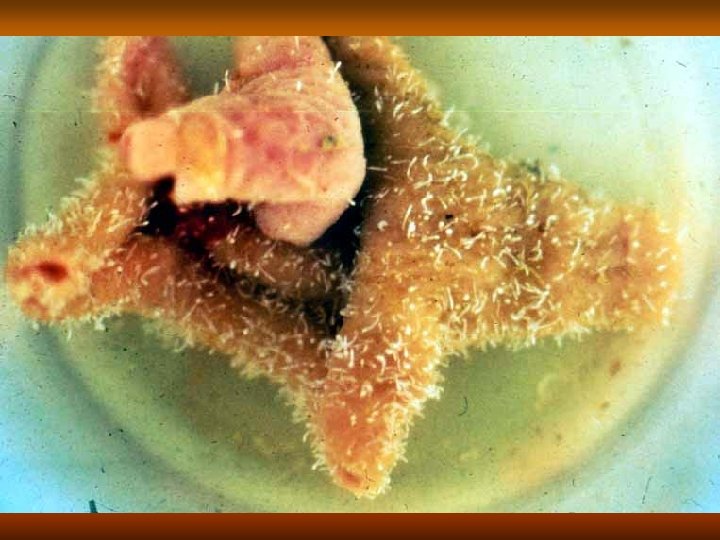
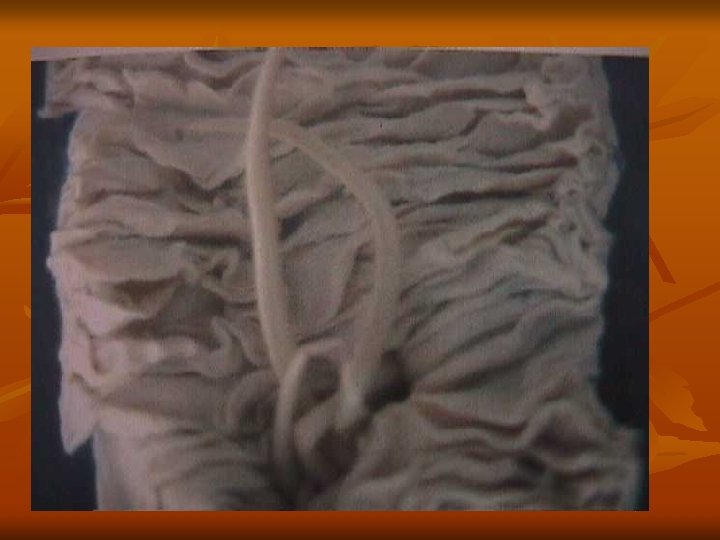
12. The injury which produced by parasites usually takes place due to two factor: A. B. Mechanical or physical action. Chemical or toxic action. (Of both adult and larvae) A. Mechanical or physical action i The movement and migration of parasite (worm) which cause irritation of intestinal wall.
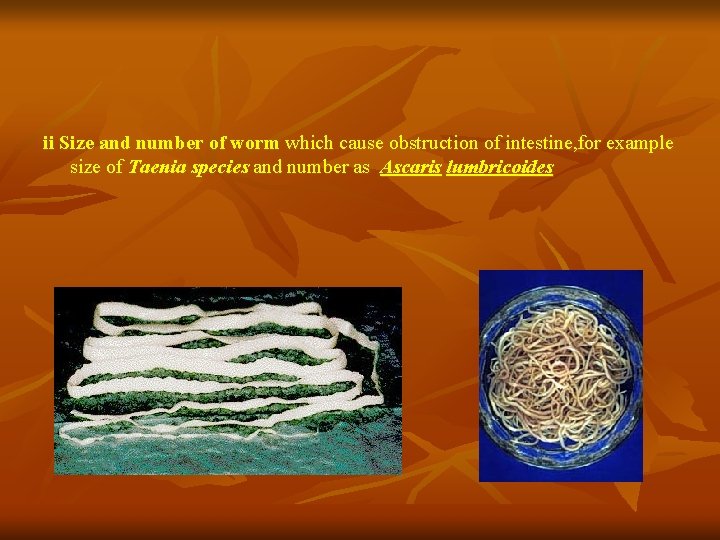
ii Size and number of worm which cause obstruction of intestine, for example size of Taenia species and number as Ascaris lumbricoides
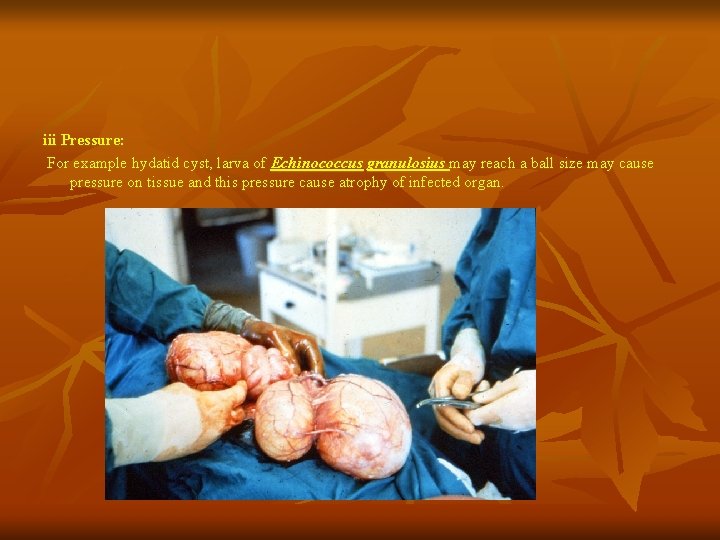
iii Pressure: For example hydatid cyst, larva of Echinococcus granulosius may reach a ball size may cause pressure on tissue and this pressure cause atrophy of infected organ.
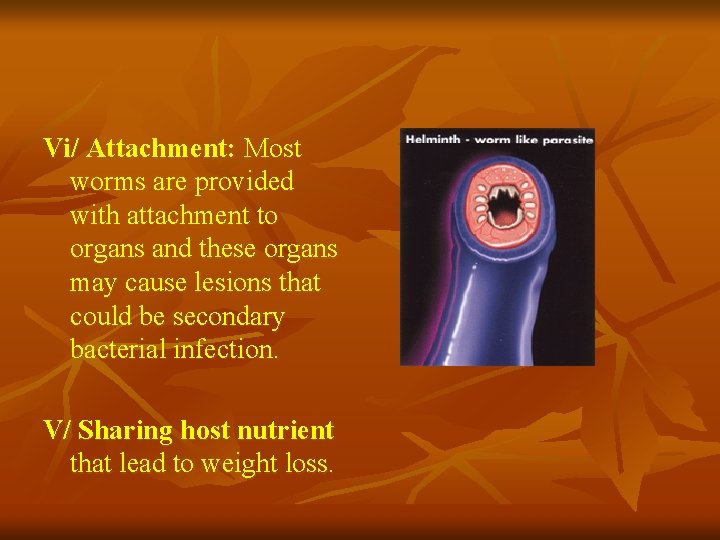
Vi/ Attachment: Most worms are provided with attachment to organs and these organs may cause lesions that could be secondary bacterial infection. V/ Sharing host nutrient that lead to weight loss.
B. Chemical or toxic action Helminths secretes a large amount of antigenic material: i/ Tissue lysins. ii/ Haemolysins. iii/ Anticoagulants. (These substances lead to local and general reaction) *Local reaction Due to infiltration of esinophils which may lead to: -Inflammation. -Necrosis. -Repairing. -Encapsulation. So destructive of parasite. *General reaction Direct: a) Chemotactic action (absorption of toxins). b) Allergic response. Indirect: Nervous reflexes.
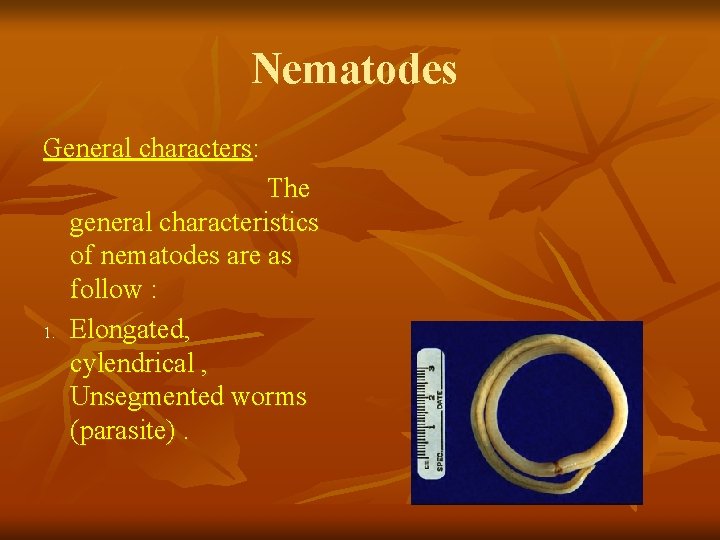
Nematodes General characters: 1. The general characteristics of nematodes are as follow : Elongated, cylendrical , Unsegmented worms (parasite).
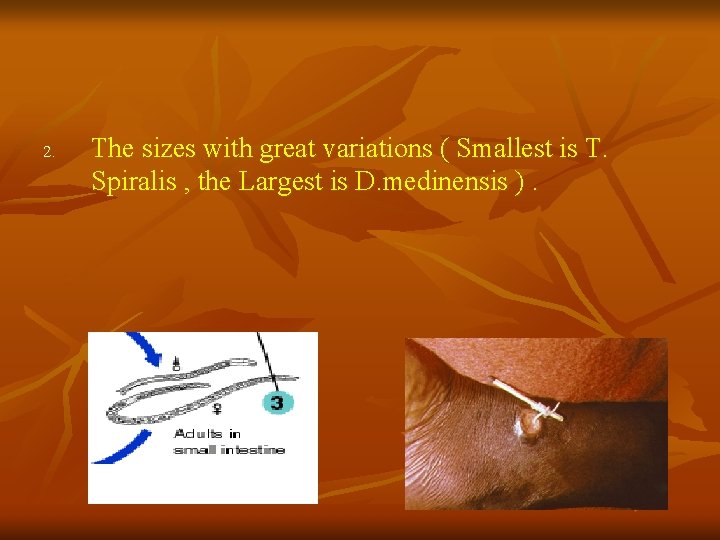
2. The sizes with great variations ( Smallest is T. Spiralis , the Largest is D. medinensis ).
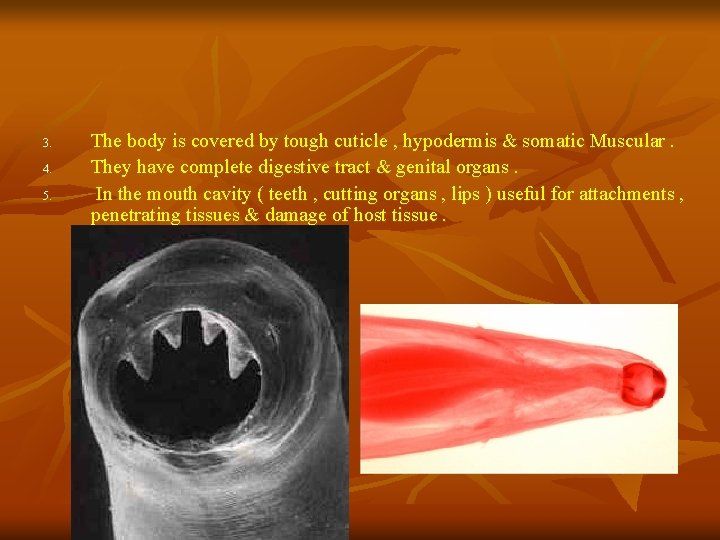
3. 4. 5. The body is covered by tough cuticle , hypodermis & somatic Muscular. They have complete digestive tract & genital organs. In the mouth cavity ( teeth , cutting organs , lips ) useful for attachments , penetrating tissues & damage of host tissue.
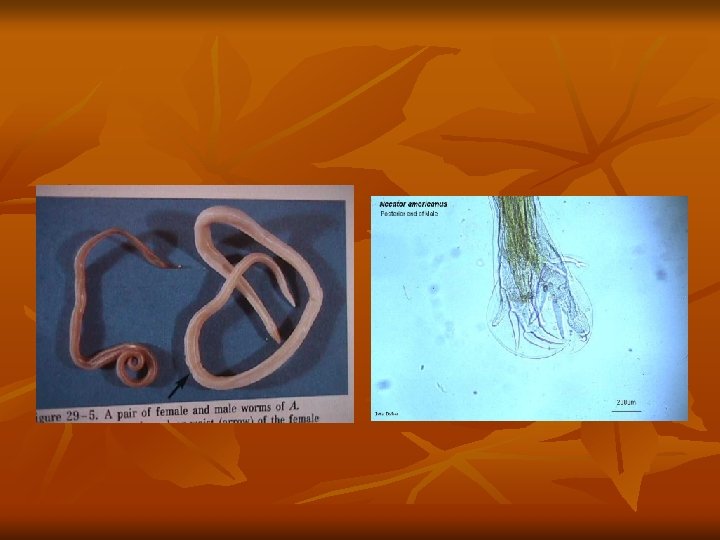
6. 7. All nematodes are diecious ( seprate sexes ), parthenogenetic. Males are smaller than females ( ventrally curved with bursa, Spicules, alae…. . et. ).
8. Female nematodes are divided as follows: A. B. C. Viviparous , e. g. T. spiralis. Oviparous , A. lumbricoides, A. duodenale, E. vermicularis. Ovo-viviparous , e. g. S. stercoralis.
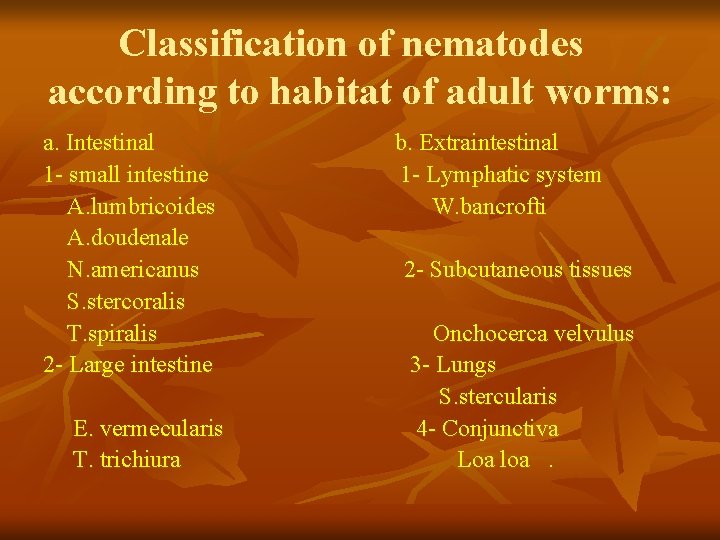
Classification of nematodes according to habitat of adult worms: a. Intestinal 1 - small intestine A. lumbricoides A. doudenale N. americanus S. stercoralis T. spiralis 2 - Large intestine E. vermecularis T. trichiura b. Extraintestinal 1 - Lymphatic system W. bancrofti 2 - Subcutaneous tissues Onchocerca velvulus 3 - Lungs S. stercularis 4 - Conjunctiva Loa loa.
Classification 1 -Intestinal 2 - Extraintestinal. 1 -Intestinal nematodes : a. A. lumbricoides: Gint intestinal round worm. b. T. trichiura : whipworm. c. E. vermeculsris: pinworm d. S. stercoralis : human threadworm. e. Hookworms : A. duodenale N. amercanus f. T. spiralis : Trichina worm 2 -Extraintestinal Nematodes: A. B. Filarial worms Larva migrans ( L. M. ) 1. 2. Cutaneous L. M. Visceral L. M.
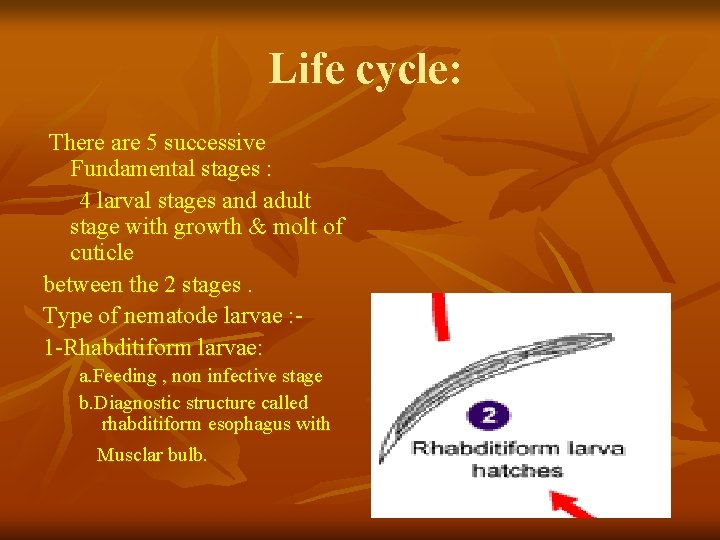
Life cycle: There are 5 successive Fundamental stages : 4 larval stages and adult stage with growth & molt of cuticle between the 2 stages. Type of nematode larvae : 1 -Rhabditiform larvae: a. Feeding , non infective stage b. Diagnostic structure called rhabditiform esophagus with Musclar bulb.
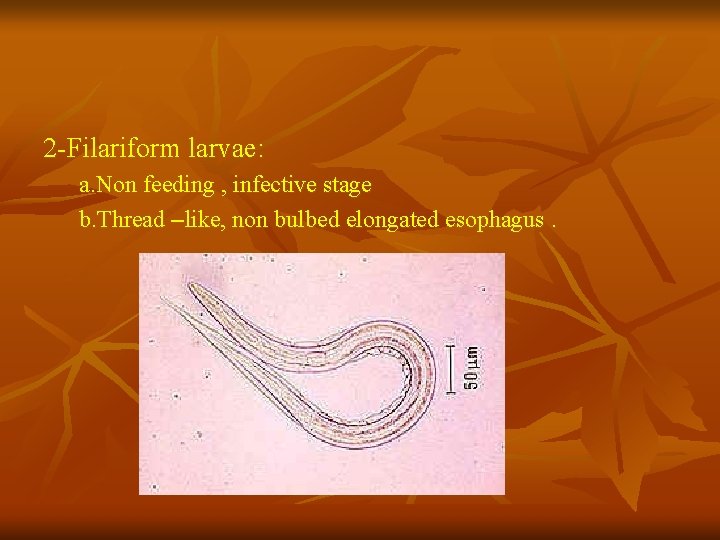
2 -Filariform larvae: a. Non feeding , infective stage b. Thread –like, non bulbed elongated esophagus.
Life cycle of nematodes: Man is the optimum host for all the nematode Parasites. They pass their life cycle in one host except the superfamilies Filaroedia and Dracunculoidia , where two hosts are required. Insect is the second host in case of Filaroidea and cyclops is the second host in case of Dracunculodea.
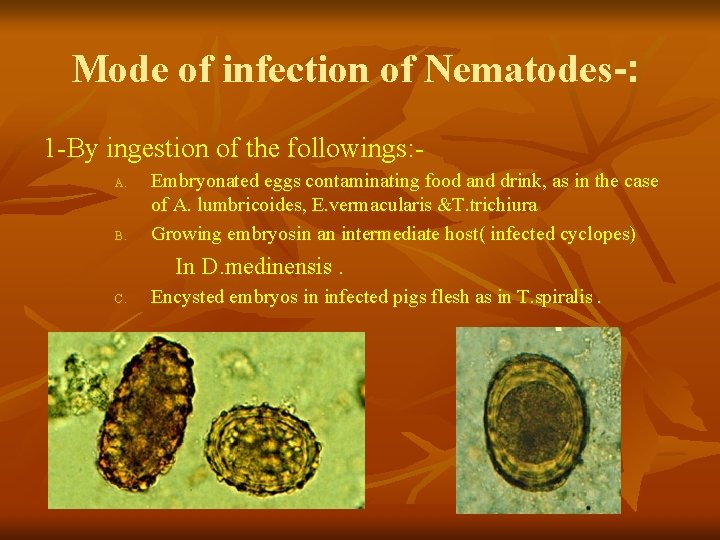
Mode of infection of Nematodes-: 1 -By ingestion of the followings: A. B. Embryonated eggs contaminating food and drink, as in the case of A. lumbricoides, E. vermacularis &T. trichiura Growing embryosin an intermediate host( infected cyclopes) In D. medinensis. C. Encysted embryos in infected pigs flesh as in T. spiralis.
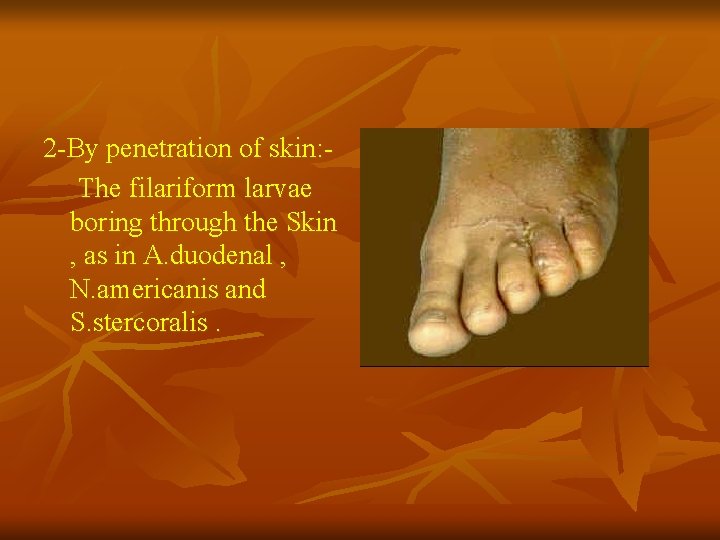
2 -By penetration of skin: The filariform larvae boring through the Skin , as in A. duodenal , N. americanis and S. stercoralis.