
Hello ASM World A Painless and Contextual Introduction

- Slides: 29
Hello ASM World: A Painless and Contextual Introduction to x 86 Assembly rogueclown Derby. Con 3. 0 September 28, 2013
who? • security consultant by vocation • mess around with computers, code, CTFs by avocation • frustrated when things feel like a black box
what is assembly language? • not exactly machine language…but close – instructions: mnemonics for machine operations – normally a one-to-one correlation between ASM instruction and machine instruction • varies by processor – today, we will be discussing 32 -bit x 86
why learn assembly language? • some infosec disciplines require it • curious about lower-level details of memory or interfacing with an operating system • it’s fun and challenging!
how does assembly language work?
hello memory • what parts of computer memory does assembly language commonly access? • how does assembly language access those parts of computer memory?
where is this memory? • what one “normally” thinks of as memory – RAM – virtual memory • CPU – registers
computer memory layout • heap – global variables, usually allocated at compile -time – envision a bookshelf…that won’t let you push books together when you take one out • stack – local, contextual variables – envision a card game discard pile – you will use this when coding ASM. a lot.
registers • memory located on the CPU • registers are awesome because they are fast. • registers are a pain because they are tiny.
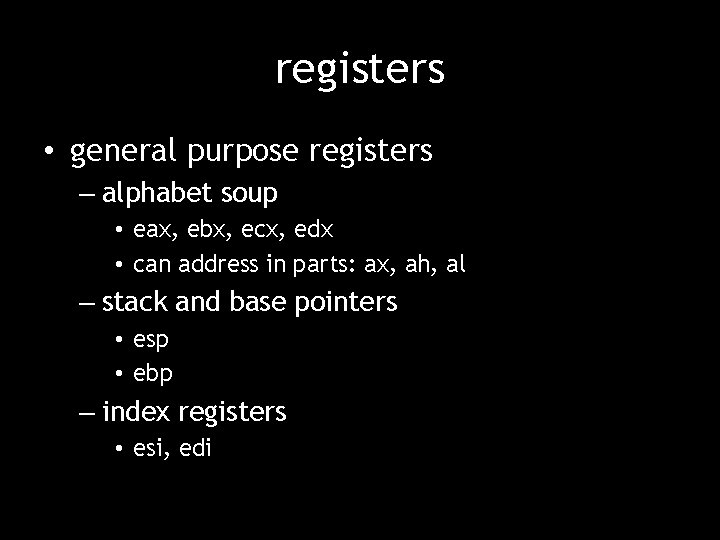
registers • general purpose registers – alphabet soup • eax, ebx, ecx, edx • can address in parts: ax, ah, al – stack and base pointers • esp • ebp – index registers • esi, edi
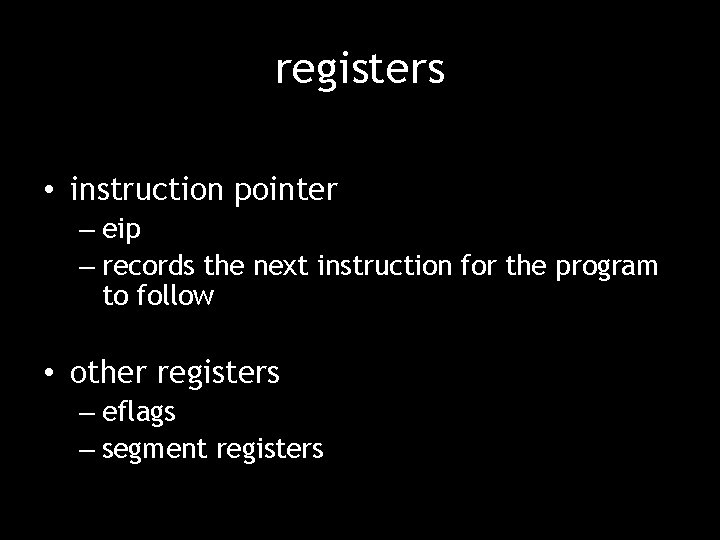
registers • instruction pointer – eip – records the next instruction for the program to follow • other registers – eflags – segment registers
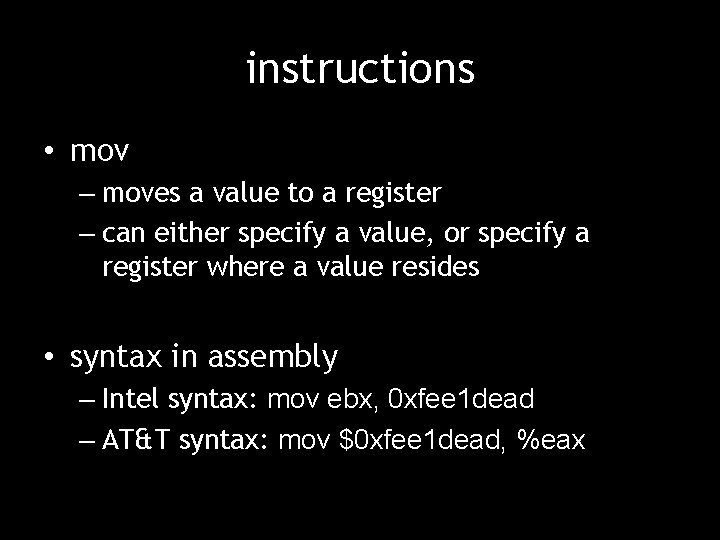
instructions • mov – moves a value to a register – can either specify a value, or specify a register where a value resides • syntax in assembly – Intel syntax: mov ebx, 0 xfee 1 dead – AT&T syntax: mov $0 xfee 1 dead, %eax
instructions • interrupt – int 0 x 80 – int 0 x 3 • system calls – how a program interacts with the kernel of the OS
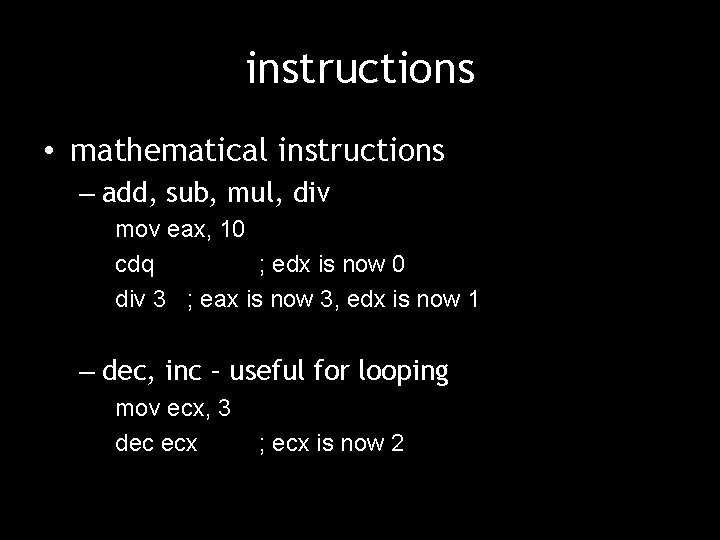
instructions • mathematical instructions – add, sub, mul, div mov eax, 10 cdq ; edx is now 0 div 3 ; eax is now 3, edx is now 1 – dec, inc – useful for looping mov ecx, 3 dec ecx ; ecx is now 2
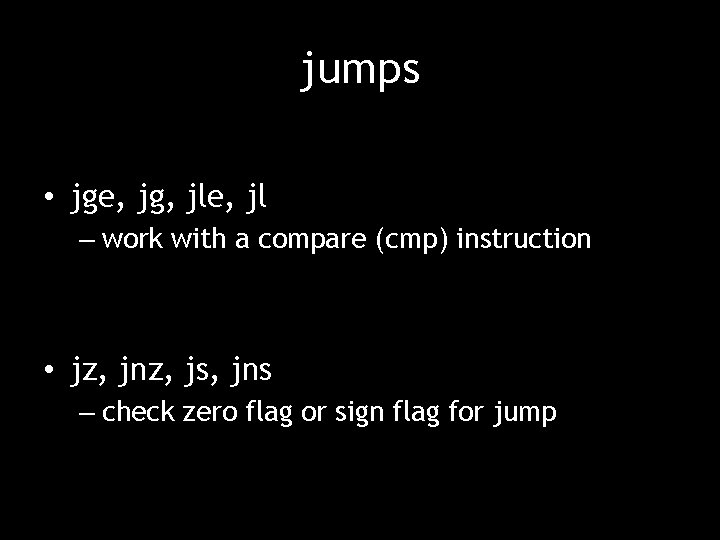
jumps • jge, jg, jle, jl – work with a compare (cmp) instruction • jz, jnz, js, jns – check zero flag or sign flag for jump
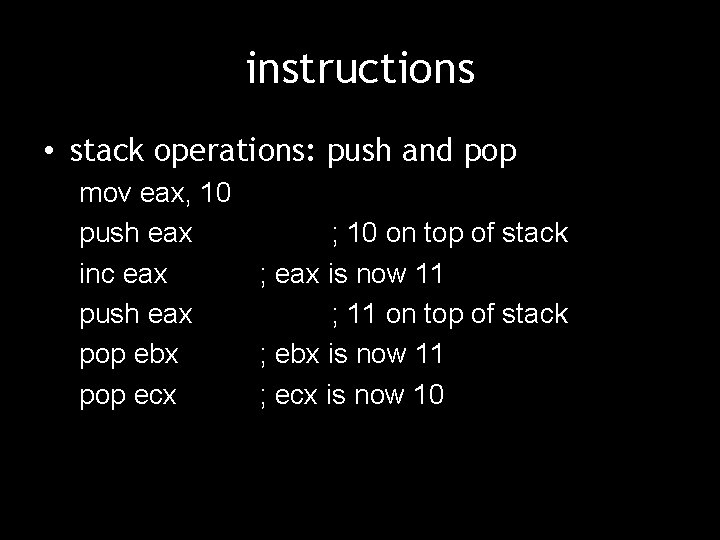
instructions • stack operations: push and pop mov eax, 10 push eax ; 10 on top of stack inc eax ; eax is now 11 push eax ; 11 on top of stack pop ebx ; ebx is now 11 pop ecx ; ecx is now 10
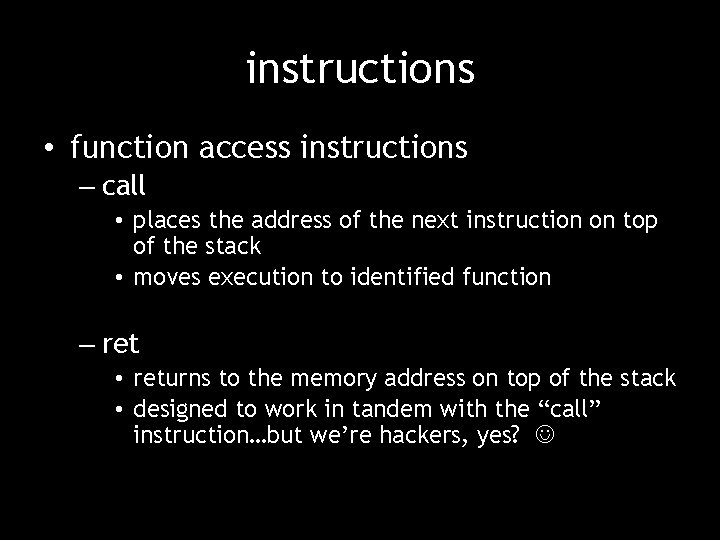
instructions • function access instructions – call • places the address of the next instruction on top of the stack • moves execution to identified function – ret • returns to the memory address on top of the stack • designed to work in tandem with the “call” instruction…but we’re hackers, yes?
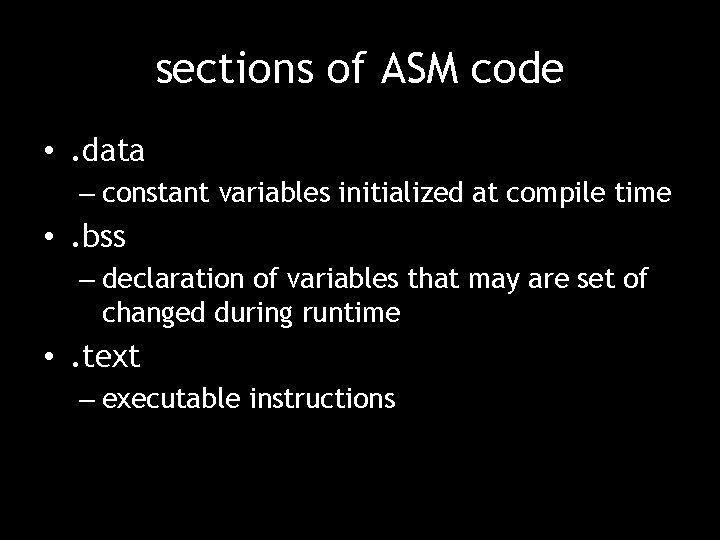
sections of ASM code • . data – constant variables initialized at compile time • . bss – declaration of variables that may are set of changed during runtime • . text – executable instructions
$%&#@%^ instructions: how do they work?
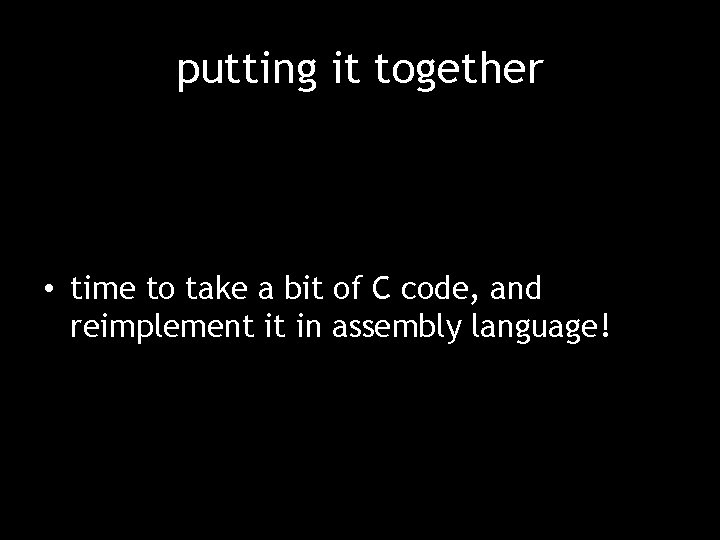
putting it together • time to take a bit of C code, and reimplement it in assembly language!
where does shellcode come in?
what is shellcode? • instructions injected into a running process • lacks some of the luxuries of writing a stand-alone program – no laying out nice memory segments in a. bss or. data section – basically, just one big. text section
a first stab at shellcode… • this is going to look mostly familiar, except for how data is handled.
why did it fail? • bad characters – shellcode is often passed to an application as a string. – if a character makes a string act funny, you may not want it in your shellcode • 0 x 00, 0 x 0 a, 0 x 0 d, etc. – use an encoder, or do it yourself
try that shellcode again…
where can i learn more about assembly language?
suggested resources • dead trees – “Hacking: The Art of Exploitation” by Jon Erickson – “Practical Malware Analysis” by Michael Sikorski and Andrew Honig – “Gray Hat Python” by Justin Seitz
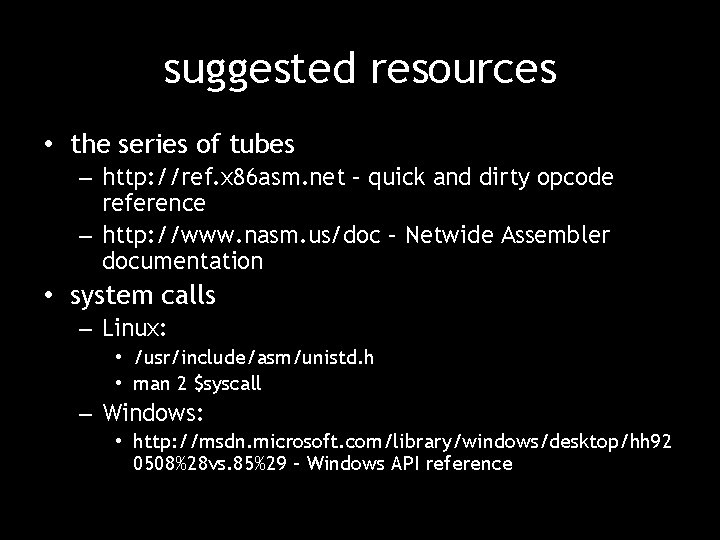
suggested resources • the series of tubes – http: //ref. x 86 asm. net – quick and dirty opcode reference – http: //www. nasm. us/doc – Netwide Assembler documentation • system calls – Linux: • /usr/include/asm/unistd. h • man 2 $syscall – Windows: • http: //msdn. microsoft. com/library/windows/desktop/hh 92 0508%28 vs. 85%29 – Windows API reference
how to find me • Twitter: @rogueclown • email: rogueclown@rogueclown. net • IRC: #derbycon, #misec, or #burbsec on Freenode • or, just wave me down at the con