
Hello and welcome Its lovely to be here
Hello and welcome It’s lovely to be here finally. Apologies to those affected by the date changes. As you know we should have been sat in a meeting room with a nice coffee and with me showing you lots of images via my laptop. Instead we’re sat here and I’m going to go old school and show you some prints. Before I do that, let’s do some introductions. Can we please go around the table with everyone introducing themselves to the group, saying a few words about their photographic experience and sharing what they’d like to get out of today. Let’s start with you…. Thankyou. We’ll definitely be covering all of that today.
So, a few points around health and safety. • Firstly – Covid. Hand sanitisers and keeping 2 metres apart. • Secondly – should you need to use the bathroom it’s… • And thirdly – we’ll obviously be in close proximity to horses today. While they are kind and gentle creatures they’re also flight animals and their instinct is to run from any danger. Therefore please work quietly and slowly around them, don’t rush up behind them, and keep all your possessions away from them. We’ll be starting the shoot around the barn area where we’ll work in pairs as the space is restricted. Later on when we work in the fields we’ll be working all together. So that we don’t block anyone’s view or get in the way of the horses we’ll be all in a line and it’s really important to keep to that line, both for your own safety and to not get in the way of your fellow photographers.
Right – let’s talk fine art equine photography and look at a few prints. Please feel free to ask questions as we go through. I’d like this to be an interactive session and for you to get the most out of it. So, Fine art equine photography: What is it? It’s such a well-used phrase but what do we actually mean when we use it For me the best definition is - Making personal, evocative images which convey an emotion rather than merely capturing a realistic rendition of the subject
So that’s what we think of as Fine Art photography. But how do you do this? It’s about thinking about what you’re trying to convey – so, for example, how you want to portray a particular horse. - What do you want to show? - How do you want someone viewing your image to feel? - And then making your image by considering your aperture, shutter speed, composition, lighting and background choice
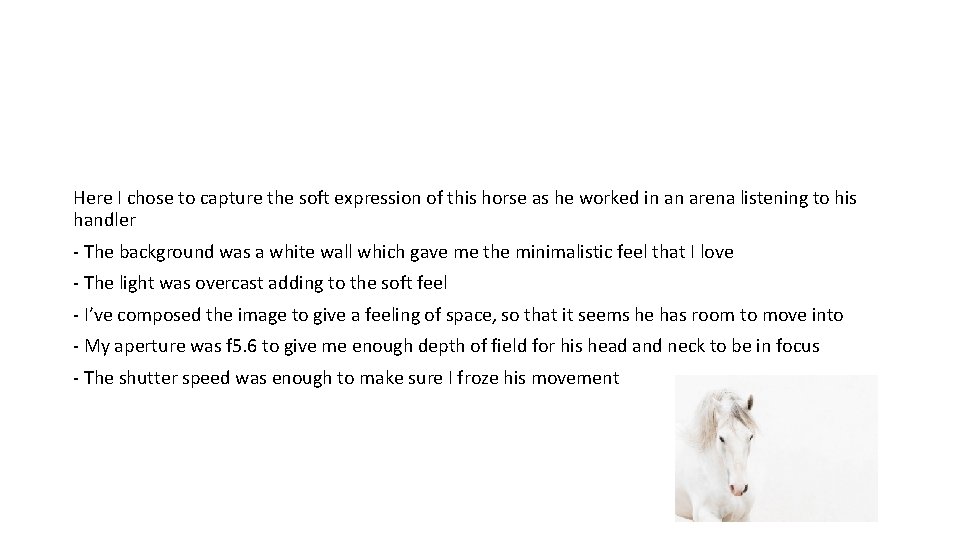
Here I chose to capture the soft expression of this horse as he worked in an arena listening to his handler - The background was a white wall which gave me the minimalistic feel that I love - The light was overcast adding to the soft feel - I’ve composed the image to give a feeling of space, so that it seems he has room to move into - My aperture was f 5. 6 to give me enough depth of field for his head and neck to be in focus - The shutter speed was enough to make sure I froze his movement
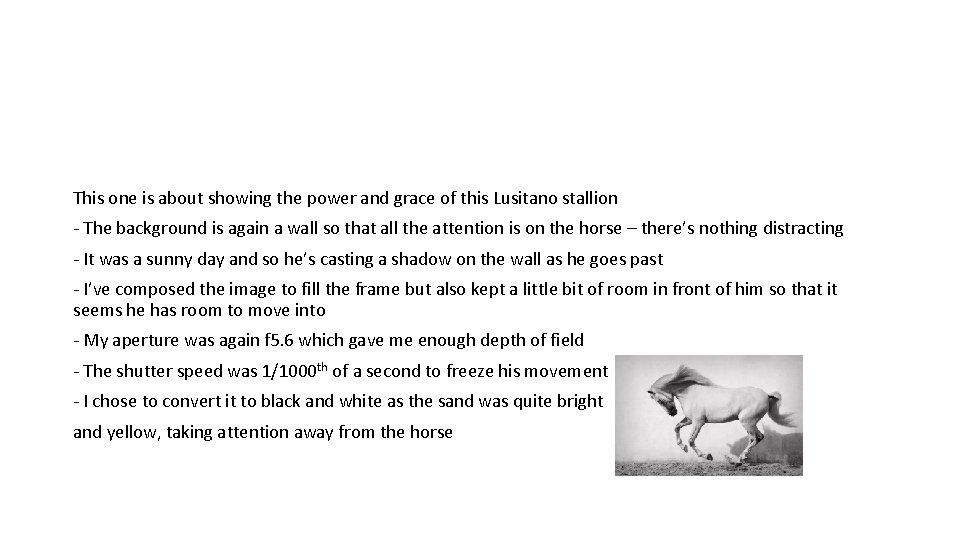
This one is about showing the power and grace of this Lusitano stallion - The background is again a wall so that all the attention is on the horse – there’s nothing distracting - It was a sunny day and so he’s casting a shadow on the wall as he goes past - I’ve composed the image to fill the frame but also kept a little bit of room in front of him so that it seems he has room to move into - My aperture was again f 5. 6 which gave me enough depth of field - The shutter speed was 1/1000 th of a second to freeze his movement - I chose to convert it to black and white as the sand was quite bright and yellow, taking attention away from the horse
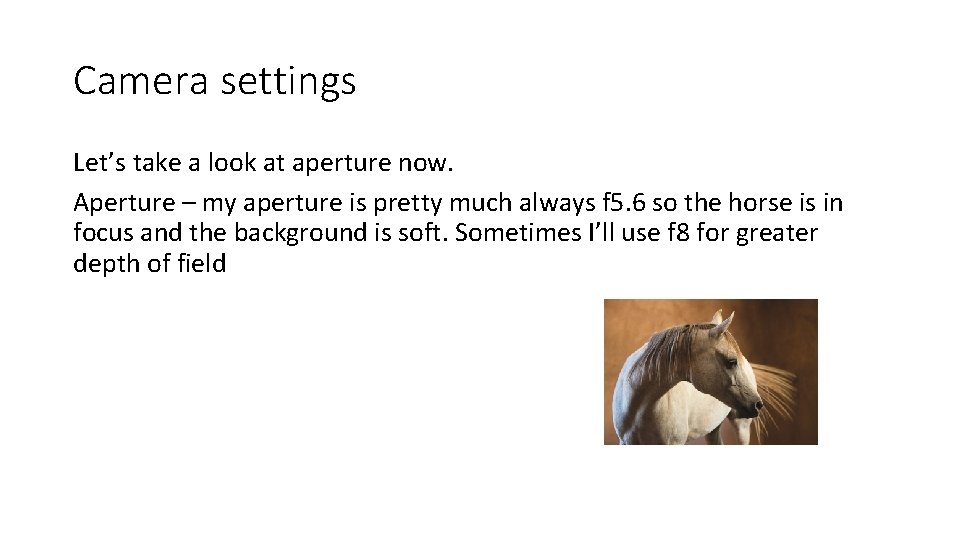
Camera settings Let’s take a look at aperture now. Aperture – my aperture is pretty much always f 5. 6 so the horse is in focus and the background is soft. Sometimes I’ll use f 8 for greater depth of field
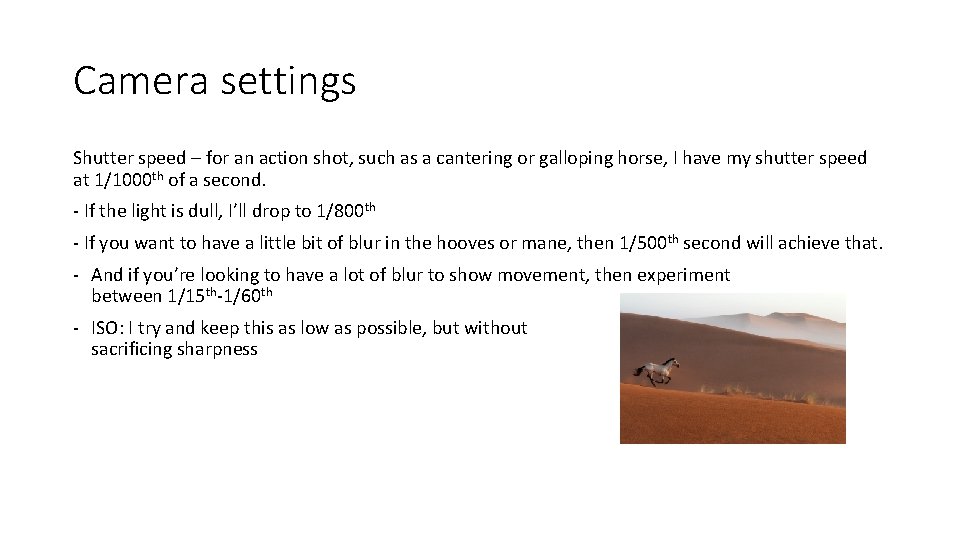
Camera settings Shutter speed – for an action shot, such as a cantering or galloping horse, I have my shutter speed at 1/1000 th of a second. - If the light is dull, I’ll drop to 1/800 th - If you want to have a little bit of blur in the hooves or mane, then 1/500 th second will achieve that. - And if you’re looking to have a lot of blur to show movement, then experiment between 1/15 th-1/60 th - ISO: I try and keep this as low as possible, but without sacrificing sharpness
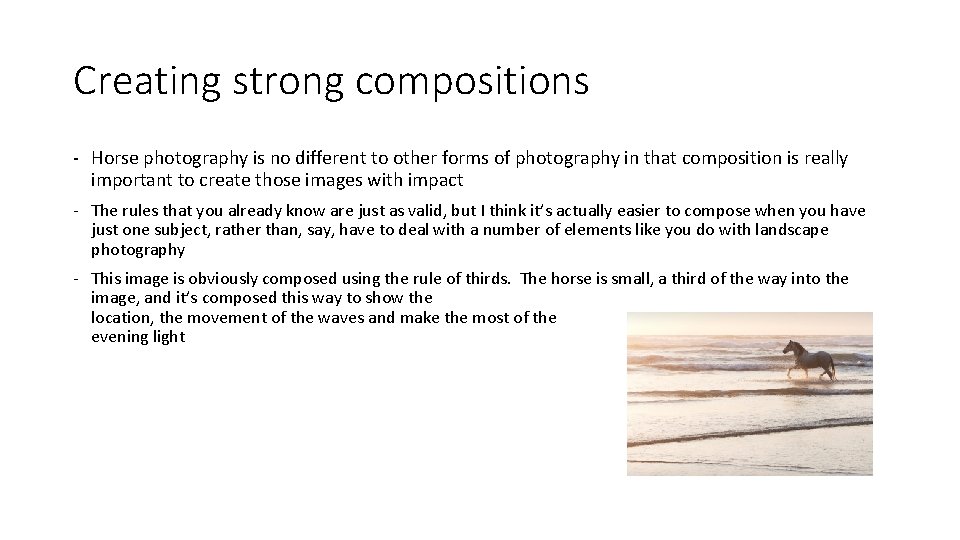
Creating strong compositions - Horse photography is no different to other forms of photography in that composition is really important to create those images with impact - The rules that you already know are just as valid, but I think it’s actually easier to compose when you have just one subject, rather than, say, have to deal with a number of elements like you do with landscape photography - This image is obviously composed using the rule of thirds. The horse is small, a third of the way into the image, and it’s composed this way to show the location, the movement of the waves and make the most of the evening light
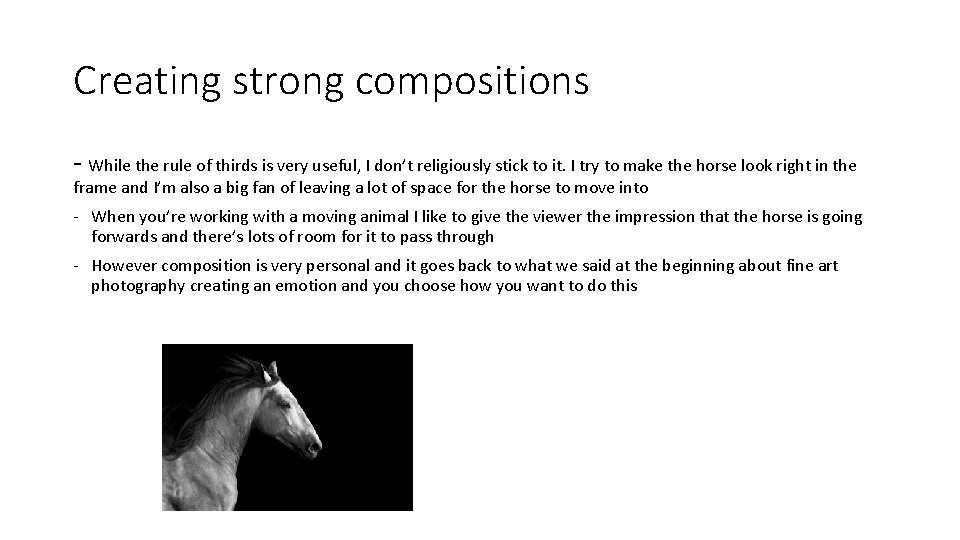
Creating strong compositions - While the rule of thirds is very useful, I don’t religiously stick to it. I try to make the horse look right in the frame and I’m also a big fan of leaving a lot of space for the horse to move into - When you’re working with a moving animal I like to give the viewer the impression that the horse is going forwards and there’s lots of room for it to pass through - However composition is very personal and it goes back to what we said at the beginning about fine art photography creating an emotion and you choose how you want to do this
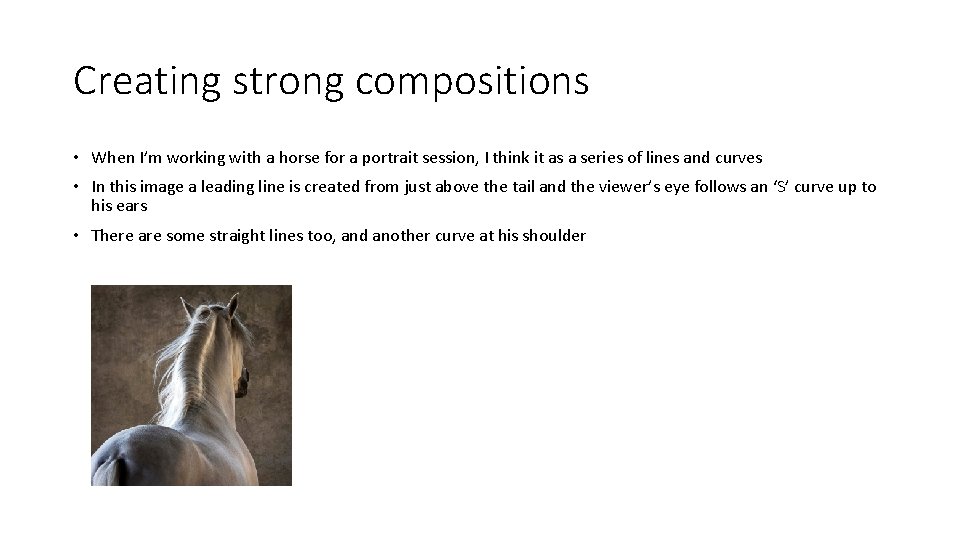
Creating strong compositions • When I’m working with a horse for a portrait session, I think it as a series of lines and curves • In this image a leading line is created from just above the tail and the viewer’s eye follows an ‘S’ curve up to his ears • There are some straight lines too, and another curve at his shoulder
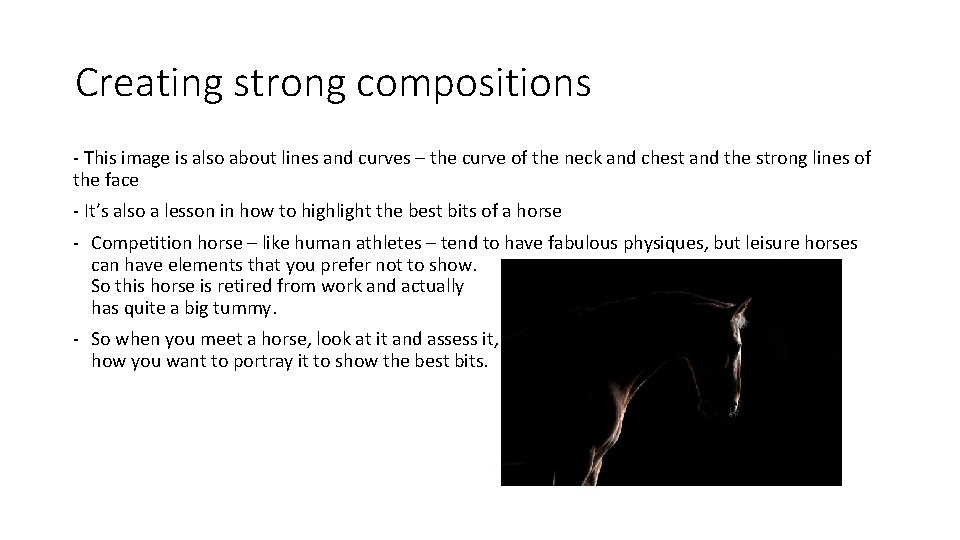
Creating strong compositions - This image is also about lines and curves – the curve of the neck and chest and the strong lines of the face - It’s also a lesson in how to highlight the best bits of a horse - Competition horse – like human athletes – tend to have fabulous physiques, but leisure horses can have elements that you prefer not to show. So this horse is retired from work and actually has quite a big tummy. - So when you meet a horse, look at it and assess it, and then work out how you want to portray it to show the best bits.
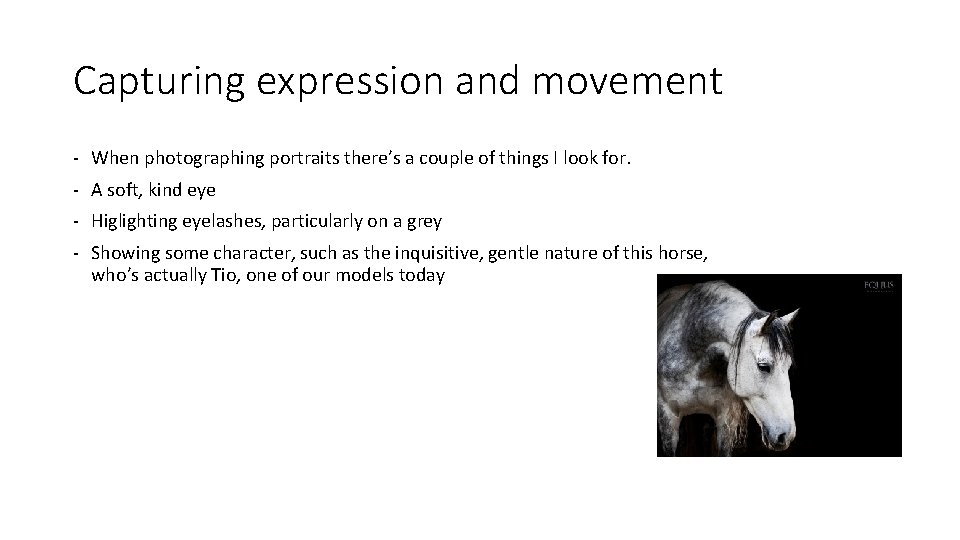
Capturing expression and movement - When photographing portraits there’s a couple of things I look for. - A soft, kind eye - Higlighting eyelashes, particularly on a grey - Showing some character, such as the inquisitive, gentle nature of this horse, who’s actually Tio, one of our models today
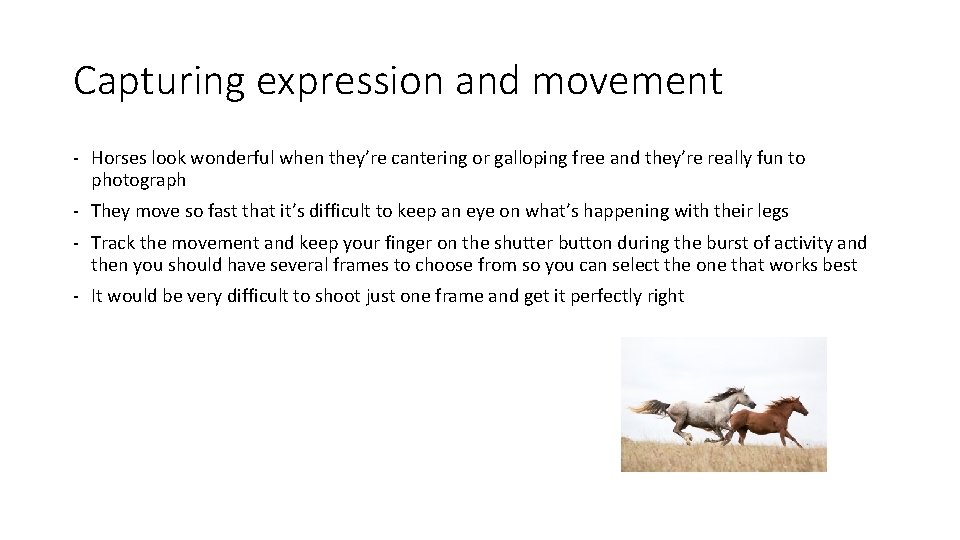
Capturing expression and movement - Horses look wonderful when they’re cantering or galloping free and they’re really fun to photograph - They move so fast that it’s difficult to keep an eye on what’s happening with their legs - Track the movement and keep your finger on the shutter button during the burst of activity and then you should have several frames to choose from so you can select the one that works best - It would be very difficult to shoot just one frame and get it perfectly right
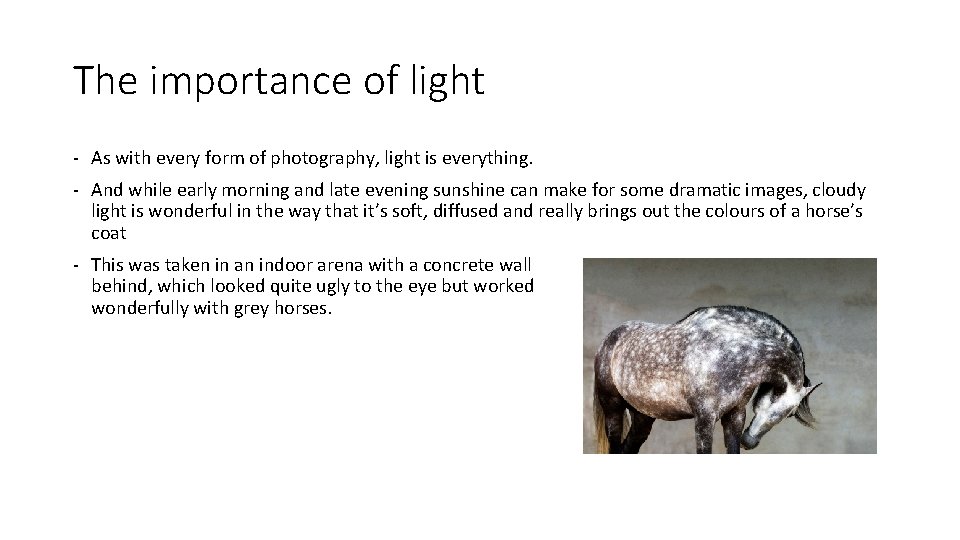
The importance of light - As with every form of photography, light is everything. - And while early morning and late evening sunshine can make for some dramatic images, cloudy light is wonderful in the way that it’s soft, diffused and really brings out the colours of a horse’s coat - This was taken in an indoor arena with a concrete wall behind, which looked quite ugly to the eye but worked wonderfully with grey horses.
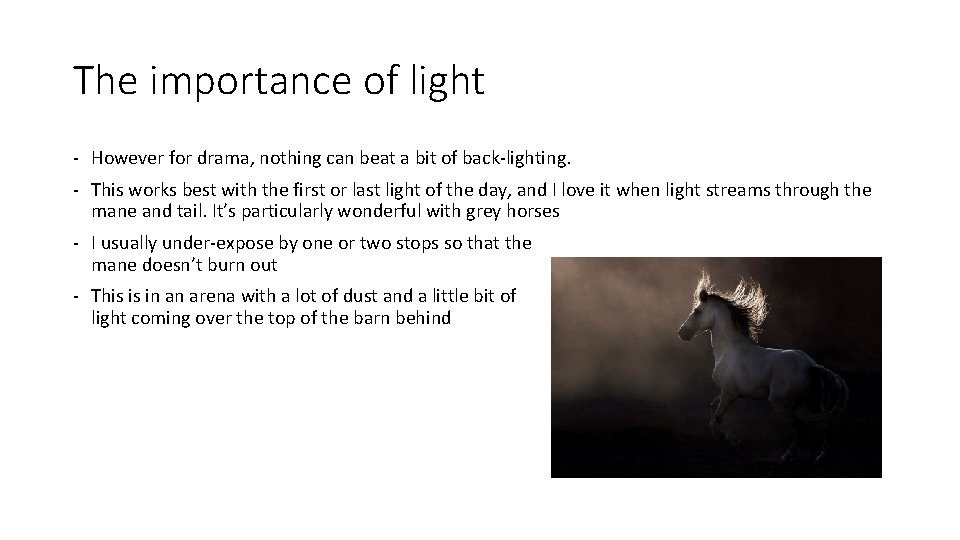
The importance of light - However for drama, nothing can beat a bit of back-lighting. - This works best with the first or last light of the day, and I love it when light streams through the mane and tail. It’s particularly wonderful with grey horses - I usually under-expose by one or two stops so that the mane doesn’t burn out - This is in an arena with a lot of dust and a little bit of light coming over the top of the barn behind
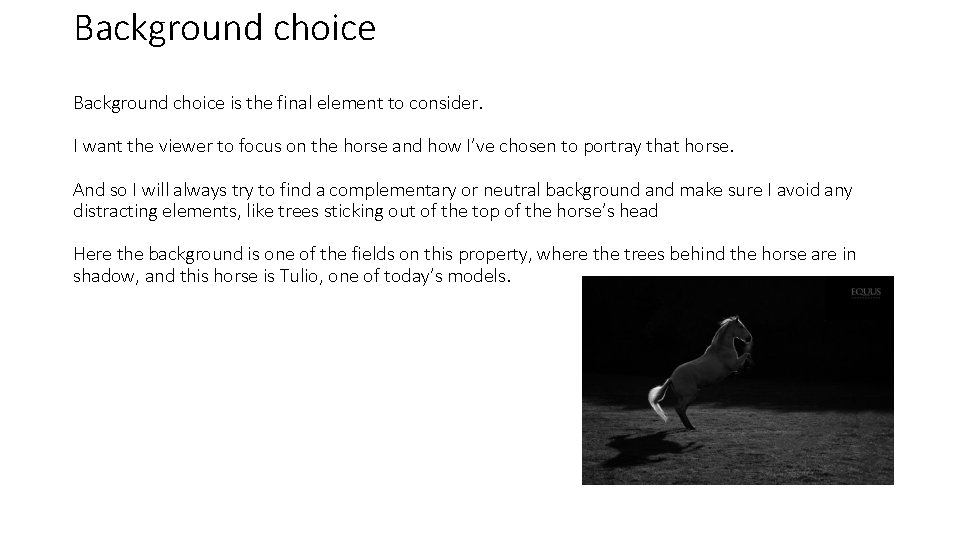
Background choice is the final element to consider. I want the viewer to focus on the horse and how I’ve chosen to portray that horse. And so I will always try to find a complementary or neutral background and make sure I avoid any distracting elements, like trees sticking out of the top of the horse’s head Here the background is one of the fields on this property, where the trees behind the horse are in shadow, and this horse is Tulio, one of today’s models.
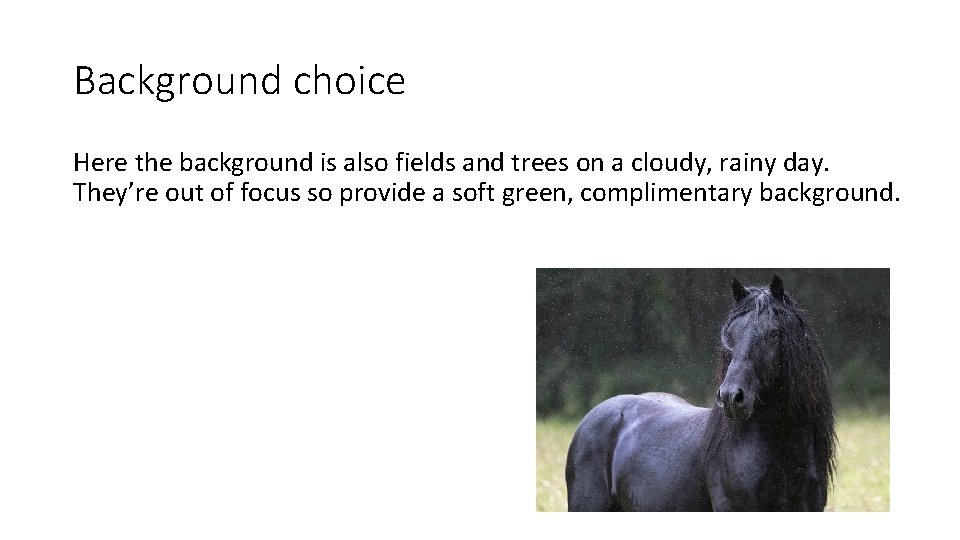
Background choice Here the background is also fields and trees on a cloudy, rainy day. They’re out of focus so provide a soft green, complimentary background.
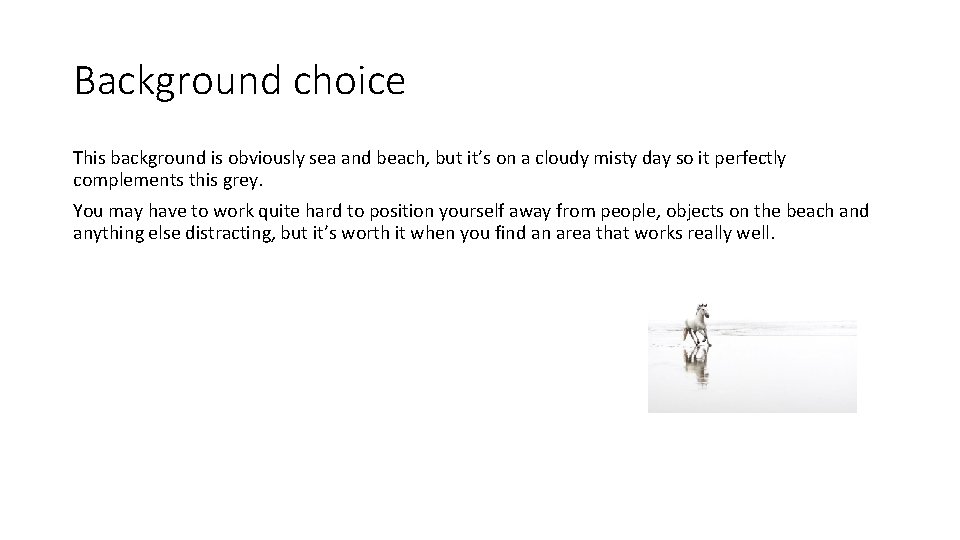
Background choice This background is obviously sea and beach, but it’s on a cloudy misty day so it perfectly complements this grey. You may have to work quite hard to position yourself away from people, objects on the beach and anything else distracting, but it’s worth it when you find an area that works really well.
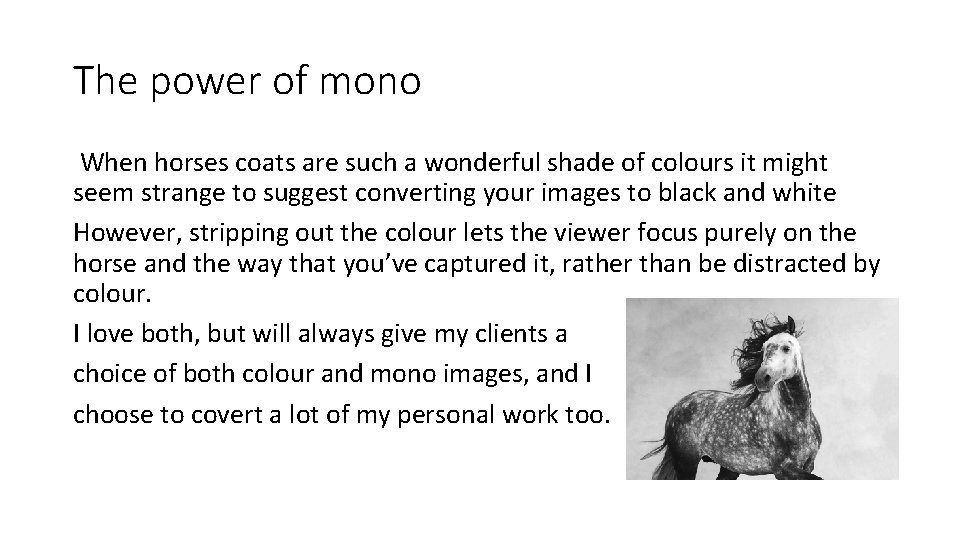
The power of mono When horses coats are such a wonderful shade of colours it might seem strange to suggest converting your images to black and white However, stripping out the colour lets the viewer focus purely on the horse and the way that you’ve captured it, rather than be distracted by colour. I love both, but will always give my clients a choice of both colour and mono images, and I choose to covert a lot of my personal work too.
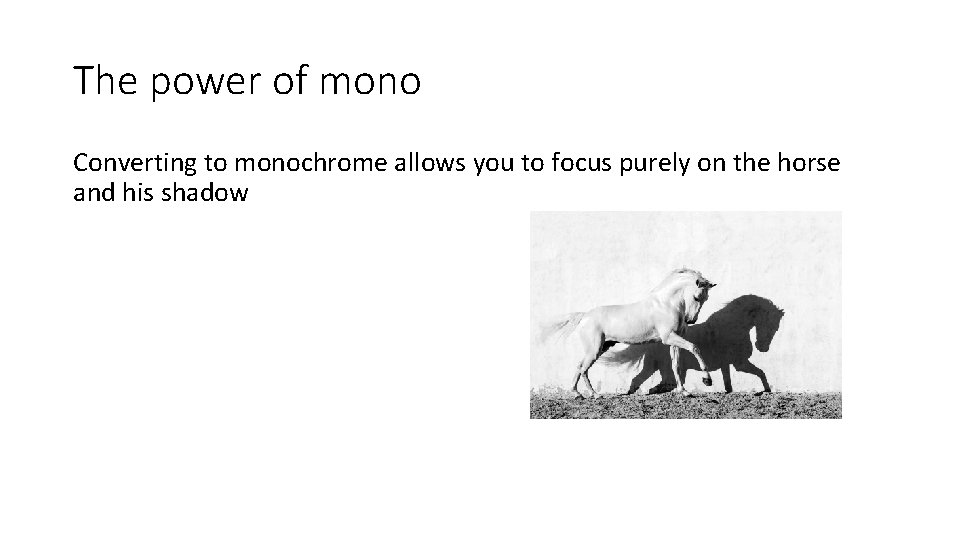
The power of mono Converting to monochrome allows you to focus purely on the horse and his shadow
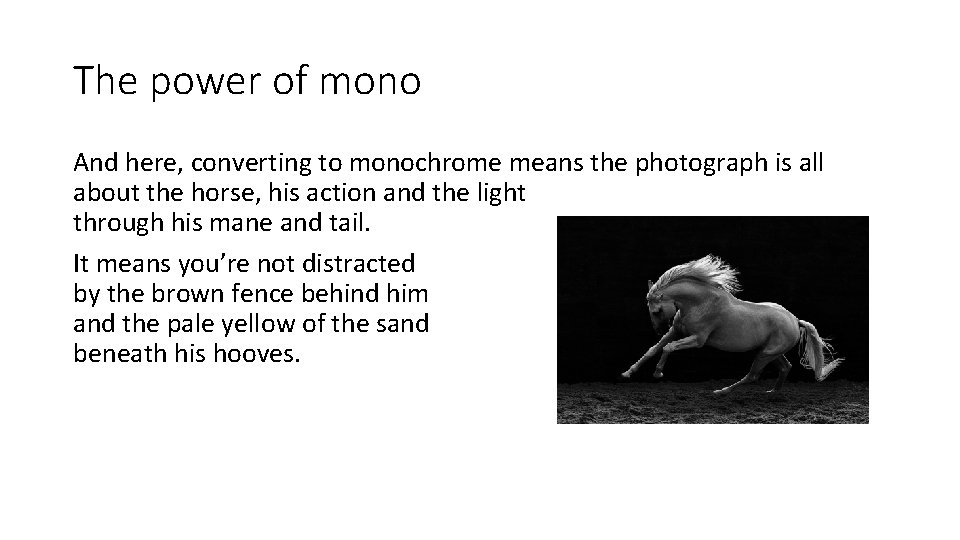
The power of mono And here, converting to monochrome means the photograph is all about the horse, his action and the light through his mane and tail. It means you’re not distracted by the brown fence behind him and the pale yellow of the sand beneath his hooves.
Any questions? • Reminders: • Consider your aperture, shutter speed, composition, light and background choice • Consider the lines and shapes of the horse and how your want to portray it • Shoot lots when we have some action • Ask questions whenever you need to
Now it’s time for you to put some of that into practice. We’ll head over to the barn to meet the horses and get ready for our first shoot. So bring your camera kit and some water if you’d like to and let’s get started. We’ll be working on some portraits with three different horses and a couple of different backgrounds first of all, and then we’ll head out into the fields after that for some different locations. We’ll take a quick break for lunch around 2 pm but otherwise will be shooting through till 4 pm. The area around the barn is quite small, so we’ll be working in pairs for the first shoot and then bigger groups after that, for the rest of the day. • Be safe • Have fun!
- Slides: 24