
Helios Heterogeneous Multiprocessing with Satellite Kernels Ed Nightingale
![Related Work �Hive [Chapin et. al. ‘ 95] Multiple kernels – single system image](https://slidetodoc.com/presentation_image_h2/7a6b612e7ab1ec95248a37d8a9986527/image-25.jpg "Related Work �Hive [Chapin et. al. ‘ 95] Multiple kernels – single system image")
- Slides: 26
Helios: Heterogeneous Multiprocessing with Satellite Kernels Ed Nightingale, Orion Hodson, Ross Mc. Ilroy, Chris Hawblitzel, Galen Hunt MICROSOFT RESEARCH 1
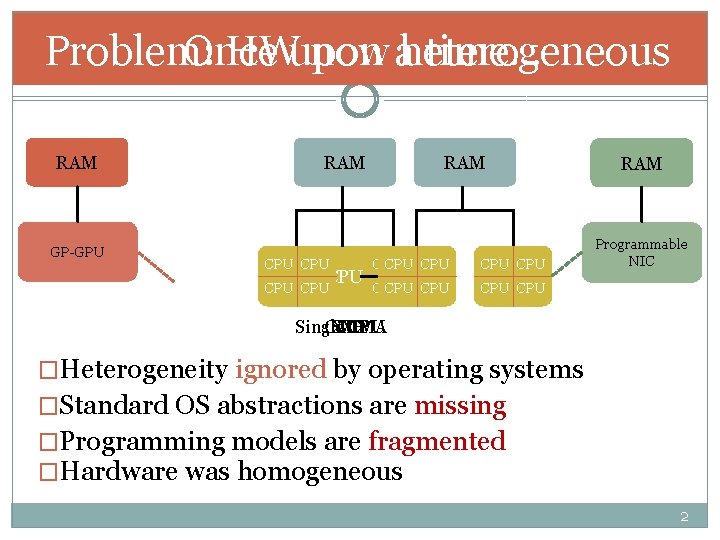
Problem: Once HWupon now aheterogeneous time… RAM GP-GPU RAM CPU CPU CPUCPU CPU CPU RAM Programmable NIC Single CMP SMP NUMA CPU �Heterogeneity ignored by operating systems �Standard OS abstractions are missing �Programming models are fragmented �Hardware was homogeneous 2
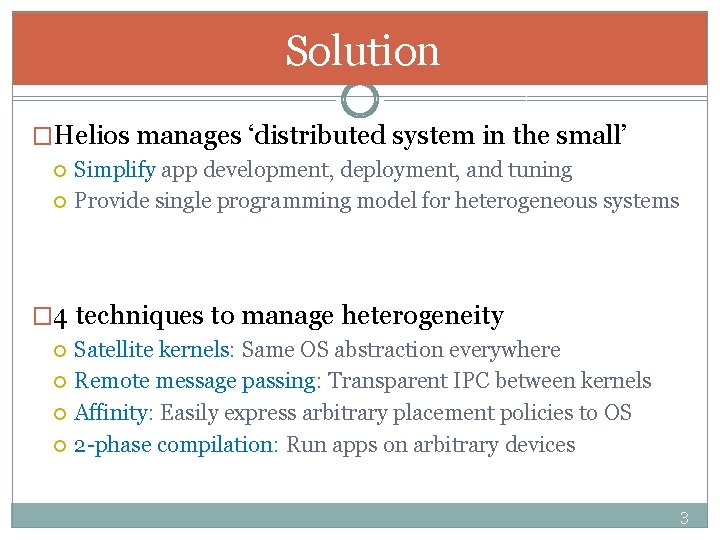
Solution �Helios manages ‘distributed system in the small’ Simplify app development, deployment, and tuning Provide single programming model for heterogeneous systems � 4 techniques to manage heterogeneity Satellite kernels: Same OS abstraction everywhere Remote message passing: Transparent IPC between kernels Affinity: Easily express arbitrary placement policies to OS 2 -phase compilation: Run apps on arbitrary devices 3
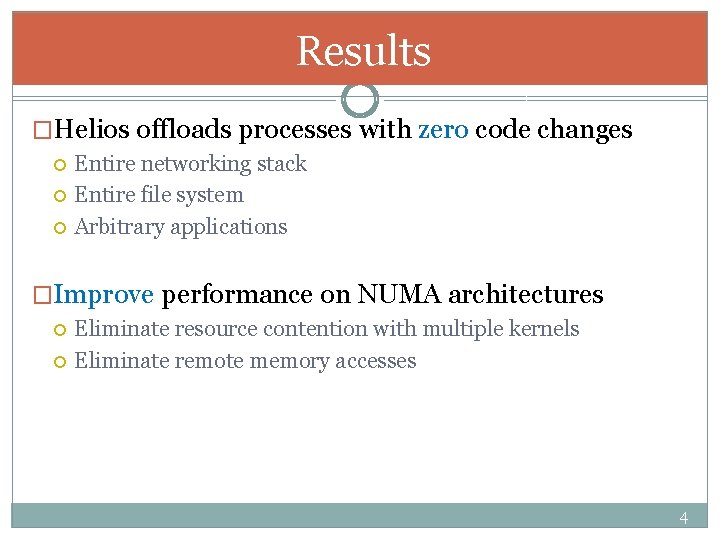
Results �Helios offloads processes with zero code changes Entire networking stack Entire file system Arbitrary applications �Improve performance on NUMA architectures Eliminate resource contention with multiple kernels Eliminate remote memory accesses 4
Outline �Motivation �Helios design Satellite kernels Remote message passing Affinity Encapsulating many ISAs �Evaluation �Conclusion 5
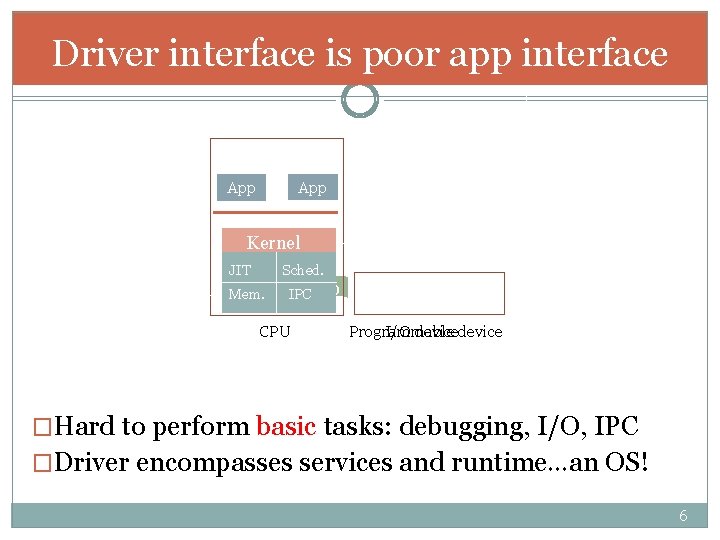
Driver interface is poor app interface App Kernel JIT Sched. Mem. driver 1010 IPC CPU Programmable I/O device �Hard to perform basic tasks: debugging, I/O, IPC �Driver encompasses services and runtime…an OS! 6
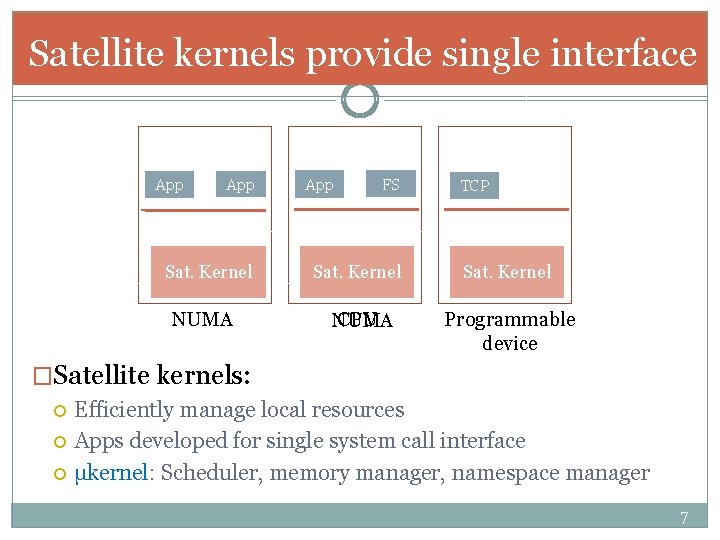
Satellite kernels provide single interface App App FS TCP \ Sat. Kernel NUMA Sat. Kernel CPU NUMA Sat. Kernel Programmable device �Satellite kernels: Efficiently manage local resources Apps developed for single system call interface μkernel: Scheduler, memory manager, namespace manager 7
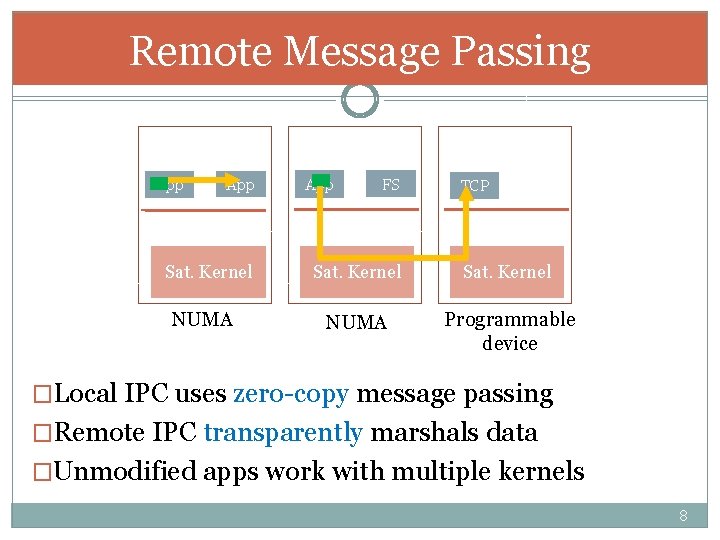
Remote Message Passing App App FS TCP \ Sat. Kernel NUMA Programmable device �Local IPC uses zero-copy message passing �Remote IPC transparently marshals data �Unmodified apps work with multiple kernels 8
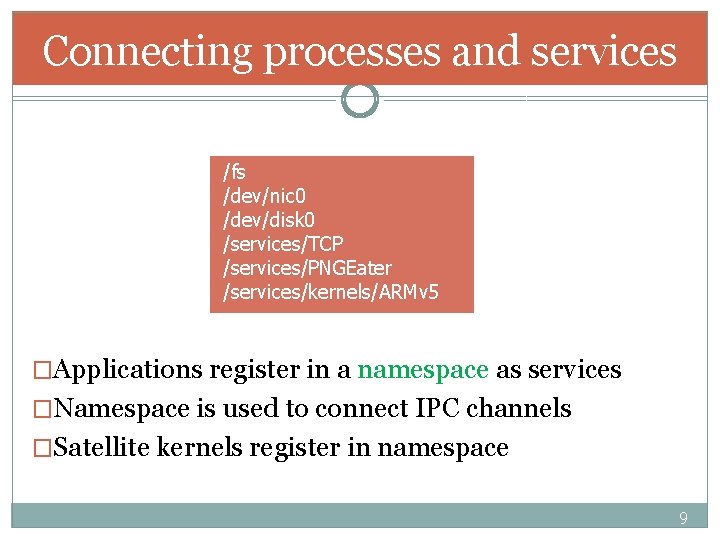
Connecting processes and services /fs /dev/nic 0 /dev/disk 0 /services/TCP /services/PNGEater /services/kernels/ARMv 5 �Applications register in a namespace as services �Namespace is used to connect IPC channels �Satellite kernels register in namespace 9
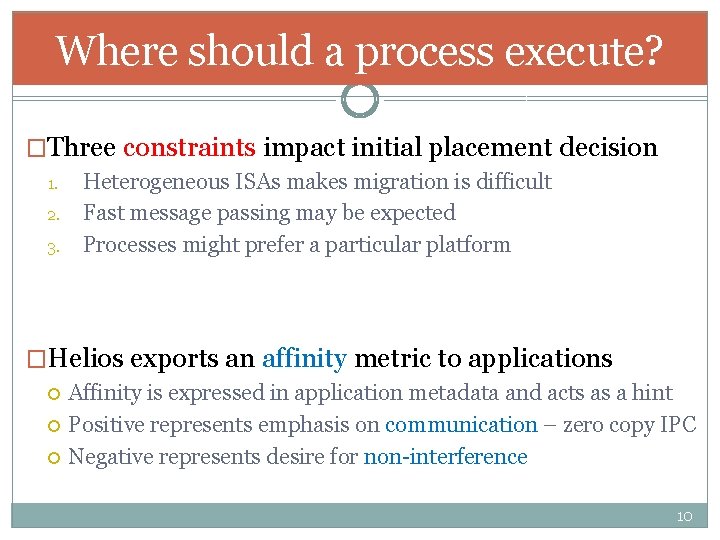
Where should a process execute? �Three constraints impact initial placement decision 1. 2. 3. Heterogeneous ISAs makes migration is difficult Fast message passing may be expected Processes might prefer a particular platform �Helios exports an affinity metric to applications Affinity is expressed in application metadata and acts as a hint Positive represents emphasis on communication – zero copy IPC Negative represents desire for non-interference 10
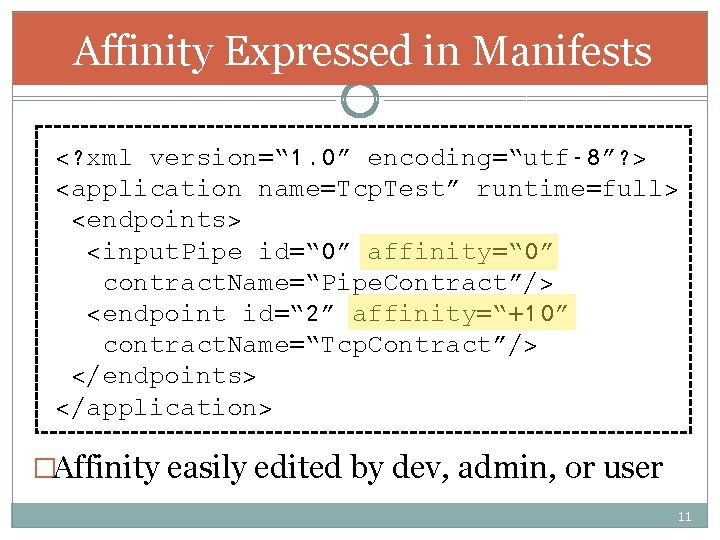
Affinity Expressed in Manifests <? xml version=“ 1. 0” encoding=“utf-8”? > <application name=Tcp. Test” runtime=full> <endpoints> <input. Pipe id=“ 0” affinity=“ 0” contract. Name=“Pipe. Contract”/> <endpoint id=“ 2” affinity=“+10” contract. Name=“Tcp. Contract”/> </endpoints> </application> �Affinity easily edited by dev, admin, or user 11
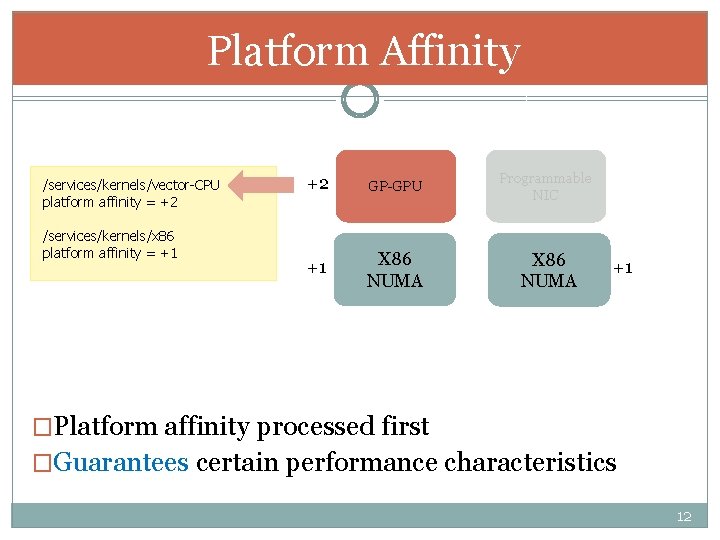
Platform Affinity /services/kernels/vector-CPU platform affinity = +2 /services/kernels/x 86 platform affinity = +1 +2 GP-GPU Programmable NIC +1 X 86 NUMA +1 �Platform affinity processed first �Guarantees certain performance characteristics 12
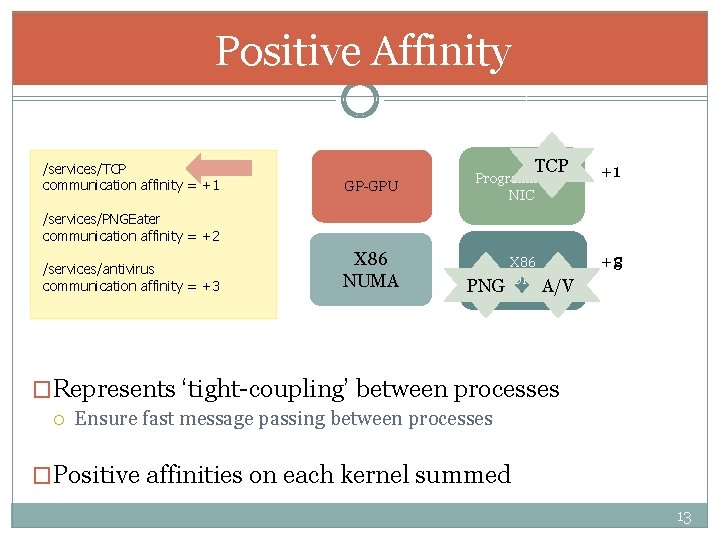
Positive Affinity /services/TCP communication affinity = +1 TCP GP-GPU Programmable NIC X 86 NUMA PNGNUMA A/V +1 /services/PNGEater communication affinity = +2 /services/antivirus communication affinity = +3 +5 +2 �Represents ‘tight-coupling’ between processes Ensure fast message passing between processes �Positive affinities on each kernel summed 13
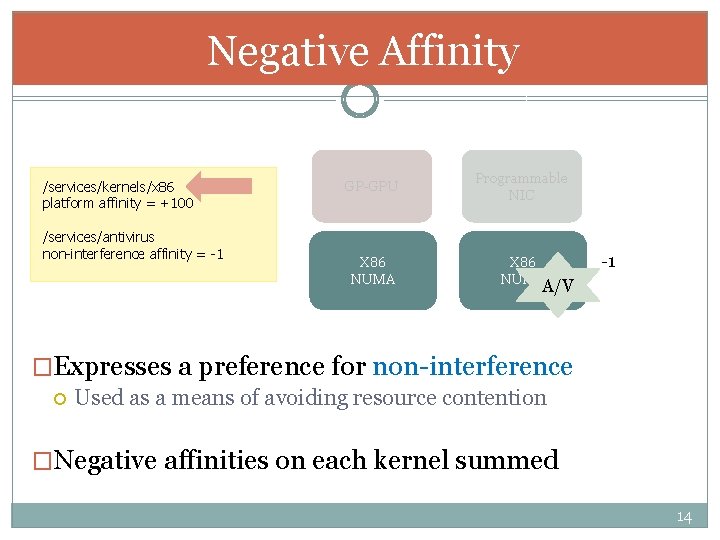
Negative Affinity /services/kernels/x 86 platform affinity = +100 /services/antivirus non-interference affinity = -1 GP-GPU X 86 NUMA Programmable NIC X 86 NUMA A/V -1 �Expresses a preference for non-interference Used as a means of avoiding resource contention �Negative affinities on each kernel summed 14
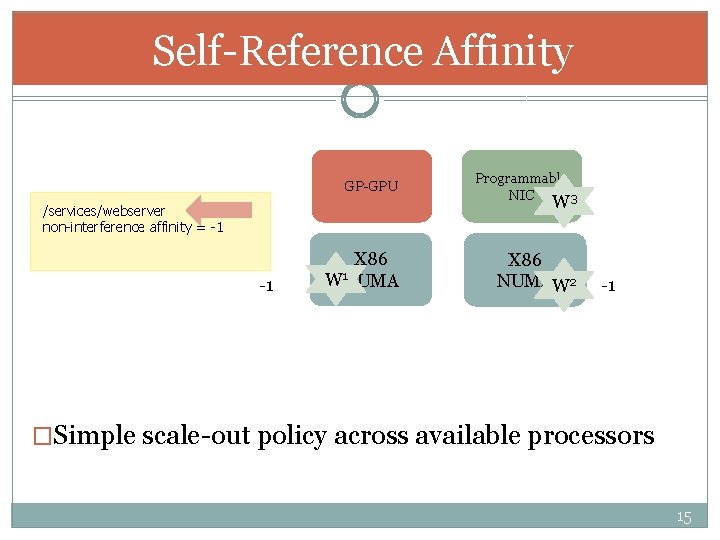
Self-Reference Affinity GP-GPU Programmable NIC 3 X 86 W 1 NUMA X 86 NUMAW 2 /services/webserver non-interference affinity = -1 -1 W -1 �Simple scale-out policy across available processors 15
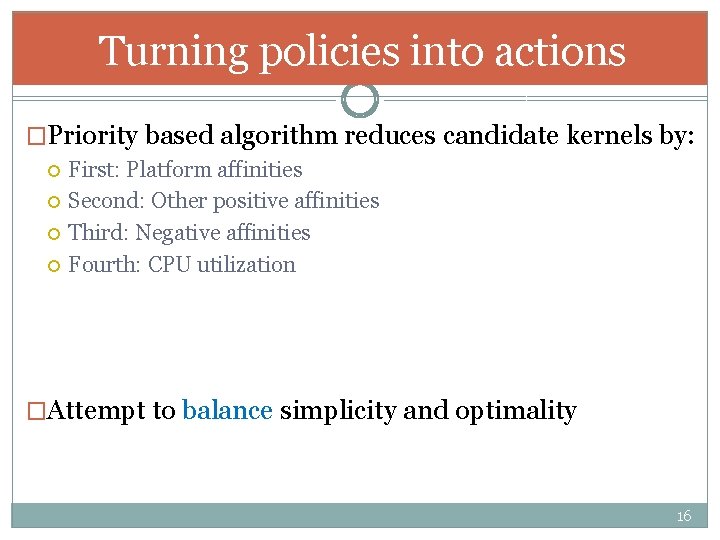
Turning policies into actions �Priority based algorithm reduces candidate kernels by: First: Platform affinities Second: Other positive affinities Third: Negative affinities Fourth: CPU utilization �Attempt to balance simplicity and optimality 16
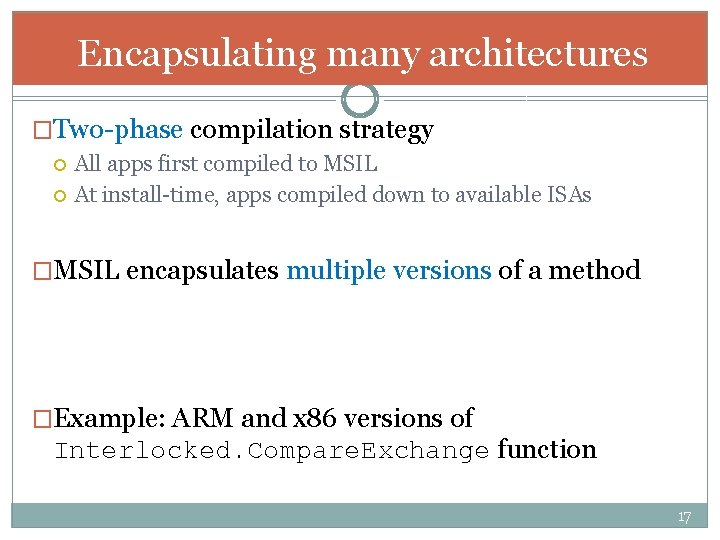
Encapsulating many architectures �Two-phase compilation strategy All apps first compiled to MSIL At install-time, apps compiled down to available ISAs �MSIL encapsulates multiple versions of a method �Example: ARM and x 86 versions of Interlocked. Compare. Exchange function 17
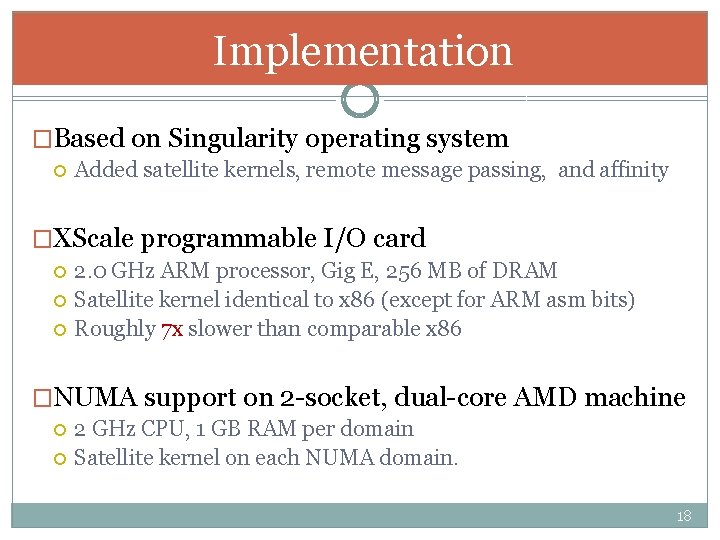
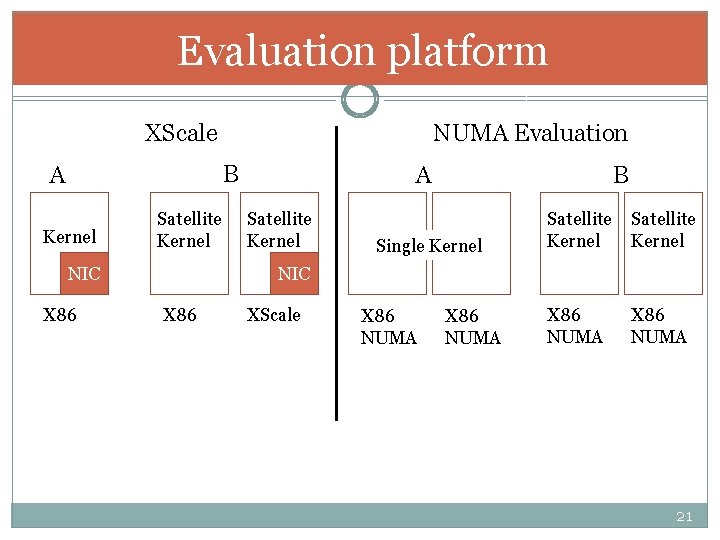
Implementation �Based on Singularity operating system Added satellite kernels, remote message passing, and affinity �XScale programmable I/O card 2. 0 GHz ARM processor, Gig E, 256 MB of DRAM Satellite kernel identical to x 86 (except for ARM asm bits) Roughly 7 x slower than comparable x 86 �NUMA support on 2 -socket, dual-core AMD machine 2 GHz CPU, 1 GB RAM per domain Satellite kernel on each NUMA domain. 18
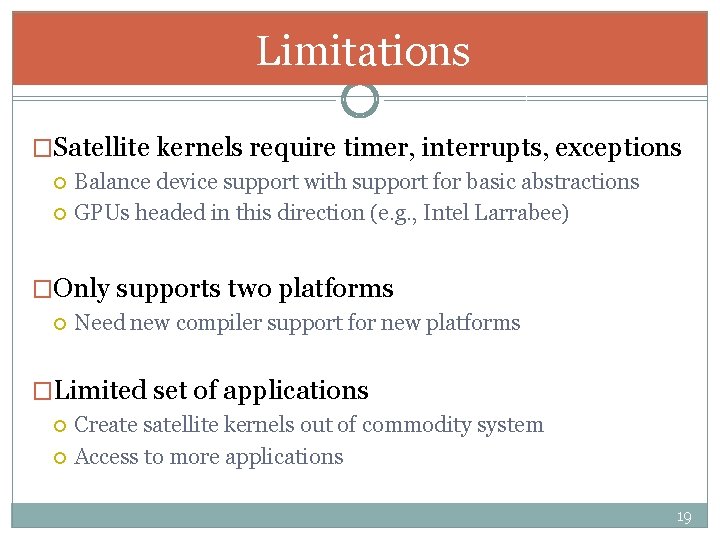
Limitations �Satellite kernels require timer, interrupts, exceptions Balance device support with support for basic abstractions GPUs headed in this direction (e. g. , Intel Larrabee) �Only supports two platforms Need new compiler support for new platforms �Limited set of applications Create satellite kernels out of commodity system Access to more applications 19
Outline �Motivation �Helios design Satellite kernels Remote message passing Affinity Encapsulating many ISAs �Evaluation �Conclusion 20
Evaluation platform XScale NUMA Evaluation B A Kernel Satellite Kernel NIC X 86 B A Satellite Kernel Single Kernel Satellite Kernel X 86 NUMA NIC X 86 XScale X 86 NUMA 21
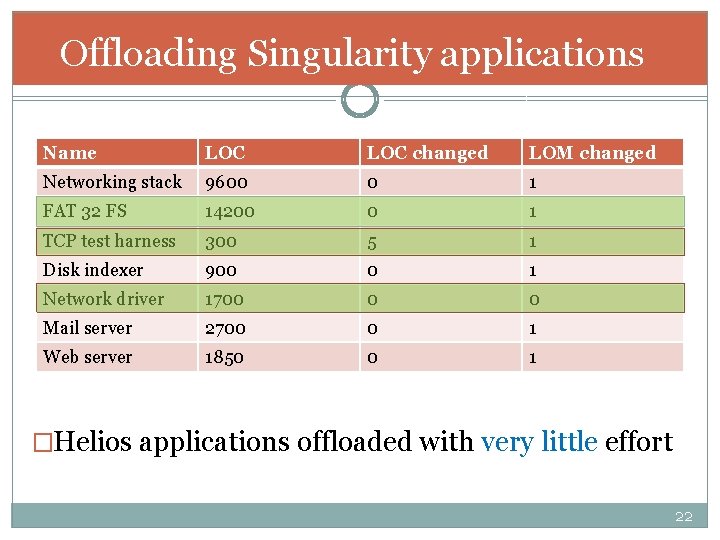
Offloading Singularity applications Name LOC changed LOM changed Networking stack 9600 0 1 FAT 32 FS 14200 0 1 TCP test harness 300 5 1 Disk indexer 900 0 1 Network driver 1700 0 0 Mail server 2700 0 1 Web server 1850 0 1 �Helios applications offloaded with very little effort 22
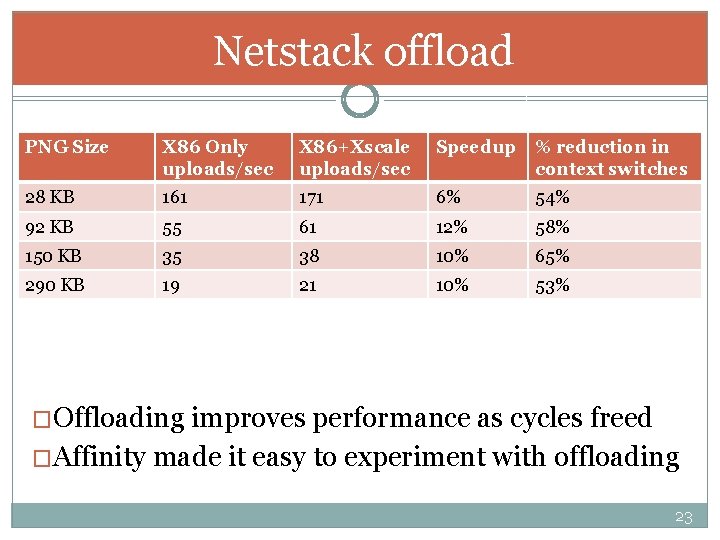
Netstack offload PNG Size X 86 Only uploads/sec X 86+Xscale uploads/sec Speedup % reduction in context switches 28 KB 161 171 6% 54% 92 KB 55 61 12% 58% 150 KB 35 38 10% 65% 290 KB 19 21 10% 53% �Offloading improves performance as cycles freed �Affinity made it easy to experiment with offloading 23
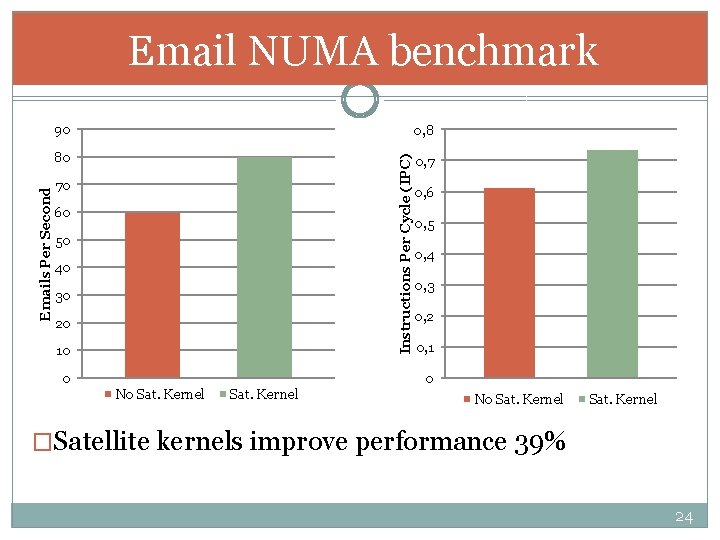
90 0, 8 80 0, 7 Instructions Per Cycle (IPC) Emails Per Second Email NUMA benchmark 70 60 50 40 30 20 10 0 0, 6 0, 5 0, 4 0, 3 0, 2 0, 1 0 No Sat. Kernel �Satellite kernels improve performance 39% 24
Related Work �Hive [Chapin et. al. ‘ 95] Multiple kernels – single system image �Multikernel [Baumann et. Al. ’ 09] Focus on scale-out performance on large NUMA architectures �Spine [Fiuczynski et. al. ‘ 98] Hydra [Weinsberg et. al. ‘ 08] Custom run-time on programmable device 25
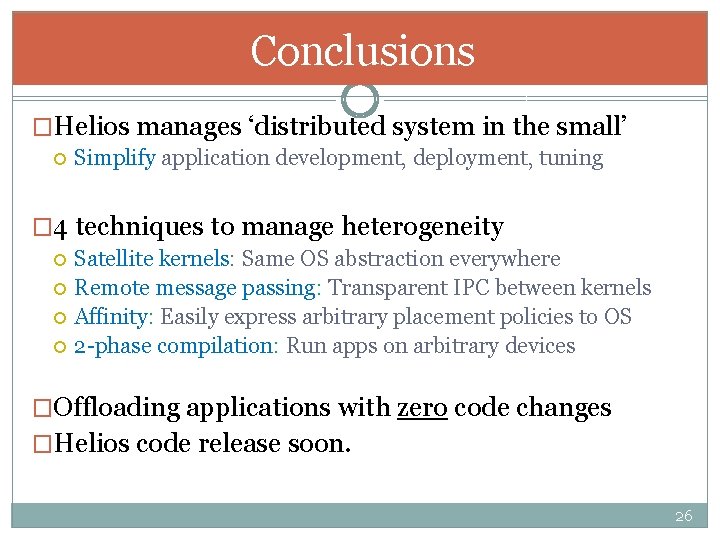
Conclusions �Helios manages ‘distributed system in the small’ Simplify application development, deployment, tuning � 4 techniques to manage heterogeneity Satellite kernels: Same OS abstraction everywhere Remote message passing: Transparent IPC between kernels Affinity: Easily express arbitrary placement policies to OS 2 -phase compilation: Run apps on arbitrary devices �Offloading applications with zero code changes �Helios code release soon. 26