
Heliocentric Model of Planetary Motion Copernicus 1473 1543
- Slides: 5
Heliocentric Model of Planetary Motion (Copernicus, 1473 -1543 CE) www. assignmentpoint. com
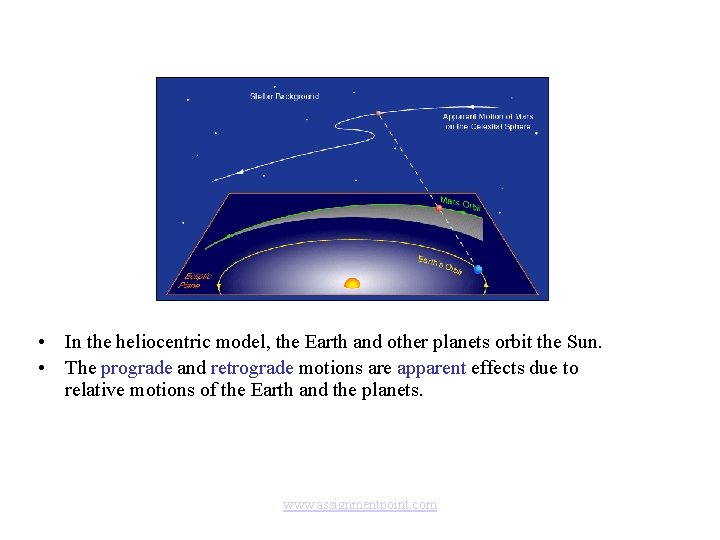
• In the heliocentric model, the Earth and other planets orbit the Sun. • The prograde and retrograde motions are apparent effects due to relative motions of the Earth and the planets. www. assignmentpoint. com
Advantages of the Heliocentric Model • The heliocentric model of Copernicus is not intrinsically more accurate. • Calculation is easier with the Copernicus model. • Copernicus was able to determine the orbital radii (relative to Earth orbit) of all six planets, while in Ptolemy model the lengths are incorrect. • Heliocentric models predict stellar parallax, while geocentric models predict otherwise. www. assignmentpoint. com
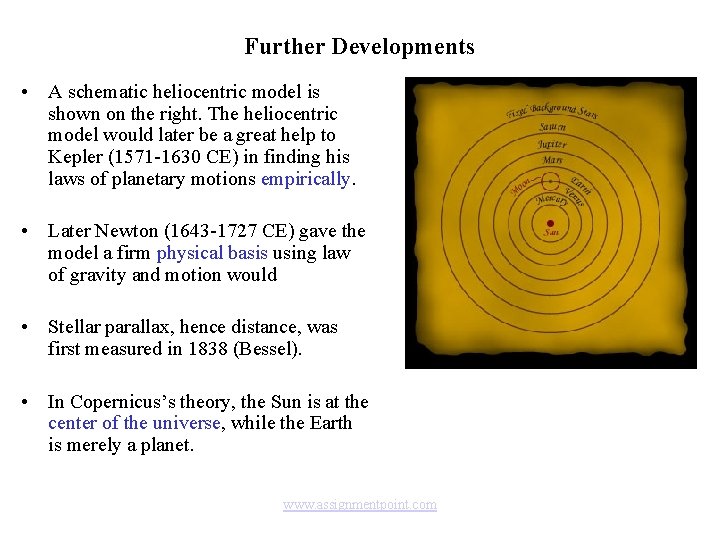
Further Developments • A schematic heliocentric model is shown on the right. The heliocentric model would later be a great help to Kepler (1571 -1630 CE) in finding his laws of planetary motions empirically. • Later Newton (1643 -1727 CE) gave the model a firm physical basis using law of gravity and motion would • Stellar parallax, hence distance, was first measured in 1838 (Bessel). • In Copernicus’s theory, the Sun is at the center of the universe, while the Earth is merely a planet. www. assignmentpoint. com
• We now know that Sun is just one of the stars in one of the galaxies (Milky Way Galaxy) in one of the group of galaxies (Local Group) in one of the superclusters (Virgo/Local Supercluster) in the universe. www. assignmentpoint. com