
Helical Solenoids for Helical Cooling Channels Mauricio Lopes
- Slides: 31
Helical Solenoids for Helical Cooling Channels Mauricio Lopes Fermilab – 04/23/2009
Outline § Introduction § HCC parameters § High field section case study • Superconductor choice • Calculation process • Geometry vs. Performance § Correction coil § Conductor improvement § Coil optimization • Grading • Hybrid § Short model plan § Conclusions
Introduction Helical cooling channels (HCC) based on a magnet system with superimposed solenoid and helical dipole and gradient, and a pressurized gas absorber in the aperture has been proposed to achieve the high efficiency of 6 D muon beam cooling. The total phase space reduction of muon beams is on the level of 105 -106. To reduce the equilibrium emittance the cooling channel was divided into several sections and each consequent section has a smaller aperture and stronger magnetic fields. 3
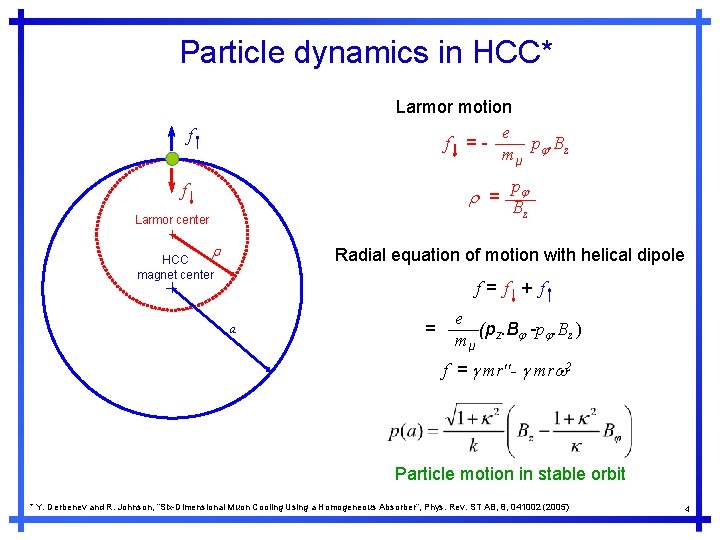
Particle dynamics in HCC* Larmor motion e f =p. B mμ z f f = Larmor center p Bz Radial equation of motion with helical dipole HCC magnet center f= f + f a = e (p. B -p. B ) mμ z z f = g mr′′- g mrw 2 Particle motion in stable orbit * Y. Derbenev and R. Johnson, “Six-Dimensional Muon Cooling Using a Homogeneous Absorber”, Phys. Rev. ST AB, 8, 041002 (2005) 4
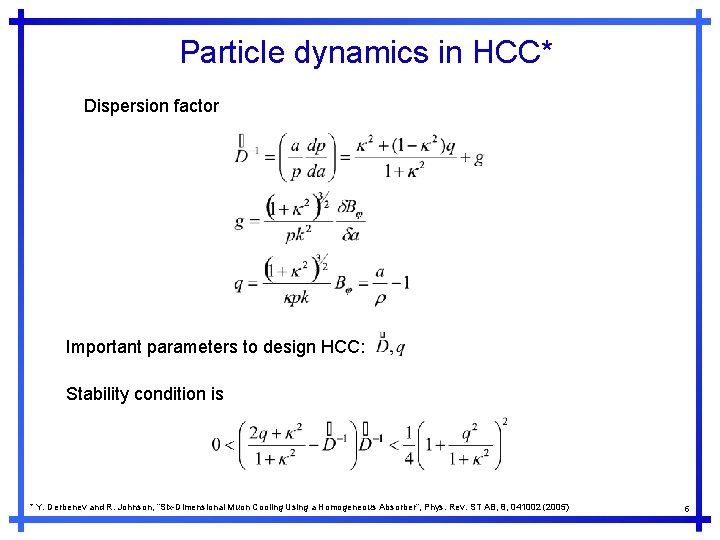
Particle dynamics in HCC* Dispersion factor Important parameters to design HCC: Stability condition is * Y. Derbenev and R. Johnson, “Six-Dimensional Muon Cooling Using a Homogeneous Absorber”, Phys. Rev. ST AB, 8, 041002 (2005) 5
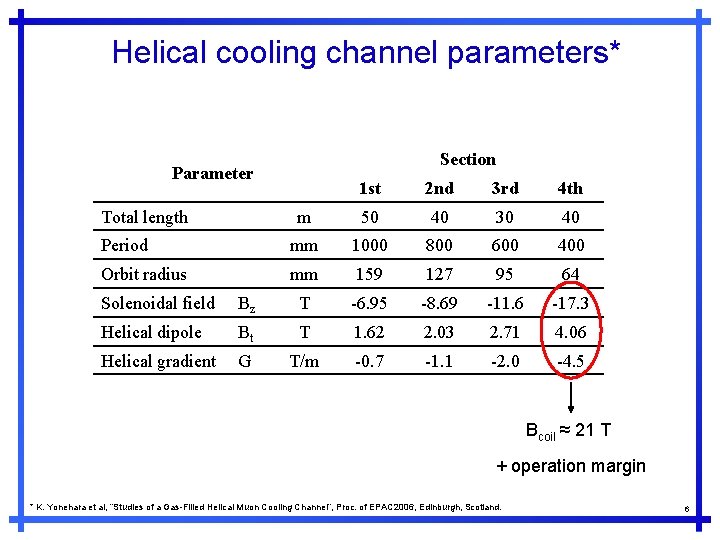
Helical cooling channel parameters* Section Parameter 1 st 2 nd 3 rd 4 th m 50 40 30 40 Period mm 1000 800 600 400 Orbit radius mm 159 127 95 64 Total length Solenoidal field Bz T -6. 95 -8. 69 -11. 6 -17. 3 Helical dipole Bt T 1. 62 2. 03 2. 71 4. 06 Helical gradient G T/m -0. 7 -1. 1 -2. 0 -4. 5 Bcoil ≈ 21 T + operation margin * K. Yonehara et al, “Studies of a Gas-Filled Helical Muon Cooling Channel”, Proc. of EPAC 2006, Edinburgh, Scotland. 6
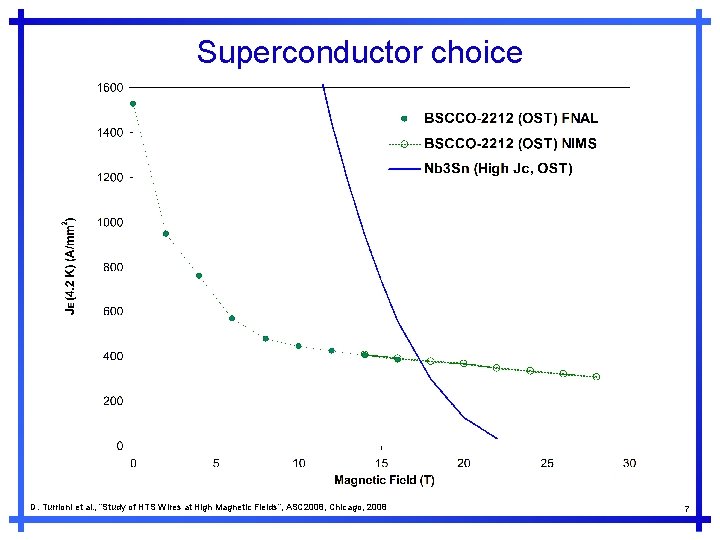
Superconductor choice D. Turrioni et al. , “Study of HTS Wires at High Magnetic Fields”, ASC 2008, Chicago, 2008 7
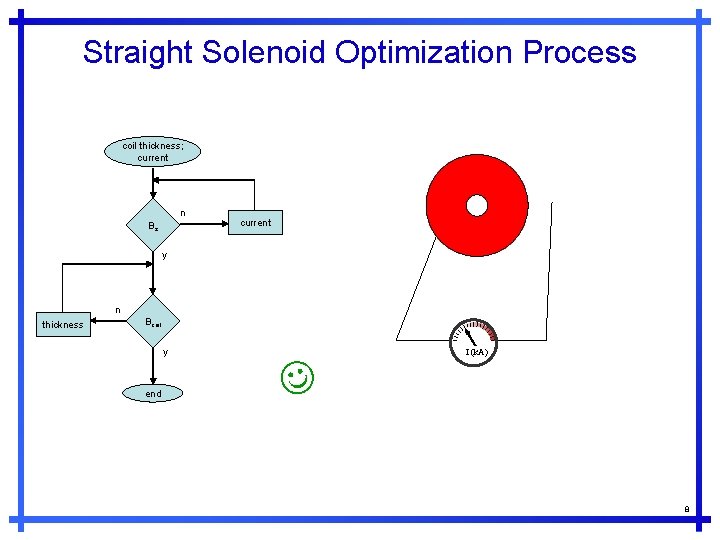
Straight Solenoid Optimization Process coil thickness; current n Bz current y n thickness Bcoil y end I (k. A) 8
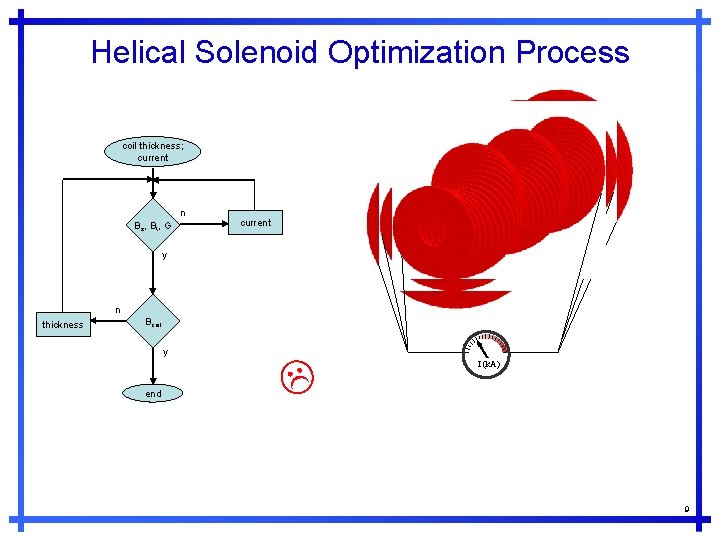
Helical Solenoid Optimization Process coil thickness; current n Bz, Bt, G current y n thickness Bcoil y end I (k. A) 9
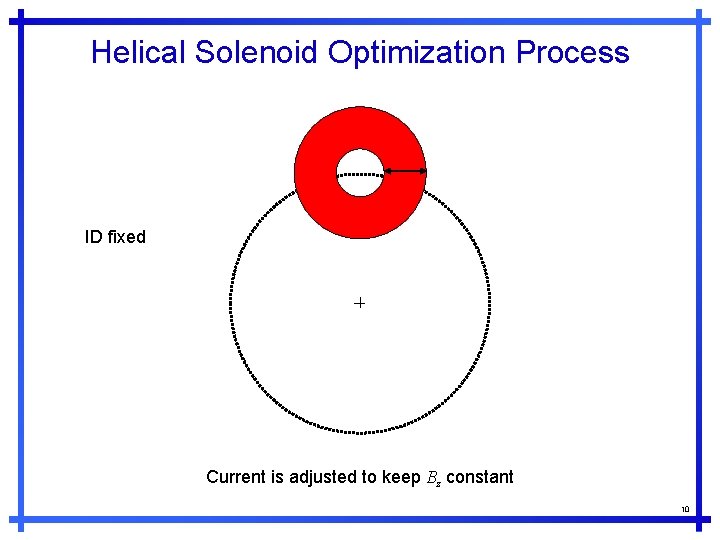
Helical Solenoid Optimization Process ID fixed Current is adjusted to keep Bz constant 10
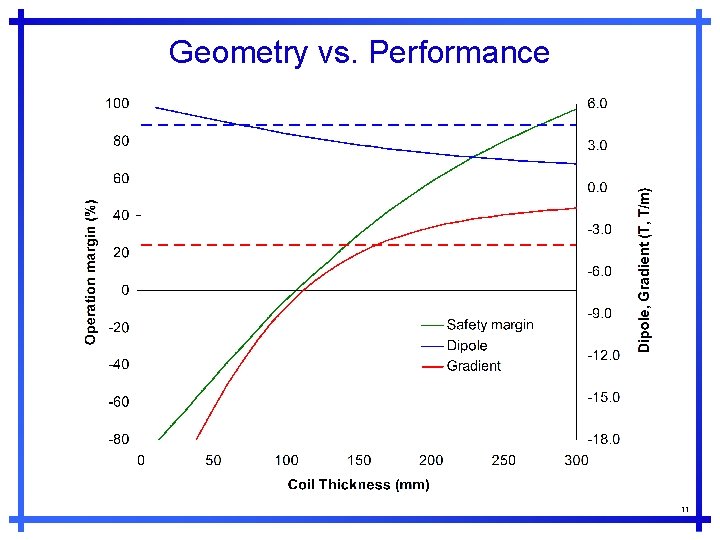
Geometry vs. Performance 11
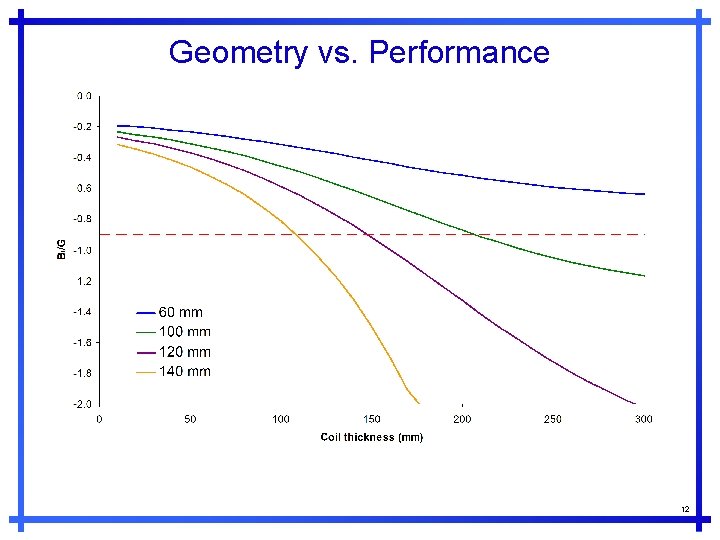
Geometry vs. Performance 12
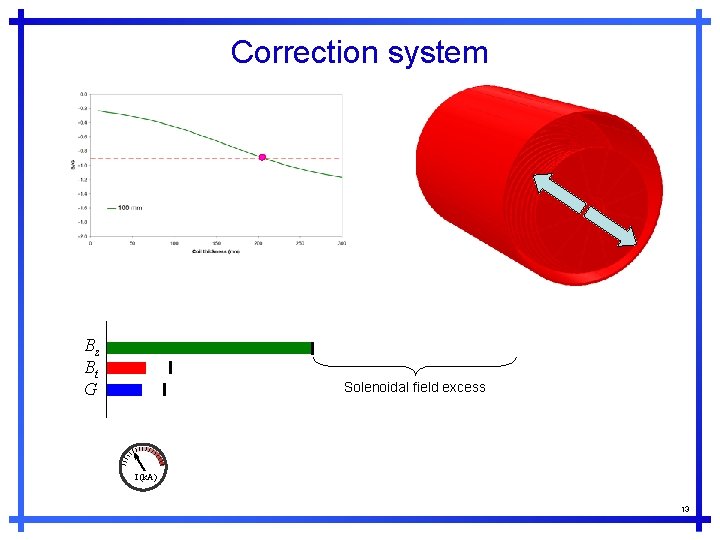
Correction system Bz Bt G Solenoidal field excess I (k. A) 13
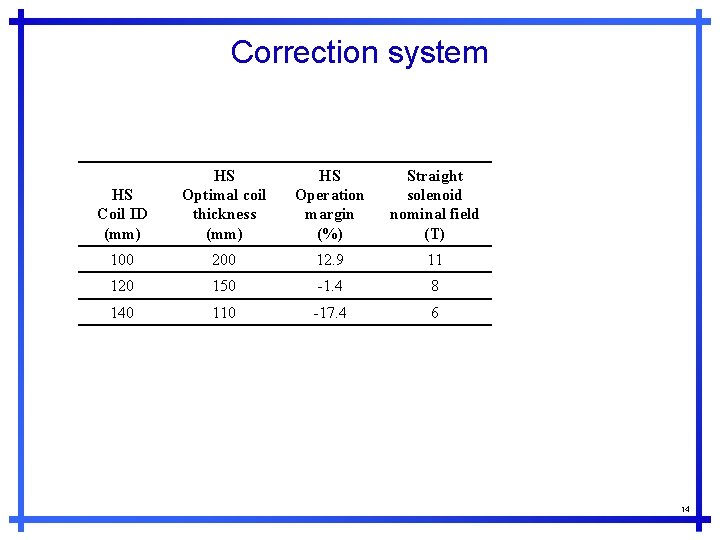
Correction system HS Coil ID (mm) HS Optimal coil thickness (mm) HS Operation margin (%) Straight solenoid nominal field (T) 100 200 12. 9 11 120 150 -1. 4 8 140 110 -17. 4 6 14
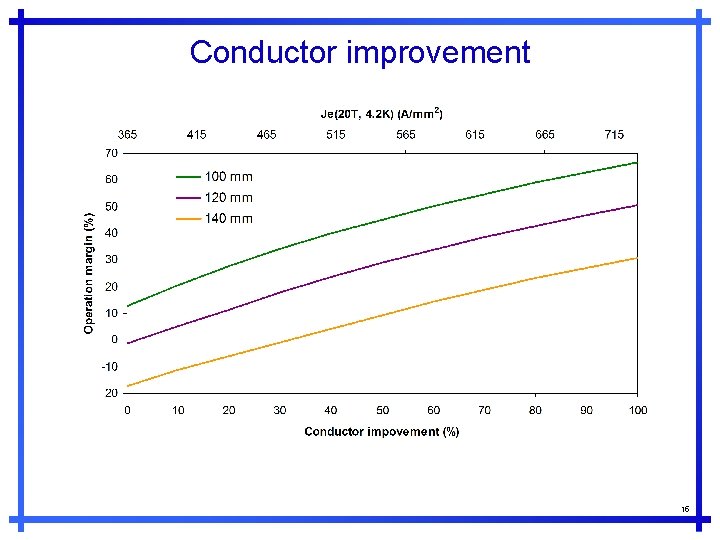
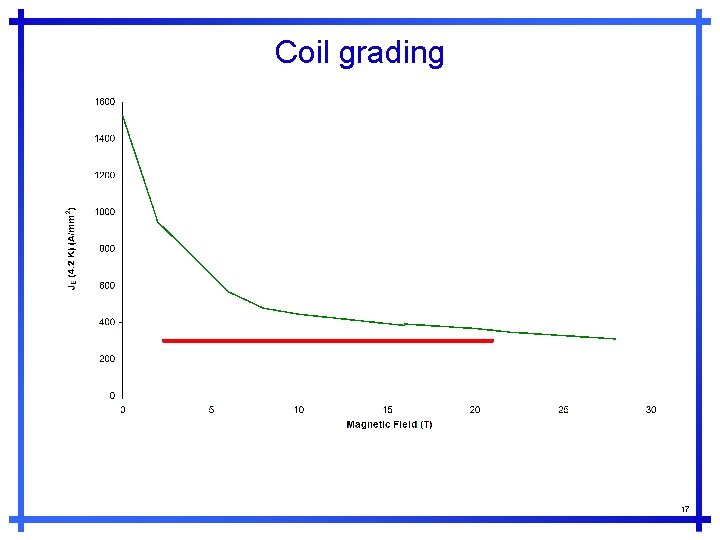
Conductor improvement 15
Coil grading 16
Coil grading 17
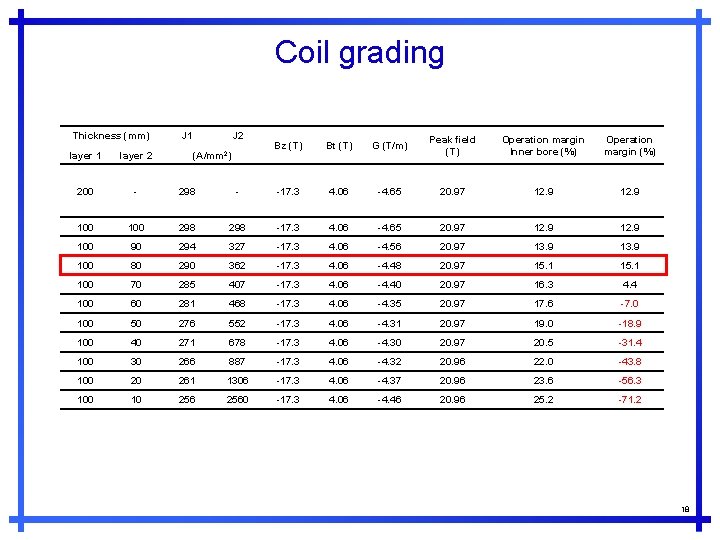
Coil grading Thickness (mm) J 1 J 2 (A/mm 2) Bz (T) Bt (T) G (T/m) Peak field (T) Operation margin Inner bore (%) Operation margin (%) layer 1 layer 2 200 - 298 - -17. 3 4. 06 -4. 65 20. 97 12. 9 100 298 -17. 3 4. 06 -4. 65 20. 97 12. 9 100 90 294 327 -17. 3 4. 06 -4. 56 20. 97 13. 9 100 80 290 362 -17. 3 4. 06 -4. 48 20. 97 15. 1 100 70 285 407 -17. 3 4. 06 -4. 40 20. 97 16. 3 4. 4 100 60 281 468 -17. 3 4. 06 -4. 35 20. 97 17. 6 -7. 0 100 50 276 552 -17. 3 4. 06 -4. 31 20. 97 19. 0 -18. 9 100 40 271 678 -17. 3 4. 06 -4. 30 20. 97 20. 5 -31. 4 100 30 266 887 -17. 3 4. 06 -4. 32 20. 96 22. 0 -43. 8 100 20 261 1306 -17. 3 4. 06 -4. 37 20. 96 23. 6 -56. 3 100 10 2560 -17. 3 4. 06 -4. 46 20. 96 25. 2 -71. 2 18
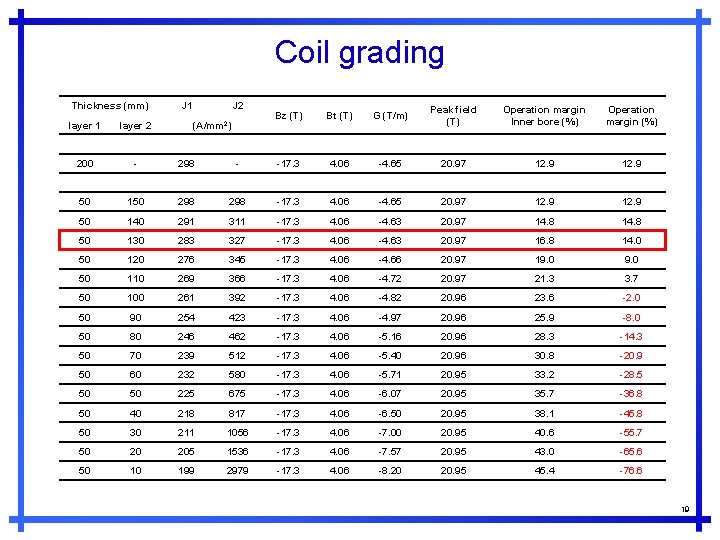
Coil grading Thickness (mm) J 1 J 2 (A/mm 2) Bz (T) Bt (T) G (T/m) Peak field (T) Operation margin Inner bore (%) Operation margin (%) layer 1 layer 2 200 - 298 - -17. 3 4. 06 -4. 65 20. 97 12. 9 50 150 298 -17. 3 4. 06 -4. 65 20. 97 12. 9 50 140 291 311 -17. 3 4. 06 -4. 63 20. 97 14. 8 50 130 283 327 -17. 3 4. 06 -4. 63 20. 97 16. 8 14. 0 50 120 276 345 -17. 3 4. 06 -4. 66 20. 97 19. 0 50 110 269 366 -17. 3 4. 06 -4. 72 20. 97 21. 3 3. 7 50 100 261 392 -17. 3 4. 06 -4. 82 20. 96 23. 6 -2. 0 50 90 254 423 -17. 3 4. 06 -4. 97 20. 96 25. 9 -8. 0 50 80 246 462 -17. 3 4. 06 -5. 16 20. 96 28. 3 -14. 3 50 70 239 512 -17. 3 4. 06 -5. 40 20. 96 30. 8 -20. 9 50 60 232 580 -17. 3 4. 06 -5. 71 20. 95 33. 2 -28. 5 50 50 225 675 -17. 3 4. 06 -6. 07 20. 95 35. 7 -36. 8 50 40 218 817 -17. 3 4. 06 -6. 50 20. 95 38. 1 -45. 8 50 30 211 1056 -17. 3 4. 06 -7. 00 20. 95 40. 6 -55. 7 50 20 205 1536 -17. 3 4. 06 -7. 57 20. 95 43. 0 -65. 6 50 10 199 2979 -17. 3 4. 06 -8. 20 20. 95 45. 4 -76. 6 19
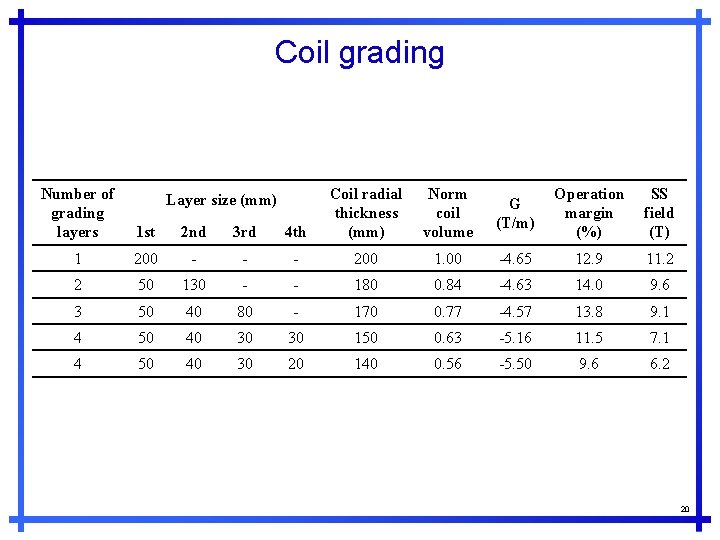
Coil grading Number of grading layers 4 th Coil radial thickness (mm) Norm coil volume G (T/m) Operation margin (%) SS field (T) 1 st 2 nd 3 rd 1 200 - - - 200 1. 00 -4. 65 12. 9 11. 2 2 50 130 - - 180 0. 84 -4. 63 14. 0 9. 6 3 50 40 80 - 170 0. 77 -4. 57 13. 8 9. 1 4 50 40 30 30 150 0. 63 -5. 16 11. 5 7. 1 4 50 40 30 20 140 0. 56 -5. 50 9. 6 6. 2 Layer size (mm) 20
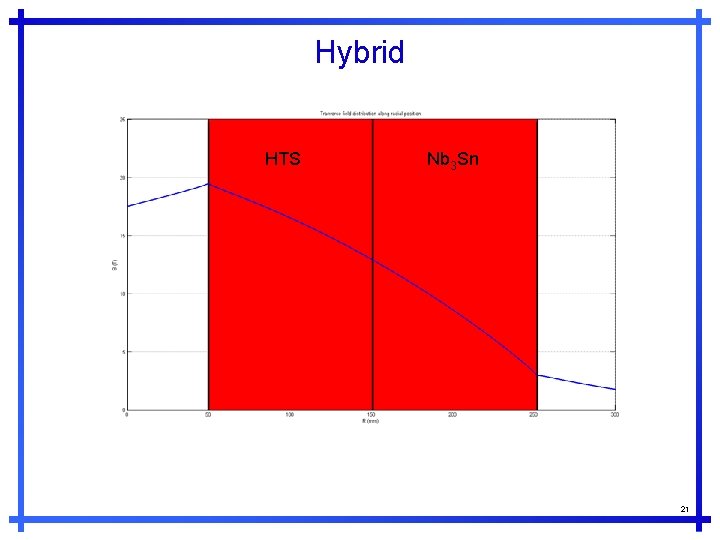
Hybrid HTS Nb 3 Sn 21
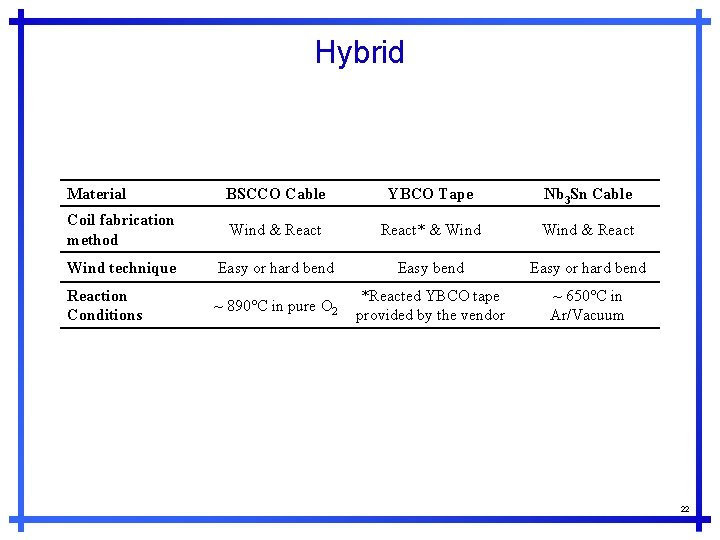
Hybrid Material BSCCO Cable YBCO Tape Nb 3 Sn Cable Coil fabrication method Wind & React* & Wind & React Wind technique Easy or hard bend Reaction Conditions ~ 890°C in pure O 2 *Reacted YBCO tape provided by the vendor ~ 650°C in Ar/Vacuum 22
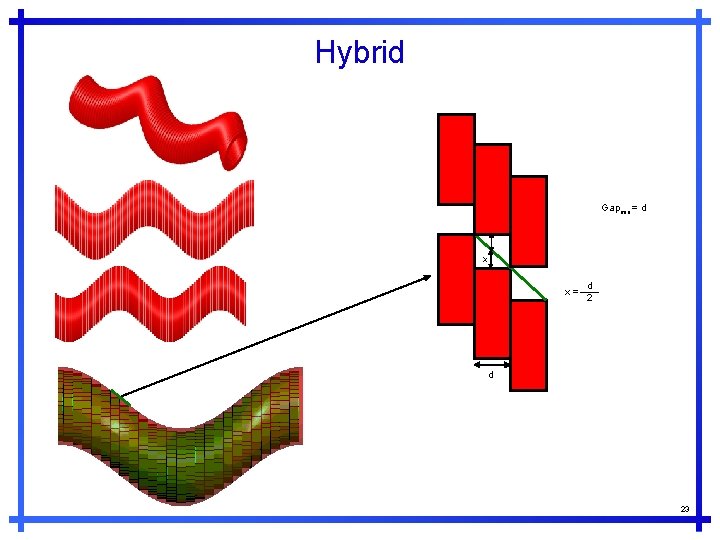
Hybrid Gapmin = d x x= d 23
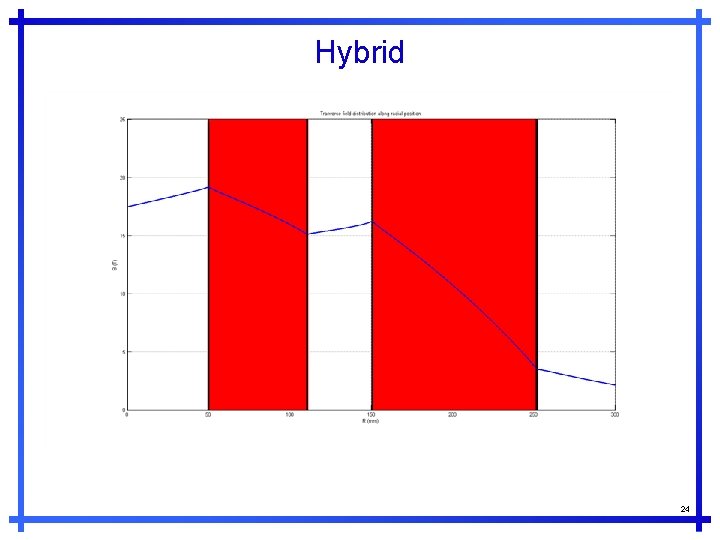
Hybrid 24
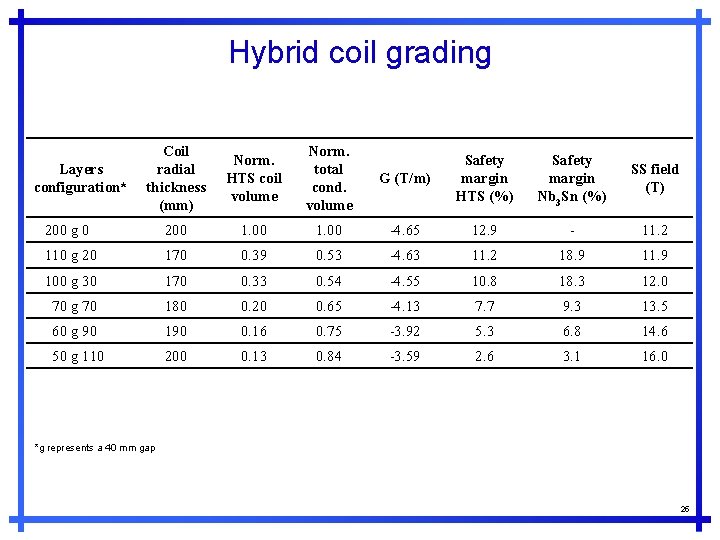
Hybrid coil grading Coil radial thickness (mm) Norm. HTS coil volume Norm. total cond. volume 200 g 0 200 110 g 20 170 100 g 30 G (T/m) Safety margin HTS (%) Safety margin Nb 3 Sn (%) SS field (T) 1. 00 -4. 65 12. 9 - 11. 2 0. 39 0. 53 -4. 63 11. 2 18. 9 11. 9 170 0. 33 0. 54 -4. 55 10. 8 18. 3 12. 0 70 g 70 180 0. 20 0. 65 -4. 13 7. 7 9. 3 13. 5 60 g 90 190 0. 16 0. 75 -3. 92 5. 3 6. 8 14. 6 50 g 110 200 0. 13 0. 84 -3. 59 2. 6 3. 1 16. 0 Layers configuration* *g represents a 40 mm gap 25
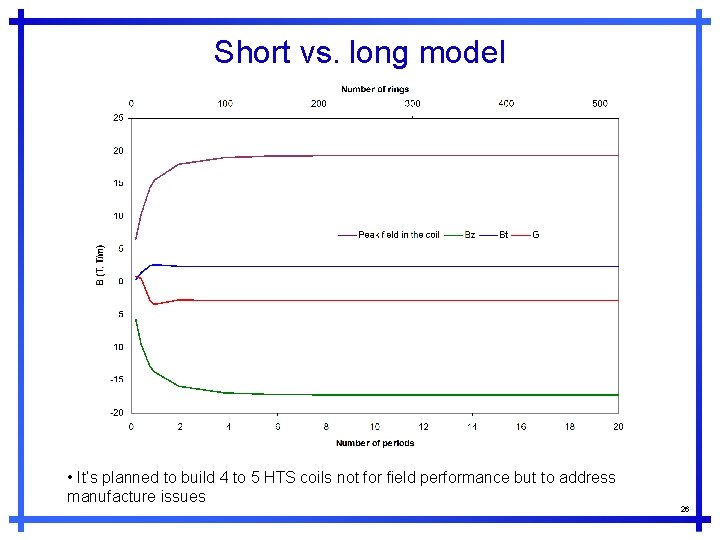
Short vs. long model • It’s planned to build 4 to 5 HTS coils not for field performance but to address manufacture issues 26
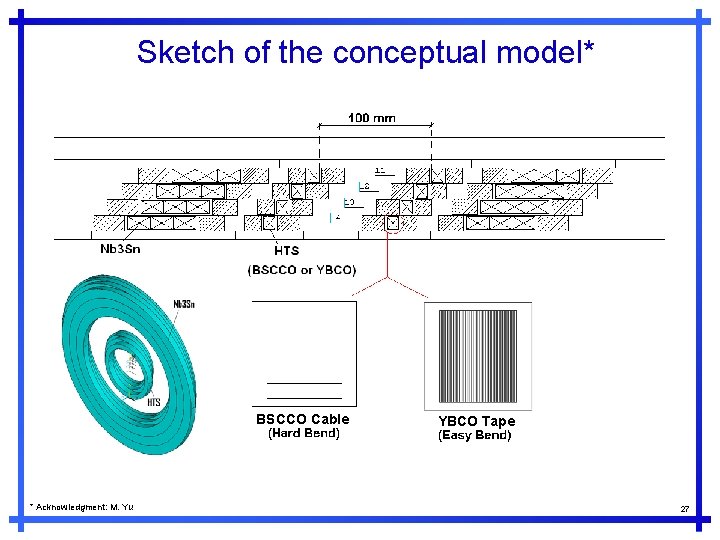
Sketch of the conceptual model* BSCCO Cable * Acknowledgment: M. Yu YBCO Tape 27
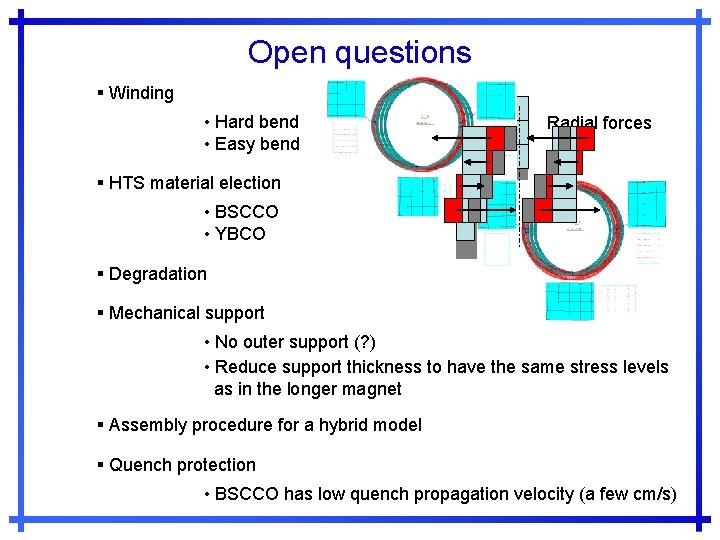
Open questions § Winding • Hard bend • Easy bend Radial forces § HTS material election • BSCCO • YBCO § Degradation § Mechanical support • No outer support (? ) • Reduce support thickness to have the same stress levels as in the longer magnet § Assembly procedure for a hybrid model § Quench protection • BSCCO has low quench propagation velocity (a few cm/s)
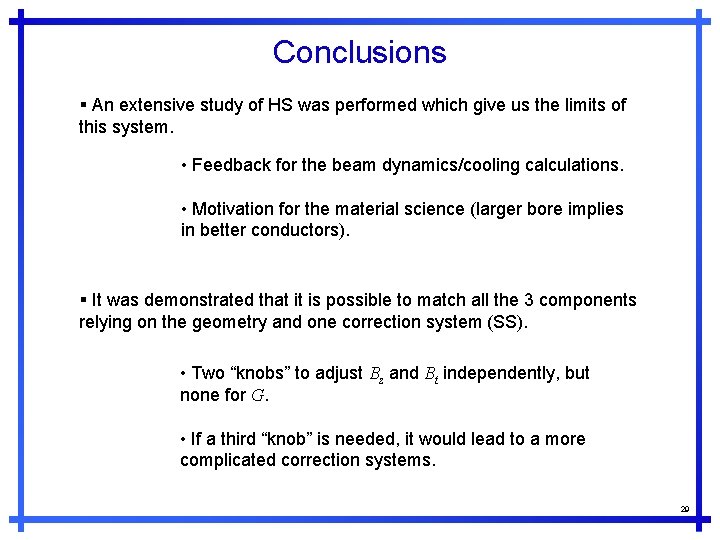
Conclusions § An extensive study of HS was performed which give us the limits of this system. • Feedback for the beam dynamics/cooling calculations. • Motivation for the material science (larger bore implies in better conductors). § It was demonstrated that it is possible to match all the 3 components relying on the geometry and one correction system (SS). • Two “knobs” to adjust Bz and Bt independently, but none for G. • If a third “knob” is needed, it would lead to a more complicated correction systems. 29
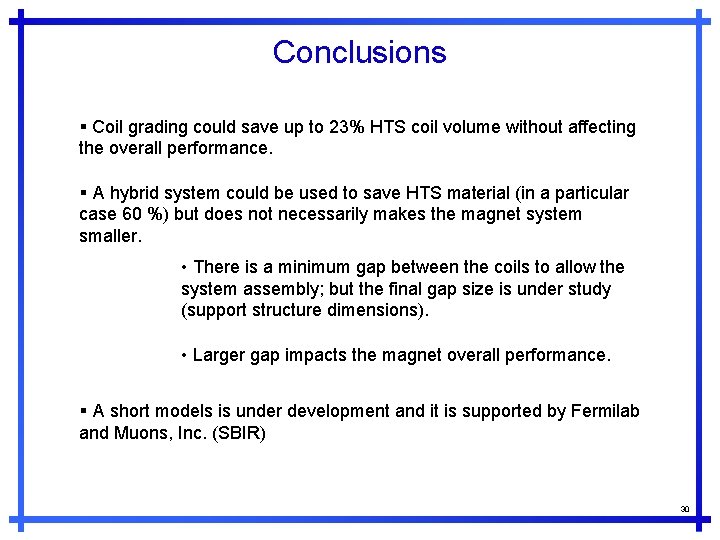
Conclusions § Coil grading could save up to 23% HTS coil volume without affecting the overall performance. § A hybrid system could be used to save HTS material (in a particular case 60 %) but does not necessarily makes the magnet system smaller. • There is a minimum gap between the coils to allow the system assembly; but the final gap size is under study (support structure dimensions). • Larger gap impacts the magnet overall performance. § A short models is under development and it is supported by Fermilab and Muons, Inc. (SBIR) 30
Acknowledgments M. Alsharo’ N. Andreev E. Barzi R. Johnson S. Kahn V. S. Kashikhin V. V. Kashikhin M. Lamm V. Lombardo A. Makarov G. Norcia D. Turrioni K. Yonehara M. Yu A. Zlobin 31