
Helical Cooling Channel Simulation with ICOOL and G
- Slides: 30
Helical Cooling Channel Simulation with ICOOL and G 4 BL K. Yonehara Dec. 13, 2004 Muon collider meeting, Miami Slide 1
Contents • Introduction • Simulation results – ICOOL and G 4 BL • Present interesting – Beam dynamics – Low momentum problem – Design RF cavity • Summary/Next to do Dec. 13, 2004 Muon collider meeting, Miami Slide 2
Introduction Analytical six-dimensional cooling demonstration in the helical cooling channel (HCC) with the high pressure gaseous hydrogen absorber has been done (Mu. Cool. Note 0284). We need to verify the new idea by a numerical method. ICOOL and G 4 BL Dec. 13, 2004 Muon collider meeting, Miami Slide 3
Introduction Now we can analyze the beam dynamics in the simulations and develop the channel for applying to a muon collider. Dec. 13, 2004 Muon collider meeting, Miami Slide 4
Collaborators D. M. Kaplan Illinois Institute of Technology, Chicago, IL M. Alsharo’a, R. P. Johnson, P. Hanlet, K. Paul, T. J. Roberts Muons, Inc. , Batavia, IL K. Beard, A. Bogacz, Y. S. Derbenev JLab, Newport News, VA Dec. 13, 2004 Muon collider meeting, Miami Slide 5
ICOOL and G 4 BL Specifications • ICOOL • G 4 BL – Fortran – Based on Geant 3 – Tested many times by many people – Easy to learn Dec. 13, 2004 – – C++ Based on Geant 4 Flexible Easy to develop Muon collider meeting, Miami Slide 6
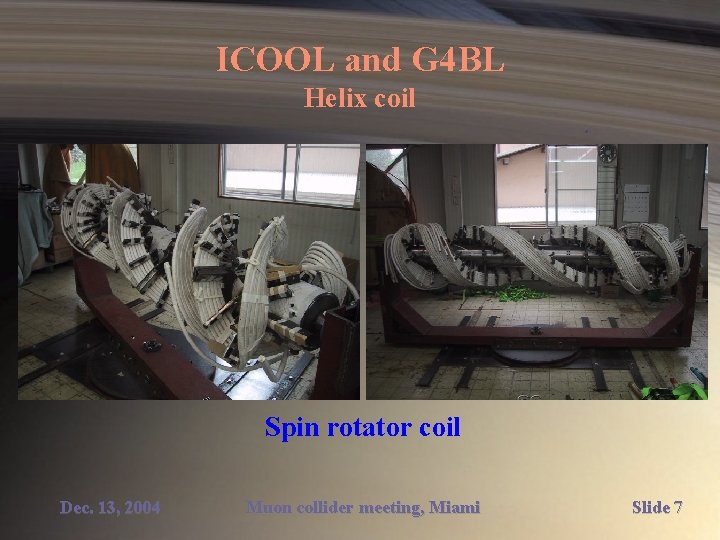
ICOOL and G 4 BL Helix coil Spin rotator coil Dec. 13, 2004 Muon collider meeting, Miami Slide 7
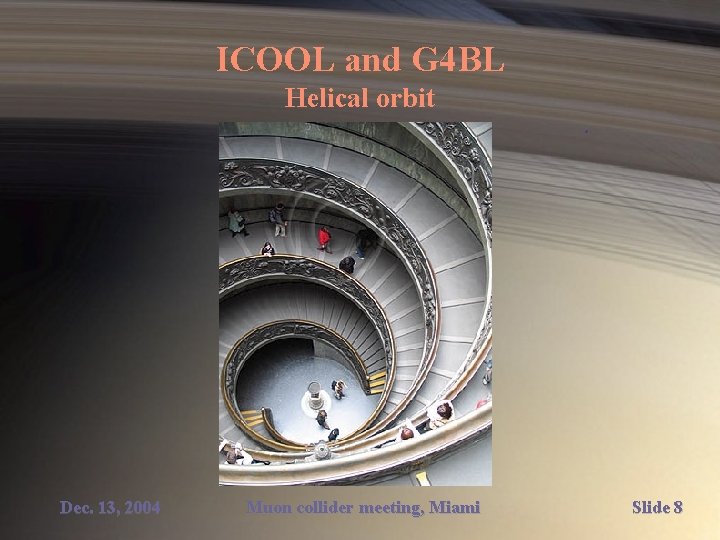
ICOOL and G 4 BL Helical orbit Dec. 13, 2004 Muon collider meeting, Miami Slide 8
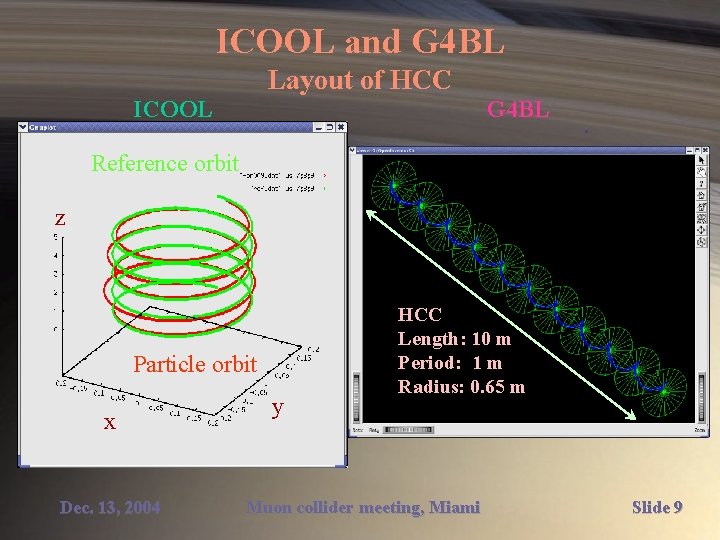
ICOOL and G 4 BL Layout of HCC ICOOL G 4 BL Reference orbit z Particle orbit x Dec. 13, 2004 y HCC Length: 10 m Period: 1 m Radius: 0. 65 m Muon collider meeting, Miami Slide 9
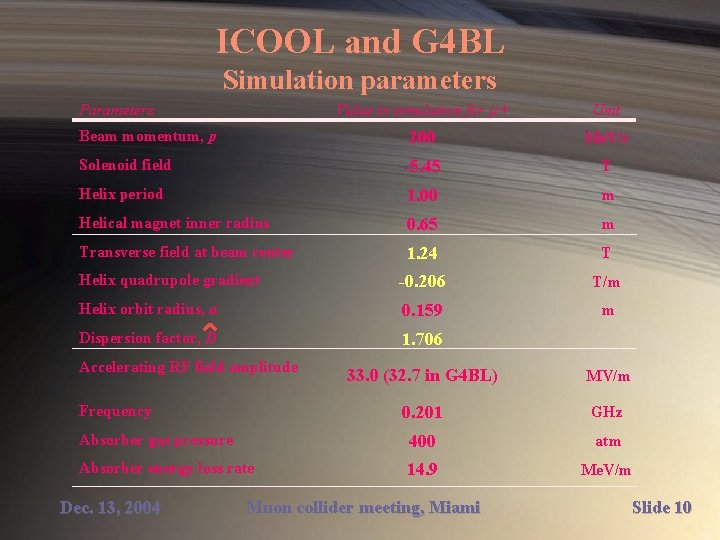
ICOOL and G 4 BL Simulation parameters Value in simulation for m+ Unit 200 Me. V/c Solenoid field -5. 45 T Helix period 1. 00 m Helical magnet inner radius 0. 65 m Transverse field at beam center 1. 24 T Helix quadrupole gradient -0. 206 T/m Helix orbit radius, a 0. 159 m Dispersion factor, D 1. 706 Parameters Beam momentum, p Accelerating RF field amplitude 33. 0 (32. 7 in G 4 BL) MV/m 0. 201 GHz Absorber gas pressure 400 atm Absorber energy loss rate 14. 9 Me. V/m Frequency Dec. 13, 2004 Muon collider meeting, Miami Slide 10
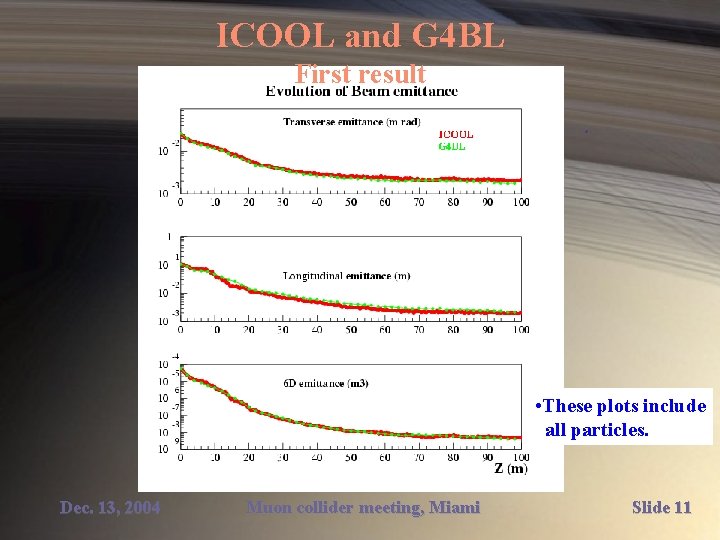
ICOOL and G 4 BL First result • These plots include all particles. Dec. 13, 2004 Muon collider meeting, Miami Slide 11
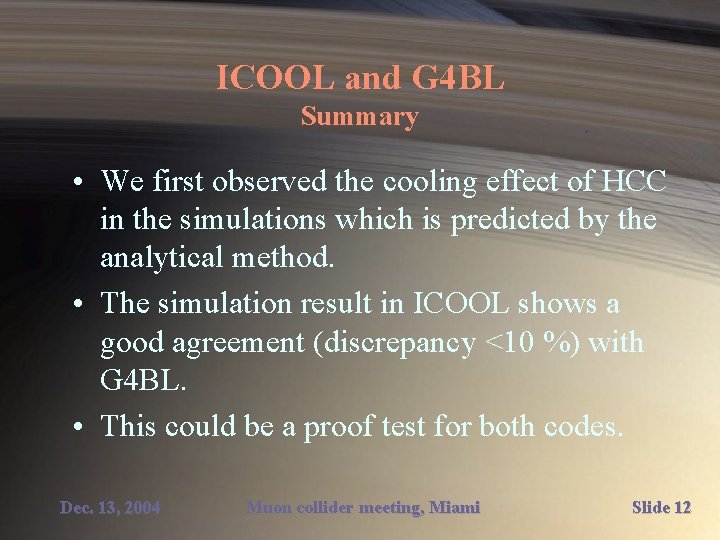
ICOOL and G 4 BL Summary • We first observed the cooling effect of HCC in the simulations which is predicted by the analytical method. • The simulation result in ICOOL shows a good agreement (discrepancy <10 %) with G 4 BL. • This could be a proof test for both codes. Dec. 13, 2004 Muon collider meeting, Miami Slide 12
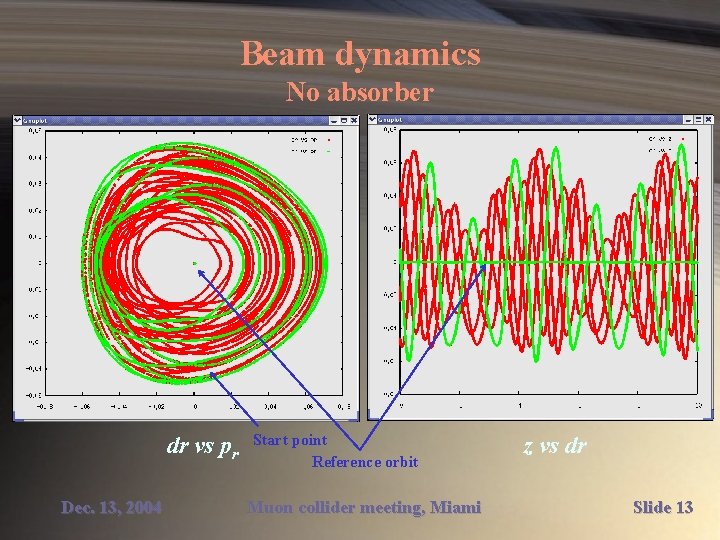
Beam dynamics No absorber dr vs pr Dec. 13, 2004 Start point Reference orbit Muon collider meeting, Miami z vs dr Slide 13
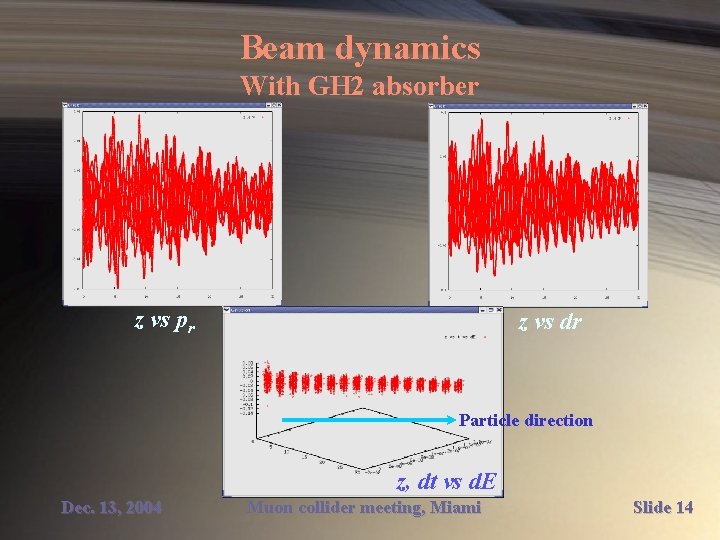
Beam dynamics With GH 2 absorber z vs pr z vs dr Particle direction z, dt vs d. E Dec. 13, 2004 Muon collider meeting, Miami Slide 14
Beam dynamics Summary • We just start considering this study. We will see more analysis results soon. • We observe a strong coupling between transverse and longitudinal motions. Dec. 13, 2004 Muon collider meeting, Miami Slide 15
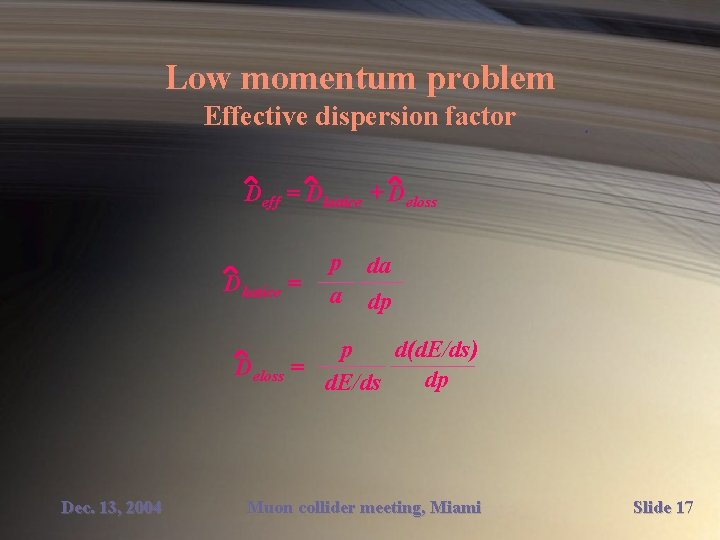
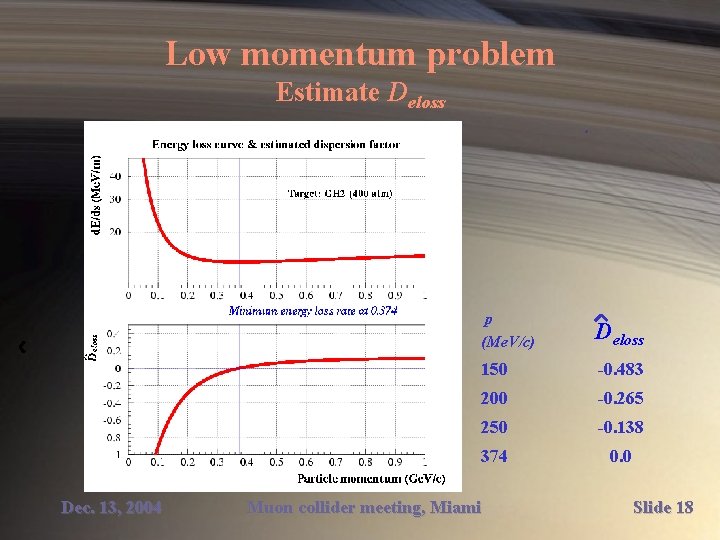
Low momentum problem Introduction The design of helical cooling channel for a lower momentum muon is practical since it can significantly reduce the strength of helix and solenoid fields. However, we never succeed to see a nice cooling result in a lower momentum region. We noticed that the dispersion factor should be modified to take into account the correction of the energy loss process. This correction should be larger for a lower momentum particle since the energy loss rate of it is larger than that of a higher momentum particle. Dec. 13, 2004 Muon collider meeting, Miami Slide 16
Low momentum problem Effective dispersion factor Deff = Dlattice + Deloss Dlattice = p a da dp p d(d. E/ds) Deloss = dp d. E/ds Dec. 13, 2004 Muon collider meeting, Miami Slide 17
Low momentum problem Estimate Deloss Dec. 13, 2004 p (Me. V/c) Deloss 150 -0. 483 200 -0. 265 250 -0. 138 374 0. 0 Muon collider meeting, Miami Slide 18
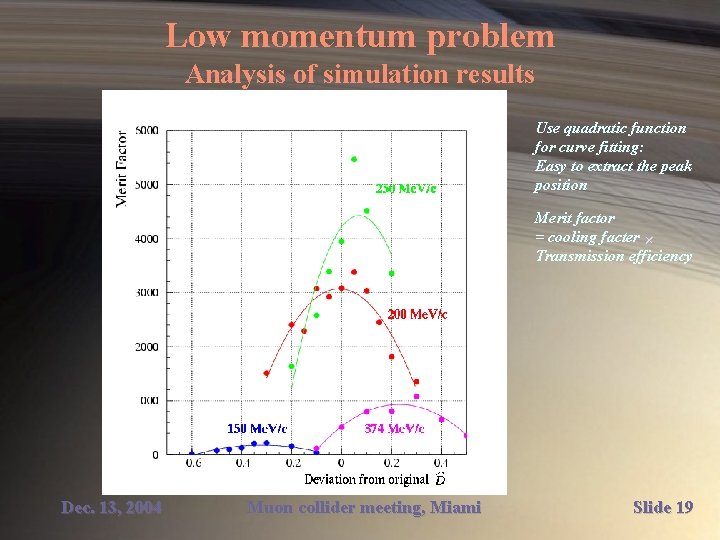
Low momentum problem Analysis of simulation results Use quadratic function for curve fitting: Easy to extract the peak position + Merit factor = cooling facter Transmission efficiency Dec. 13, 2004 Muon collider meeting, Miami Slide 19
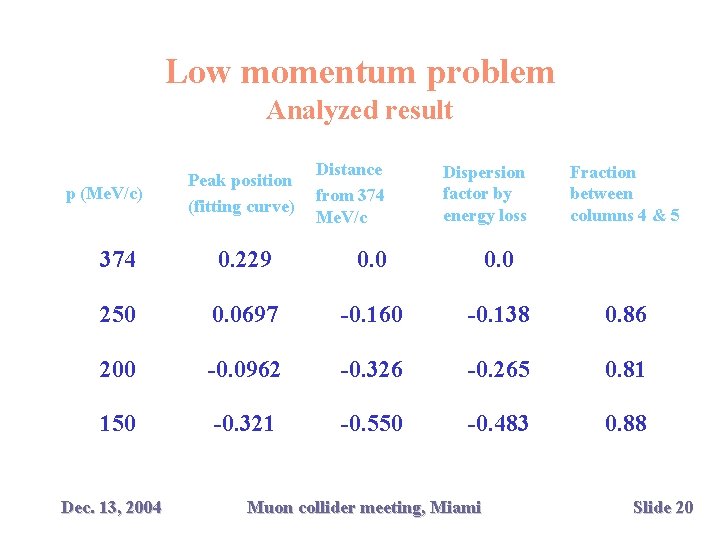
Low momentum problem Analyzed result p (Me. V/c) Peak position (fitting curve) Distance from 374 Me. V/c Dispersion factor by energy loss Fraction between columns 4 & 5 374 0. 229 0. 0 250 0. 0697 -0. 160 -0. 138 0. 86 200 -0. 0962 -0. 326 -0. 265 0. 81 150 -0. 321 -0. 550 -0. 483 0. 88 Dec. 13, 2004 Muon collider meeting, Miami Slide 20
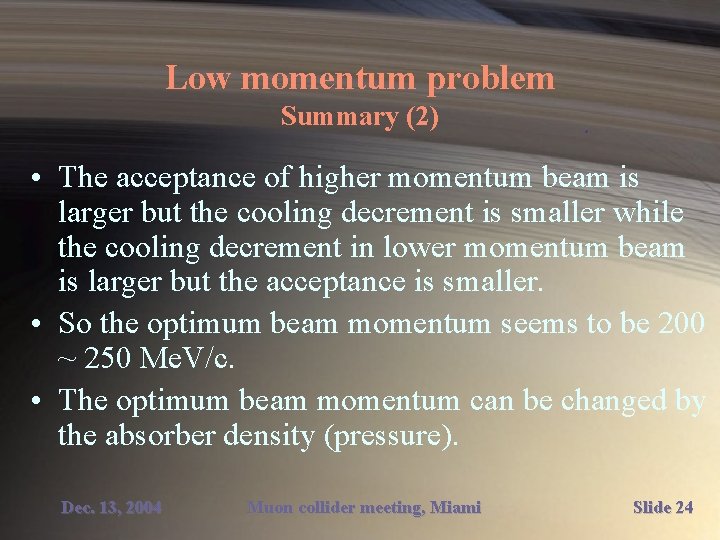
Low momentum problem Summary (1) • The additional dispersion factor caused by the energy loss effect well reproduces the peak position in the merit factor curve. • However, we still see a small fraction in the effective dispersion factor. This could be caused by another dispersion effect. Dec. 13, 2004 Muon collider meeting, Miami Slide 21
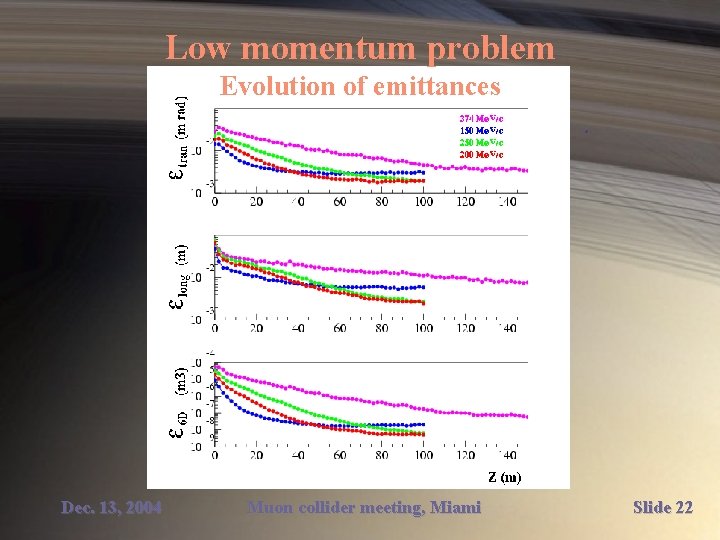
Low momentum problem Evolution of emittances Dec. 13, 2004 Muon collider meeting, Miami Slide 22
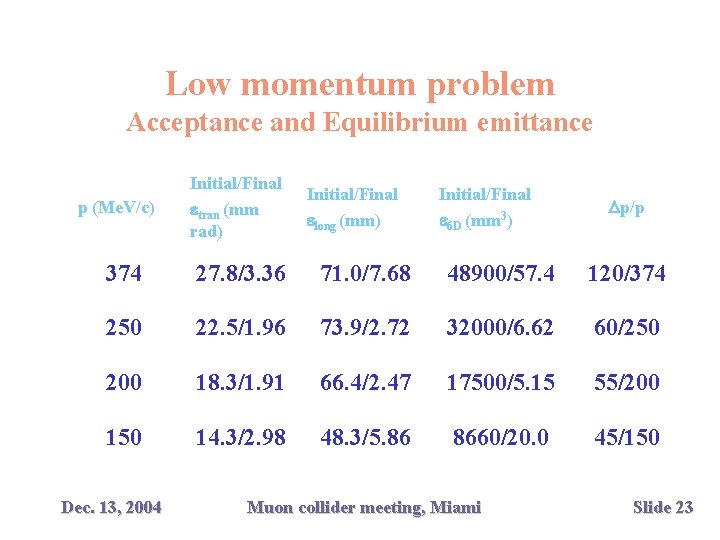
Low momentum problem Acceptance and Equilibrium emittance p (Me. V/c) Initial/Final etran (mm rad) Initial/Final elong (mm) Initial/Final e 6 D (mm 3) Dp/p 374 27. 8/3. 36 71. 0/7. 68 48900/57. 4 120/374 250 22. 5/1. 96 73. 9/2. 72 32000/6. 62 60/250 200 18. 3/1. 91 66. 4/2. 47 17500/5. 15 55/200 150 14. 3/2. 98 48. 3/5. 86 8660/20. 0 45/150 Dec. 13, 2004 Muon collider meeting, Miami Slide 23
Low momentum problem Summary (2) • The acceptance of higher momentum beam is larger but the cooling decrement is smaller while the cooling decrement in lower momentum beam is larger but the acceptance is smaller. • So the optimum beam momentum seems to be 200 ~ 250 Me. V/c. • The optimum beam momentum can be changed by the absorber density (pressure). Dec. 13, 2004 Muon collider meeting, Miami Slide 24
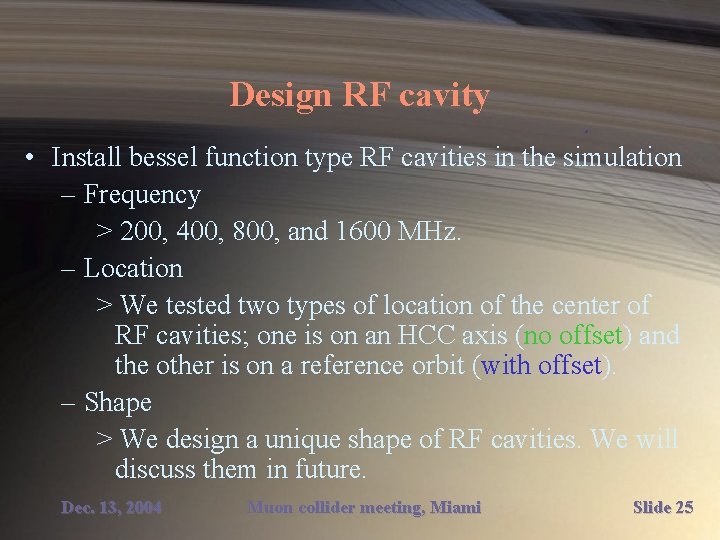
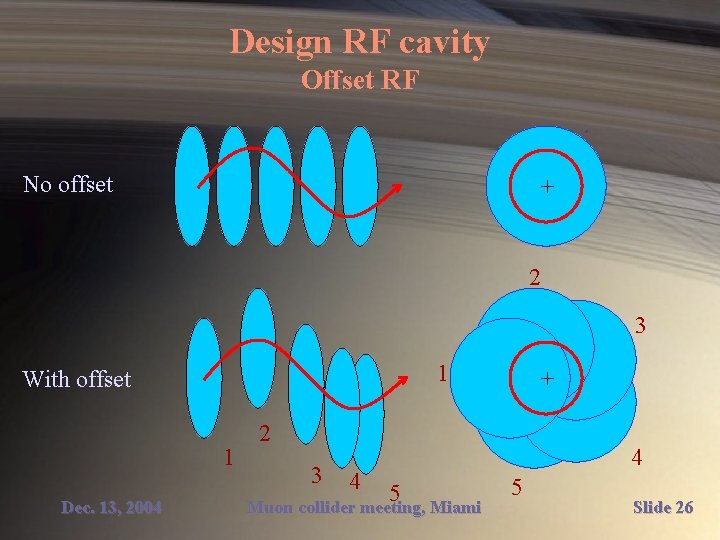
Design RF cavity • Install bessel function type RF cavities in the simulation – Frequency > 200, 400, 800, and 1600 MHz. – Location > We tested two types of location of the center of RF cavities; one is on an HCC axis (no offset) and the other is on a reference orbit (with offset). – Shape > We design a unique shape of RF cavities. We will discuss them in future. Dec. 13, 2004 Muon collider meeting, Miami Slide 25
Design RF cavity Offset RF No offset + 2 3 1 With offset 1 Dec. 13, 2004 + 2 3 4 4 5 Muon collider meeting, Miami 5 Slide 26
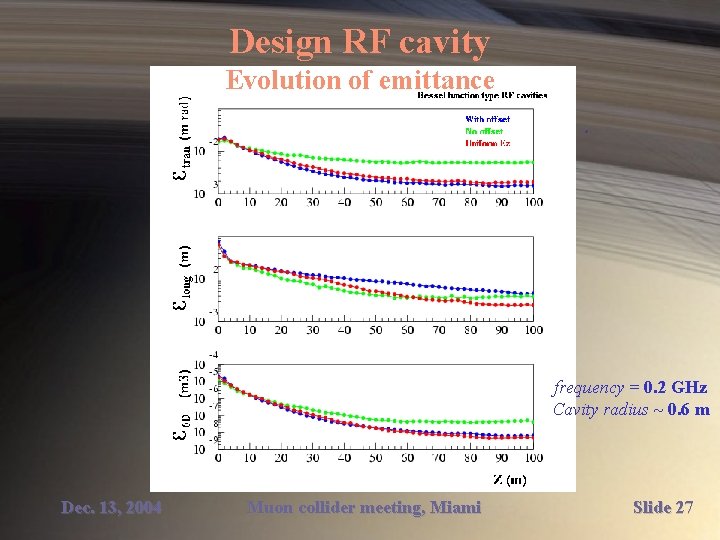
Design RF cavity Evolution of emittance frequency = 0. 2 GHz Cavity radius ~ 0. 6 m Dec. 13, 2004 Muon collider meeting, Miami Slide 27
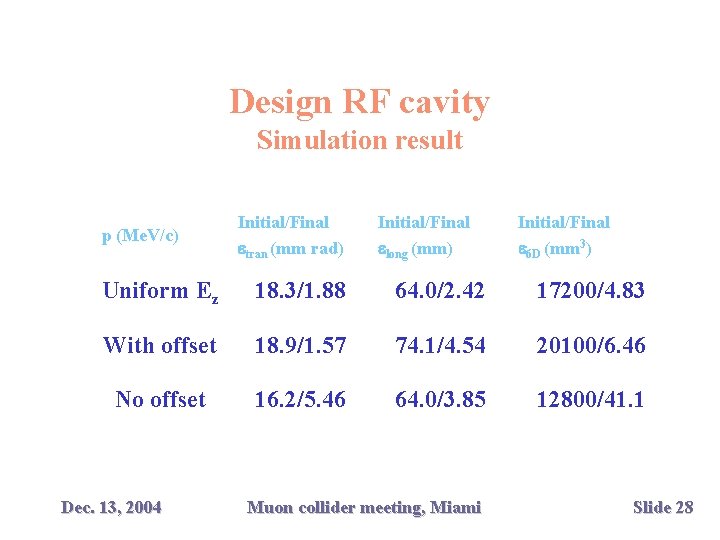
Design RF cavity Simulation result p (Me. V/c) Initial/Final etran (mm rad) Initial/Final elong (mm) Initial/Final e 6 D (mm 3) Uniform Ez 18. 3/1. 88 64. 0/2. 42 17200/4. 83 With offset 18. 9/1. 57 74. 1/4. 54 20100/6. 46 No offset 16. 2/5. 46 64. 0/3. 85 12800/41. 1 Dec. 13, 2004 Muon collider meeting, Miami Slide 28
Design RF cavity Summary • The RF cavities with offset works well. • However, we observe a less reduction of the longitudinal emittance by using the offset type RF cavities. • We need to improve the propagation of longitudinal beam cooling in HCC. Dec. 13, 2004 Muon collider meeting, Miami Slide 29
Summary/Next to do • • • The two simulations work pretty well. We study beam dynamics in HCC. We found the effective dispersion factor. We design several type of RF cavities. We figure out the matching problem. Dec. 13, 2004 Muon collider meeting, Miami Slide 30