
Heinz Werner Geometrictechnical and Physiognomic Perception by Ruben
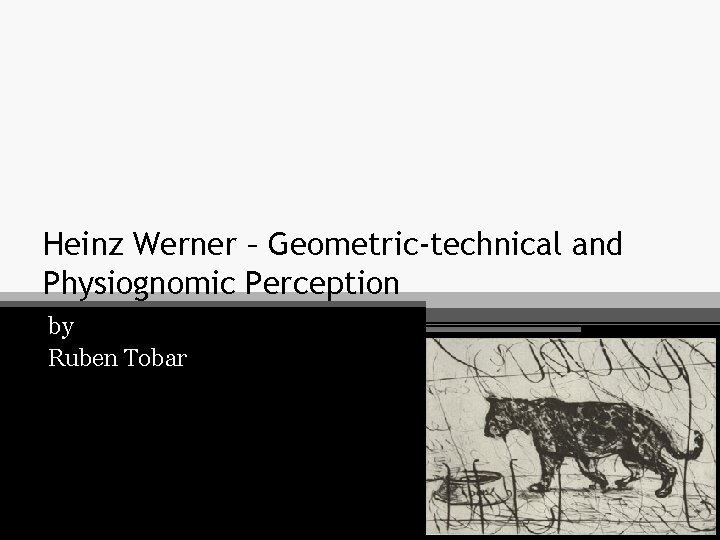
Heinz Werner – Geometric-technical and Physiognomic Perception by Ruben Tobar
What I Would Have Done Differently • • More Participants at Middle School Level Participants at High School Level More Male Participants for Second Part of Research Study
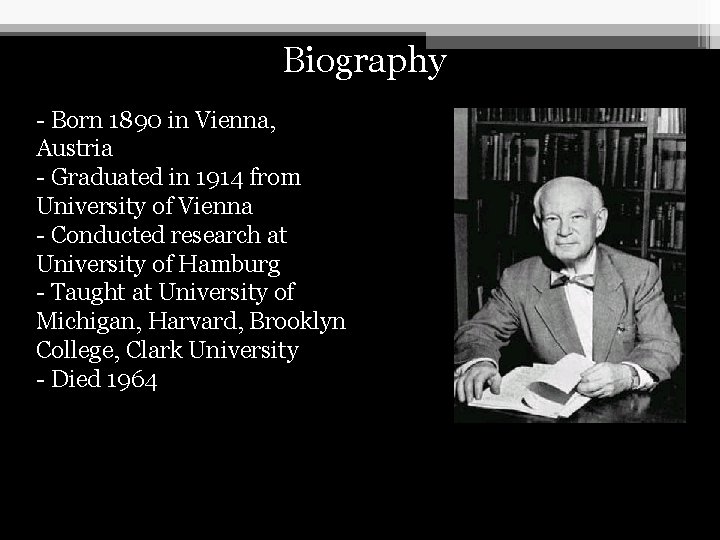
Biography - Born 1890 in Vienna, Austria - Graduated in 1914 from University of Vienna - Conducted research at University of Hamburg - Taught at University of Michigan, Harvard, Brooklyn College, Clark University - Died 1964
Key Terms - Gestalt: “[T]o refer to unified whole, complete structures, totalities, the nature of which is not revealed by simply analyzing the several parts that make it up. ” - Organismic: “[A]pproaches that emphasize the need to view a behaving organism as a biological entity, one which must be approached as the coordinated functioning of a multitude of interrelated processes. ” - Microgenetic mobility: “[A]bility to regress farther back and fully utilize both primative and advanced forms of thinking. ” - Physiognomy: “The physical appearance of the face, the use of the face and facial expressions to judge mental abilities, character, emotional attitudes. ” - Physiognomic Perception: [Perception characterized as] an emphatic reaction in which emotional qualities are interjected into perceptual/cognitive judgements; e. g. , a brand-new car looks “alert. ” - Geometric-Technical Perception: [Perception of] objects in terms of shape, length, hue, width, and other objective, measurable properties. Geometrictechnical perception is more realistic and matter-of-fact. ” - Synesthesia: “The condition in which a sensory experience normally associated with one modality occurs when another modality is stimulated. ”
Proposal To investigate whether patterns of language used to interpret an experience with a poem are different when a sensory stimulus (music) is added to the experience of the poem. In particular, to investigate whether a uni-modal experience (text only) produces a more geometric-technical response and a multi-modal experience (text and music) produces a more physiognomic response.
Question (1) Are there more physiognomic than geometric-technical qualities in the vocabulary of participants’ responses to a multi-modal experience? (Comparison and contrast responses individually and collectively. ) (2) Is the outside stimulus (music) a plausible aid or inhibitor of a more synesthetic response?
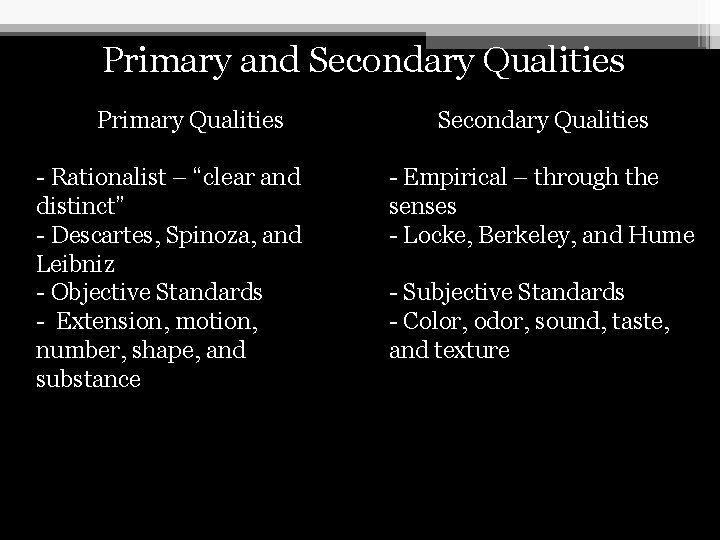
Primary and Secondary Qualities Primary Qualities - Rationalist – “clear and distinct” - Descartes, Spinoza, and Leibniz - Objective Standards - Extension, motion, number, shape, and substance Secondary Qualities - Empirical – through the senses - Locke, Berkeley, and Hume - Subjective Standards - Color, odor, sound, taste, and texture
(Why are Primary and Secondary Qualities Important for this Research Study? Added after presentation) I believe the instruction (the prompt for the responses) needs to be delivered in such a manner that will allow for a higher probability of more physiognomic vocabulary. To this extent, the format of the instruction has to reduce the possibility of geometric-technical (which can be synonymous with primary qualities) vocabulary by avoid wording a prompt which asks for a summary (objective). Instead by wording the prompt to focus on a response that demands a message or moral to be interpreted (subjective) from the text, I believe that this instruction allows for a higher probability for more physiognomic vocabulary.
Rilke's “The Panther” IN THE JADIN DES PLANTES, PARIS His glance, worn by the passing of the bars, has grown so weary it has lost its hold. It seems to him, there a thousand bars, and then behind a thousand bars no world. The soft gait of the supple, forceful paces, revolving in a circle almost nil, is like a dance of power that embraces a core containing, dazed, a might will. Rarely the pupil’s curtain, soundlessly, is raised - and then an image enters him, goes through the silent tension of the limbs and in his heart ceases to be.
Goethe's “Der König in Thule” In Thule there was a king, Faithful unto the grave, To whom his mistress, dying, A golden goblet gave. He dined at evenfall With all his chivalry In the ancestral hall In the castle by the sea Nothing he held more dear, At every meal he used it; His eyes would fill with tears As often as he mused it. The old man rose at last And drank life’s sunset flow, And the sacred goblet he cast Into the flood below. And when he came to dying, The towns in his realm he told, Naught to his heirs denying, Except the goblet of gold. He saw it plunging, drinking. And sinking into the sea; His eyes were also sinking, And nevermore drank he.
Participants First Classroom Goethe – Uni-modal, Rilke – Multi-modal Six participants One male, five females All are employed and/or had employment history Second Classroom Goethe – Multi-modal, Rilke – Uni-modal Not applicable
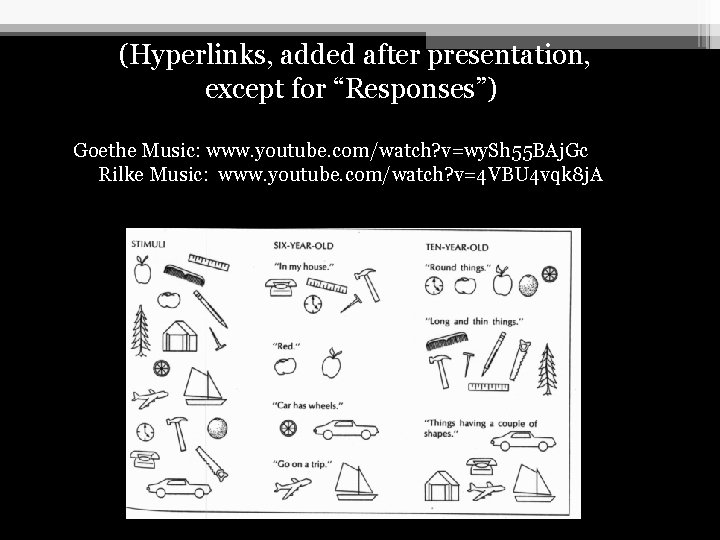
Responses
Conclusion Not enough data/responses ≈ Inconclusive
Nature versus Nurture Werner Nurture Nature “Werner said that children, compared to Western adults, often think in pictures” (100). “Werner called this perceptual mode physiognomic because it is the physiognomy – the face – that most directly conveys emotion to us, although we may also perceive emotion in other ways – for instance, through a person's posture” (101). “Werner, taking the broadest possible perspective, noted that both qualitative and qualitative changes occur. Like Rousseau, however, he really believed that the most important changes are qualitative” (109). “[T]he process of self-object differentiation. . . by which children separate themselves from the environment. . . through three levels. . . in differing developmental patterns” (96).
Sources Crain, William. Theories of Development: Sixth Edition. New Jersey: Pearson Education, Inc. , 2011 Modern Philosophy: Second Edition. ed. by Ariew, Roger and Watkins, Eric. Indiana: Hackett Publishing Company Inc. , 2009 Reber, Arthur S. The Penguin Dictionary of Psychology. New York: Penguin Books, 1985.
(Hyperlinks, added after presentation, except for “Responses”) Goethe Music: www. youtube. com/watch? v=wy. Sh 55 BAj. Gc Rilke Music: www. youtube. com/watch? v=4 VBU 4 vqk 8 j. A
a Kulakofsky Pr[esentation]
- Slides: 17