
HEINSENBERGS UNCERTAINTY PRINCIPLE It is impossible to determine
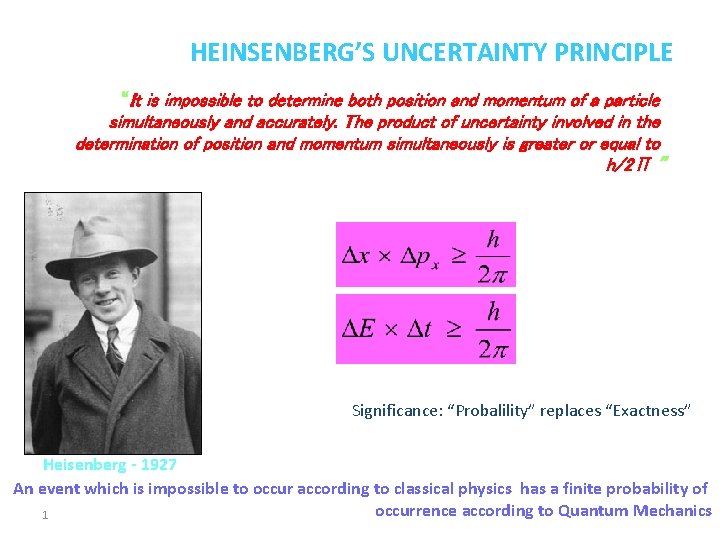
HEINSENBERG’S UNCERTAINTY PRINCIPLE “It is impossible to determine both position and momentum of a particle simultaneously and accurately. The product of uncertainty involved in the determination of position and momentum simultaneously is greater or equal to h/2Π ” Significance: “Probalility” replaces “Exactness” Heisenberg - 1927 An event which is impossible to occur according to classical physics has a finite probability of occurrence according to Quantum Mechanics 1
The Uncertainty Principle Since we deal with probabilities we have to • ask ourselves: “How precise is our knowledge? ” Specifically, we want to know Coordinate • and Momentum of a particle at time t = 0 If we know the forces acting upon the particle – than, according to classical physics, we know everything about a particle at any moment in the future
The Uncertainty Principle But it is impossible to give the precise position of a wave A wave is naturally spread out Consider the case of diffraction Most of the energy arriving at a distant screen falls within the first maximum • •
The Uncertainty Principle Can we know Coordinate and Momentum • (velocity) at some time t = 0 exactly, if we deal here with probabilities? The answer in Quantum Mechanics is • different from that in Classical Physics, and is presented by the Heisenberg’s Uncertainty Principle
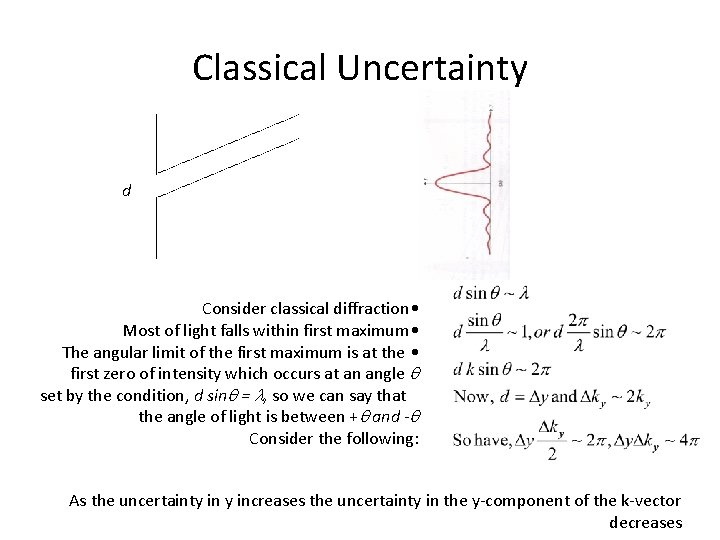
Classical Uncertainty d Consider classical diffraction • Most of light falls within first maximum • The angular limit of the first maximum is at the • first zero of intensity which occurs at an angle set by the condition, d sin = , so we can say that the angle of light is between + and - Consider the following: As the uncertainty increases the uncertainty in the y-component of the k-vector decreases
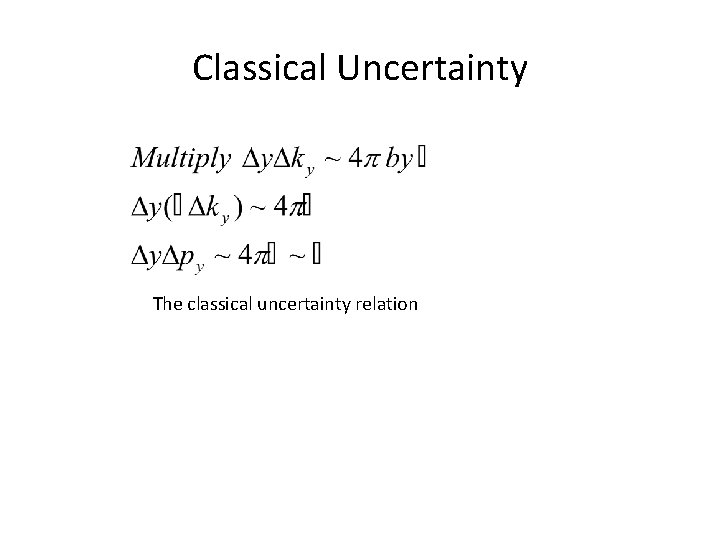
Classical Uncertainty The classical uncertainty relation
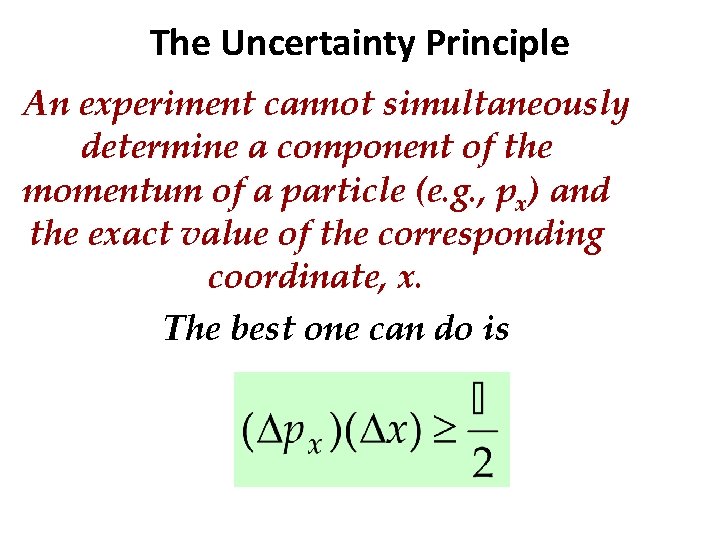
The Uncertainty Principle An experiment cannot simultaneously determine a component of the momentum of a particle (e. g. , px) and the exact value of the corresponding coordinate, x. The best one can do is
The Uncertainty Principle The limitations imposed by the uncertainty. 1 principle have nothing to do with quality of the experimental equipment The uncertainty principle does imply that one. 2 cannot determine the position or the momentum with arbitrary accuracy It refers to the impossibility of precise knowledge about both: e. g. if Δx = 0, then Δ px is infinity, and vice versa – The uncertainty principle is confirmed by. 3 experiment, and is a direct consequence of the de Broglie’s hypothesis
HOWEVER Since the wavefunction, Ψ(x, t), describes a • particle, its evolution in time under the action of the wave equation describes the future history of the particle Ψ(x, t) is determined by Ψ(x, t = 0) – Thus, instead of the coordinate and velocity • at t = 0 we want to know the wavefunction at t=0 Thus uncertainty is built in from the beginning – and the wavefunction at all times is related to the evolution of probability
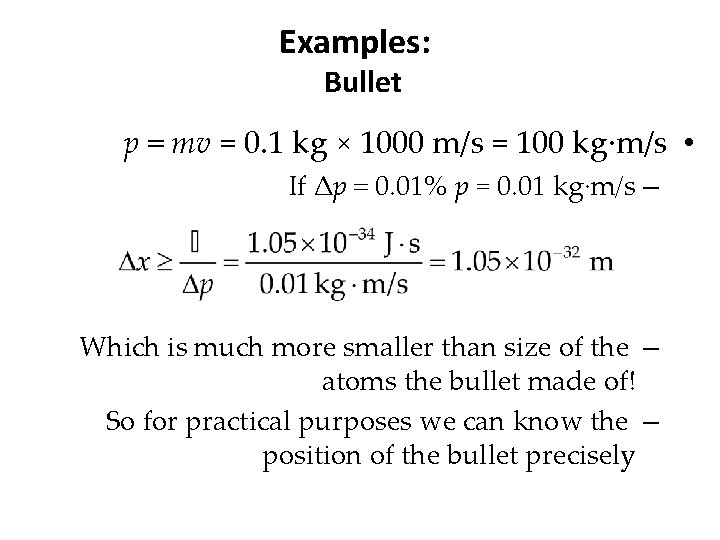
Examples: Bullet p = mv = 0. 1 kg × 1000 m/s = 100 kg·m/s • If Δp = 0. 01% p = 0. 01 kg·m/s – Which is much more smaller than size of the – atoms the bullet made of! So for practical purposes we can know the – position of the bullet precisely
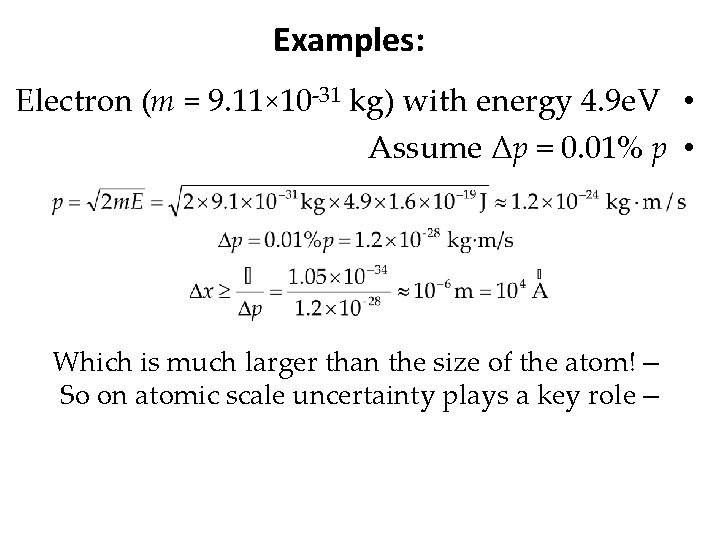
Examples: Electron (m = 9. 11× 10 -31 kg) with energy 4. 9 e. V • Assume Δp = 0. 01% p • Which is much larger than the size of the atom! – So on atomic scale uncertainty plays a key role –
Quantum Mechanics The methods of Quantum Mechanics • consist in finding the wavefunction associated with a particle or a system Once we know this wavefunction we • know “everything” about the system!
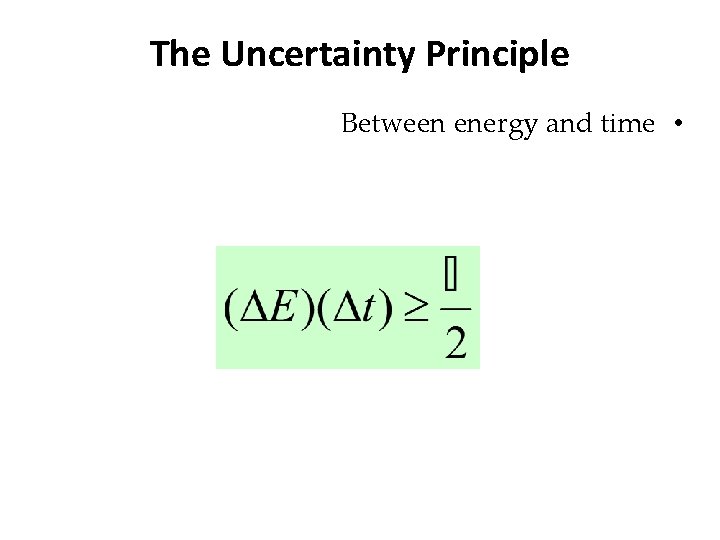
The Uncertainty Principle Between energy and time •
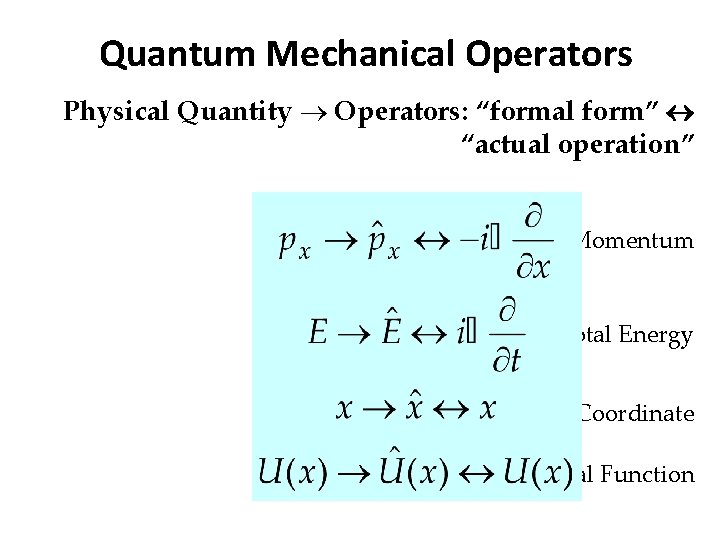
Quantum Mechanical Operators Physical Quantity Operators: “formal form” “actual operation” Momentum Total Energy Coordinate Potential Function
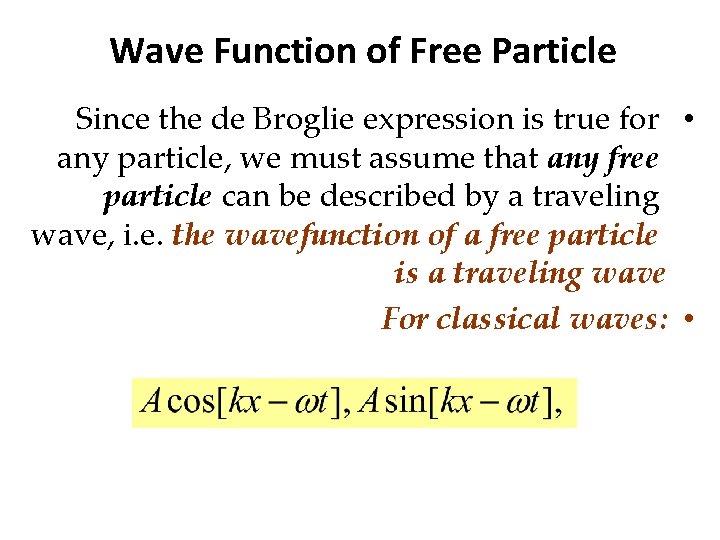
Wave Function of Free Particle Since the de Broglie expression is true for • any particle, we must assume that any free particle can be described by a traveling wave, i. e. the wavefunction of a free particle is a traveling wave For classical waves: •

Wave Function of Free Particle However, these functions are not eigenfunctions of the • momentum operator, with them we do not find, But see what happens if we try, • After some “manipulations” we get •
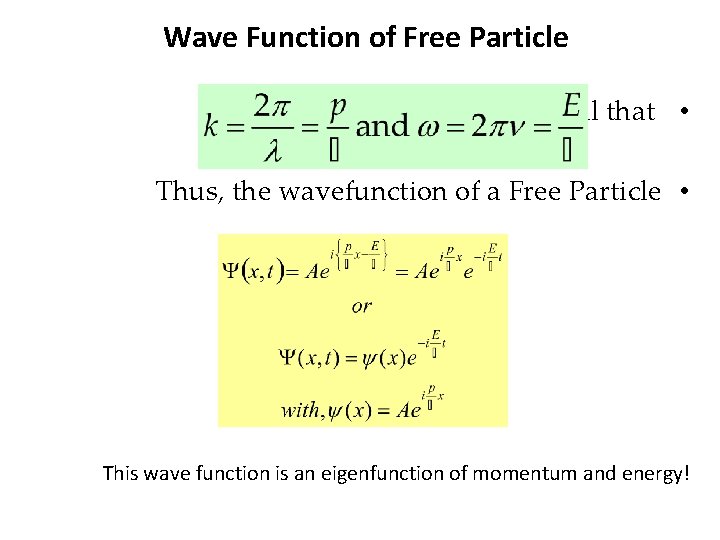
Wave Function of Free Particle Recall that • Thus, the wavefunction of a Free Particle • This wave function is an eigenfunction of momentum and energy!
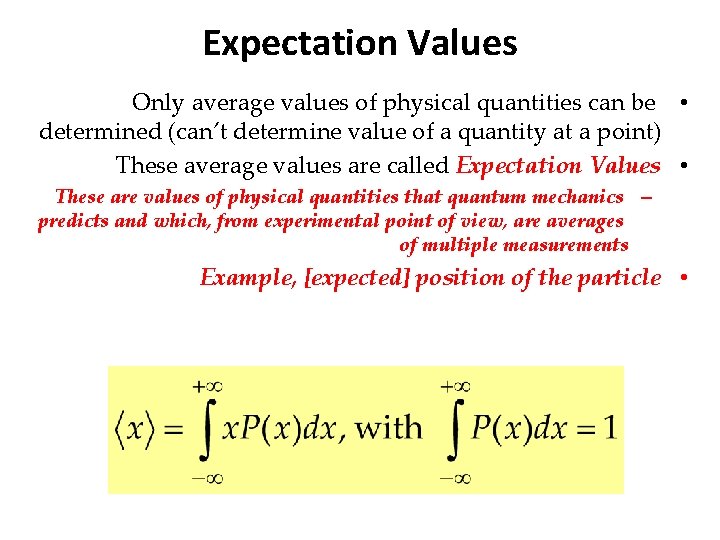
Expectation Values Only average values of physical quantities can be • determined (can’t determine value of a quantity at a point) These average values are called Expectation Values • These are values of physical quantities that quantum mechanics – predicts and which, from experimental point of view, are averages of multiple measurements Example, [expected] position of the particle •
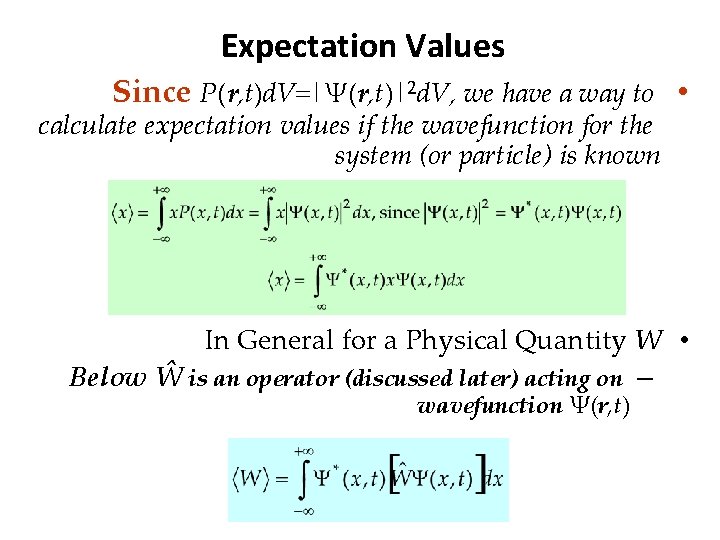
Expectation Values Since P(r, t)d. V=|Ψ(r, t)|2 d. V, we have a way to • calculate expectation values if the wavefunction for the system (or particle) is known In General for a Physical Quantity W • Below Ŵ is an operator (discussed later) acting on – wavefunction Ψ(r, t)
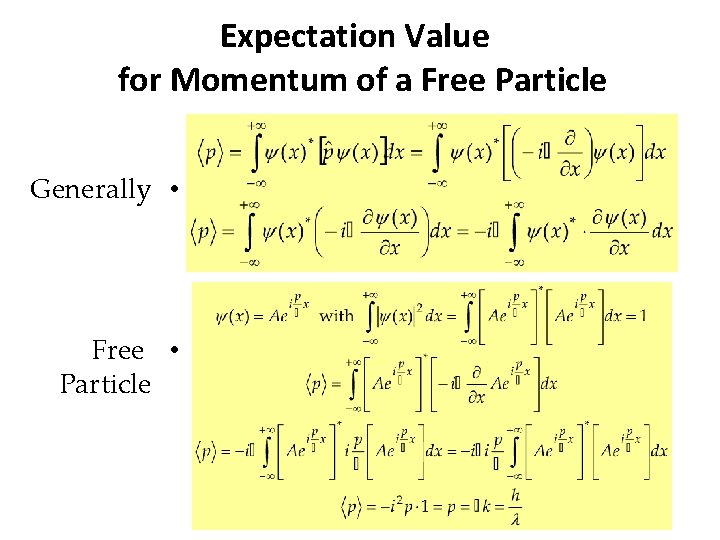
Expectation Value for Momentum of a Free Particle Generally • Free • Particle
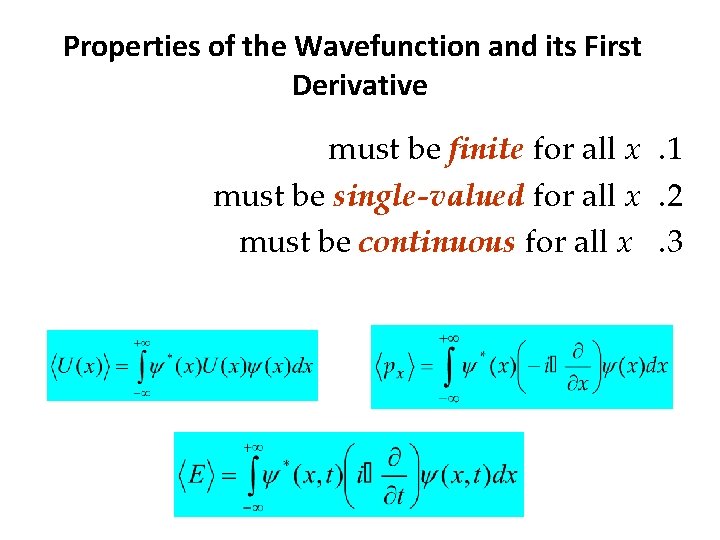
Properties of the Wavefunction and its First Derivative must be finite for all x. 1 must be single-valued for all x. 2 must be continuous for all x. 3
- Slides: 21