
HEIGHTS AND DISTANCE Department of Analytical Skills Content


- Slides: 37
HEIGHTS AND DISTANCE © Department of Analytical Skills
Content 1) Introduction i. Trigonometry identities iii. Values of T ratio iv. Angle of elevation and depression 2) Problems i. Two of the sides given ii. One angle and one side given iii. Two heights and one angle iv. Two angles and one height v. Two angles and two heights vi. Calculating time and distance 3) Solved problems 4) Practice problems © Department of Analytical Skills
1) Introduction This chapter deals with finding the heights, distances and angles using trigonometric values © Department of Analytical Skills
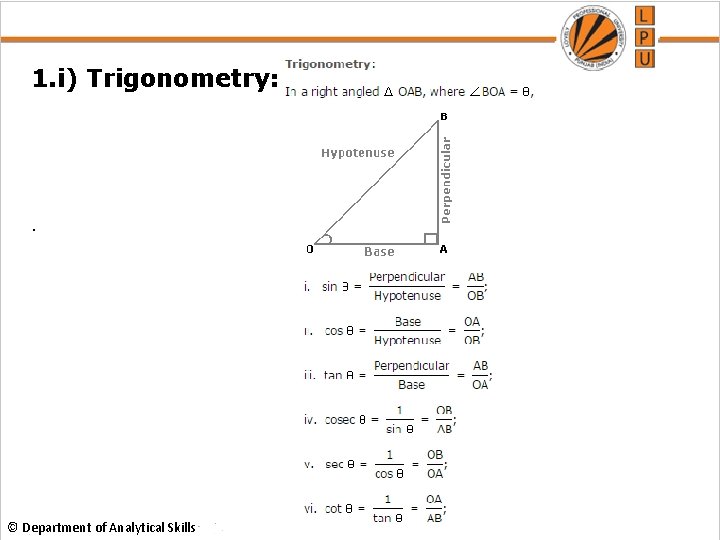
1. i) Trigonometry: . © Department of Analytical Skills
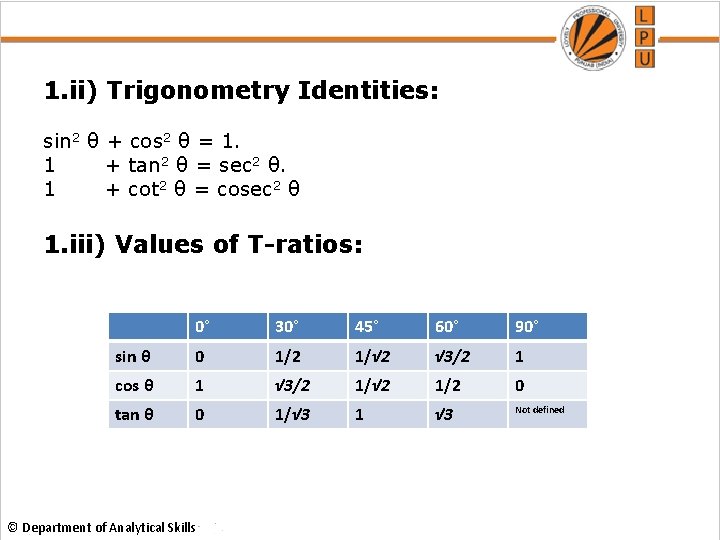
1. ii) Trigonometry Identities: sin 2 θ + cos 2 θ = 1. 1 + tan 2 θ = sec 2 θ. 1 + cot 2 θ = cosec 2 θ 1. iii) Values of T-ratios: 0° 30° 45° 60° 90° sin θ 0 1/2 1/√ 2 √ 3/2 1 cos θ 1 √ 3/2 1/√ 2 1/2 0 tan θ 0 1/√ 3 1 √ 3 Not defined © Department of Analytical Skills
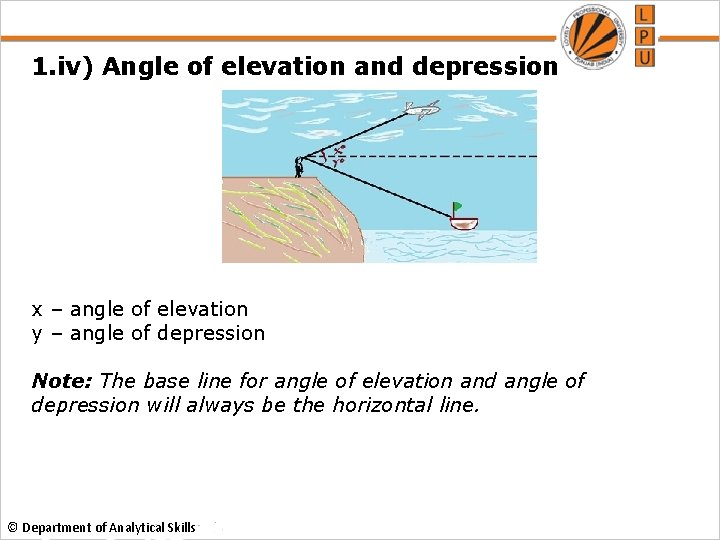
1. iv) Angle of elevation and depression x – angle of elevation y – angle of depression Note: The base line for angle of elevation and angle of depression will always be the horizontal line. © Department of Analytical Skills
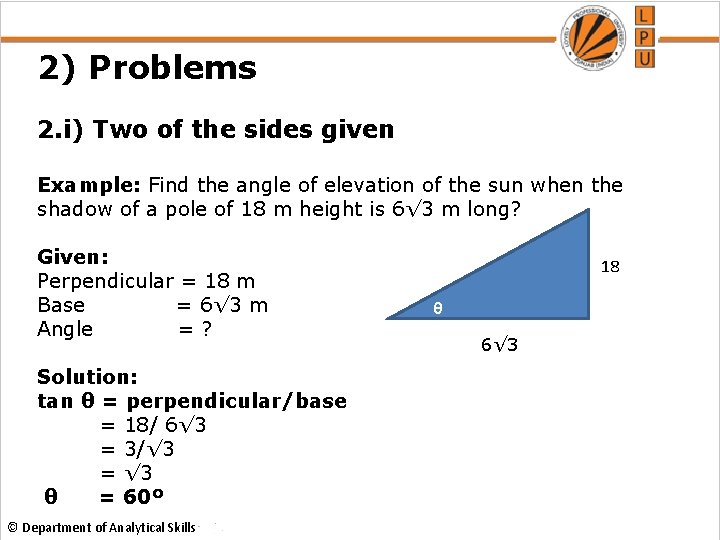
2) Problems 2. i) Two of the sides given Example: Find the angle of elevation of the sun when the shadow of a pole of 18 m height is 6√ 3 m long? Given: Perpendicular = 18 m Base = 6√ 3 m Angle =? Solution: tan θ = perpendicular/base = 18/ 6√ 3 = 3/√ 3 = √ 3 θ = 60º © Department of Analytical Skills 18 θ 6√ 3
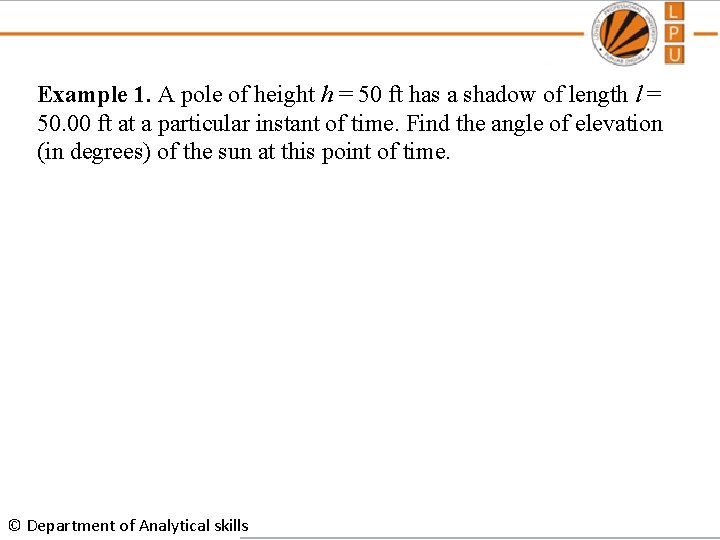
Example 1. A pole of height h = 50 ft has a shadow of length l = 50. 00 ft at a particular instant of time. Find the angle of elevation (in degrees) of the sun at this point of time. © Department of Analytical skills
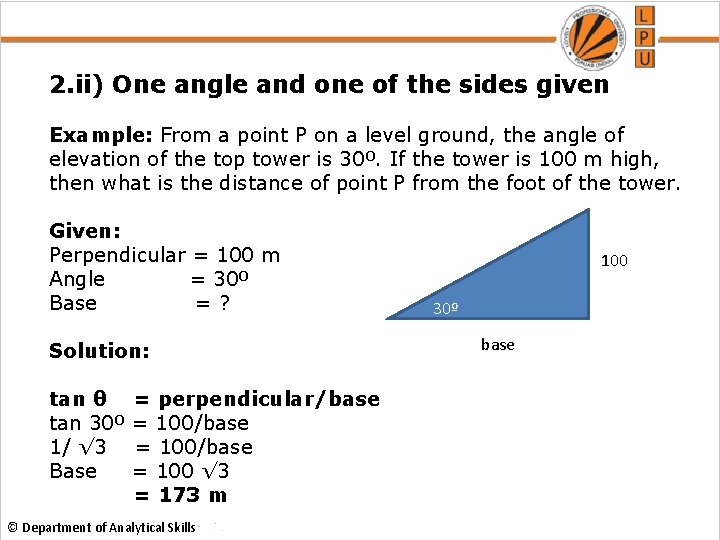
2. ii) One angle and one of the sides given Example: From a point P on a level ground, the angle of elevation of the top tower is 30º. If the tower is 100 m high, then what is the distance of point P from the foot of the tower. Given: Perpendicular = 100 m Angle = 30º Base =? Solution: tan θ tan 30º 1/ √ 3 Base = perpendicular/base = 100/base = 100 √ 3 = 173 m © Department of Analytical Skills 100 30º base
Example 2. A man is walking along a straight road. He notices the top of a tower subtending an angle A = 60 o with the ground at the point where he is standing. If the height of the tower is h = 25 m, then what is the distance (in meters) of the man from the tower? © Department of Analytical Skills
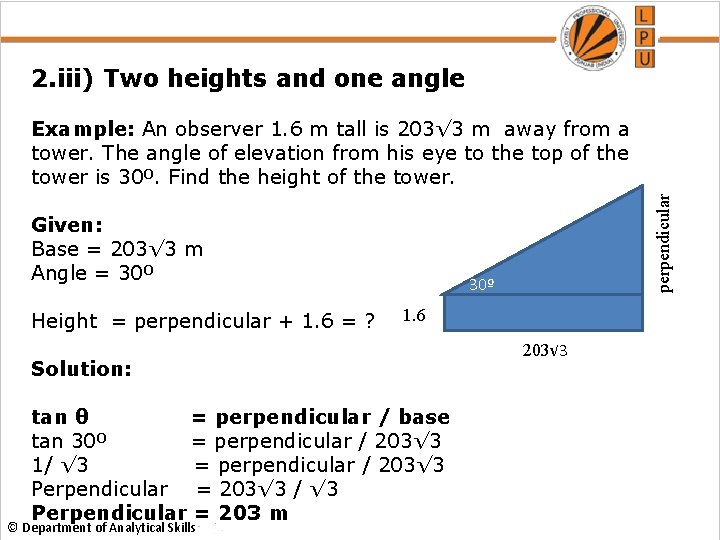
2. iii) Two heights and one angle Given: Base = 203√ 3 m Angle = 30º Height = perpendicular + 1. 6 = ? 30º 1. 6 Solution: tan θ = perpendicular / base tan 30º = perpendicular / 203√ 3 1/ √ 3 = perpendicular / 203√ 3 Perpendicular = 203√ 3 / √ 3 Perpendicular = 203 m © Department of Analytical Skills perpendicular Example: An observer 1. 6 m tall is 203√ 3 m away from a tower. The angle of elevation from his eye to the top of the tower is 30º. Find the height of the tower. 203√ 3
Height of the tower = perpendicular + 1. 6 = 203 + 1. 6 = 204. 6 m 30º © Department of Analytical Skills
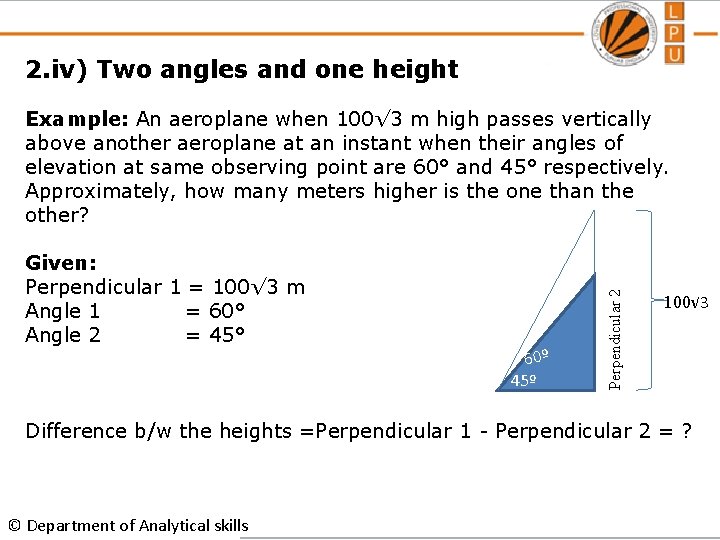
2. iv) Two angles and one height Given: Perpendicular 1 = 100√ 3 m Angle 1 = 60° Angle 2 = 45° 60º 45º Perpendicular 2 Example: An aeroplane when 100√ 3 m high passes vertically above another aeroplane at an instant when their angles of elevation at same observing point are 60° and 45° respectively. Approximately, how many meters higher is the one than the other? 100√ 3 Difference b/w the heights =Perpendicular 1 - Perpendicular 2 = ? © Department of Analytical skills
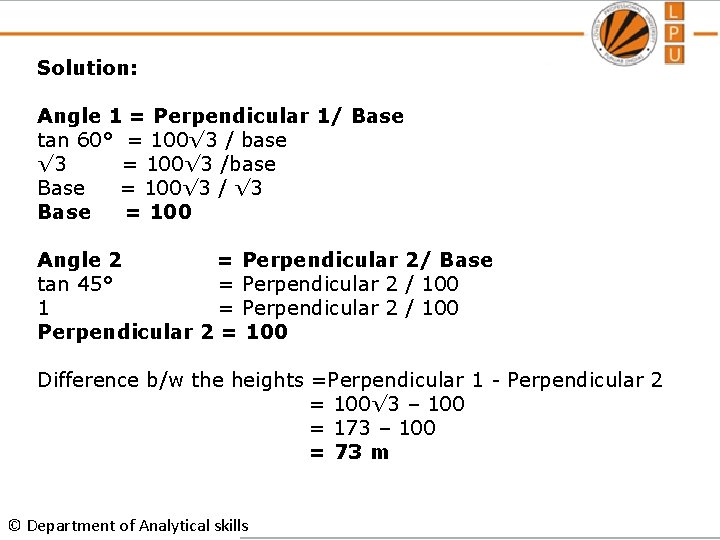
Solution: Angle 1 = Perpendicular 1/ Base tan 60° = 100√ 3 / base √ 3 = 100√ 3 /base Base = 100√ 3 / √ 3 Base = 100 Angle 2 = Perpendicular 2/ Base tan 45° = Perpendicular 2 / 100 1 = Perpendicular 2 / 100 Perpendicular 2 = 100 Difference b/w the heights =Perpendicular 1 - Perpendicular 2 = 100√ 3 – 100 = 173 – 100 = 73 m © Department of Analytical skills
Example 3. Two ships are sailing in the sea on the two sides of a lighthouse. The angle of elevation of the top of the lighthouse is observed from the ships are 30º and 45º respectively. If the lighthouse is 100 m high, then find the distance between the two ships is. © Department of Analytical Skills
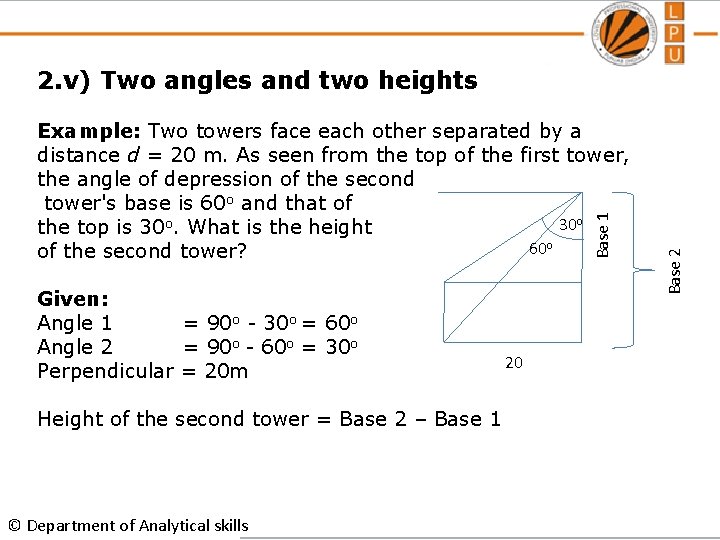
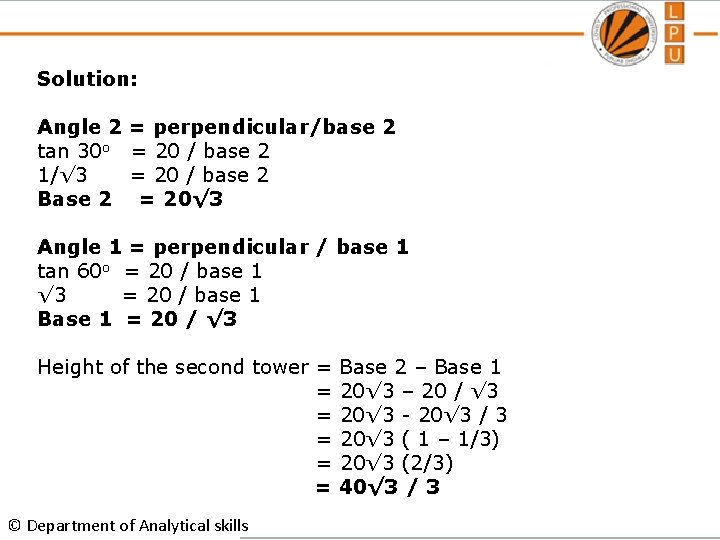
Base 1 Example: Two towers face each other separated by a distance d = 20 m. As seen from the top of the first tower, the angle of depression of the second tower's base is 60 o and that of 30 o the top is 30 o. What is the height 60 o of the second tower? Given: Angle 1 = 90 o - 30 o = 60 o Angle 2 = 90 o - 60 o = 30 o Perpendicular = 20 m Height of the second tower = Base 2 – Base 1 © Department of Analytical skills 20 Base 2 2. v) Two angles and two heights
Solution: Angle 2 tan 30 o 1/√ 3 Base 2 = perpendicular/base 2 = 20 / base 2 = 20√ 3 Angle 1 = perpendicular / base 1 tan 60 o = 20 / base 1 √ 3 = 20 / base 1 Base 1 = 20 / √ 3 Height of the second tower = Base 2 – Base 1 = 20√ 3 – 20 / √ 3 = 20√ 3 - 20√ 3 / 3 = 20√ 3 ( 1 – 1/3) = 20√ 3 (2/3) = 40√ 3 / 3 © Department of Analytical skills
Example 4. To a man standing outside his house, the angles of elevation of the top and bottom of a window are 60° and 45° respectively. If the height of the man is 180 cm and he is 5 m away from the wall, what is the length of the window? © Department of Analytical skills
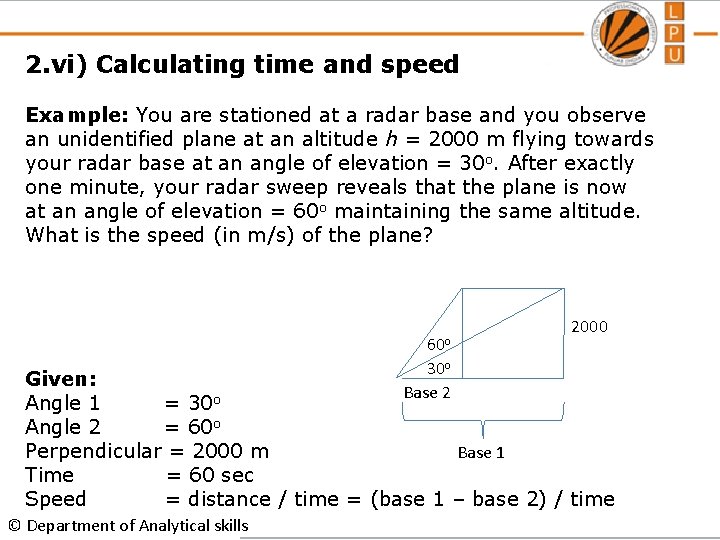
2. vi) Calculating time and speed Example: You are stationed at a radar base and you observe an unidentified plane at an altitude h = 2000 m flying towards your radar base at an angle of elevation = 30 o. After exactly one minute, your radar sweep reveals that the plane is now at an angle of elevation = 60 o maintaining the same altitude. What is the speed (in m/s) of the plane? 60 o 30 o Base 2 2000 Given: Angle 1 = 30 o Angle 2 = 60 o Perpendicular = 2000 m Base 1 Time = 60 sec Speed = distance / time = (base 1 – base 2) / time © Department of Analytical skills
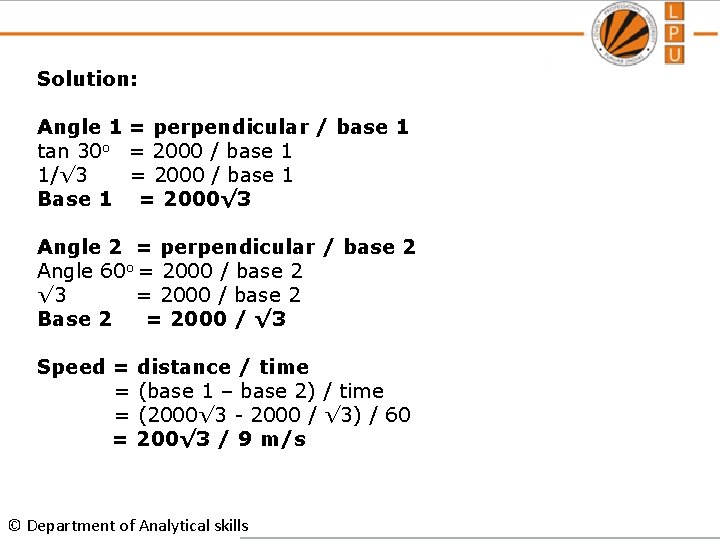
Solution: Angle 1 tan 30 o 1/√ 3 Base 1 = perpendicular / base 1 = 2000√ 3 Angle 2 = perpendicular / base 2 Angle 60 o = 2000 / base 2 √ 3 = 2000 / base 2 Base 2 = 2000 / √ 3 Speed = distance / time = (base 1 – base 2) / time = (2000√ 3 - 2000 / √ 3) / 60 = 200√ 3 / 9 m/s © Department of Analytical skills
Example 5. A balloon leaves the earth at a point A and rises vertically at uniform speed. At the end of 2 minutes, John finds the angular elevation of the balloon as 60°. If the point at which John is standing is 150 m away from point A, then what is the speed of the balloon? © Department of Analytical Skills
3) Solved examples © Department of Analytical skills
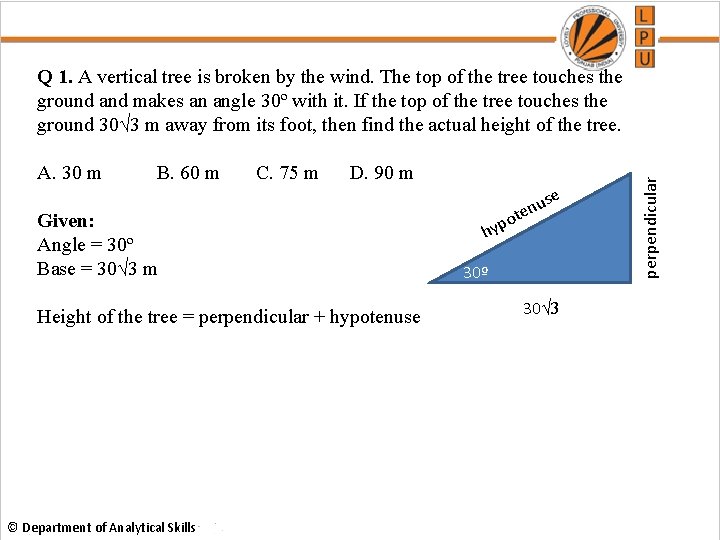
A. 30 m B. 60 m C. 75 m D. 90 m Given: Angle = 30º Base = 30√ 3 m Height of the tree = perpendicular + hypotenuse © Department of Analytical Skills se u n te o hyp 30º 30√ 3 perpendicular Q 1. A vertical tree is broken by the wind. The top of the tree touches the ground and makes an angle 30º with it. If the top of the tree touches the ground 30√ 3 m away from its foot, then find the actual height of the tree.
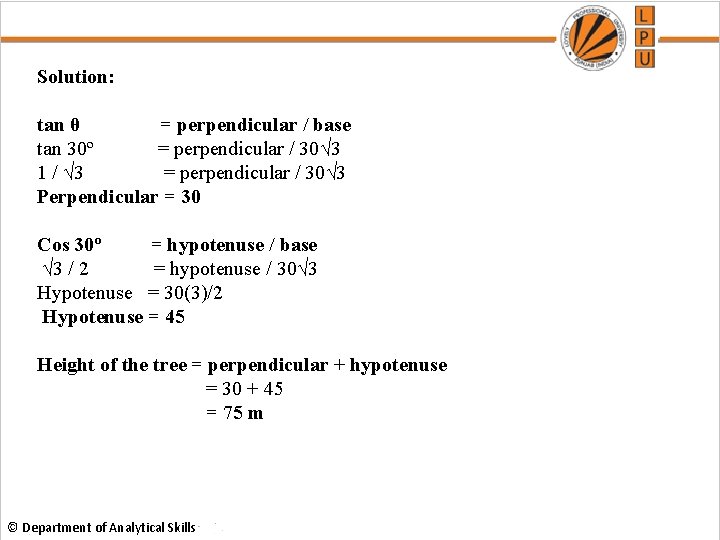
Solution: tan θ = perpendicular / base tan 30º = perpendicular / 30√ 3 1 / √ 3 = perpendicular / 30√ 3 Perpendicular = 30 Cos 30º = hypotenuse / base √ 3 / 2 = hypotenuse / 30√ 3 Hypotenuse = 30(3)/2 Hypotenuse = 45 Height of the tree = perpendicular + hypotenuse = 30 + 45 = 75 m © Department of Analytical Skills
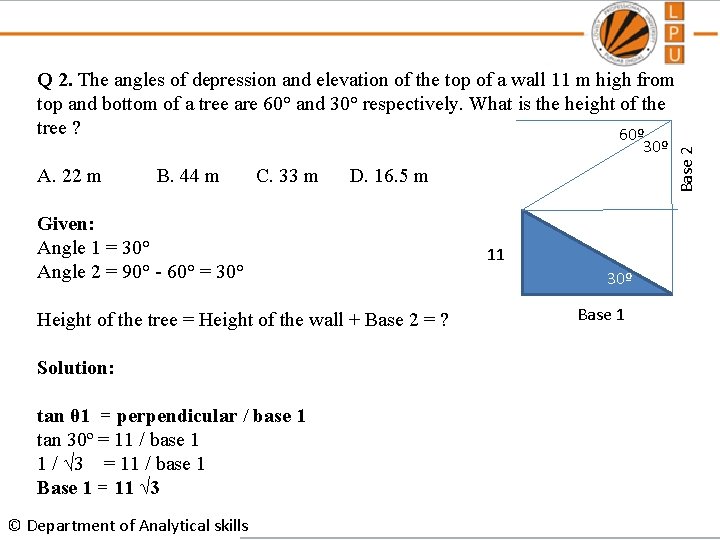
30º A. 22 m B. 44 m C. 33 m D. 16. 5 m Given: Angle 1 = 30° Angle 2 = 90° - 60° = 30° Height of the tree = Height of the wall + Base 2 = ? Solution: tan θ 1 = perpendicular / base 1 tan 30º = 11 / base 1 1 / √ 3 = 11 / base 1 Base 1 = 11 √ 3 © Department of Analytical skills 11 30º Base 1 Base 2 Q 2. The angles of depression and elevation of the top of a wall 11 m high from top and bottom of a tree are 60° and 30° respectively. What is the height of the tree ? 60º
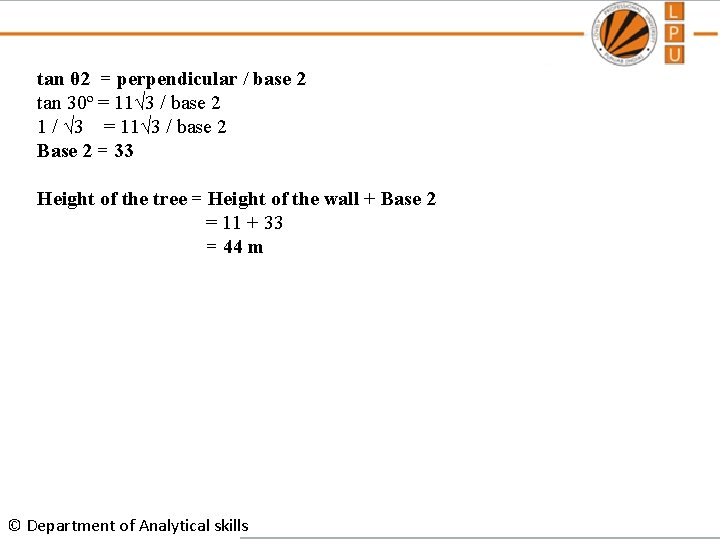
tan θ 2 = perpendicular / base 2 tan 30º = 11√ 3 / base 2 1 / √ 3 = 11√ 3 / base 2 Base 2 = 33 Height of the tree = Height of the wall + Base 2 = 11 + 33 = 44 m © Department of Analytical skills
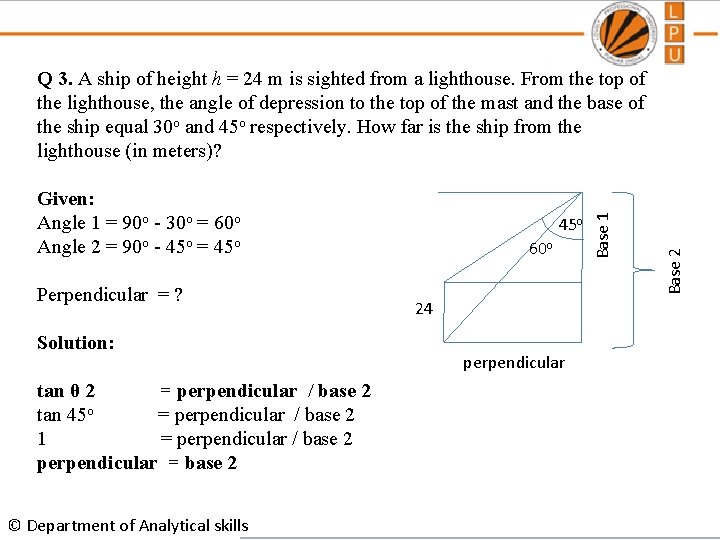
Perpendicular = ? Solution: tan θ 2 = perpendicular / base 2 tan 45 o = perpendicular / base 2 1 = perpendicular / base 2 perpendicular = base 2 © Department of Analytical skills 45 o 60 o 24 perpendicular Base 2 Given: Angle 1 = 90 o - 30 o = 60 o Angle 2 = 90 o - 45 o = 45 o Base 1 Q 3. A ship of height h = 24 m is sighted from a lighthouse. From the top of the lighthouse, the angle of depression to the top of the mast and the base of the ship equal 30 o and 45 o respectively. How far is the ship from the lighthouse (in meters)?
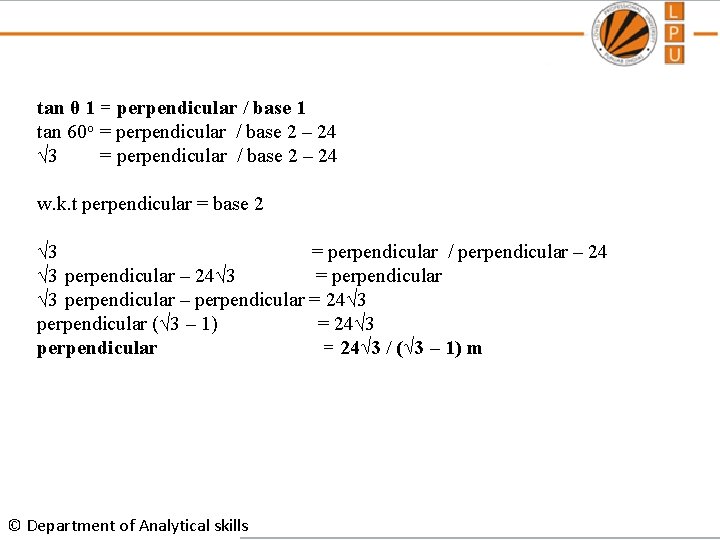
tan θ 1 = perpendicular / base 1 tan 60 o = perpendicular / base 2 – 24 √ 3 = perpendicular / base 2 – 24 w. k. t perpendicular = base 2 √ 3 = perpendicular / perpendicular – 24 √ 3 perpendicular – 24√ 3 = perpendicular √ 3 perpendicular – perpendicular = 24√ 3 perpendicular (√ 3 – 1) = 24√ 3 perpendicular = 24√ 3 / (√ 3 – 1) m © Department of Analytical skills
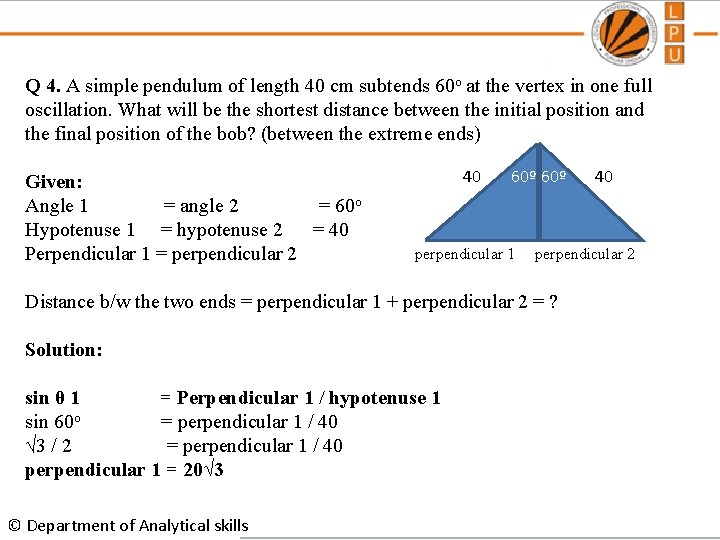
Q 4. A simple pendulum of length 40 cm subtends 60 o at the vertex in one full oscillation. What will be the shortest distance between the initial position and the final position of the bob? (between the extreme ends) Given: Angle 1 = angle 2 = 60 o Hypotenuse 1 = hypotenuse 2 = 40 Perpendicular 1 = perpendicular 2 40 60º perpendicular 1 perpendicular 2 Distance b/w the two ends = perpendicular 1 + perpendicular 2 = ? Solution: sin θ 1 = Perpendicular 1 / hypotenuse 1 sin 60 o = perpendicular 1 / 40 √ 3 / 2 = perpendicular 1 / 40 perpendicular 1 = 20√ 3 © Department of Analytical skills 40
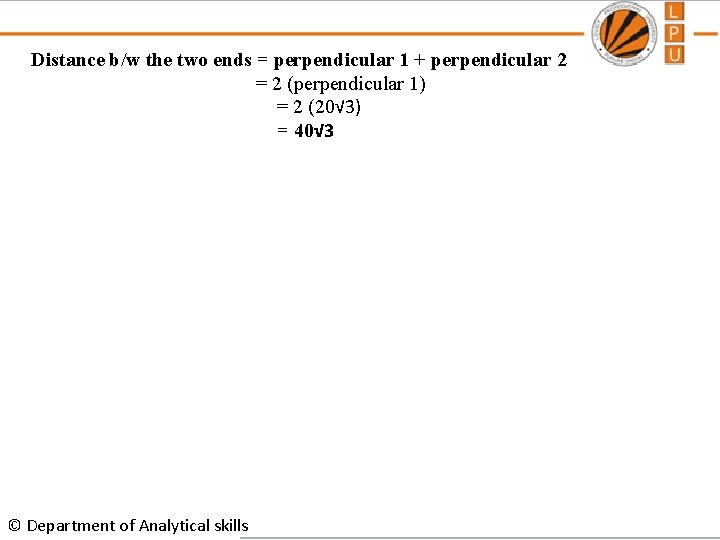
Distance b/w the two ends = perpendicular 1 + perpendicular 2 = 2 (perpendicular 1) = 2 (20√ 3) = 40√ 3 © Department of Analytical skills
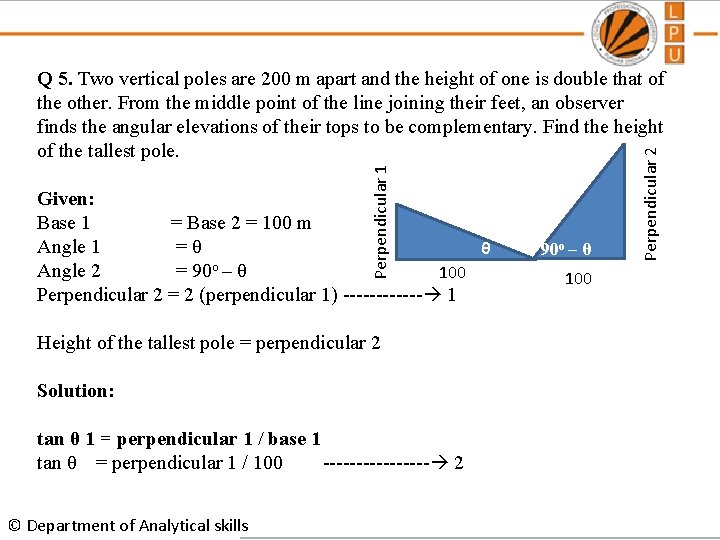
Given: Base 1 = Base 2 = 100 m Angle 1 =θ θ Angle 2 = 90 o – θ 100 Perpendicular 2 = 2 (perpendicular 1) ------ 1 Height of the tallest pole = perpendicular 2 Solution: tan θ 1 = perpendicular 1 / base 1 tan θ = perpendicular 1 / 100 -------- 2 © Department of Analytical skills 90 o – θ 100 Perpendicular 2 Perpendicular 1 Q 5. Two vertical poles are 200 m apart and the height of one is double that of the other. From the middle point of the line joining their feet, an observer finds the angular elevations of their tops to be complementary. Find the height of the tallest pole.
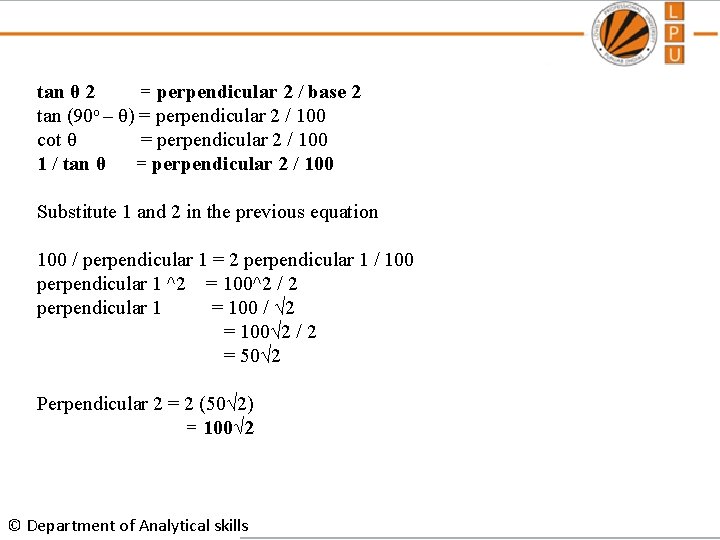
tan θ 2 = perpendicular 2 / base 2 tan (90 o – θ) = perpendicular 2 / 100 cot θ = perpendicular 2 / 100 1 / tan θ = perpendicular 2 / 100 Substitute 1 and 2 in the previous equation 100 / perpendicular 1 = 2 perpendicular 1 / 100 perpendicular 1 ^2 = 100^2 / 2 perpendicular 1 = 100 / √ 2 = 100√ 2 / 2 = 50√ 2 Perpendicular 2 = 2 (50√ 2) = 100√ 2 © Department of Analytical skills
4) Practice problems © Department of Analytical skills
1. From a tower of 80 m high, the angle of depression of a bus is 30°. How far is the bus from the tower? A. B. C. D. 80 m 80√ 3 / 3 m 240 m © Department of Analytical Skills
2. Two men on the same side of a tall building notice the angle of elevation to the top of the building to be 30 o and 60 o respectively. If the height of the building is known to be h =80 m, find the distance (in meters) between the two men. A. B. C. D. 80√ 3 m 80√ 3 / 3 m 80 (√ 3 – 1) m 80√ 3 – 80 / √ 3 m © Department of Analytical skills
3. The top of a 15 metre high tower makes an angle of elevation of 60° with the bottom of an electronic pole and angle of elevation of 30° with the top of the pole. What is the height of the electric pole? A. B. C. D. 5 metres 8 metres 10 metres 12 metres © Department of Analytical skills