
Heel pain Plantar Fasciitis Dr Isstelle Joubert May

Heel pain: Plantar Fasciitis Dr Isstelle Joubert May 2011
Presenting History: Mr A, 39 yo man ü bilateral painful feet ü one year history ü gradual onset ü no history of trauma or recent surgery lower limbs ü job: salesman Previous history: ü Surgical: both ankles, knee and right arm fracture ü Medical: gout, chronic sinusitis ü Social: OH stop July 2010, non-smoker, 4 L coke DAILY! ü Family history: dad died age 48 - myocardial infarction
Clinical examination: ü BP - 130/90 ü BMI - 39. 8 (W=138 kg, H=184 cm) ü Examination of feet: localized tenderness plantar aspects, especially medial calcaneal tuberosities Current chronic medication: ü Puricos 300 i od (raised u/a) ü Glucophage 500 mg i od (raised insulin) ü Lorien 20 mg i od (depressive mood)
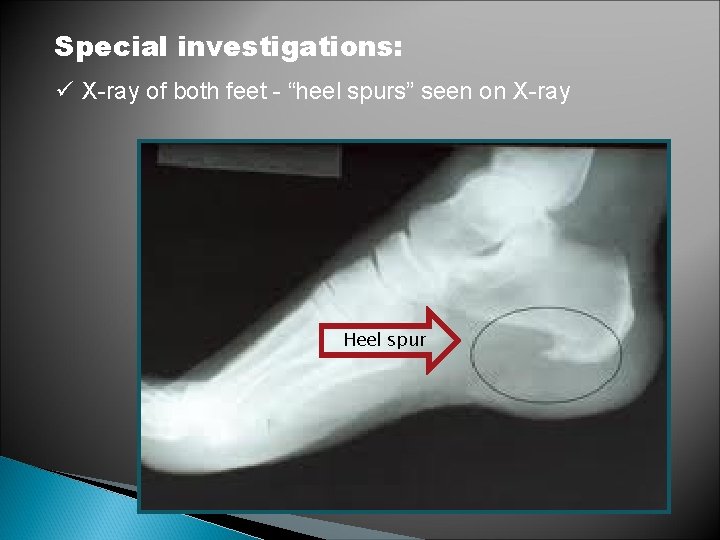
Special investigations: ü X-ray of both feet - “heel spurs” seen on X-ray Heel spur
Management: ü Local infiltration of steroid (both heels) ü Insoles in shoes ü Weight loss advised Follow-up: ü one foot - totally pain free ü other one - some discomfort
Three stage assessment: Biological ü change his current health status drastically - diet, weight, level of exercise Personal/Psychological impact ü fear of loss of income if pain persists ü stays at home when pain is unbearable ü gets frustrated - conflict with clients Social/contextual impact ü expectations colleagues (not staying at home), family (activity, diet - better quality of life)
Problem list: ü Active - bilateral painful feet ü Passive § obesity § hyperinsulinaemia § family history - MI § increased blood levels of uric acid § unhealthy diet § no exercise
Differential diagnosis: ü Plantar fasciitis ü Tibialis posterior syndrome ü Referred pain as a result of a S 1 -radiculopathy ü Stress fracture - calcaneal or navicular ü Fat pad injury ü Peripheral neurogenic pain: tibial nerve related ü Trigger point pain
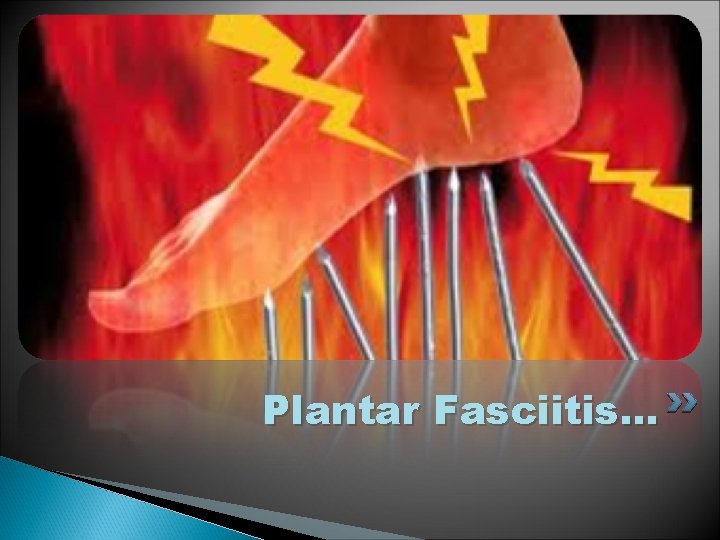
Plantar Fasciitis. . .
Synonyms: ü painful heel syndrome ü heel spur syndrome ü runner’s heel ü subcalcaneal bursitis ü periostitis ü policeman’s heel (most of day-time on their feet)1
Definition: ü musculoskeletal disorder ü affecting the plantar aponeurosis or fascia (inflammation) ü mostly infero-medial aspect
Prevalence: ü young and old ü athletes and non-athletes ü not gender specific 2 United States 3, 4 ü 600 000 outpatient visits annually ü athletes, 5 - 14%5 of running injuries
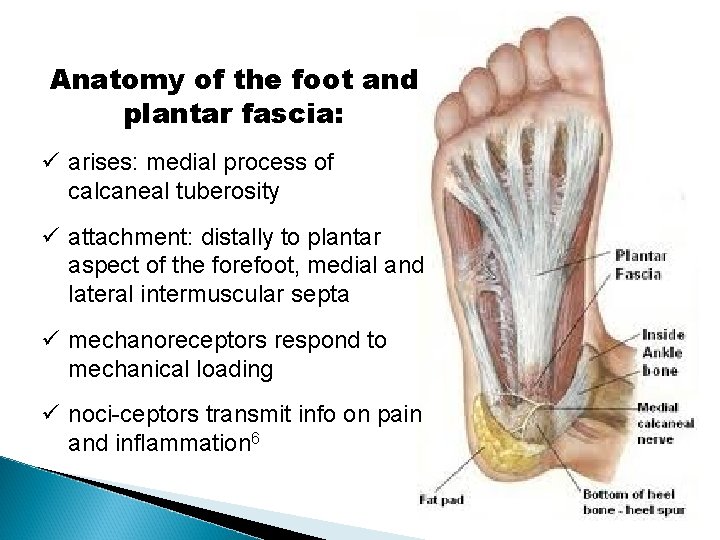
Anatomy of the foot and plantar fascia: ü arises: medial process of calcaneal tuberosity ü attachment: distally to plantar aspect of the forefoot, medial and lateral intermuscular septa ü mechanoreceptors respond to mechanical loading ü noci-ceptors transmit info on pain and inflammation 6
Pathophysiology: ü not well understood ü mechanical overload and excessive strain ü microscopic tears in the fascia ü triggering the inflammatory repair processes ü entesal fibrocartilage - prone to degenerative change ü increase cartilage cell clustering ü formation of fissures within the fibrocartilage ü ossification = spurs
Differential diagnosis 4, 8, 9: Neurologic Soft tissue Skeletal nerve entrapment lumbar spine disorders neuropathies tarsal tunnel syndrome achilles tendonitis fat pad atrophy plantar fascia rupture heel contusion retrocalcaneal bursitis posterior tibial tendonitis calcaneal epiphysitis calcaneal stress fracture inflammatory arthropathies infections (osteomyelitis) subtalar arthritis Other metabolic disorders: tumors osteomalacia, Paget’s vascular insufficiency disease, sickle cell disease
Symptoms and signs: ü pain inferior on heel ü worse on weight bearing ü worse: first few steps in the morning ü persisting from months to years ü character: throbbing or piercing ü improves after resting - worsens again with continued activity throughout the day ü limiting daily activities - walking barefoot, on toes or climbing stairs

tenderness localised to medial aspect of the calcaneal tuberosity
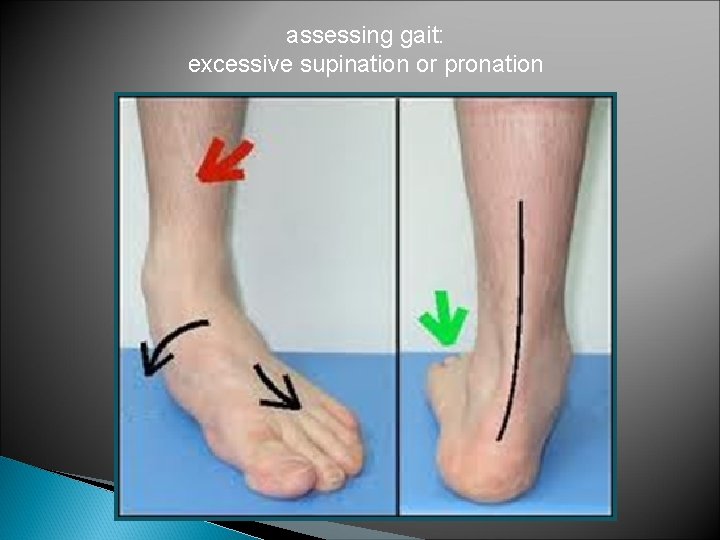
assessing gait: excessive supination or pronation

plantar fascia tight stretching reproduce pain
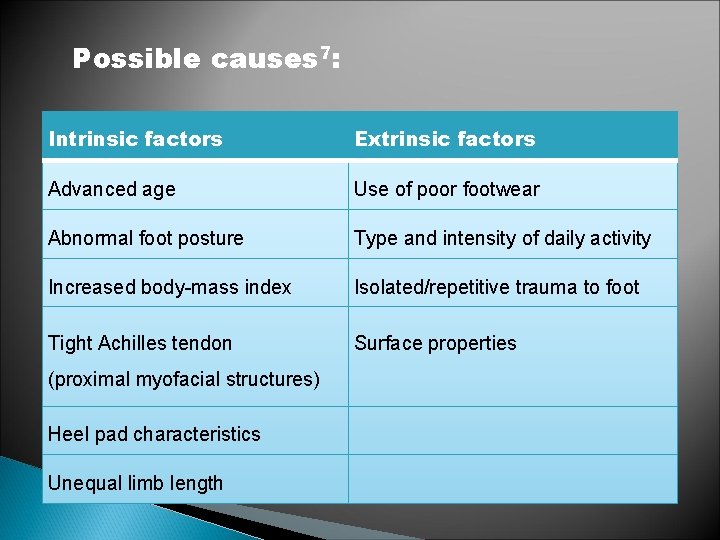
Possible causes 7: Intrinsic factors Extrinsic factors Advanced age Use of poor footwear Abnormal foot posture Type and intensity of daily activity Increased body-mass index Isolated/repetitive trauma to foot Tight Achilles tendon Surface properties (proximal myofacial structures) Heel pad characteristics Unequal limb length
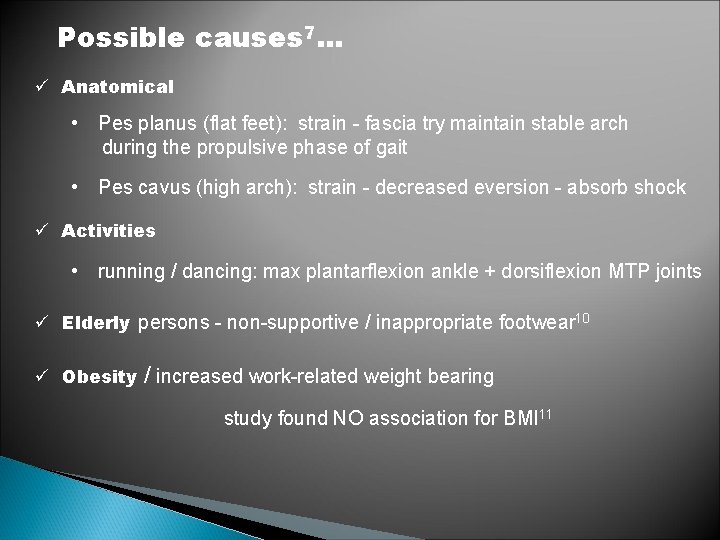
Possible causes 7. . . ü Anatomical • Pes planus (flat feet): strain - fascia try maintain stable arch during the propulsive phase of gait • Pes cavus (high arch): strain - decreased eversion - absorb shock ü Activities • running / dancing: max plantarflexion ankle + dorsiflexion MTP joints ü Elderly persons - non-supportive / inappropriate footwear 10 ü Obesity / increased work-related weight bearing study found NO association for BMI 11
Special investigations: • aim ü confirm the diagnosis • modalities available ü ü ü ultrasound plain x-rays of feet bone-scan MRI nerve conduction studies blood tests
Special investigations: • Ultrasound ü useful ü non-invasive technique ü increased thickness + hypo-echoic fascia
Special investigations: • Plain x-rays of feet ü generally unhelpful ü rule out stress fractures of calcaneus ü calcifications noticed + osteophytes (heel spurs) study: osteophytes visible 50% with plantar fasciitis, 19% without plantar fasciitis 12
Special investigations: • Bone-scan ü increased uptake at the calcaneus ü not very specific technique ü very sensitive ü potential malignant bony lesions

Special investigations: • Magnetic Resonance Imaging (MRI) ü thickening of the plantar fascia ü detecting tears or rupture of the fascia
Special investigations: • Nerve conducting studies ü no improvement in three months’ of conservative Rx ü ? other causes: nerve entrapment / tarsal tunnel syndrome
Special investigations: • Blood tests ü CRP - ? infection ü HLA B 27 -genes - ? HLA-B 27 -spondyloarthropaties (psoriatic arthritis or ankylosing spondylitis) ü uric acid - gout ü raised ALP, normal PO 4 + Ca 2+ - ? Paget’s disease
Management: • Avoidance of aggravating activities • Cryotherapy • NSAID • Stretching • Night splinting • Taping • Soft tissue therapy • Foot orthoses • Corticosteroid injection • Iontophoresis 16 • Extracorporeal shock wave therapy 17, 18 • Surgery
Management: • Avoidance of aggravating activities • Cryotherapy 8 ↓ pain by ↓ motor, sensory nerve conduction velocity ↓ swelling, cellular metabolism methods reusable cold packs / crushed ice bags ice massage / endothermal cold packs (towel between bag and skin - avoid nerve damage/ frostbite) on area of pain - 5 - 30 minutes • NSAID: orally / topically / injection (1 st month of Rx) ↓ local inflammation
Management: • Stretching 7: • Focus on calf and Achilles tendon or plantar fascia itself • Key-component in Rx • Short term benefits pain relief increased calf flexibility • Long-term benefits decrease in pain and functional limitations high rate of satisfaction effective inexpensive easy to implement-tool
Management: • Taping: ü designed to provide inversion of the calcaneus ü improving the biomechanical position and stability ü limits the range of motion ü increase proprioception ü increase reduction of intensity of pain • Biomechanical correction with foot orthoses: ü ↓ pain associated with plantar fasciitis 14 ü prefabricated foot orthoses + stretching = ↓ pain ü silicone heel pads / well supported arches and midsoles
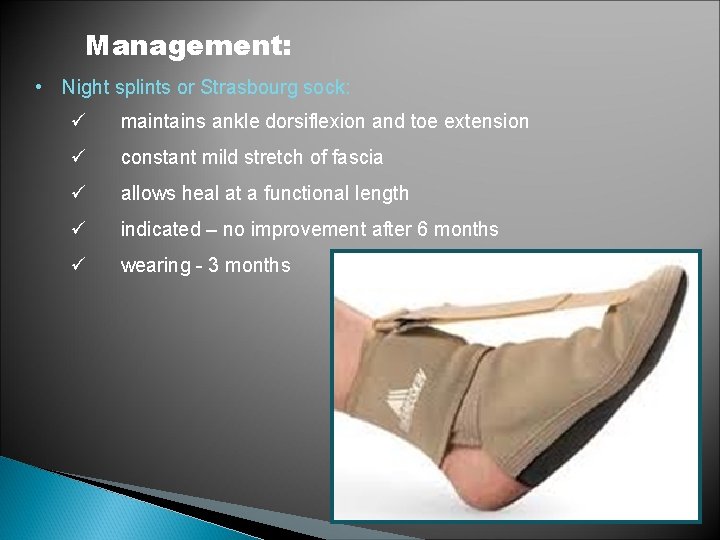
• Management: Night splints or Strasbourg sock: ü maintains ankle dorsiflexion and toe extension ü constant mild stretch of fascia ü allows heal at a functional length ü indicated – no improvement after 6 months ü wearing - 3 months
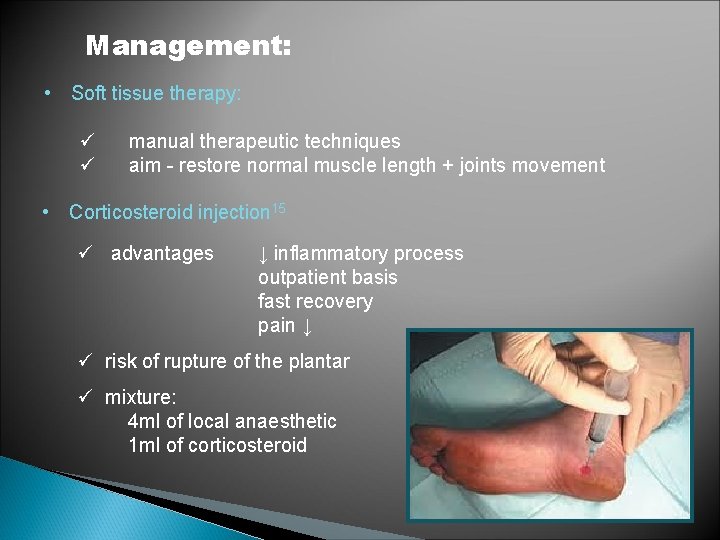
Management: • Soft tissue therapy: ü manual therapeutic techniques ü aim - restore normal muscle length + joints movement • Corticosteroid injection 15 ü advantages ↓ inflammatory process outpatient basis fast recovery pain ↓ ü risk of rupture of the plantar ü mixture: 4 ml of local anaesthetic 1 ml of corticosteroid
Management: • Iontophoresis 16 ü topically applied steroid Dexamethasone 0. 4% or acetic acid 5% delivered topically ü propelled into the injured tissue with a small electric charge ü short term pain relief (2 - 4 weeks)
• Management: 17, 18 Extracorporeal shock wave therapy ü what: • stimulation healing of the soft tissue • reduction of calcification • inhibition of pain receptors or denervation • to achieve pain relief ü proposed responses due to • release of enzymes • hyperstimulation of axons • release of nitrous oxide and growth factors ü Three devices • Ossa. Tron • Epos Ultra • Sonorex
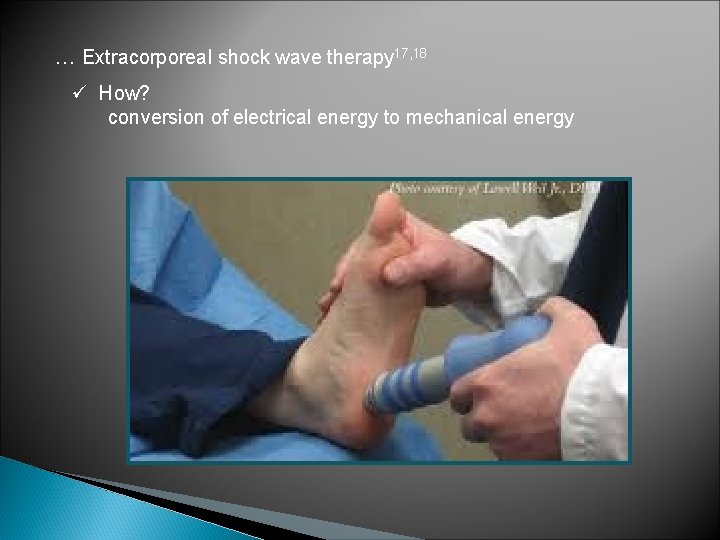
. . . Extracorporeal shock wave therapy 17, 18 ü How? conversion of electrical energy to mechanical energy

Management: . . . Extracorporeal shock wave therapy 17, 18 ü four main goals § 50% improvement in pain from baseline § ↓ pain on rising, walking in morning of at least 50% § ↑ activity level + self-assessed ability to move pain free for time + distance § discontinuation of pain meds ü Successful when: all criteria are met in 3 - 12 months after treatment
• Management: Surgery: ü Options isolated, partial or complete release with or without the resection of the calcaneal spur excision of abnormal tissue or nerve decompression ü Open or via endoscopic approach ü Who? moderate to severe symptoms persistent resistant in spite of conservative management at least six months ü Endoscopic procedures more rapid recovery return to pre-surgery activities
What is new / controversial in plantar fasciitis? ü Shock waves ü Elastography 20 ü Botulinum toxin A 21 ü Bipolar radiofrequency 22 ü Acupunture 23 ü Platelet rich plasma therapy 24, 25

What is new / controversial in plantar fasciitis? • Shock waves: • sound waves create vibrations • cause controlled injury to tissue • ↑ healing ability • ↑ repair process • Intracorporeal pneumatic shock 19 therapy vs extracorporeal shock wave therapy • energy generated inside / outside the body • when extracorporeal shock devices are not available • cheap, readily available, effective, safe
What is new / controversial in plantar fasciitis? • Elastography 20 ü new modality ü measures tissue elasticity of plantar fascia ü detect early stages of plantar fasciitis ü ultrasonography (U/S): • U/S: 65. 8% sensitivity, 75% specificity • elastography: 95% sensitivity, 100% specificity • sono-elastography ↑ accuracy of dx from 68% to 96% • staging of disease
What is new / controversial in plantar fasciitis? • Botulinum toxin A 21: ü improve pain relief and overall foot function ü ease severe muscle contractions ü decrease inflammatory reactions ü diminish wrinkles + tension headaches Dr Brodsky, president of American Orthopaedic Foot and Ankle Society ü pain relief lasted at least one year ü larger study under way ü cost-effectiveness - $$ ü refractory patients
What is new / controversial in plantar fasciitis? • Bipolar radiofrequency 22: ü minimally invasive technique ü viable surgical treatment option ü not improve on conservative measures • Acupunture 23: ü enhances inhibitory processes ü by stimulation of trigger points ü muscles and peripheral nerves ü increase the concentration of endorphins in the CNS ü decreasing local inflammation
What is new / controversial in plantar fasciitis? • Platelet rich plasma therapy 24, 25 (autologous growth factors) ü new therapy ü mid 1990’s for the discipline of maxillofacial surgery ü pain relief ü long lasting healing of musculoskeletal conditions ü sample of patient’s blood - centrifuge ü separates platelets from other components ü concentrated platelet rich plasma injected into site of injury ü initiates an increased healing response ü lasting results

Plantar Fasciitis In conclusion. . . v think on your feet. . . v Be aware of many reasons for painful feet v Be aware of many management options
References: 1. Akhtar A, Abbasie SH, Shami A et al. A comparative study of conventional versus interventional treatment in patients of plantar fasciitis. Ann Pak Inst Med Sci 2009; 5(2): 81 -83 2. Di. Giovanni BF, Nawoczenski DA, Lintal ME, et al. Tissue specific plantar fascia stretching exercise enhances outcomes in patients with chronic heel pain. The Journal of Bone and Joint Surgery 2003; 85 A: 1270 -77 3. Riddle DL, Schappert SM. Volume of ambulatory care visits and patterns of care for patients diagnosed with plantar fasciitis: a national study of medical doctors. Foot Ankle Int 2004; 25: 303 -10 4. Cole C, Seto C, Gazewood J. Plantar Fasciitis: evidence-based review of diagnosis and therapy. Am Fam Physician 2005; 72: 2237 -42 5. Noakes T. Lore of Running. Human Kinetics 2001 6. Wearing SC, Smeathers JE, Urry SR et al. The pathomechanics of plantar fasciitis. Sports Med 2006; 36 (7): 585 -611 7. Leaque AC. Current concepts Review: Plantar Fasciitis. Foot and Ankle international. 2008; 29 (3) 358 -366
References: 8. Brukner P, Khan K. Clinical Sports Medicine 3 rd edition. Mc. Graw Hill 2002. 9. Murphy C. Plantar Fasiitis. Sportex. net 10. Riddle DL, Pulisic M, Pidcoe P, et al. Risk factors for plantar fasciitis: a matched case-control study. J Bone Joint Surg Br. 2003; 85 B (5): 872 -7 11. Irving DB, Cook JL, Menz HB. Factors associated with chronic plantar heel pain: a systematic review. Journal of Science and Medicine in Sport 2006; 9: 11 -22 12. Di. Marcangelo MT, Yu TC. Diagnostic imaging of heel pain and plantar fasciitis. Clin Podiatr Med Surg 1997; 14: 281 -301. 13. Potter AJ. Investigating plantar Fasciitis. Foot and Ankle online Journal. Nov 2009 2(11): 4. 14. Hume P, Hopkins W, Rome K et al. Effectiveness of Foot orthoses for treatment and prevention of lower limb injuries. Sports Med 2008; 38 (9): 759 -779
References: 15. Wen-Chung T, Chih-Chin Hsu, Carl PC et al. Plantar fasciitis treated with local steroid injection: comparison between sonographic and palpation guidance. Journal of Clinical U/S Jan 2006 ; 34 (1) 12 -16 16. Foye PM, Lorenzo CT. Physical medicine and rehabilitation for plantar fasciitis treatment and management. Sep 2010. 17. Kaltenborn JM. The Efficacy of Extracorporeal shock-wave treatment: a new perspective. Human Kinetics. 2005; 6: 50 -51 18. Moretti B, Garofalo R, Patella V et al. Extracorporeal shock wave therapy in runners with a symptomatic heel spur. Knee Surg Sports Traumatol Arthrose 2006; 14: 1029 -1032 19. Dogramaci Y, Kalaci A, Emir A, Yanat AN, Gökce A. Intracorporeal pneumatic shock application for the treatment of chronic plantar fasciitis: a randomized, double blind prospective clinical trial. Arch Orthop Trauma Surg. 2010 Apr; 130 (4): 541 -6. Epub 2009 Aug 11 20. Kapoor A, Sandhu HS, Sandhu PS et al. Realtime elastography in plantar fasciitis: comparison with ultrasonography and MRI. Current orthopaedic practice. Nov/Dec 2010; 21(6): 600 -608
References: 21. Zablocki E. Botulinum toxin injection decreases plantar fascia pain. Medscape medical news. Nov 2005. 22. Weil L Jnr, Glover JP, Weil LS Sr. A new minimally invasive technique for treating plantar fasciosis using bipolar radiofrequency: a prospective analysis. Foot Ankle Spec Feb 2008; 1 (1): 13 -18 23. Perez-Millan R, Foster L. Low frequency electro-acupuncture in the management of refractory plantar fasciitis: a case series. Medical Acupuncture: a Journal for physicians by physicians. 2001(13) nr 1. 24. Creaney L, Hamilton B. Growth factor delivery methods in management of sports injuries: the state of play. Br. J. Sports Med. Nov 2007. 25. Barrett SL, Erredge SE. Growth Factors for Chronic Plantar Fasciitis? Podiatry Today. Nov 2004.
- Slides: 50