
Hedging with Tbond Futures Example Suppose a mortgage
Hedging with T-bond Futures • Example: – Suppose a mortgage banker has agreed on March 1 st to supply $1 million in funds to clients wishing to purchase homes. The terms of the agreement are for 12% mortgages over 20 years. So, 12% is the “market rate” as of March 1 st, when this agreement is made. – Furthermore, the broker has agreed to supply these funds on May 1 st, (2 months later).
Hedging with T-bond Futures • Many mortgage bankers (including this one) make these agreements before they have the $1 million dollars in hand. • So, they must shop around to find a buyer for the 12% mortgages that will be established on May 1 st. The buyer purchases the mortgages and provides funds to be passed on to the home buyers. The mortgage banker will play middle man.
Hedging with T-bond Futures • It takes time to shop around for a buyer. Many insurance companies look for such opportunities to invest part of their excess cash. • Suppose on April 15 th, the mortgage banker finds a willing insurance company to buy the mortgages.
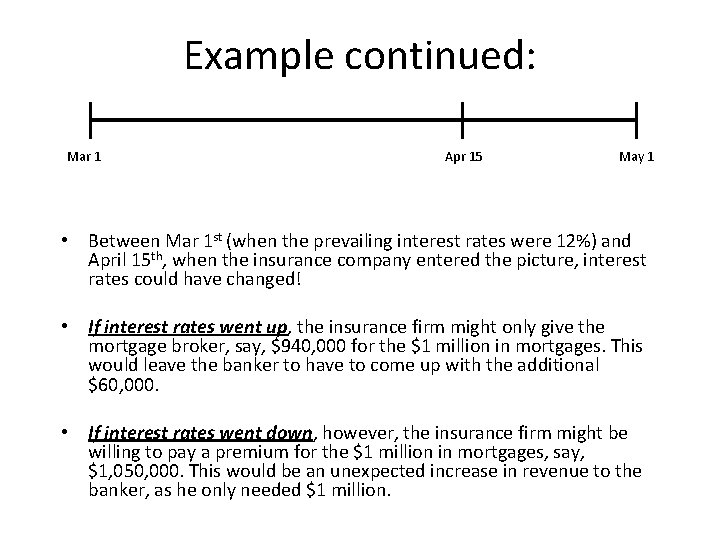
Example continued: Mar 1 Apr 15 May 1 • Between Mar 1 st (when the prevailing interest rates were 12%) and April 15 th, when the insurance company entered the picture, interest rates could have changed! • If interest rates went up, the insurance firm might only give the mortgage broker, say, $940, 000 for the $1 million in mortgages. This would leave the banker to have to come up with the additional $60, 000. • If interest rates went down, however, the insurance firm might be willing to pay a premium for the $1 million in mortgages, say, $1, 050, 000. This would be an unexpected increase in revenue to the banker, as he only needed $1 million.
Questions: • How could the Mortgage Broker hedge against this Interest Rate Risk using Treasury Bond Futures (a. k. a. Interest Rate Futures)? – Should the broker take a long or short position? – How many contracts to cover exposure? – When should these contracts be entered into and when should they be closed out (reverse the position)?
Example continued: • How could the Mortgage Broker hedge against this Interest Rate Risk? • Use Treasury Bond Futures (a. k. a. Interest Rate Futures). • Current situation: – If interest rates go up, banker gets hurt – If interest rates go down, banker profits. • To hedge, we want an instrument that has the opposite reactions to interest rate changes!
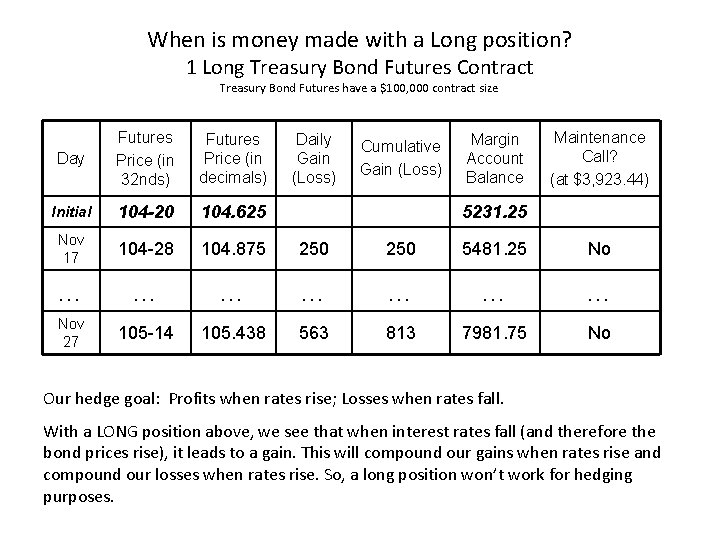
When is money made with a Long position? 1 Long Treasury Bond Futures Contract Treasury Bond Futures have a $100, 000 contract size Day Futures Price (in 32 nds) Futures Price (in decimals) Initial 104 -20 104. 625 Nov 17 104 -28 104. 875 250 5481. 25 No … … … … Nov 27 105 -14 105. 438 563 813 7981. 75 No Daily Gain (Loss) Cumulative Gain (Loss) Margin Account Balance Maintenance Call? (at $3, 923. 44) 5231. 25 Our hedge goal: Profits when rates rise; Losses when rates fall. With a LONG position above, we see that when interest rates fall (and therefore the bond prices rise), it leads to a gain. This will compound our gains when rates rise and compound our losses when rates rise. So, a long position won’t work for hedging purposes.
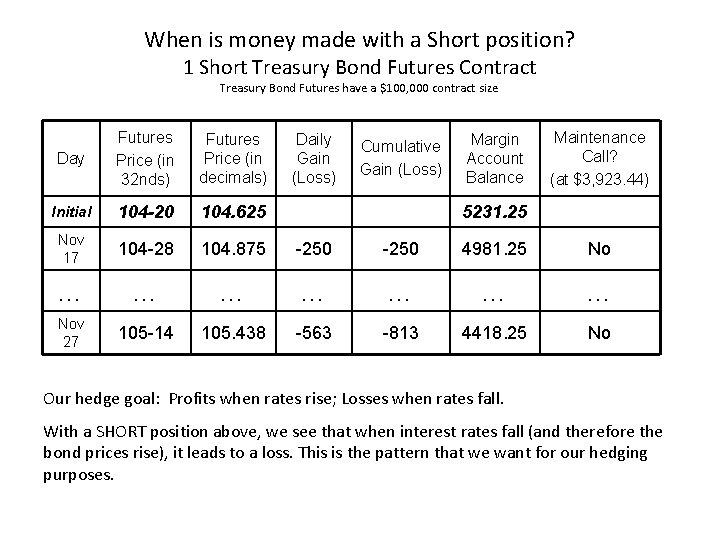
When is money made with a Short position? 1 Short Treasury Bond Futures Contract Treasury Bond Futures have a $100, 000 contract size Day Futures Price (in 32 nds) Futures Price (in decimals) Initial 104 -20 104. 625 Nov 17 104 -28 104. 875 -250 4981. 25 No … … … … Nov 27 105 -14 105. 438 -563 -813 4418. 25 No Daily Gain (Loss) Cumulative Gain (Loss) Margin Account Balance Maintenance Call? (at $3, 923. 44) 5231. 25 Our hedge goal: Profits when rates rise; Losses when rates fall. With a SHORT position above, we see that when interest rates fall (and therefore the bond prices rise), it leads to a loss. This is the pattern that we want for our hedging purposes.
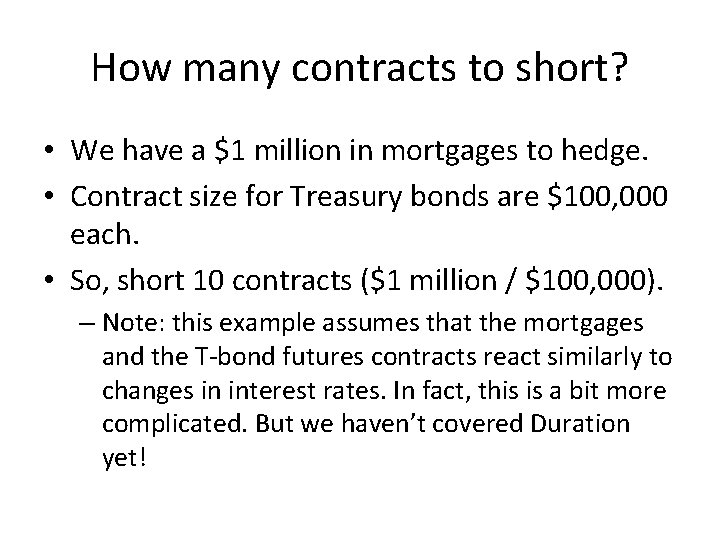
How many contracts to short? • We have a $1 million in mortgages to hedge. • Contract size for Treasury bonds are $100, 000 each. • So, short 10 contracts ($1 million / $100, 000). – Note: this example assumes that the mortgages and the T-bond futures contracts react similarly to changes in interest rates. In fact, this is a bit more complicated. But we haven’t covered Duration yet!
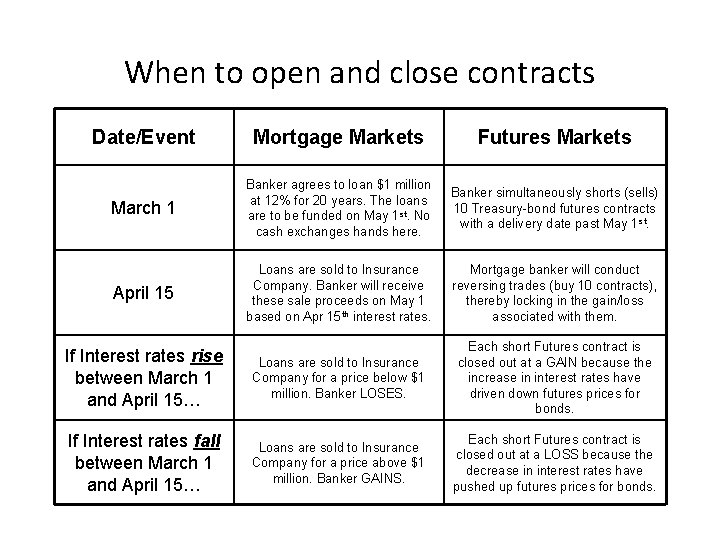
When to open and close contracts Date/Event Mortgage Markets Futures Markets March 1 Banker agrees to loan $1 million at 12% for 20 years. The loans are to be funded on May 1 st. No cash exchanges hands here. Banker simultaneously shorts (sells) 10 Treasury-bond futures contracts with a delivery date past May 1 st. April 15 Loans are sold to Insurance Company. Banker will receive these sale proceeds on May 1 based on Apr 15 th interest rates. Mortgage banker will conduct reversing trades (buy 10 contracts), thereby locking in the gain/loss associated with them. If Interest rates rise between March 1 and April 15… Loans are sold to Insurance Company for a price below $1 million. Banker LOSES. Each short Futures contract is closed out at a GAIN because the increase in interest rates have driven down futures prices for bonds. If Interest rates fall between March 1 and April 15… Loans are sold to Insurance Company for a price above $1 million. Banker GAINS. Each short Futures contract is closed out at a LOSS because the decrease in interest rates have pushed up futures prices for bonds.
- Slides: 10