
HECRAS Mixed Flow Jon Fripp NDCSMC 2016 Module


- Slides: 32
HEC-RAS Mixed Flow Jon Fripp NDCSMC 2016
Module 6: Mixed Flow What does “Mixed Flow” mean? Why should we care? Issues with ‘fast’ water
Subcritical Flow: • • • Described as tranquil or streaming Lower energy Deeper depths (greater than critical) Slower Velocities Surface waves propagate upstream and downstream Most common flow in natural channels Super Critical Flow: • • • Described as shooting, rapid, and torrential. Higher energy Shallow depths (less than critical) Higher velocities Surface waves propagate only downstream Generally see supercritical flow only on very short stretches of natural channels
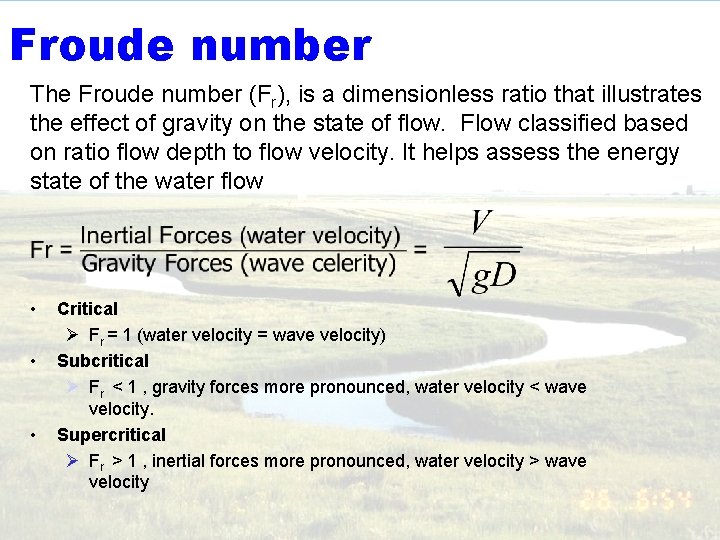
Froude number The Froude number (Fr), is a dimensionless ratio that illustrates the effect of gravity on the state of flow. Flow classified based on ratio flow depth to flow velocity. It helps assess the energy state of the water flow • • • Critical Ø Fr = 1 (water velocity = wave velocity) Subcritical Ø Fr < 1 , gravity forces more pronounced, water velocity < wave velocity. Supercritical Ø Fr > 1 , inertial forces more pronounced, water velocity > wave velocity
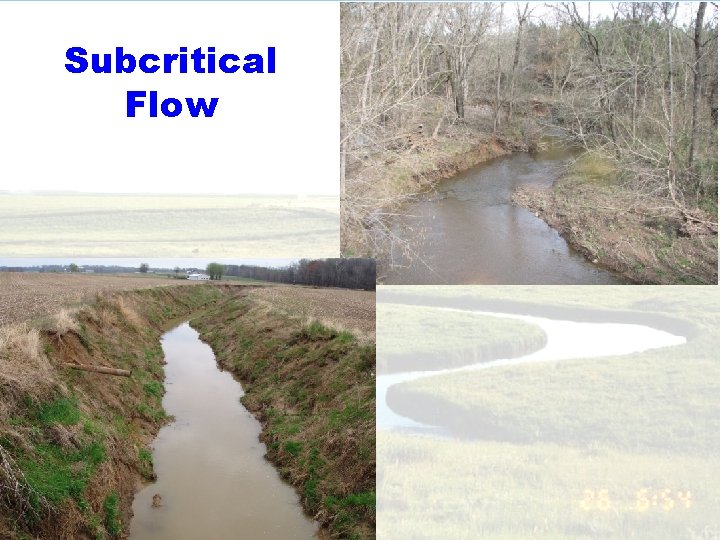
Subcritical Flow
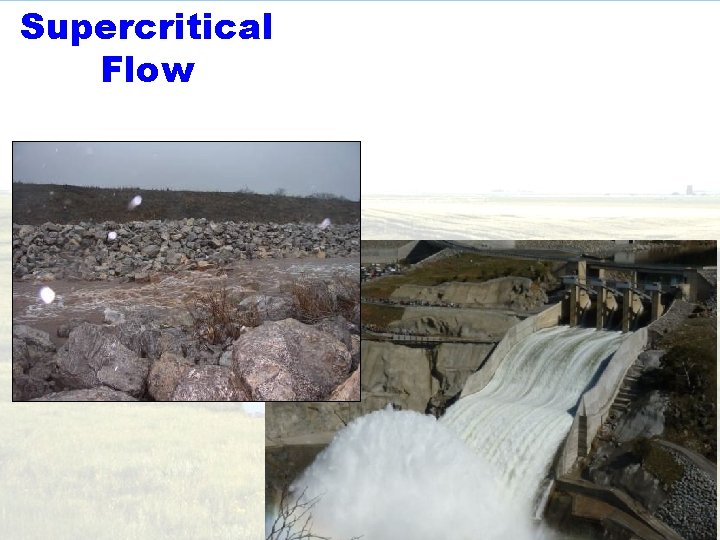
Supercritical Flow
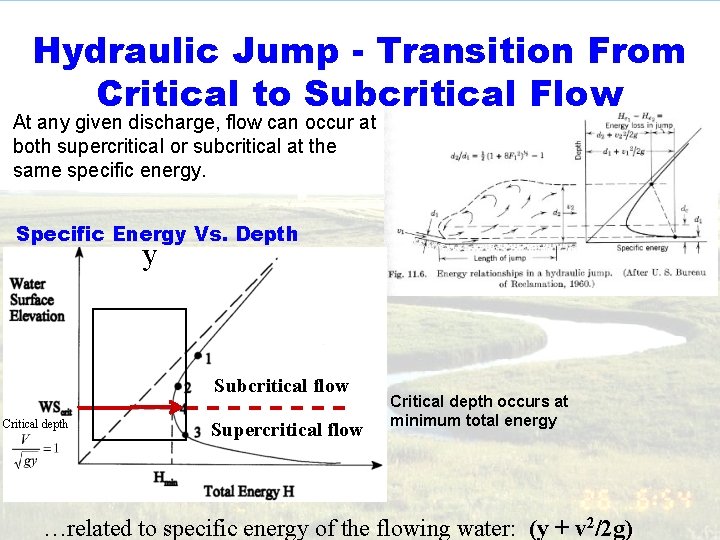
Hydraulic Jump - Transition From Critical to Subcritical Flow At any given discharge, flow can occur at both supercritical or subcritical at the same specific energy. Specific Energy Vs. Depth y Subcritical flow Critical depth Supercritical flow Critical depth occurs at minimum total energy …related to specific energy of the flowing water: (y + v 2/2 g)
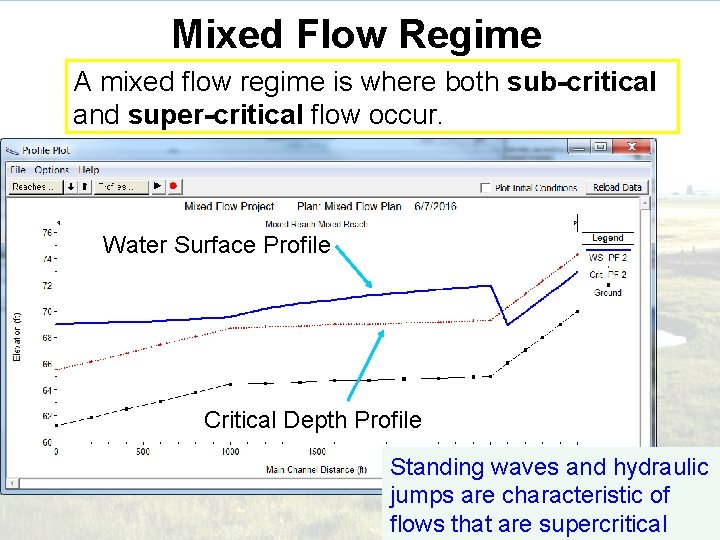
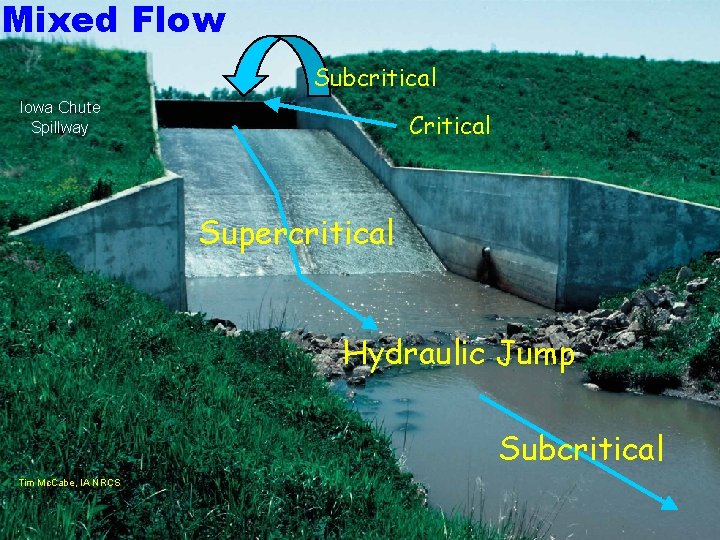
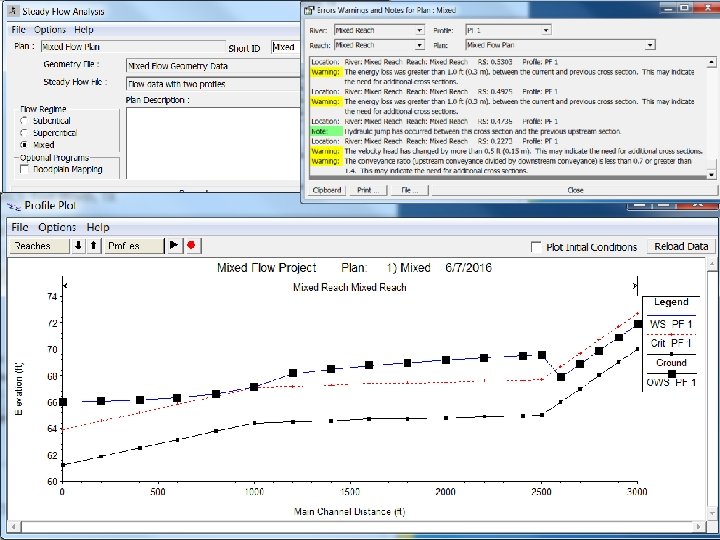
Mixed Flow Regime A mixed flow regime is where both sub-critical and super-critical flow occur. Water Surface Profile Critical Depth Profile Standing waves and hydraulic jumps are characteristic of flows that are supercritical
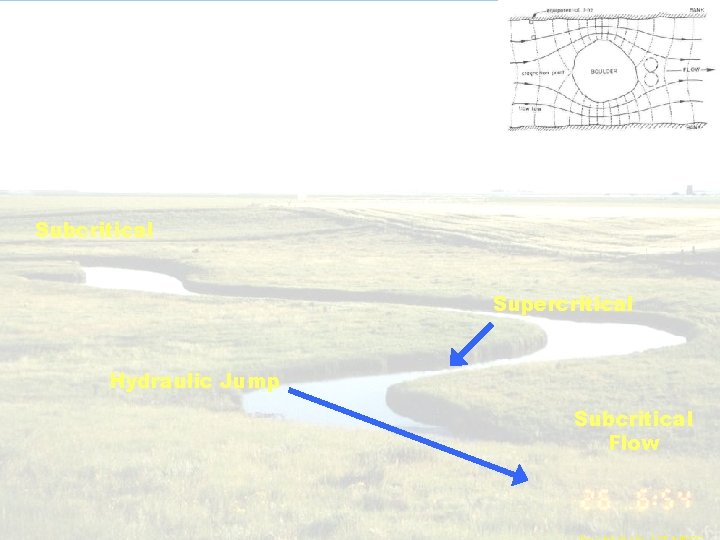
Mixed Flow Subcritical Supercritical Hydraulic Jump Subcritical Flow
Mixed Flow Subcritical Iowa Chute Spillway Critical Supercritical Hydraulic Jump Subcritical Tim Mc. Cabe, IA NRCS
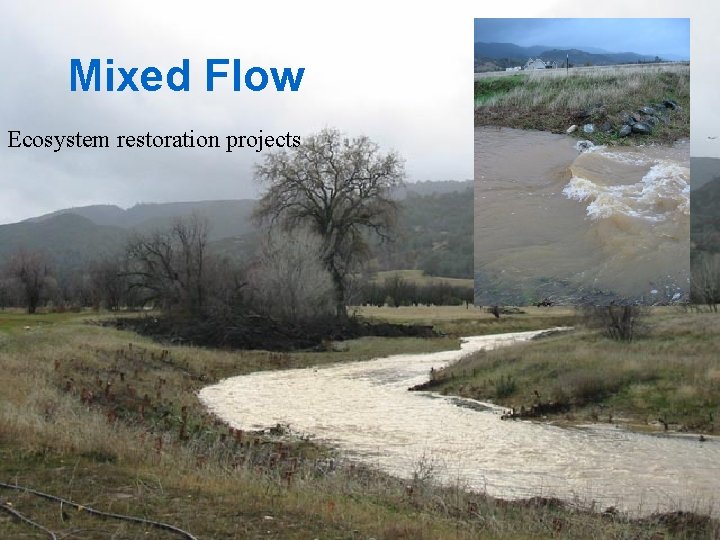
Mixed Flow Ecosystem restoration projects
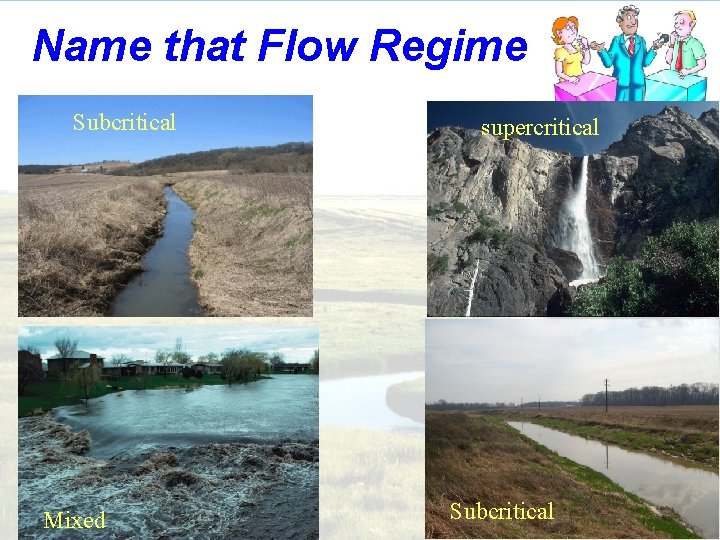
Name that Flow Regime Subcritical Mixed supercritical Subcritical
Some things to think about If your design has very high velocities • High velocities can result in significant damage to the channel boundary • High velocities are can be associated with standing waves and turbulence • Supercritical flow can cause significant erosion in natural channels which can increase roughness and result in subcritical flow which can increase depth • When flows are supercritical, air entrainment and bulking can occur • Highway departments typically require a higher factor of safety for supercritical flows • TR 25 states “…. all supercritical channels not excavated in rock will require lining…” • Appendix C of FEMA’s Guidelines and Specification for Flood Hazard Mapping Partners states “Elevations associated with supercritical flow for natural streams are not plotted on flood profiles or reflected on FIRMs. With the approval of the RPO, supercritical flood profiles may be shown for concrete lined chutes, specifically designed and constructed to carry supercritical flow. ”
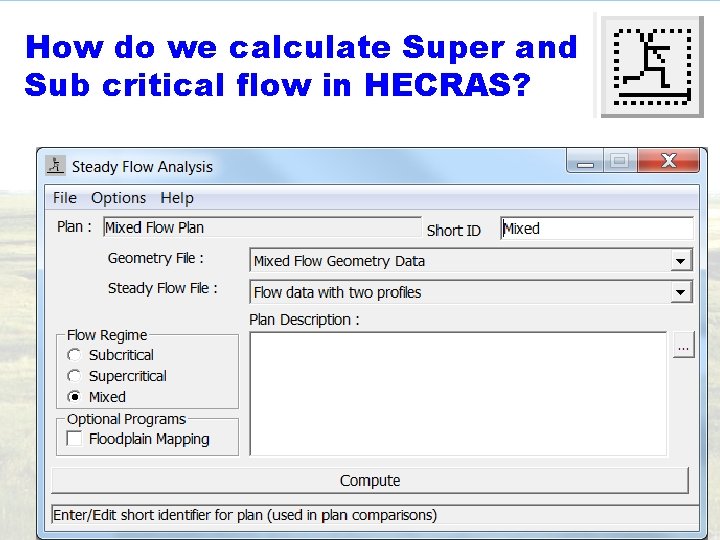
How do we calculate Super and Sub critical flow in HECRAS?
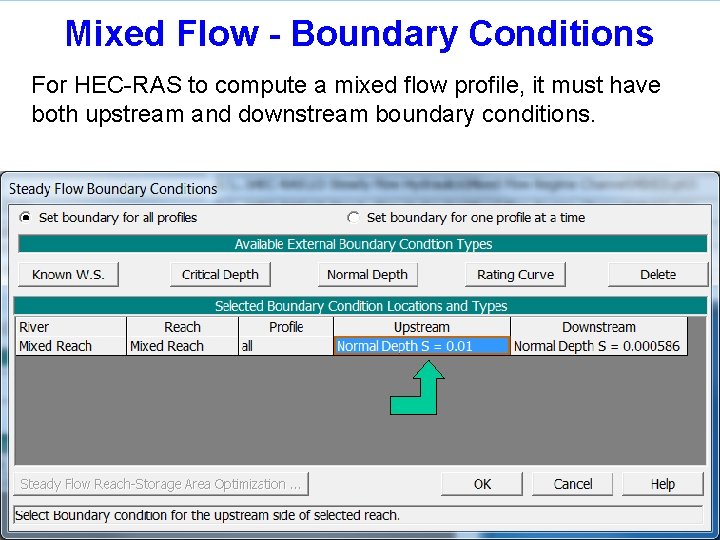
Mixed Flow - Boundary Conditions For HEC-RAS to compute a mixed flow profile, it must have both upstream and downstream boundary conditions.
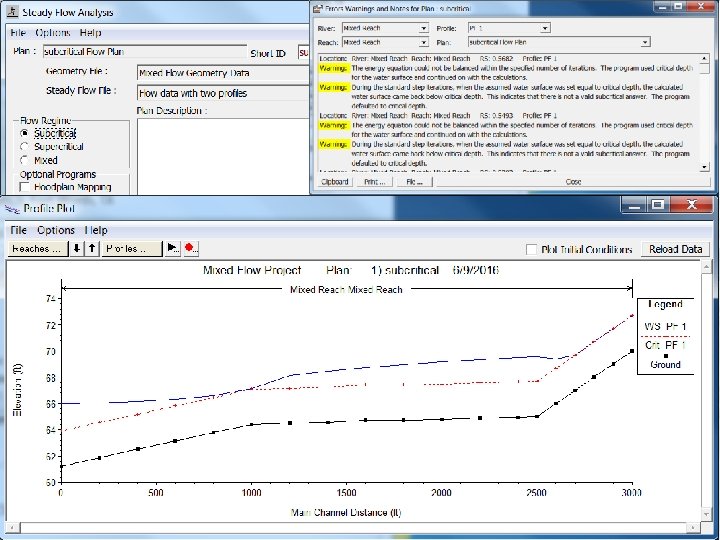
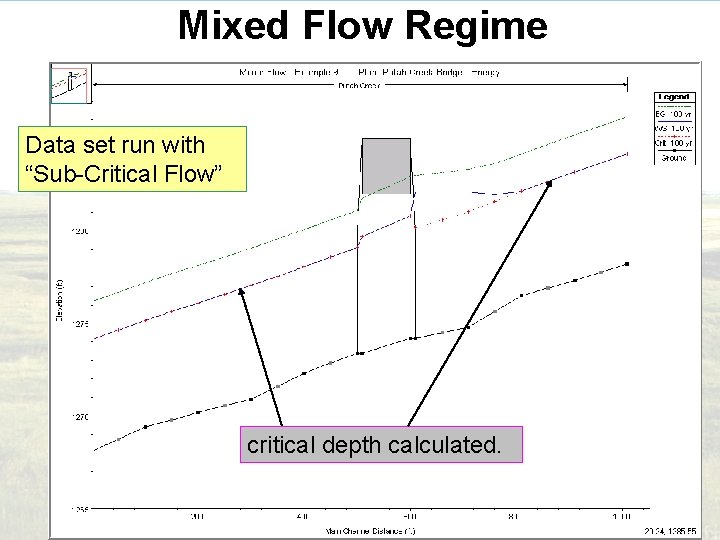
Mixed Flow Regime Data set run with “Sub-Critical Flow” critical depth calculated.
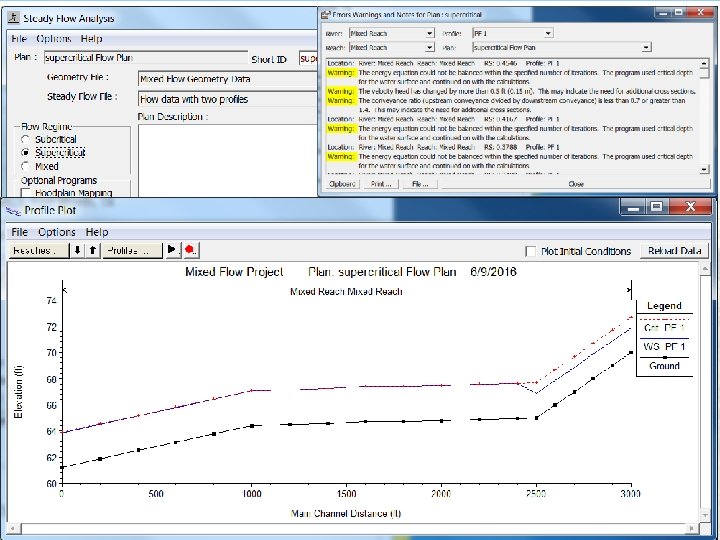
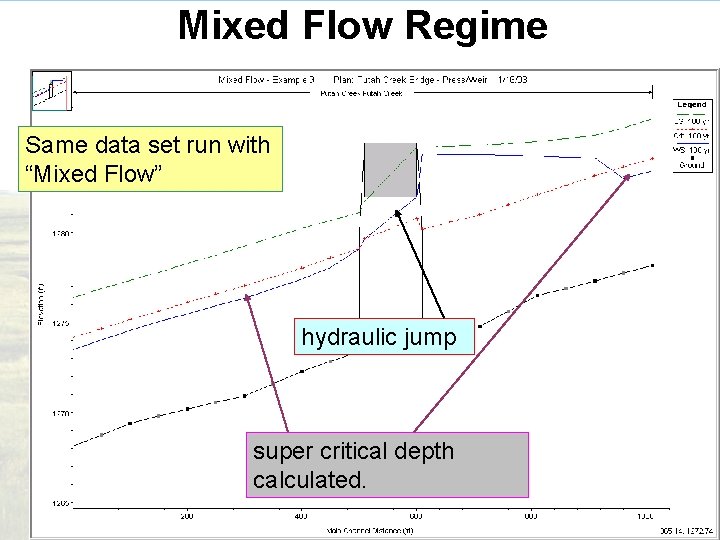
Mixed Flow Regime Same data set run with “Mixed Flow” hydraulic jump super critical depth calculated.
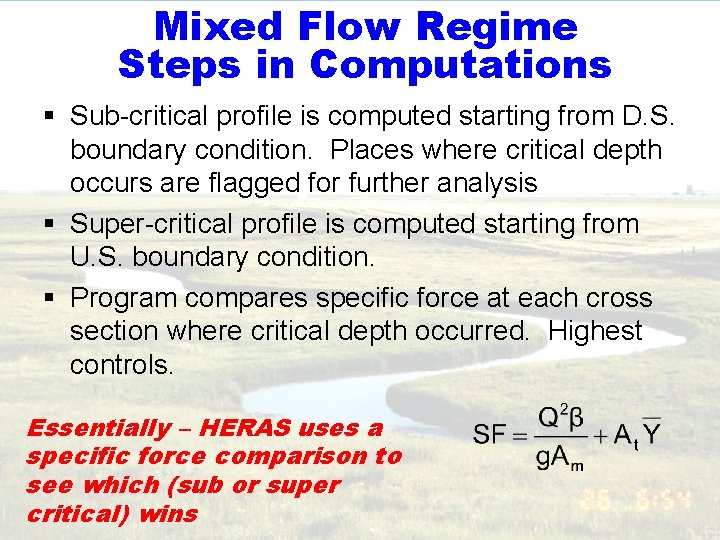
Mixed Flow Regime Steps in Computations § Sub-critical profile is computed starting from D. S. boundary condition. Places where critical depth occurs are flagged for further analysis § Super-critical profile is computed starting from U. S. boundary condition. § Program compares specific force at each cross section where critical depth occurred. Highest controls. Essentially – HERAS uses a specific force comparison to see which (sub or super critical) wins
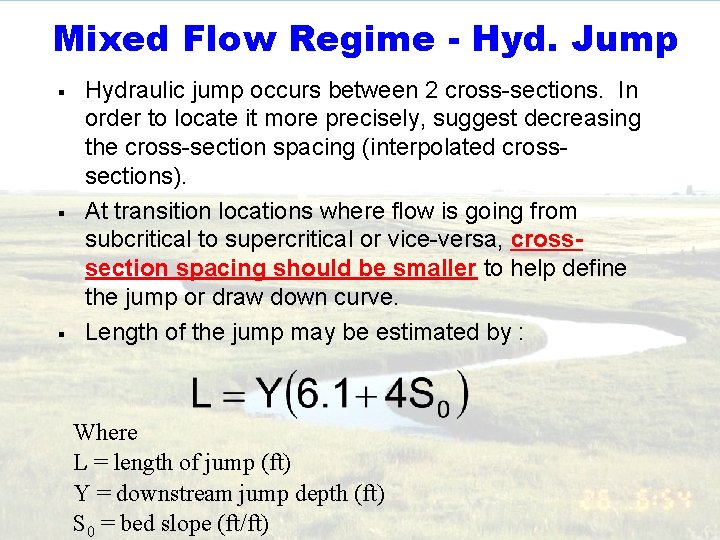
Mixed Flow Regime - Hyd. Jump § § § Hydraulic jump occurs between 2 cross-sections. In order to locate it more precisely, suggest decreasing the cross-section spacing (interpolated crosssections). At transition locations where flow is going from subcritical to supercritical or vice-versa, crosssection spacing should be smaller to help define the jump or draw down curve. Length of the jump may be estimated by : Where L = length of jump (ft) Y = downstream jump depth (ft) S 0 = bed slope (ft/ft)
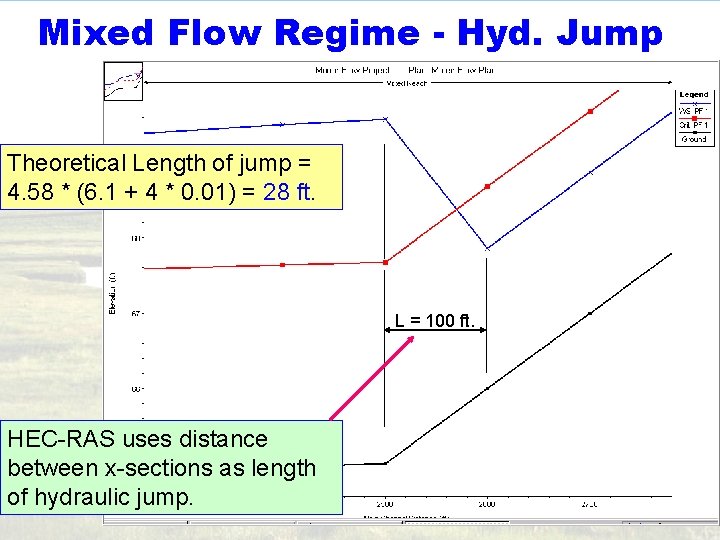
Mixed Flow Regime - Hyd. Jump Theoretical Length of jump = 4. 58 * (6. 1 + 4 * 0. 01) = 28 ft. L = 100 ft. HEC-RAS uses distance between x-sections as length of hydraulic jump.
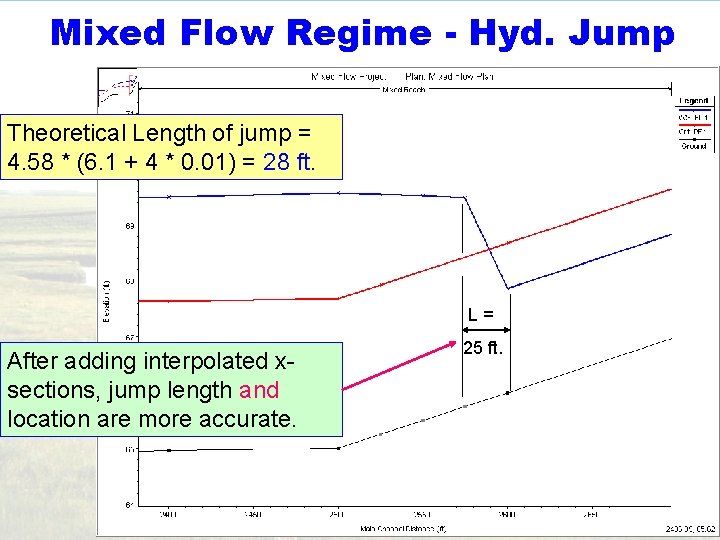
Mixed Flow Regime - Hyd. Jump Theoretical Length of jump = 4. 58 * (6. 1 + 4 * 0. 01) = 28 ft. L = After adding interpolated xsections, jump length and location are more accurate. 25 ft.
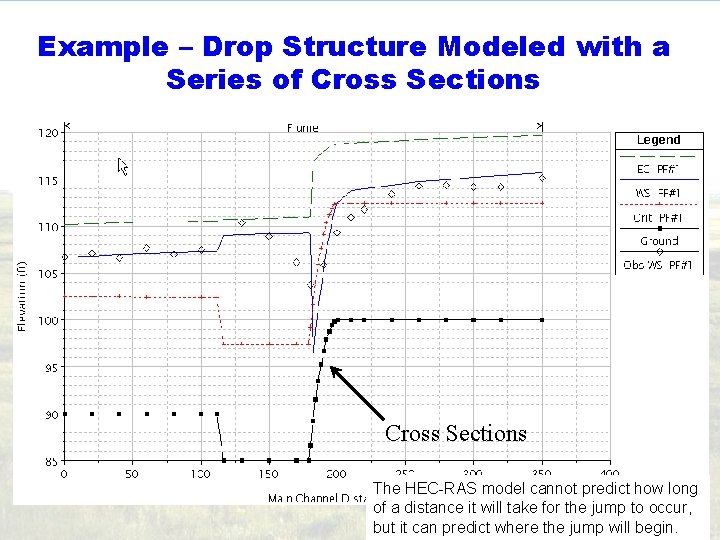
Example – Drop Structure Modeled with a Series of Cross Sections The HEC-RAS model cannot predict how long of a distance it will take for the jump to occur, 25 but it can predict where the jump will begin.
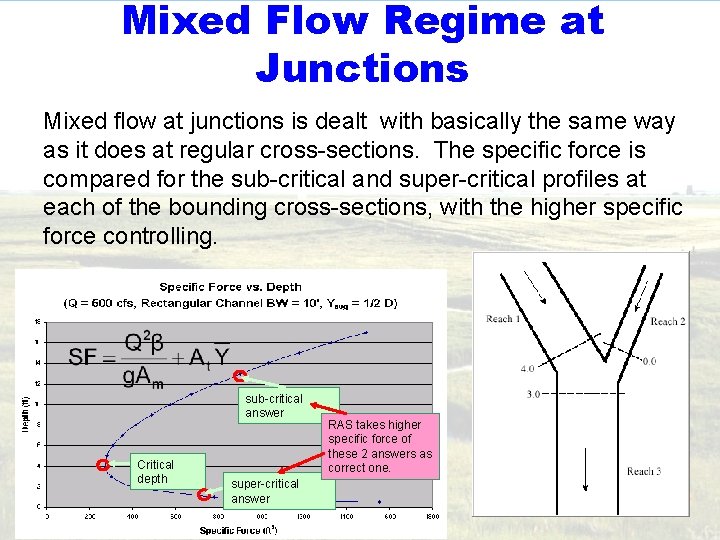
Mixed Flow Regime at Junctions Mixed flow at junctions is dealt with basically the same way as it does at regular cross-sections. The specific force is compared for the sub-critical and super-critical profiles at each of the bounding cross-sections, with the higher specific force controlling. sub-critical answer Critical depth super-critical answer RAS takes higher specific force of these 2 answers as correct one.
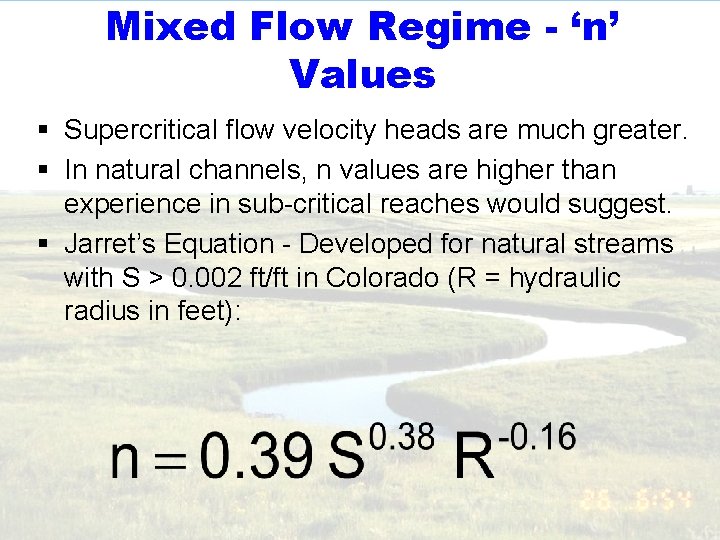
Mixed Flow Regime - ‘n’ Values § Supercritical flow velocity heads are much greater. § In natural channels, n values are higher than experience in sub-critical reaches would suggest. § Jarret’s Equation - Developed for natural streams with S > 0. 002 ft/ft in Colorado (R = hydraulic radius in feet):
Contraction & Expansion Coefficients • When modeling a supercritical flow reach, expansion and contraction coefficients should be set to smaller values (practical experience suggests 0. 05 for contraction and 0. 10 for expansion). • Small changes in depth can cause large changes in velocity heads. • Losses due to expansion and contraction are calculated using difference in velocity heads between x-sections, therefore, using same coefficients would over-estimate losses. • Over estimating the losses could show up as oscillations in the water surface profile.
Cross Section Spacing Slope • Bed slope plays an important role in cross section spacing. – Steeper slopes require more cross sections – Streams flowing under supercritical flow may require cross sections on the order of 50 feet or less. – Larger uniform rivers with flat slopes may only require cross sections on the order of 1000 ft or less.
Cross Section Spacing – Slope …a few more thoughts… �At transition locations where flow is going from subcritical to supercritical or vice-versa, crosssection spacing should be smaller to help define the jump or draw down curve. �Hydraulic jump occurs between 2 crosssections. In order to locate it more precisely, the user should decrease the cross-section spacing (consider interpolated cross-sections).
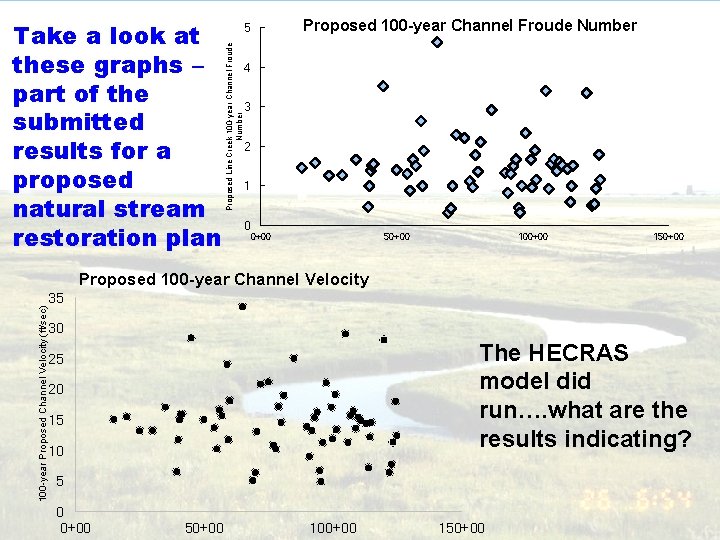
Proposed Line Creek 100 -year Channel Froude Number Take a look at these graphs – part of the submitted results for a proposed natural stream restoration plan Proposed 100 -year Channel Froude Number 5 4 3 2 1 0 0+00 50+00 100+00 150+00 Proposed 100 -year Channel Velocity 100 -year Proposed Channel Velocity (ft/sec) 35 30 The HECRAS model did run…. what are the results indicating? 25 20 15 10 5 0 0+00 50+00 100+00 150+00
Any Questions?