
Hec RAS for NRCS Unsteady Flow Debugging Hec
Hec. RAS for NRCS Unsteady Flow Debugging
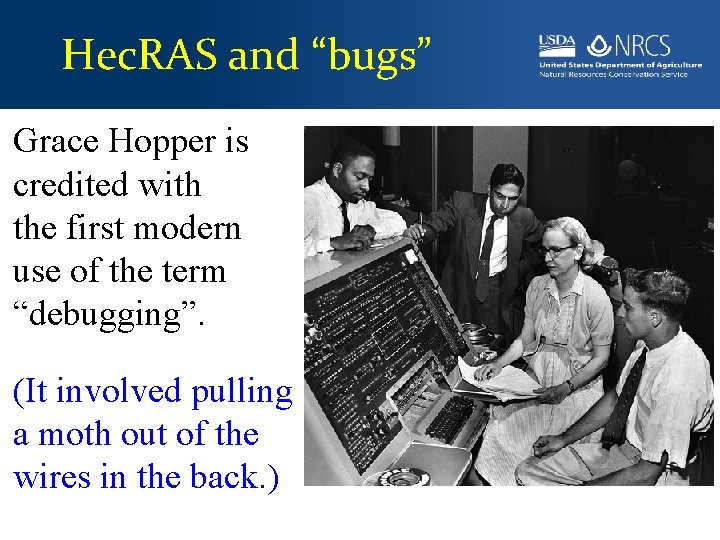
Hec. RAS and “bugs” Grace Hopper is credited with the first modern use of the term “debugging”. (It involved pulling a moth out of the wires in the back. )
Hec. RAS and “bugs” Today, we can be fully confident that the RAS computer code has aleady been debugged. Our concerns involve bugs in the model setup. And the first place to look for trouble?
modern terrain representations
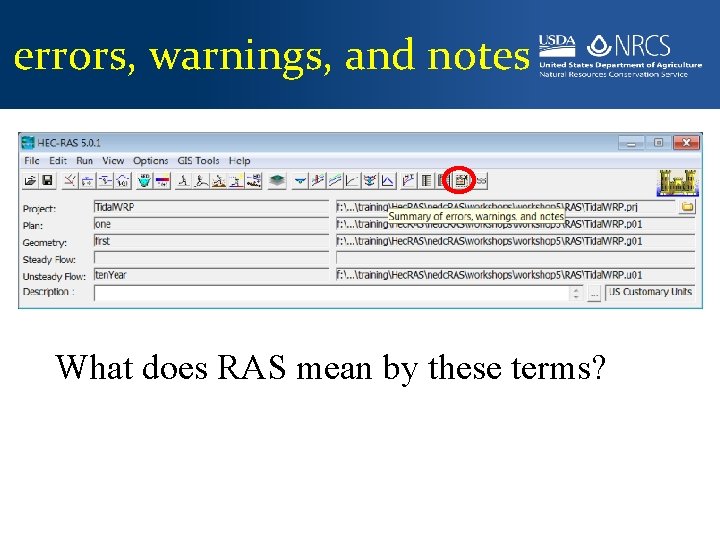
errors, warnings, and notes What does RAS mean by these terms?
errors, warnings, and notes Errors – The model won’t run! Warnings – RAS wants to make sure the user understands some internal procedure. (May or may not call for action. ) Notes – more of an FYI, to let user know which of more than one option is in effect.
errors, warnings, and notes Warnings and Notes can be very helpful! Some engineers “forget” to check. (67. 3% of engineers are LAZY)
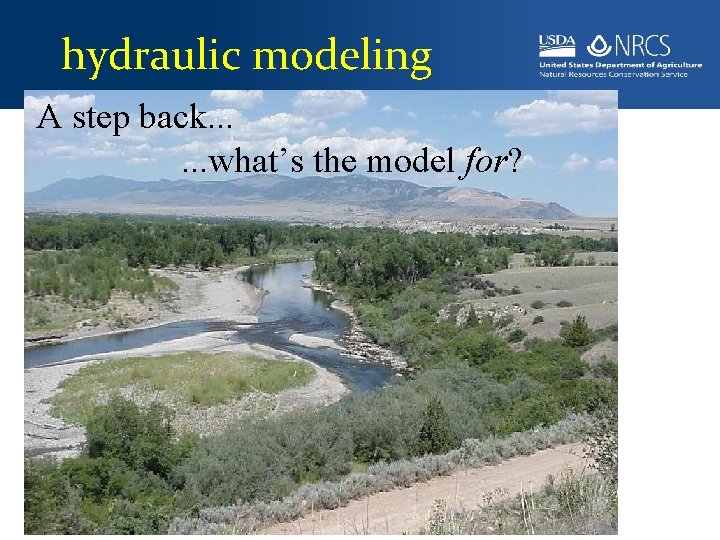
hydraulic modeling A step back. . . what’s the model for?
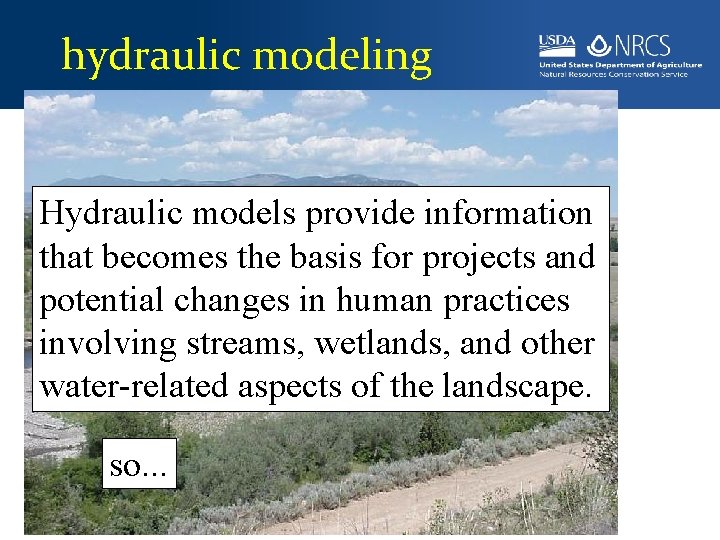
hydraulic modeling Hydraulic models provide information that becomes the basis for projects and potential changes in human practices involving streams, wetlands, and other water-related aspects of the landscape. so. . .
hydraulic modeling Debugging also involves making sure we have: 1) set up the model to answer the right questions (including all the relevant landscape features) 2) provided the model sufficiently accurate and pertinent input data
unsteady debugging See User Manual, page 8 -69, Model Accuracy, Stability, and Sensitivity
unsteady debugging See User Manual, page 8 -69, Model Accuracy, Stability, and Sensitivity 1) We want results that closely match reality. (But how can we tell? !!!)
unsteady debugging See User Manual, page 8 -69, Model Accuracy, Stability, and Sensitivity 2) We want the numerical model to converge to a stable, believable solution. (The model might run, but should we believe it? )
unsteady debugging See User Manual, page 8 -69, Model Accuracy, Stability, and Sensitivity 3) We need to know about the numerical model sensitivity parameters. (How to set them and their effect on accuracy!)
unsteady debugging Aspects that affect accuracy and stability: 1) cross-section spacing 2) computation time step 3) full equation set versus diffusion wave 4) theta weighting factor 5) any structures that cause relatively sudden changes in hydraulic parameters
a few tips. . . cross-section spacing vs. time step More xsecs is often better because it helps the model account for changes more gradually. Closer xsecs results in smaller time step. why?
a few tips. . . rule of thumb on computational time step: We don’t want the flow to pass more than one xsec in a single time step. Ok, so. . . estimate velocity, find the smallish reach lengths, compute required time step.
a few tips. . . Keep in mind that if the model has trouble it will often be where the rule of thumb has been stretched. After all, we’d prefer not to have the overall time step dependent on a max velocity that is rare in the run, or on just a few xsecs that need to be very closely spaced.
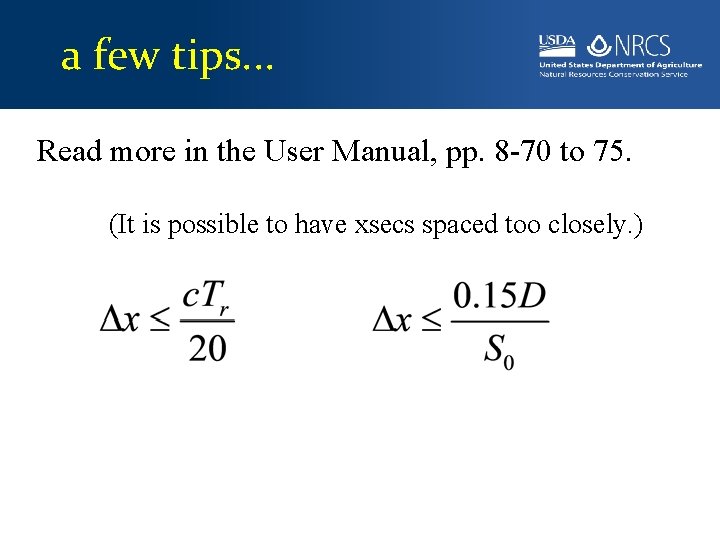
a few tips. . . Read more in the User Manual, pp. 8 -70 to 75. (It is possible to have xsecs spaced too closely. )
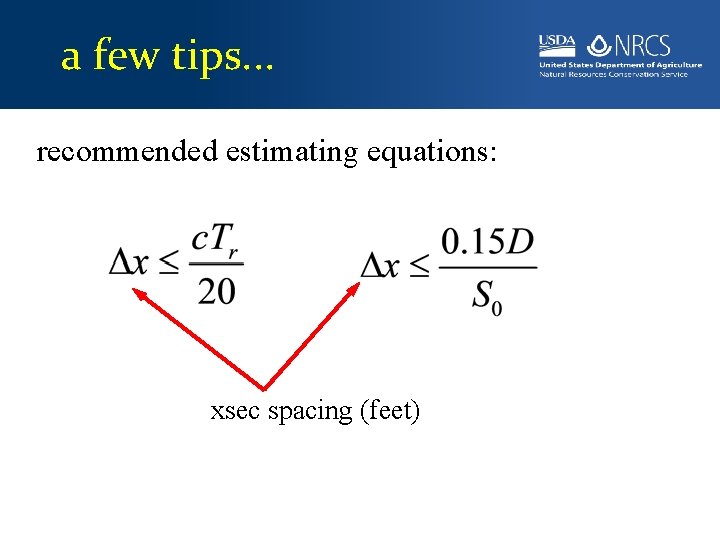
a few tips. . . recommended estimating equations: xsec spacing (feet)
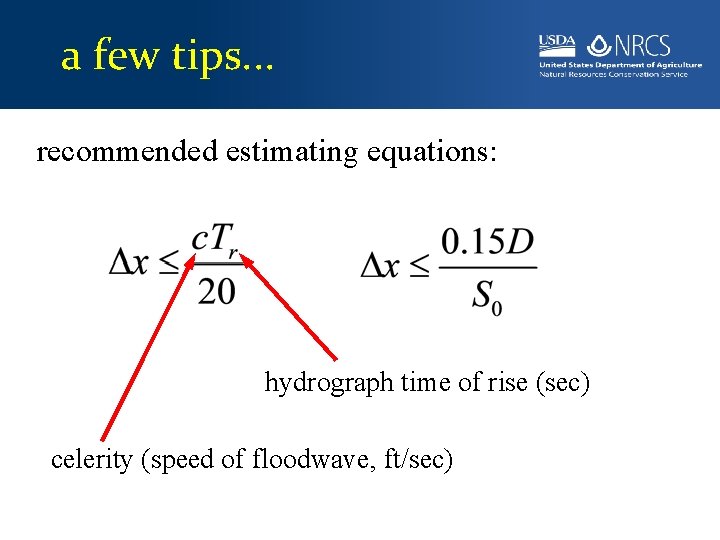
a few tips. . . recommended estimating equations: hydrograph time of rise (sec) celerity (speed of floodwave, ft/sec)
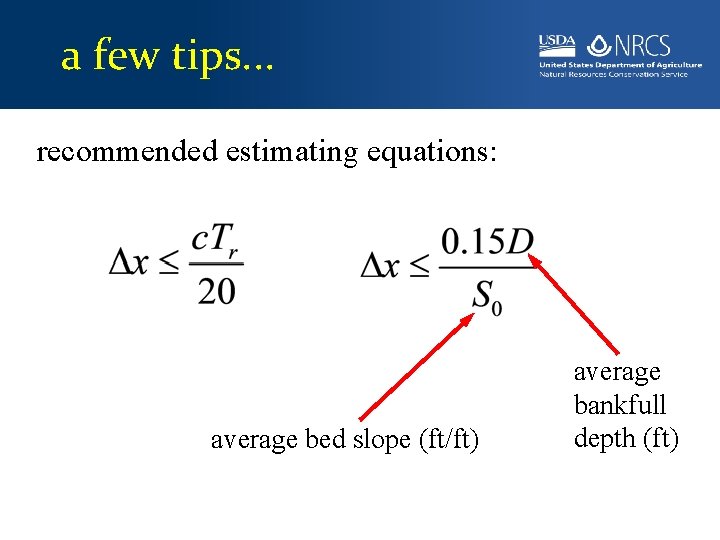
a few tips. . . recommended estimating equations: average bed slope (ft/ft) average bankfull depth (ft)
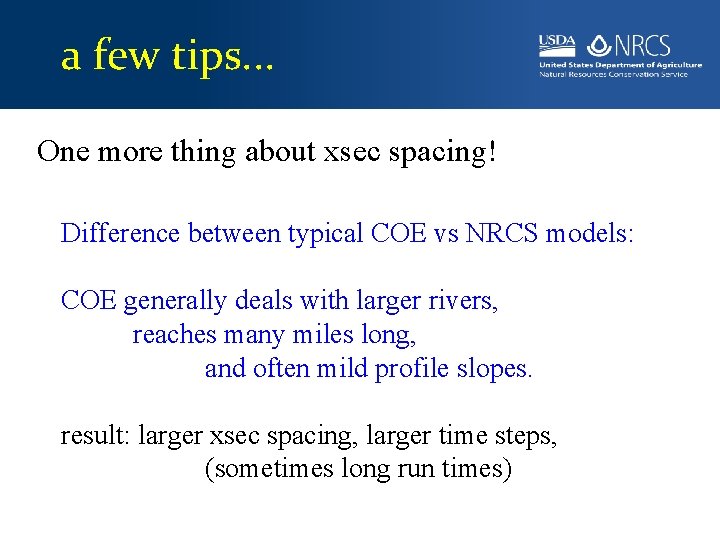
a few tips. . . One more thing about xsec spacing! Difference between typical COE vs NRCS models: COE generally deals with larger rivers, reaches many miles long, and often mild profile slopes. result: larger xsec spacing, larger time steps, (sometimes long run times)
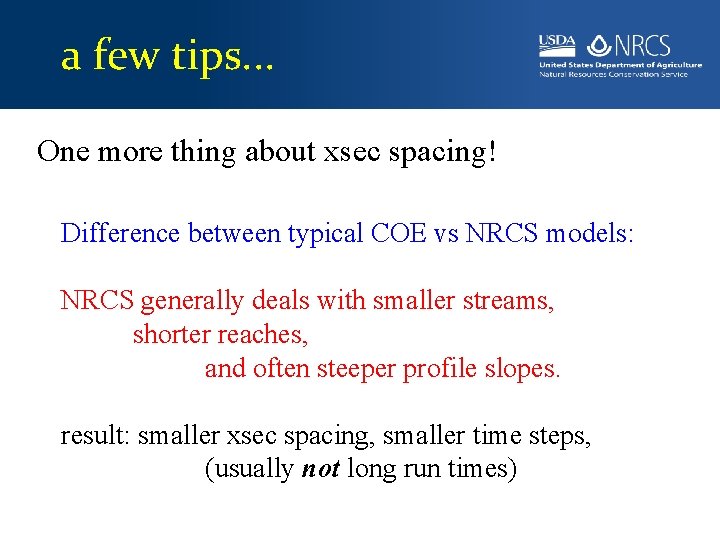
a few tips. . . One more thing about xsec spacing! Difference between typical COE vs NRCS models: NRCS generally deals with smaller streams, shorter reaches, and often steeper profile slopes. result: smaller xsec spacing, smaller time steps, (usually not long run times)
a few tips. . . Side effect of this difference: NRCS can often afford to do models entirely in 2 D because it can be quicker to set up than 1 D!
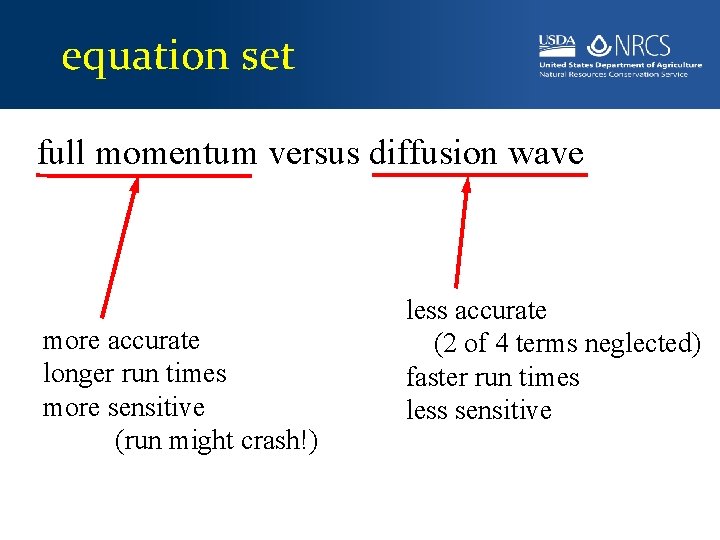
equation set full momentum versus diffusion wave more accurate longer run times more sensitive (run might crash!) less accurate (2 of 4 terms neglected) faster run times less sensitive
equation set full momentum versus diffusion wave This option is actually available only with 2 D. Unsteady flow 1 D uses full momentum.
bridges, etc. See User Manual, page 8 -80. . . Pay attention to the Hydraulic Property Tables
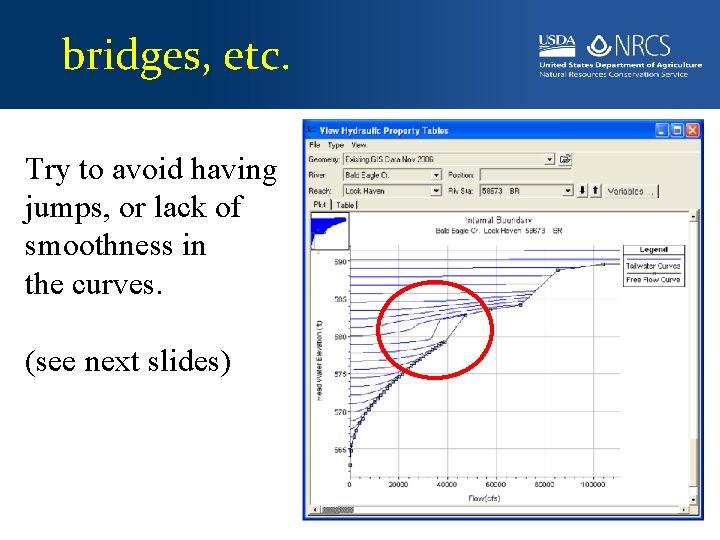
bridges, etc. Try to avoid having jumps, or lack of smoothness in the curves. (see next slides)
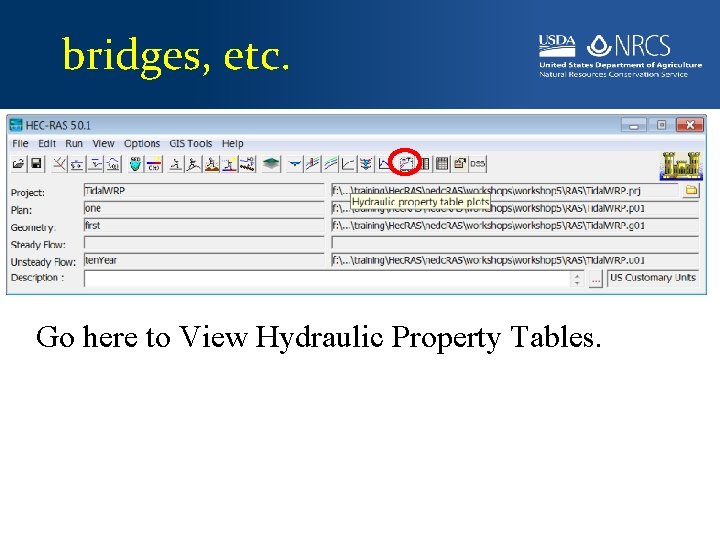
bridges, etc. Go here to View Hydraulic Property Tables.
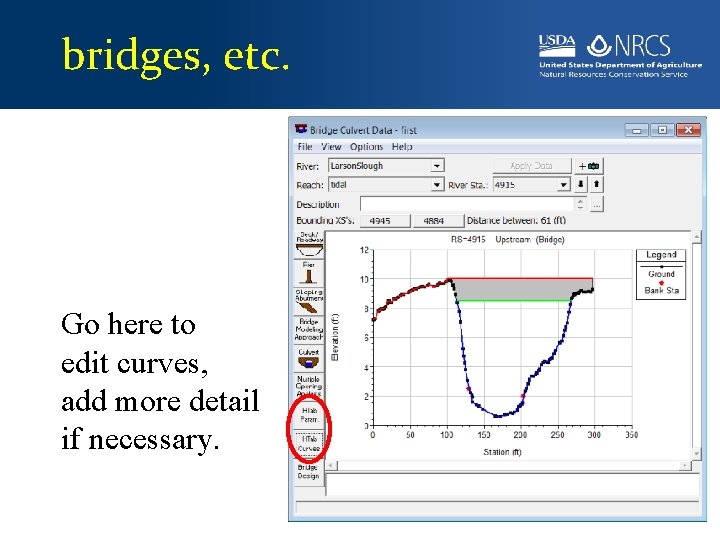
bridges, etc. Go here to edit curves, add more detail if necessary.
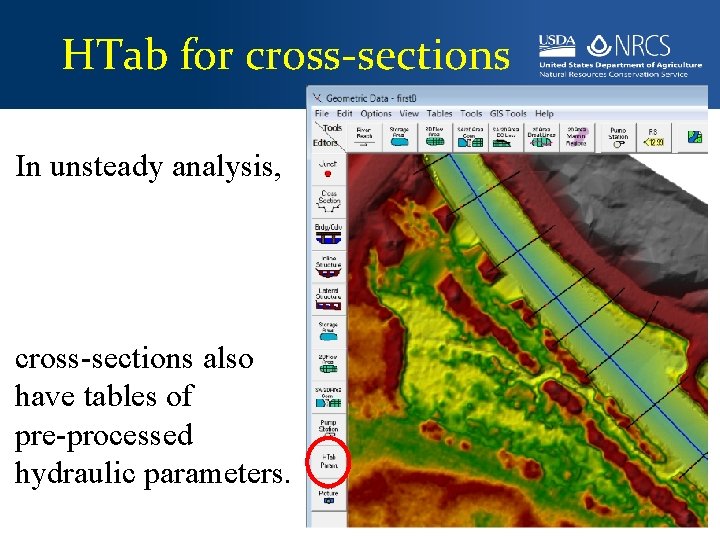
HTab for cross-sections In unsteady analysis, cross-sections also have tables of pre-processed hydraulic parameters.

HTab for cross-sections Sometimes the default tables don’t go high enough!
a few more tips. . . Assuming you are modeling the right thing, and providing good input. . . Build the unsteady model incrementally, making test runs along the way. Don’t make one huge complicated model before you make a single run.
a few more tips. . . Assuming you are modeling the right thing, and provided good input, AND your unsteady run is not crashing. . . Examine output for signs of instability.
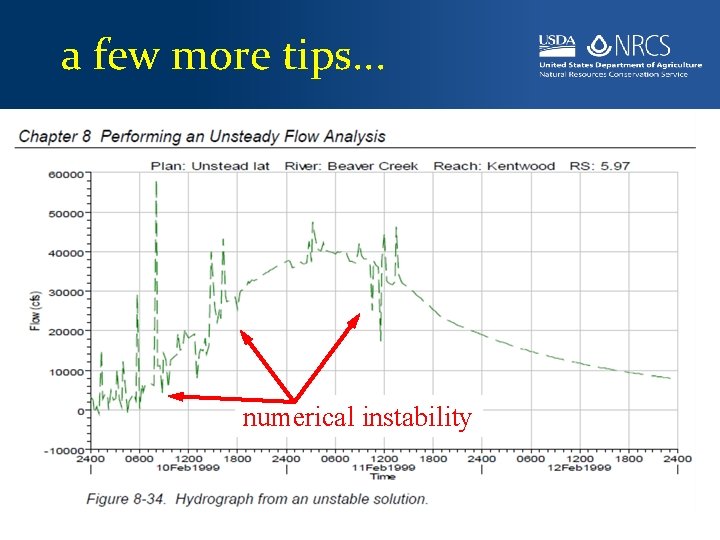
a few more tips. . . numerical instability
a few more tips. . . Assuming you are modeling the right thing, and provided good input, AND your unsteady run is not crashing. . . Examine output for signs of instability. Make test runs, checking how the output reflects choices of time step, xsec spacing, equation set, theta weighting, structure stability factors, etc.
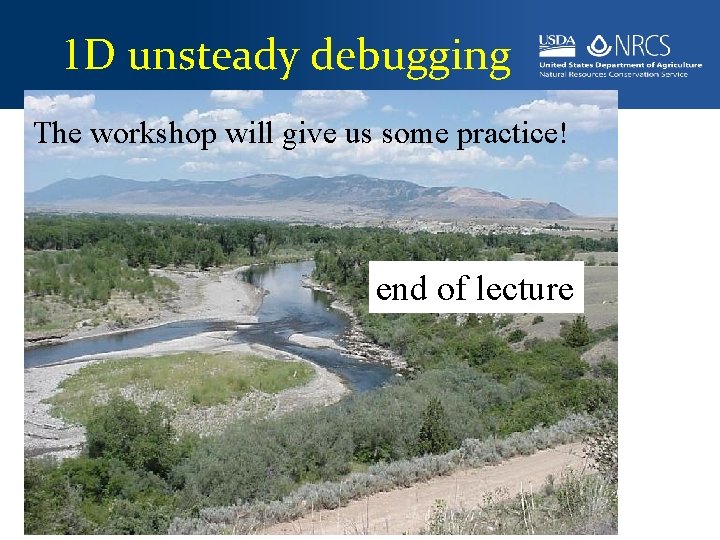
1 D unsteady debugging The workshop will give us some practice! end of lecture

The U. S. Department of Agriculture (USDA) prohibits discrimination in all its programs and activities on the basis of race, color, national origin, age, disability, and where applicable, sex, marital status, familial status, parental status, religion, sexual orientation, genetic information, political beliefs, reprisal, or because all or a part of an individual's income is derived from any public assistance program. (Not all prohibited bases apply to all programs. ) Persons with disabilities who require alternative means for communication of program information (Braille, large print, audiotape, etc. ) should contact USDA's TARGET Center at (202) 720 -2600 (voice and TDD). To file a complaint of discrimination write to USDA, Director, Office of Civil Rights, 1400 Independence Avenue, S. W. , Washington, D. C. 20250 -9410 or call (800) 795 -3272 (voice) or (202) 720 -6382 (TDD). USDA is an equal opportunity provider and employer.
- Slides: 39