
Hebrews Chapter 4 part 2 Verses 14 16

Hebrews – Chapter 4 part 2 (Verses 14 – 16)
Introduction • The book of Hebrews now makes a transition – or actually a revisiting of the matter of Jesus’ priesthood. • We now re-visit the idea first mentioned in Chapter 2 v 16 – 18 • • He does not give aid to Angels, but to the seed of Abraham – humans. He took on Human flesh, not angelic being. This was essential for Him to be our High Priest – to be our kinsman redeemer He had to be subject to all the difficulties of humanity and overcome them. • The exhortation of these last 3 verses conflates the ideas of 1. 2. 3. 4. 5. 6. 7. 8. His faithfulness in wanting to help those who are tempted; and, His superior position as God’s Son, meaning there is no one higher to act as our priest; and, His ability, therefore, to restore us to a place higher than the angels – as His brethren and God’s sons The magnificence of His humility, being a son unlike Moses who was a servant. Having the one who built the house as a priest of the house The magnificence of the eternal rest He offers The importance of not hardening the heart through unbelief and the deceitfulness of sin The fact that His rest remains available for believers • And returns to the concept of Priesthood (High-Priesthood) and once again uses the word ‘Therefore’ • ‘Seeing then’ is the same Greek word as is used for ‘Therefore’ verse 1 – ‘Because of this’ or ‘consequently’
Hebrews 4 v 14 - 16 • So! Because we have a Great High Priest who passed through the heavens, let us hold fast our confession. • The question is, why would this influence the Hebrew recipients to remain faithful, given their experience of High Priests (corrupt, greedy, unjust, legalistic). • The Hebrew Christians of this day would have had two competing information streams: 1. Their knowledge from what they saw and experienced; and, 2. Their understanding of the scriptures • • It was to this latter stream that the writer is appealing or taking them back. Later in this letter, the writer tells us that Jesus’ priesthood is Melchizadekian However, the High Priestley comparison here is Aaronic. So let’s understand what the High Priest was there to do: his role, his function.
Hebrews 4 v 14 - 16 • We need to understand some of the functions of the High Priest • An important thing is to understand the difference between a prophet and a priest • The prophet goes to the people on God’s behalf or represents God to the people • The Priest goes to God on the people’s behalf, or represents the people to God. • So, when the Priest stands before God, the people are standing before God • But sinful man in his raw state cannot be in the presence of God • So in every way, the priest became something greater than himself (symbolically) when he was functioning in his priestly office. • The Aaronic priests were not priests because they were any better than anyone else – it was a quirk of being born of the tribe of Levi. • It could not be earned or worked for • So he needed some special preparation to make him able to act as Priest • We need to read from Leviticus 8, Exodus 28 and 29 (36 v 8 for the colour comparisons) and 39 for the making of the garments

The priest’s undergarments, tunic and sash Exodus 28 v 39 - 42
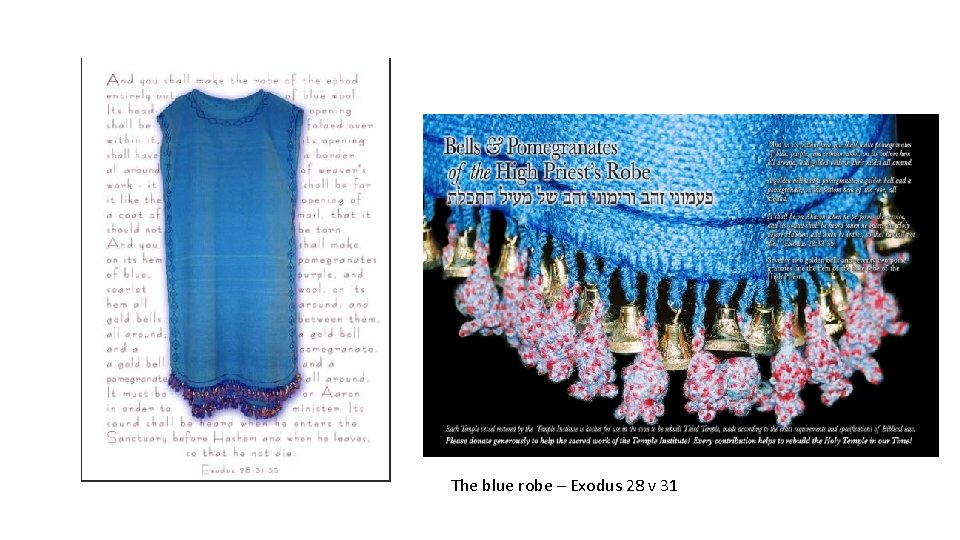
The blue robe – Exodus 28 v 31
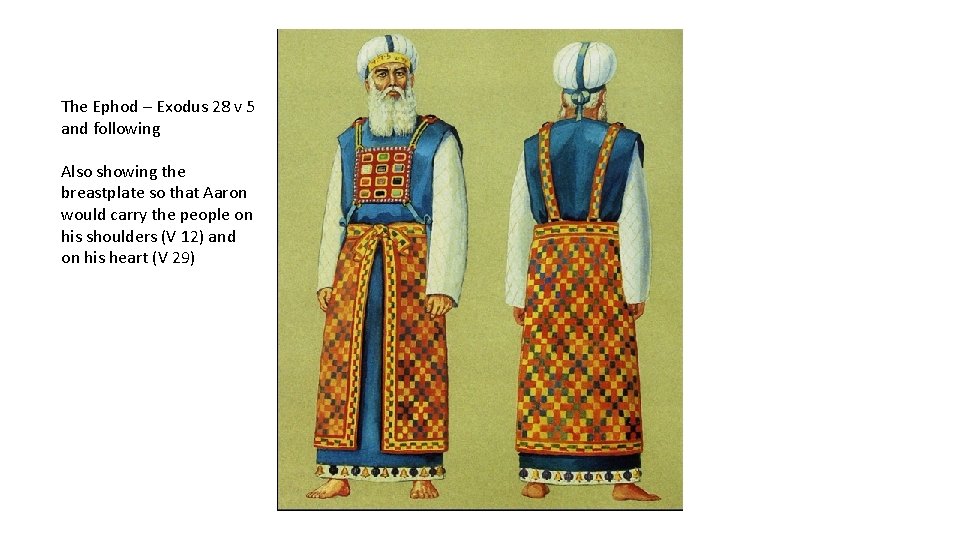
The Ephod – Exodus 28 v 5 and following Also showing the breastplate so that Aaron would carry the people on his shoulders (V 12) and on his heart (V 29)
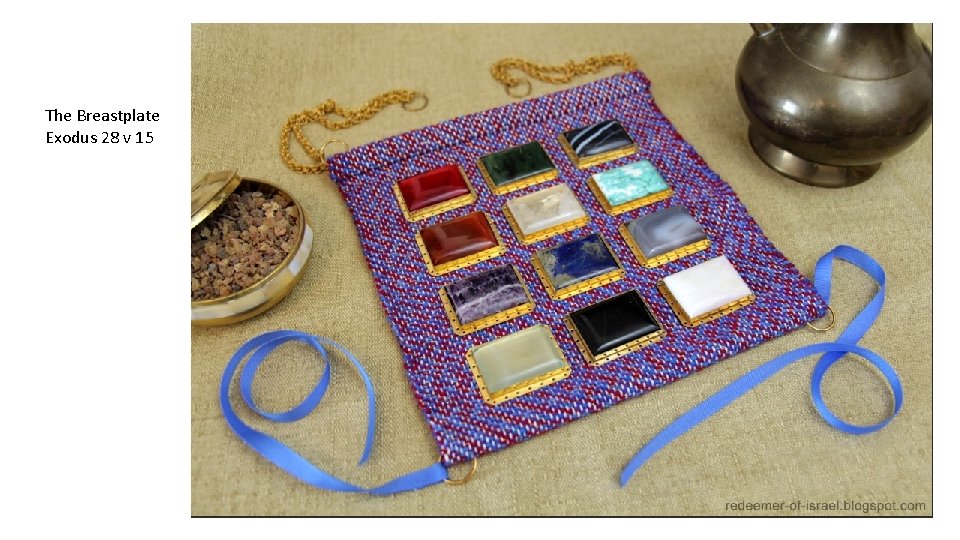
The Breastplate Exodus 28 v 15
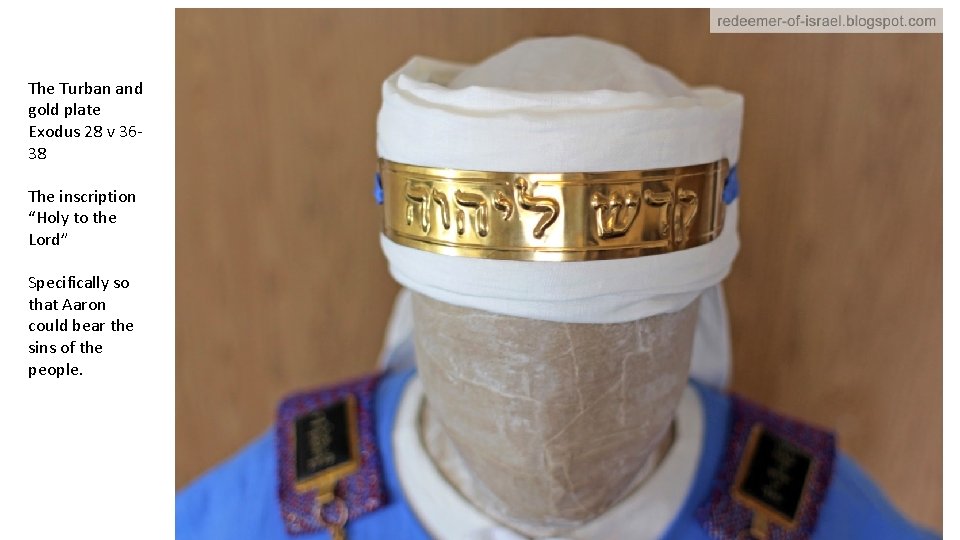
The Turban and gold plate Exodus 28 v 3638 The inscription “Holy to the Lord” Specifically so that Aaron could bear the sins of the people.
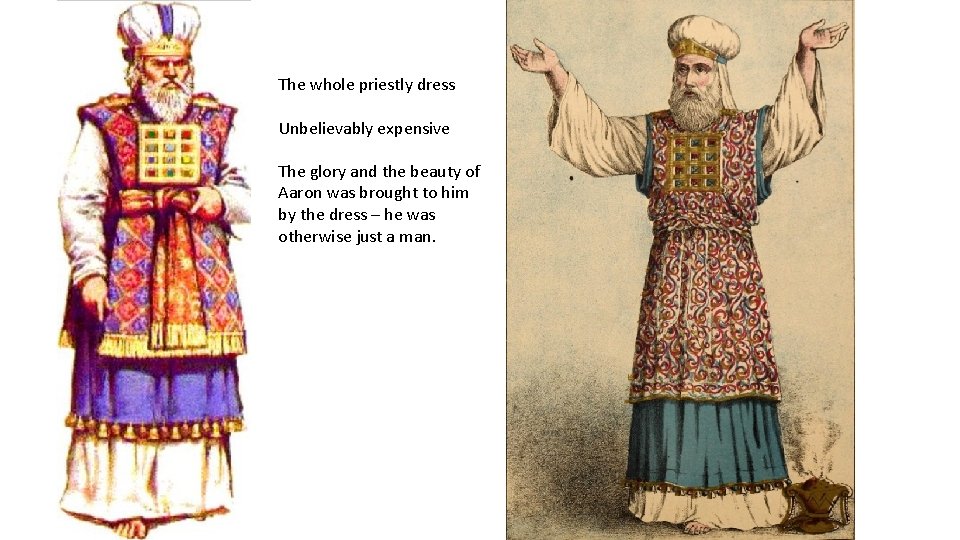
The whole priestly dress Unbelievably expensive The glory and the beauty of Aaron was brought to him by the dress – he was otherwise just a man.
Chapter 4 v 14 - 16 • Urim and Thummim • They are first mentioned in the description of the breastplate of judgment ( Exodus 28: 30; Leviticus 8: 8). When Joshua succeeded Moses as leader over Israel, he was to receive answers from God by means of the Urim through Eleazar the high priest (Numbers 27: 21). • Aside from other reasons, the High Priestly garments were “for glory and for beauty” • (He didn’t dress himself – we was clothed in the garments (of salvation? )) – Psalm 132 v 9, Isaiah 61 v 10 & 59 v 17, (64 v 6 – filthy garments), Zechariah 3 v 4 and so on – we need Him to dress us in the robes of righteousness too. • He had to wear the right clothing in the right way “Lest he Die” • In other words, when dressed correctly He was transformed and though he could not make atonement when not in his priestly robes, once wearing them, he could represent the one who could – he was a type of Christ • The colours of his robes were the same as the furnishings of the tabernacle – the beauty of the inside of the tabernacle – usually hidden – comes out and is displayed in the beauty and glory of the high priest. • • • Every time he was seen people would notice – he was glorious and beautiful. He had one notable priestly duty to perform every year He could perform as a priest at any time, just as any other priest may However, there was one particular officiation that only he could do. This was the day of atonement which we explore in Leviticus 16
Chapter 4 v 14 - 16 • In Leviticus chapter 9 we learn that these priests had to be ‘Hallowed’ or made holy before they could minister • The bull – sin offering – is made when Aaron and his sons are in their priestly robes • Like Jesus, the bull was sacrificed outside the camp • The priests were therefore rendered spotless – Christ-like – • We know from the sorry tale of Leviticus 10 v 1 and following that if the priest was not presented exactly as prescribed, they died. • So to an extent, whilst they could not represent and make atonement in their own righteousness, after the sacrifice and in the priest’s garb, they could – they were types of Christ. • Their efforts were only temporary in their effects
Chapter 4 v 14 - 16 • • • In Leviticus 16 we read about the feast of atonement The priest divests himself of his glory and beauty to enter the holy of holies Then he enters and makes atonement by the sprinkling of blood Then he comes out after successful atonement and takes back on his beauty and glory – a type of Christ’s death, resurrection and ascension. However, as the writer is making clear, these priests would make atonement for only a single year They had not passed through the heavens Their ministry was entirely earthly, temporary and limited (it had to be repeated annually). Note the significance of the final statement, made to those who were being tempted back to Judaism. Let us come BOLDLY to the throne of grace The Aaronic priests did not come boldly, they came in fear and trembling and after much special preparation and could only cover sins for a year Jesus ministered in the heavenly Holy of Holies once and for all to provide grace to help in time of need – in Hebrews chapter 9 v 23 we read that the High Priest was ministering in the patterns of things in the heavens, but Jesus ministered in heaven its self. The Hebrew Christians were in need and were in danger of turning to somewhere that could not provide grace.
- Slides: 13