
Hebrew is FUNdamental n Welcome n Questions n
Hebrew is FUNdamental n Welcome n Questions n © Dina Maiben ברוכים הבאים Tech Support? Andy@Behrmanhouse. com 1 -800 -221 -2755 www. Behrman. House. com 1
What You’ll Get From Today’s Presentation Ø Ø © Dina Maiben See how Alef Bet Quest works Understand the research on which it’s based Learn how this primer efficiently & effectively teaches Hebrew decoding Know what it can and cannot do for you www. Behrman. House. com 2

Alef Bet Quest ? נשתנה Ø Ø Ø מה Innovative Integrated Learning System Based on Hebrew Reading Research Engaging & Cute © Dina Maiben www. Behrman. House. com 3
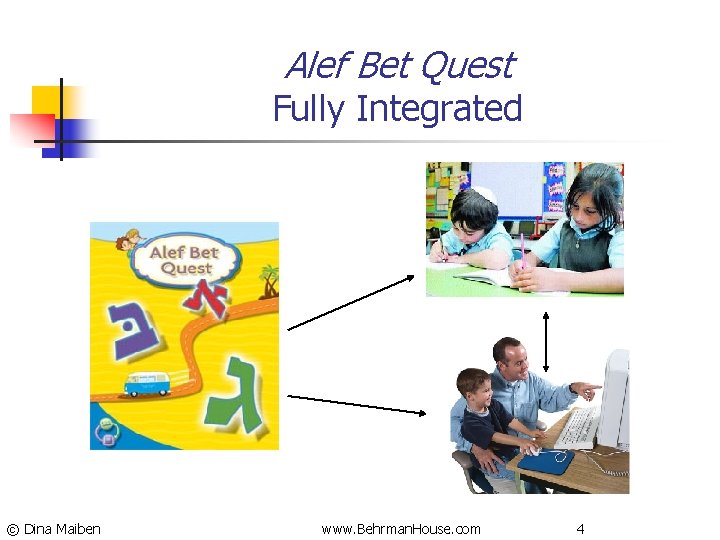
Alef Bet Quest Fully Integrated © Dina Maiben www. Behrman. House. com 4
Based on Research in Hebrew Reading Ø Ø Ø © Dina Maiben Learn how Israeli researchers uncovered the secrets of successful Hebrew reading instruction. Examine their findings on efficient & effective Hebrew phonics instruction. Discuss how these findings apply to our classrooms today. www. Behrman. House. com 5
4 Questions for Hebrew Reading 1. 2. 3. 4. Why is learning to decode Hebrew often so difficult? What are the right sequences for introducing letters and vowels? What is the optimum age to begin Hebrew instruction? How can you include meaningful Hebrew language at the primer level? © Dina Maiben www. Behrman. House. com 6
Survey Says… What is the biggest problem you face in teaching Hebrew decoding? A. Letters that look alike. B. Vowels. C. Not enough time. D. No one at home can help. © Dina Maiben www. Behrman. House. com 7
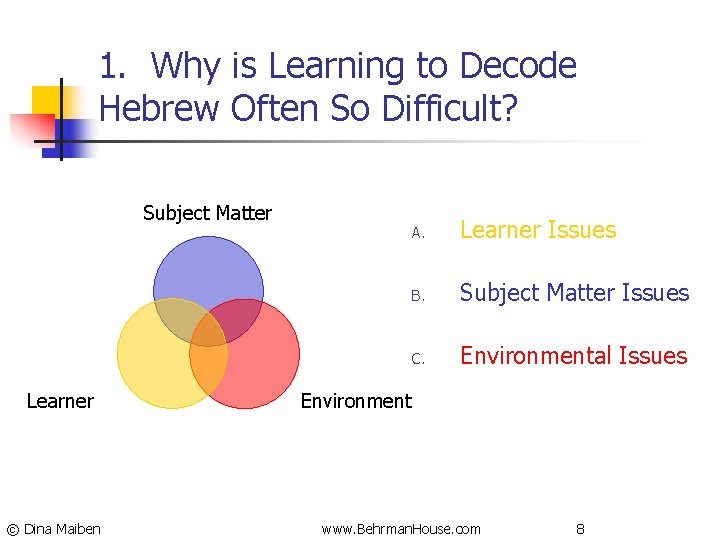
1. Why is Learning to Decode Hebrew Often So Difficult? Subject Matter Learner © Dina Maiben A. Learner Issues B. Subject Matter Issues C. Environmental Issues Environment www. Behrman. House. com 8
Learner Issues Ø Ø General Learning Skills— the “ 10 -80 -10 Rule” Age & Prior Experience with Hebrew Ø Interest & Motivation Ø Tolerance for Frustration © Dina Maiben www. Behrman. House. com 9
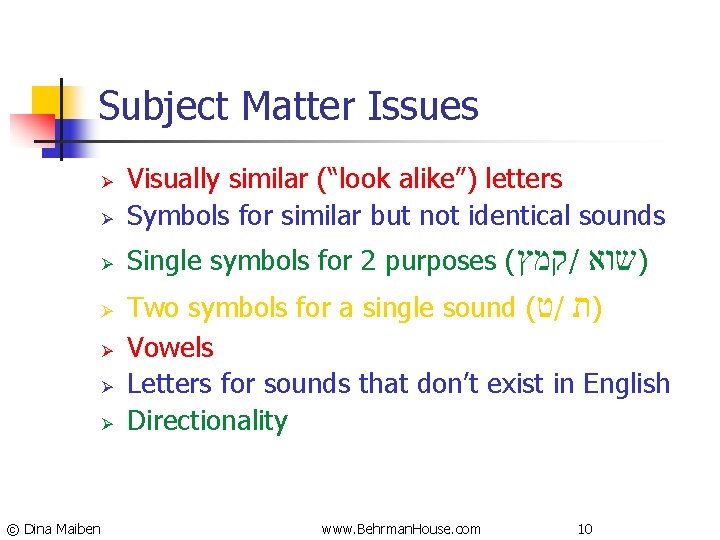
Subject Matter Issues Ø Visually similar (“look alike”) letters Symbols for similar but not identical sounds Ø Single symbols for 2 purposes ( קמץ / Ø Ø Ø © Dina Maiben )שוא Two symbols for a single sound ( ט / )ת Vowels Letters for sounds that don’t exist in English Directionality www. Behrman. House. com 10
Environmental Issues Ø Ø © Dina Maiben Don’t understand what they’re reading Not enough instructional time English reading strategies do not help No one at home who can provide assistance www. Behrman. House. com 11

Survey Results… © Dina Maiben www. Behrman. House. com 12
2. What Are the Right Sequences for Introducing Hebrew Letters & Vowels Feitelson’s Team, 1958 Began with error analysis—what was difficult for students. Feitelson’s team conducted classroom experiments to find optimal approaches to Hebrew reading instruction. v v v A. B. © Dina Maiben Sequence of Introduction Patterns for Reading Drills www. Behrman. House. com 13
A. Introductory Sequences v Symbols that are visually similar. v Symbols that represent similar, but not identical, sounds. v Different symbols that represent a single sound. v Single symbols that represents more than one sound. © Dina Maiben www. Behrman. House. com 14
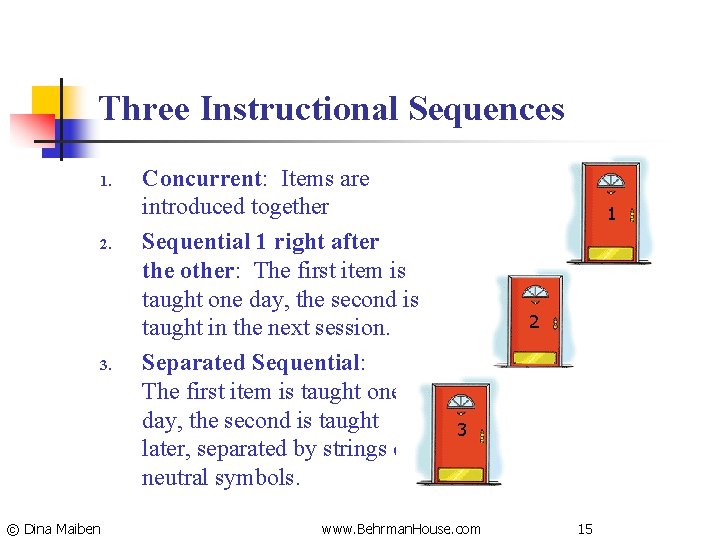
Three Instructional Sequences 1. 2. 3. © Dina Maiben Concurrent: Items are introduced together Sequential 1 right after the other: The first item is taught one day, the second is taught in the next session. Separated Sequential: The first item is taught one day, the second is taught later, separated by strings of neutral symbols. 1 2 3 www. Behrman. House. com 15
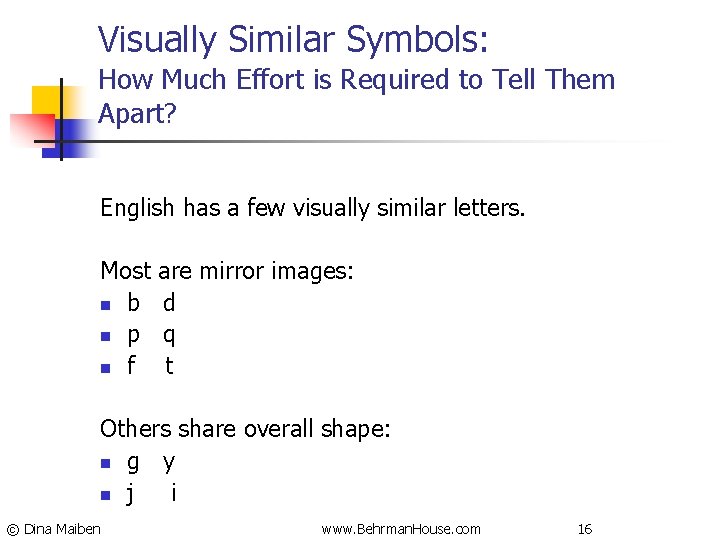
Visually Similar Symbols: How Much Effort is Required to Tell Them Apart? English has a few visually similar letters. Most n b n p n f are mirror images: d q t Others share overall shape: n g y n j i © Dina Maiben www. Behrman. House. com 16
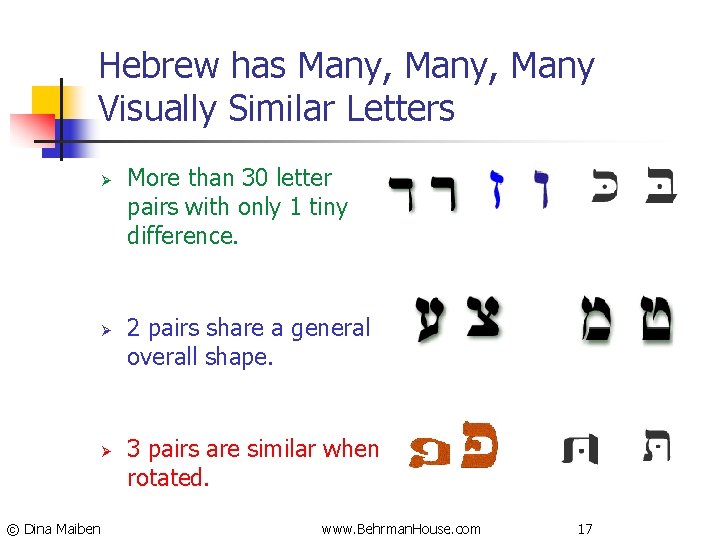
Hebrew has Many, Many Visually Similar Letters Ø Ø Ø © Dina Maiben More than 30 letter pairs with only 1 tiny difference. 2 pairs share a general overall shape. 3 pairs are similar when rotated. www. Behrman. House. com 17
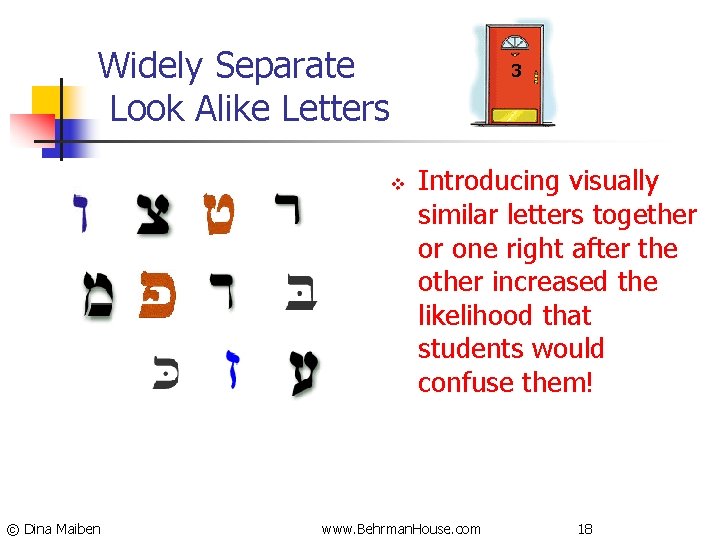
Widely Separate Look Alike Letters 3 v © Dina Maiben Introducing visually similar letters together or one right after the other increased the likelihood that students would confuse them! www. Behrman. House. com 18
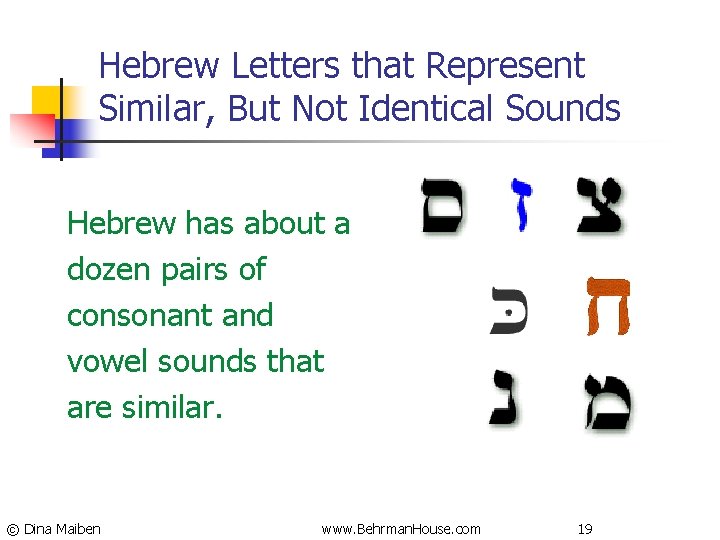
Hebrew Letters that Represent Similar, But Not Identical Sounds Hebrew has about a dozen pairs of consonant and vowel sounds that are similar. © Dina Maiben www. Behrman. House. com 19
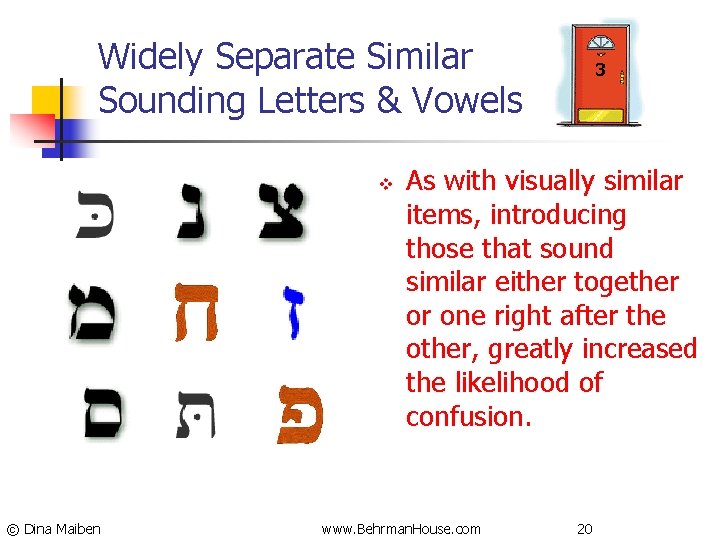
Widely Separate Similar Sounding Letters & Vowels v © Dina Maiben 3 As with visually similar items, introducing those that sound similar either together or one right after the other, greatly increased the likelihood of confusion. www. Behrman. House. com 20
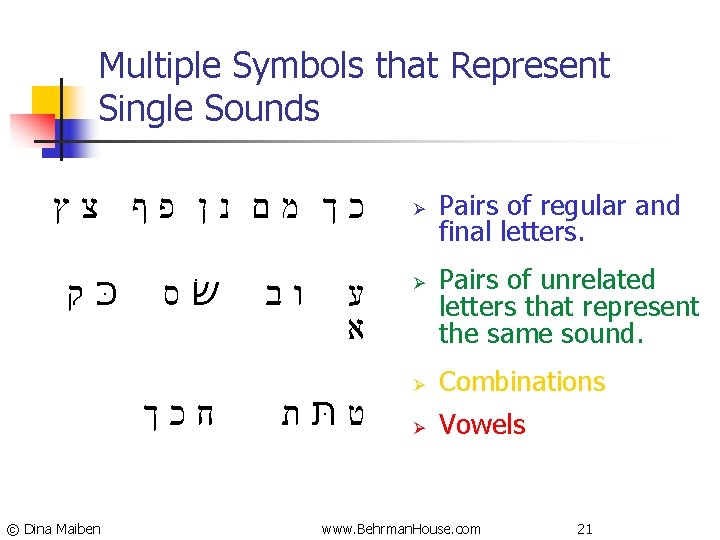
Multiple Symbols that Represent Single Sounds כך מם נן פף צץ כּק שׂס חכך © Dina Maiben וב ע א טתּת Ø Ø Pairs of regular and final letters. Pairs of unrelated letters that represent the same sound. Ø Combinations Ø Vowels www. Behrman. House. com 21
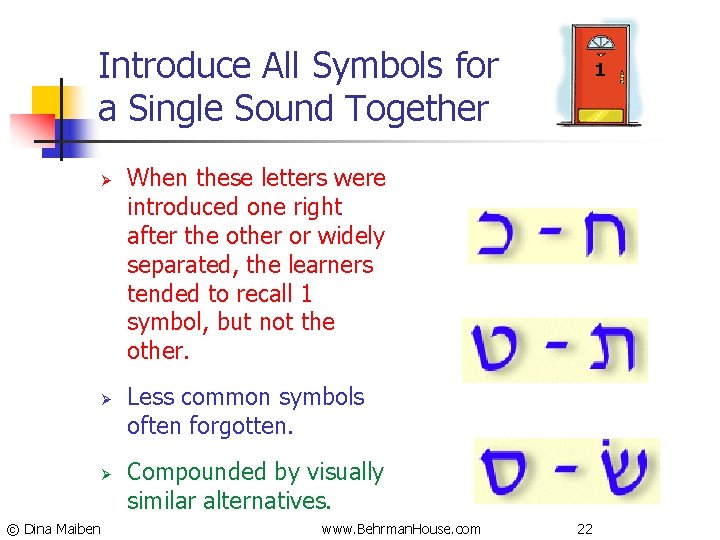
Introduce All Symbols for a Single Sound Together Ø Ø Ø © Dina Maiben 1 When these letters were introduced one right after the other or widely separated, the learners tended to recall 1 symbol, but not the other. Less common symbols often forgotten. Compounded by visually similar alternatives. www. Behrman. House. com 22
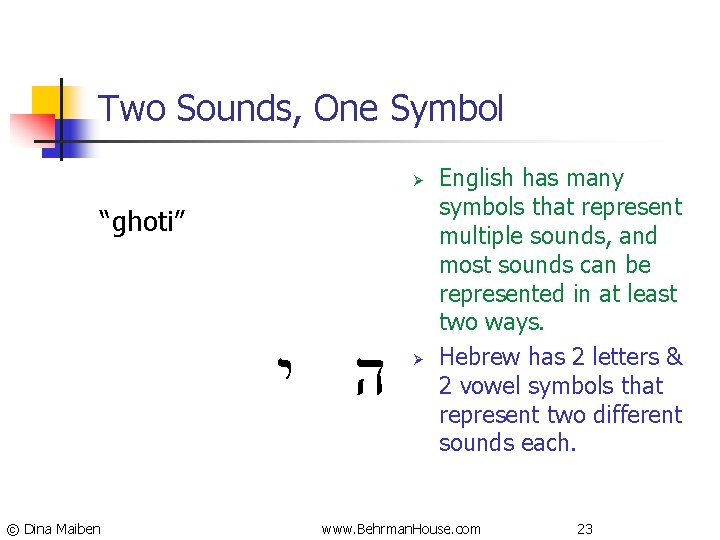
Two Sounds, One Symbol Ø “ghoti” ה י © Dina Maiben Ø English has many symbols that represent multiple sounds, and most sounds can be represented in at least two ways. Hebrew has 2 letters & 2 vowel symbols that represent two different sounds each. www. Behrman. House. com 23
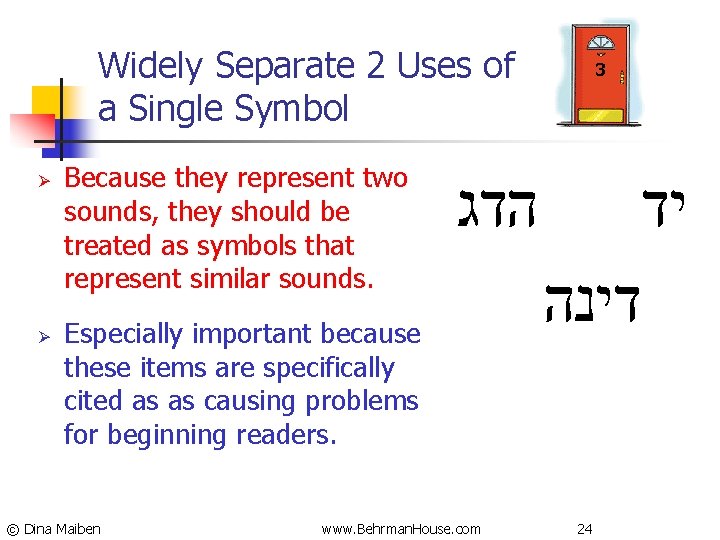
Widely Separate 2 Uses of a Single Symbol Ø Ø Because they represent two sounds, they should be treated as symbols that represent similar sounds. הדג Especially important because these items are specifically cited as as causing problems for beginning readers. © Dina Maiben 3 www. Behrman. House. com יד דינה 24
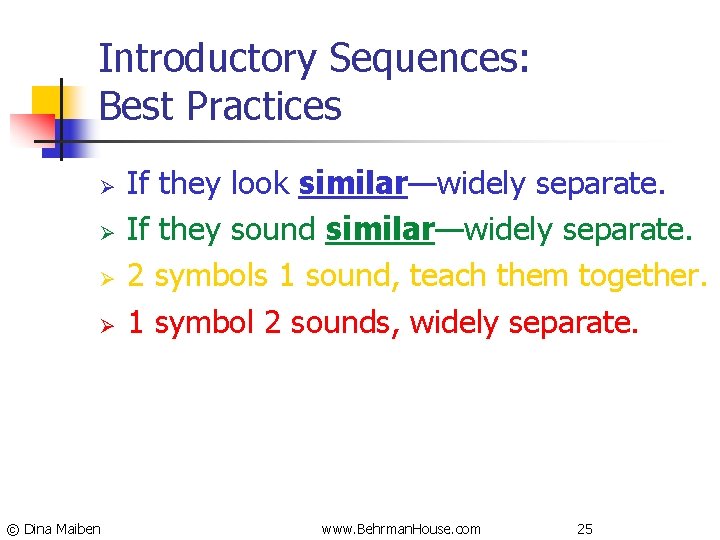
Introductory Sequences: Best Practices Ø Ø © Dina Maiben If they look similar—widely separate. If they sound similar—widely separate. 2 symbols 1 sound, teach them together. 1 symbol 2 sounds, widely separate. www. Behrman. House. com 25
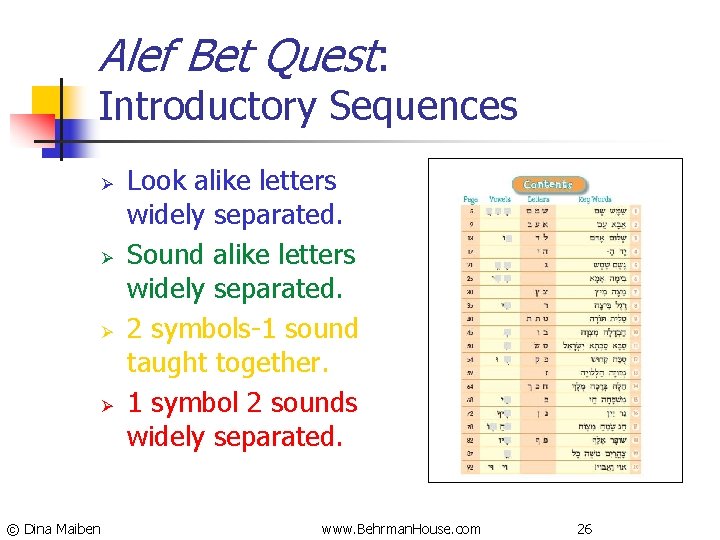
Alef Bet Quest: Introductory Sequences Ø Ø © Dina Maiben Look alike letters widely separated. Sound alike letters widely separated. 2 symbols-1 sound taught together. 1 symbol 2 sounds widely separated. www. Behrman. House. com 26
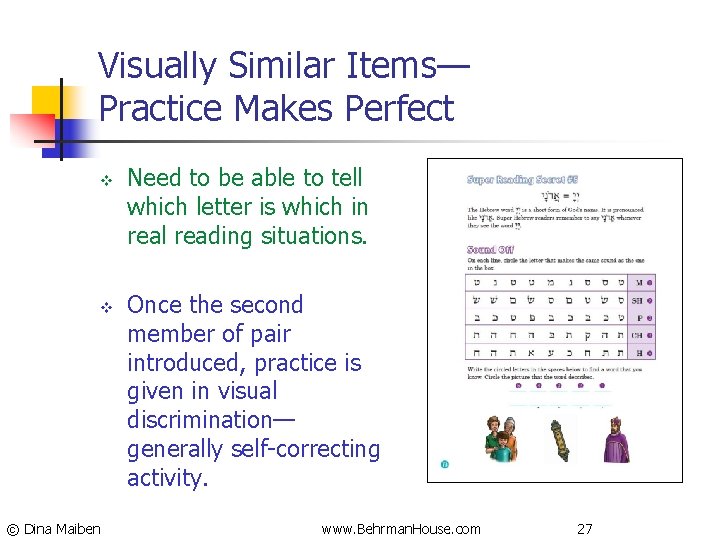
Visually Similar Items— Practice Makes Perfect v v © Dina Maiben Need to be able to tell which letter is which in real reading situations. Once the second member of pair introduced, practice is given in visual discrimination— generally self-correcting activity. www. Behrman. House. com 27
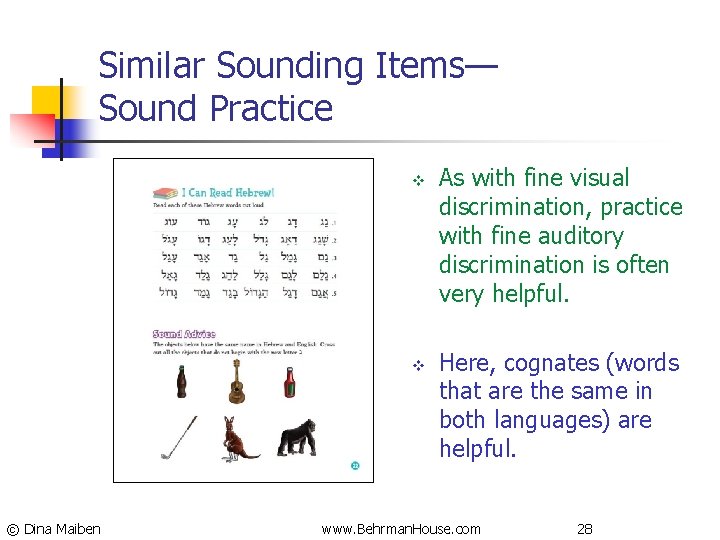
Similar Sounding Items— Sound Practice v v © Dina Maiben As with fine visual discrimination, practice with fine auditory discrimination is often very helpful. Here, cognates (words that are the same in both languages) are helpful. www. Behrman. House. com 28
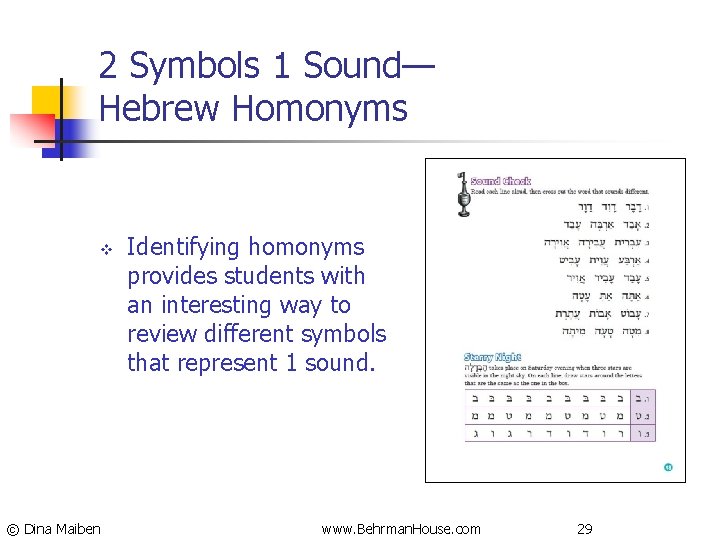
2 Symbols 1 Sound— Hebrew Homonyms v © Dina Maiben Identifying homonyms provides students with an interesting way to review different symbols that represent 1 sound. www. Behrman. House. com 29
? שאלות Questions? © Dina Maiben www. Behrman. House. com 30
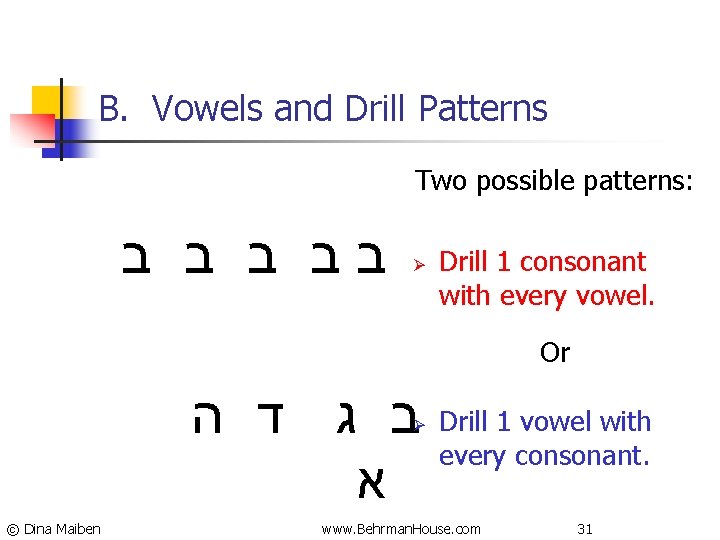
B. Vowels and Drill Patterns Two possible patterns: בב ב Ø Drill 1 consonant with every vowel. Or ב ג ד ה א Ø © Dina Maiben Drill 1 vowel with every consonant. www. Behrman. House. com 31
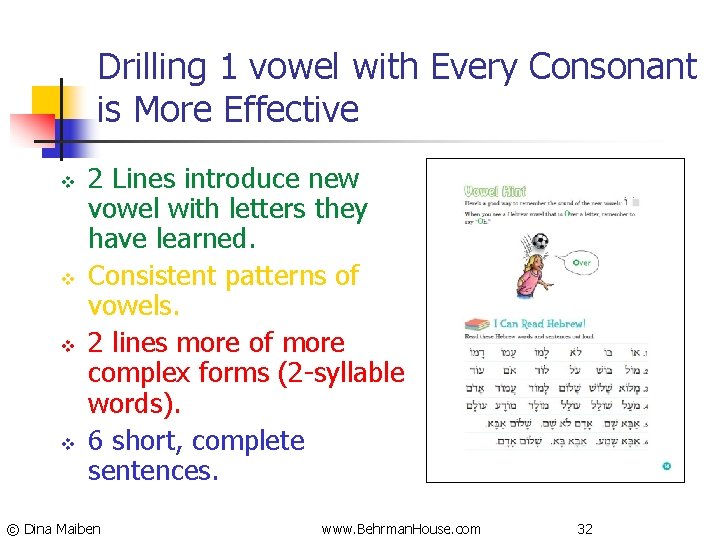
Drilling 1 vowel with Every Consonant is More Effective v v 2 Lines introduce new vowel with letters they have learned. Consistent patterns of vowels. 2 lines more of more complex forms (2 -syllable words). 6 short, complete sentences. © Dina Maiben www. Behrman. House. com 32
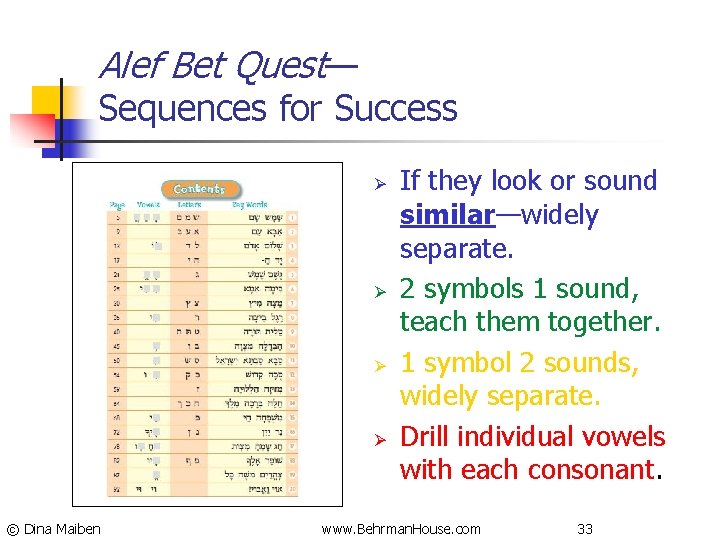
Alef Bet Quest— Sequences for Success Ø Ø © Dina Maiben If they look or sound similar—widely separate. 2 symbols 1 sound, teach them together. 1 symbol 2 sounds, widely separate. Drill individual vowels with each consonant. www. Behrman. House. com 33
Environmental Issues: The More Things Change… A. B. C. © Dina Maiben English reading strategies not help. Parents unable to assist. Students learning to read a language they don’t know. www. Behrman. House. com 34
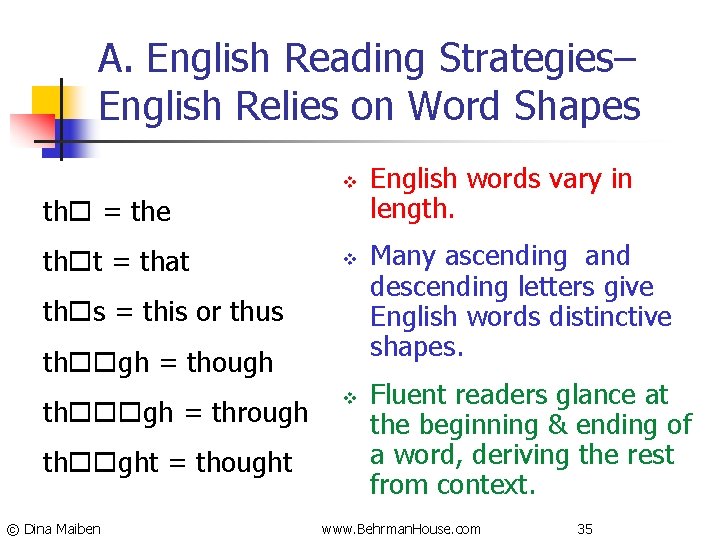
A. English Reading Strategies– English Relies on Word Shapes v th = the th t = that v th s = this or thus th gh = though th gh = through th ght = thought © Dina Maiben v English words vary in length. Many ascending and descending letters give English words distinctive shapes. Fluent readers glance at the beginning & ending of a word, deriving the rest from context. www. Behrman. House. com 35
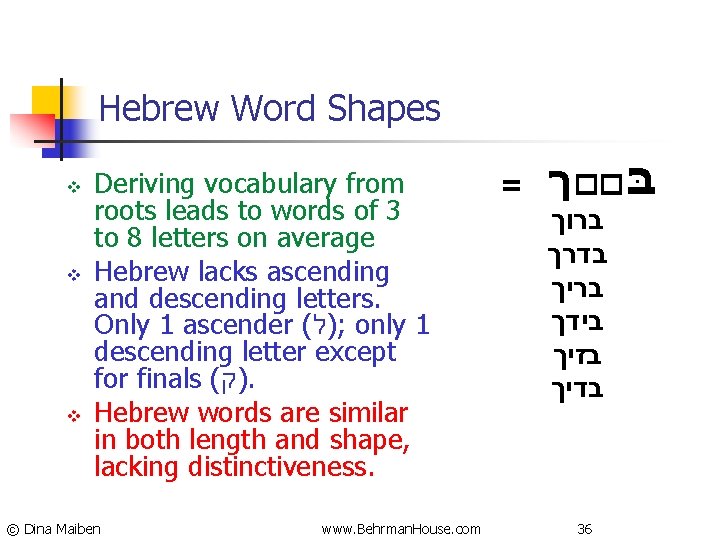
Hebrew Word Shapes v v v Deriving vocabulary from roots leads to words of 3 to 8 letters on average Hebrew lacks ascending and descending letters. Only 1 ascender ( ; )ל only 1 descending letter except for finals ( )ק. Hebrew words are similar in both length and shape, lacking distinctiveness. © Dina Maiben www. Behrman. House. com = ך בּ ברוך בדרך בריך בידך בזיך בדיך 36
Parental Assistance—Feitelson’s Findings Ø Ø © Dina Maiben 1950 Reading failure in Israel reaches 50%. Szold Institute hires Feitelson to study causes. 10 classes studied, 9 from immigrant communities, 1 control class from established area. Won Israel Prize in 1953 www. Behrman. House. com 37
B. Parents Unable to Assist— Modern Solutions to Old Problems © Dina Maiben www. Behrman. House. com 38
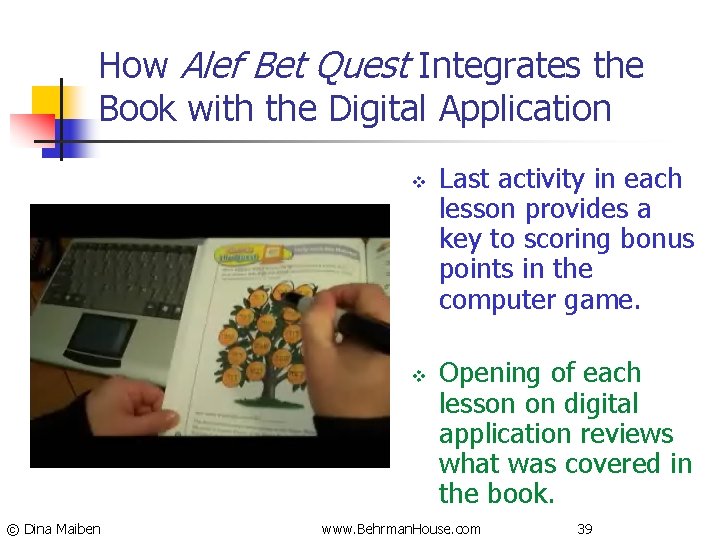
How Alef Bet Quest Integrates the Book with the Digital Application v v © Dina Maiben Last activity in each lesson provides a key to scoring bonus points in the computer game. Opening of each lesson on digital application reviews what was covered in the book. www. Behrman. House. com 39
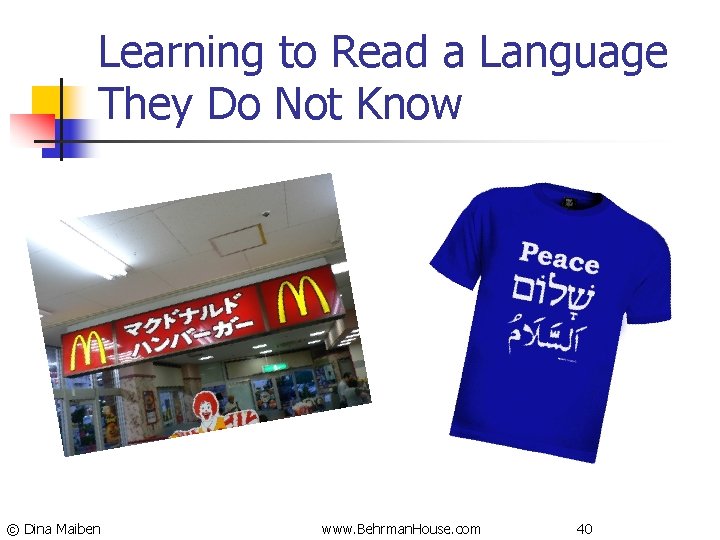
Learning to Read a Language They Do Not Know © Dina Maiben www. Behrman. House. com 40
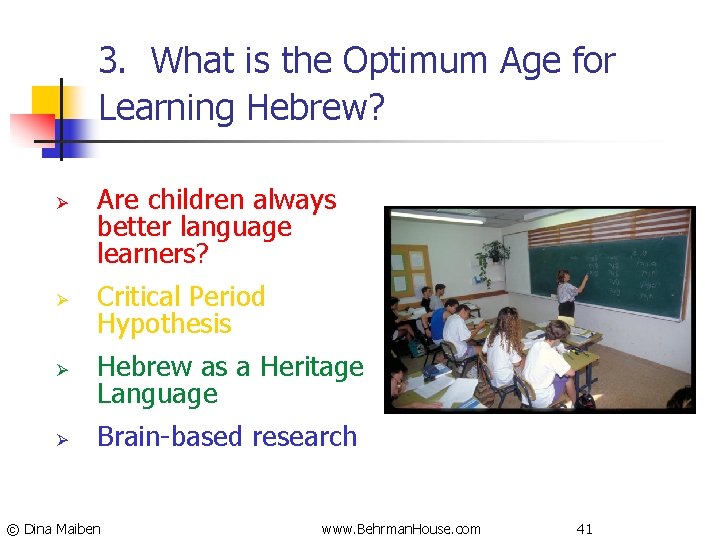
3. What is the Optimum Age for Learning Hebrew? Ø Are children always better language learners? Ø Critical Period Hypothesis Ø Hebrew as a Heritage Language Ø Brain-based research © Dina Maiben www. Behrman. House. com 41
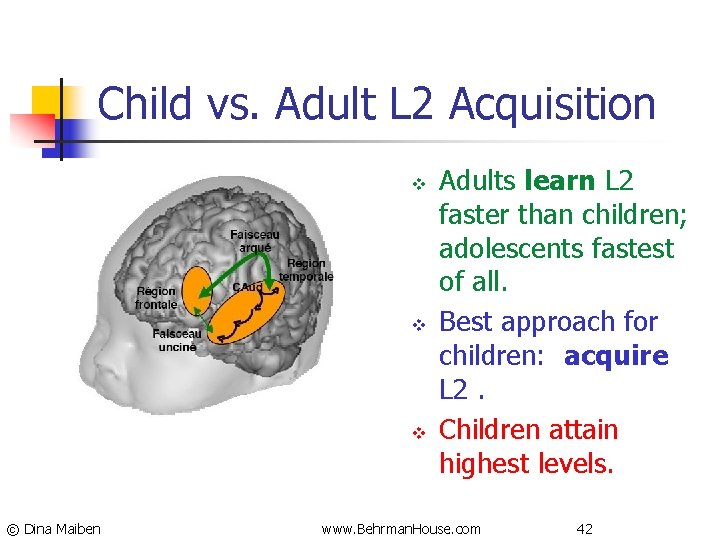
Child vs. Adult L 2 Acquisition v v v © Dina Maiben Adults learn L 2 faster than children; adolescents fastest of all. Best approach for children: acquire L 2. Children attain highest levels. www. Behrman. House. com 42
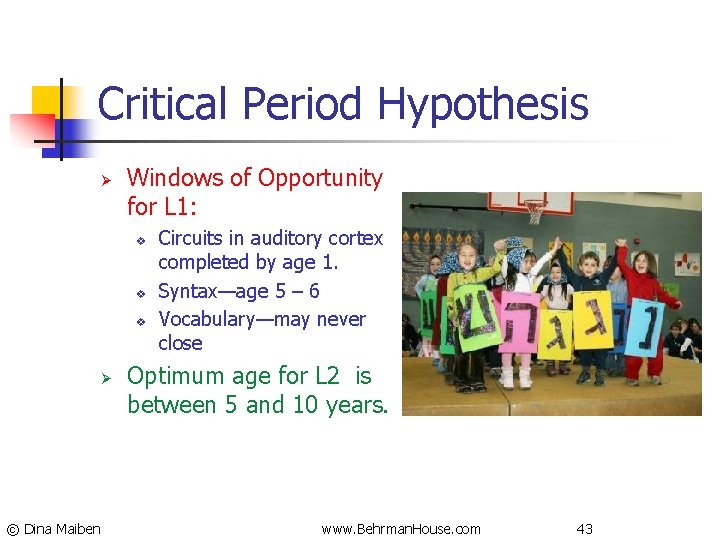
Critical Period Hypothesis Ø Windows of Opportunity for L 1: v v v Ø © Dina Maiben Circuits in auditory cortex completed by age 1. Syntax—age 5 – 6 Vocabulary—may never close Optimum age for L 2 is between 5 and 10 years. www. Behrman. House. com 43
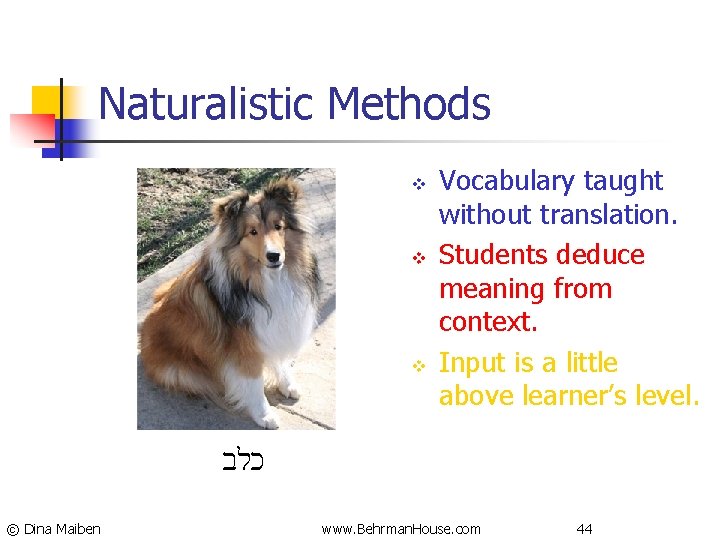
Naturalistic Methods v v v Vocabulary taught without translation. Students deduce meaning from context. Input is a little above learner’s level. כלב © Dina Maiben www. Behrman. House. com 44
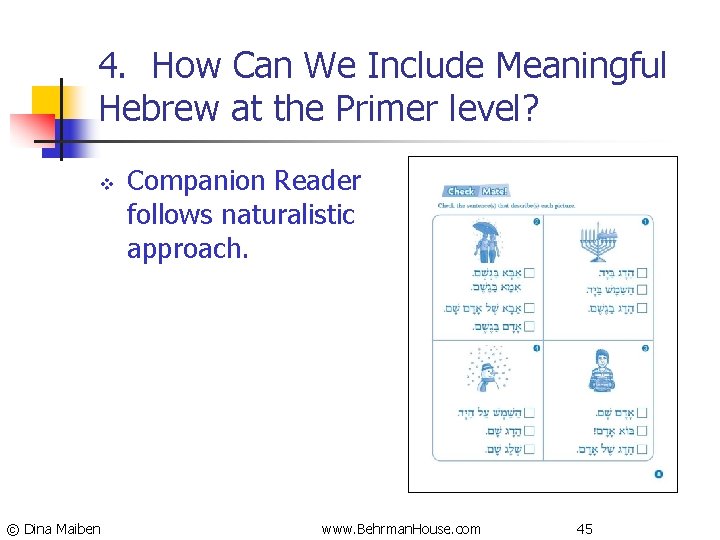
4. How Can We Include Meaningful Hebrew at the Primer level? v © Dina Maiben Companion Reader follows naturalistic approach. www. Behrman. House. com 45
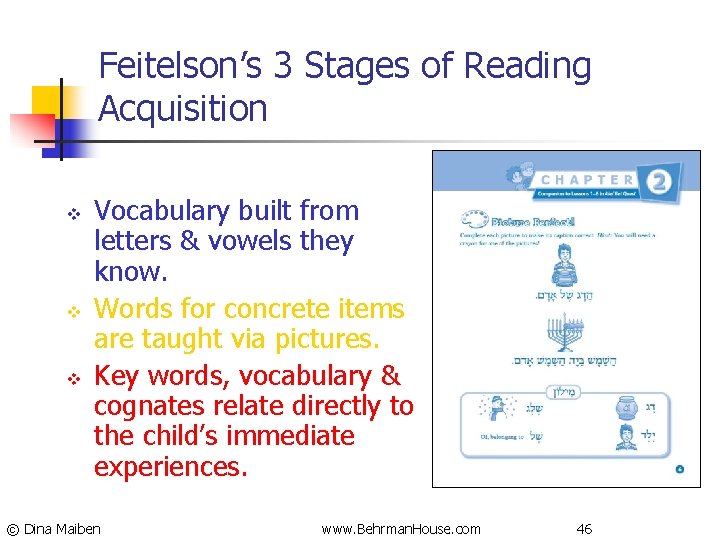
Feitelson’s 3 Stages of Reading Acquisition v v v Vocabulary built from letters & vowels they know. Words for concrete items are taught via pictures. Key words, vocabulary & cognates relate directly to the child’s immediate experiences. © Dina Maiben www. Behrman. House. com 46
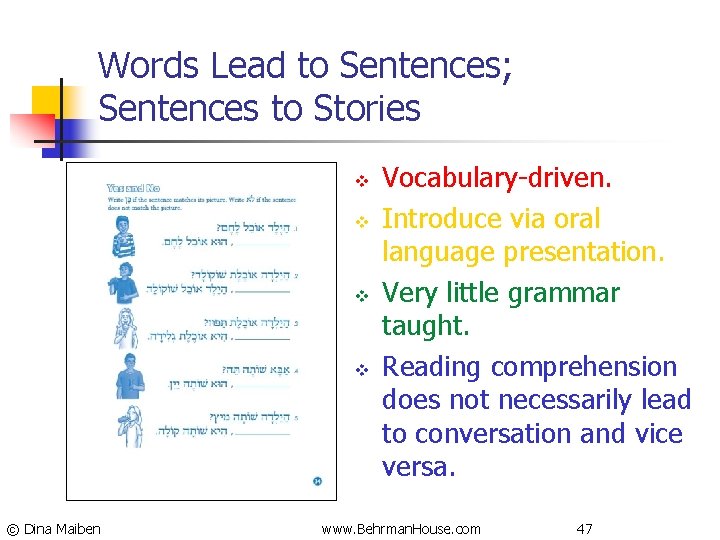
Words Lead to Sentences; Sentences to Stories v v © Dina Maiben Vocabulary-driven. Introduce via oral language presentation. Very little grammar taught. Reading comprehension does not necessarily lead to conversation and vice versa. www. Behrman. House. com 47
? שאלות Questions? © Dina Maiben www. Behrman. House. com 48
Conclusion Dina. Maiben@Gmail. com © Dina Maiben www. Behrman. House. com 49
- Slides: 49