
Hebrew Communications This module introduces the basic elements
Hebrew Communications This module introduces the basic elements of communicating in Modern Hebrew, with emphasis on verbal communications. These elements will focus on sentence structure and syntax for the various types of sentences one normally encounters in the language. After these elements are described, examples of various common conversational scenarios and situations one may encounter, and related dialogues, will be introduced to illustrate verbal Hebrew communications. Modern Hebrew for Beginners Copyright © 2007 -09 Uri Yosef for Virtual. Yeshiva. com All rights reserved. 1

Hebrew Communications (cont’d) Sentence structure and syntax rules In general, the Hebrew sentence structures are similar to their English counterparts. However, there also differences, some of which will be noted later. Most Hebrew sentences contain a subject, a verb and other elements. So that the general syntax of the Hebrew sentence is subject-verbobject, i. e. , the subject precedes the predicate*. It should be noted that there is some flexibility in the syntax of the Hebrew sentence in some cases. Hebrew includes the following basic sentence structures: 1. the nominal sentence 2. the verbal sentence 3. the interrogative sentence 4. the verbal infinitive sentence 5. the conditional sentence A simple example of each is shown in the next slide. * The predicate is the part of a sentence that shows what is being said about the subject. Modern Hebrew for Beginners Copyright © 2007 -09 Uri Yosef for Virtual. Yeshiva. com All rights reserved. 2

Hebrew Communications (cont’d) Sentence structure and syntax rules (cont’d) The following table contains simple examples that correspond the five common Hebrew sentence structures listed in the previous slide: # אנגלית 1. I am in the class. תעתיק עברית . אני בכתה . אני לומד בכתה ? מי נרשם לכתה a. NI ba’ki. TAH 2. I am learning in the class. a. NI lo. MED ba’ki. TAH 3. Who is registered for the class? MI nir. SHAM la’ki. TAH 4. I want to learn. a. NI ro. TSAH lil. MOD 5. If we’ll study then we’ll know. IM nil. MAD AZ nei. DA . אני רוצה ללמד . אם נלמד אז נדע The most significant differences between the respective syntax of Hebrew and English sentences will be noted in the next several slides. Modern Hebrew for Beginners Copyright © 2007 -09 Uri Yosef for Virtual. Yeshiva. com All rights reserved. 3

Hebrew Communications (cont’d) Sentence structure and syntax rules (cont’d) It was pointed out in Slide 2 that differences exist between the Hebrew and English sentence syntax. One difference is the usage of the Hebrew verb equivalent to the English verb “to be” in the present tense. Note that in the example for the nominal sentence (#1), the Hebrew contains no explicit verb corresponding to the “am” in the English (i. e. , it is implicit). In the example of the verbal sentence (#2), the simple present tense verb לומד means “am learning” as shown combined with the singular masculine 1 st-person pronoun (the English translation changes for the singular masculine 2 nd-person and 3 rd-person pronouns). Here too, the explicit present tense of the Hebrew verb equivalent to the English verb “to be” corresponding to the “am” (or to the “are” or “is” in the case of the singular masculine 2 nd-person and 3 rd-person pronoun cases) is absent (i. e. , it is implicit). This also applies to the other conjugations in the present tense, i. e. , to the singular feminine and plural masculine & feminine conjugations. Modern Hebrew for Beginners Copyright © 2007 -09 Uri Yosef for Virtual. Yeshiva. com All rights reserved. 4
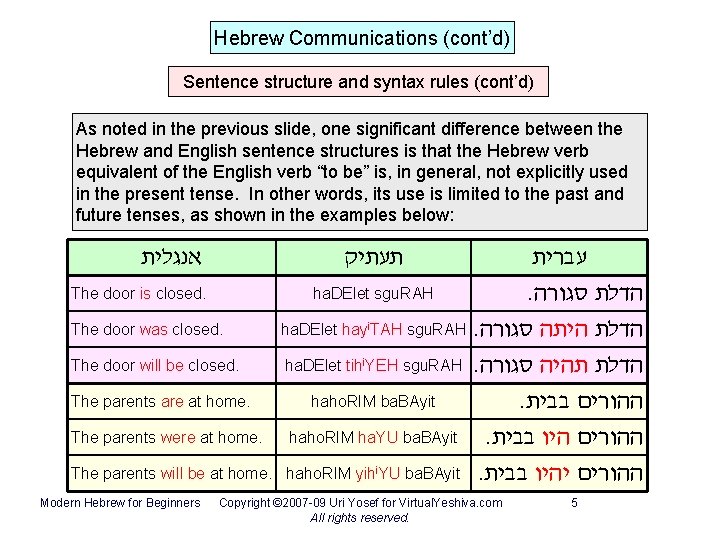
Hebrew Communications (cont’d) Sentence structure and syntax rules (cont’d) As noted in the previous slide, one significant difference between the Hebrew and English sentence structures is that the Hebrew verb equivalent of the English verb “to be” is, in general, not explicitly used in the present tense. In other words, its use is limited to the past and future tenses, as shown in the examples below: אנגלית תעתיק The door is closed. The door was closed. The door will be closed. The parents are at home. The parents were at home. עברית ha. DElet sgu. RAH. הדלת סגורה ha. DElet hayi. TAH sgu. RAH. הדלת היתה סגורה ha. DElet tihi. YEH sgu. RAH. הדלת תהיה סגורה haho. RIM ba. BAyit haho. RIM ha. YU ba. BAyit The parents will be at home. haho. RIM yihi. YU ba. BAyit Modern Hebrew for Beginners . ההורים בבית . ההורים היו בבית . ההורים יהיו בבית Copyright © 2007 -09 Uri Yosef for Virtual. Yeshiva. com All rights reserved. 5

Hebrew Communications (cont’d) Sentence structure and syntax rules (cont’d) Another significant difference between Hebrew and English sentence syntax is the position of an adjective”. Unlike in the syntax of an English sentence, where the adjective precedes the noun (or pronoun) that it describes, in the Hebrew sentence the adjective generally follows the noun it describes. The adjective in Hebrew also takes on the gender and plurality of the noun it modifies. Also, whenever the noun is modified by the Hebrew equivalent of the definite article, the adjective also carries the definite article. On the other hand, as is the case with the English sentence syntax, in Hebrew the adverb** generally follows the verb it describes. Unlike the situation with the Hebrew adjective relative to the noun, the Hebrew adverb does not assume the attributes of the conjugated verb (i. e. , tense, gender, person, and singular/plural). Examples are shown in the table on the next slide. * An adjective is a part of speech that describes a noun or pronoun. ** An adverb is a part of speech that modifies a verb, an adjective, or another adverb. Modern Hebrew for Beginners Copyright © 2007 -09 Uri Yosef for Virtual. Yeshiva. com All rights reserved. 6

Hebrew Communications (cont’d) Sentence structure and syntax rules (cont’d) In the following table, the first four entries demonstrate the syntax of the Hebrew adjectives and its properties in a simple sentence. The last two entries in the table demonstrate the syntax of the Hebrew adverb and its properties in a simple sentence. אנגלית תעתיק A big boy ate in the kitchen. YEled ga. DOL a. CHAL ba’mit. BAH The big girl is eating in the kitchen. ha’yal. DAH ha’gdo. LAH o. CHElet ba’mit. BAH Big boys ate in the kitchen. yela. DIM gdo. LIM ach. LU ba’mit. BAH The big girls are eating in the kitchen. The big boy ate fast. The big girls are eating Modern fast. Hebrew for Beginners עברית . ילד גדול אכל במטבח . הילדה הגדולה אוכלת במטבח . ילדים גדולים אכלו במטבח . הילדות הגדולות אוכלות במטבח ha’YEled ha’ga. DOL a. CHAL הילד הגדול אכל מהר. ma. HER ha’y la. DOT ha’gdo. LOT הגדולות אוכלות הילדות 7 Copyright © 2007 -09 Virtual. Yeshiva. com och. LOT ma. HERUri Yosef for. מהר ha’yila. DOT ha’gdo. LOT och. LOT ba’mit. BAH i All rights reserved.

Hebrew Communications (cont’d) Sentence structure and syntax rules (cont’d) An interrogative sentence, i. e. , a question, was previously listed as one of the five basic sentence structures in Hebrew. In Hebrew, questions are generally formed in two ways: • Raising the intonation at the end of an ordinary sentence (we have already encountered this in several earlier modules). For this type of question the answer is, quite often, either ( כן yes) or ( לא no). • Starting the sentence with an interrogative word or phrase, of which there are quite a few, depending on the nature of the question. One interrogative word in particular, ( האם loosely translated as “Is it …? ”, but this changes depending on what follows )האם , which introduces a question, the answer to which is, quite often, either כן or לא. Some commonly used interrogative words and phrases are listed on the next slide. It should be noted that, in general, these either start a question or are a question by themselves. Also, as is the case in the English language, most of these terms have non-interrogative meanings when they appear in the middle of any sentence. Modern Hebrew for Beginners Copyright © 2007 -09 Uri Yosef for Virtual. Yeshiva. com All rights reserved. 8

Hebrew Communications (cont’d) Interrogative words – (mi. LOT sheei. LAH) מלות שאלה אנגלית עברית תעתיק אנגלית עברית תעתיק Interrogative ha-, heprefix of 1 st word , ־ ה , ה־ How…? How many (much)…? Why…? la. MAH (LAmah)* למה Why…? ma. DU’a מדוע Who…? MI Ei. CH איך ka. MAH (KAmah)* כמה To how many lecha. MAH (much)…? (le. CHAmah)* לכמה Which…? What…? ei. ZEH (EIzeh)* איזה To which…? To what…? leei. ZEH (le. EIzeh)* לאיזה Which…? What…? ei. ZO (EIzo)* מי How old is…? BEN ka. MAH (KAmah)* בן כמה At which…? At what…? beei. ZO (be. EIzo)* BAT ka. MAH (KAmah)* בת כמה To where…? le. AN איזו באיזו In whom…? be. MI במי How old is…? To/for whom…? le. MI למי What…? MAH מהמה From where…? mei. Ayin מאין ma. TAI מתי To what…? le. MAH למה Where…? ei. FOH (EIfoh)* איפה When…? From me’ei. FOH From when…? mima. TAI mi. MAH what…? where…? (me’EIfoh)* * The terms in parentheses show the (acceptable) pronunciations used by most speakers, whereas the terms above show the (proper) pronunciation in the formal language. More on this on the next slide. ממתי Modern Hebrew for Beginners ממה Copyright © 2007 -09 Uri Yosef for Virtual. Yeshiva. com All rights reserved. 9 לאן מאיפה

Hebrew Communications (cont’d) Sentence structure and syntax rules (cont’d) The examples in the table show that some interrogative words may be prefixed with common prepositions and, thereby, form related interrogative terms. When the interrogative prefix ה־ , ה־ is applied to the first word in an ordinary sentence, it turns the sentence into a question after a minor modification of the syntax. Some interrogative words may be preceded by certain elements, such as the preposition עד , (AD; “to, till”), which turns the combination into an interrogative phrase of its own, e. g. , ( עד מתי AD ma. TAI; “Till when…? ”). The examples in the table also show that several different interrogative words have the same meanings. In colloquial (spoken) Hebrew, some of these terms are generally interchangeable. However, formal Hebrew makes a distinction between questions that inquire about a reason and questions that inquire about a purpose. A notable example of this is the pair למה and – מדוע these two words are used in both ways by many Hebrew speakers. However, in formal Hebrew, למה is restricted to questions about the purpose of an action, the answers to which usually uses the word ( כדי ke. DEI; “in order to”). Similarly, מדוע is restricted to inquiries about reason, the answers to which usually uses the word ( כי KI; “because”). Selected examples of questions & answers are shown on the next two slides. Modern Hebrew for Beginners Copyright © 2007 -09 Uri Yosef for Virtual. Yeshiva. com All rights reserved. 10
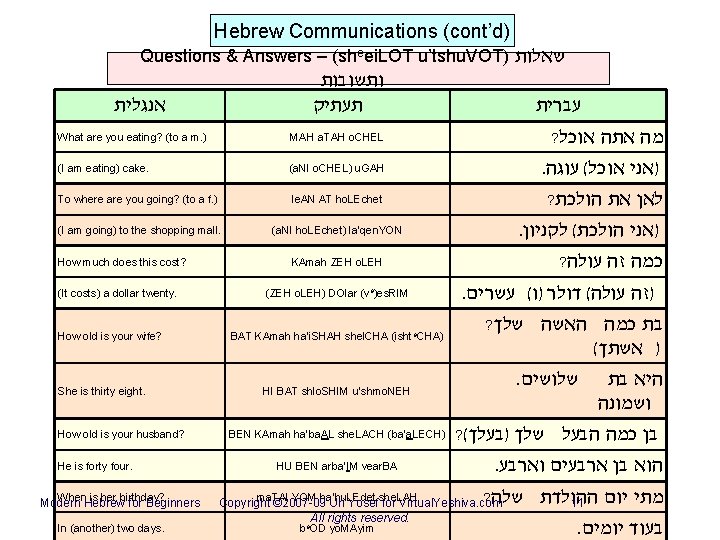
Hebrew Communications (cont’d) Questions & Answers – (sheei. LOT u’tshu. VOT) שאלות ותשובות תעתיק אנגלית What are you eating? (to a m. ) MAH a. TAH o. CHEL (I am eating) cake. (a. NI o. CHEL) u. GAH To where are you going? (to a f. ) le. AN AT ho. LEchet (I am going) to the shopping mall. (a. NI ho. LEchet) la’qen. YON How much does this cost? (It costs) a dollar twenty. How old is your wife? She is thirty eight. How old is your husband? He is forty four. When is her birthday? Modern Hebrew for Beginners In (another) two days. עברית ? אוכל . )אני אוכל( עוגה ? הולכת BAT KAmah ha’i. SHAH shel. CHA (isht e. CHA) ? עולה HU BEN arba’IM vear. BA ? שלך be. OD yo. MAyim בת כמה האשה ( ) אשתך . שלושים ? ( )בעלך היא בת ושמונה בן כמה הבעל שלך . הוא בן ארבעים וארבע ההולדת שלה מתי יום 11 ? Copyright © 2007 -09 Uri Yosef for Virtual. Yeshiva. com All rights reserved. ma. TAI YOM ha’hu. LEdet she. LAH כמה זה . )זה עולה( דולר )ו( עשרים HI BAT shlo. SHIM u’shmo. NEH BEN KAmah ha’ba. AL she. LACH (ba’a. LECH) לאן את . )אני הולכת( לקניון KAmah ZEH o. LEH (ZEH o. LEH) DOlar (ve)es. RIM מה אתה . בעוד יומים
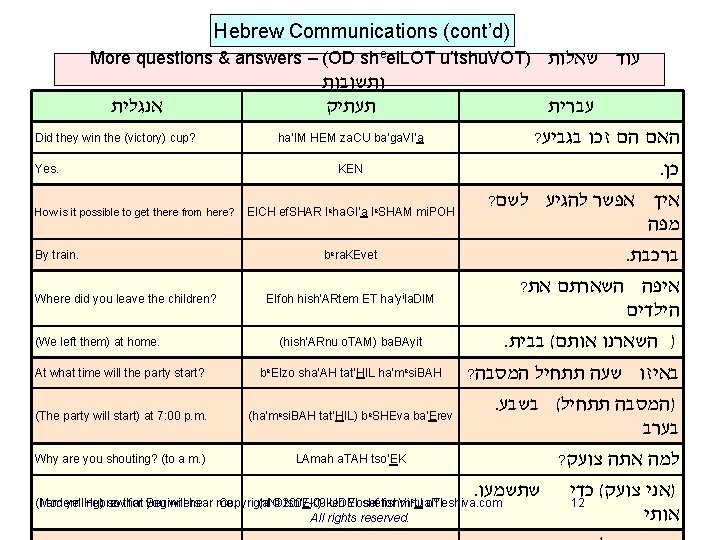
Hebrew Communications (cont’d) More questions & answers – (OD sheei. LOT u’tshu. VOT) עוד שאלות אנגלית Did they win the (victory) cup? Yes. How is it possible to get there from here? By train. Where did you leave the children? (We left them) at home. ותשובות תעתיק עברית ? בגביע ha’IM HEM za. CU ba’ga. VI’a האם הם זכו . כן KEN EICH ef. SHAR leha. GI’a le. SHAM mi. POH ? לשם איך אפשר להגיע מפה . ברכבת bera. KEvet ? את EIfoh hish’ARtem ET ha’yila. DIM . ) השארנו אותם( בבית (hish’ARnu o. TAM) ba. BAyit At what time will the party start? be. EIzo sha’AH tat’HIL ha’mesi. BAH (The party will start) at 7: 00 p. m. (ha’mesi. BAH tat’HIL) be. SHEva ba’Erev Why are you shouting? (to a m. ) LAmah a. TAH tso’EK איפה השארתם הילדים ? המסבה באיזו שעה תתחיל . )המסבה תתחיל( בשבע בערב ? צועק . שתשמעו e. U o. TI (IModern am yelling) so that you will hear me. (a. NI tso’EK) ke. DEI shetishm Hebrew for Beginners Copyright © 2007 -09 Uri Yosef for Virtual. Yeshiva. com All rights reserved. למה אתה )אני צועק( כדי 12 אותי
- Slides: 12