
HeavyHitter Detection Entirely in the Data Plane VIBHAALAKSHMI

Heavy-Hitter Detection Entirely in the Data Plane VIBHAALAKSHMI SIVARAMAN SRINIVAS NARAYANA, ORI ROTTENSTREICH, MUTHUKRSISHNAN, JENNIFER REXFORD 1
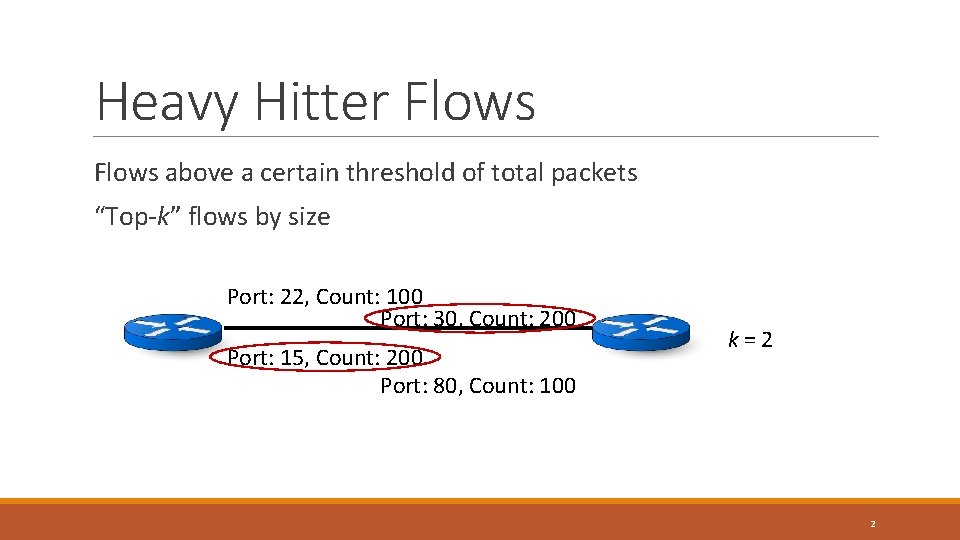
Heavy Hitter Flows above a certain threshold of total packets “Top-k” flows by size Port: 22, Count: 100 Port: 30, Count: 200 Port: 15, Count: 200 Port: 80, Count: 100 k=2 2
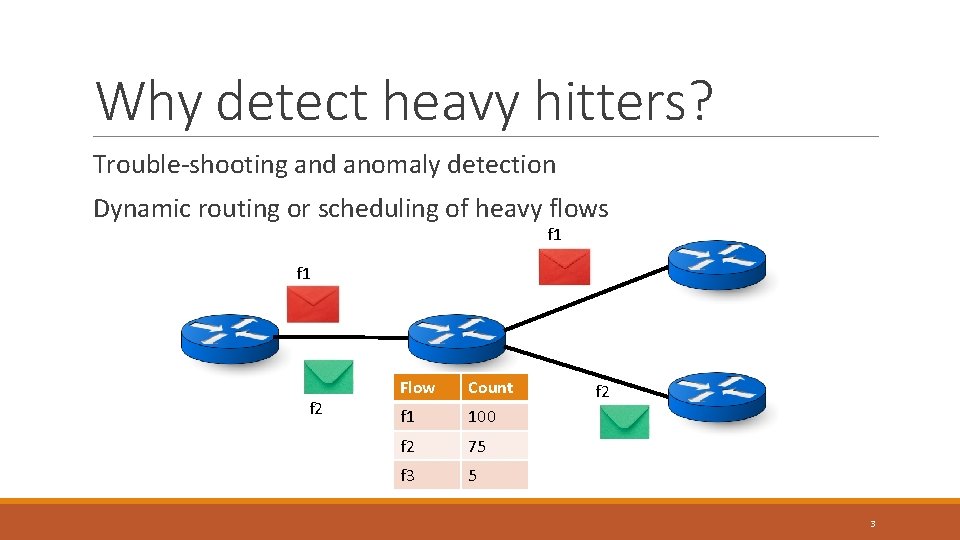
Why detect heavy hitters? Trouble-shooting and anomaly detection Dynamic routing or scheduling of heavy flows f 1 f 2 Flow Count f 1 100 f 2 75 f 3 5 f 2 3
Problem Statement Restrict processing to data plane Low data plane state High accuracy Line-rate packet processing 4
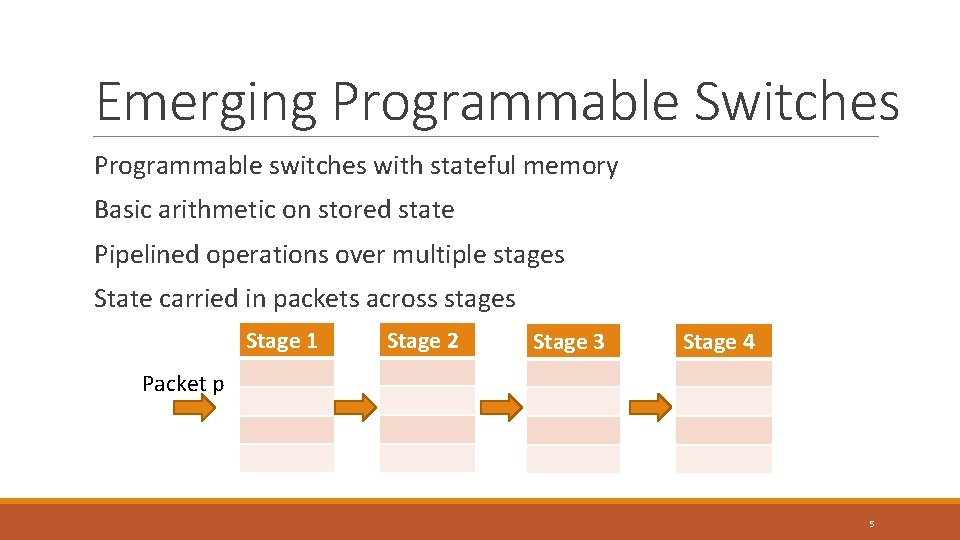
Emerging Programmable Switches Programmable switches with stateful memory Basic arithmetic on stored state Pipelined operations over multiple stages State carried in packets across stages Stage 1 Stage 2 Stage 3 Stage 4 Packet p 5
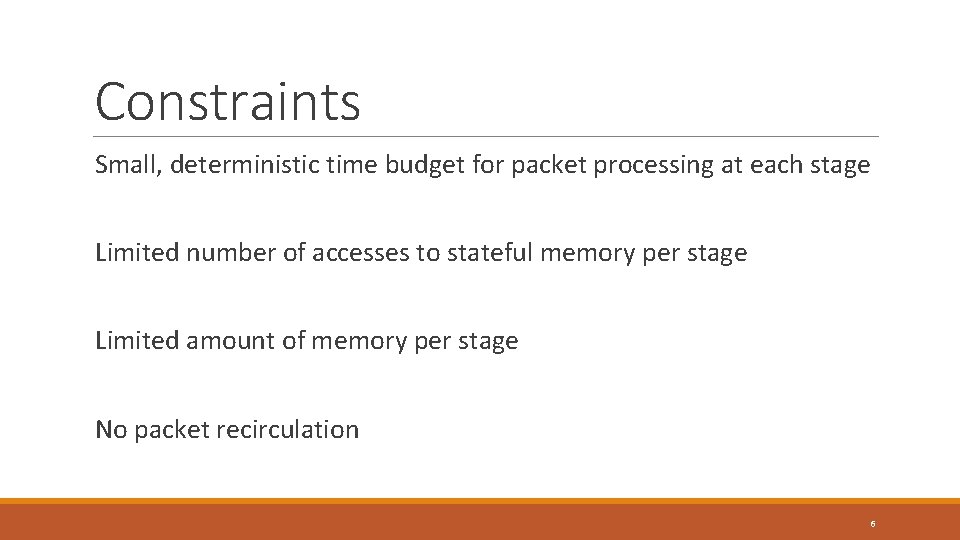
Constraints Small, deterministic time budget for packet processing at each stage Limited number of accesses to stateful memory per stage Limited amount of memory per stage No packet recirculation 6
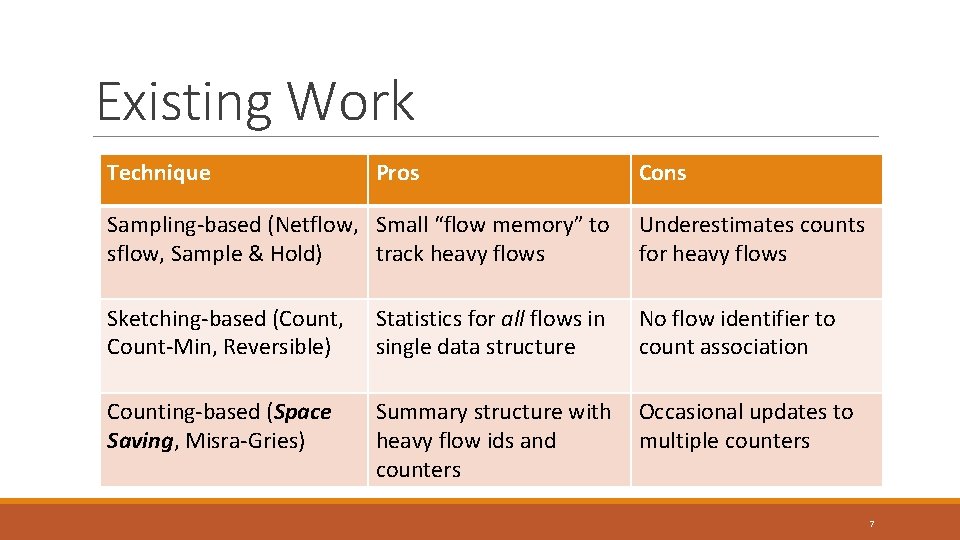
Existing Work Technique Pros Cons Sampling-based (Netflow, Small “flow memory” to sflow, Sample & Hold) track heavy flows Underestimates counts for heavy flows Sketching-based (Count, Count-Min, Reversible) Statistics for all flows in single data structure No flow identifier to count association Counting-based (Space Saving, Misra-Gries) Summary structure with heavy flow ids and counters Occasional updates to multiple counters 7
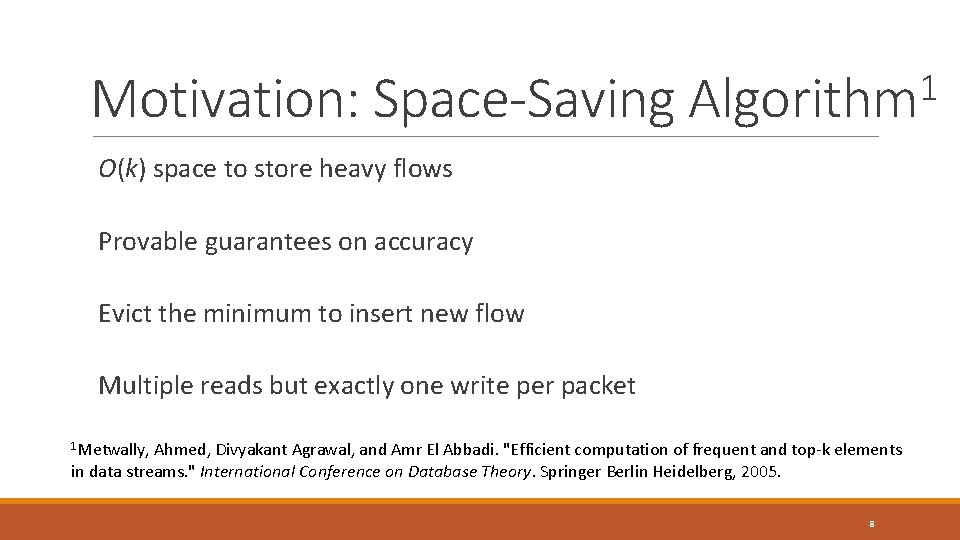
Motivation: Space-Saving 1 Algorithm O(k) space to store heavy flows Provable guarantees on accuracy Evict the minimum to insert new flow Multiple reads but exactly one write per packet 1 Metwally, Ahmed, Divyakant Agrawal, and Amr El Abbadi. "Efficient computation of frequent and top-k elements in data streams. " International Conference on Database Theory. Springer Berlin Heidelberg, 2005. 8
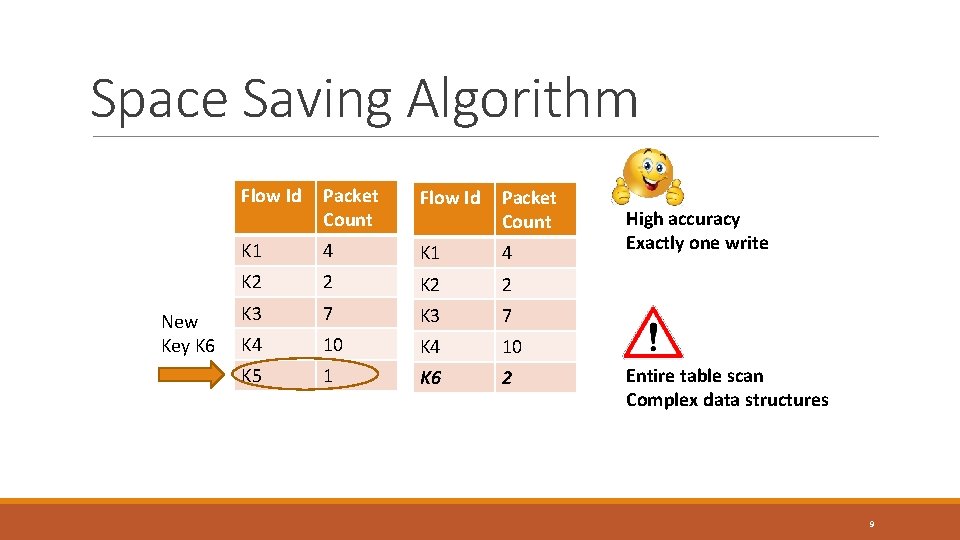
Space Saving Algorithm New Key K 6 Flow Id Packet Count K 1 4 K 2 2 K 3 7 K 4 10 K 5 1 K 6 2 High accuracy Exactly one write Entire table scan Complex data structures 9
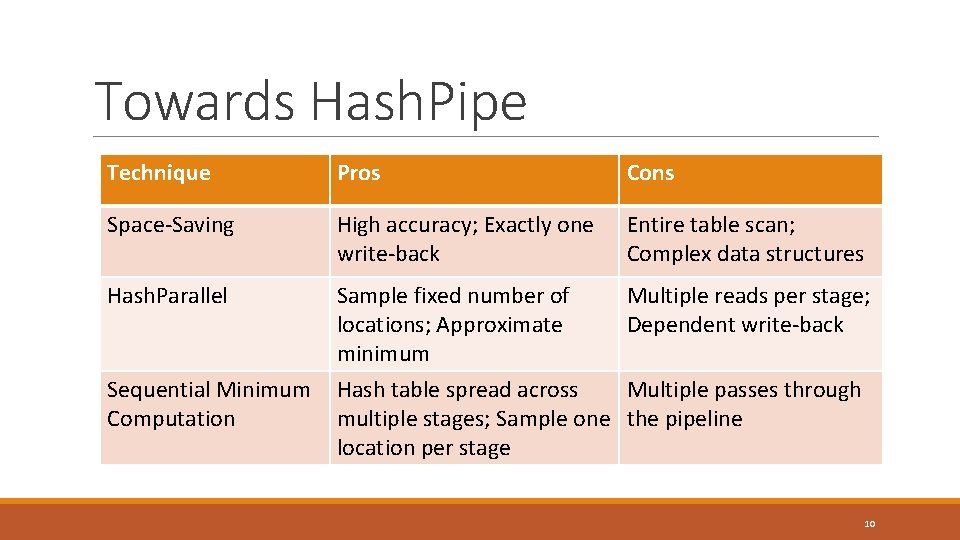
Towards Hash. Pipe Technique Pros Cons Space-Saving High accuracy; Exactly one write-back Entire table scan; Complex data structures Hash. Parallel Sample fixed number of locations; Approximate minimum Multiple reads per stage; Dependent write-back Sequential Minimum Computation Hash table spread across Multiple passes through multiple stages; Sample one the pipeline location per stage 10
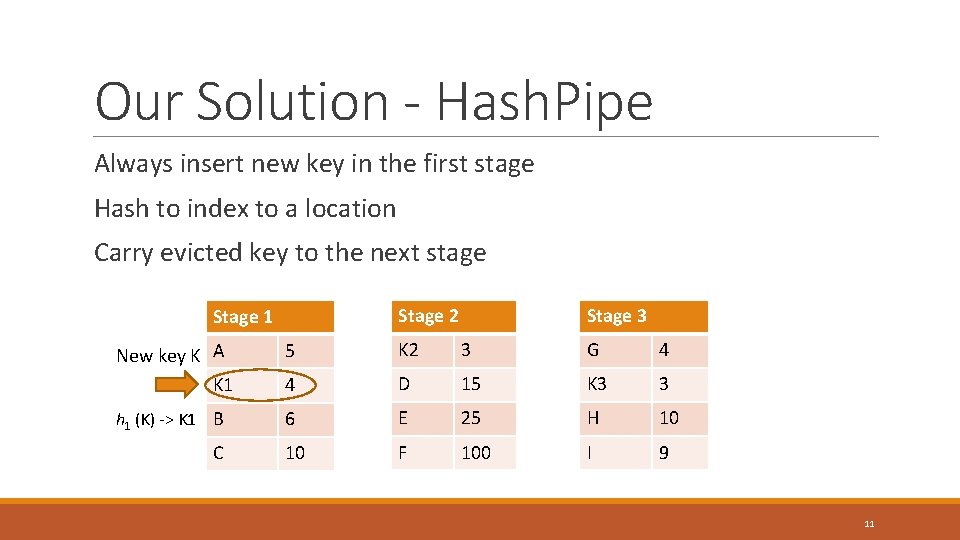
Our Solution - Hash. Pipe Always insert new key in the first stage Hash to index to a location Carry evicted key to the next stage Stage 2 Stage 1 Stage 3 New key K A K 1 5 K 2 3 G 4 4 D 15 K 3 3 h 1 (K) -> K 1 B 6 E 25 H 10 10 F 100 I 9 C 11
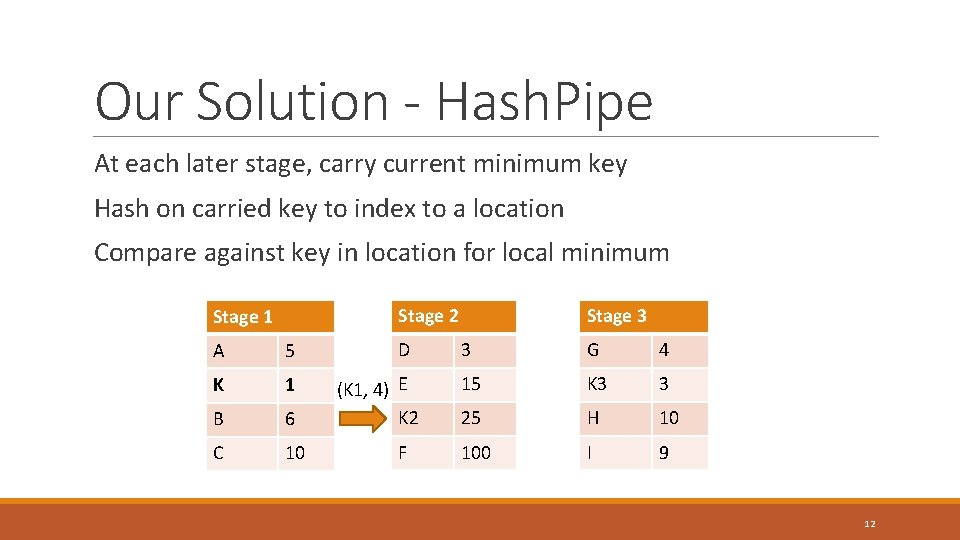
Our Solution - Hash. Pipe At each later stage, carry current minimum key Hash on carried key to index to a location Compare against key in location for local minimum Stage 2 Stage 1 A 5 K 1 B 6 C 10 D (K 1, 4) E K 2 F Stage 3 3 G 4 15 K 3 3 25 H 10 100 I 9 12
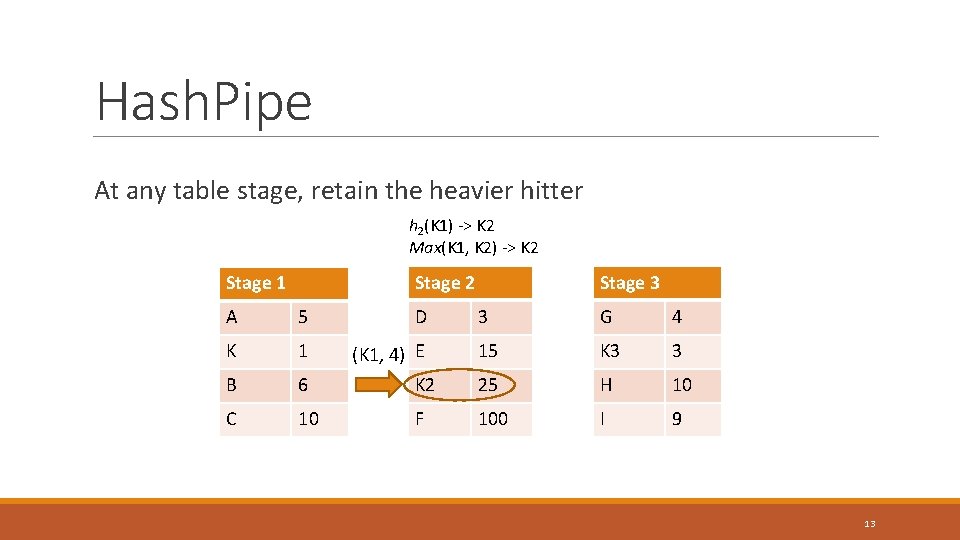
Hash. Pipe At any table stage, retain the heavier hitter h 2(K 1) -> K 2 Max(K 1, K 2) -> K 2 Stage 1 A 5 D K 1 (K 1, 4) E B 6 C 10 Stage 3 3 G 4 15 K 3 3 K 2 25 H 10 F 100 I 9 13
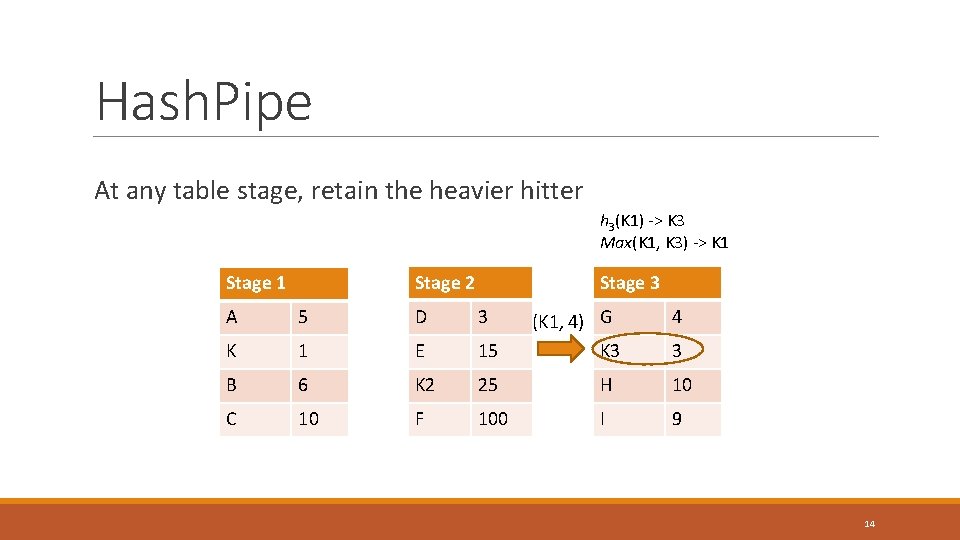
Hash. Pipe At any table stage, retain the heavier hitter h 3(K 1) -> K 3 Max(K 1, K 3) -> K 1 Stage 2 Stage 1 Stage 3 A 5 D 3 (K 1, 4) G K 3 4 K 1 E 15 B 6 K 2 25 H 10 C 10 F 100 I 9 3 14
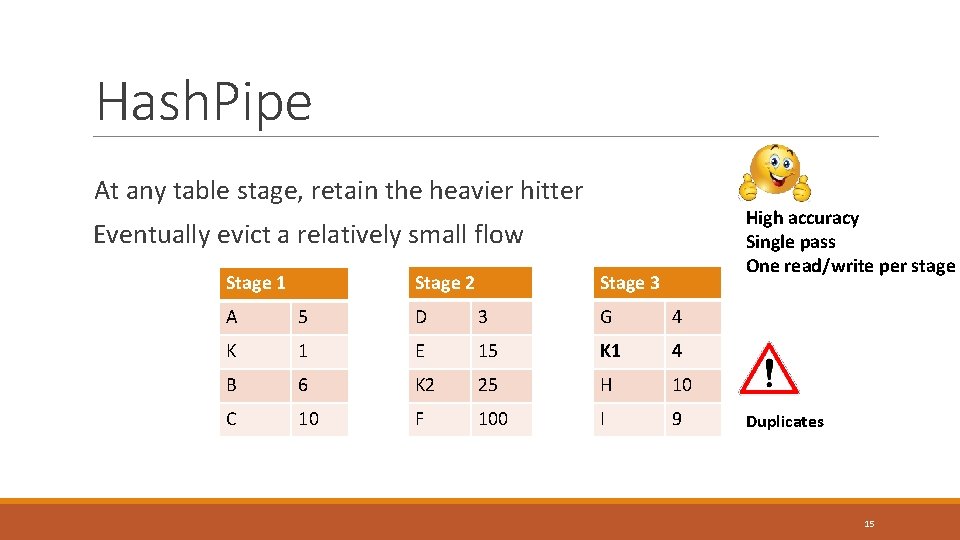
Hash. Pipe At any table stage, retain the heavier hitter High accuracy Single pass One read/write per stage Eventually evict a relatively small flow Stage 2 Stage 1 Stage 3 A 5 D 3 G 4 K 1 E 15 K 1 4 B 6 K 2 25 H 10 C 10 F 100 I 9 Duplicates 15
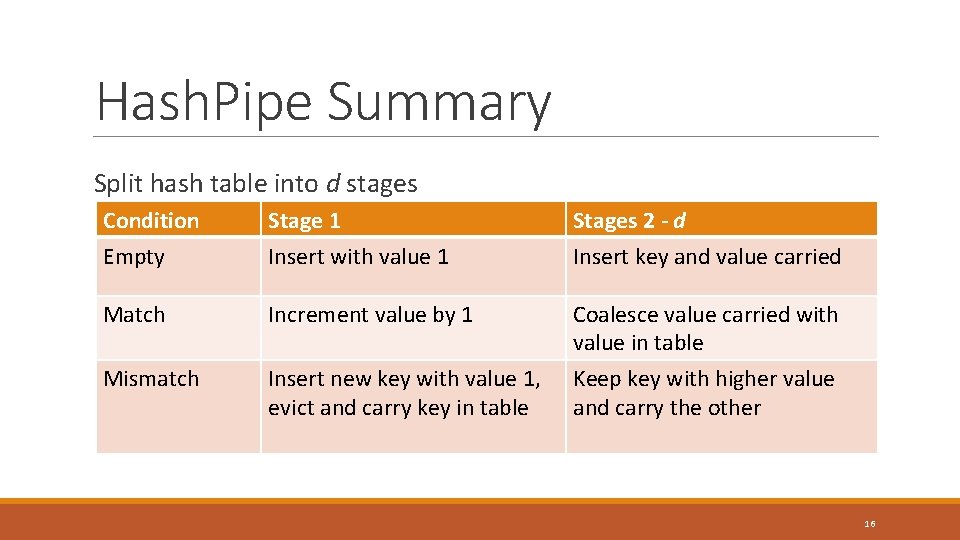
Hash. Pipe Summary Split hash table into d stages Condition Empty Stage 1 Insert with value 1 Stages 2 - d Insert key and value carried Match Increment value by 1 Coalesce value carried with value in table Mismatch Insert new key with value 1, evict and carry key in table Keep key with higher value and carry the other 16
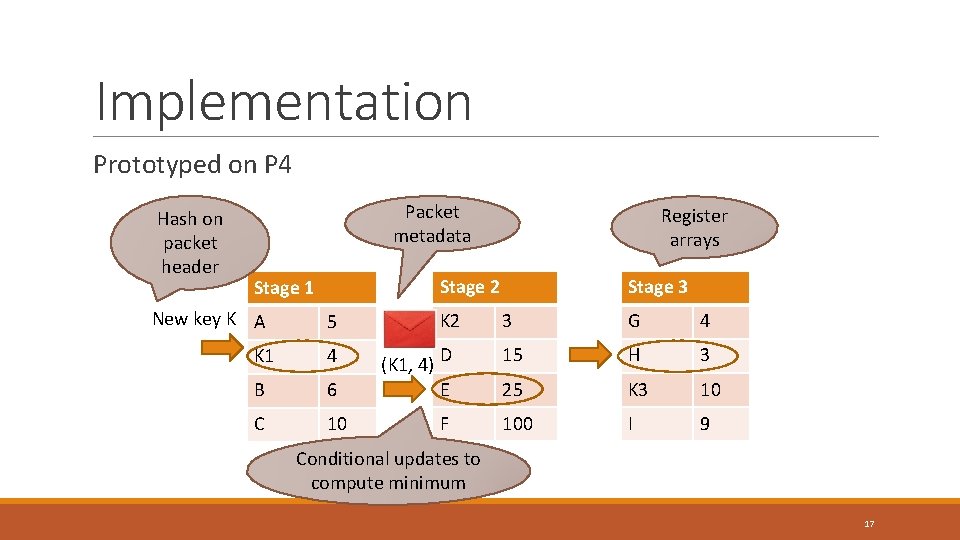
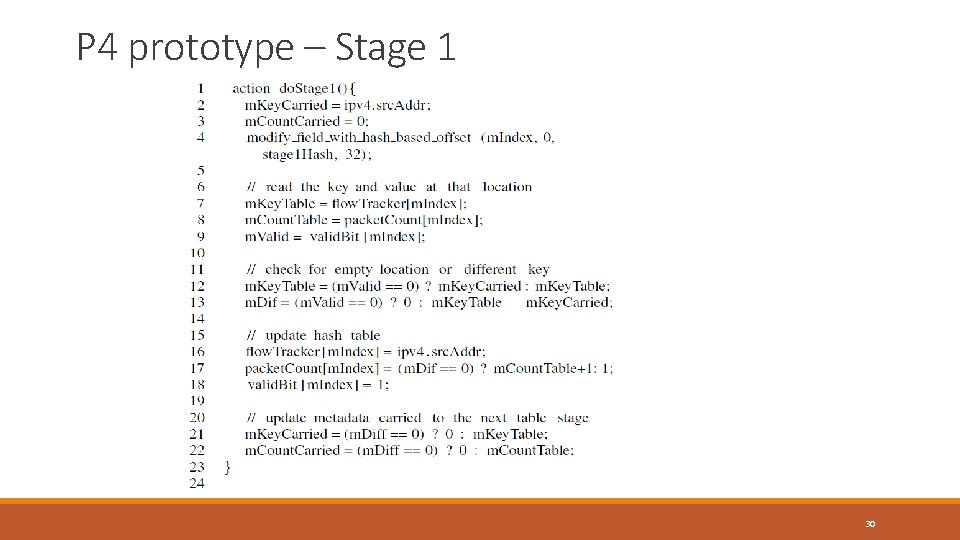
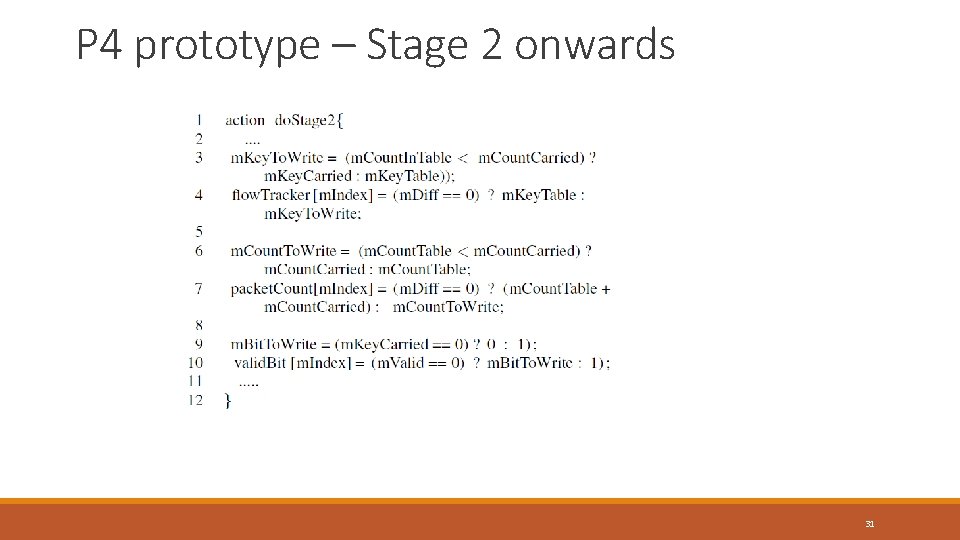
Implementation Prototyped on P 4 Hash on packet header Packet metadata Stage 2 Stage 1 New key K A Register arrays 5 K 1 4 B 6 C 10 K 2 (K 1, 4) D E F Stage 3 3 G 4 15 H 3 25 K 3 10 100 I 9 Conditional updates to compute minimum 17
Evaluation Setup Top-k 5 tuples on CAIDA traffic traces with 500 M packets 50 trials, each 20 s long with 10 M packets and 400, 000 flows Memory allocated: 10 KB to 100 KB; k value: 60 to 300 Metrics: false negatives, false positives, count estimation error 18
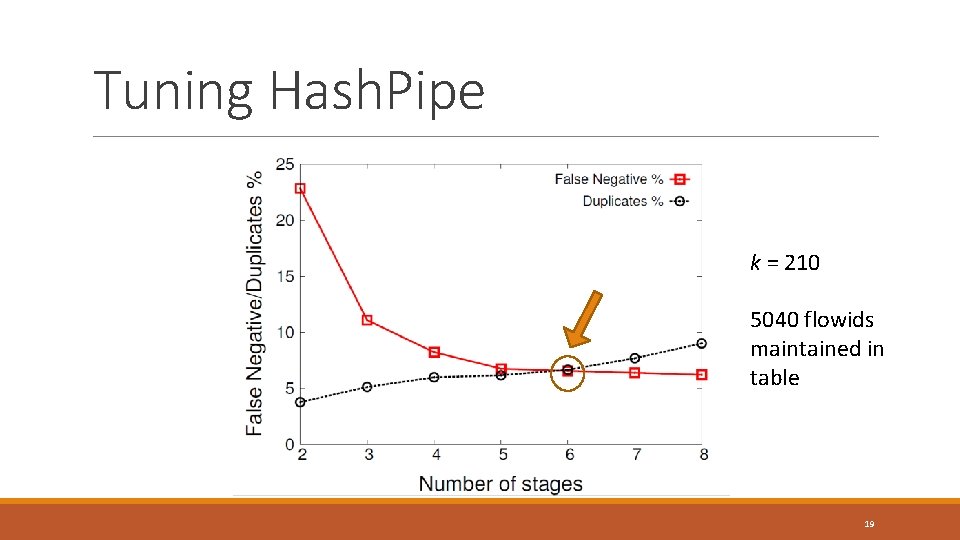
Tuning Hash. Pipe k = 210 5040 flowids maintained in table 19
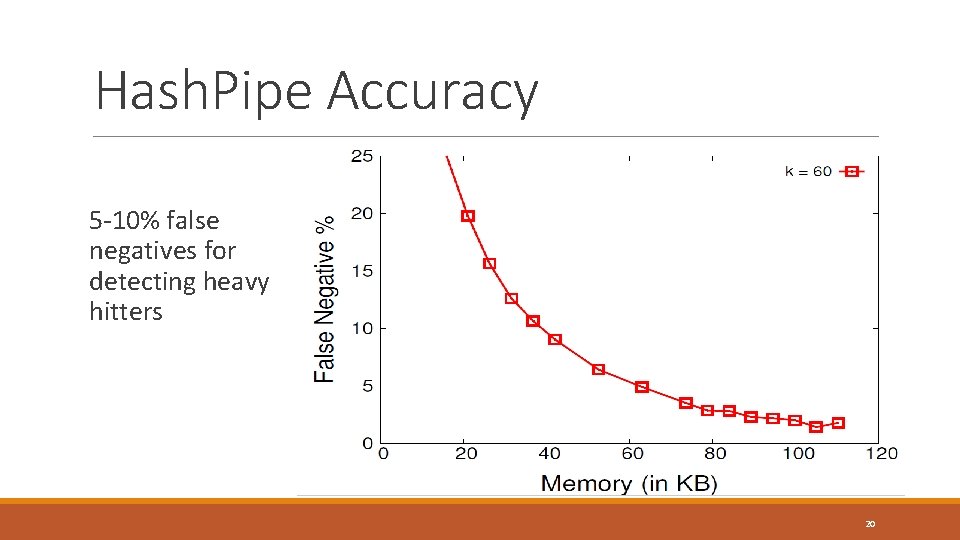
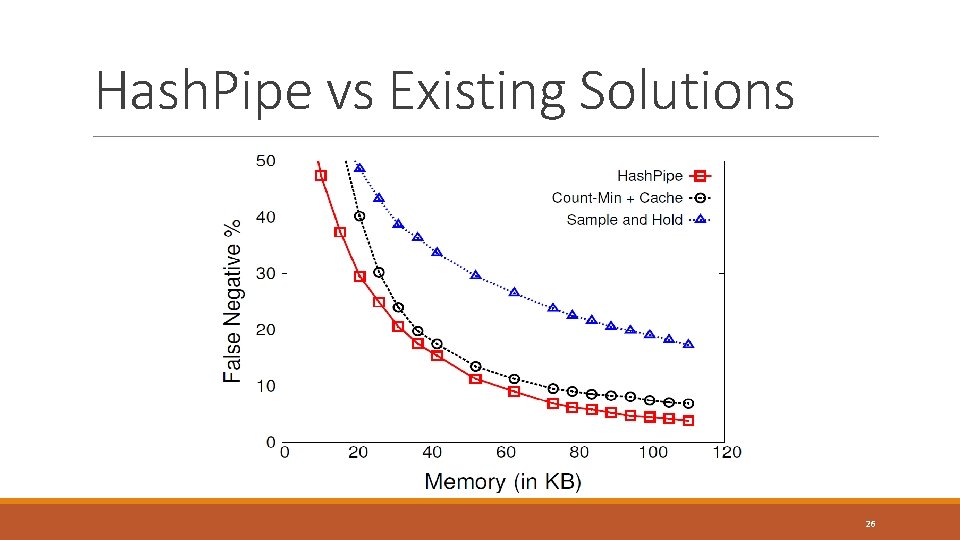
Hash. Pipe Accuracy 5 -10% false negatives for detecting heavy hitters 20
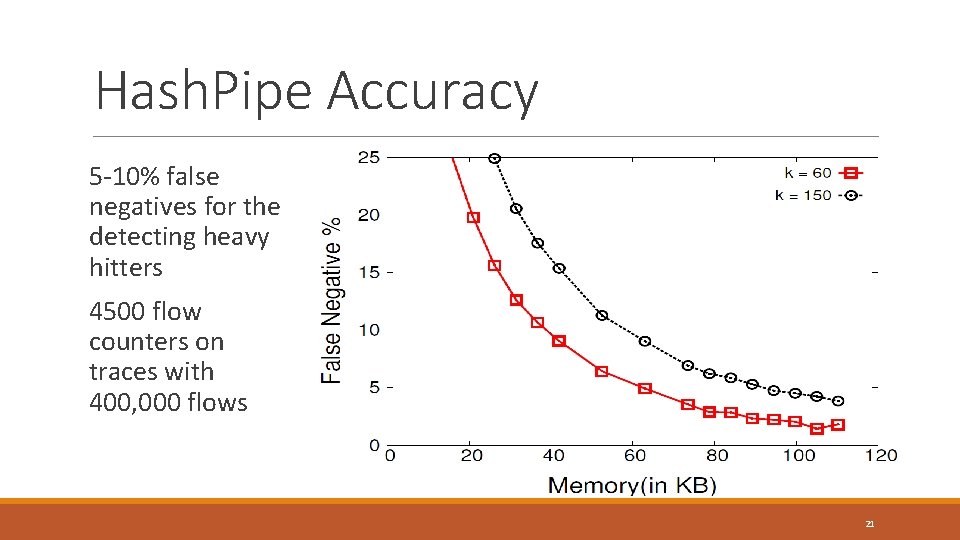
Hash. Pipe Accuracy 5 -10% false negatives for the detecting heavy hitters 4500 flow counters on traces with 400, 000 flows 21
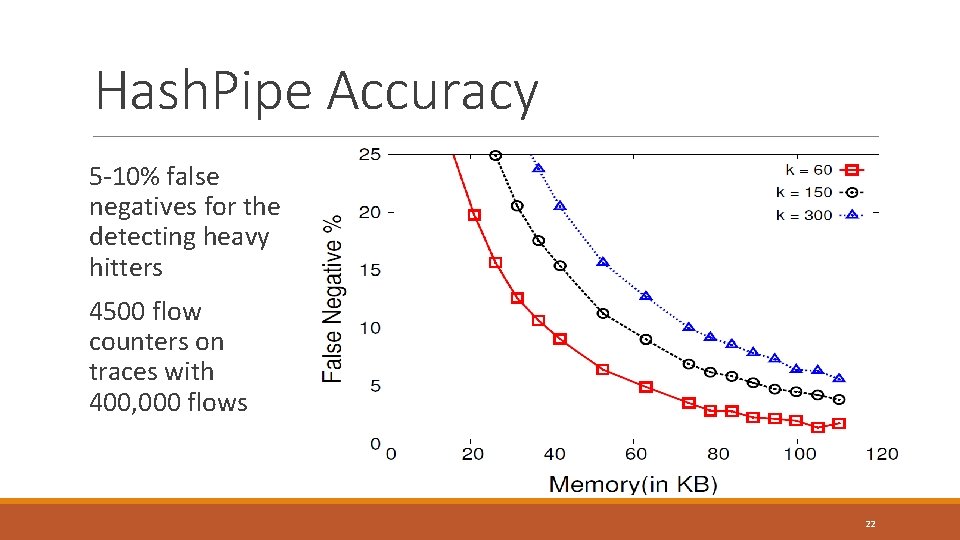
Hash. Pipe Accuracy 5 -10% false negatives for the detecting heavy hitters 4500 flow counters on traces with 400, 000 flows 22
Competing Schemes Sample and Hold ◦ Sample packets of new flows ◦ Increment counters for all packets of a flow once sampled Count-Min Sketch ◦ Increment counters for every packet at d hashed locations ◦ Estimate using minimum among d location ◦ Track heavy hitters in cache 23
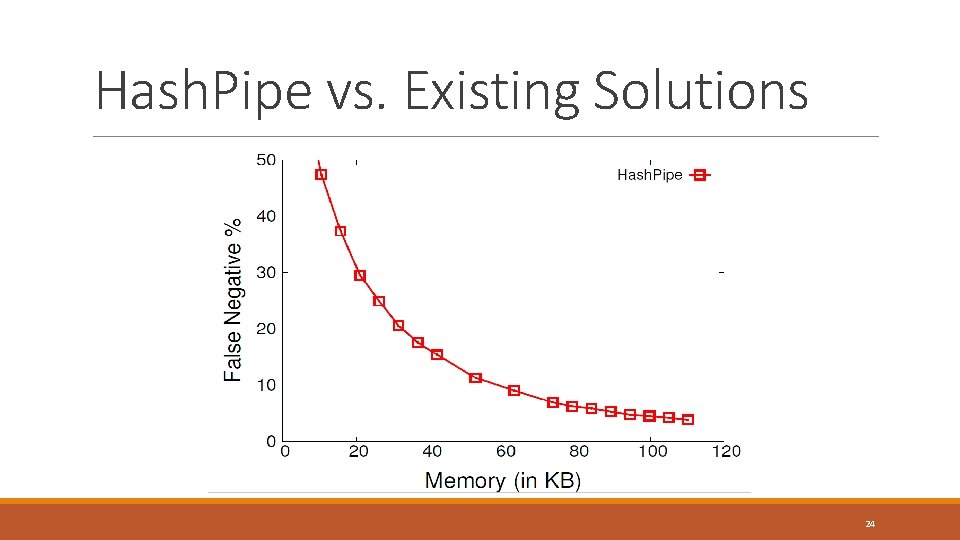
Hash. Pipe vs. Existing Solutions 24
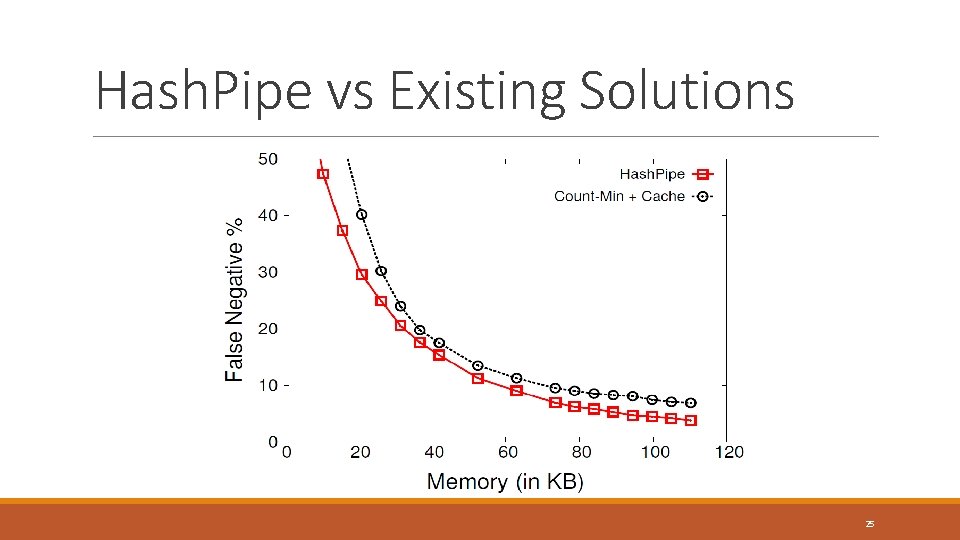
Hash. Pipe vs Existing Solutions 25
Hash. Pipe vs Existing Solutions 26

Contributions and Future Work Contributions: o Heavy hitter detection on programmable data planes o Pipelined hash table with preferential eviction of smaller flows o P 4 prototype - https: //github. com/vibhaa/iw 15 -heavyhitters Future Work: o Analytical results and theoretical bounds o Controlled experiments on synthetic traces 27

THANK YOU vibhaa@princeton. edu 28
Backup Slides 29
P 4 prototype – Stage 1 30
P 4 prototype – Stage 2 onwards 31
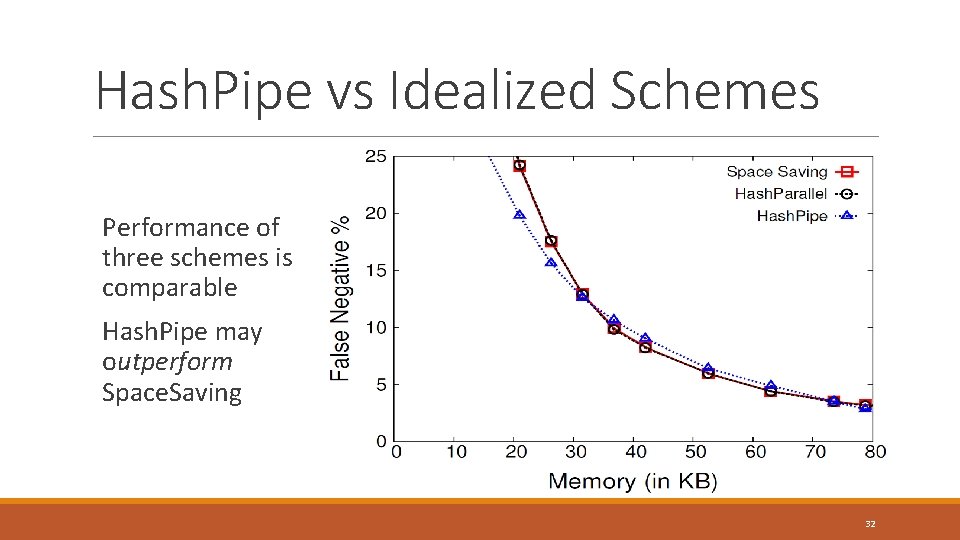
Hash. Pipe vs Idealized Schemes Performance of three schemes is comparable Hash. Pipe may outperform Space. Saving 32
Programmable Switches New switches that allow us to run novel algorithms Barefoot Tofino, RMT, Xilinx, Netronome, etc. Languages like P 4 to program the switches 33
- Slides: 33