
HeavyDuty OBD Proposed Amendments to HeavyDuty OnBoard Diagnostic
Heavy-Duty OBD Proposed Amendments to Heavy-Duty On-Board Diagnostic Requirements August 23, 2012
Heavy-Duty OBD Today’s Presentation • • Background Proposed Amendments Remaining Issue Summary
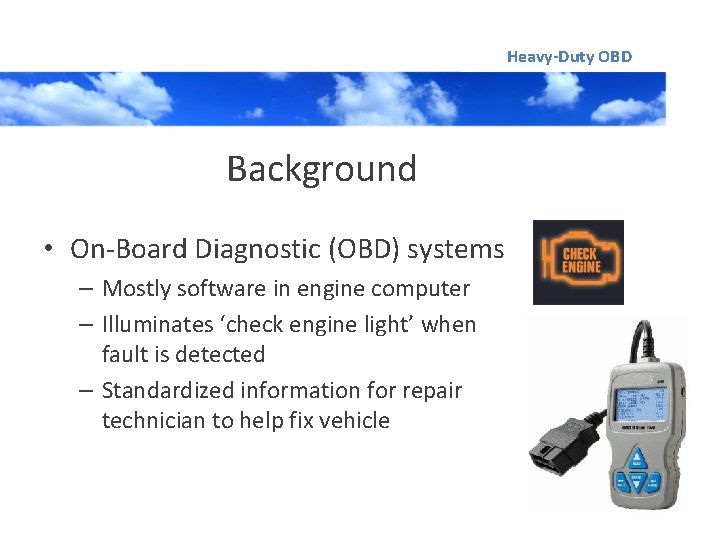
Heavy-Duty OBD Background • On-Board Diagnostic (OBD) systems – Mostly software in engine computer – Illuminates ‘check engine light’ when fault is detected – Standardized information for repair technician to help fix vehicle
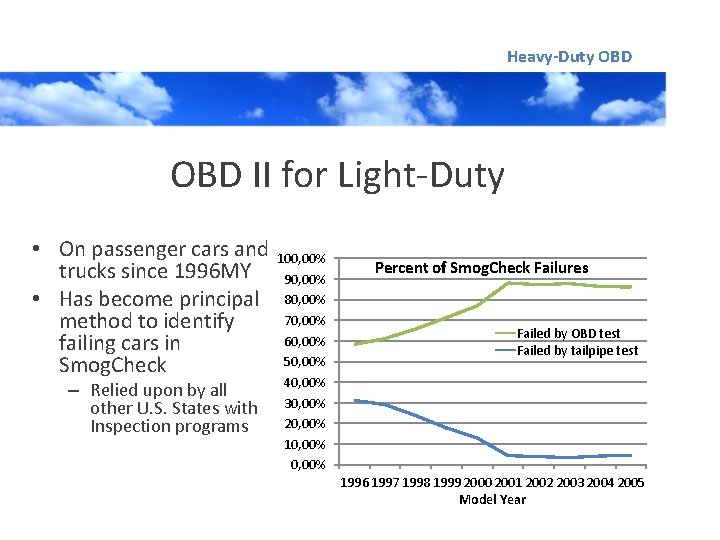
Heavy-Duty OBD II for Light-Duty • On passenger cars and trucks since 1996 MY • Has become principal method to identify failing cars in Smog. Check – Relied upon by all other U. S. States with Inspection programs 100, 00% 90, 00% 80, 00% 70, 00% 60, 00% 50, 00% 40, 00% 30, 00% 20, 00% 10, 00% Percent of Smog. Check Failures Failed by OBD test Failed by tailpipe test 1996 1997 1998 1999 2000 2001 2002 2003 2004 2005 Model Year
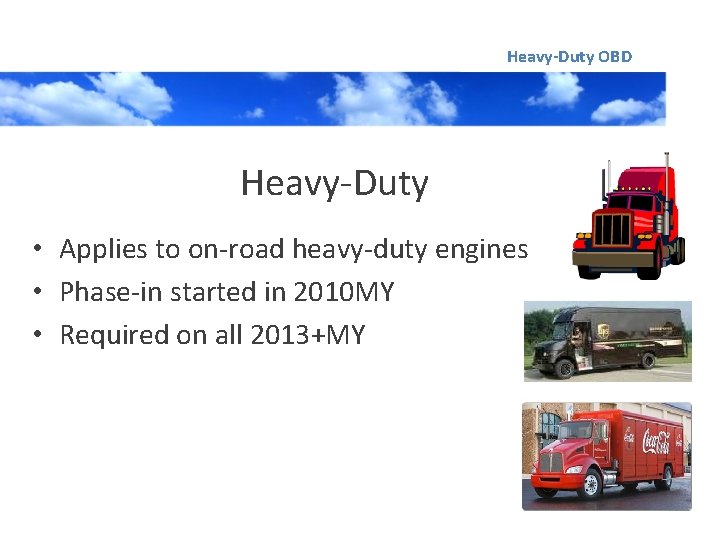
Heavy-Duty OBD Heavy-Duty • Applies to on-road heavy-duty engines • Phase-in started in 2010 MY • Required on all 2013+MY
Heavy-Duty OBD Reason for Changes • Program updates occur regularly – Technology forcing regulation – Periodic reviews to check progress • Last revisions before wide-scale implementation in 2013 MY • Changes affect heavy- and medium-duty – Mostly diesel engines
Heavy-Duty OBD Overview of Proposed Changes • Changes that affect 2013 -2015 MY – Reflect current state of the art technology • More stringent requirements for 2016 MY or later • Revised/new definitions and other revisions to clarify stakeholder responsibilities
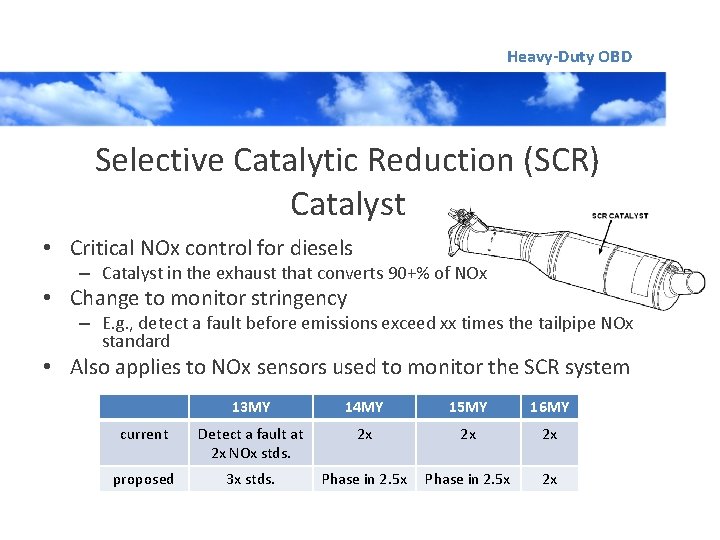
Heavy-Duty OBD Selective Catalytic Reduction (SCR) Catalyst • Critical NOx control for diesels – Catalyst in the exhaust that converts 90+% of NOx • Change to monitor stringency – E. g. , detect a fault before emissions exceed xx times the tailpipe NOx standard • Also applies to NOx sensors used to monitor the SCR system 13 MY 14 MY 15 MY 16 MY current Detect a fault at 2 x NOx stds. 2 x 2 x 2 x proposed 3 x stds. Phase in 2. 5 x 2 x
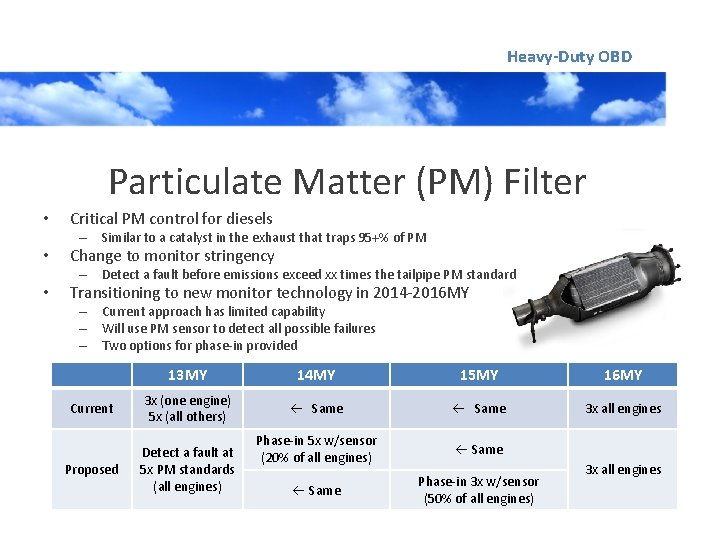
Heavy-Duty OBD Particulate Matter (PM) Filter • Critical PM control for diesels – Similar to a catalyst in the exhaust that traps 95+% of PM • Change to monitor stringency – Detect a fault before emissions exceed xx times the tailpipe PM standard • Transitioning to new monitor technology in 2014 -2016 MY – Current approach has limited capability – Will use PM sensor to detect all possible failures – Two options for phase-in provided 13 MY 14 MY 15 MY 16 MY Current 3 x (one engine) 5 x (all others) Same 3 x all engines Phase-in 5 x w/sensor (20% of all engines) Same Proposed Detect a fault at 5 x PM standards (all engines) Same Phase-in 3 x w/sensor (50% of all engines) 3 x all engines
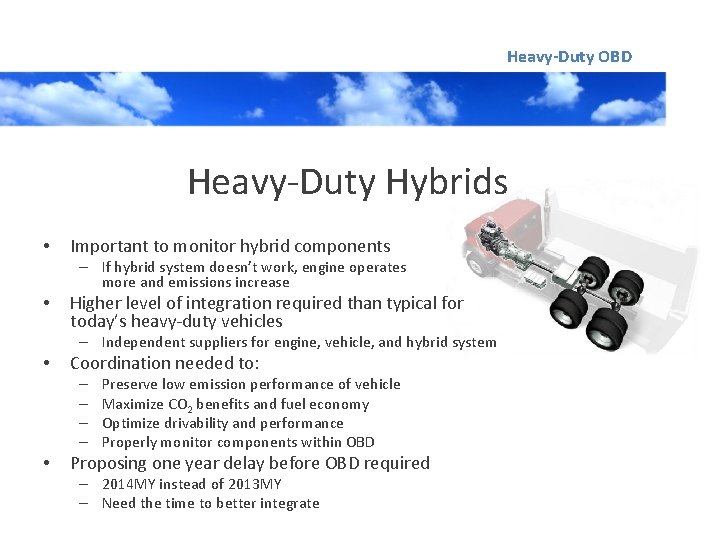
Heavy-Duty OBD Heavy-Duty Hybrids • Important to monitor hybrid components – If hybrid system doesn’t work, engine operates more and emissions increase • Higher level of integration required than typical for today’s heavy-duty vehicles – Independent suppliers for engine, vehicle, and hybrid system • Coordination needed to: – – • Preserve low emission performance of vehicle Maximize CO 2 benefits and fuel economy Optimize drivability and performance Properly monitor components within OBD Proposing one year delay before OBD required – 2014 MY instead of 2013 MY – Need the time to better integrate
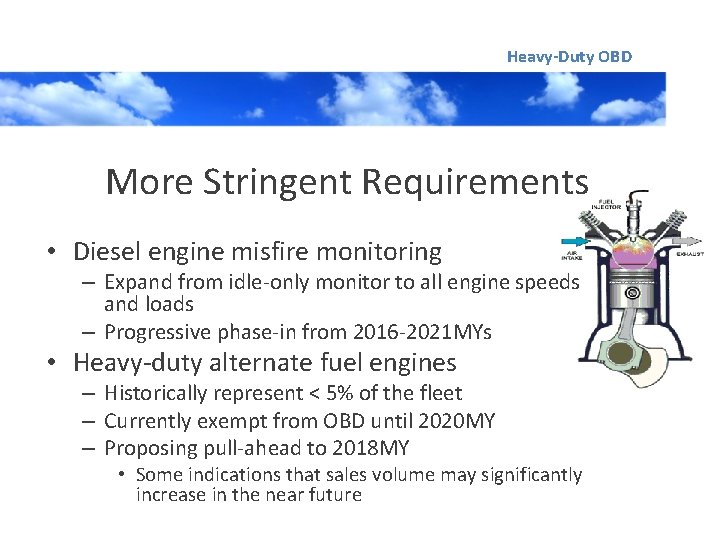
Heavy-Duty OBD More Stringent Requirements • Diesel engine misfire monitoring – Expand from idle-only monitor to all engine speeds and loads – Progressive phase-in from 2016 -2021 MYs • Heavy-duty alternate fuel engines – Historically represent < 5% of the fleet – Currently exempt from OBD until 2020 MY – Proposing pull-ahead to 2018 MY • Some indications that sales volume may significantly increase in the near future
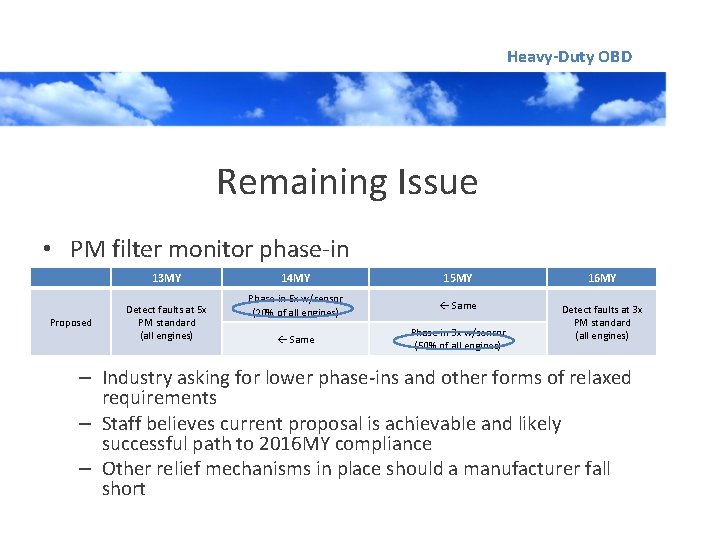
Heavy-Duty OBD Remaining Issue • PM filter monitor phase-in 13 MY Proposed Detect faults at 5 x PM standard (all engines) 14 MY 15 MY 16 MY Phase-in 5 x w/sensor (20% of all engines) Same Phase-in 3 x w/sensor (50% of all engines) Detect faults at 3 x PM standard (all engines) – Industry asking for lower phase-ins and other forms of relaxed requirements – Staff believes current proposal is achievable and likely successful path to 2016 MY compliance – Other relief mechanisms in place should a manufacturer fall short
Heavy-Duty OBD Costs and Cost-Effectiveness • Minimal impacts to cost of 2005 regulation – Remains at $134/engine (<2% of retail price) • Cost-effectiveness remains very good: – $0. 15/lb of ROG+NOx and $22. 50/lb of PM
Heavy-Duty OBD Summary • Proposed changes necessary to ensure successful heavy-duty OBD program – Balance of interim adjustments and addition of future improvements • Staff recommends adoption of amendments – With 15 -day changes
- Slides: 14