
Heavy Menstrual Bleeding Heavy Menstrual Bleeding Excessive menstrual

Heavy Menstrual Bleeding

Heavy Menstrual Bleeding – Excessive menstrual blood loss that interferes with the physical, social, emotional and/or Qo. L – • 3% of premenopausal women
– HMB is the most common type of menstrual bleeding disorder – blood loss of greater than 80 ml period methods to quantify: menstrual blood loss are both 1. inaccurate (poor correlation with hemoglobin level) 2. Impractical So clinical diagnosis based on the patient’s own perception of blood loss is preferred.

The etiology of HMB may be hormonal or structural, with common causes listed below: • Fibroids: 30% of HMB is associated with fibroids. • Adenomyosis: 70% of women will have AUB/HMB. • Endometrial polyps • Coagulation disorders (e. g. von Willebrand disease). • Pelvic inflammatory disease (PID). • Thyroid disease. • Drug therapy (e. g. warfarin). • Intrauterine devices (IUDs). • Endometrial/cervical carcinoma.
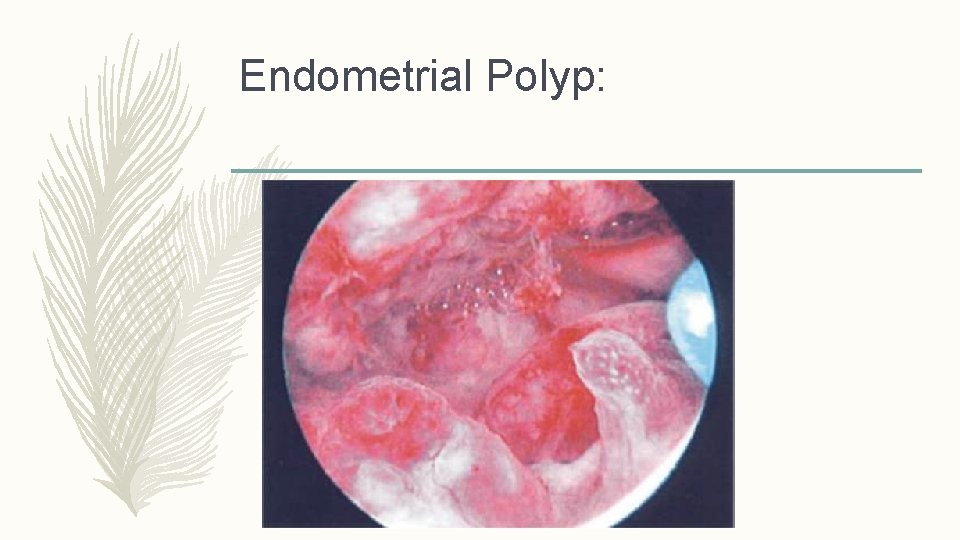
Endometrial Polyp:
History and examination – The relevant questions to determine heaviness of the period and the extent to which it disrupts the woman’s life and causes anemia : – Information of pad usage, flooding, clots, duration – The woman's personal opinion of her menstrual loss – Gynecological history, examination and investigations. – In younger women it is important to question whether HMB started at menarche, as this is much less likely to be associated with pathology. – The regularity of the menstrual cycle is also important as heavy anovulatory bleeds may be associated with early puberty, polycystic ovary syndrome or the perimenopause.
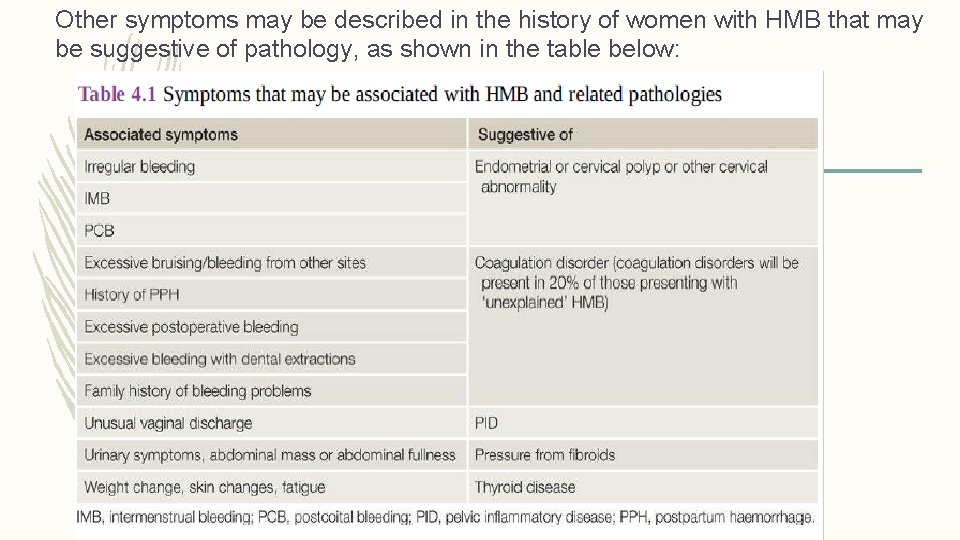
Other symptoms may be described in the history of women with HMB that may be suggestive of pathology, as shown in the table below:
Examination – the patient should be examined for – signs of anaemia( pallor ) – Signs of hypothyroidism – Bruises or gum bleeding – And BMI – it is also important to perform an abdominal and pelvic examination in all women complaining of HMB. This enables any abdominal or pelvic masses to be palpated and the cervix to be visualized for polyps/carcinoma, swabs to be taken if pelvic infection is suspected or a cervical smear to be taken if one is due.
Investigations – The NICE guidelines for HMB indicate the following investigations and are useful guide for clinicians: – • Full blood count (FBC) should be performed in all women (but serum ferritin should not be performed). – • Coagulation screen only if HMB since menarche or family history of coagulation defects. – • Hormone testing should not be performed. – • Pelvic ultrasound scan if history suggests structural or histological abnormality such as PCB, IMB, pain/pressure symptoms, or enlarged uterus or vaginal mass is palpable on pelvic examination. – • High vaginal and endocervical swabs. – • Endometrial biopsy should be considered if risk factors such as age over 45, treatment failure or risk factors for endometrial pathology. Sensitivity of EB increases when performed in addition to using the cut-off of 4 mm endometrial thickness on TVUSS. – • Thyroid function tests should only be carried out when the history is suggestive of a thyroid disorder.
An outpatient hysteroscopy with guided biopsy may be indicated if: – • Endometrial biopsy attempt fails. – • Endometrial biopsy sample is insufficient for histopathology assessment. – • TVUSS is inconclusive, for example to establish the exact location of a submucosal or intramural – fibroid. – • There is an abnormality on TVUSS amenable to treatment (e. g. suggested endometrial polyp or submucosal fibroid), if there are facilities to perform resections. – If the patient fails to tolerate an outpatient procedure, if the cervix needs to be dilated to enter the cavity, or for treatment of large polyps or submucosal fibroids, then a hysteroscopy proceeding to treatment under general anaesthetic may be required.
Role of EB in HMB An EB or outpatient hysteroscopy is indicated if there is: – • Postmenopausal bleeding and endometrial thickness on TVUSS >4 mm. – • HMB over 45 years. – • HMB associated with IMB. – • Treatment failure. – • Prior to ablative techniques.
Management – For some women, the demonstration that their blood loss is in fact ‘normal’ may be sufficient to reassure them and make further treatment unnecessary. – For others, there a number of different treatments for HMB. The effectiveness of medical treatments is often temporary, while surgical treatments are mostly incompatible with desired fertility. – When selecting appropriate management for the patient, it is important to consider and discuss: – • The patient’s preference of treatment. • Risks/benefits of each option. – • Contraceptive requirements: • family complete? • current contraception – • Past medical history: • any contraindications to medical therapies for HMB? – • suitability for an anaesthetic. • Previous surgical history on uterus.
Management of HMB – • Levonorgestrel intrauterine system (LNG-IUS, Mirena™ – • Transexmic acid/mefenamic acid or combined oral contraceptive pill (COCP). – • Progestogens. – • Endometrial ablation. – • Hysterectomy or umbilical artery embolization (UAE) for fibroids.
Treatment ; Medical Hormonal – • Mirena IUS Levonorgestrel – Causes endometrial atrophy – Blood loss ↓ by up to 90% – 30% will be amenorrhoeic at 12 months It is obviously not suitable for women wishing to conceive. – Provides contraception – ↓ in number of hysterectomies – • Progesterone (Cyclic) – Norethisterone, – taken 15 mg daily in a cyclical pattern from day 6 to day 26 of the menstrual cycle. – Significant reduction in menstrual blood loss
– • Combined oral contraceptive which will induce slightly lighter periods. – • Gonadotrophin-releasing hormone (Gn. RH) agonists: – these drugs act on the pituitary to stop the production of oestrogen, which results in amenorrhoea. – These are only used in the short term due to the resulting hypo-oestrogenic state that predisposes to osteoporosis. Shouldn’t be used for more than 6 months – They may be used preoperatively to shrink fibroids or cause endometrial suppression to enhance visualization at hysteroscopy. – In severe HMB they can allow the patient the opportunity to improve their haemoglobin by providing a respite from bleeding.
Treatment ; Medical Non-hormonal – • Antifibrinolytics – Tranexamic acid: – 1 g tds days 1– 4 – reduces blood loss by 50% – • NSAIDS – Mefenamic acid: – 500 mg tds days 1– 5 – inhibits prostaglandin synthesis – • reduces blood loss by 30%-40% – • Significant ↓ in dysmenorrhoea
Surgical – Surgical treatment is normally restricted to women for whom medical treatments have failed or where there associated symptoms such as pressure symptoms from fibroids or prolapse. – Women contemplating surgical treatment for HMB must be certain that their family is complete. – While this caveat is obvious for women contemplating hysterectomy, in which the uterus will be removed, it also applies to women contemplating endometrial ablation. – Therefore, women wishing to preserve their fertility for future attempts at childbearing should be advised to use medical methods of treatment. – The risks of a pregnancy after an ablation procedure theoretically include prematurity and morbidly adherent placenta.
Minimally invasive (uterine preserving) – • Endometrial resection – • Endometrial ablation – • Myomectomy in cases of fibroid – • Polypectomy Hysterectomy : – 1 Laparoscopic – 2 Open – 3 Vaginal
Endometrial ablation – All endometrial destructive procedures employ the principle that ablation of the endometrial lining of the uterus to sufficient depth prevents regeneration of the endometrium – Ablation is suitable for women with a uterus no bigger than 10 weeks’ size and with fibroids less than 3 cm. – Types including: – • Impedance controlled endometrial ablation (Novosure™). – • Thermal uterine balloon therapy. – • Microwave ablation (Microsulis™)
– Uterine artery embolization – UAE is treatment useful for HMB associated with fibroids – Myomectomy – This may be a sensible option or women with HMB secondary to large fibroids with pressure symptoms who wish to conceive (and are at an age where this is realistic). – Transcervical resection of fibroid – submucosal – may reduce HMB and is appropriate in women wishing to conceive. By hysteroscope – Hysterectomy – A hysterectomy is the surgical removal of the uterus – It can be avoided in some women by medical and ablation procedures. However, it can be necessary to control HMB in women who have not responded. It may be a first-line treatment in women who have HMB associated with large fibroids who also have pressure symptoms, or who have a smaller uterus and associated uterine prolapse.
Adenomyosis – The endometrium is usually well demarcated from the underlying myometrium. – Adenomyosis is a disorder in which endometrial glands and stroma are found deep within the myometrium. – Adenomyosis can only be definitively diagnosed following histopathological examination of a hysterectomy specimen, where it is identified in 40% of uteri from a general female population of reproductive age. – This ectopic endometrium is responsive to cyclical hormonal changes that result in bleeding within the myometrium, leading to increasingly severe secondary dysmenorrhoea (pain throughout menses), uterine enlargement & HMB.
– Women with adenomyosis are usually multiparous and diagnosed in their late 30 s or early 40 s. – Examination may reveal a bulky and sometimes tender ‘boggy’ uterus, particularly if examined perimenstrually. – Ultrasound examination of the uterus may be helpful for diagnosis when adenomyosis is particularly localized, showing haemorrhage-filled, distended endometrial glands. Sometimes this may give an irregular nodular development within the uterus, very similar to that of uterine fibroids. – MRI is the investigation of choice although expensive, as it provides excellent images of the myometrium, endometrium and areas of adenomyosis
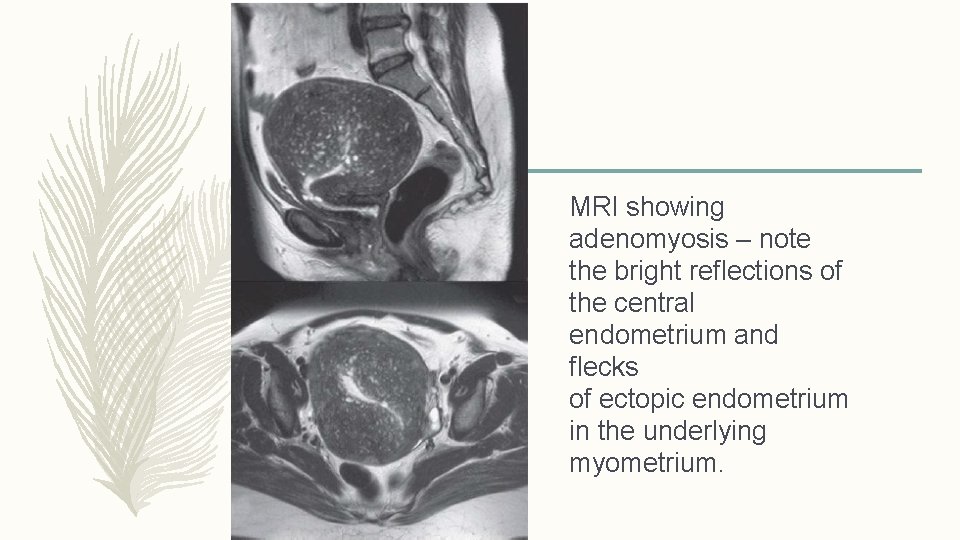
MRI showing adenomyosis – note the bright reflections of the central endometrium and flecks of ectopic endometrium in the underlying myometrium.
Treatment – Given the practical difficulty in making the diagnosis of adenomyosis preoperatively, conservative surgery and medical treatments are so far poorly developed. – In general, any treatment that induces amenorrhoea will be helpful as it will render the ectopic endometrium quiescent, relieving pain and excessive bleeding. – Thus, the use of the progestin-containing long-acting reversible contraceptives such as the: 1. LNG-IUS 2. depot Provero 3. short term Gn. RH agonists – On ceasing treatment, however, the symptoms rapidly return in the majority of patients, and hysterectomy remains the only definitive treatment.
- Slides: 24