
Heavy Lift Cargo Plane Progress Presentation Matthew Chin





- Slides: 43
Heavy Lift Cargo Plane Progress Presentation Matthew Chin, Aaron Dickerson Brett J. Ulrich, Tzvee Wood November 4 th, 2004 Group #1 – Project #3
Presentation Outline • Review of Project Objectives & Deliverables • Early Design Concepts • Computer Software Implementation – Data Digitalization – WINFOIL Evaluations – Engineering Equation Solver Calculations • Design Concepts – – Wing Landing Gear Tail Prop • Schedule Update
Project Objectives • Compete in SAE Aero East Competition • Apply areas of Mechanical Engineering education to a real life problem: – Dynamics – Fluid Mechanics – Modeling & Simulation – Analysis of Stresses
Project Objectives • Dynamics/Analysis of stresses Force of drag, weight, and gravity on the wing/fuselage • Fluid Mechanics Used in analysis of airfoil • Modeling & Simulation For CAD models of wing, fuselage, landing gear
Anticipated Deliverables • • Finished calculations Final wing selection Sketches of the final design CAD drawings - wing, fuselage, landing gear • Projected construction budget • Parts order
Problems To Watch Out For • Ideal design needs to be able to be actually constructed • Stability of construction so that the plane does not fall apart on landing • Time management for construction • Previous team only used one design did not iterate • More practice on shrink wrap coating procedure for wing
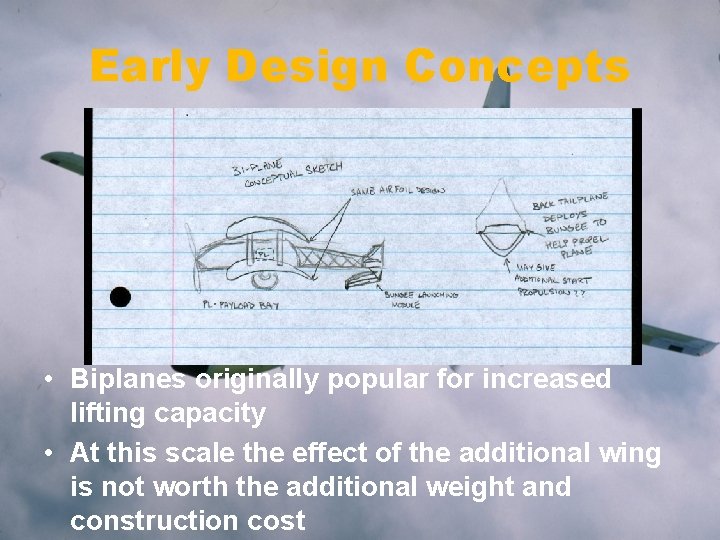
Early Design Concepts • Biplanes originally popular for increased lifting capacity • At this scale the effect of the additional wing is not worth the additional weight and construction cost
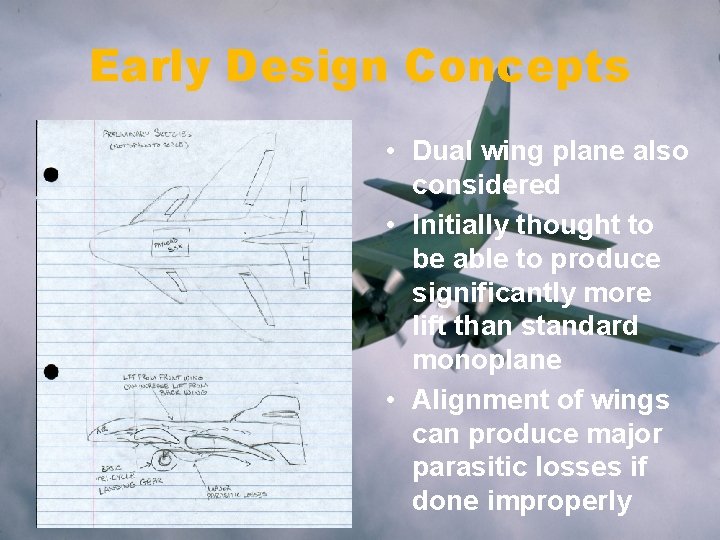
Early Design Concepts • Dual wing plane also considered • Initially thought to be able to produce significantly more lift than standard monoplane • Alignment of wings can produce major parasitic losses if done improperly
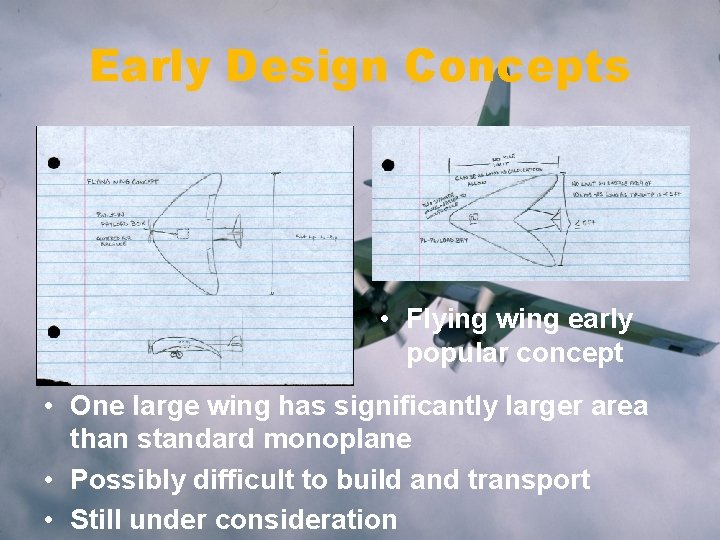
Early Design Concepts • Flying wing early popular concept • One large wing has significantly larger area than standard monoplane • Possibly difficult to build and transport • Still under consideration
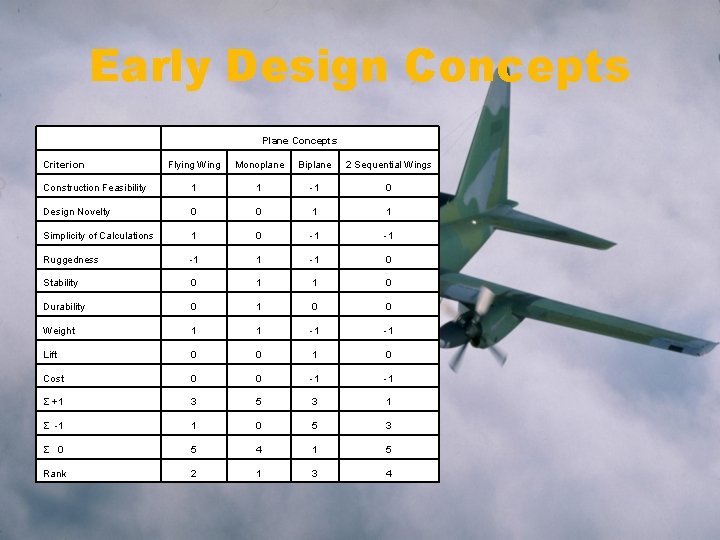
Early Design Concepts Plane Concepts Criterion Flying Wing Monoplane Biplane 2 Sequential Wings Construction Feasibility 1 1 -1 0 Design Novelty 0 0 1 1 Simplicity of Calculations 1 0 -1 -1 Ruggedness -1 1 -1 0 Stability 0 1 1 0 Durability 0 1 0 0 Weight 1 1 -1 -1 Lift 0 0 1 0 Cost 0 0 -1 -1 Σ +1 3 5 3 1 Σ -1 1 0 5 3 Σ 0 5 4 1 5 Rank 2 1 3 4
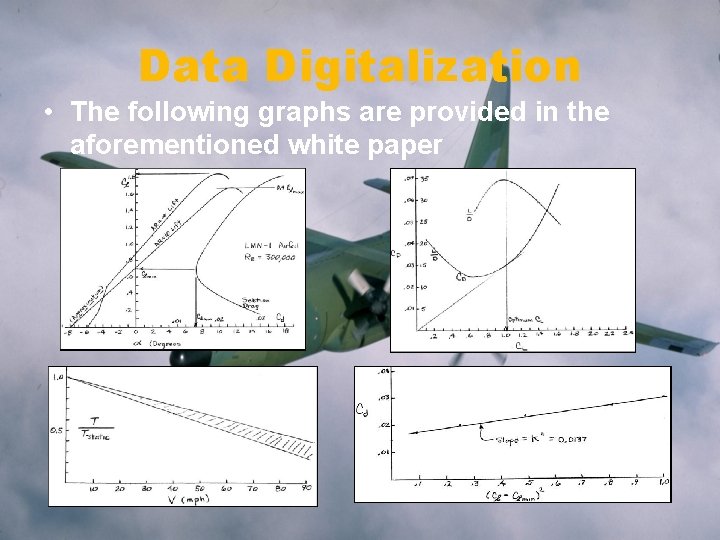
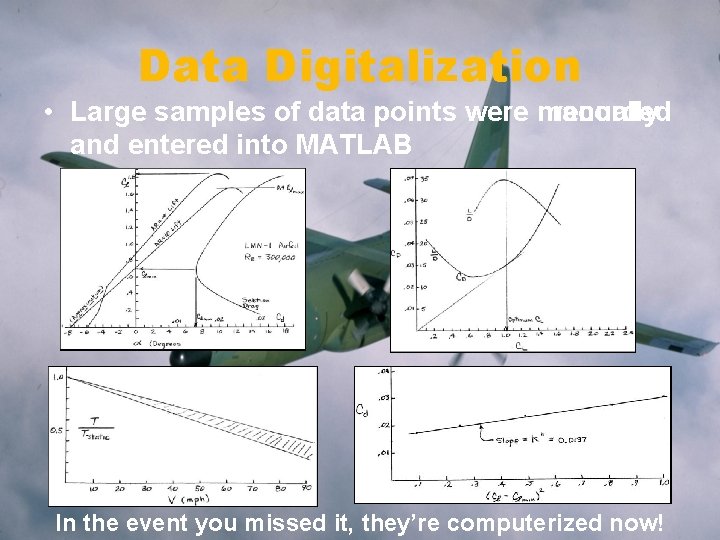
Data Digitalization • SAE Documentation Provides Data for LMN-1 Airfoil (similar to Selig 1223, Liebeck LD-X 17 A and other RC aircraft) • Data includes: – The dependence of CL on Aspect Ratio and Angle of Attack – Viscous drag due to lift – Ratio of Thrust to Static Thrust vs. Speed
Data Digitalization • The following graphs are provided in the aforementioned white paper
Data Digitalization • Large samples of data points were manually recorded and entered into MATLAB In the event you missed it, they’re computerized now!
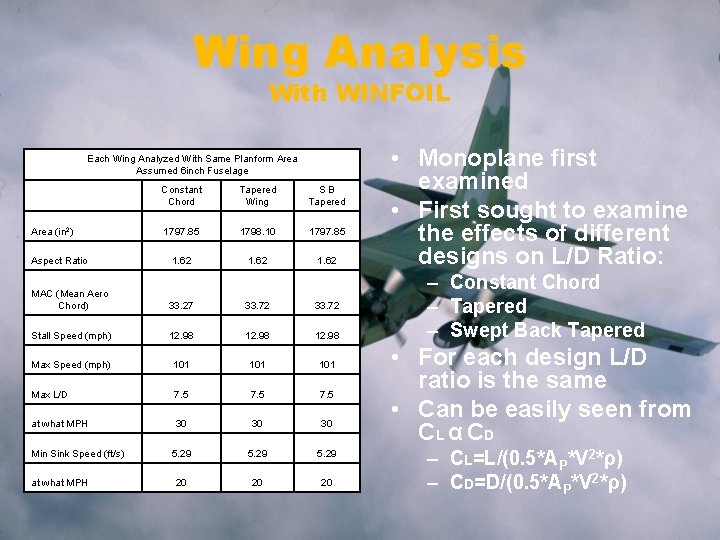
Wing Analysis With WINFOIL Each Wing Analyzed With Same Planform Area Assumed 6 inch Fuselage Area (in 2) Aspect Ratio Constant Chord Tapered Wing SB Tapered 1797. 85 1798. 10 1797. 85 1. 62 MAC (Mean Aero Chord) 33. 27 33. 72 Stall Speed (mph) 12. 98 Max Speed (mph) 101 101 Max L/D 7. 5 at what MPH 30 30 30 5. 29 20 20 20 Min Sink Speed (ft/s) at what MPH • Monoplane first examined • First sought to examine the effects of different designs on L/D Ratio: – Constant Chord – Tapered – Swept Back Tapered • For each design L/D ratio is the same • Can be easily seen from CL α CD – CL=L/(0. 5*AP*V 2*ρ) – CD=D/(0. 5*AP*V 2*ρ)
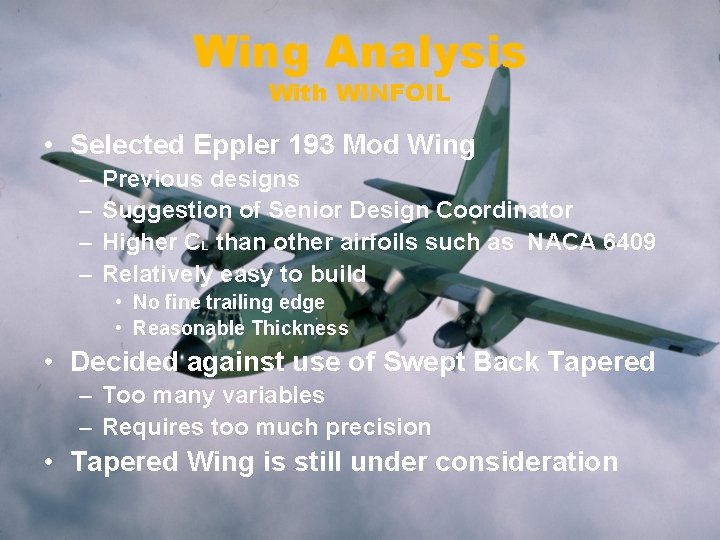
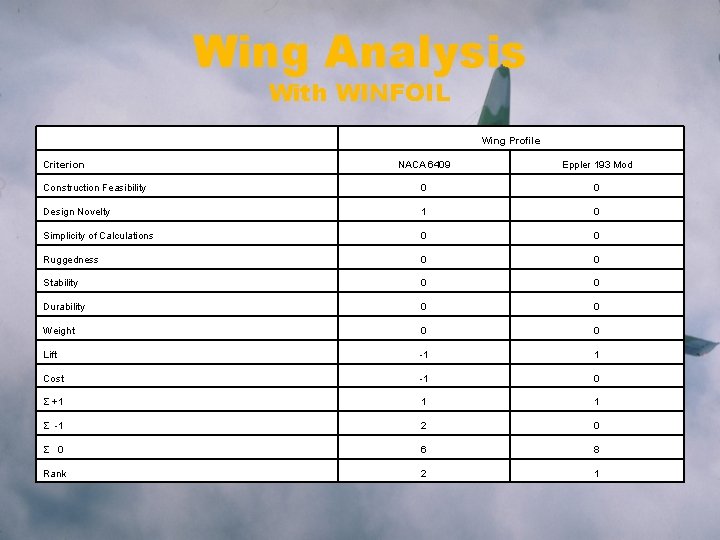
Wing Analysis With WINFOIL • Selected Eppler 193 Mod Wing – – Previous designs Suggestion of Senior Design Coordinator Higher CL than other airfoils such as NACA 6409 Relatively easy to build • No fine trailing edge • Reasonable Thickness • Decided against use of Swept Back Tapered – Too many variables – Requires too much precision • Tapered Wing is still under consideration
Wing Analysis With WINFOIL Wing Profile Criterion NACA 6409 Eppler 193 Mod Construction Feasibility 0 0 Design Novelty 1 0 Simplicity of Calculations 0 0 Ruggedness 0 0 Stability 0 0 Durability 0 0 Weight 0 0 Lift -1 1 Cost -1 0 Σ +1 1 1 Σ -1 2 0 Σ 0 6 8 Rank 2 1
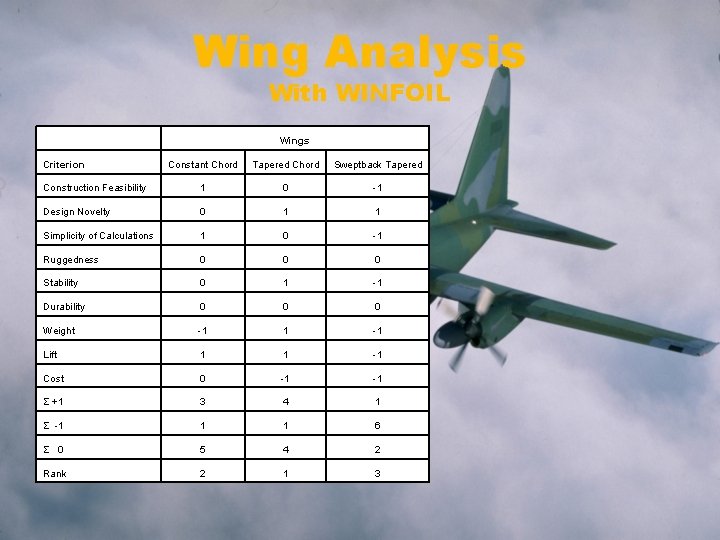
Wing Analysis With WINFOIL Wings Criterion Constant Chord Tapered Chord Sweptback Tapered Construction Feasibility 1 0 -1 Design Novelty 0 1 1 Simplicity of Calculations 1 0 -1 Ruggedness 0 0 0 Stability 0 1 -1 Durability 0 0 0 Weight -1 1 -1 Lift 1 1 -1 Cost 0 -1 -1 Σ +1 3 4 1 Σ -1 1 1 6 Σ 0 5 4 2 Rank 2 1 3
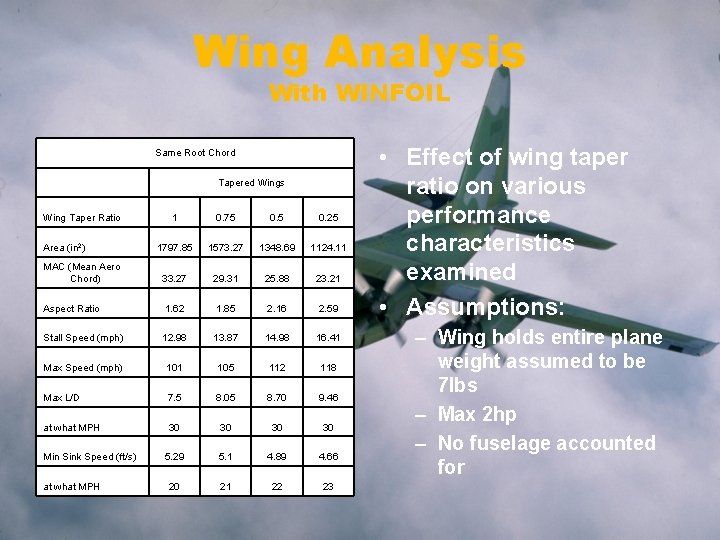
Wing Analysis With WINFOIL Same Root Chord Tapered Wings Wing Taper Ratio 1 0. 75 0. 25 1797. 85 1573. 27 1348. 69 1124. 11 MAC (Mean Aero Chord) 33. 27 29. 31 25. 88 23. 21 Aspect Ratio 1. 62 1. 85 2. 16 2. 59 Stall Speed (mph) 12. 98 13. 87 14. 98 16. 41 Max Speed (mph) 101 105 112 118 Max L/D 7. 5 8. 05 8. 70 9. 46 at what MPH 30 30 5. 29 5. 1 4. 89 4. 66 20 21 22 23 Area (in 2) Min Sink Speed (ft/s) at what MPH • Effect of wing taper ratio on various performance characteristics examined • Assumptions: – Wing holds entire plane weight assumed to be 7 lbs – Max 2 hp – No fuselage accounted for
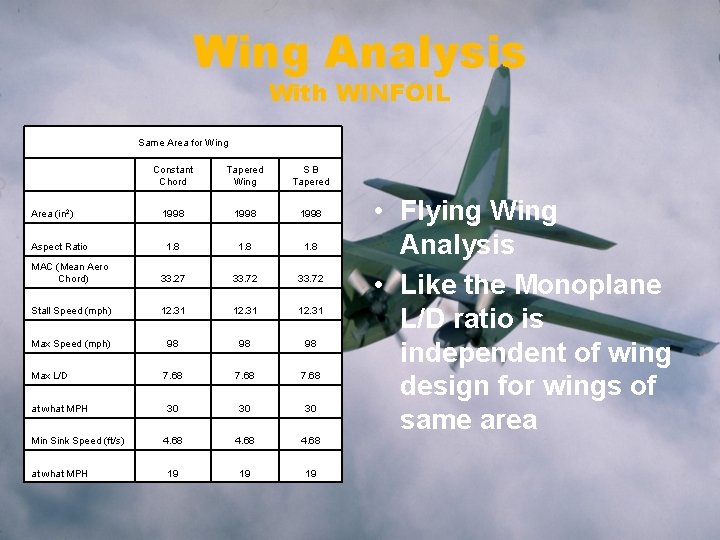
Wing Analysis With WINFOIL Same Area for Wing Constant Chord Tapered Wing SB Tapered 1998 1. 8 MAC (Mean Aero Chord) 33. 27 33. 72 Stall Speed (mph) 12. 31 Max Speed (mph) 98 98 98 7. 68 30 30 30 4. 68 19 19 19 Area (in 2) Aspect Ratio Max L/D at what MPH Min Sink Speed (ft/s) at what MPH • Flying Wing Analysis • Like the Monoplane L/D ratio is independent of wing design for wings of same area
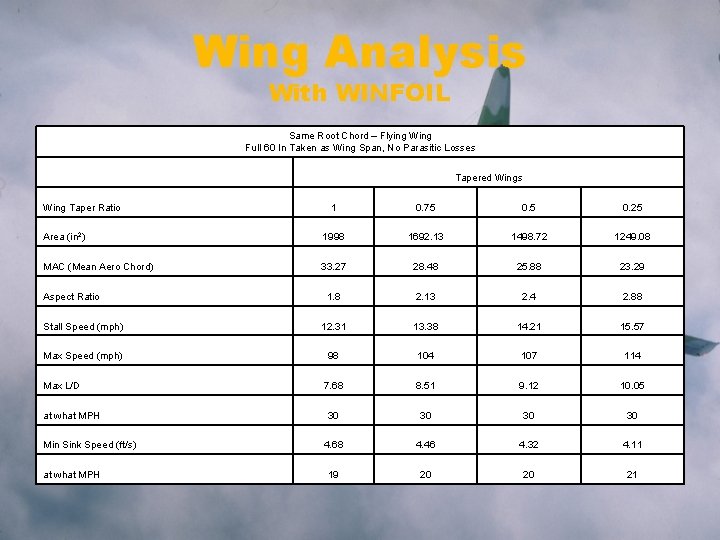
Wing Analysis With WINFOIL Same Root Chord – Flying Wing Full 60 In Taken as Wing Span, No Parasitic Losses Tapered Wings Wing Taper Ratio 1 0. 75 0. 25 Area (in 2) 1998 1692. 13 1498. 72 1249. 08 MAC (Mean Aero Chord) 33. 27 28. 48 25. 88 23. 29 1. 8 2. 13 2. 4 2. 88 Stall Speed (mph) 12. 31 13. 38 14. 21 15. 57 Max Speed (mph) 98 104 107 114 7. 68 8. 51 9. 12 10. 05 30 30 4. 68 4. 46 4. 32 4. 11 19 20 20 21 Aspect Ratio Max L/D at what MPH Min Sink Speed (ft/s) at what MPH
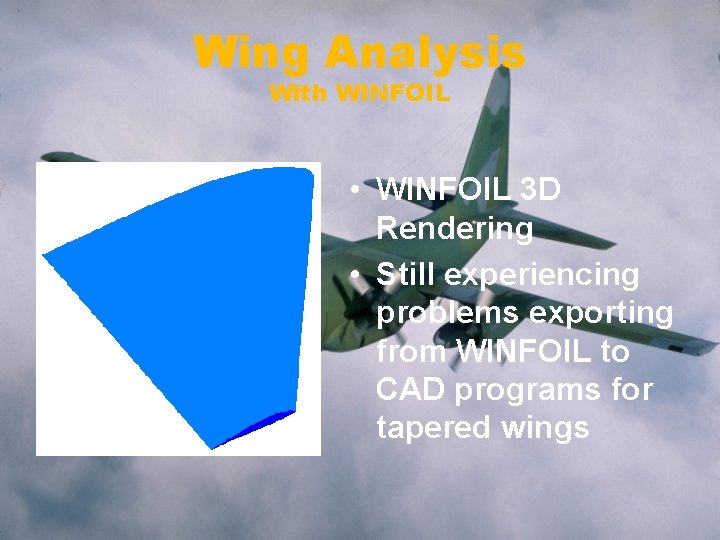
Wing Analysis With WINFOIL • WINFOIL 3 D Rendering • Still experiencing problems exporting from WINFOIL to CAD programs for tapered wings
Wing Features Being Considered • Hoerner Plates – reduce tip losses • Dihedral Angle – reduces chance of stall under banked conditions May not be necessary for a 60” wingspan
Add’l Computer Analysis • Previously generated MATLAB curve fits utilized in EES for calculations • Entire current EES model included in presentation handouts
Add’l Computer Analysis • Based upon white paper and aerodynamic principles • Input Design Parameters – – – – – Takeoff distance (e. g. , <190 ft) 28 ft Landing Distance (e. g. , <380 ft) 46 ft Fuselage. Length 10 in Fuselage. Width 5 in Fuselage. Boom. Length 40 in Wing. Span 60 in Wing. AR 1. 62 Wing. Taper 1. 0 S_Ref 1800 in 2
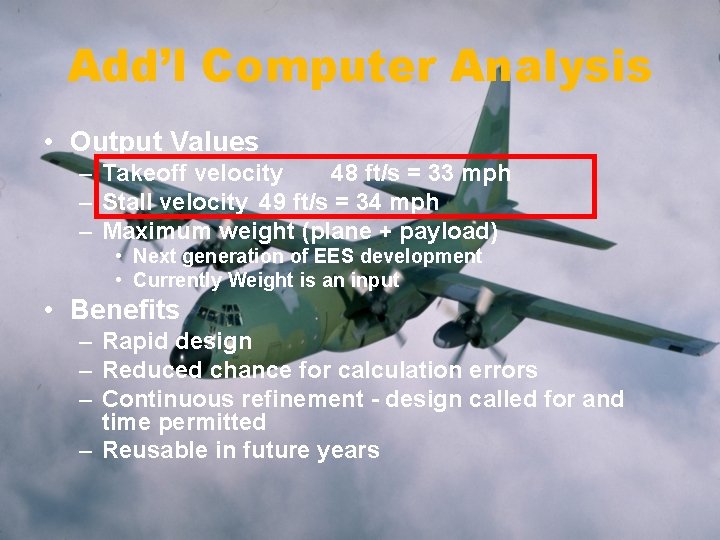
Add’l Computer Analysis • Output Values – Takeoff velocity 48 ft/s = 33 mph – Stall velocity 49 ft/s = 34 mph – Maximum weight (plane + payload) • Next generation of EES development • Currently Weight is an input • Benefits – Rapid design – Reduced chance for calculation errors – Continuous refinement - design called for and time permitted – Reusable in future years
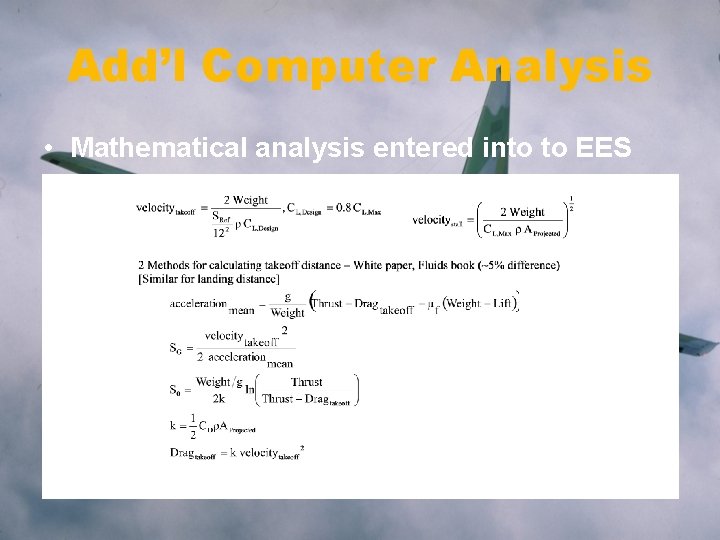
Add’l Computer Analysis • Mathematical analysis entered into to EES
Add’l Computer Analysis • Mathematical analysis entered into to EES
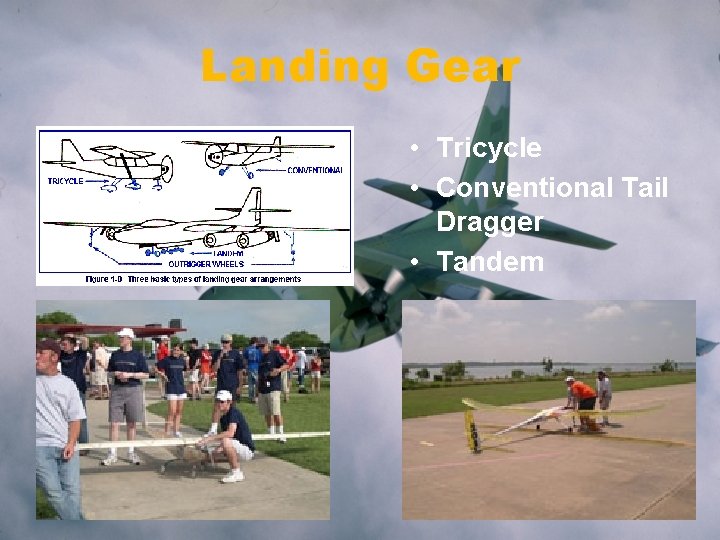
Landing Gear • Tricycle • Conventional Tail Dragger • Tandem
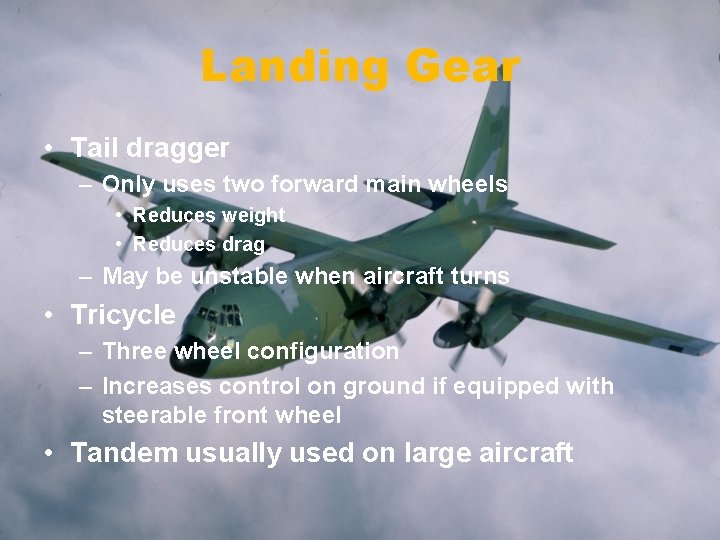
Landing Gear • Tail dragger – Only uses two forward main wheels • Reduces weight • Reduces drag – May be unstable when aircraft turns • Tricycle – Three wheel configuration – Increases control on ground if equipped with steerable front wheel • Tandem usually used on large aircraft
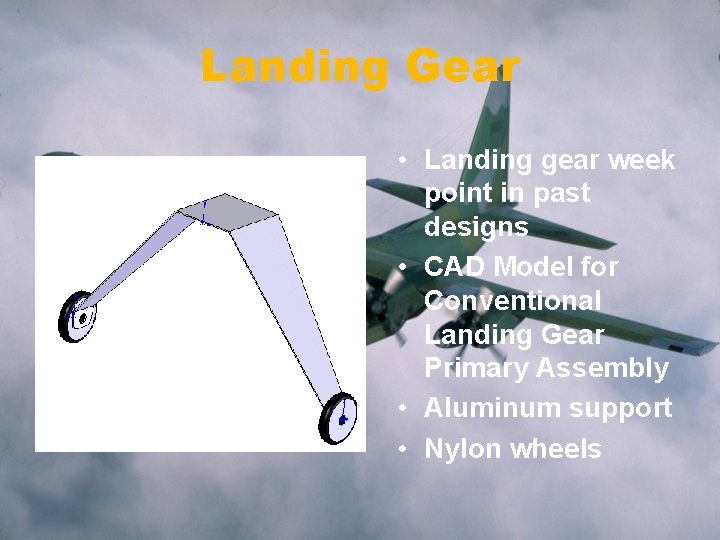
Landing Gear • Landing gear week point in past designs • CAD Model for Conventional Landing Gear Primary Assembly • Aluminum support • Nylon wheels
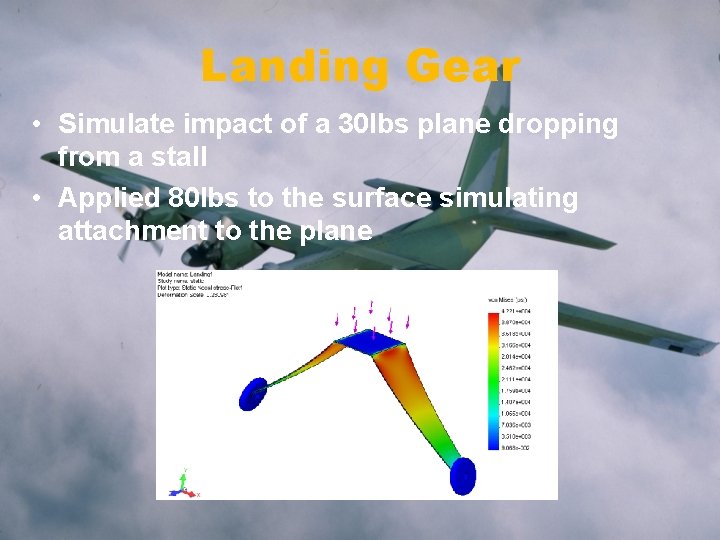
Landing Gear • Simulate impact of a 30 lbs plane dropping from a stall • Applied 80 lbs to the surface simulating attachment to the plane
Other Plane Features • Boom length – too long can create increased drag and instability • Vertical stabilizer height – if too large, the control surface induces a large moment leading to instability Led to a crash in 2002
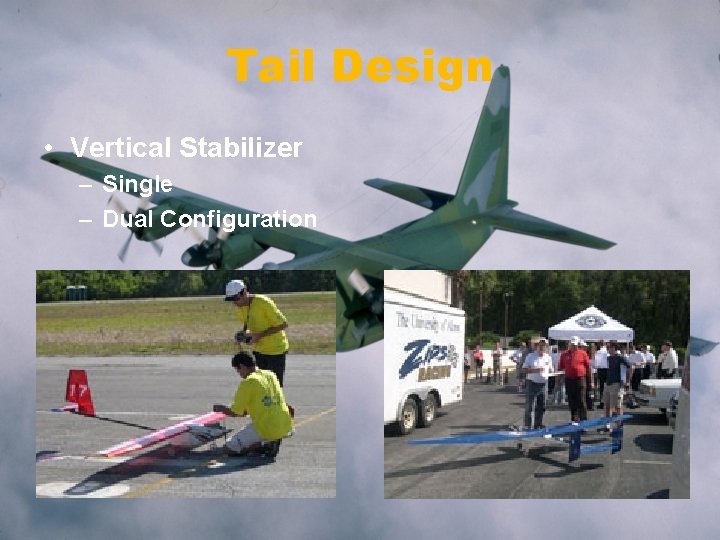
Tail Design • Vertical Stabilizer – Single – Dual Configuration
Tail Design • Stabilizer/Elevator – Fixed Stabilizer Portion – Moveable Elevator – Requires complex mechanism to move elevator – Increases drag if not trimmed for the specific cruising speed of the aircraft • Stabilator – Serves double duty as a stabilizer and elevator – Rotates on aerodynamic center – Mechanism to rotate stabilator will be less complex than required for stabilizer/elevator – Theoretically reduces drag – Generally used in very fast aircraft
Prop Selection • Propeller selection depends upon the size of the engine • Propeller will be purchased from outside source – Precise dimensions difficult to manufacture by hand – Higher grade materials with higher strength to weight ratio available commercially
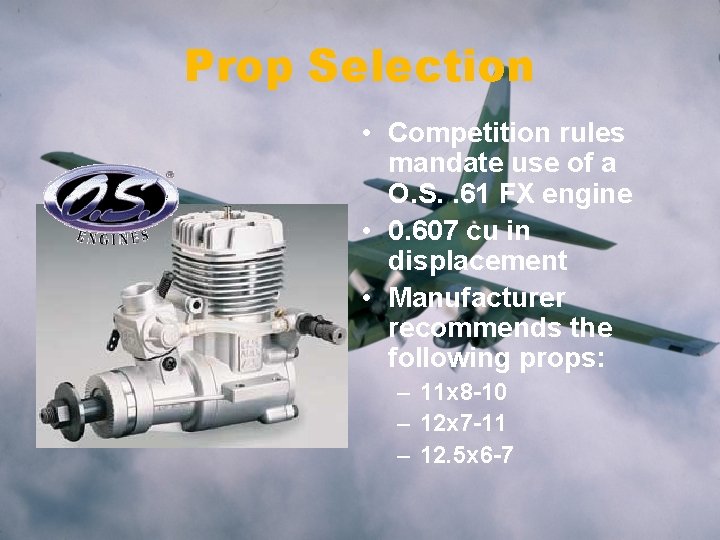
Prop Selection • Competition rules mandate use of a O. S. . 61 FX engine • 0. 607 cu in displacement • Manufacturer recommends the following props: – 11 x 8 -10 – 12 x 7 -11 – 12. 5 x 6 -7
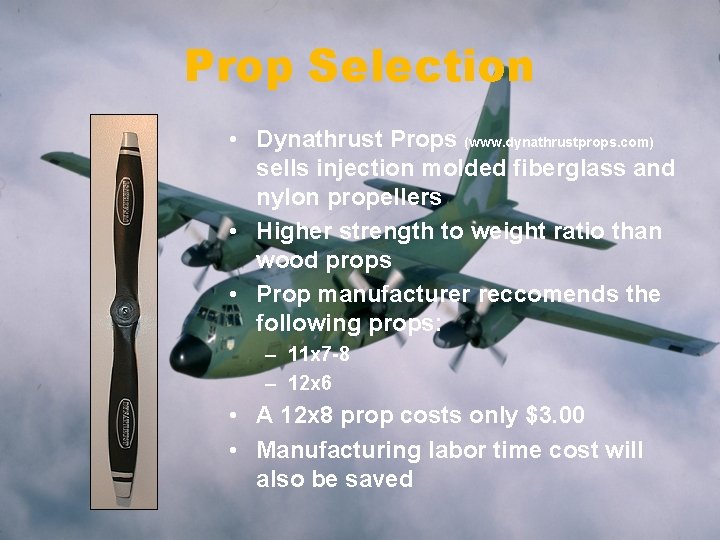
Prop Selection • Dynathrust Props (www. dynathrustprops. com) sells injection molded fiberglass and nylon propellers • Higher strength to weight ratio than wood props • Prop manufacturer reccomends the following props: – 11 x 7 -8 – 12 x 6 • A 12 x 8 prop costs only $3. 00 • Manufacturing labor time cost will also be saved
Materials • • • Balsa wood Injection molded fiberglass and nylon Light metal, such as aluminum Heat shrink monocoat for wing Rip-stop Nylon Carbon fiber tubing
Schedule Update
Conclusions • Digitalized data enables swift calculations in EES • Design team has evaluated past difficulties • Wing design is on schedule – Select final wing profile – Select monoplane or flying wing • Landing gear will be selected when plane design is finalized – Monoplane = Conventional Tail Dragger – Flying Wing = Tricycle • Tail will consist of a single vertical stabilizer, exact shape to be determined when wing design is complete • Prop will be outsourced to save time and money
We Welcome Your Questions and Feedback Thank You
References • http: //students. sae. org/competitions/aerodesign/east • http: //adg. stanford. edu/aa 241/performance/landing. h tml • http: //adg. stanford. edu/aa 241/wingdesign/wingparam s. html • http: //www. profili 2. com/eng/default. htm • http: //www. uoguelph. ca/~antoon/websites/air. htm • http: //www. angelfire. com/ar 2/planes 2/links. html • http: //www. geocities. com/Cape. Canaveral/Hall/2716/i ndex. html • http: //www. winfoil. com/