
Heavy Ion Physics with LHCb Patrick Robbe LAL
Heavy Ion Physics with LHCb Patrick Robbe, LAL Orsay, 8 November 2017
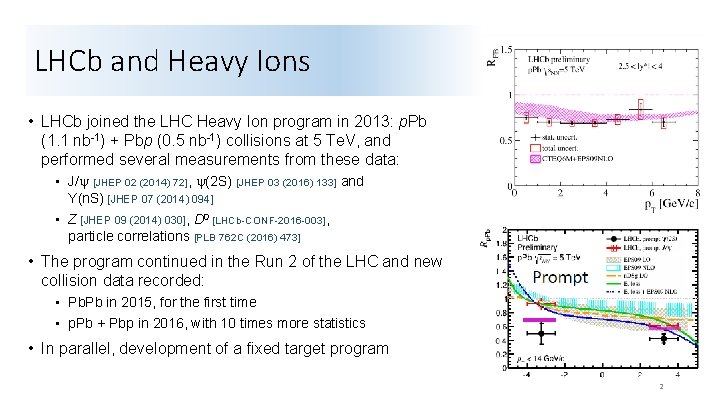
LHCb and Heavy Ions • LHCb joined the LHC Heavy Ion program in 2013: p. Pb (1. 1 nb-1) + Pbp (0. 5 nb-1) collisions at 5 Te. V, and performed several measurements from these data: • J/y [JHEP 02 (2014) 72], y(2 S) [JHEP 03 (2016) 133] and Y(n. S) [JHEP 07 (2014) 094] • Z [JHEP 09 (2014) 030], D 0 [LHCb-CONF-2016 -003], particle correlations [PLB 762 C (2016) 473] • The program continued in the Run 2 of the LHC and new collision data recorded: • Pb. Pb in 2015, for the first time • p. Pb + Pbp in 2016, with 10 times more statistics • In parallel, development of a fixed target program 2
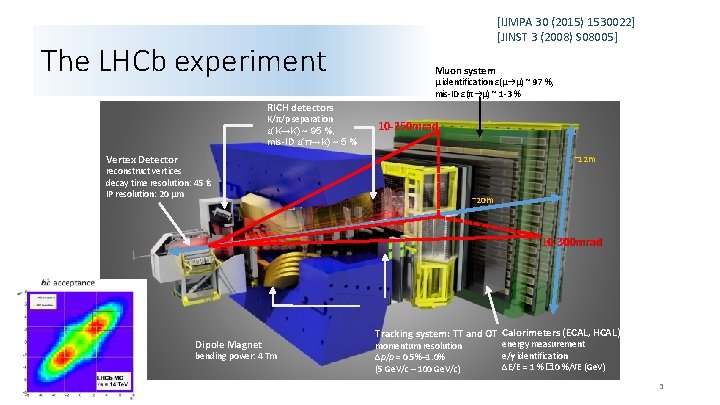
The LHCb experiment [IJMPA 30 (2015) 1530022] [JINST 3 (2008) S 08005] Muon system μ identification ε(μ→μ) ~ 97 %, mis-ID ε(π→μ) ~ 1 -3 % RICH detectors K/π/p separation ε(K→K) ~ 95 %, mis-ID ε(π→K) ~ 5 % 10 -250 mrad Vertex Detector ~12 m reconstruct vertices decay time resolution: 45 fs IP resolution: 20 μm ~20 m 10 -300 mrad Dipole Magnet bending power: 4 Tm Tracking system: TT and OT Calorimeters (ECAL, HCAL) momentum resolution Δp/p = 0. 5%– 1. 0% (5 Ge. V/c – 100 Ge. V/c) energy measurement e/γ identification ΔE/E = 1 % � 10 %/√E (Ge. V) 3
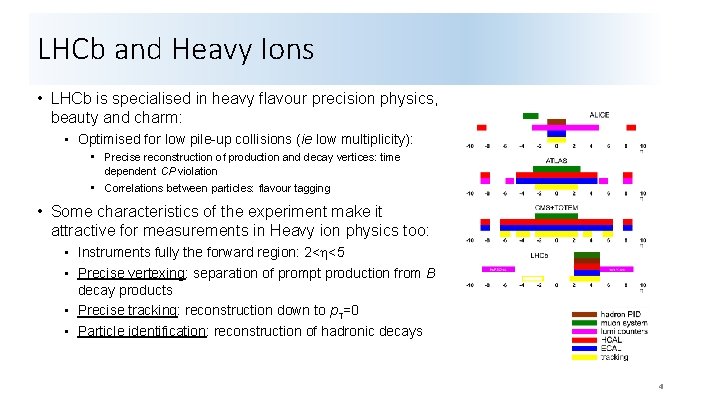
LHCb and Heavy Ions • LHCb is specialised in heavy flavour precision physics, beauty and charm: • Optimised for low pile-up collisions (ie low multiplicity): • Precise reconstruction of production and decay vertices: time dependent CP violation • Correlations between particles: flavour tagging • Some characteristics of the experiment make it attractive for measurements in Heavy ion physics too: • Instruments fully the forward region: 2<h<5 • Precise vertexing: separation of prompt production from B decay products • Precise tracking: reconstruction down to p. T=0 • Particle identification: reconstruction of hadronic decays 4
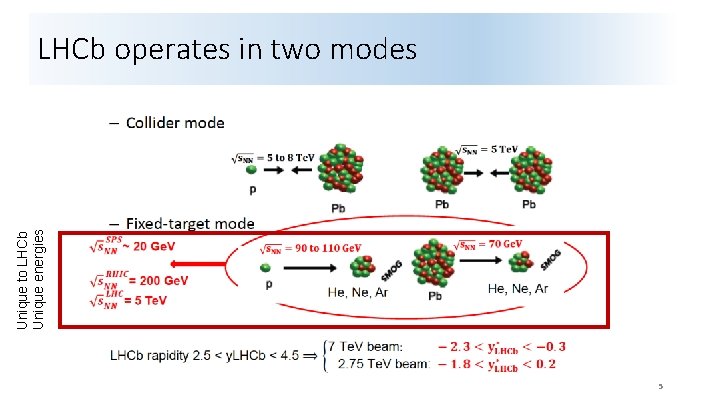
Unique to LHCb Unique energies LHCb operates in two modes 5
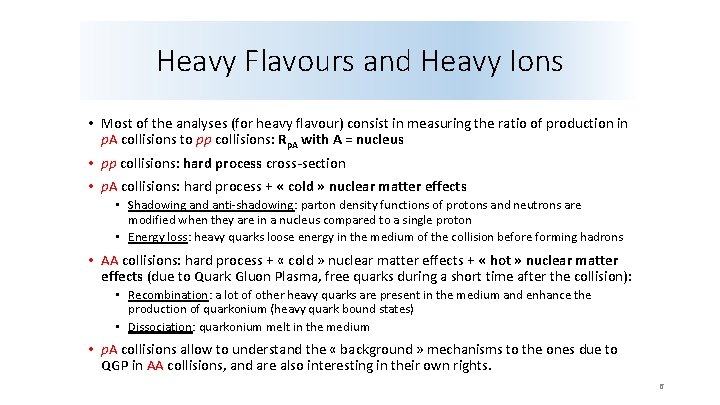
Heavy Flavours and Heavy Ions • Most of the analyses (for heavy flavour) consist in measuring the ratio of production in p. A collisions to pp collisions: Rp. A with A = nucleus • pp collisions: hard process cross-section • p. A collisions: hard process + « cold » nuclear matter effects • Shadowing and anti-shadowing: parton density functions of protons and neutrons are modified when they are in a nucleus compared to a single proton • Energy loss: heavy quarks loose energy in the medium of the collision before forming hadrons • AA collisions: hard process + « cold » nuclear matter effects + « hot » nuclear matter effects (due to Quark Gluon Plasma, free quarks during a short time after the collision): • Recombination: a lot of other heavy quarks are present in the medium and enhance the production of quarkonium (heavy quark bound states) • Dissociation: quarkonium melt in the medium • p. A collisions allow to understand the « background » mechanisms to the ones due to QGP in AA collisions, and are also interesting in their own rights. 6
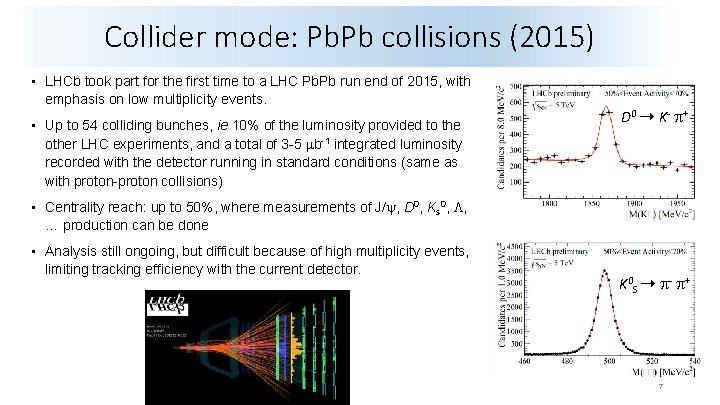
Collider mode: Pb. Pb collisions (2015) • LHCb took part for the first time to a LHC Pb. Pb run end of 2015, with emphasis on low multiplicity events. • Up to 54 colliding bunches, ie 10% of the luminosity provided to the other LHC experiments, and a total of 3 -5 mb-1 integrated luminosity recorded with the detector running in standard conditions (same as with proton-proton collisions) D 0 ➝ K- p+ • Centrality reach: up to 50%, where measurements of J/y, D 0, Ks 0, L, … production can be done • Analysis still ongoing, but difficult because of high multiplicity events, limiting tracking efficiency with the current detector. K 0 S ➝ p- p+ 7
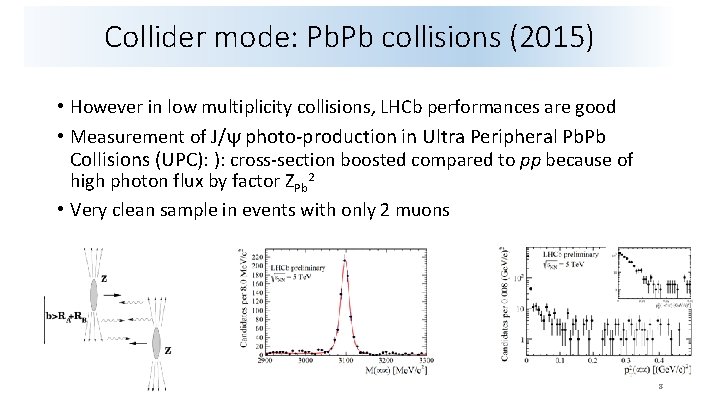
Collider mode: Pb. Pb collisions (2015) • However in low multiplicity collisions, LHCb performances are good • Measurement of J/y photo-production in Ultra Peripheral Pb. Pb Collisions (UPC): ): cross-section boosted compared to pp because of high photon flux by factor ZPb 2 • Very clean sample in events with only 2 muons 8
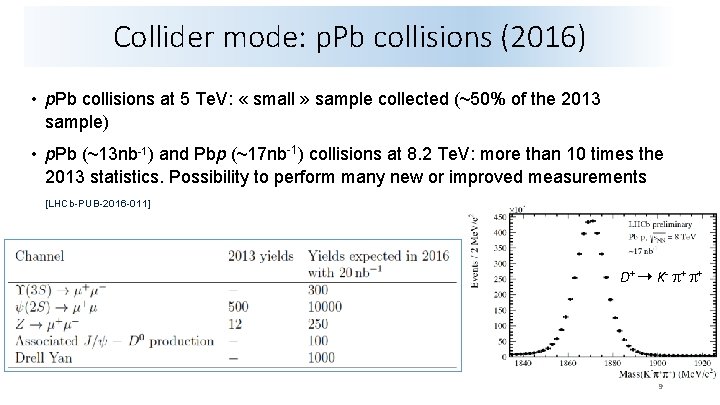
Collider mode: p. Pb collisions (2016) • p. Pb collisions at 5 Te. V: « small » sample collected (~50% of the 2013 sample) • p. Pb (~13 nb-1) and Pbp (~17 nb-1) collisions at 8. 2 Te. V: more than 10 times the 2013 statistics. Possibility to perform many new or improved measurements [LHCb-PUB-2016 -011] D+ ➝ K- p+ p+ 9
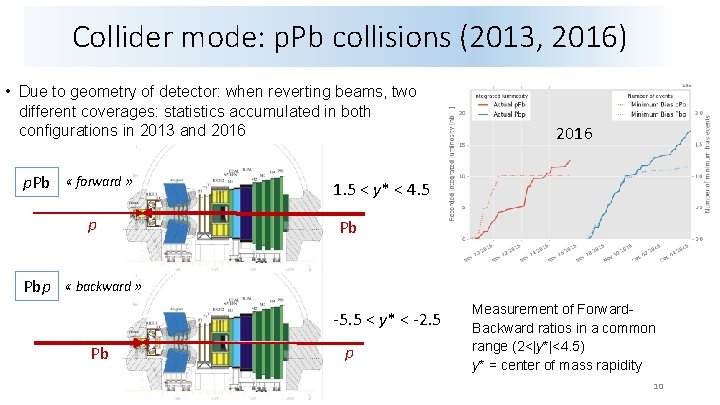
Collider mode: p. Pb collisions (2013, 2016) • Due to geometry of detector: when reverting beams, two different coverages: statistics accumulated in both configurations in 2013 and 2016 p. Pb « forward » p Pbp 2016 1. 5 < y* < 4. 5 Pb « backward » -5. 5 < y* < -2. 5 Pb p Measurement of Forward. Backward ratios in a common range (2<|y*|<4. 5) y* = center of mass rapidity 10
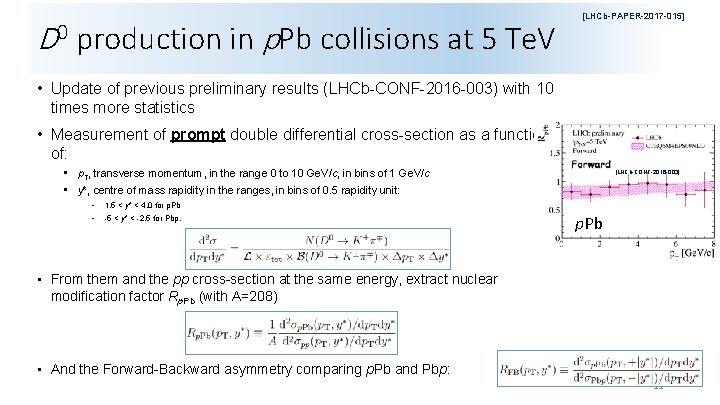
D 0 production in p. Pb collisions at 5 Te. V [LHCb-PAPER-2017 -015] • Update of previous preliminary results (LHCb-CONF-2016 -003) with 10 times more statistics • Measurement of prompt double differential cross-section as a function of: • p. T, transverse momentum, in the range 0 to 10 Ge. V/c, in bins of 1 Ge. V/c • y*, centre of mass rapidity in the ranges, in bins of 0. 5 rapidity unit: • 1. 5 < y* < 4. 0 for p. Pb • -5 < y* < -2. 5 for Pbp, [LHCb-CONF-2016 -003] p. Pb • From them and the pp cross-section at the same energy, extract nuclear modification factor Rp. Pb (with A=208) • And the Forward-Backward asymmetry comparing p. Pb and Pbp: 11
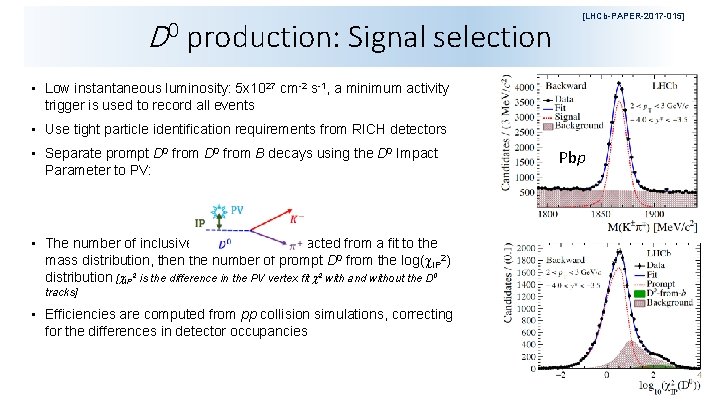
D 0 production: Signal selection [LHCb-PAPER-2017 -015] • Low instantaneous luminosity: 5 x 1027 cm-2 s-1, a minimum activity trigger is used to record all events • Use tight particle identification requirements from RICH detectors • Separate prompt D 0 from B decays using the D 0 Impact Parameter to PV: Pbp • The number of inclusive candidates is extracted from a fit to the mass distribution, then the number of prompt D 0 from the log(c. IP 2) distribution [c. IP 2 is the difference in the PV vertex fit c 2 with and without the D 0 tracks] • Efficiencies are computed from pp collision simulations, correcting for the differences in detector occupancies 12
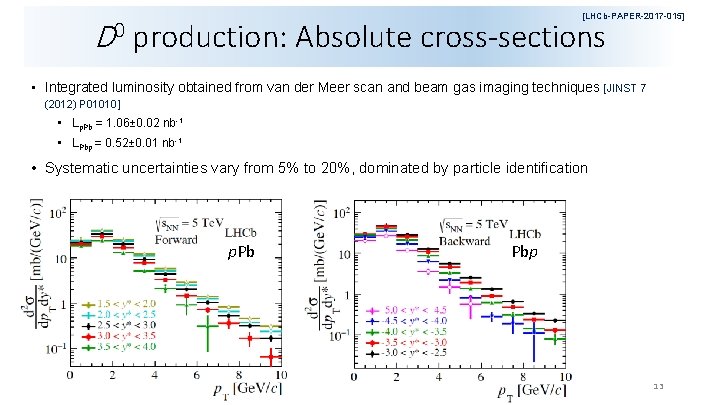
[LHCb-PAPER-2017 -015] D 0 production: Absolute cross-sections • Integrated luminosity obtained from van der Meer scan and beam gas imaging techniques [JINST 7 (2012) P 01010] • Lp. Pb = 1. 06± 0. 02 nb-1 • LPbp = 0. 52± 0. 01 nb-1 • Systematic uncertainties vary from 5% to 20%, dominated by particle identification p. Pb Pbp 13
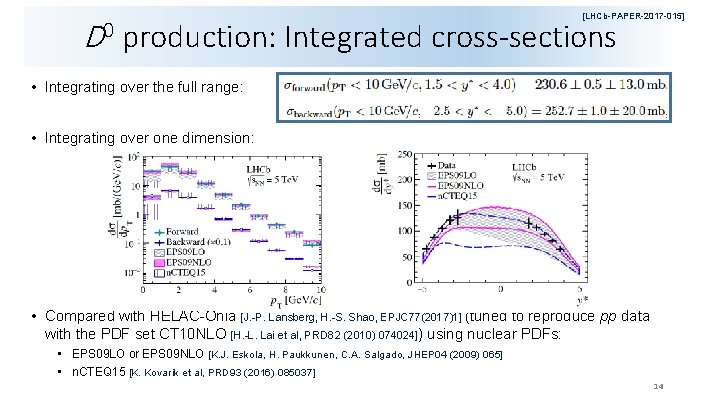
[LHCb-PAPER-2017 -015] D 0 production: Integrated cross-sections • Integrating over the full range: • Integrating over one dimension: • Compared with HELAC-Onia [J. -P. Lansberg, H. -S. Shao, EPJC 77(2017)1] (tuned to reproduce pp data with the PDF set CT 10 NLO [H. -L. Lai et al, PRD 82 (2010) 074024]) using nuclear PDFs: • EPS 09 LO or EPS 09 NLO [K. J. Eskola, H. Paukkunen, C. A. Salgado, JHEP 04 (2009) 065] • n. CTEQ 15 [K. Kovarik et al, PRD 93 (2016) 085037] 14
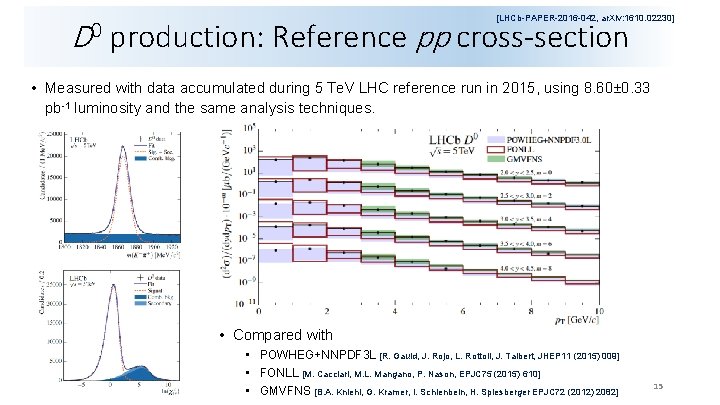
[LHCb-PAPER-2016 -042, ar. Xiv: 1610. 02230] D 0 production: Reference pp cross-section • Measured with data accumulated during 5 Te. V LHC reference run in 2015, using 8. 60± 0. 33 pb-1 luminosity and the same analysis techniques. • Compared with • POWHEG+NNPDF 3 L [R. Gauld, J. Rojo, L. Rottoli, J. Talbert, JHEP 11 (2015) 009] • FONLL [M. Cacciari, M. L. Mangano, P. Nason, EPJC 75 (2015) 610] • GMVFNS [B. A. Kniehl, G. Kramer, I. Schienbein, H. Spiesberger EPJC 72 (2012) 2082] 15
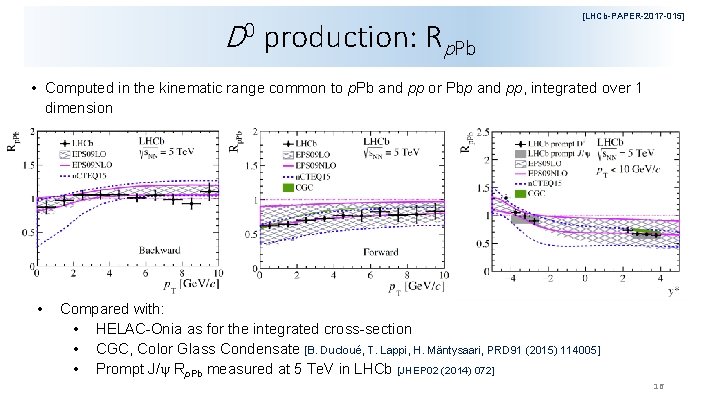
D 0 production: Rp. Pb [LHCb-PAPER-2017 -015] • Computed in the kinematic range common to p. Pb and pp or Pbp and pp, integrated over 1 dimension • Compared with: • HELAC-Onia as for the integrated cross-section • CGC, Color Glass Condensate [B. Ducloué, T. Lappi, H. Mäntysaari, PRD 91 (2015) 114005] • Prompt J/y Rp. Pb measured at 5 Te. V in LHCb [JHEP 02 (2014) 072] 16
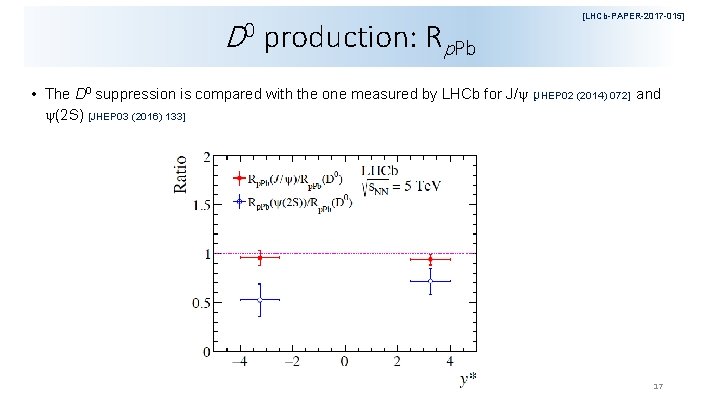
D 0 production: Rp. Pb [LHCb-PAPER-2017 -015] • The D 0 suppression is compared with the one measured by LHCb for J/y [JHEP 02 (2014) 072] and y(2 S) [JHEP 03 (2016) 133] 17
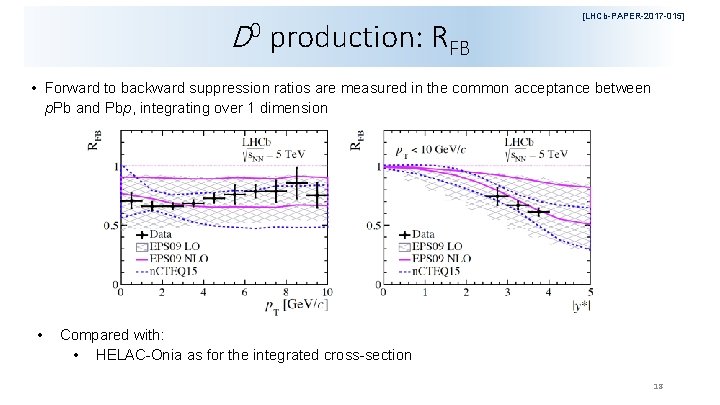
D 0 production: RFB [LHCb-PAPER-2017 -015] • Forward to backward suppression ratios are measured in the common acceptance between p. Pb and Pbp, integrating over 1 dimension • Compared with: • HELAC-Onia as for the integrated cross-section 18
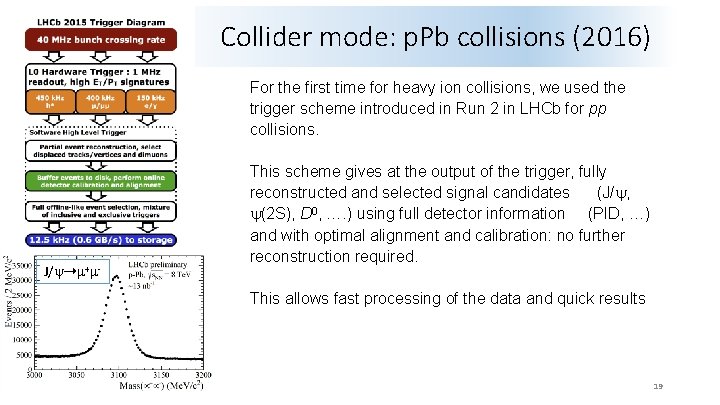
Collider mode: p. Pb collisions (2016) For the first time for heavy ion collisions, we used the trigger scheme introduced in Run 2 in LHCb for pp collisions. J/y➝m+m- This scheme gives at the output of the trigger, fully reconstructed and selected signal candidates (J/y, y(2 S), D 0, …. ) using full detector information (PID, …) and with optimal alignment and calibration: no further reconstruction required. This allows fast processing of the data and quick results 19
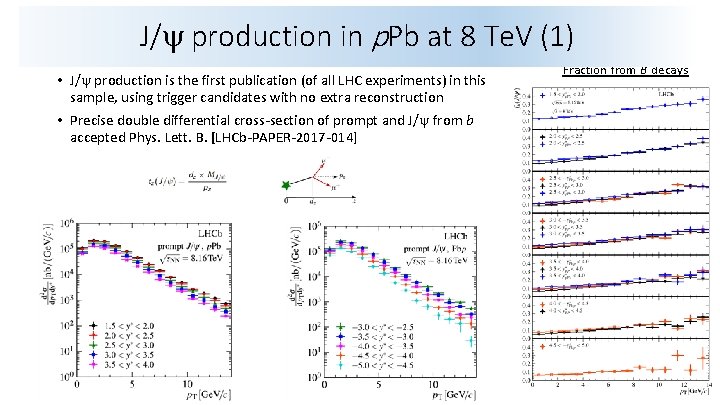
J/y production in p. Pb at 8 Te. V (1) • J/y production is the first publication (of all LHC experiments) in this sample, using trigger candidates with no extra reconstruction Fraction from B decays • Precise double differential cross-section of prompt and J/y from b accepted Phys. Lett. B. [LHCb-PAPER-2017 -014] 20
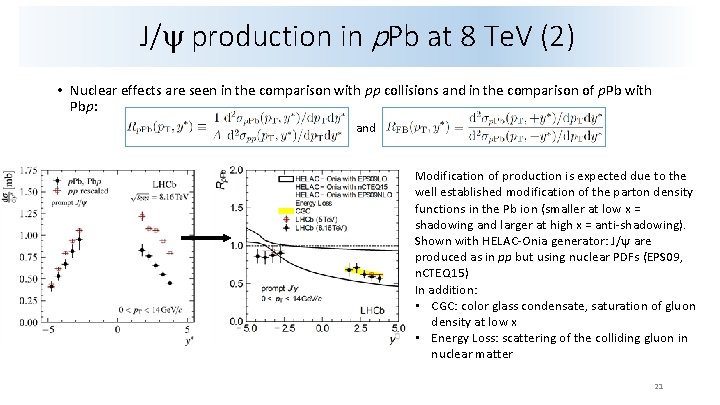
J/y production in p. Pb at 8 Te. V (2) • Nuclear effects are seen in the comparison with pp collisions and in the comparison of p. Pb with Pbp: and Modification of production is expected due to the well established modification of the parton density functions in the Pb ion (smaller at low x = shadowing and larger at high x = anti-shadowing). Shown with HELAC-Onia generator: J/y are produced as in pp but using nuclear PDFs (EPS 09, n. CTEQ 15) In addition: • CGC: color glass condensate, saturation of gluon density at low x • Energy Loss: scattering of the colliding gluon in nuclear matter 21
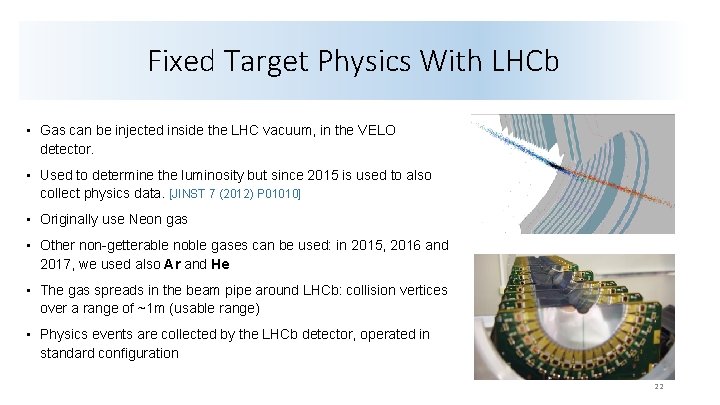
Fixed Target Physics With LHCb • Gas can be injected inside the LHC vacuum, in the VELO detector. • Used to determine the luminosity but since 2015 is used to also collect physics data. [JINST 7 (2012) P 01010] • Originally use Neon gas • Other non-getterable noble gases can be used: in 2015, 2016 and 2017, we used also Ar and He • The gas spreads in the beam pipe around LHCb: collision vertices over a range of ~1 m (usable range) • Physics events are collected by the LHCb detector, operated in standard configuration 22
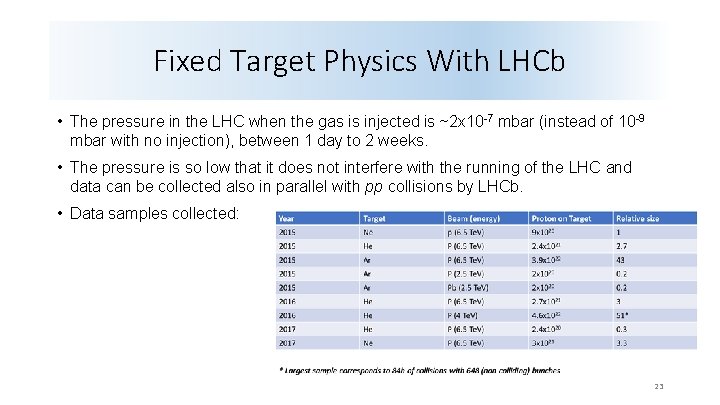
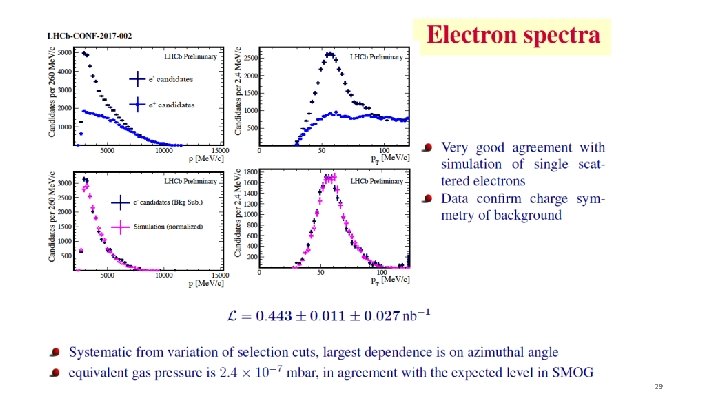
Fixed Target Physics With LHCb • The pressure in the LHC when the gas is injected is ~2 x 10 -7 mbar (instead of 10 -9 mbar with no injection), between 1 day to 2 weeks. • The pressure is so low that it does not interfere with the running of the LHC and data can be collected also in parallel with pp collisions by LHCb. • Data samples collected: 23
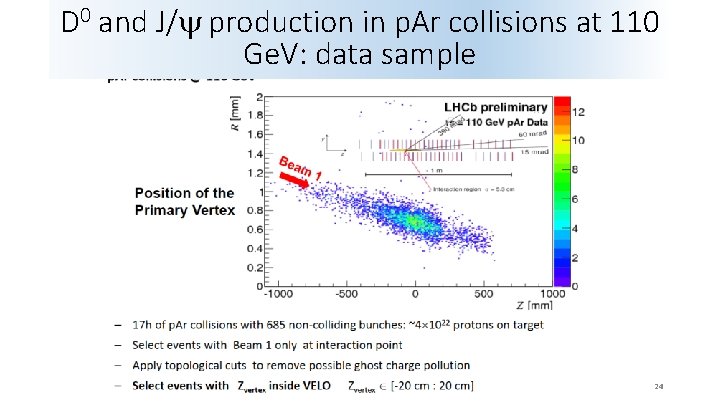
D 0 and J/y production in p. Ar collisions at 110 Ge. V: data sample 24
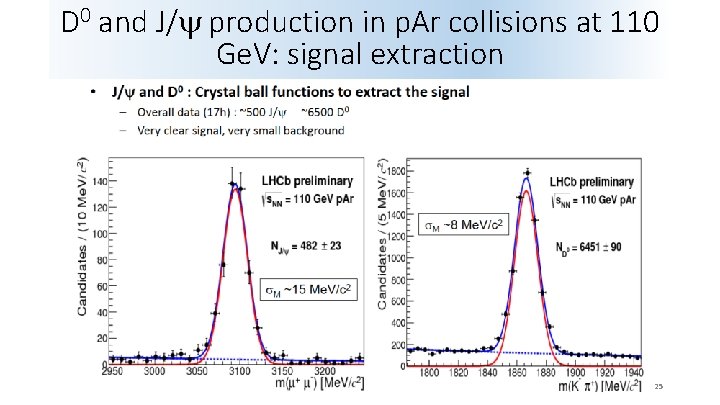
D 0 and J/y production in p. Ar collisions at 110 Ge. V: signal extraction 25
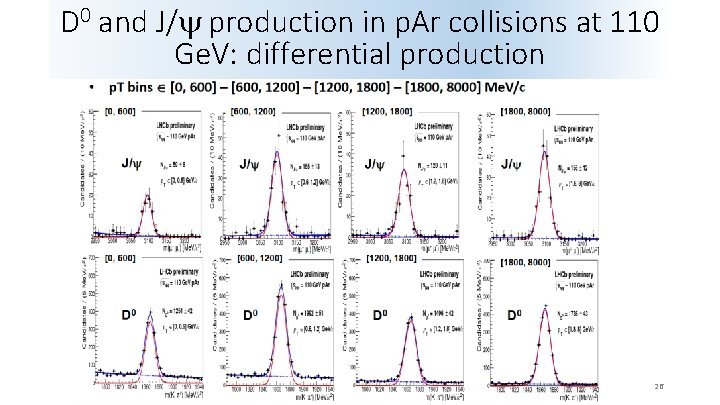
D 0 and J/y production in p. Ar collisions at 110 Ge. V: differential production 26
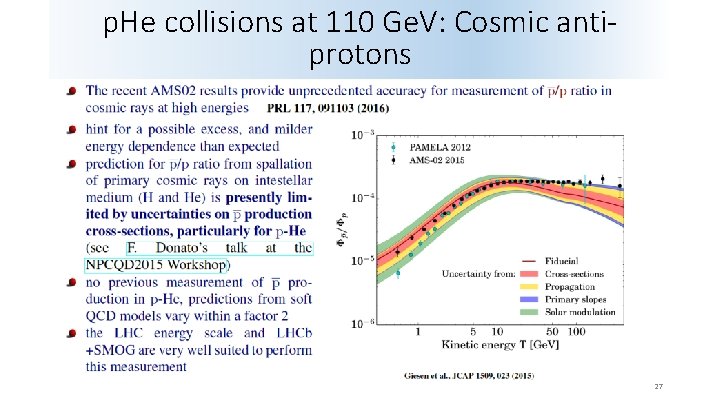
p. He collisions at 110 Ge. V: Cosmic antiprotons 27
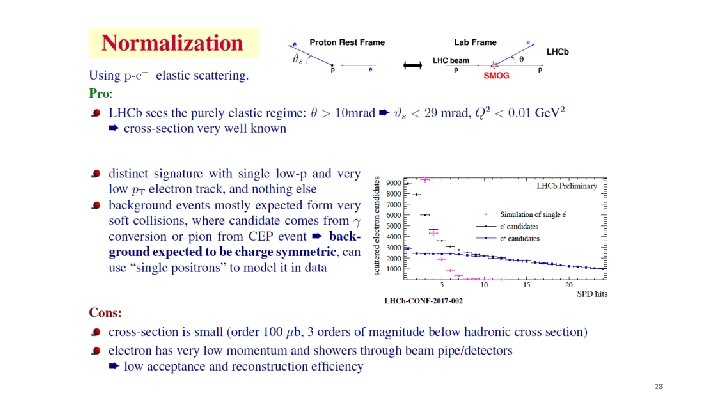
28
29
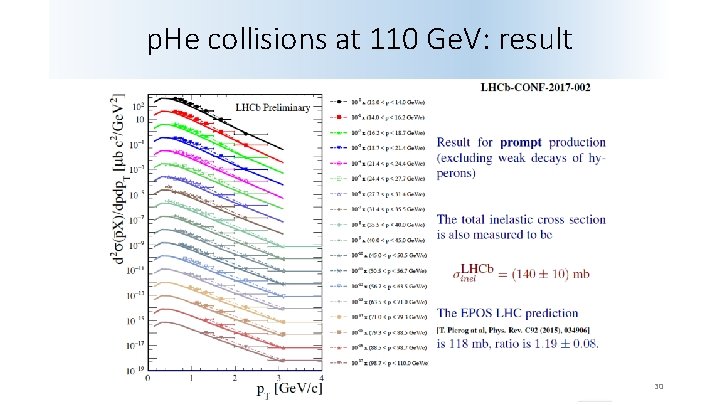
p. He collisions at 110 Ge. V: result Results 30
Conclusions • Active program of study of heavy ion collisions at LHCb: • Proton-Lead collisions • Fixed target program • Improvements foreseen after detector upgrade for Pb. Pb, where the granularity and high multiplicity reach will be improved • Success of fixed target program triggered new ideas: bent crystals, wire targets, improved gas injection system that are under study • A large fraction of the activities I presented are done at LAL: we welcome collaborations on these subjects ! 31
- Slides: 31