
Heavy Ion Fusion Science Virtual National Laboratory Collective
Heavy Ion Fusion Science Virtual National Laboratory Collective Focusing of a Neutralized Intense Ion Beam Propagating Along a Weak Solenodial Magnetic Field M. Dorf (LLNL) In collaboration with I. Kaganovich, E. Startsev, and R. C. Davidson (PPPL) DOE Plasma Science Center, Teleseminar, April 19, 2012 This work was performed under the auspices of the U. S. Department of Energy by the Lawrence Livermore National Laboratory under contract DE-AC 52 -07 NA 27344, and by the Princeton Plasma Physics Laboratory under contract AC 02 -76 CH-O 3073 LLNL- PRES-635456
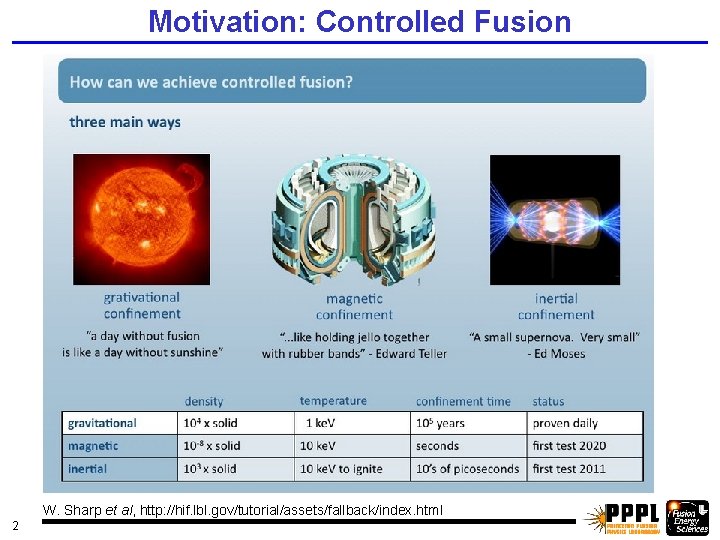
Motivation: Controlled Fusion W. Sharp et al, http: //hif. lbl. gov/tutorial/assets/fallback/index. html 2
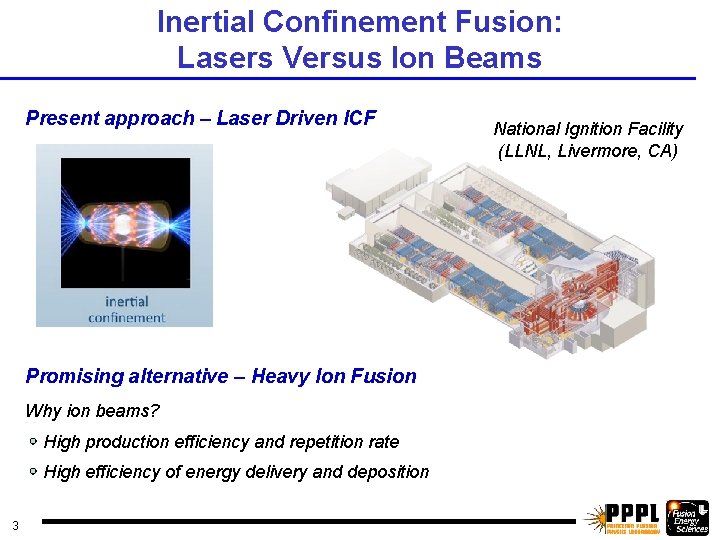
Inertial Confinement Fusion: Lasers Versus Ion Beams Present approach – Laser Driven ICF Promising alternative – Heavy Ion Fusion Why ion beams? High production efficiency and repetition rate High efficiency of energy delivery and deposition 3 National Ignition Facility (LLNL, Livermore, CA)
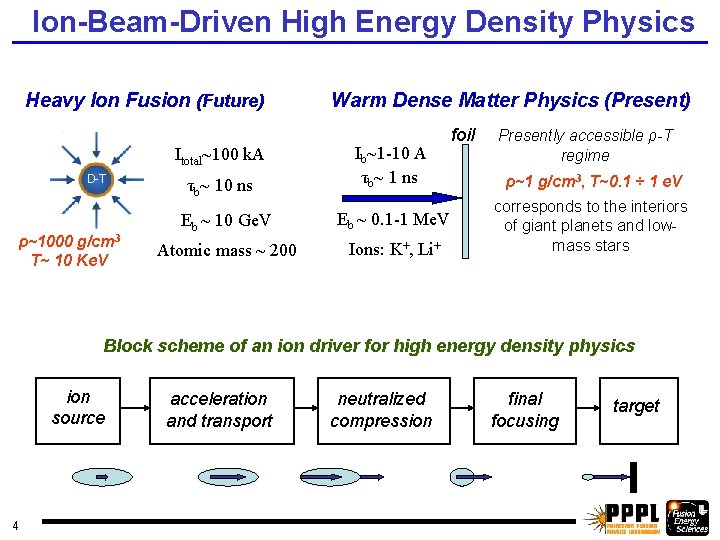
Ion-Beam-Driven High Energy Density Physics Heavy Ion Fusion (Future) Itotal~100 k. A D-T ρ~1000 g/cm 3 T~ 10 Ke. V τb~ 10 ns Warm Dense Matter Physics (Present) Ib~1 -10 A τb~ 1 ns Eb ~ 10 Ge. V Eb ~ 0. 1 -1 Me. V Atomic mass ~ 200 Ions: K+, Li+ foil Presently accessible ρ-T regime ρ~1 g/cm 3, T~0. 1 ÷ 1 e. V corresponds to the interiors of giant planets and lowmass stars Block scheme of an ion driver for high energy density physics ion source 4 acceleration and transport neutralized compression final focusing target
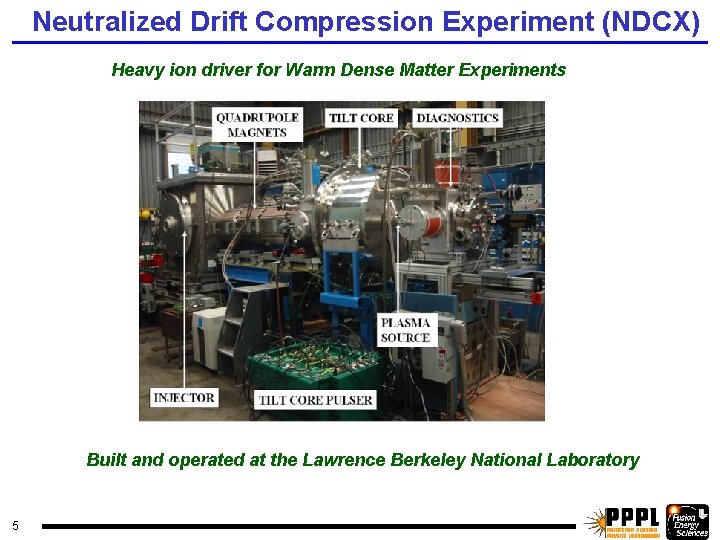
Neutralized Drift Compression Experiment (NDCX) Heavy ion driver for Warm Dense Matter Experiments Built and operated at the Lawrence Berkeley National Laboratory 5
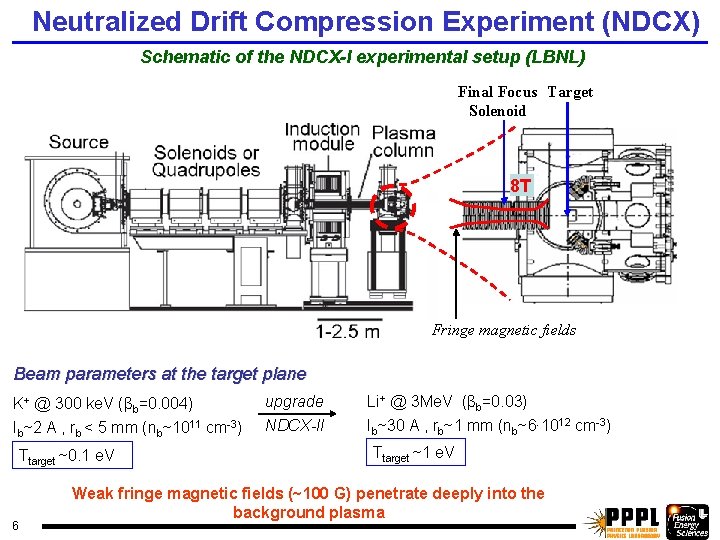
Neutralized Drift Compression Experiment (NDCX) Schematic of the NDCX-I experimental setup (LBNL) Final Focus Target Solenoid 8 T Fringe magnetic fields Beam parameters at the target plane K+ @ 300 ke. V (βb=0. 004) Ib~2 A , rb < 5 mm (nb~1011 cm-3) Ttarget ~0. 1 e. V 6 upgrade NDCX-II Li+ @ 3 Me. V (βb=0. 03) Ib~30 A , rb~1 mm (nb~6∙ 1012 cm-3) Ttarget ~1 e. V Weak fringe magnetic fields (~100 G) penetrate deeply into the background plasma
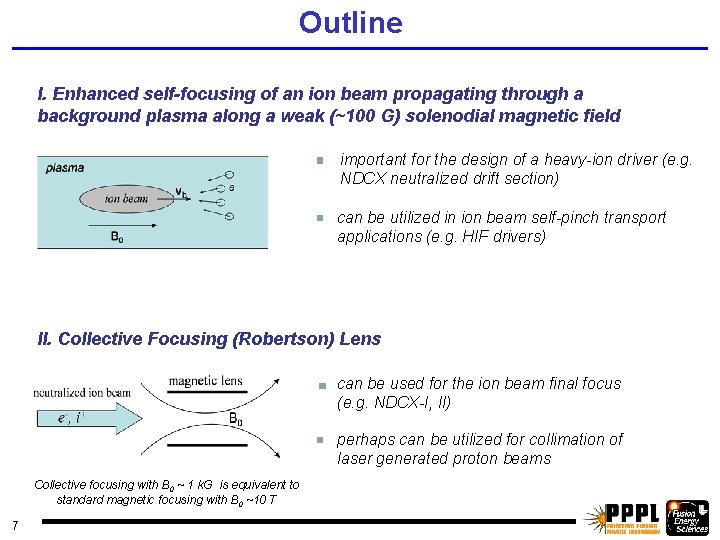
Outline I. Enhanced self-focusing of an ion beam propagating through a background plasma along a weak (~100 G) solenodial magnetic field important for the design of a heavy-ion driver (e. g. NDCX neutralized drift section) can be utilized in ion beam self-pinch transport applications (e. g. HIF drivers) II. Collective Focusing (Robertson) Lens can be used for the ion beam final focus (e. g. NDCX-I, II) perhaps can be utilized for collimation of laser generated proton beams Collective focusing with B 0 ~ 1 k. G is equivalent to standard magnetic focusing with B 0 ~10 T 7

I. Ion Beam Propagation through a Neutralizing Background Plasma Along a Solenoidal Magnetic Field plasma ion beam B 0 8 vb e-
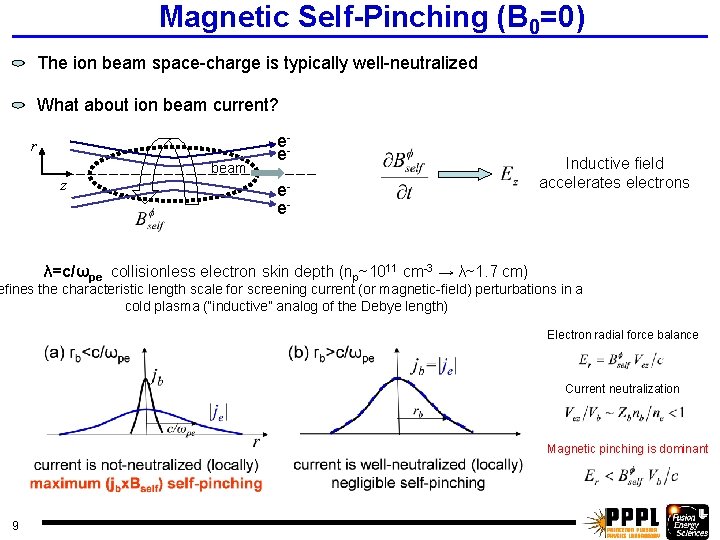
Magnetic Self-Pinching (B 0=0) The ion beam space-charge is typically well-neutralized What about ion beam current? r z beam e-e ee- Inductive field accelerates electrons λ=c/ωpe collisionless electron skin depth (np~1011 cm-3 → λ~1. 7 cm) efines the characteristic length scale for screening current (or magnetic-field) perturbations in a cold plasma (“inductive” analog of the Debye length) Electron radial force balance Current neutralization Magnetic pinching is dominant 9
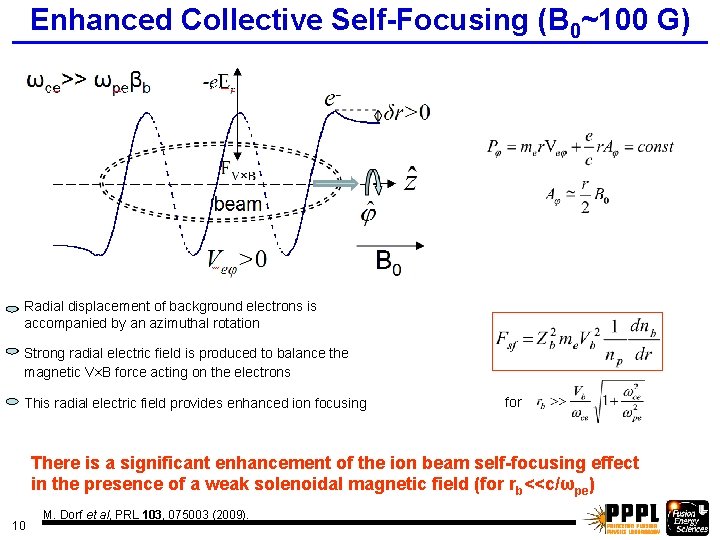
Enhanced Collective Self-Focusing (B 0~100 G) Radial displacement of background electrons is accompanied by an azimuthal rotation Strong radial electric field is produced to balance the magnetic V×B force acting on the electrons This radial electric field provides enhanced ion focusing for There is a significant enhancement of the ion beam self-focusing effect in the presence of a weak solenoidal magnetic field (for rb<<c/ωpe) 10 M. Dorf et al, PRL 103, 075003 (2009).
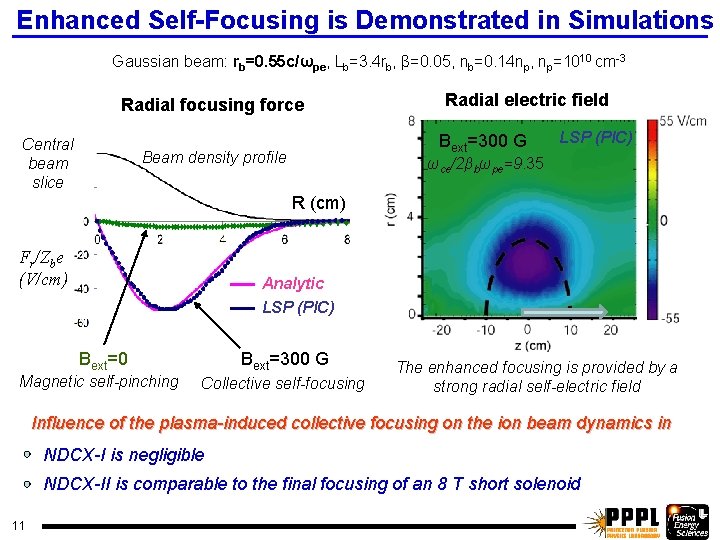
Enhanced Self-Focusing is Demonstrated in Simulations Gaussian beam: rb=0. 55 c/ωpe, Lb=3. 4 rb, β=0. 05, nb=0. 14 np, np=1010 cm-3 Radial focusing force Central beam slice Radial electric field Bext=300 G Beam density profile LSP (PIC) ωce/2βbωpe=9. 35 R (cm) Fr/Zbe (V/cm) Analytic LSP (PIC) Bext=0 Bext=300 G Magnetic self-pinching Collective self-focusing The enhanced focusing is provided by a strong radial self-electric field Influence of the plasma-induced collective focusing on the ion beam dynamics in NDCX-I is negligible NDCX-II is comparable to the final focusing of an 8 T short solenoid 11
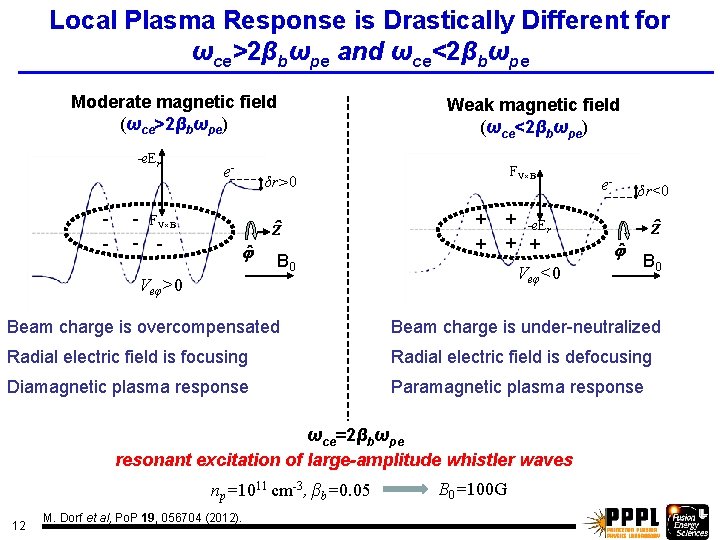
Local Plasma Response is Drastically Different for ωce>2βbωpe and ωce<2βbωpe Moderate magnetic field (ωce>2βbωpe) -e. Er - - e- FV×B δr>0 FV×B - Weak magnetic field (ωce<2βbωpe) B 0 + + + -e. Er + + Veφ<0 Veφ>0 e- δr<0 B 0 Beam charge is overcompensated Beam charge is under-neutralized Radial electric field is focusing Radial electric field is defocusing Diamagnetic plasma response Paramagnetic plasma response ωce=2βbωpe resonant excitation of large-amplitude whistler waves np=1011 cm-3, βb=0. 05 12 M. Dorf et al, Po. P 19, 056704 (2012). B 0=100 G
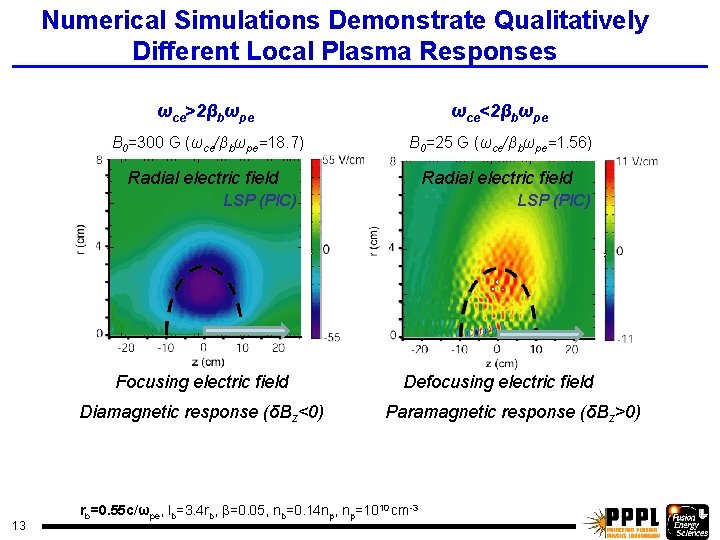
Numerical Simulations Demonstrate Qualitatively Different Local Plasma Responses ωce>2βbωpe ωce<2βbωpe B 0=300 G (ωce/βbωpe=18. 7) B 0=25 G (ωce/βbωpe=1. 56) Radial electric field LSP (PIC) Focusing electric field Diamagnetic response (δBz<0) 13 LSP (PIC) Defocusing electric field Paramagnetic response (δBz>0) rb=0. 55 c/ωpe, lb=3. 4 rb, β=0. 05, nb=0. 14 np, np=1010 cm-3
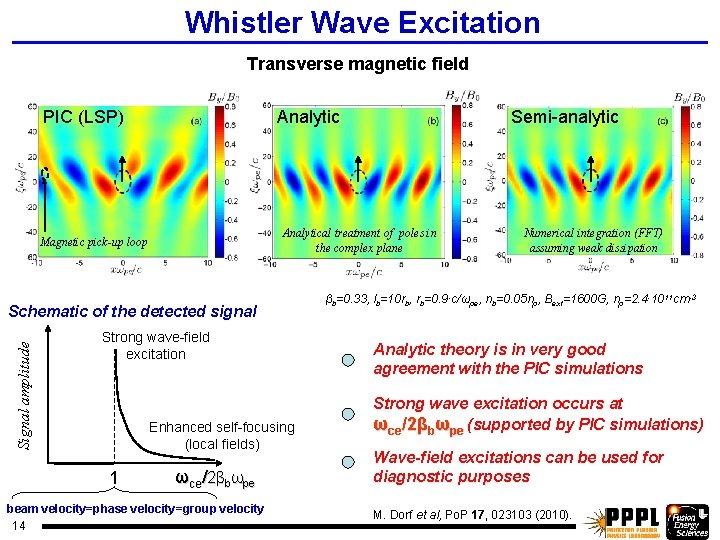
Whistler Wave Excitation Transverse magnetic field PIC (LSP) Analytical treatment of poles in the complex plane Magnetic pick-up loop Signal amplitude Schematic of the detected signal Strong wave-field excitation Enhanced self-focusing (local fields) 1 Semi-analytic ωce/2βbωpe beam velocity=phase velocity=group velocity 14 Numerical integration (FFT) assuming weak dissipation βb=0. 33, lb=10 rb, rb=0. 9∙c/ωpe, nb=0. 05 np, Bext=1600 G, np=2. 4∙ 1011 cm-3 Analytic theory is in very good agreement with the PIC simulations Strong wave excitation occurs at ωce/2βbωpe (supported by PIC simulations) Wave-field excitations can be used for diagnostic purposes M. Dorf et al, Po. P 17, 023103 (2010).
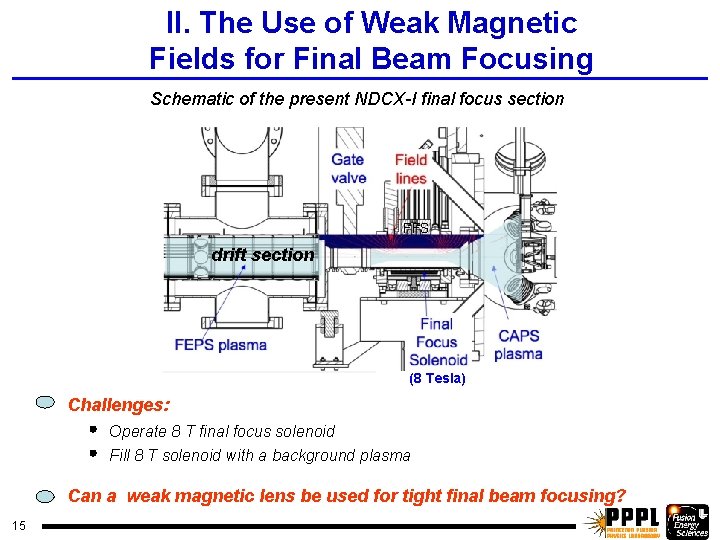
II. The Use of Weak Magnetic Fields for Final Beam Focusing Schematic of the present NDCX-I final focus section FFS drift section (8 Tesla) Challenges: Operate 8 T final focus solenoid Fill 8 T solenoid with a background plasma Can a weak magnetic lens be used for tight final beam focusing? 15
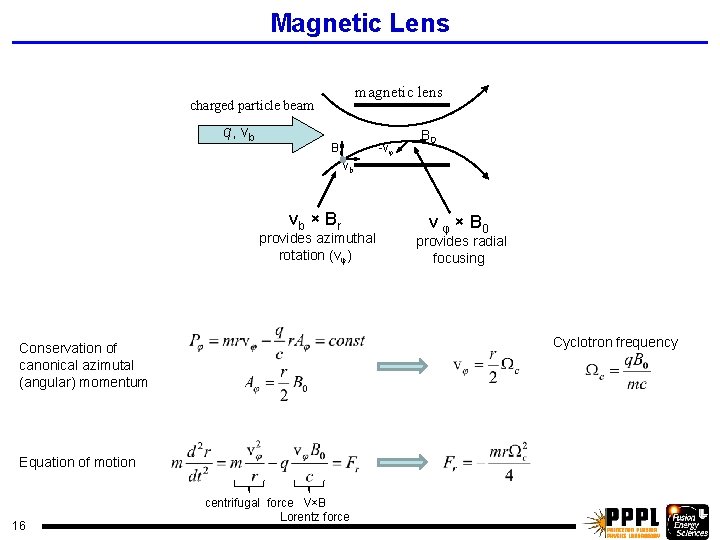
Magnetic Lens magnetic lens charged particle beam q, vb Br -vφ B 0 vb vb × Br provides azimuthal rotation (vφ) provides radial focusing Cyclotron frequency Conservation of canonical azimutal (angular) momentum Equation of motion 16 v φ × B 0 centrifugal force V×B Lorentz force
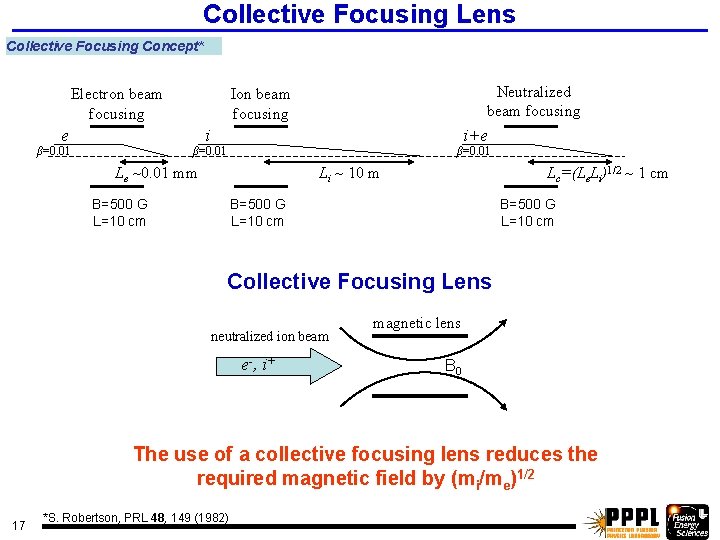
Collective Focusing Lens Collective Focusing Concept* Electron beam focusing e Neutralized beam focusing Ion beam focusing i β=0. 01 i+e β=0. 01 Le ~0. 01 mm Li ~ 10 m B=500 G L=10 cm Lc=(Le. Li)1/2 ~ 1 cm B=500 G L=10 cm Collective Focusing Lens neutralized ion beam e- , i+ magnetic lens B 0 The use of a collective focusing lens reduces the required magnetic field by (mi/me)1/2 17 *S. Robertson, PRL 48, 149 (1982)
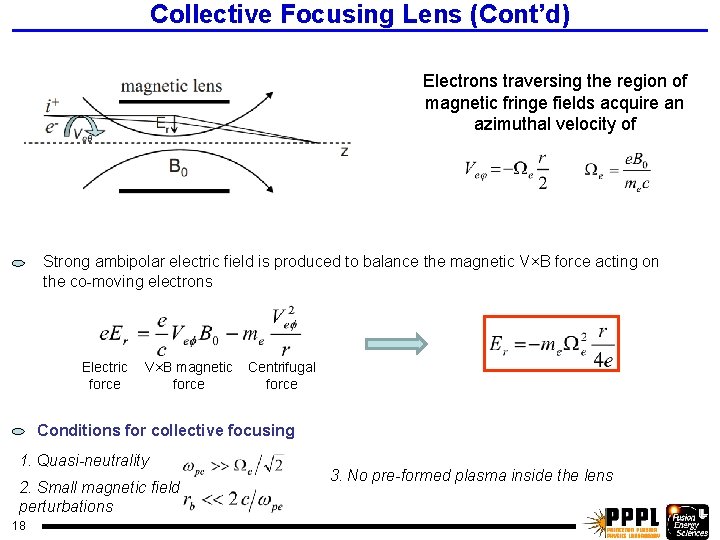
Collective Focusing Lens (Cont’d) Electrons traversing the region of magnetic fringe fields acquire an azimuthal velocity of Strong ambipolar electric field is produced to balance the magnetic V×B force acting on the co-moving electrons Electric force V×B magnetic force Centrifugal force Conditions for collective focusing 1. Quasi-neutrality 2. Small magnetic field perturbations 18 3. No pre-formed plasma inside the lens
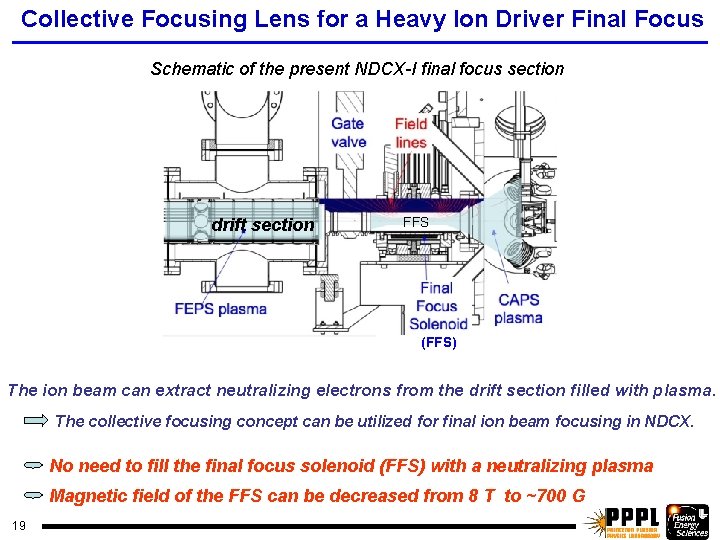
Collective Focusing Lens for a Heavy Ion Driver Final Focus Schematic of the present NDCX-I final focus section drift section FFS (FFS) The ion beam can extract neutralizing electrons from the drift section filled with plasma. The collective focusing concept can be utilized for final ion beam focusing in NDCX. No need to fill the final focus solenoid (FFS) with a neutralizing plasma Magnetic field of the FFS can be decreased from 8 T to ~700 G 19
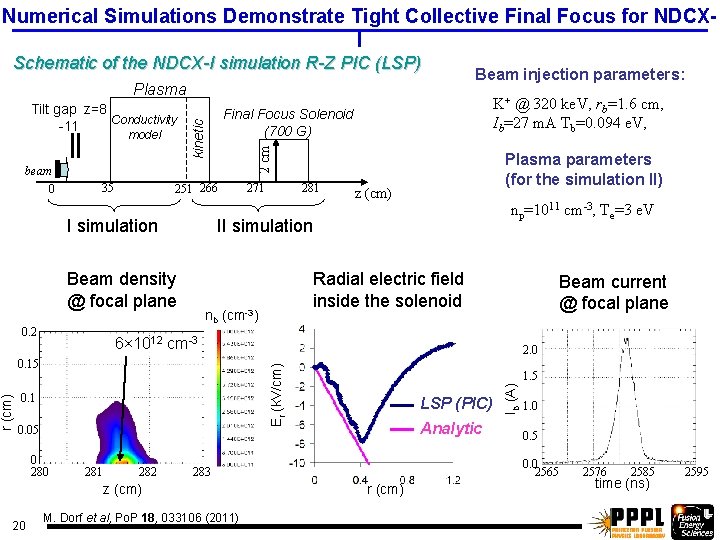
Numerical Simulations Demonstrate Tight Collective Final Focus for NDCXI Schematic of the NDCX-I simulation R-Z PIC (LSP) Plasma 2 cm model beam 0 35 251 266 I simulation z (cm) np=1011 cm-3, Te=3 e. V Radial electric field inside the solenoid Beam current @ focal plane 6× 1012 cm-3 2. 0 Er (k. V/cm) 0. 1 0. 05 0 281 282 1. 5 LSP (PIC) Analytic M. Dorf et al, Po. P 18, 033106 (2011) 1. 0 0. 5 0. 0 2565 283 z (cm) Ib (A) r (cm) 281 nb (cm-3) 0. 15 20 271 Plasma parameters (for the simulation II) II simulation Beam density @ focal plane 0. 2 K+ @ 320 ke. V, rb=1. 6 cm, Ib=27 m. A Tb=0. 094 e. V, Final Focus Solenoid (700 G) kinetic Tilt gap z=8 Conductivity -11 Beam injection parameters: r (cm) 2576 2585 time (ns) 2595
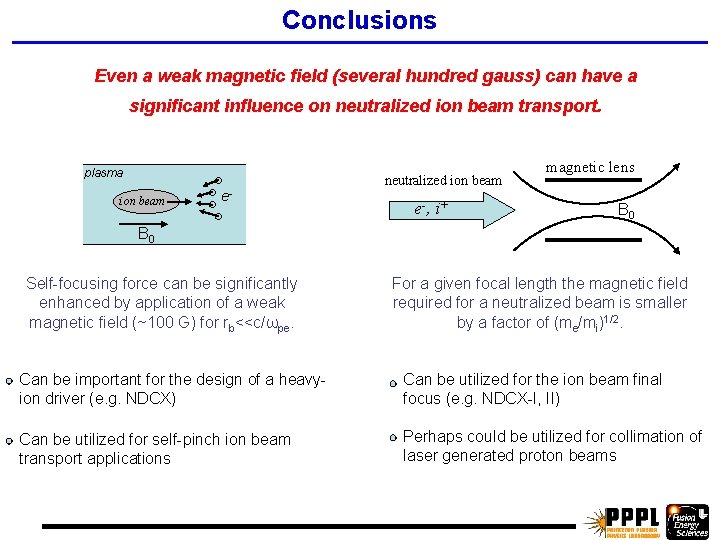
Conclusions Even a weak magnetic field (several hundred gauss) can have a significant influence on neutralized ion beam transport. plasma neutralized ion beam e- e- , i+ magnetic lens B 0 Self-focusing force can be significantly enhanced by application of a weak magnetic field (~100 G) for rb<<c/ωpe. For a given focal length the magnetic field required for a neutralized beam is smaller by a factor of (me/mi)1/2. Can be important for the design of a heavyion driver (e. g. NDCX) Can be utilized for the ion beam final focus (e. g. NDCX-I, II) Can be utilized for self-pinch ion beam transport applications Perhaps could be utilized for collimation of laser generated proton beams
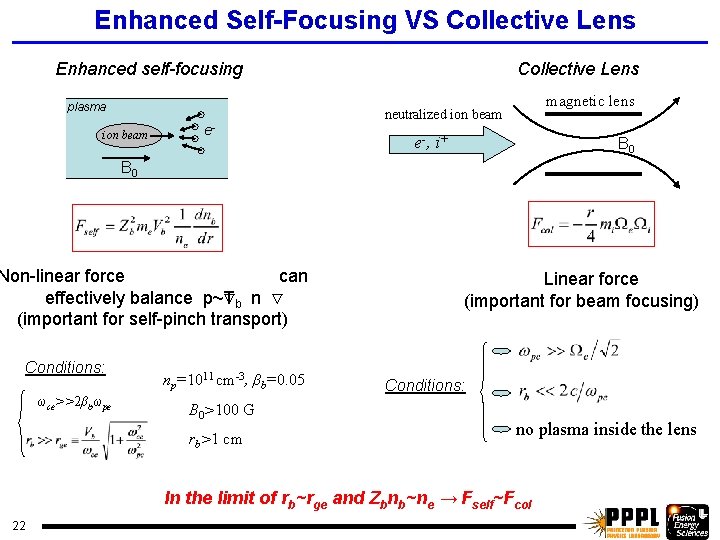
Enhanced Self-Focusing VS Collective Lens Enhanced self-focusing plasma Collective Lens magnetic lens neutralized ion beam e- e- , i+ B 0 Non-linear force can effectively balance p~Tb n (important for self-pinch transport) Conditions: ωce>>2βbωpe np=1011 cm-3, βb=0. 05 B 0>100 G rb>1 cm Linear force (important for beam focusing) Conditions: no plasma inside the lens In the limit of rb~rge and Zbnb~ne → Fself~Fcol 22
- Slides: 22