
Heavy Ion Collisions at Collider Energies Insights from

- Slides: 27
Heavy Ion Collisions at Collider Energies Insights from PHENIX ICPAQGC Axel Drees, SUNY Stony Brook Jaipur, India November 26, 2001 Results from run 2000 ~ 3. 5 106 minimum bias Au-Au events at s. NN = 130 Ge. V Global observables: ET and Nch Hadrons: yields and spectra suppression of high p. T hadrons Electron: inclusive spectra Other PHENIX talks: Tue. Session 6 Tue. Session 7 Fr. Session 19 David Silvermyr: Julia Velkovska: John Sullivan: Charged Particle Multiplicity in Au-Au Collisions at RHIC Identified Charged Hadron Production at RHIC Global Observables and Identified Hadrons in PHENIX
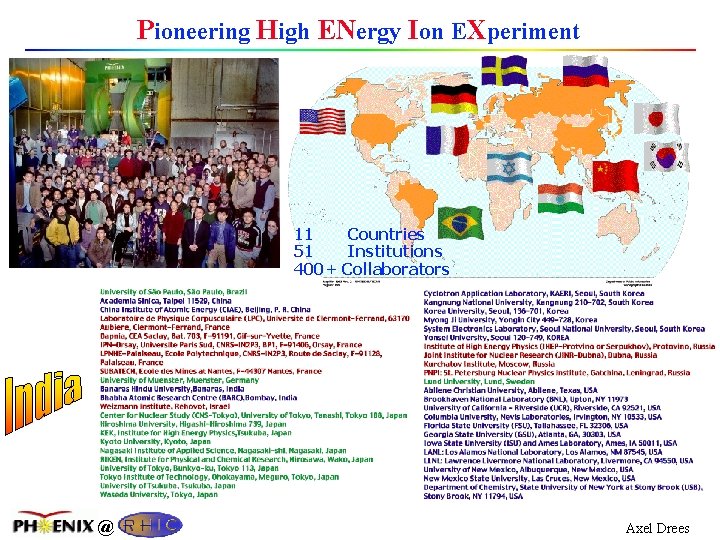
Pioneering High ENergy Ion EXperiment 11 Countries 51 Institutions 400+ Collaborators @ Axel Drees
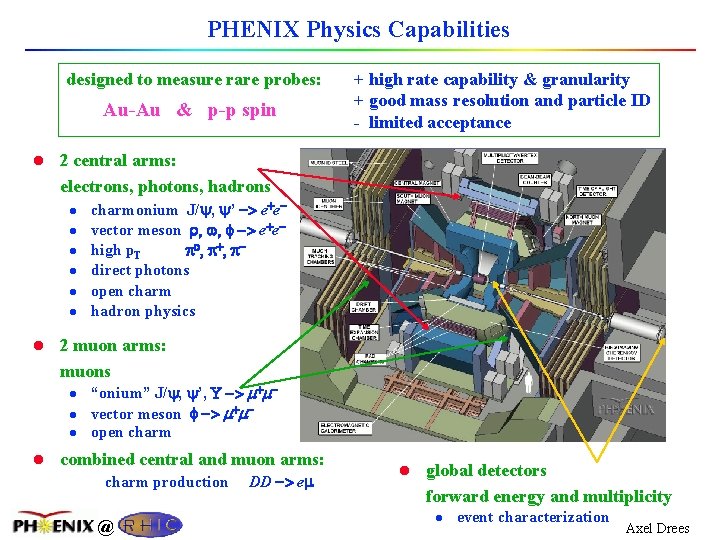
PHENIX Physics Capabilities designed to measure rare probes: Au-Au & p-p spin + high rate capability & granularity + good mass resolution and particle ID - limited acceptance l 2 central arms: electrons, photons, hadrons l l l charmonium J/ , ’ -> e+evector meson r, w, -> e+ehigh p. T o, +, direct photons open charm hadron physics l 2 muon arms: muons l l l “onium” J/ , ’, -> m+mvector meson -> m+mopen charm l combined central and muon arms: charm production DD -> em @ l global detectors forward energy and multiplicity l event characterization Axel Drees
PHENIX Installation During Au-Au Run 2001 Mu. ID EMCAL TOF Mu. Trk TEC/TRD PCs DC RICH collaborator BBC MVD ZDC @ Axel Drees
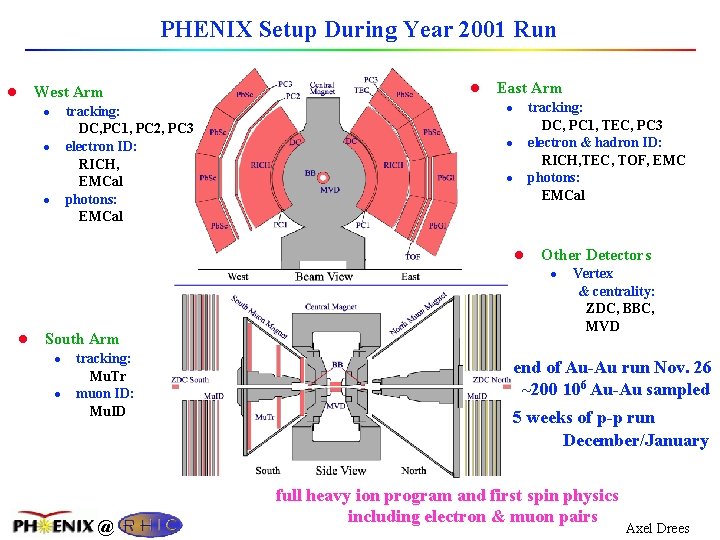
PHENIX Setup During Year 2001 Run West Arm l tracking: DC, PC 1, PC 2, PC 3 electron ID: RICH, EMCal photons: EMCal l l East Arm tracking: DC, PC 1, TEC, PC 3 electron & hadron ID: RICH, TEC, TOF, EMC photons: EMCal l l Other Detectors l l South Arm l l tracking: Mu. Tr muon ID: Mu. ID @ Vertex & centrality: ZDC, BBC, MVD end of Au-Au run Nov. 26 ~200 106 Au-Au sampled 5 weeks of p-p run December/January full heavy ion program and first spin physics including electron & muon pairs Axel Drees
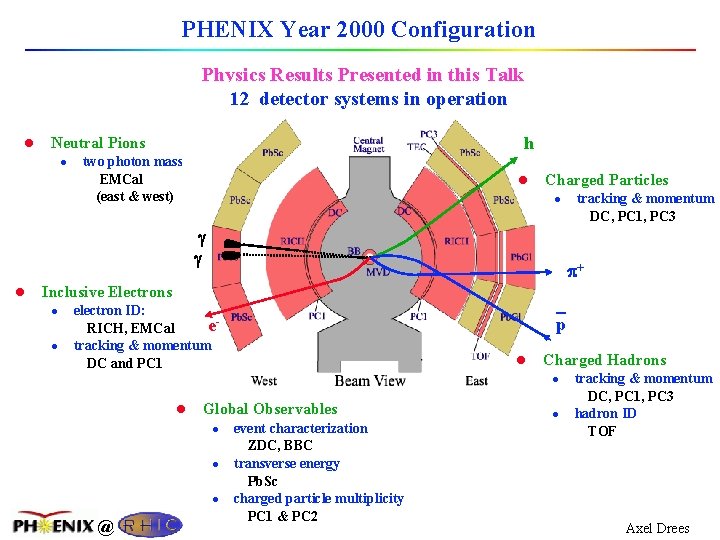
PHENIX Year 2000 Configuration Physics Results Presented in this Talk 12 detector systems in operation l h Neutral Pions l two photon mass EMCal (east & west) l Charged Particles l g g l tracking & momentum DC, PC 1, PC 3 + Inclusive Electrons l l electron ID: e. RICH, EMCal tracking & momentum DC and PC 1 p l Charged Hadrons l l Global Observables l l l @ event characterization ZDC, BBC transverse energy Pb. Sc charged particle multiplicity PC 1 & PC 2 l tracking & momentum DC, PC 1, PC 3 hadron ID TOF Axel Drees
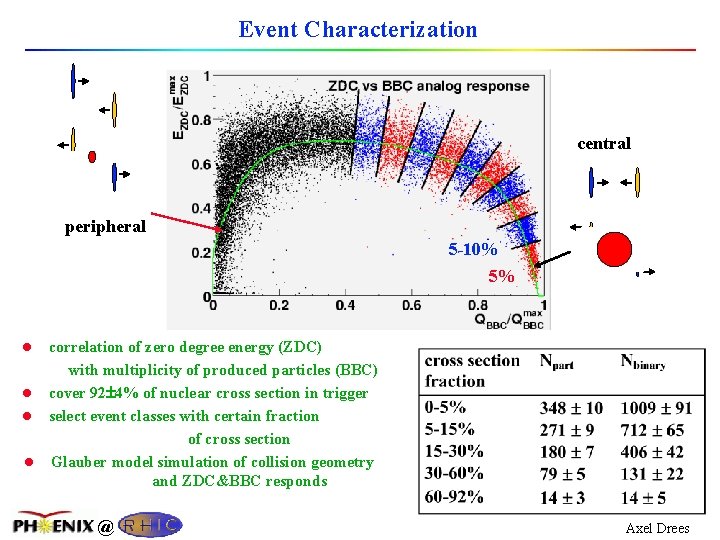
Event Characterization central peripheral 5 -10% 5% correlation of zero degree energy (ZDC) with multiplicity of produced particles (BBC) l cover 92 4% of nuclear cross section in trigger l select event classes with certain fraction of cross section l Glauber model simulation of collision geometry and ZDC&BBC responds l @ Axel Drees
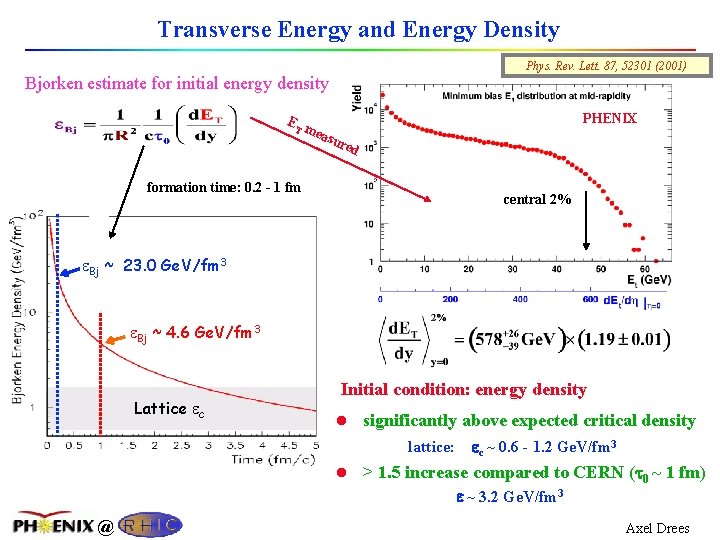
Transverse Energy and Energy Density Phys. Rev. Lett. 87, 52301 (2001) Bjorken estimate for initial energy density ET PHENIX me asu red formation time: 0. 2 - 1 fm central 2% e. Bj ~ 23. 0 Ge. V/fm 3 e. Bj ~ 4. 6 Ge. V/fm 3 Lattice ec Initial condition: energy density l significantly above expected critical density lattice: c ~ 0. 6 - 1. 2 Ge. V/fm 3 l > 1. 5 increase compared to CERN ( 0 ~ 1 fm) ~ 3. 2 Ge. V/fm 3 @ Axel Drees
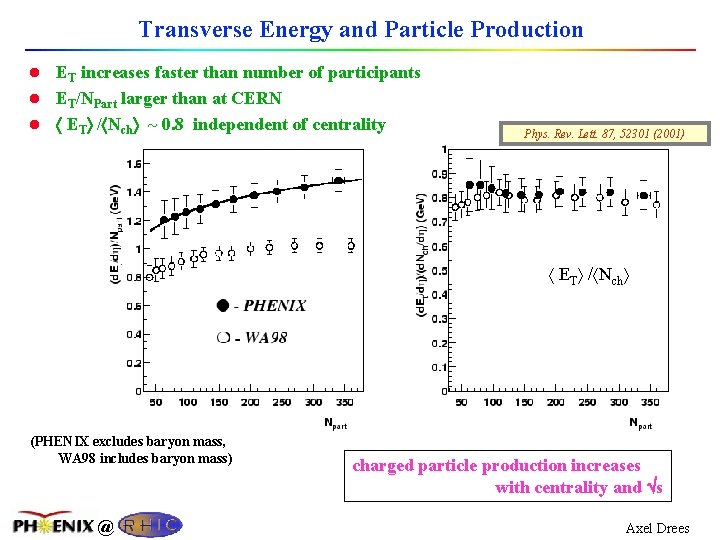
Transverse Energy and Particle Production l ET increases faster than number of participants l ET/NPart larger than at CERN l ET / Nch ~ 0. 8 independent of centrality Phys. Rev. Lett. 87, 52301 (2001) ET / Nch (PHENIX excludes baryon mass, WA 98 includes baryon mass) @ charged particle production increases with centrality and s Axel Drees
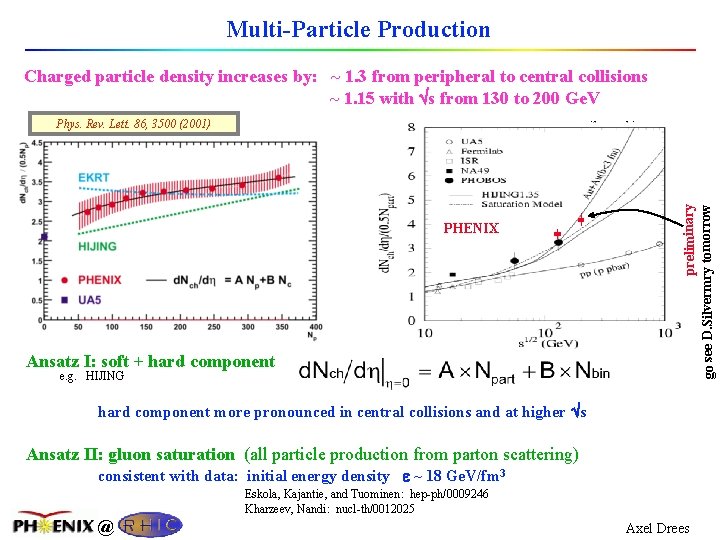
Multi-Particle Production Charged particle density increases by: ~ 1. 3 from peripheral to central collisions ~ 1. 15 with s from 130 to 200 Ge. V Phys. Rev. Lett. 86, 3500 (2001) with quenching no jet quenching PHENIX Ansatz I: soft + hard component e. g. HIJING preliminary go see D. Silvermry tomorrow saturation hard component more pronounced in central collisions and at higher s Ansatz II: gluon saturation (all particle production from parton scattering) consistent with data: initial energy density ~ 18 Ge. V/fm 3 Eskola, Kajantie, and Tuominen: hep-ph/0009246 Kharzeev, Nandi: nucl-th/0012025 @ Axel Drees
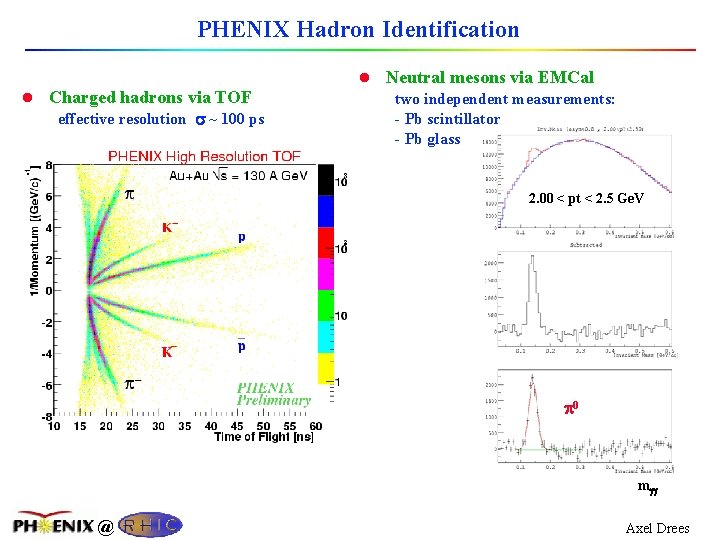
PHENIX Hadron Identification l Charged hadrons via TOF effective resolution ~ 100 ps l Neutral mesons via EMCal two independent measurements: - Pb scintillator - Pb glass 2. 00 < pt < 2. 5 Ge. V 0 mgg @ Axel Drees
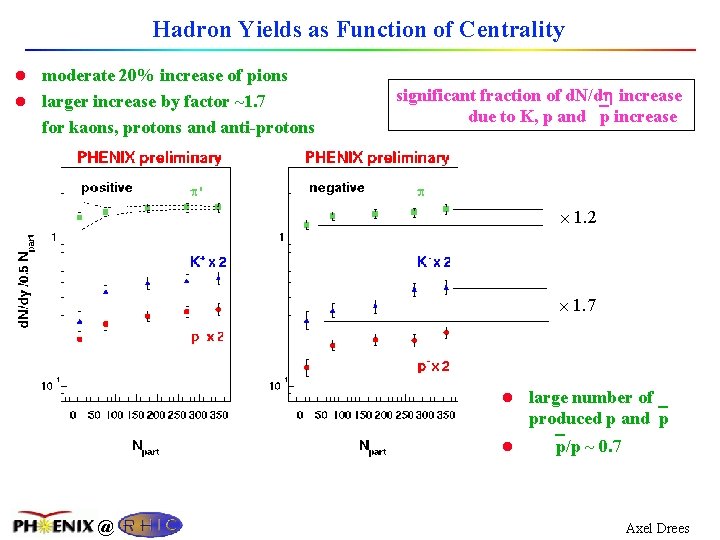
Hadron Yields as Function of Centrality l moderate 20% increase of pions l larger increase by factor ~1. 7 for kaons, protons and anti-protons significant fraction of d. N/d increase due to K, p and p increase 1. 2 1. 7 l large number of produced p and p l @ p/p ~ 0. 7 Axel Drees
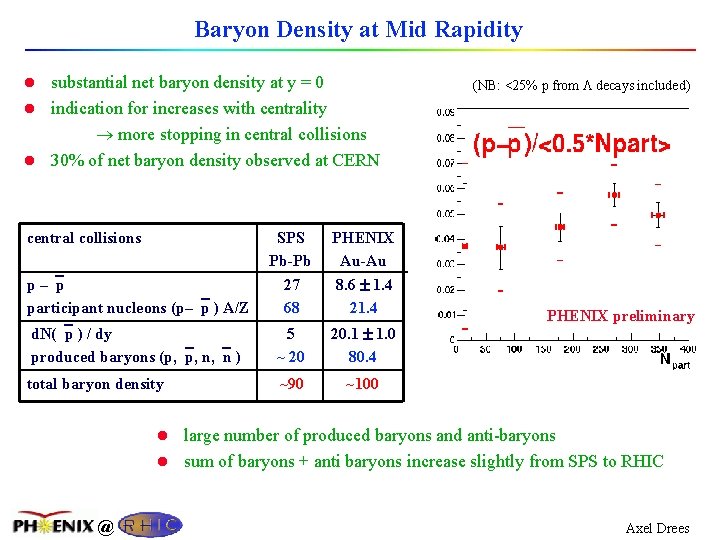
Baryon Density at Mid Rapidity l substantial net baryon density at y = 0 (NB: <25% p from L decays included) l indication for increases with centrality more stopping in central collisions l 30% of net baryon density observed at CERN central collisions SPS Pb-Pb PHENIX Au-Au p – p participant nucleons (p– p ) A/Z 27 68 8. 6 1. 4 21. 4 d. N( p ) / dy produced baryons (p, p, n, n ) 5 ~ 20 20. 1 1. 0 80. 4 total baryon density ~90 ~100 PHENIX preliminary l large number of produced baryons and anti-baryons l sum of baryons + anti baryons increase slightly from SPS to RHIC @ Axel Drees
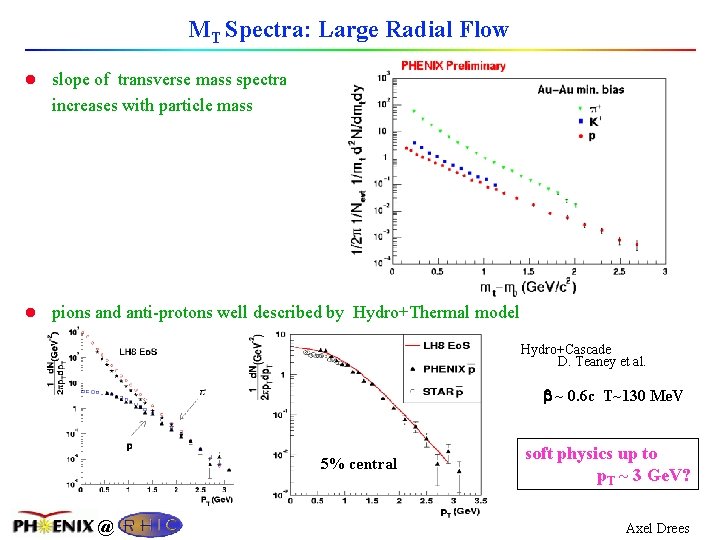
MT Spectra: Large Radial Flow l slope of transverse mass spectra increases with particle mass l pions and anti-protons well described by Hydro+Thermal model Hydro+Cascade D. Teaney et al. ~ 0. 6 c T~130 Me. V 5% central @ soft physics up to p. T ~ 3 Ge. V? Axel Drees
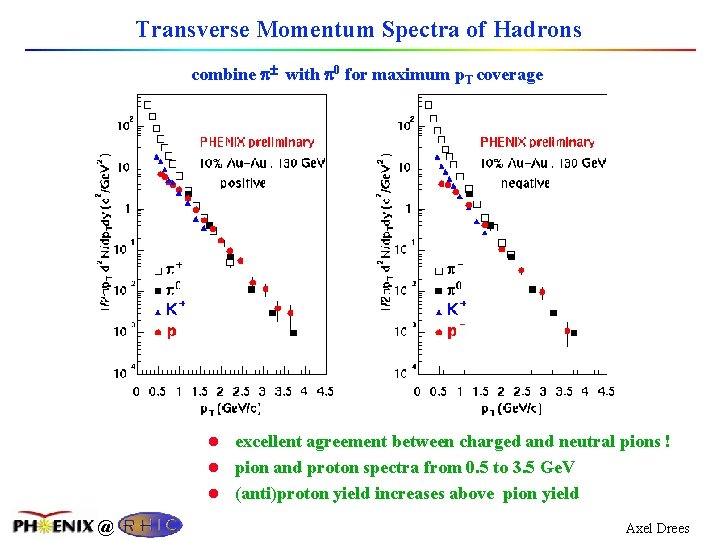
Transverse Momentum Spectra of Hadrons combine with 0 for maximum p. T coverage l excellent agreement between charged and neutral pions ! l pion and proton spectra from 0. 5 to 3. 5 Ge. V l (anti)proton yield increases above pion yield @ Axel Drees
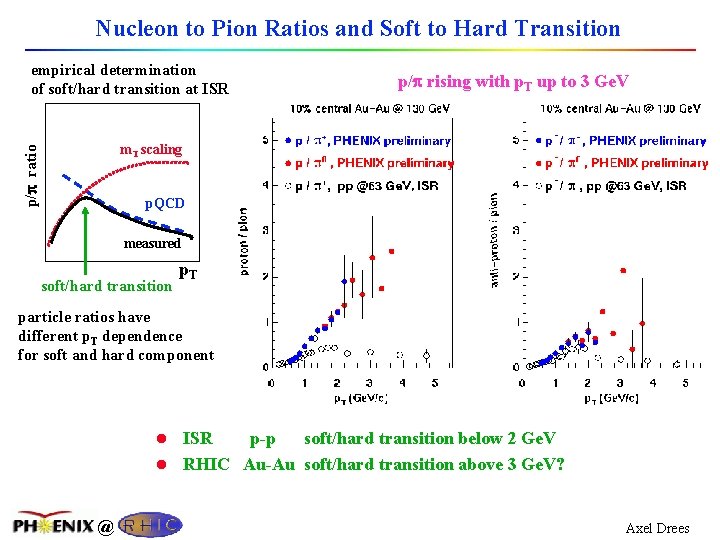
Nucleon to Pion Ratios and Soft to Hard Transition empirical determination of soft/hard transition at ISR p/ rising with p. T up to 3 Ge. V p/ ratio m. T scaling p. QCD measured soft/hard transition p. T particle ratios have different p. T dependence for soft and hard component l ISR p-p soft/hard transition below 2 Ge. V l RHIC Au-Au soft/hard transition above 3 Ge. V? @ Axel Drees
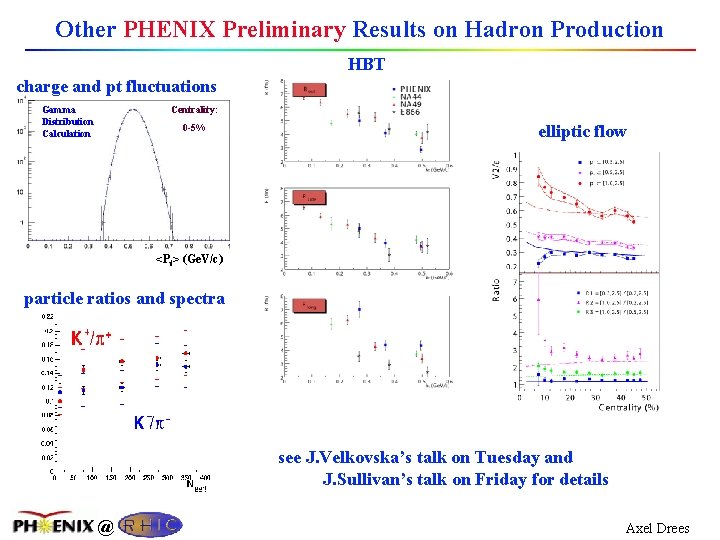
Other PHENIX Preliminary Results on Hadron Production HBT charge and pt fluctuations Centrality: Gamma Distribution Calculation 0 -5% elliptic flow <Pt> (Ge. V/c) particle ratios and spectra see J. Velkovska’s talk on Tuesday and J. Sullivan’s talk on Friday for details @ Axel Drees
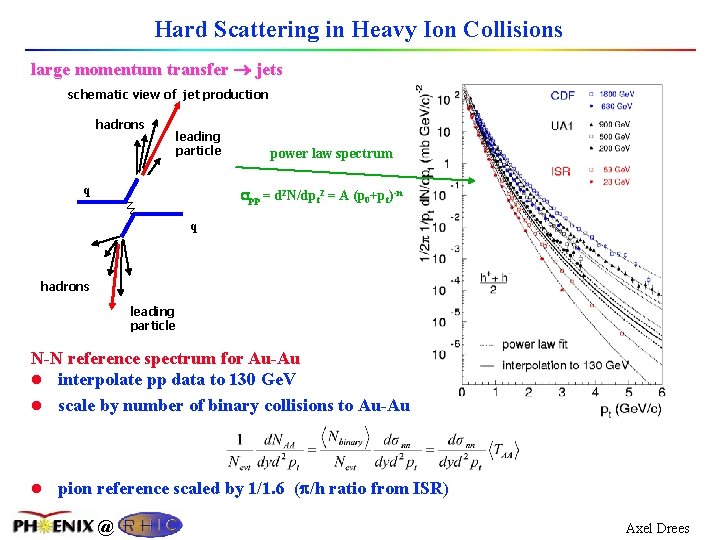
Hard Scattering in Heavy Ion Collisions large momentum transfer jets schematic view of jet production hadrons leading particle q power law spectrum pp = d 2 N/dpt 2 = A (p 0+pt)-n q hadrons leading particle N-N reference spectrum for Au-Au l interpolate pp data to 130 Ge. V l scale by number of binary collisions to Au-Au l pion reference scaled by 1/1. 6 ( /h ratio from ISR) @ Axel Drees
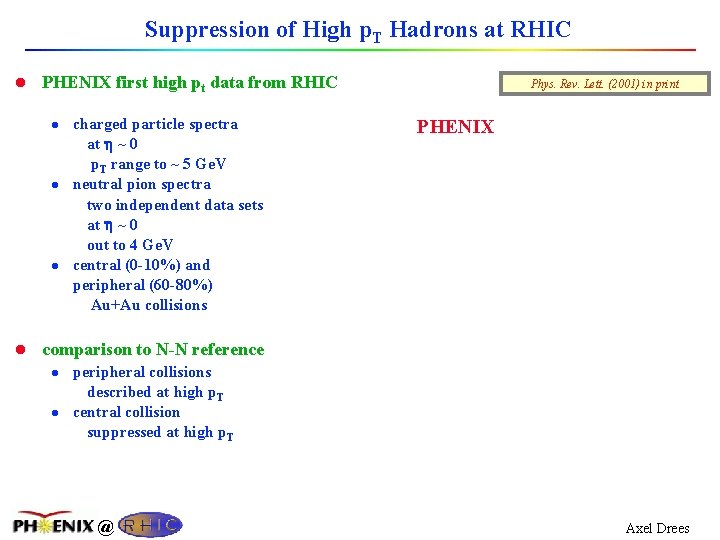
Suppression of High p. T Hadrons at RHIC l PHENIX first high pt data from RHIC l l l charged particle spectra at ~ 0 p. T range to ~ 5 Ge. V neutral pion spectra two independent data sets at ~ 0 out to 4 Ge. V central (0 -10%) and peripheral (60 -80%) Au+Au collisions Phys. Rev. Lett. (2001) in print PHENIX l comparison to N-N reference l peripheral collisions described at high p. T l central collision suppressed at high p. T @ Axel Drees
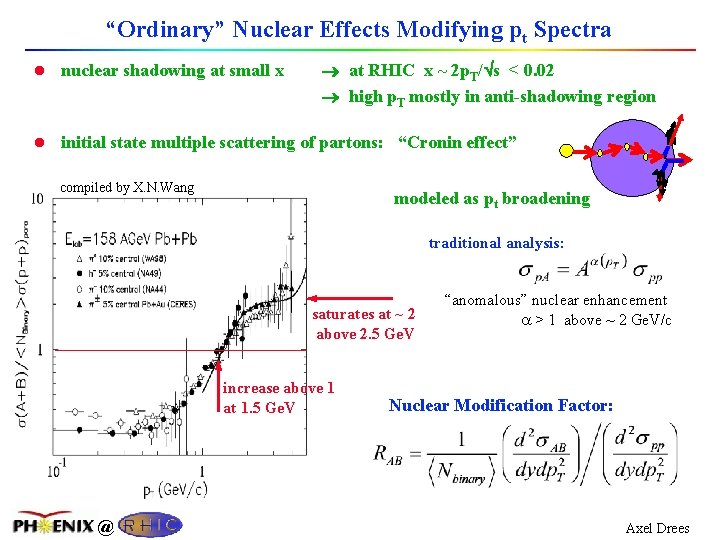
“Ordinary” Nuclear Effects Modifying pt Spectra l nuclear shadowing at small x at RHIC x ~ 2 p. T/ s < 0. 02 high p. T mostly in anti-shadowing region l initial state multiple scattering of partons: “Cronin effect” compiled by X. N. Wang modeled as pt broadening traditional analysis: saturates at ~ 2 above 2. 5 Ge. V increase above 1 at 1. 5 Ge. V @ “anomalous” nuclear enhancement > 1 above ~ 2 Ge. V/c Nuclear Modification Factor: Axel Drees
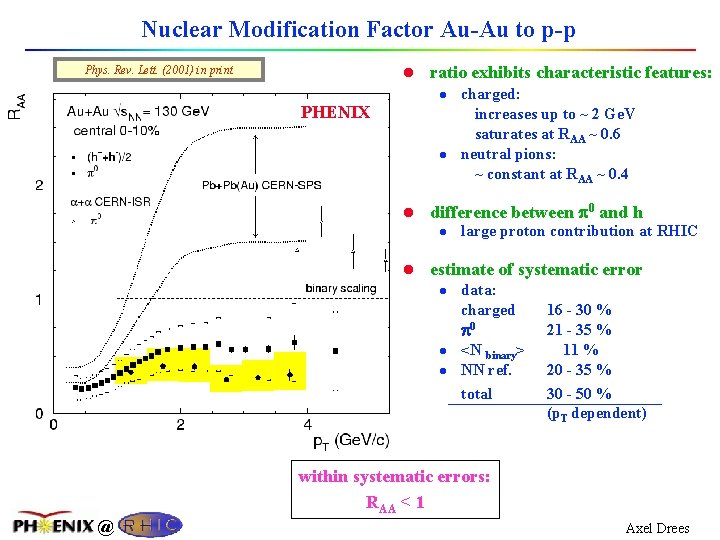
Nuclear Modification Factor Au-Au to p-p Phys. Rev. Lett. (2001) in print PHENIX l ratio exhibits characteristic features: l charged: increases up to ~ 2 Ge. V saturates at RAA ~ 0. 6 l neutral pions: ~ constant at RAA ~ 0. 4 l difference between 0 and h l large proton contribution at RHIC l estimate of systematic error l data: charged 16 - 30 % 0 21 - 35 % l <N binary> 11 % l NN ref. 20 - 35 % total 30 - 50 % (p. T dependent) within systematic errors: RAA < 1 @ Axel Drees
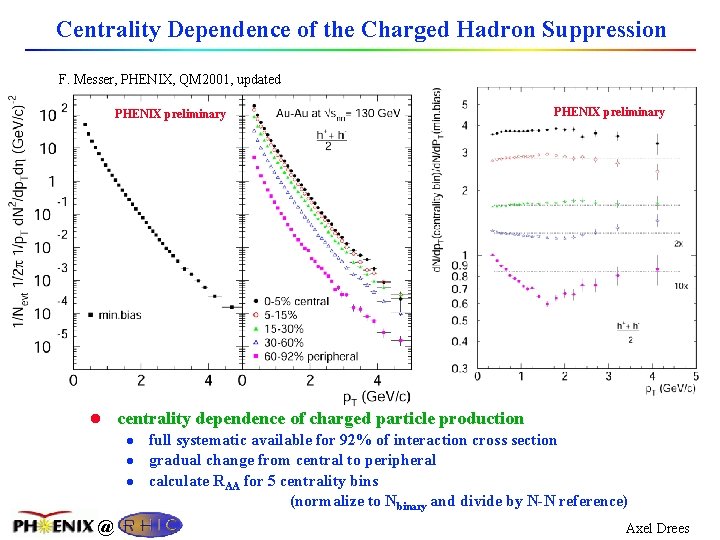
Centrality Dependence of the Charged Hadron Suppression F. Messer, PHENIX, QM 2001, updated PHENIX preliminary l centrality dependence of charged particle production l full systematic available for 92% of interaction cross section l gradual change from central to peripheral l calculate RAA for 5 centrality bins (normalize to Nbinary and divide by N-N reference) @ Axel Drees
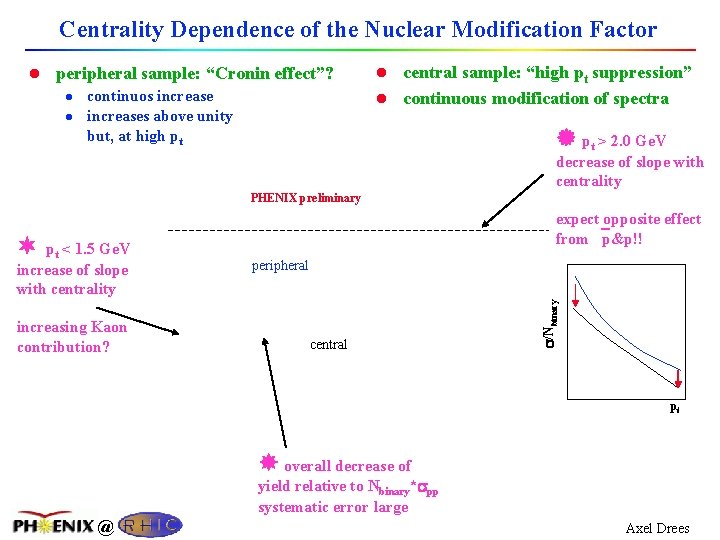
Centrality Dependence of the Nuclear Modification Factor l peripheral sample: “Cronin effect”? l continuos increase l increases above unity but, at high pt l central sample: “high pt suppression” l continuous modification of spectra pt > 2. 0 Ge. V decrease of slope with centrality PHENIX preliminary pt < 1. 5 Ge. V increase of slope with centrality increasing Kaon contribution? peripheral central /Nbinary expect opposite effect from p&p!! pt overall decrease of yield relative to Nbinary* pp systematic error large @ Axel Drees
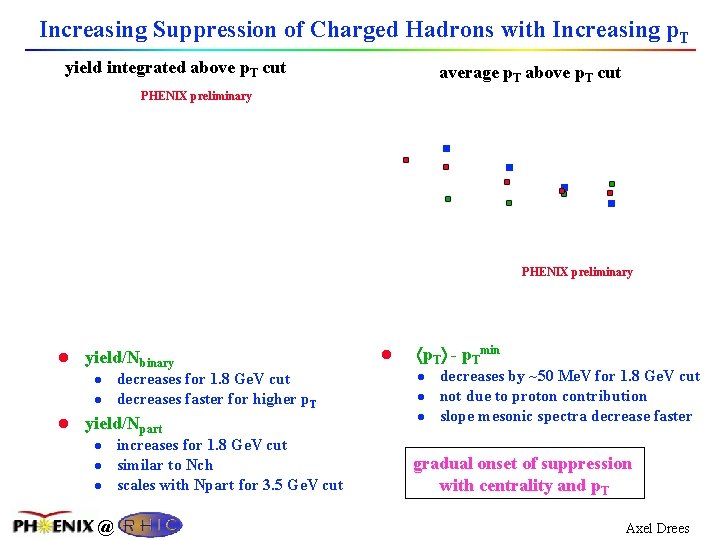
Increasing Suppression of Charged Hadrons with Increasing p. T yield integrated above p. T cut average p. T above p. T cut PHENIX preliminary l yield/Nbinary l decreases for 1. 8 Ge. V cut l decreases faster for higher p. T l yield/Npart l increases for 1. 8 Ge. V cut l similar to Nch l scales with Npart for 3. 5 Ge. V cut @ l p. T - p. Tmin l l l decreases by ~50 Me. V for 1. 8 Ge. V cut not due to proton contribution slope mesonic spectra decrease faster gradual onset of suppression with centrality and p. T Axel Drees
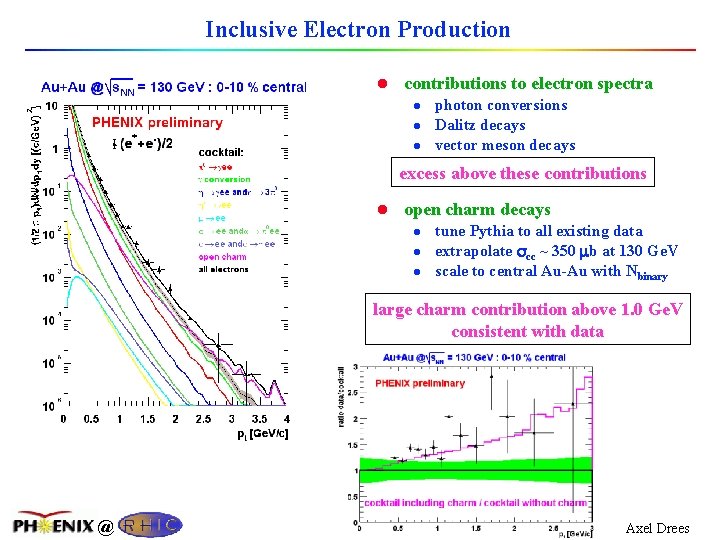
Inclusive Electron Production l contributions to electron spectra l photon conversions l Dalitz decays l vector meson decays excess above these contributions l open charm decays l tune Pythia to all existing data l extrapolate cc ~ 350 mb at 130 Ge. V l scale to central Au-Au with Nbinary large charm contribution above 1. 0 Ge. V consistent with data @ Axel Drees
Large Amounts of Results from PHENIX l global observables l Initial energy density > 4. 6 Ge. V/fm 3 l d. Nch/d and d. ET/d hard+soft component or gluon saturation l hadron p. T spectra: soft physics l d. Nbaryon/dy ~ 100 (baryon + anti-baryon) l hydro+thermal interpretation of p. T spectra large radial flow l hadron p. T spectra: hard physics l p/ increases up to 3. 5 Ge. V to values above 1 no sign of soft/hard transition l high p. T charged hadron and 0 yield suppressed in central collisions different from Cronin effect and shadowing l continuous centrality dependence: peripheral similar to Cronin effect l suppression sets in gradually for more central collisions l increasing centrality: decreasing relative yield with increasing p. T l increasing centrality: decreasing average p. T above 1. 8 Ge. V l electron spectra l consistent with large charm cross section 3. 5 106 event in 2000 ~200 106 events in 2001 + pp data @ Axel Drees
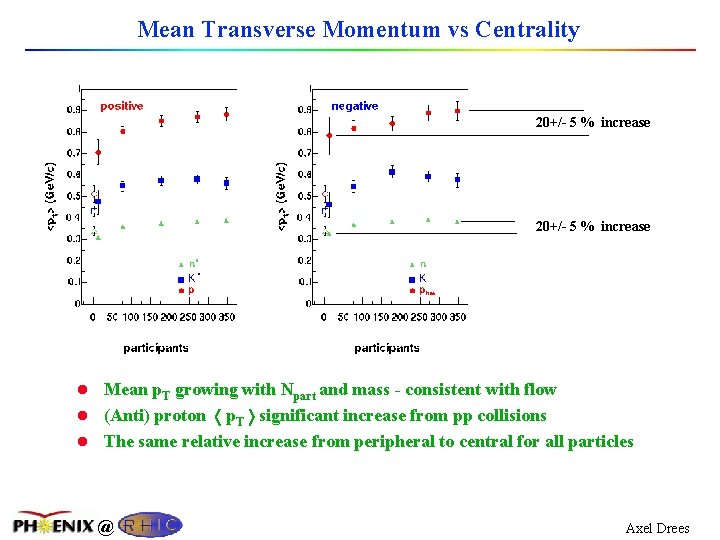
Mean Transverse Momentum vs Centrality 20+/- 5 % increase l Mean p. T growing with Npart and mass - consistent with flow l (Anti) proton p. T significant increase from pp collisions l The same relative increase from peripheral to central for all particles @ Axel Drees