
Heavy Flavour Physics Lecture 1 of 3 Tim
- Slides: 41
Heavy Flavour Physics Lecture 1 of 3 Tim Gershon University of Warwick HCPSS 2015 1 July 2015 Tim Gershon Flavour Physics 1
Contents ● Part 1 – ● Part 2 – ● Why is flavour physics interesting? What do we know from the previous generation of experiments? Part 3 – What do we hope to learn from current and future heavy flavour experiments? Today hope to cover Part 1 & start Part 2 Tim Gershon Flavour Physics (but let's see how we go) 2
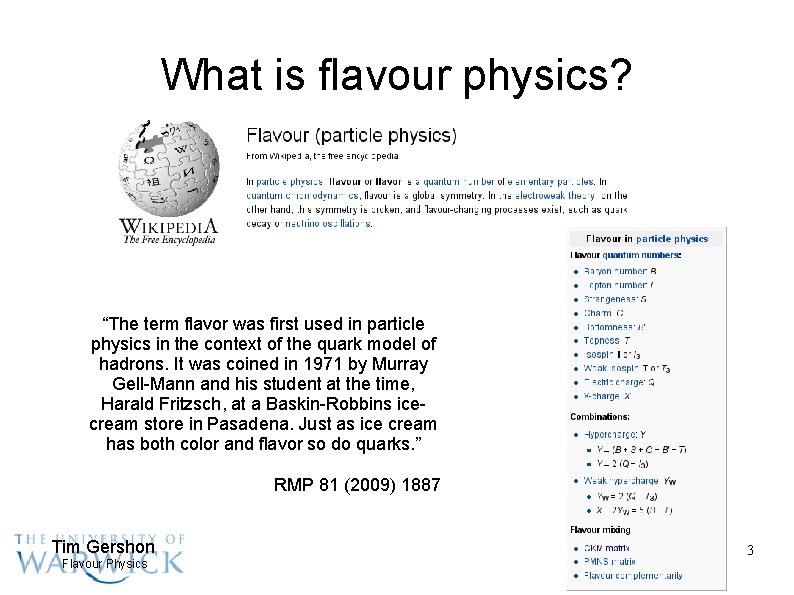
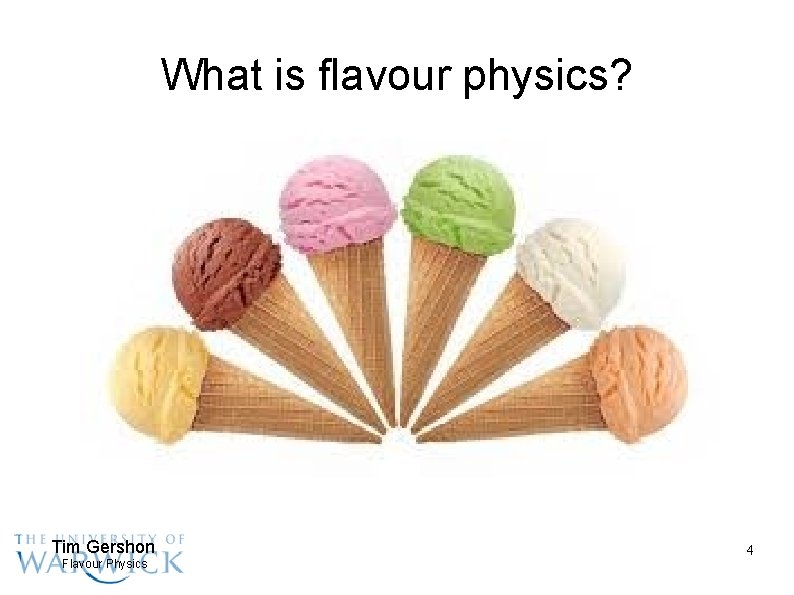
What is flavour physics? “The term flavor was first used in particle physics in the context of the quark model of hadrons. It was coined in 1971 by Murray Gell-Mann and his student at the time, Harald Fritzsch, at a Baskin-Robbins icecream store in Pasadena. Just as ice cream has both color and flavor so do quarks. ” RMP 81 (2009) 1887 Tim Gershon Flavour Physics 3
What is flavour physics? Tim Gershon Flavour Physics 4
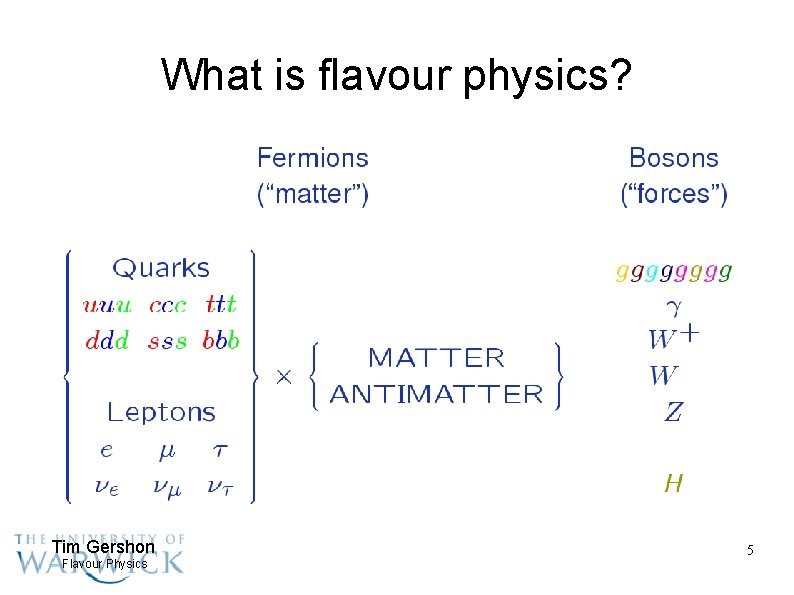
What is flavour physics? Tim Gershon Flavour Physics 5
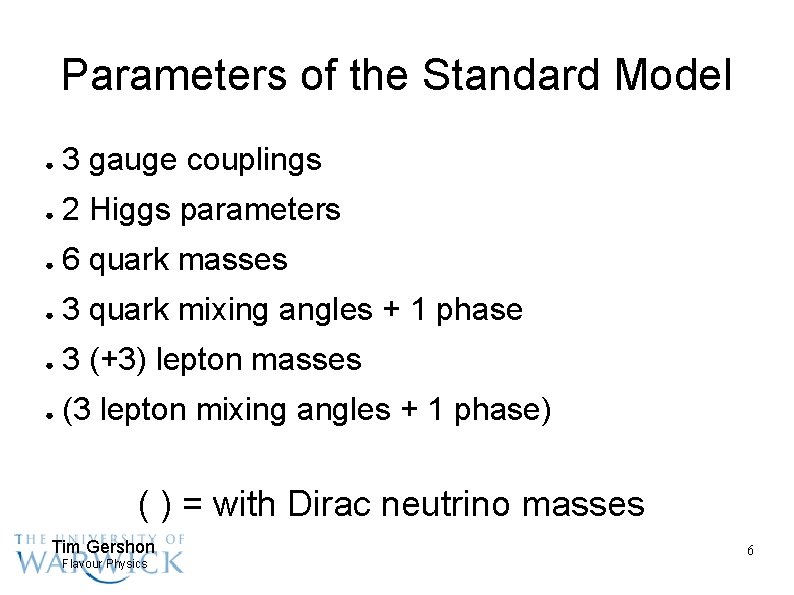
Parameters of the Standard Model ● 3 gauge couplings ● 2 Higgs parameters ● 6 quark masses ● 3 quark mixing angles + 1 phase ● 3 (+3) lepton masses ● (3 lepton mixing angles + 1 phase) ( ) = with Dirac neutrino masses Tim Gershon Flavour Physics 6
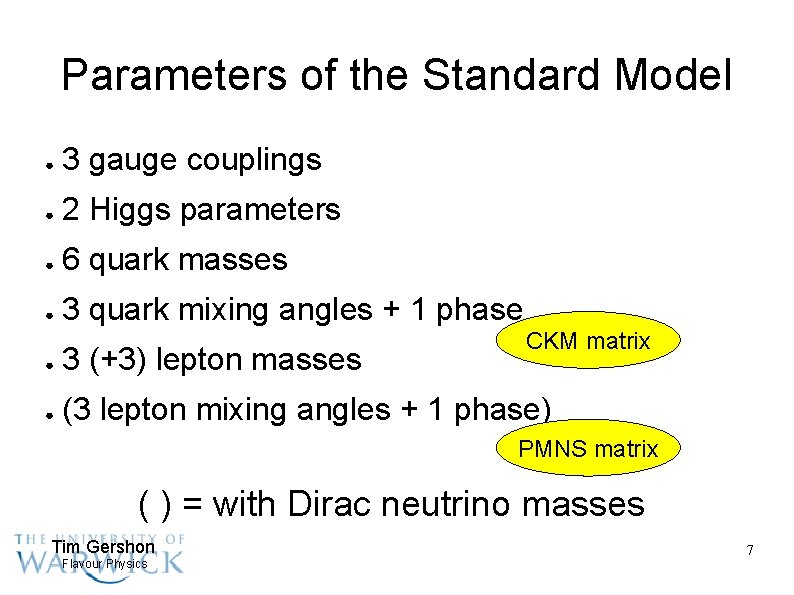
Parameters of the Standard Model ● 3 gauge couplings ● 2 Higgs parameters ● 6 quark masses ● 3 quark mixing angles + 1 phase CKM matrix ● 3 (+3) lepton masses ● (3 lepton mixing angles + 1 phase) PMNS matrix ( ) = with Dirac neutrino masses Tim Gershon Flavour Physics 7
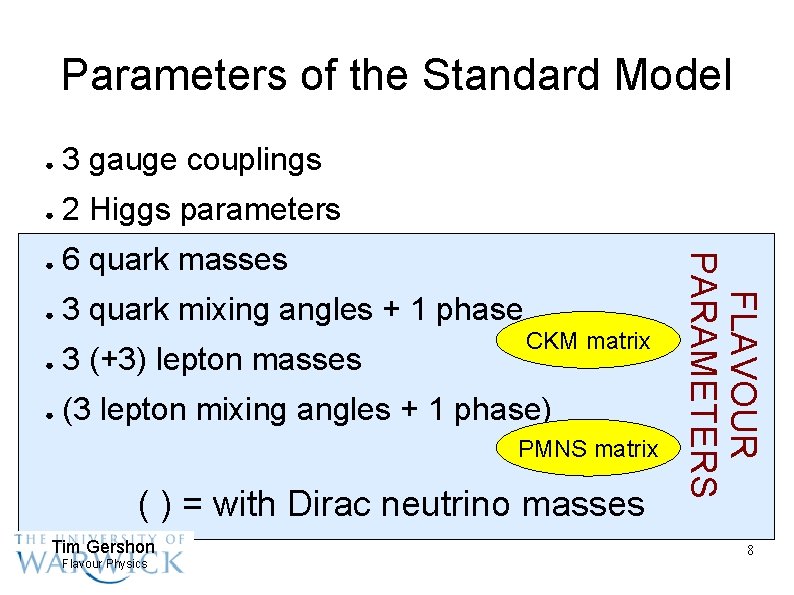
Parameters of the Standard Model 3 gauge couplings ● 2 Higgs parameters ● 6 quark masses ● 3 quark mixing angles + 1 phase CKM matrix ● 3 (+3) lepton masses ● (3 lepton mixing angles + 1 phase) PMNS matrix ( ) = with Dirac neutrino masses Tim Gershon Flavour Physics FLAVOUR PARAMETERS ● 8
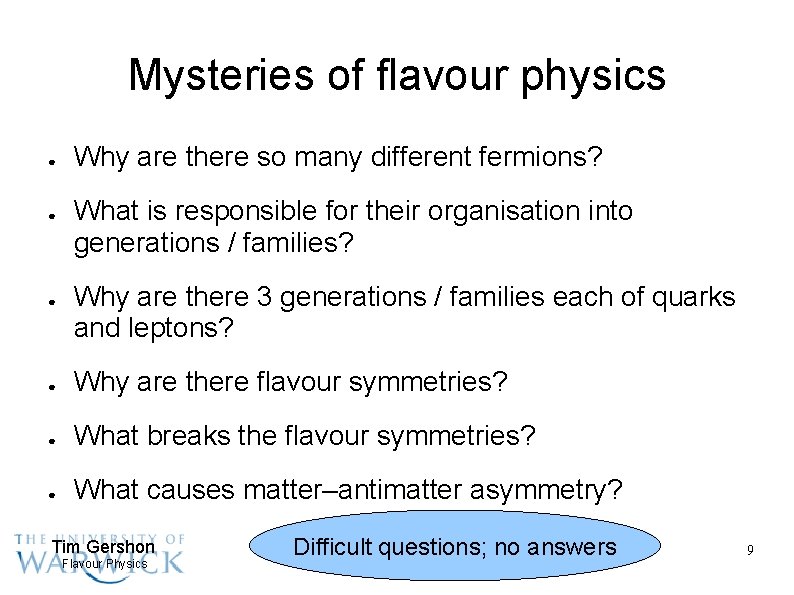
Mysteries of flavour physics ● ● ● Why are there so many different fermions? What is responsible for their organisation into generations / families? Why are there 3 generations / families each of quarks and leptons? ● Why are there flavour symmetries? ● What breaks the flavour symmetries? ● What causes matter–antimatter asymmetry? Tim Gershon Flavour Physics Difficult questions; no answers 9
Reducing the scope ● ● Flavour physics includes – Neutrinos – Charged leptons – Kaon physics – Charm & beauty physics – (Some aspects of) top physics My focus will be on charm & beauty – Tim Gershon Flavour Physics will touch on others when appropriate 10
Heavy quark flavour physics ● Focus in these lectures will be on – ● ● ● flavour-changing interactions of charm and beauty quarks But quarks feel the strong interaction and hence hadronise – various different charmed and beauty hadrons – many, many possible decays to different final states The hardest part of quark flavour physics is learning the names of all the damned hadrons! On the other hand, hadronisation greatly increases the observability of CP violation effects – the strong Tim Gershon interaction can be seen either. I. Bigi, as the “unsung hep-ph/0509153 hero” or the “villain” in the story of quark flavour physics Flavour Physics 11
Why is heavy flavour physics interesting? ● ● ● Hope to learn something about the mysteries of the flavour structure of the Standard Model CP violation and its connection to the matter– antimatter asymmetry of the Universe Discovery potential far beyond the energy frontier via searches for rare or SM forbidden processes Tim Gershon Flavour Physics 12
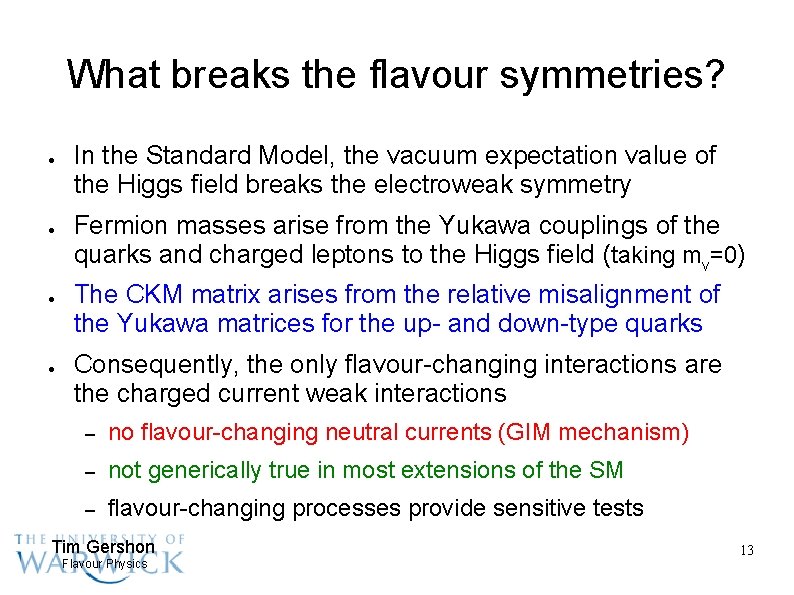
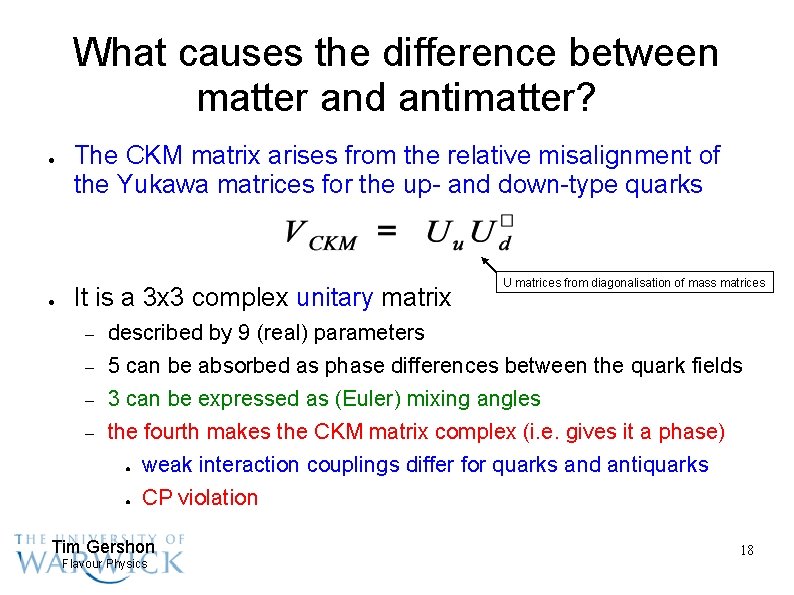
What breaks the flavour symmetries? ● ● In the Standard Model, the vacuum expectation value of the Higgs field breaks the electroweak symmetry Fermion masses arise from the Yukawa couplings of the quarks and charged leptons to the Higgs field (taking mν=0) The CKM matrix arises from the relative misalignment of the Yukawa matrices for the up- and down-type quarks Consequently, the only flavour-changing interactions are the charged current weak interactions – no flavour-changing neutral currents (GIM mechanism) – not generically true in most extensions of the SM – flavour-changing processes provide sensitive tests Tim Gershon Flavour Physics 13
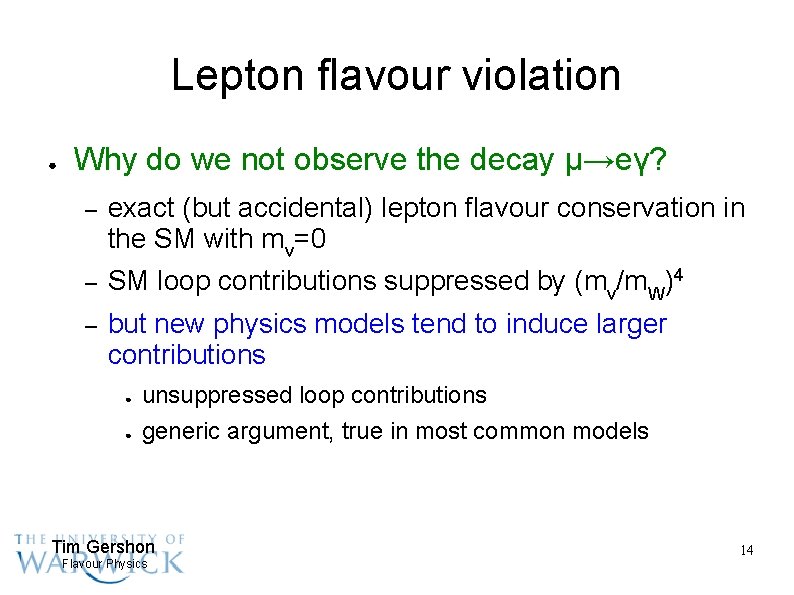
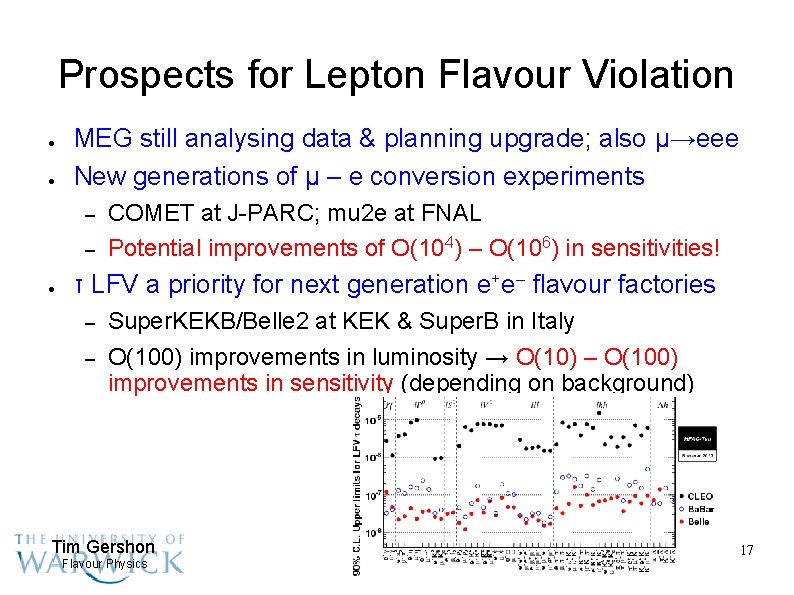
Lepton flavour violation ● Why do we not observe the decay μ→eγ? – exact (but accidental) lepton flavour conservation in the SM with mν=0 – SM loop contributions suppressed by (mν/m. W)4 – but new physics models tend to induce larger contributions ● ● unsuppressed loop contributions generic argument, true in most common models Tim Gershon Flavour Physics 14
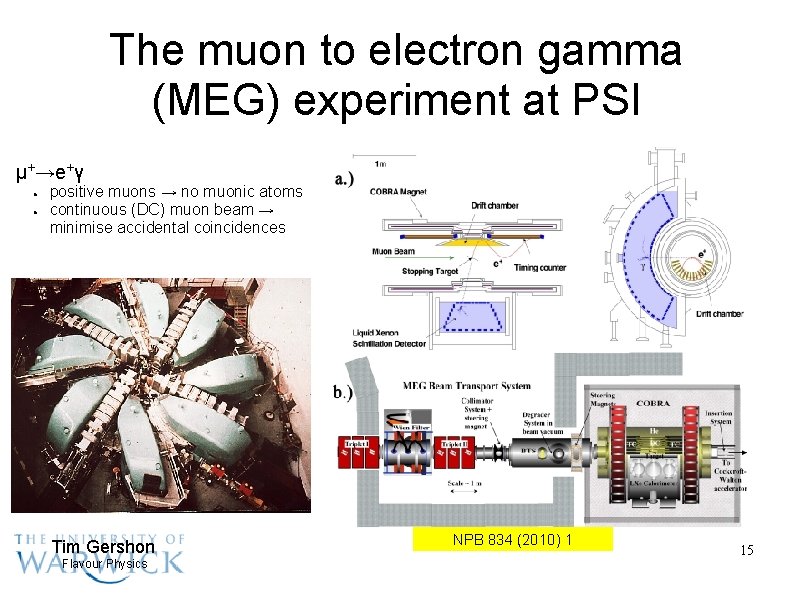
The muon to electron gamma (MEG) experiment at PSI μ+→e+γ ● ● positive muons → no muonic atoms continuous (DC) muon beam → minimise accidental coincidences Tim Gershon Flavour Physics NPB 834 (2010) 1 15
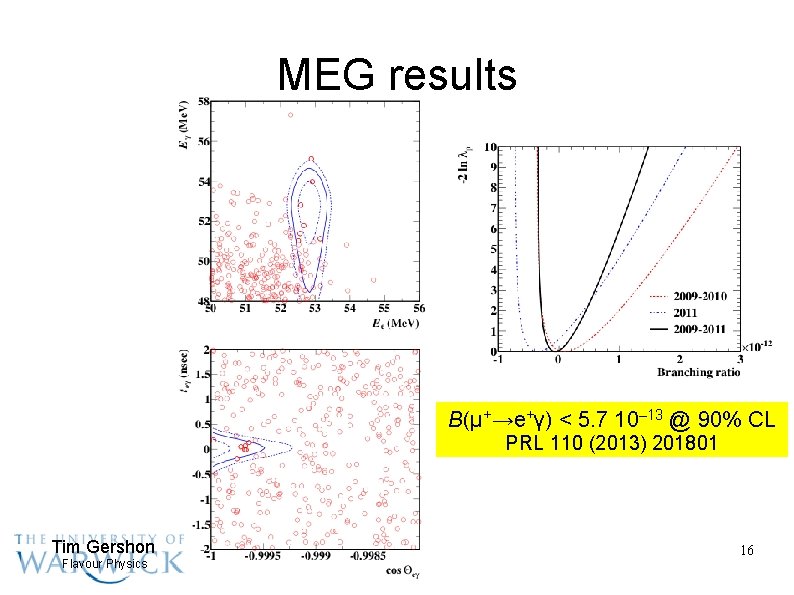
MEG results B(μ+→e+γ) < 5. 7 10– 13 @ 90% CL PRL 110 (2013) 201801 Tim Gershon Flavour Physics 16
Prospects for Lepton Flavour Violation ● ● MEG still analysing data & planning upgrade; also μ→eee New generations of μ – e conversion experiments – – ● COMET at J-PARC; mu 2 e at FNAL Potential improvements of O(104) – O(106) in sensitivities! τ LFV a priority for next generation e+e– flavour factories – – Super. KEKB/Belle 2 at KEK & Super. B in Italy O(100) improvements in luminosity → O(10) – O(100) improvements in sensitivity (depending on background) Tim Gershon Flavour Physics 17
What causes the difference between matter and antimatter? ● ● The CKM matrix arises from the relative misalignment of the Yukawa matrices for the up- and down-type quarks It is a 3 x 3 complex unitary matrix U matrices from diagonalisation of mass matrices – described by 9 (real) parameters – 5 can be absorbed as phase differences between the quark fields – 3 can be expressed as (Euler) mixing angles – the fourth makes the CKM matrix complex (i. e. gives it a phase) ● weak interaction couplings differ for quarks and antiquarks ● CP violation Tim Gershon Flavour Physics 18
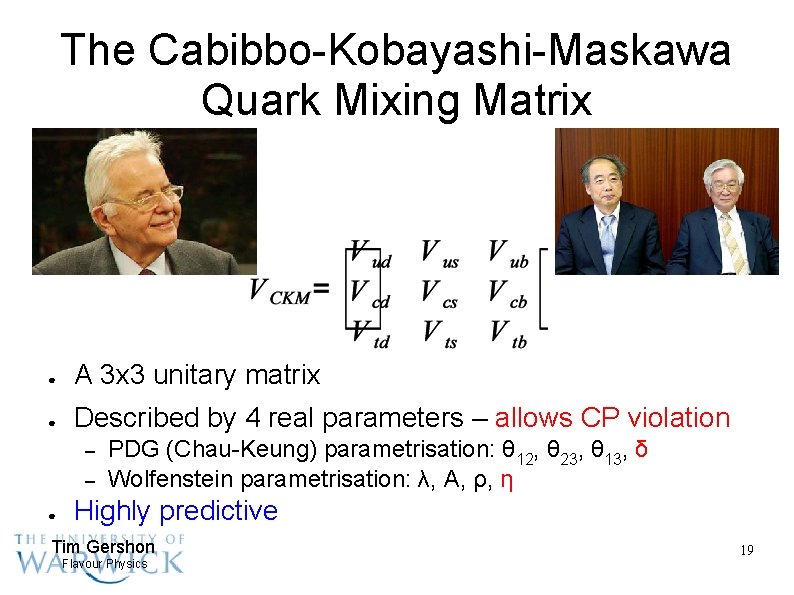
The Cabibbo-Kobayashi-Maskawa Quark Mixing Matrix ● A 3 x 3 unitary matrix ● Described by 4 real parameters – allows CP violation – – ● PDG (Chau-Keung) parametrisation: θ 12, θ 23, θ 13, δ Wolfenstein parametrisation: λ, A, ρ, η Highly predictive Tim Gershon Flavour Physics 19
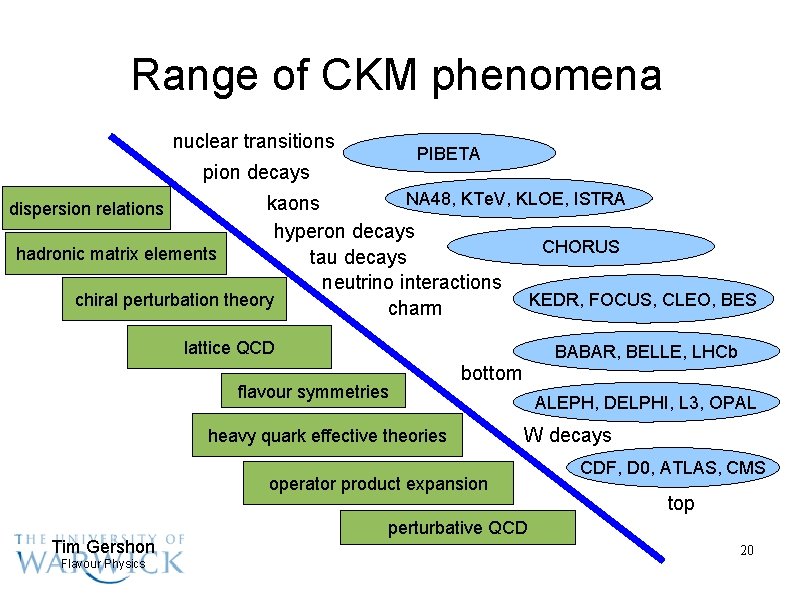
Range of CKM phenomena nuclear transitions PIBETA pion decays NA 48, KTe. V, KLOE, ISTRA kaons hyperon decays CHORUS hadronic matrix elements tau decays neutrino interactions chiral perturbation theory KEDR, FOCUS, CLEO, BES charm dispersion relations lattice QCD flavour symmetries BABAR, BELLE, LHCb bottom heavy quark effective theories ALEPH, DELPHI, L 3, OPAL W decays operator product expansion Tim Gershon Flavour Physics CDF, D 0, ATLAS, CMS top perturbative QCD 20
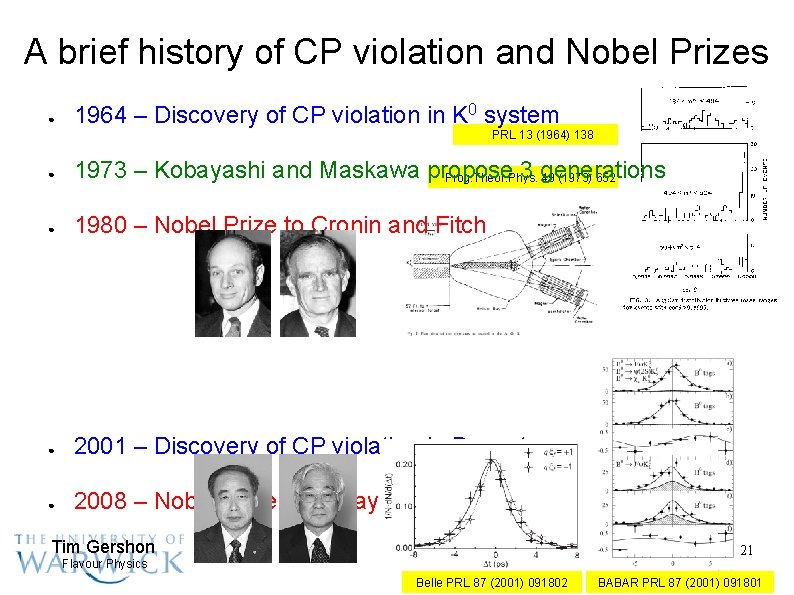
A brief history of CP violation and Nobel Prizes ● 1964 – Discovery of CP violation in K 0 system PRL 13 (1964) 138 ● 1973 – Kobayashi and Maskawa propose 3 generations Prog. Theor. Phys. 49 (1973) 652 ● 1980 – Nobel Prize to Cronin and Fitch ● 2001 – Discovery of CP violation in Bd system ● 2008 – Nobel Prize to Kobayashi and Maskawa Tim Gershon 21 Flavour Physics Belle PRL 87 (2001) 091802 BABAR PRL 87 (2001) 091801
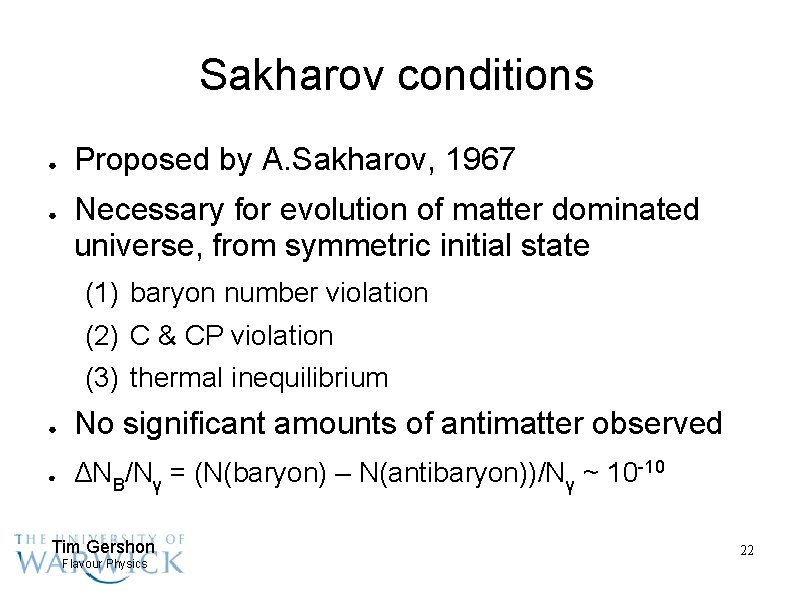
Sakharov conditions ● ● Proposed by A. Sakharov, 1967 Necessary for evolution of matter dominated universe, from symmetric initial state (1) baryon number violation (2) C & CP violation (3) thermal inequilibrium ● No significant amounts of antimatter observed ● ΔNB/Nγ = (N(baryon) – N(antibaryon))/Nγ ~ 10 -10 Tim Gershon Flavour Physics 22
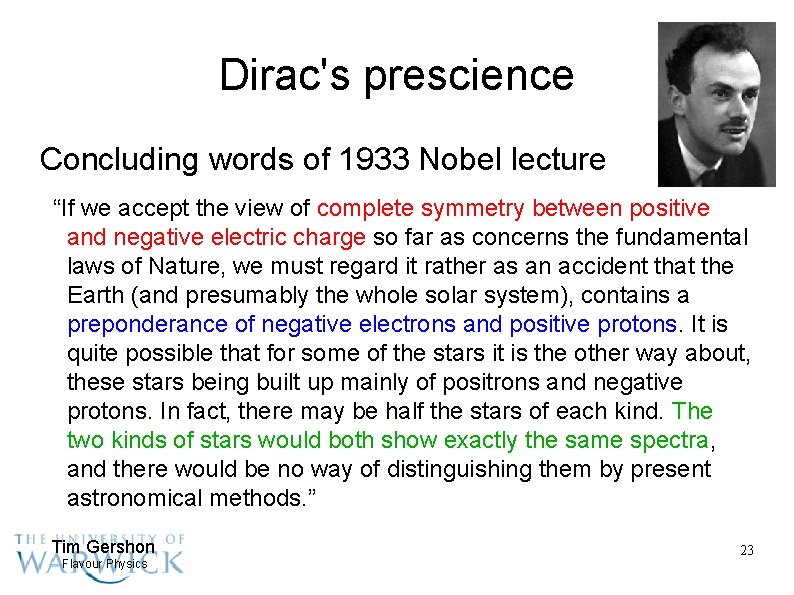
Dirac's prescience Concluding words of 1933 Nobel lecture “If we accept the view of complete symmetry between positive and negative electric charge so far as concerns the fundamental laws of Nature, we must regard it rather as an accident that the Earth (and presumably the whole solar system), contains a preponderance of negative electrons and positive protons. It is quite possible that for some of the stars it is the other way about, these stars being built up mainly of positrons and negative protons. In fact, there may be half the stars of each kind. The two kinds of stars would both show exactly the same spectra, and there would be no way of distinguishing them by present astronomical methods. ” Tim Gershon Flavour Physics 23
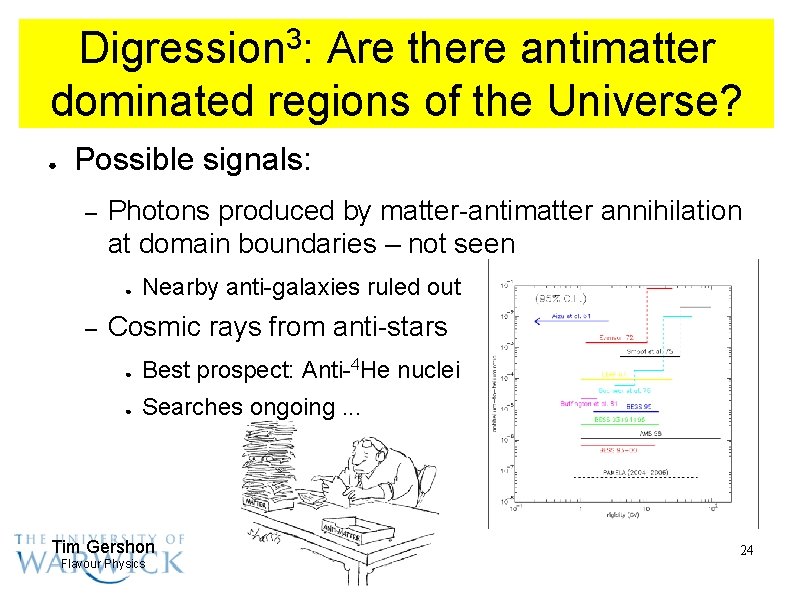
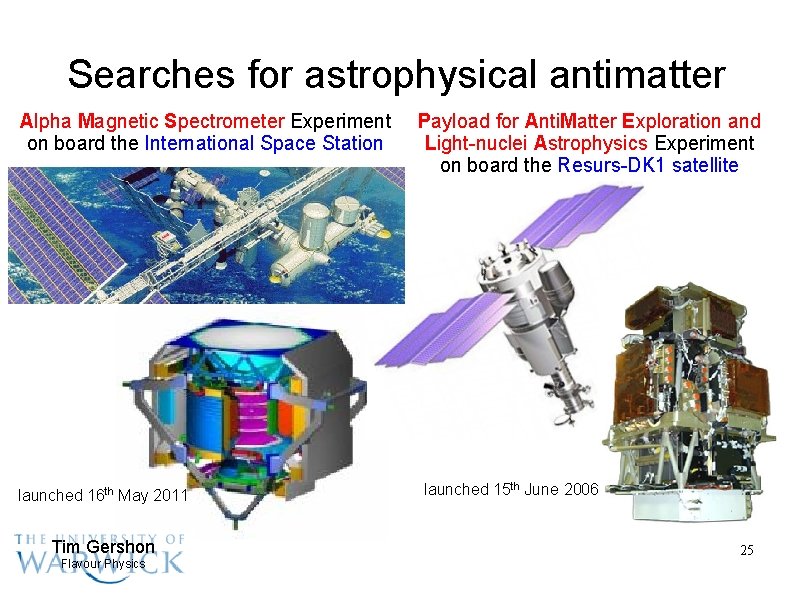
Digression 3: Are there antimatter dominated regions of the Universe? ● Possible signals: – Photons produced by matter-antimatter annihilation at domain boundaries – not seen ● – Nearby anti-galaxies ruled out Cosmic rays from anti-stars ● Best prospect: Anti-4 He nuclei ● Searches ongoing. . . Tim Gershon Flavour Physics 24
Searches for astrophysical antimatter Alpha Magnetic Spectrometer Experiment on board the International Space Station launched 16 th May 2011 Tim Gershon Flavour Physics Payload for Anti. Matter Exploration and Light-nuclei Astrophysics Experiment on board the Resurs-DK 1 satellite launched 15 th June 2006 25
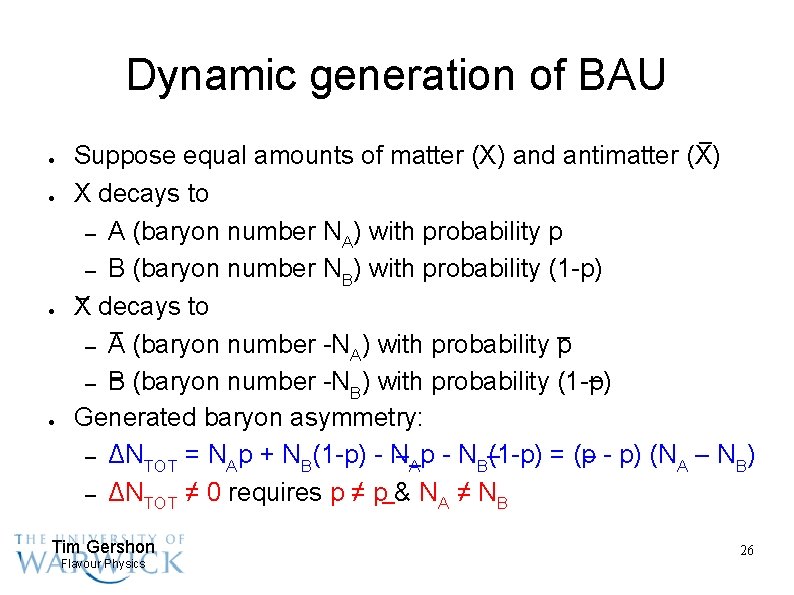
Dynamic generation of BAU ● ● – Suppose equal amounts of matter (X) and antimatter (X) X decays to – A (baryon number NA) with probability p – B (baryon number NB) with probability (1 -p) – decays to X – – – A (baryon number -NA) with probability p – (baryon number -N ) with probability (1 -p) – – B B Generated baryon asymmetry: – - p) (NA – NB) – ΔNTOT = NAp + NB(1 -p) - N –Ap - NB–(1 -p) = (p – ΔNTOT ≠ 0 requires p ≠ p–& NA ≠ NB Tim Gershon Flavour Physics 26
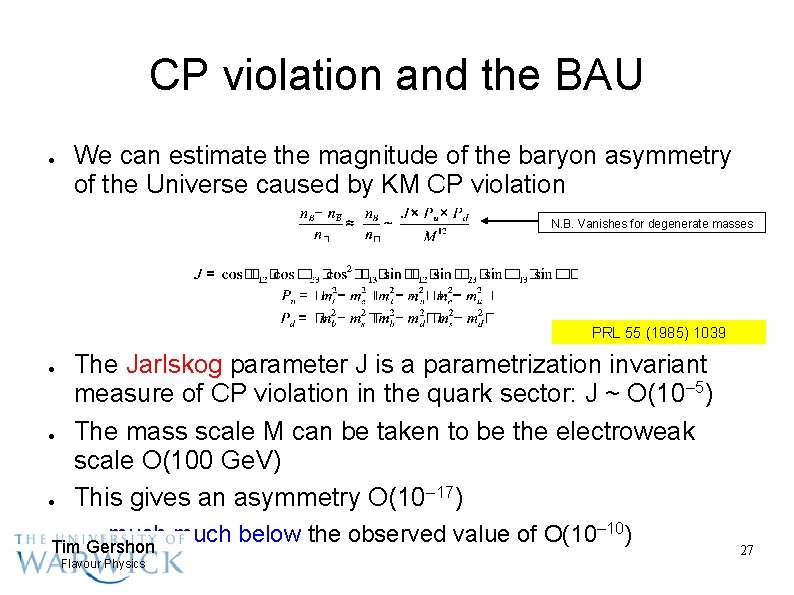
CP violation and the BAU ● We can estimate the magnitude of the baryon asymmetry of the Universe caused by KM CP violation N. B. Vanishes for degenerate masses PRL 55 (1985) 1039 ● ● ● The Jarlskog parameter J is a parametrization invariant measure of CP violation in the quark sector: J ~ O(10– 5) The mass scale M can be taken to be the electroweak scale O(100 Ge. V) This gives an asymmetry O(10– 17) – much Tim Gershon Flavour Physics much below the observed value of O(10– 10) 27
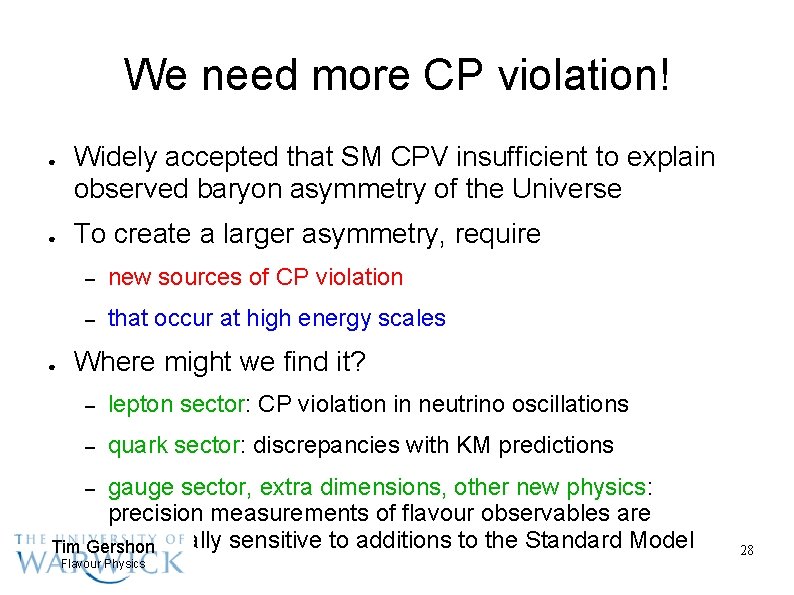
We need more CP violation! ● ● ● Widely accepted that SM CPV insufficient to explain observed baryon asymmetry of the Universe To create a larger asymmetry, require – new sources of CP violation – that occur at high energy scales Where might we find it? – lepton sector: CP violation in neutrino oscillations – quark sector: discrepancies with KM predictions gauge sector, extra dimensions, other new physics: precision measurements of flavour observables are generically sensitive to additions to the Standard Model Tim Gershon – Flavour Physics 28
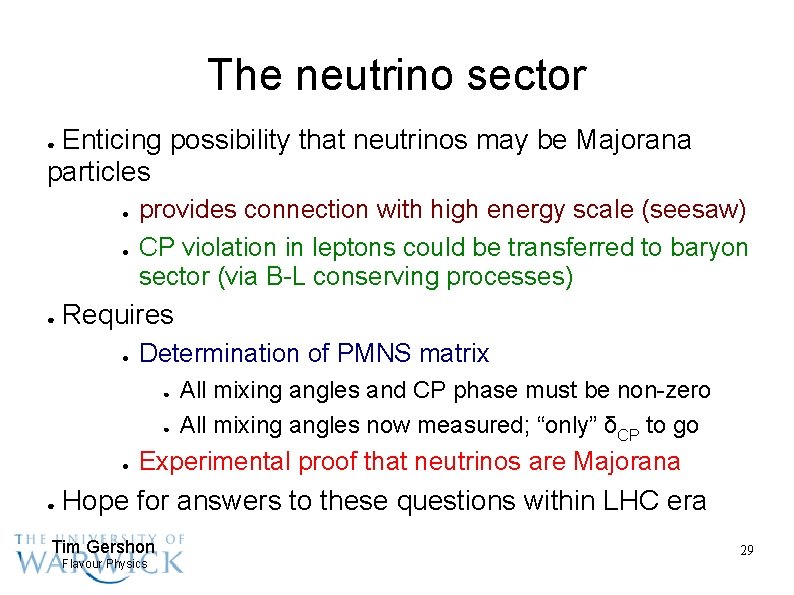
The neutrino sector Enticing possibility that neutrinos may be Majorana particles ● ● provides connection with high energy scale (seesaw) CP violation in leptons could be transferred to baryon sector (via B-L conserving processes) Requires ● Determination of PMNS matrix ● ● All mixing angles and CP phase must be non-zero All mixing angles now measured; “only” δCP to go Experimental proof that neutrinos are Majorana Hope for answers to these questions within LHC era Tim Gershon Flavour Physics 29
Flavour for new physics discoveries Tim Gershon Flavour Physics 30
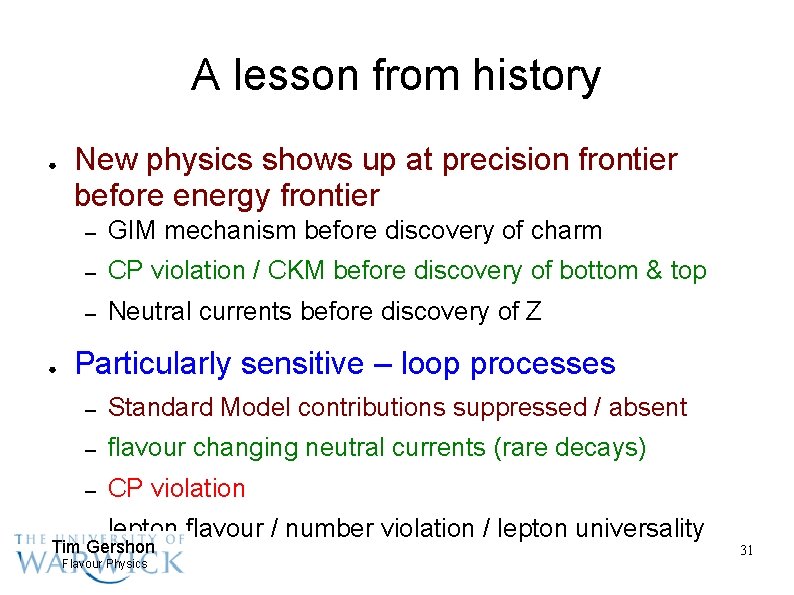
A lesson from history ● ● New physics shows up at precision frontier before energy frontier – GIM mechanism before discovery of charm – CP violation / CKM before discovery of bottom & top – Neutral currents before discovery of Z Particularly sensitive – loop processes – Standard Model contributions suppressed / absent – flavour changing neutral currents (rare decays) – CP violation – lepton flavour / number violation / lepton universality Tim Gershon Flavour Physics 31
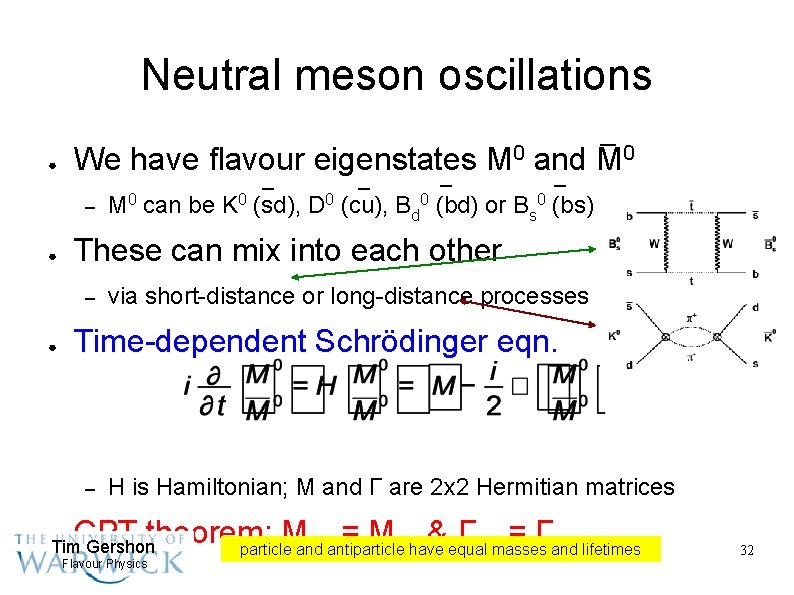
Neutral meson oscillations ● We have flavour eigenstates – ● – 0 – and M 0 – M can be K (sd), D (cu), Bd (bd) or Bs (bs) via short-distance or long-distance processes Time-dependent Schrödinger eqn. – ● 0 – 0 These can mix into each other – ● 0 M 0 H is Hamiltonian; M and Γ are 2 x 2 Hermitian matrices CPT theorem: M 11 antiparticle = M 22 have &equal Γ 11 masses = Γand 22 lifetimes particle and Tim Gershon Flavour Physics 32
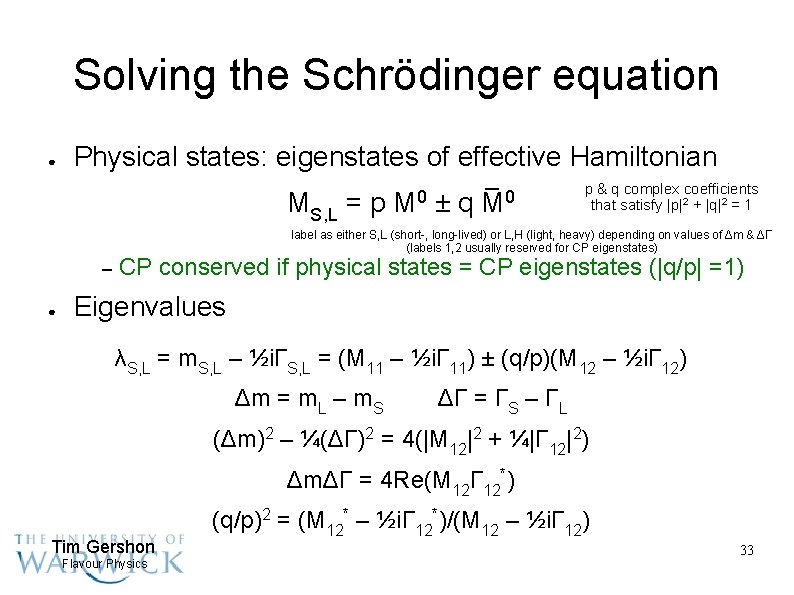
Solving the Schrödinger equation ● Physical states: eigenstates of effective Hamiltonian 0 – 0 MS, L = p M ± q M p & q complex coefficients that satisfy |p|2 + |q|2 = 1 label as either S, L (short-, long-lived) or L, H (light, heavy) depending on values of Δm & ΔΓ (labels 1, 2 usually reserved for CP eigenstates) – ● CP conserved if physical states = CP eigenstates (|q/p| =1) Eigenvalues λS, L = m. S, L – ½iΓS, L = (M 11 – ½iΓ 11) ± (q/p)(M 12 – ½iΓ 12) Δm = m. L – m. S ΔΓ = ΓS – ΓL (Δm)2 – ¼(ΔΓ)2 = 4(|M 12|2 + ¼|Γ 12|2) ΔmΔΓ = 4 Re(M 12Γ 12*) Tim Gershon Flavour Physics (q/p)2 = (M 12* – ½iΓ 12*)/(M 12 – ½iΓ 12) 33
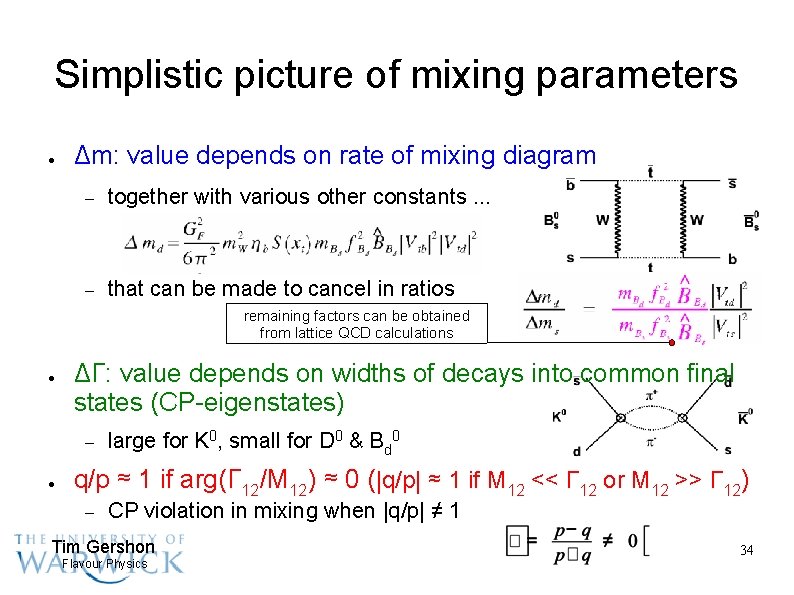
Simplistic picture of mixing parameters ● Δm: value depends on rate of mixing diagram – together with various other constants. . . – that can be made to cancel in ratios remaining factors can be obtained from lattice QCD calculations ● ΔΓ: value depends on widths of decays into common final states (CP-eigenstates) – ● large for K 0, small for D 0 & Bd 0 q/p ≈ 1 if arg(Γ 12/M 12) ≈ 0 (|q/p| ≈ 1 if M 12 << Γ 12 or M 12 >> Γ 12) – CP violation in mixing when |q/p| ≠ 1 Tim Gershon Flavour Physics 34
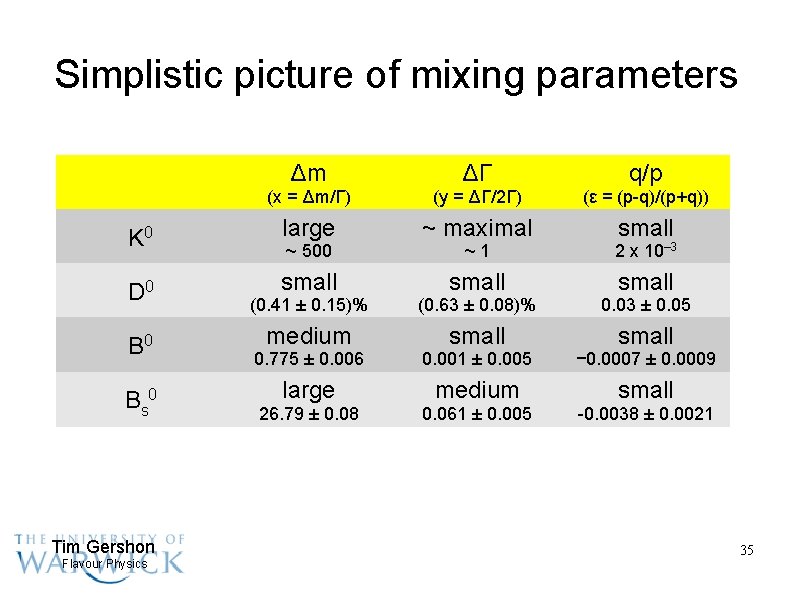
Simplistic picture of mixing parameters Δm ΔΓ q/p (x = Δm/Γ) (y = ΔΓ/2Γ) (ε = (p-q)/(p+q)) K 0 large ~ maximal small ~ 500 ~1 2 x 10– 3 D 0 small (0. 41 ± 0. 15)% (0. 63 ± 0. 08)% 0. 03 ± 0. 05 medium small 0. 775 ± 0. 006 0. 001 ± 0. 005 − 0. 0007 ± 0. 0009 large medium small 26. 79 ± 0. 08 0. 061 ± 0. 005 -0. 0038 ± 0. 0021 B 0 Bs 0 Tim Gershon Flavour Physics 35
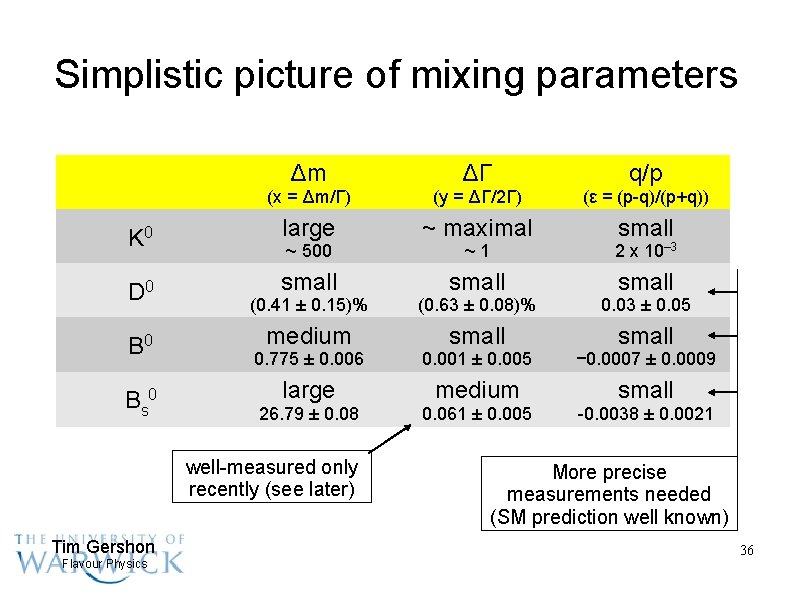
Simplistic picture of mixing parameters Δm ΔΓ q/p (x = Δm/Γ) (y = ΔΓ/2Γ) (ε = (p-q)/(p+q)) K 0 large ~ maximal small ~ 500 ~1 2 x 10– 3 D 0 small (0. 41 ± 0. 15)% (0. 63 ± 0. 08)% 0. 03 ± 0. 05 medium small 0. 775 ± 0. 006 0. 001 ± 0. 005 − 0. 0007 ± 0. 0009 large medium small 26. 79 ± 0. 08 0. 061 ± 0. 005 -0. 0038 ± 0. 0021 B 0 Bs 0 well-measured only recently (see later) Tim Gershon Flavour Physics More precise measurements needed (SM prediction well known) 36
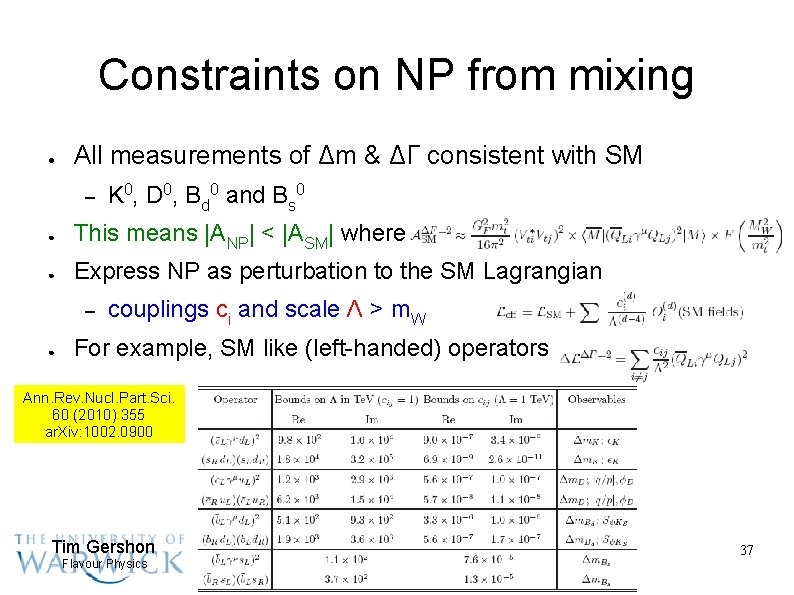
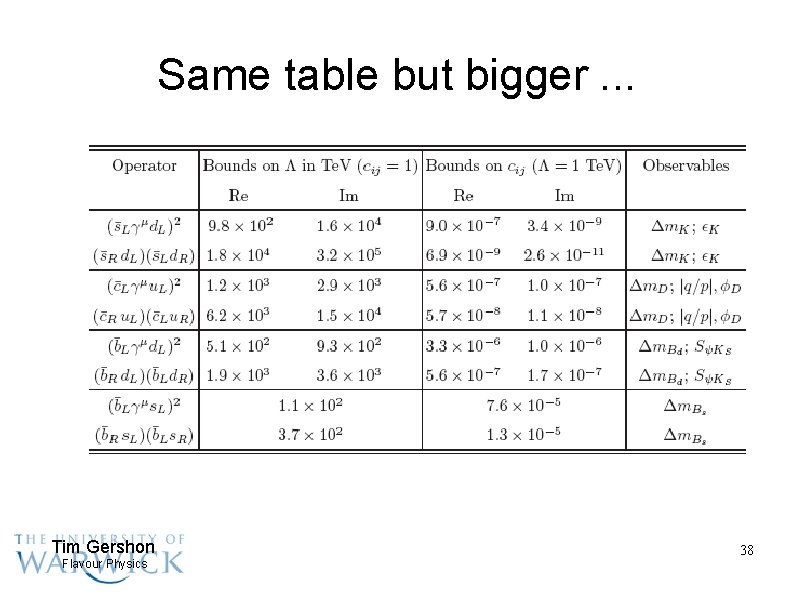
Constraints on NP from mixing ● All measurements of Δm & ΔΓ consistent with SM – K 0, D 0, Bd 0 and Bs 0 ● This means |ANP| < |ASM| where ● Express NP as perturbation to the SM Lagrangian – ● couplings ci and scale Λ > m. W For example, SM like (left-handed) operators Ann. Rev. Nucl. Part. Sci. 60 (2010) 355 ar. Xiv: 1002. 0900 Tim Gershon Flavour Physics 37
Same table but bigger. . . Tim Gershon Flavour Physics 38
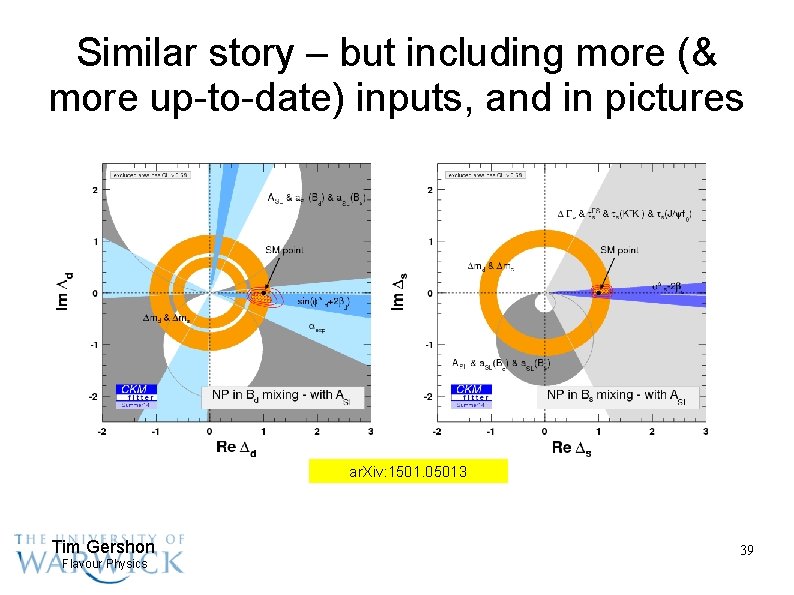
Similar story – but including more (& more up-to-date) inputs, and in pictures ar. Xiv: 1501. 05013 Tim Gershon Flavour Physics 39
New Physics Flavour Problem ● Limits on NP scale at least 100 Te. V for generic couplings – ● model-independent argument, also for rare decays But we need NP at the ~Te. V scale to solve the hierarchy problem (and to provide DM candidate, etc. ) ● So we need NP flavour-changing couplings to be small ● Why? – minimal flavour violation? ● ● NPB 645 (2002) 155 perfect alignment of flavour violation in NP and SM – some other approximate symmetry? – flavour structure tells us about physics at very high scales There are still important observables that are not yet well-tested 40 Tim Gershon Flavour Physics
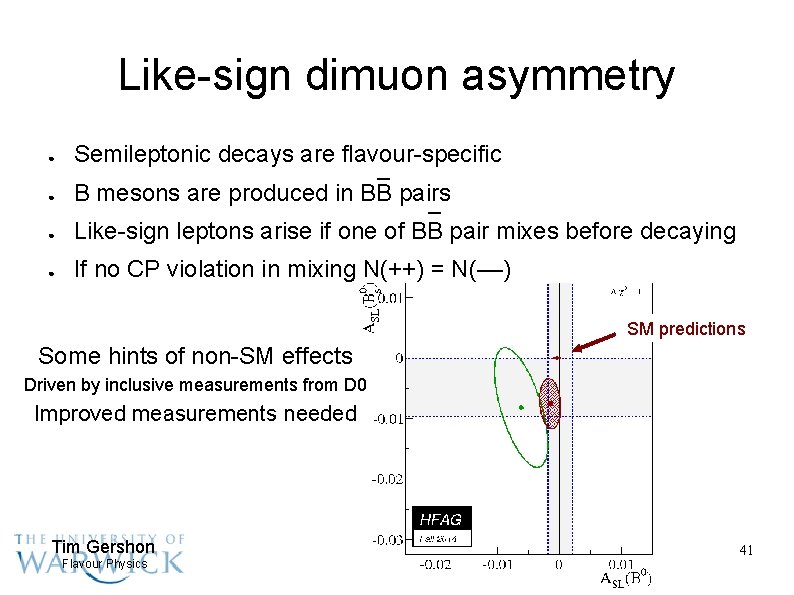
Like-sign dimuon asymmetry ● Semileptonic decays are flavour-specific – B mesons are produced in BB pairs – Like-sign leptons arise if one of BB pair mixes before decaying ● If no CP violation in mixing N(++) = N(––) ● ● SM predictions Some hints of non-SM effects Driven by inclusive measurements from D 0 Improved measurements needed Tim Gershon Flavour Physics 41