
Heatstroke Aware Recognize and Act Robert Lugo DO
Heatstroke: Aware, Recognize, and Act Robert Lugo, DO, MBS Physical Medicine & Rehabilitation Baylor College of Medicine

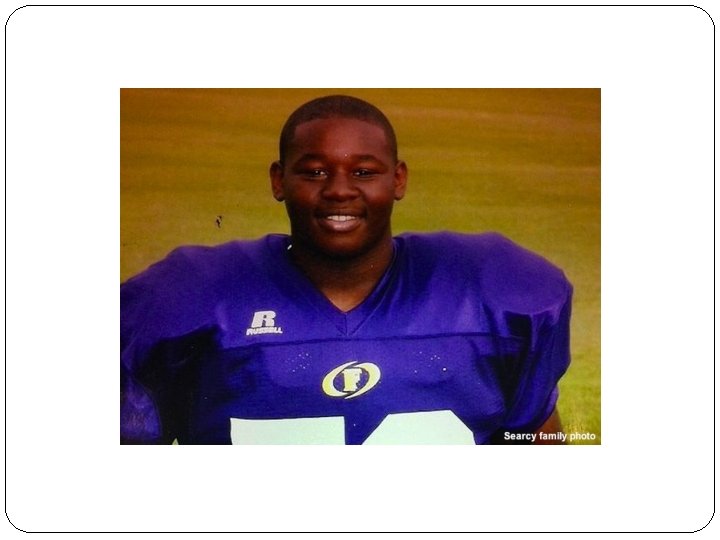
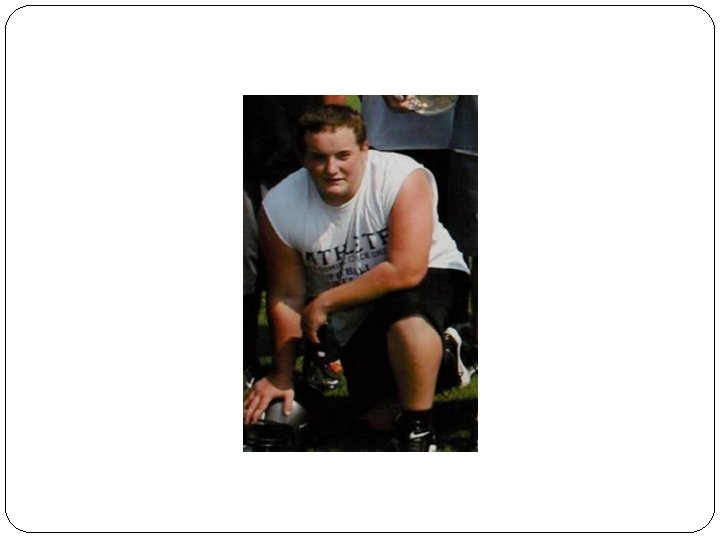
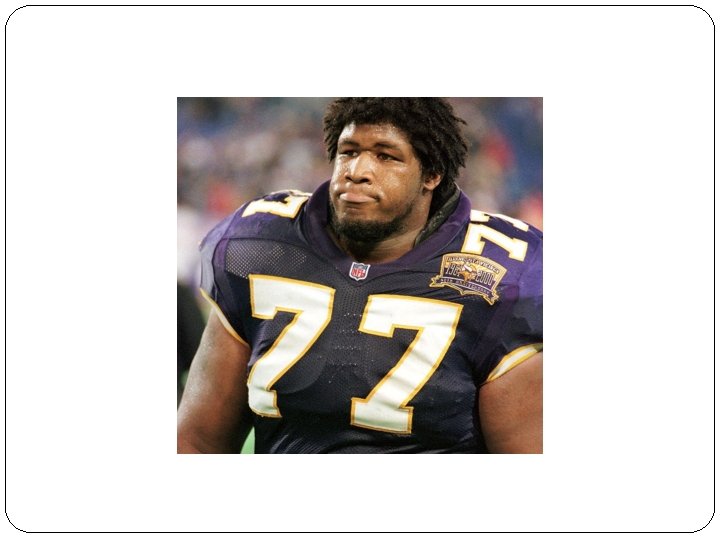
Epidemiology � 2005 -2009 saw more exertional heat stroke (EHS) -related deaths in organized sports than any other 5 -year period in the past 35 years. �The risk of EHS appears highest in football, particularly during preseason � 3 rd major cause of death in high school athletes �Its entirely preventable!
Epidemiology �The highest rate of non-fatal heat illness in the US high school athletes is found among American football players �High school football is the leading activity associated with an ED evaluation for heat illness in US patients ≤ 19 years old �Approximately two-thirds of these episodes occur in August (preseason) �Heat illness in athletes is preventable
Heat Stroke: 2 types �Classic (non-exertional) Heat Stroke: �Arises from environmental exposure to heat �More common in younger children who are unable to escape from hot environments and those with chronic medical conditions that impair thermoregulation �Exertional Heat Stroke (EHS): �Generally occurs in young, otherwise healthy individuals who engage in heavy exercise during periods of high ambient temp and humidity �Typically seen in athletes and military recruits in basic training
Exercise In The Heat � Prevention, recognition, and management of heat- associated illness. � Humans can only survive core temps > 106 o. F for short periods of time � Protein denatures at a body temp of 113 o. F � Sweat - one of the greatest capacities to lose heat during exercise and safely regulate body temp even during exercise of long duration � Occasionally, heatstroke occurs in athletes that are not exercising in hot environments. This suggests that individual susceptibility, rather than the environmental conditions, play a much more important role in the development of this condition than has previously been acknowledged.
EHS Risk Factors • Environmental conditions • Lack of acclimatization • Earlier initiation of sweating mechanism • Increased rate of sweating • Poor conditioning • Drugs • Dehydration • Vigorous physical activity • Obesity • Recent illness
Heat Gain & Heat Loss �Body temp is maintained within a narrow range by balancing heat-load with heat-dissipation �The body’s heat-load results from both metabolic processes + absorption of heat from the environment �Heat-load is produced by internal sources (muscle activity and metabolism) and external sources (transfer to the body when environmental temp exceeds body temp) �The rate of heat production and the risk of heatstroke is greatest in those who run the fastest and highest number of repetitions (i. e. in shortdistance rather than a marathon)
Heat Gain & Heat Loss � Evaporation is the principal mechanism of heat loss in a hot environment, but becomes ineffective above a relative humidity of 75% � Other major methods of heat-dissipation/loss occurs by: �Conduction (direct transfer of heat to an adjacent, cooler object) �Convection (heat from skin to environment) �Radiation (emission of IR EM energy) �But these mechanisms cannot efficiently transfer heat when environmental temp exceeds skin temp (typically 35 o. C or 95 o. C) � At rest, when environmental temp < body temp, thermal balance is maintained by convection of heat to the skin surface and then radiation of heat to the environment
Heat Gain & Heat Loss � As an individual starts to exercise and produce more heat, sweating provides compensatory heat loss through evaporation � The effectiveness of sweating to cool the body is affected by humidity �Evaporation is the principal mechanism of heat loss in a hot environment, but becomes ineffective above a relative humidity of 75% � In a dry environment, sweat is evaporated. � A humid environment, in which there is a high level of water vapor in the air, limits the evaporation of sweat and its cooling affect � Therefore, the combination of high temp and high humidity is particularly dangerous
Heat Gain & Heat Loss �Temp elevation increase in oxygen consumption & metabolic rate leading to elevated HR and breathing rate �Above 42 o. C (108 o. C), energy production at the cellular fails as a variety of enzymes cease to function. As a result, these athletes/patients are at risk for multi-organ failure. �Muscles, Kidneys, Heart, Liver, Lungs, Brain �Athletes should avoid exercising in these conditions if possible. �When the humidity is high and the temp is in excess of 91 o. F, core temp can increase substantially even in relatively short-distance
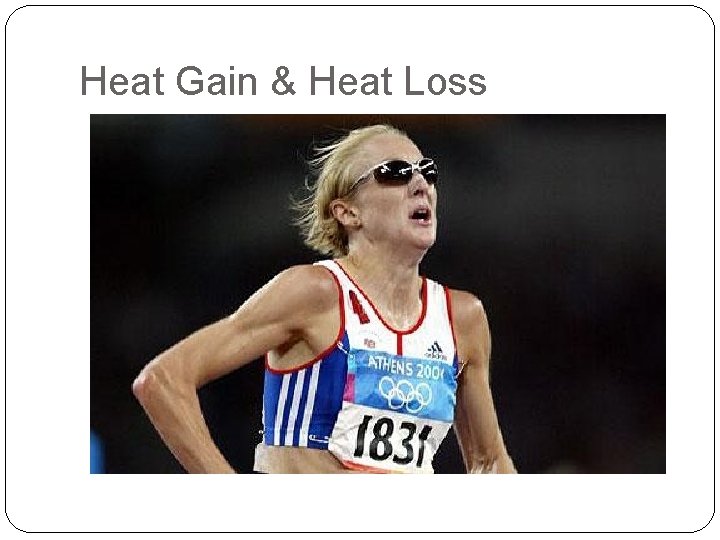
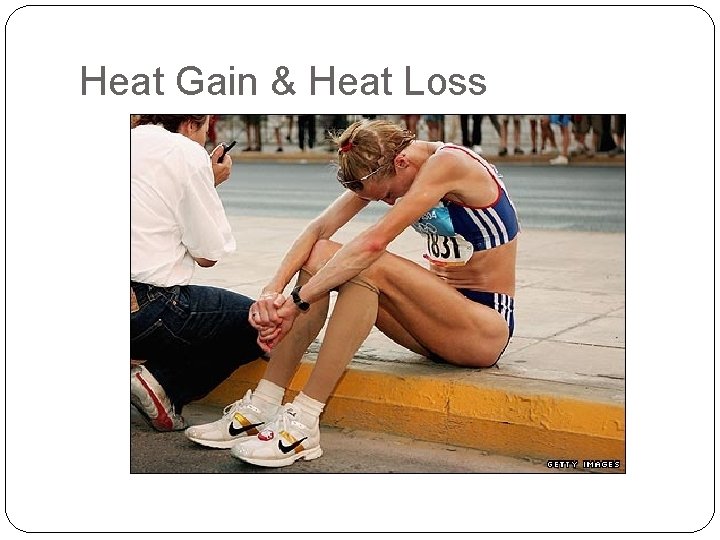
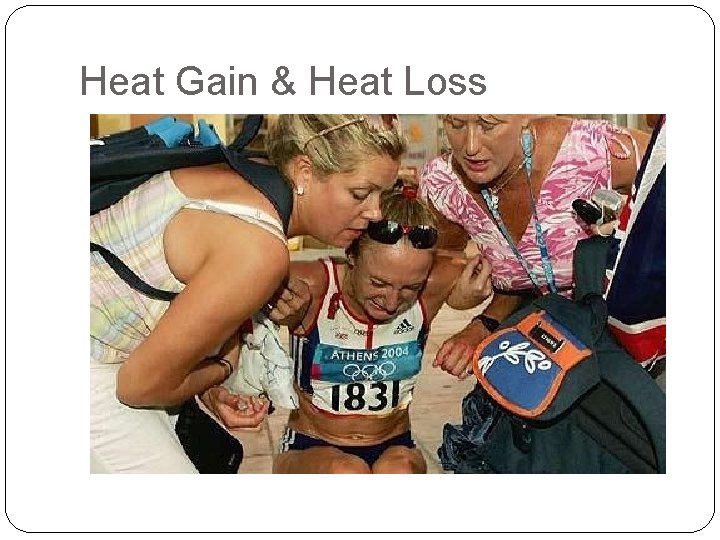
Heat Gain & Heat Loss �Heavier athletes - produce more heat and have greater difficulty losing that heat than lighter athletes when both exercise at the same velocity in humid conditions �In contrast, smaller athletes produce less heat when exercising at the same velocity as heavier athletes, which gives smaller athletes an advantage when competing in prolonged events in the heat �Example: Marathon world record holder Paula Radcliffe in the Athens 2004 Olympic Marathon
Heat Gain & Heat Loss
Heat Gain & Heat Loss
Heat Gain & Heat Loss
Heat Gain & Heat Loss �Radcliffe was unable both to run at the pace of the smaller women and maintain thermal homeostasis. �Instead her core temp continued to rise until it reached 42 o. C (107. 6 o. F), at which time she become temporarily paralyzed and unable to continue running.
Recognition �The level of “dehydration” during exercise cannot be determined accurately by clinical examination; only the measurement of the body-weight-loss provides some measure of the likely fluid loss during prolonged exercise �If the athlete is unconscious, the crucial initial measurement is the: �Rectal temp (core body temp) �Core body temp should be measured in all athletes. � Oral, axillary, or tympanic membrane temps are unreliable in treating heat illness. �Heart rate �Blood pressure
Recognition � If rectal temp is > 41 o. C (106 o. F), the diagnosis is heatstroke and the athlete must be cooled immediately and cooling continues until rectal temp stabilizes at 38 o. C (100 o. F) or lower. � According to Up. To. Date, the diagnostic criteria for Heatstroke are elevated core body temp (≥ 40 o. C or ≥ 104 o. F) and CNS abnormalities following environmental heat exposure. � CNS symptoms may be subtle or deceptive, such as: � Impaired judgment or inappropriate behavior � Children commonly present with more significant symptoms such as: Seizures Delirium Hallucinations Ataxia (loss of balance) Dysarthria (difficulty speaking) Coma � skin may be flushed and warm or diaphoretic (sweaty) � vomiting and diarrhea are also common � � �
Recognition � Heatstroke = rectal temp > 41 o. C (106 o. F) + AMS + exercising � When running, the metabolic rate is a function of running speed and body mass; �thus, the highest rectal temps are usually seen in the fastest runners competing. � High rectal temps are usually associated with symptoms such as: �Dizziness �Weakness �Nausea �Headache �Confusion �Disorientation �Irrational behavior (aggressive combativeness or drowsiness progressing to coma) � Examination reveals low BP and elevated HR
Recognition �The presence or absence of sweating doe NOT influence the diagnosis of heatstroke �If, during exercise, a previously healthy athlete shows marked changes in mental functioning, in association with rectal temp > 106 o. F, the diagnosis of heatstroke is confirmed and warrants immediate initiation of cooling.
Prehospital Care �In general, athletes who have a loss of consciousness with exertion in warm weather should be treated as if they have heatstroke. �However, the diagnosis of heat-related illness can be challenging in the prehospital environment. �Core temp measurement is generally not performed, and some cooling may or may not have occurred prior to the arrival of prehospital personal
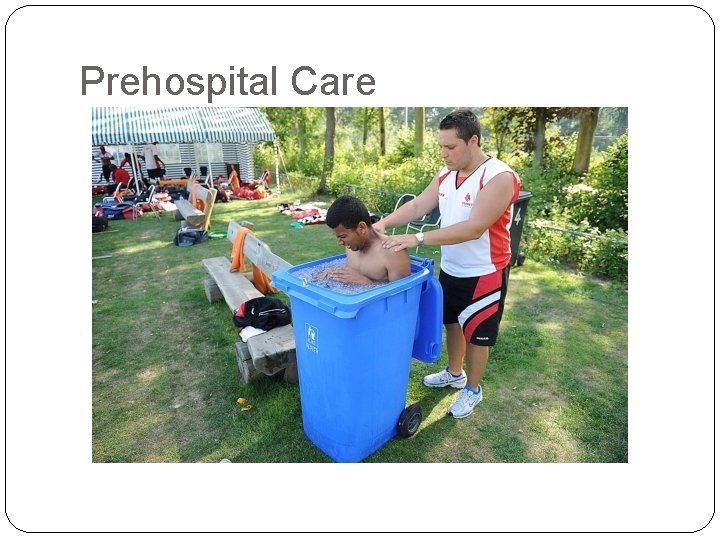
Prehospital Care � There are no studies that address the best method of prehospital cooling in the pediatric population. The following guidance for prehospital treatment is based on small trials and observational series performed in adult populations: �Athletes with severe heat-related illness require removal from the source of heat stress & rapid cooling, as the risk of death for athletes with heat-related illness is associated with the duration of elevated core body temp �Ice water immersion �Evaporative external cooling � May be accomplished in the field by spraying athletes with water and fanning, either manually or with power fans � Application of ice packs to the neck, axilla, and groin may compliment evaporative cooling efforts.
Prehospital Care
Management of EHS � The more rapidly the rectal temp is reduced to 38 o. C (100 o. F) the better the prognosis � The athlete should be placed in a bath of ice water for 5 -10 minutes �The body should temp should be decreased to 38 o. C (100 o. F) within this time. �Care must be taken to avoid inducing hypothermia as rectal temp lags behind the core temp � Shivering indicates that core temp has deceased to 37 o. C (99 o. C) or below. � Mortality from heatstroke should be zero in healthy athletes who are cooled promptly � It is usual for athletes to be fully recovered and ambulatory within 30 -60 minutes of collapse, provided they are correctly and expeditiously treated �Any delay in initiating cooling can convert an uncomplicated case of heatstroke into a potentially fatal condition

Summary � Awareness � Recognize � Act promptly
References � Brukner & Khan’s Clinical Sports Medicine, 4 th Ed. � Heat stroke in children, Up. To. Date. com � Kerr et al. Exertional heat stroke management strategies in the United States high school football. American Journal of Sports Medicine. Jan 2014, Vol. 42, No. 1 � Adams et al. The secondary school football coach’s relationship with the athletic trainer and perspective on exertional heat stroke. Journal of Athletic Training. 2014; 49(4): 469 -447. � Allen et al. Out of the frying pan, into the fire: a case of heat shock and its fatal complications. Pediatric Emergency Care. December 2014, Vol. 30, No. 12.
- Slides: 29