
Heating the Atmosphere Weather vs Climate Both deal
Heating the Atmosphere
Weather vs. Climate • Both deal with atmospheric phenomena • Weather denotes the state of the atmosphere over short time scales - hours or days • Climate denotes these phenomena over long time scales many years or centuries • Seasons denote an intermediate time scale of months.
What Do We Measure? • “ELEMENTS” of weather are different from “elements” of the Periodic Table: • • • Air Temperature (measured in the shade) Humidity Type/Amount of Cloudiness Type/Amount of Precipitation Air Pressure Wind Speed and Direction.
Atmospheric Pressure “The Weight of the Overlying Molecules” • Measured with a Barometer • “baro-” = pressure, “-meter” = measuring device • Pressure of One Atmosphere = 1 bar • Variations in pressure at the surface of the Earth are measured in thousandths of a bar = millibars • Avg pressure @ sea level = 1. 013 bars = 1013 mb • Variations result from: • Changes in altitude • Changes in the direction of net movement of air.
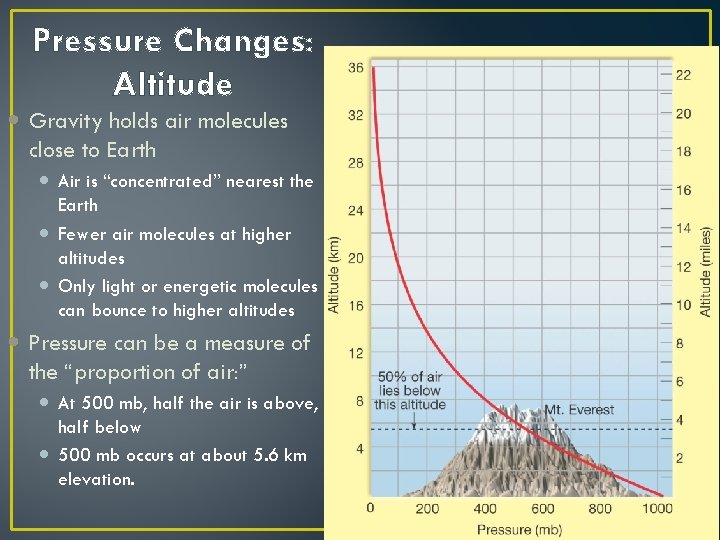
Pressure Changes: Altitude Gravity holds air molecules close to Earth Air is “concentrated” nearest the Earth Fewer air molecules at higher altitudes Only light or energetic molecules can bounce to higher altitudes Pressure can be a measure of the “proportion of air: ” At 500 mb, half the air is above, half below 500 mb occurs at about 5. 6 km elevation.
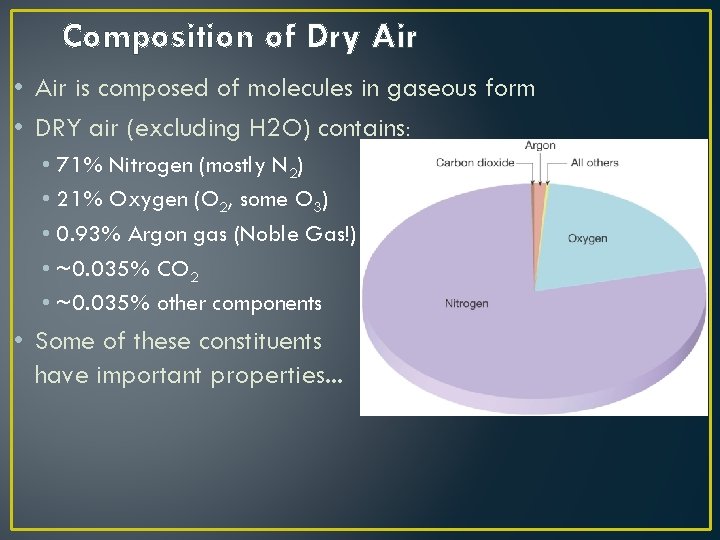
Composition of Dry Air • Air is composed of molecules in gaseous form • DRY air (excluding H 2 O) contains: • 71% Nitrogen (mostly N 2) • 21% Oxygen (O 2, some O 3) • 0. 93% Argon gas (Noble Gas!) • ~0. 035% CO 2 • ~0. 035% other components • Some of these constituents have important properties. . .
Variable Components: DUST • Dust is made of (for example): • Silicate materials • Salt crystals • Dust plays some very important roles: • Reflects sunlight back into space • There was a ½° DROP in average global temperature after the eruption of Mt. Pinatubo in 1992! • Absorbs sunlight • Helps to warm the atmosphere • Important nucleus for condensation • Every raindrop initially forms around a particle.
Variable Components: Ozone • Ozone (O 3) can act as a POLLUTANT. . . • Smell of “burnt air” after a lightning strike • Not good for us to breathe • . . . but also acts as a PROTECTANT • Ozone is a strong absorber of ultraviolet (UV) radiation that can kill living organisms • More on this later. . .
The Ozone Hole Problem • The “ozone hole” is a well-defined, large-scale destruction of the ozone layer over Antarctica that occurs each Antarctic spring. • The word "hole" is a misnomer; the hole is really a significant reduction in ozone concentrations which results in the destruction of up to 70% of the ozone normally found over Antarctica • Ozone is very reactive, easily losing its third oxygen atom in the presence of other highly reactive compounds called radicals, which contain chlorine, hydrogen, nitrogen, or bromine. Minute quantities of these radicals can cause large decreases in ozone because they are not consumed in the reaction. This is called a catalytic cycle.
Ozone Hole and CFCs • Humans have introduced Chlorofluorocarbons (CFCs) that interact with ozone • CFCs are INERT at the Earth’s surface • Make great aerosol propellants • Drift up into the stratosphere • CFCs are broken down by UV rays (like ozone) • Products re-unite with that free oxygen atom. . . • . . . so Ozone cannot reform • CFCs continue to deplete the supply of ozone. . .
Ozone Hole is Seasonal • In Antarctica, it grows in the Spring (October) and shrinks in the Fall (March).
Variable Components: CO 2 + H 2 O Gases are TRANSPARENT to Visible Light They allow sunlight to pass through the atmosphere How do we know this? Hmm. . . CO 2 & H 2 O ABSORB IR Radiation from Earth They help keep atmosphere warm Any increase in their abundance means warmer temperatures These are two important Greenhouse Gases.
Temperature A Specific Definition • Temperature is often a relative measure: • “This porridge is too hot!” • “This porridge is too cold!” • “Temperature is a measure of the average kinetic energy (thermal energy of motion) of the particles of a substance. ” • We will use a more objective measure: • Thermometer measures T in C • Freezing pt of Water = 32 F = 0 C • Boiling pt of water = 212 F = 100 C
Heating = Transfer of Thermal Energy • Some Physics: • Hot objects have molecules with lots of thermal energy • They try to give that energy to objects that are “less fortunate” (cold objects) – or to empty space • Hot objects heat cool objects • We don’t say that a cold object is cooling a hot object • “Hot coffee warms the ice” in your Iced Mocha
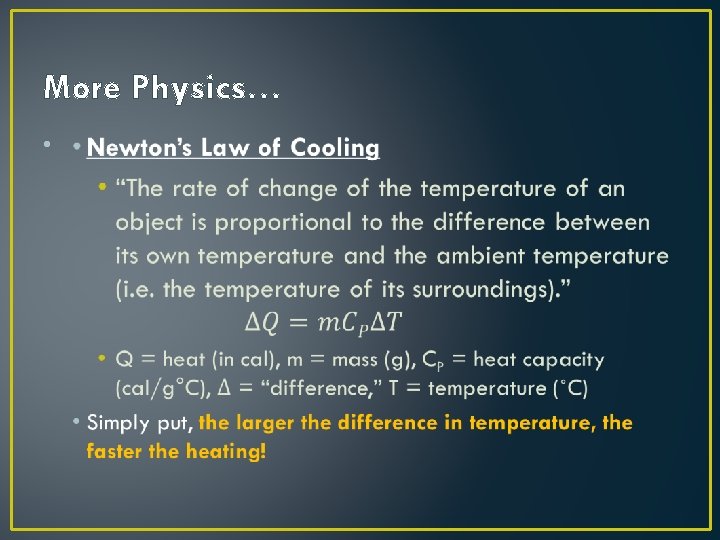
More Physics… •
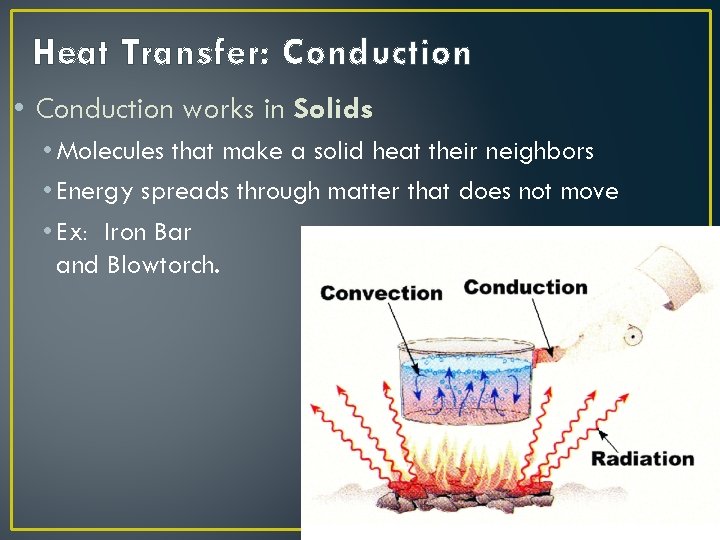
Heat Transfer: Conduction • Conduction works in Solids • Molecules that make a solid heat their neighbors • Energy spreads through matter that does not move • Ex: Iron Bar and Blowtorch.
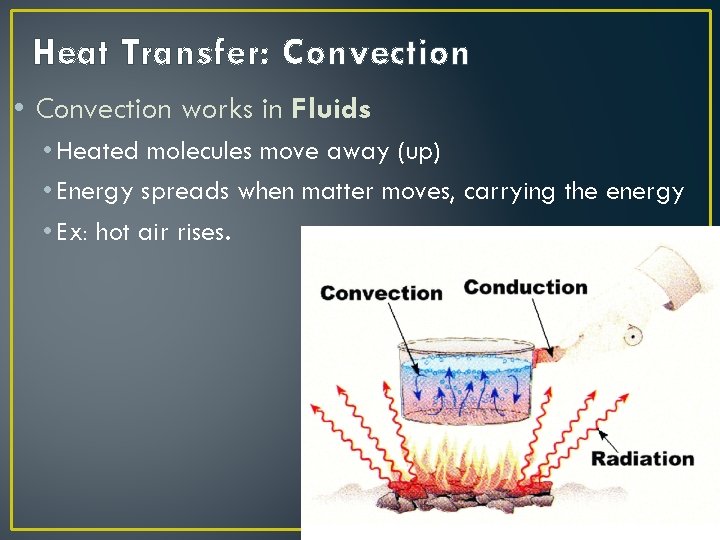
Heat Transfer: Convection • Convection works in Fluids • Heated molecules move away (up) • Energy spreads when matter moves, carrying the energy • Ex: hot air rises.
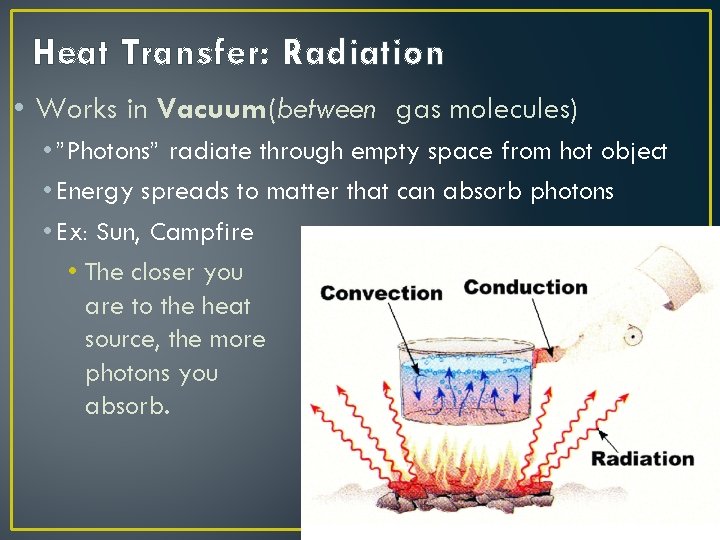
Heat Transfer: Radiation • Works in Vacuum (between gas molecules) • ”Photons” radiate through empty space from hot object • Energy spreads to matter that can absorb photons • Ex: Sun, Campfire • The closer you are to the heat source, the more photons you absorb.
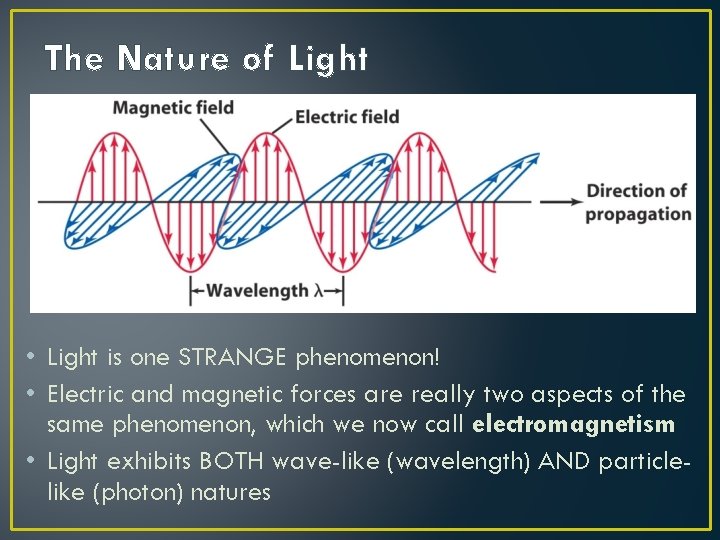
The Nature of Light • Light is one STRANGE phenomenon! • Electric and magnetic forces are really two aspects of the same phenomenon, which we now call electromagnetism • Light exhibits BOTH wave-like (wavelength) AND particlelike (photon) natures
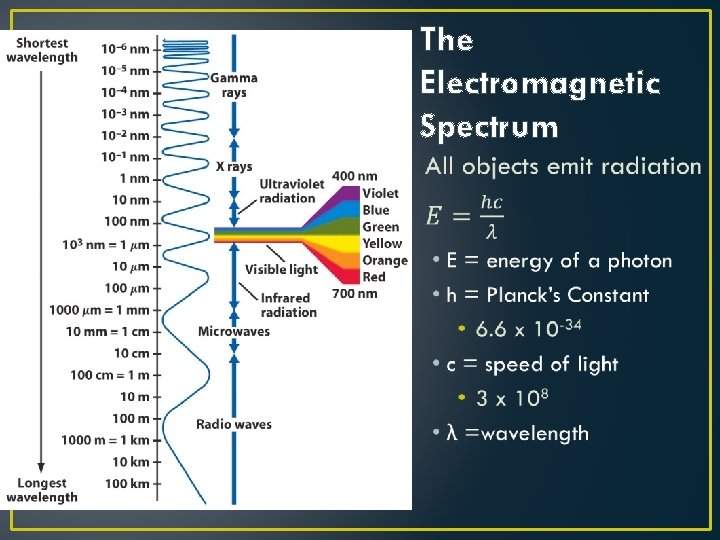
The Electromagnetic Spectrum •
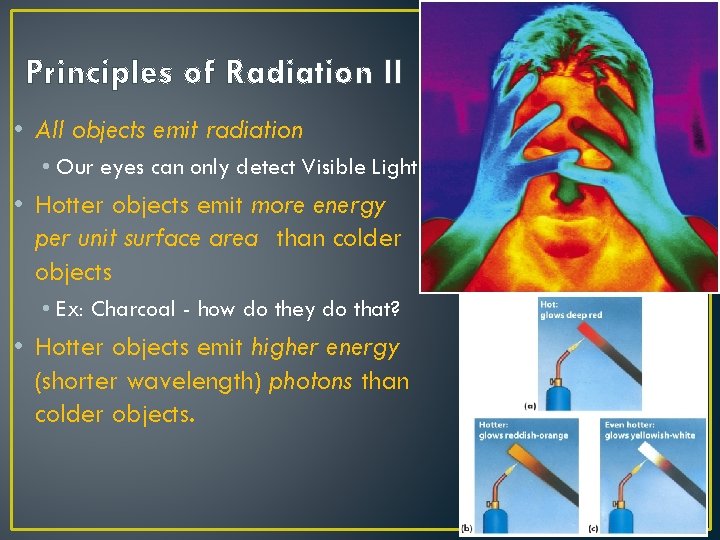
Principles of Radiation II • All objects emit radiation • Our eyes can only detect Visible Light • Hotter objects emit more energy per unit surface area than colder objects • Ex: Charcoal - how do they do that? • Hotter objects emit higher energy (shorter wavelength) photons than colder objects.
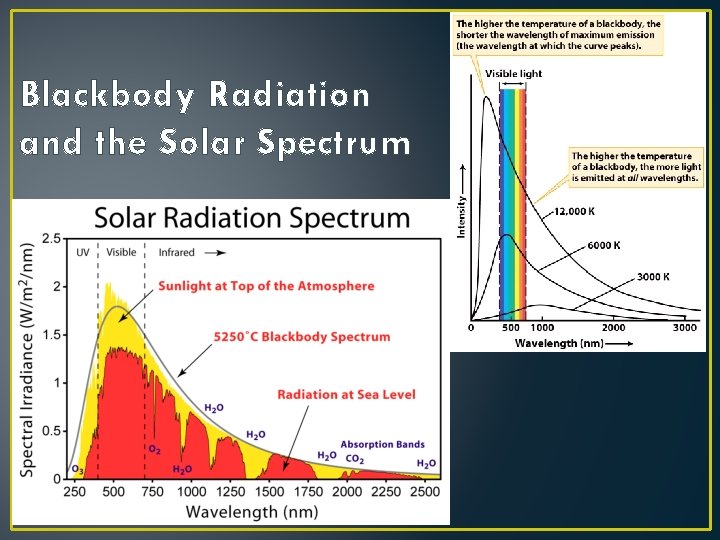
Blackbody Radiation and the Solar Spectrum
Principles of Radiation III • Good Absorbers Make Good Emitters • If this weren’t true, what would happen? • Some materials absorb everything; • Some materials are selective absorbers • Gases of H 2 O and CO 2 are examples: • They DON’T absorb Visible light • They DO absorb IR radiation.
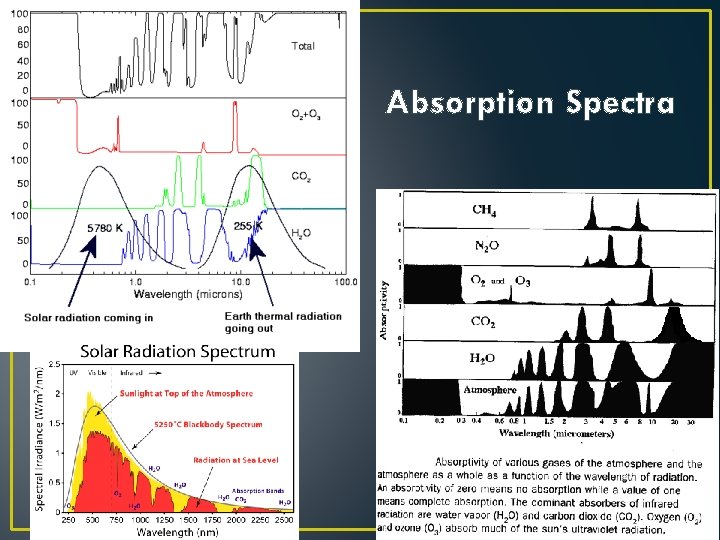
Absorption Spectra
Simple Question: • If Hot Air rises, why is there snow in the mountains?
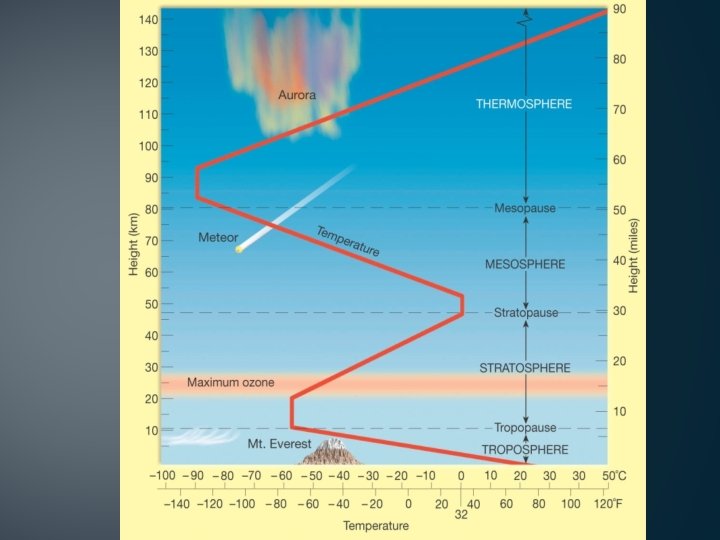
Temperature Variations I • If we send a balloon up through the atmosphere to measure the temperature: • Temperature DROPS through the Troposphere • Temperature RISES through the Stratosphere • Temperature DROPS through the Mesosphere • Temperature RISES through the Thermosphere
Temperature Variations II • Remember that simple question? • If Hot Air rises, why is there snow in the mountains? • Answer is not so simple! • How is each layer heated? It needs: • Heat Source, which emits some… • Type of Radiation • Material to absorb photons.
The Troposphere • This is also known as the “Weather Sphere” • Temperature drops with increasing altitude • Rate of decrease with altitude is known as the Environmental Lapse Rate (ELR) • Average (or Normal) ELR is 6. 5°C/km (3. 5°F/1000 ft), but varies widely with place, season, etc. • Earth is the source of heat for the Troposphere • Discussed further in a moment • Top is defined where the temperature stops dropping called the Tropopause.
The Stratosphere • Temperature rises with increasing altitude • The SUN must be the heat source! • OZONE absorbs UV rays and becomes warmer • “Heat Rises”, but. . . • . . . what this really means is that “Air that is warmer than its surroundings will rise” • Air doesn’t rise much in Stratosphere - lack of vertical motion results in layering • Top of Stratosphere is called the Stratopause.
The Mesosphere • Temperature drops with increasing altitude • “Heat source” is hot material (atoms) escaping from the Stratosphere • Ozone doesn’t exist in this thin air • Sun’s rays are extremely energetic, but there is nothing there to absorb the energy! • Top of Mesosphere is the Mesopause.
The Thermosphere • Temperature rises with increasing altitude • Energetic rays of the Sun are absorbed by ions of O and N • Highest temperature of any layer is reached - more than 1000°C!! • Pressure is VERY low - very few atoms or molecules around • Thermosphere grades out into the vacuum of space.
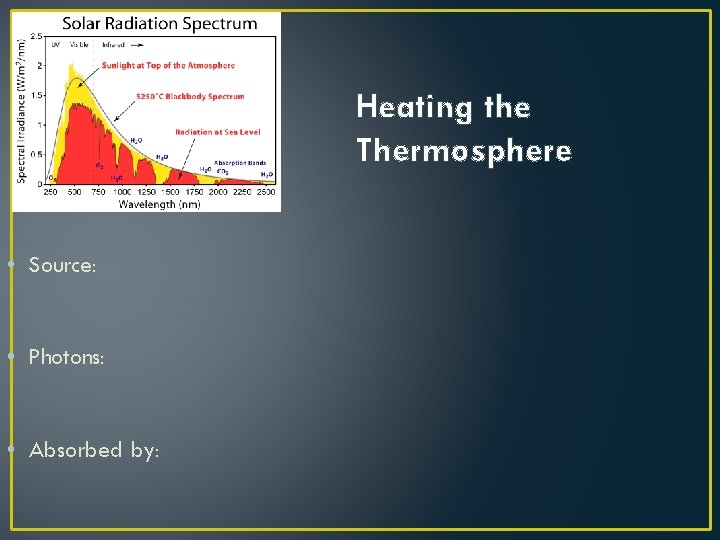
Heating the Thermosphere • Source: • Photons: • Absorbed by:
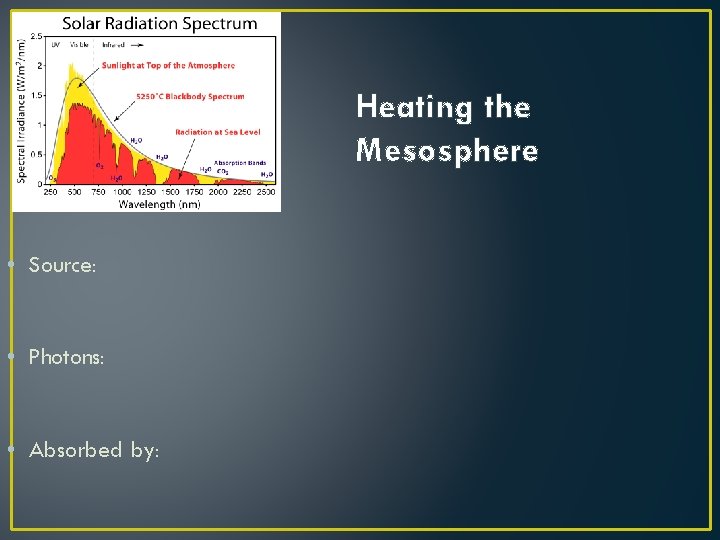
Heating the Mesosphere • Source: • Photons: • Absorbed by:
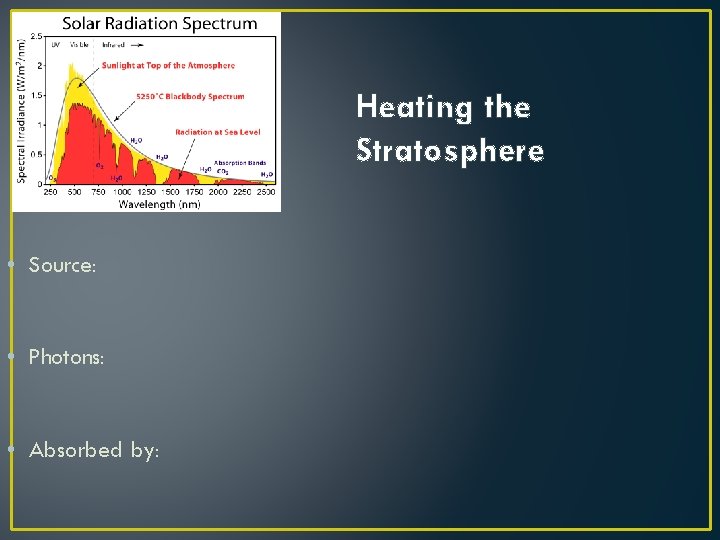
Heating the Stratosphere • Source: • Photons: • Absorbed by:
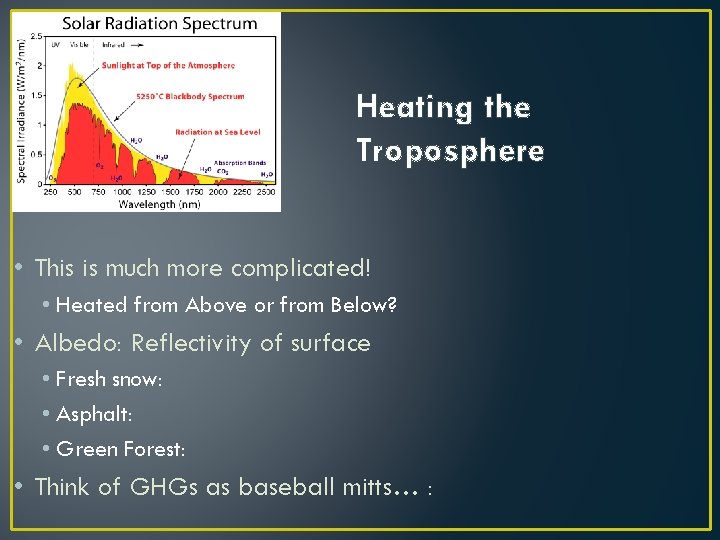
Heating the Troposphere • This is much more complicated! • Heated from Above or from Below? • Albedo: Reflectivity of surface • Fresh snow: • Asphalt: • Green Forest: • Think of GHGs as baseball mitts… :
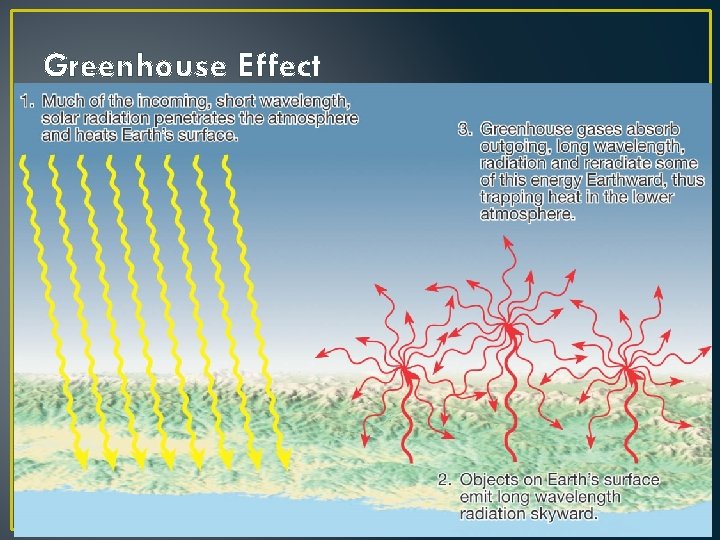
Greenhouse Effect
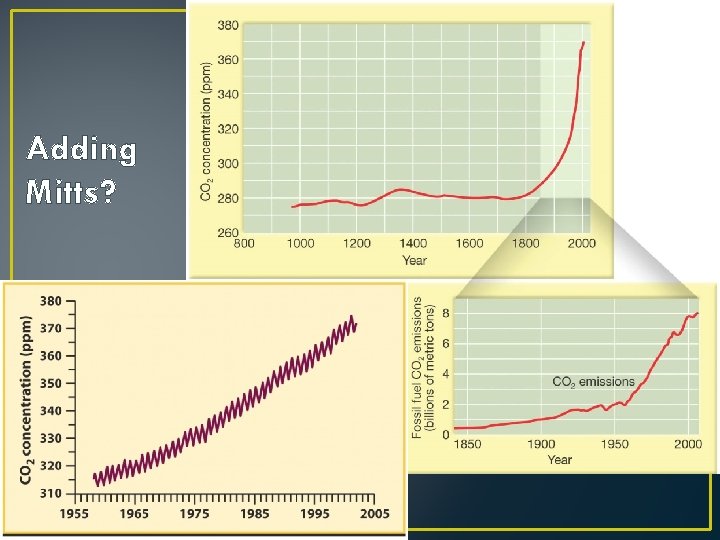
Adding Mitts?
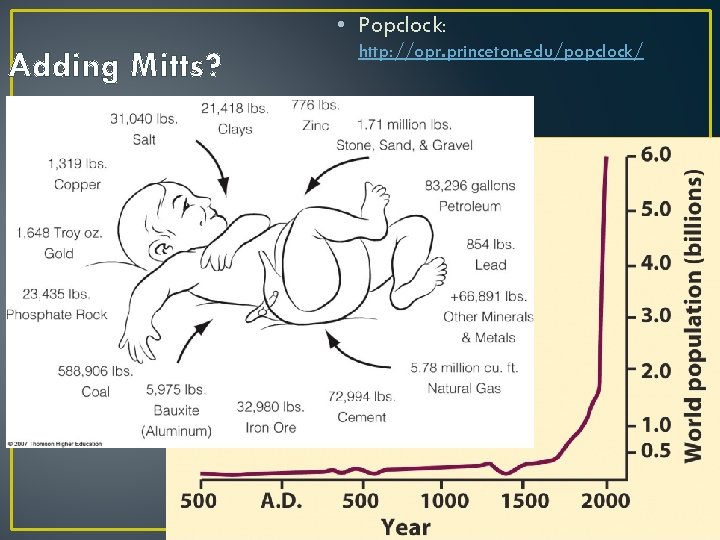
• Popclock: Adding Mitts? http: //opr. princeton. edu/popclock/
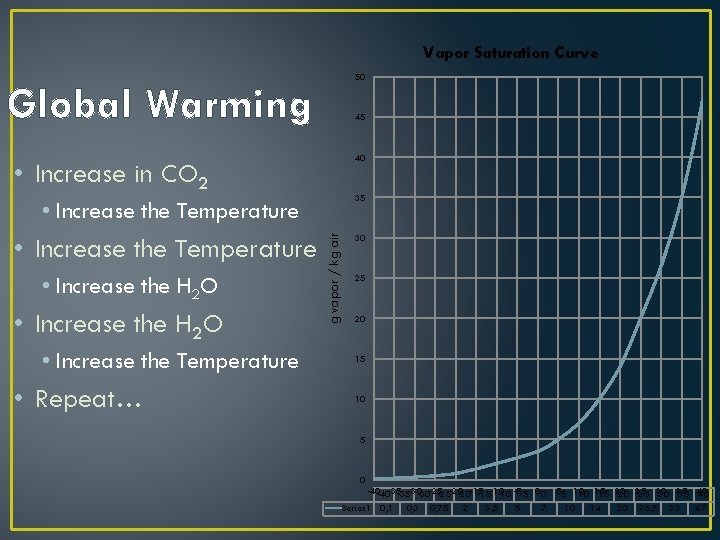
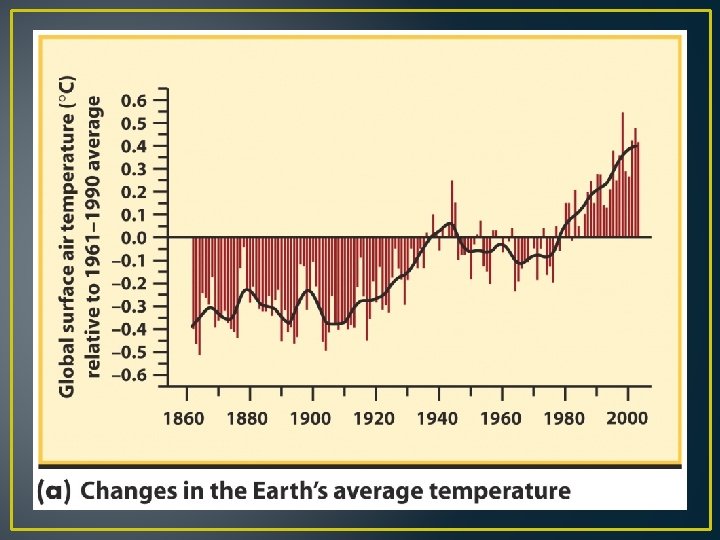
Vapor Saturation Curve 50 Global Warming 45 40 • Increase in CO 2 35 • Increase the Temperature • Increase the H 2 O • Increase the Temperature • Repeat… g vapor / kg air • Increase the Temperature 30 25 20 15 10 5 0 -40 -40 -35 -35 -30 -30 -25 -25 -20 -20 -15 -15 -10 -5 -5 00 55 10 10 15 15 20 20 25 25 30 30 35 35 40 40 Series 1 0, 3 0, 75 2 3, 5 5 7 10 14 20 26, 5 35 47
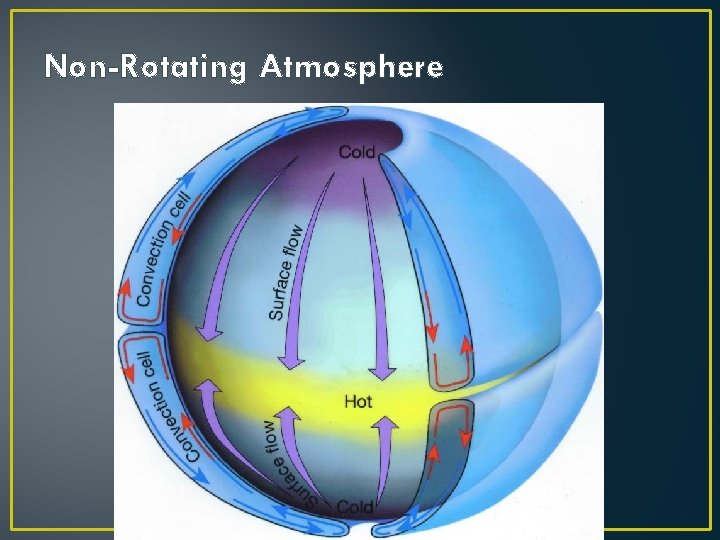
Non-Rotating Atmosphere
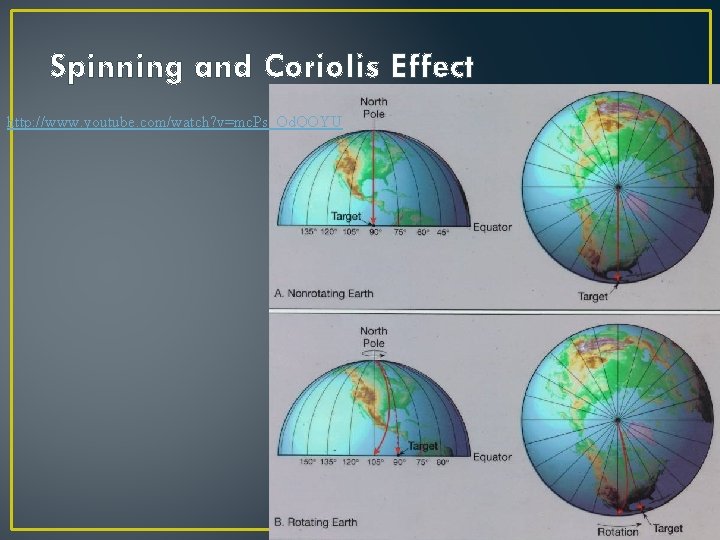
Spinning and Coriolis Effect http: //www. youtube. com/watch? v=mc. Ps_Od. QOYU
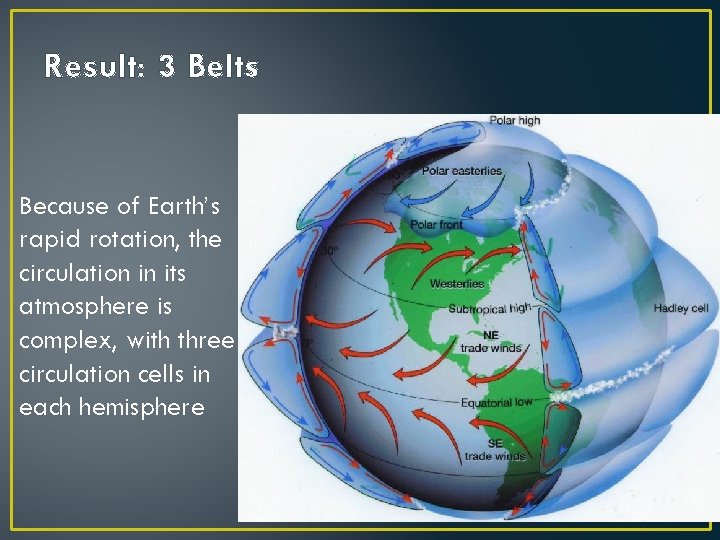
Result: 3 Belts Because of Earth’s rapid rotation, the circulation in its atmosphere is complex, with three circulation cells in each hemisphere
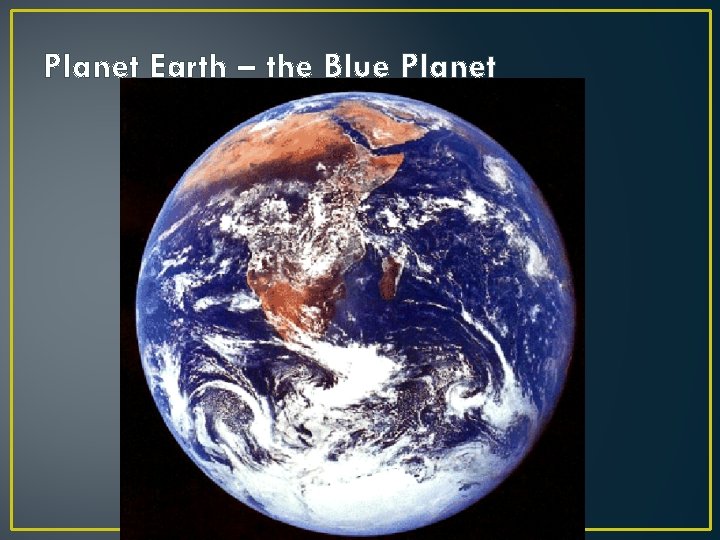
Planet Earth – the Blue Planet
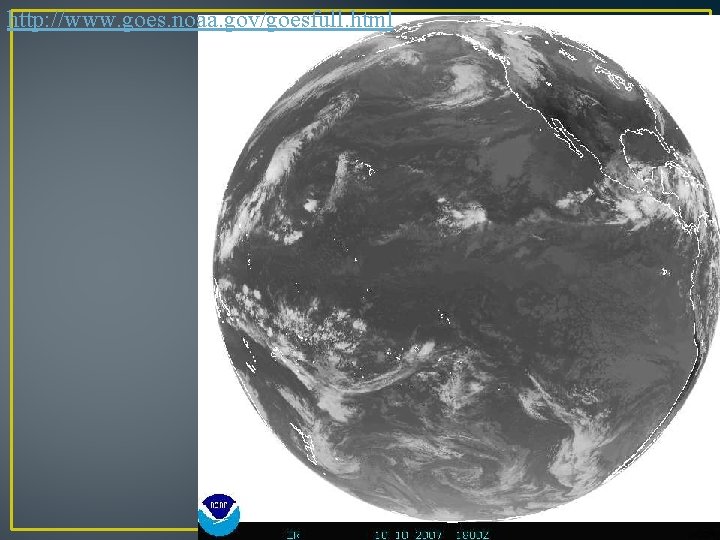
http: //www. goes. noaa. gov/goesfull. html
- Slides: 46