
Heat Treatment Cooling Curves I T Diagram v
- Slides: 8
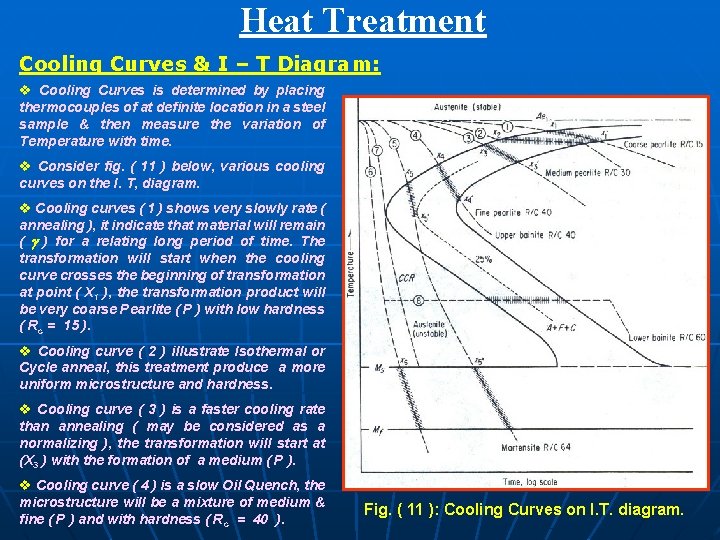
Heat Treatment Cooling Curves & I – T Diagram: v Cooling Curves is determined by placing thermocouples of at definite location in a steel sample & then measure the variation of Temperature with time. v Consider fig. ( 11 ) below, various cooling curves on the I. T, diagram. v Cooling curves ( 1 ) shows very slowly rate ( annealing ), it indicate that material will remain ( g ) for a relating long period of time. The transformation will start when the cooling curve crosses the beginning of transformation at point ( X 1 ), the transformation product will be very coarse Pearlite ( P ) with low hardness ( Rc = 15 ). v Cooling curve ( 2 ) illustrate Isothermal or Cycle anneal, this treatment produce a more uniform microstructure and hardness. v Cooling curve ( 3 ) is a faster cooling rate than annealing ( may be considered as a normalizing ), the transformation will start at (X 3 ) with the formation of a medium ( P ). v Cooling curve ( 4 ) is a slow Oil Quench, the microstructure will be a mixture of medium & fine ( P ) and with hardness ( Rc = 40 ). Fig. ( 11 ): Cooling Curves on I. T. diagram.
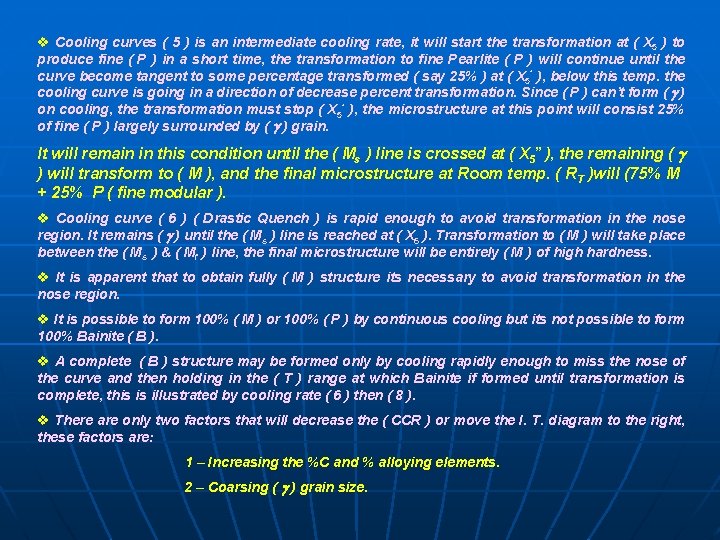
v Cooling curves ( 5 ) is an intermediate cooling rate, it will start the transformation at ( X 5 ) to produce fine ( P ) in a short time, the transformation to fine Pearlite ( P ) will continue until the curve become tangent to some percentage transformed ( say 25% ) at ( X 5’ ), below this temp. the cooling curve is going in a direction of decrease percent transformation. Since ( P ) can’t form ( g ) on cooling, the transformation must stop ( X 5’ ), the microstructure at this point will consist 25% of fine ( P ) largely surrounded by ( g ) grain. It will remain in this condition until the ( Ms ) line is crossed at ( X 5” ), the remaining ( g ) will transform to ( M ), and the final microstructure at Room temp. ( RT )will (75% M + 25% P ( fine modular ). v Cooling curve ( 6 ) ( Drastic Quench ) is rapid enough to avoid transformation in the nose region. It remains ( g ) until the ( Ms ) line is reached at ( X 6 ). Transformation to ( M ) will take place between the ( Ms ) & ( Mf ) line, the final microstructure will be entirely ( M ) of high hardness. v It is apparent that to obtain fully ( M ) structure its necessary to avoid transformation in the nose region. v It is possible to form 100% ( M ) or 100% ( P ) by continuous cooling but its not possible to form 100% Bainite ( B ). v A complete ( B ) structure may be formed only by cooling rapidly enough to miss the nose of the curve and then holding in the ( T ) range at which Bainite if formed until transformation is complete, this is illustrated by cooling rate ( 6 ) then ( 8 ). v There are only two factors that will decrease the ( CCR ) or move the I. T. diagram to the right, these factors are: 1 – Increasing the %C and % alloying elements. 2 – Coarsing ( g ) grain size.
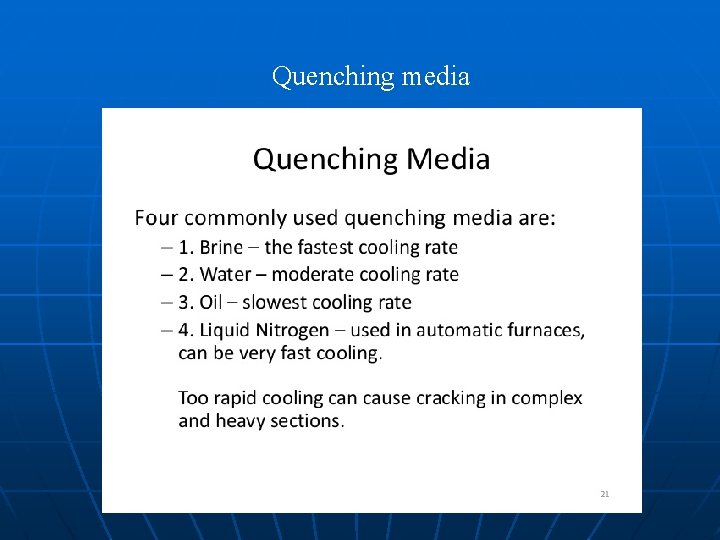
Quenching media
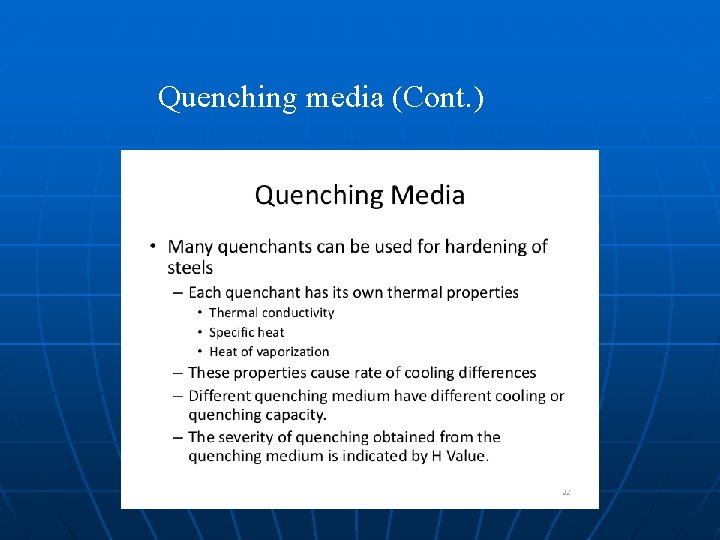
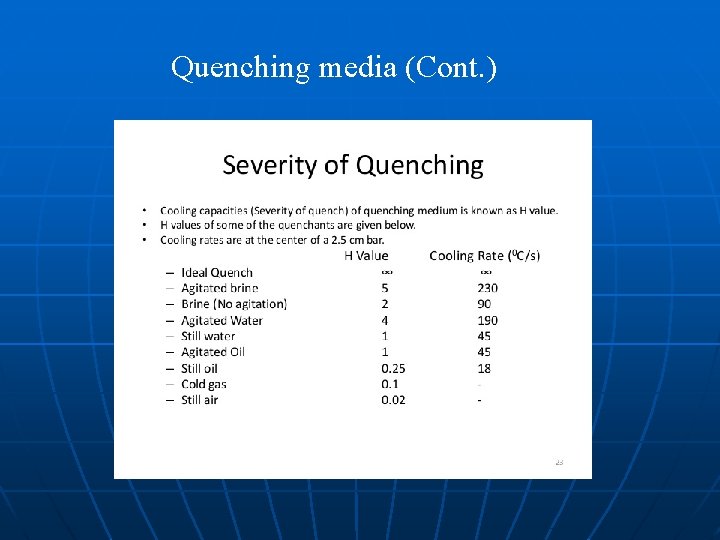
Quenching media (Cont. ) Quenching media
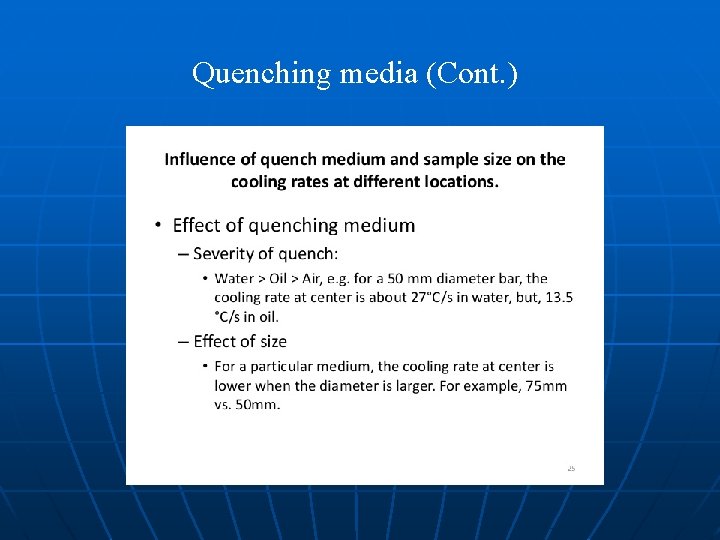
Quenching media (Cont. )
Quenching media (Cont. )
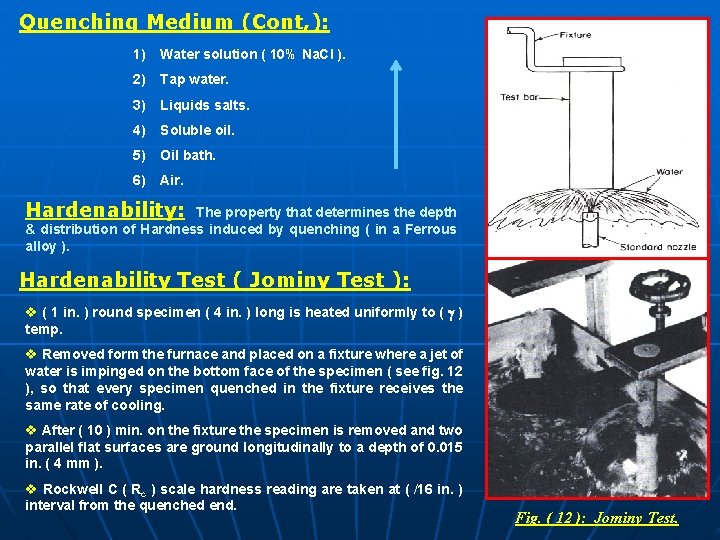
Quenching Medium (Cont, ): 1) Water solution ( 10% Na. Cl ). 2) Tap water. 3) Liquids salts. 4) Soluble oil. 5) Oil bath. 6) Air. Hardenability: The property that determines the depth & distribution of Hardness induced by quenching ( in a Ferrous alloy ). Hardenability Test ( Jominy Test ): v ( 1 in. ) round specimen ( 4 in. ) long is heated uniformly to ( g ) temp. v Removed form the furnace and placed on a fixture where a jet of water is impinged on the bottom face of the specimen ( see fig. 12 ), so that every specimen quenched in the fixture receives the same rate of cooling. v After ( 10 ) min. on the fixture the specimen is removed and two parallel flat surfaces are ground longitudinally to a depth of 0. 015 in. ( 4 mm ). v Rockwell C ( Rc ) scale hardness reading are taken at ( /16 in. ) interval from the quenched end. Fig. ( 12 ): Jominy Test.
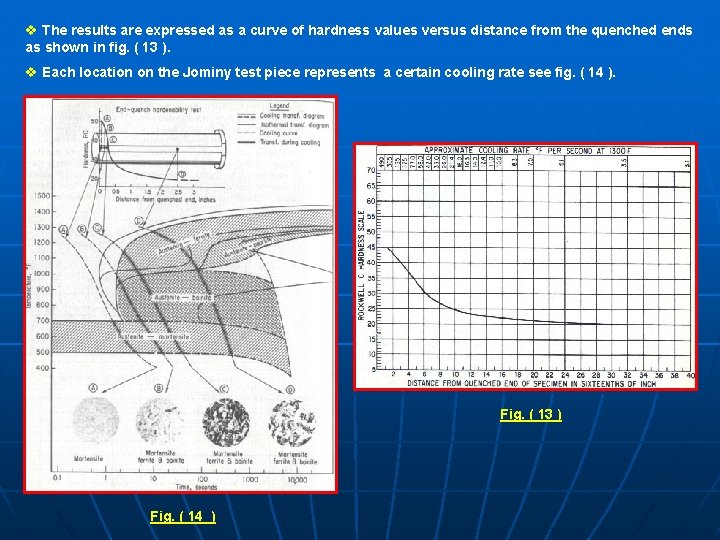
v The results are expressed as a curve of hardness values versus distance from the quenched ends as shown in fig. ( 13 ). v Each location on the Jominy test piece represents a certain cooling rate see fig. ( 14 ). Fig. ( 13 ) Fig. ( 14 )