
Heat Transfers Methods of heat transfer Conduction when

- Slides: 14
Heat Transfers
Methods of heat transfer ¬Conduction- when the two objects actually touch. (this is the best method) ¬Convection- through a circulation of fluids. ¬Radiation- energy leaving in the form of an electromagnetic wave (like light). ¬Radiation will have the lowest rate of transfer, but it is also impossible to stop.
Conductors and Insulators ¬Conductors- materials that allow heat to quickly pass throughout the material (like metals) ¬Insulators- materials that do not allow heat to quickly pass throughout a material (like wood or plastic) ¬This mainly deals with the movement of particles ¬metals have a “sea of electrons” which allows for quick heat transfer.
Why do metals feel cool to the touch at room temperature? ¬Room temperature is cooler than human body temperature. ¬Heat is ONLY noticed when there is a transfer!! ¬Metals quickly conduct heat from your body throughout the metal (since it is taking heat it feels cold). ¬Wood or plastic don’t conduct heat quickly so not as much is taken from your skin. ¬Good insulators normally have a lot of space for air, because gases don’t conduct as well as solids.
Insulated Container ¬Any insulated container (Thermos, Yeti, Hydroflask), is a container that is capable of keeping hot items hot or cold items cold. ¬They sell very cheap ones that go into little kid’s lunch boxes. They sell very expensive ones that keep beverages hot or cold for much longer. ¬A insulated container works by preventing transfers of heat!
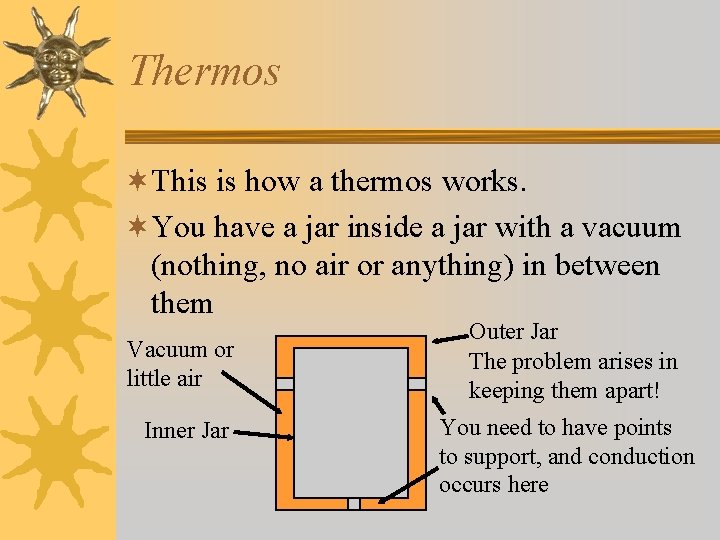
Thermos ¬This is how a thermos works. ¬You have a jar inside a jar with a vacuum (nothing, no air or anything) in between them Vacuum or little air Inner Jar Outer Jar The problem arises in keeping them apart! You need to have points to support, and conduction occurs here
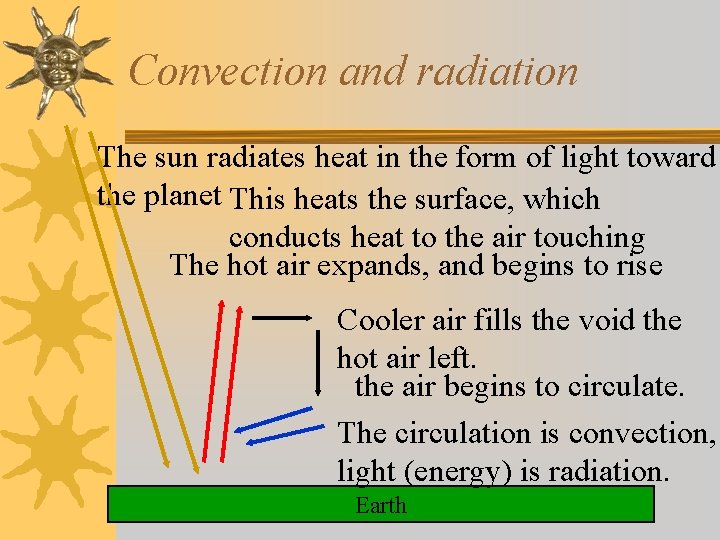
Convection and radiation The sun radiates heat in the form of light toward the planet This heats the surface, which conducts heat to the air touching The hot air expands, and begins to rise Cooler air fills the void the hot air left. the air begins to circulate. The circulation is convection, light (energy) is radiation. Earth
How do clothes keep you warm? ¬They prevent a transfer of heat by convection. ¬Internal body temperature is 98. 6 o F, skin temperature is closer to 80 o F. ¬This is because heat is transferred away from the skin. ¬Thicker clothes slow down this transfer. ¬Cooler clothes are correctly called breezy as they allow the convection to take place rapidly.
Why is water colder/hotter than air? ¬ 70 o degree air is comfortable, 70 o water is very cold. ¬ 100 o air is uncomfortable, but livable. 100 o water (hot tubs) come with a warning, don’t stay in the water for extended time, or you can die. ¬Why?
Why ¬Heat is noticed when there is a transfer. ¬Water is better at transferring heat through convection than air. ¬At 75 o F air is transferring just enough heat away to make you comfortable. ¬Water transfers heat away at a faster rate, so it feels cold. ¬At 100 o, water transfers enough heat to you to kill you, if you stayed in it for an extended period of time. Air does not.
Radiation Energy ¬This is from Bohr’s research. ¬High energy atoms, one’s that are hotter, have more motion. ¬The electrons jump to higher energy level orbitals because of the extra energy. ¬This atom is said to be “excited”. ¬This is unstable, and the electrons will “fall” back into place shortly.
“falling electrons” ¬When the electrons fall back into the correct energy level orbital, it releases a packet of energy called a photon. ¬The photon is the base unit of radiation. ¬Every atom has exact distances between energy levels, so there are only certain types of photons each atom can produce. ¬Neon produces photons which we see as a red visible light, argon as blue visible light.
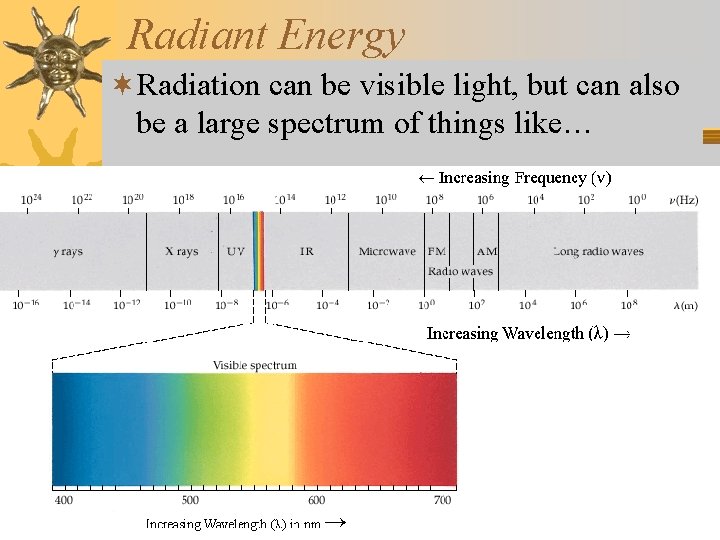
Radiant Energy ¬Radiation can be visible light, but can also be a large spectrum of things like…
Conduction and reactions ¬Reactions require an activation energy. ¬For paper to burn it must reach 451 o F or 233 o C ¬If it can conduct heat at lower temperatures it will not burn, even in an open flame. ¬Water can boil in a paper cup because it never gets above 100 o C.