
HEAT SHOCK PROTEINS IN BALNEOTHERAPY Prof Dr Nergis
HEAT SHOCK PROTEINS IN BALNEOTHERAPY Prof Dr Nergis Erdoğan Turkish Hungarian Balneotherapy Congress Balçova İzmir 2006 1
Heat Shock (Stress) Proteins Why heat shock proteins interest us? What Are they? What are the functions of HSPs? The HSP 70 family Thermotolerance HSP 70 functions associated with stress tolerance Factors and conditions that modulate hsp 70 expression Summary and future directions Turkish Hungarian Balneotherapy Congress Balçova İzmir 2006 2
Why do heat shock proteins interest us? Thermomineral or hyperthermal water baths take an important place in balneotherapy Hot water bath is an excellent media to develop hyperthermia In a 40 o. C thermal bath, body temperature rises to 39 o. C in 15 -25 minutes Physiological stresses ranging from hyperthermia to myocardial ischemia and genetic mutations produce protein damage and misfolded protein structures Turkish Hungarian Balneotherapy Congress Balçova İzmir 2006 3
How does the cell respond? Cell respondes to stresses by the rapid synthesis of polypeptides termed (HSPs) or stres proteins The correct folding of many proteins in a cell requires protein-folding machinery called “molecular chaperones” HSPs behave as chaperones to repair denatured proteins or promote their degradation after heat shock. Turkish Hungarian Balneotherapy Congress Balçova İzmir 2006 4
Why heat shock proteins interest us? Body temperature rise or hyperthermia, causes heat shock protein syntesis in addition to other events Studies in the last decades suggest that heat shock protein syntesis could occure in physiologically relevant body temperatures Increased HSP sythesis may be responsible partly from the general effects of balneotherapy? ? Turkish Hungarian Balneotherapy Congress Balçova İzmir 2006 5
What Are "Heat Shock" Proteins (HSPs)? HSPs initially discovered by Ritossa from Italy in Drosphilia Melanogaster larvae that were exposed to “heat shock” in 1962 HSPs are a group of proteins that are induced when a cell undergoes various types of environmental stresses These proteins are ubiquitous, occurring in all organisms from bacteria and yeast to humans HSPs present in various forms and are categorized into families on the basis of their molecular weights ranging 10 to 150 k. Da HSPs may be present in all cell compartments and are called by molecular sizes as follows: Hsp 27, Hsp 70, and Hsp 90 Turkish Hungarian Balneotherapy Congress Balçova İzmir 2006 6
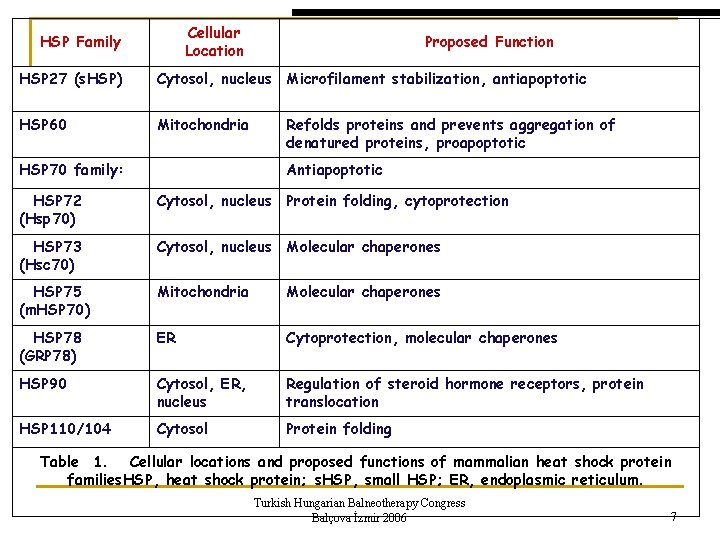
Cellular Location HSP Family Proposed Function HSP 27 (s. HSP) Cytosol, nucleus Microfilament stabilization, antiapoptotic HSP 60 Mitochondria HSP 70 family: Refolds proteins and prevents aggregation of denatured proteins, proapoptotic Antiapoptotic HSP 72 (Hsp 70) Cytosol, nucleus Protein folding, cytoprotection HSP 73 (Hsc 70) Cytosol, nucleus Molecular chaperones HSP 75 (m. HSP 70) Mitochondria Molecular chaperones HSP 78 (GRP 78) ER Cytoprotection, molecular chaperones HSP 90 Cytosol, ER, nucleus Regulation of steroid hormone receptors, protein translocation HSP 110/104 Cytosol Protein folding Table 1. Cellular locations and proposed functions of mammalian heat shock protein families. HSP, heat shock protein; s. HSP, small HSP; ER, endoplasmic reticulum. Turkish Hungarian Balneotherapy Congress Balçova İzmir 2006 7
What are the functions of HSPs? HSPs play important physiological roles in both normal cellular homeostasis and systemic or cellular stress such as ischemia, cytokines, and energy depletion Most HSPs have strong cytoprotective effects, Behave as molecular chaperones for other cellular proteins Essential for survival at both normal and elevated temperatures HSPs also appear to play a critical role in the development of thermotolerance Turkish Hungarian Balneotherapy Congress Balçova İzmir 2006 8
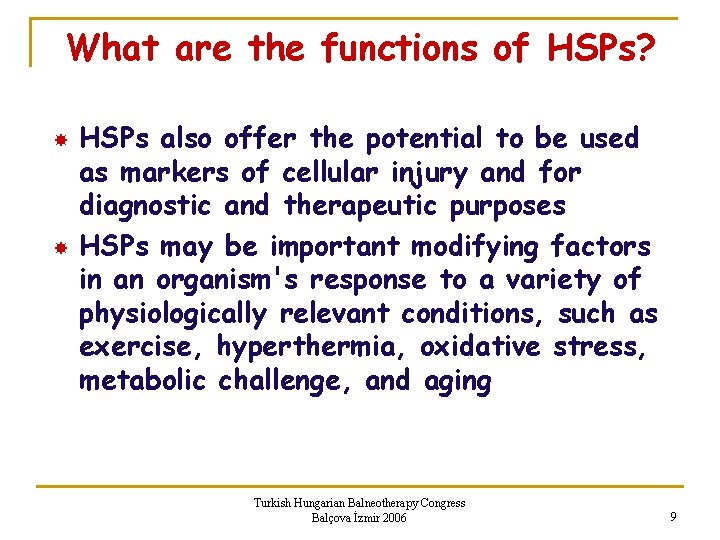
What are the functions of HSPs? HSPs also offer the potential to be used as markers of cellular injury and for diagnostic and therapeutic purposes HSPs may be important modifying factors in an organism's response to a variety of physiologically relevant conditions, such as exercise, hyperthermia, oxidative stress, metabolic challenge, and aging Turkish Hungarian Balneotherapy Congress Balçova İzmir 2006 9
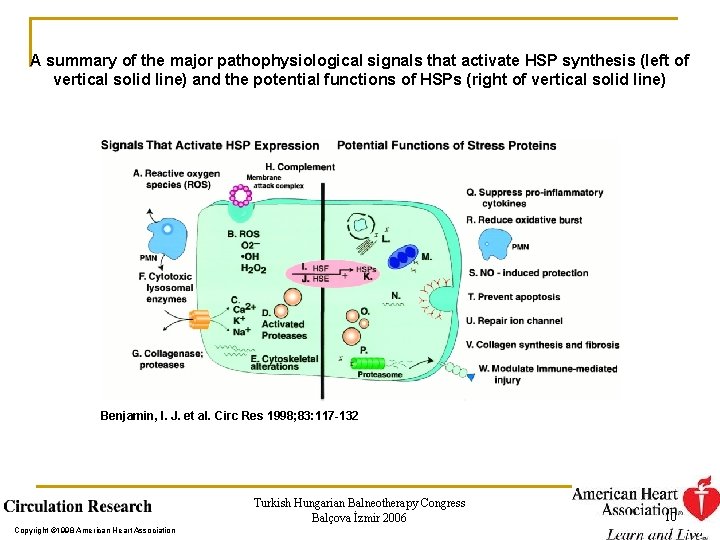
A summary of the major pathophysiological signals that activate HSP synthesis (left of vertical solid line) and the potential functions of HSPs (right of vertical solid line) Benjamin, I. J. et al. Circ Res 1998; 83: 117 -132 Turkish Hungarian Balneotherapy Congress Balçova İzmir 2006 Copyright © 1998 American Heart Association 10

With which ways do HSPs perform these functions? 1) the folding of proteins in various intracellular compartments, 2) the maintenance of structural proteins, 3) the refolding of misfolded proteins, 4) translocation of proteins across membranes and into various cellular compartments, 5) the prevention of protein aggregation, and 6) the degradation of unstable proteins Turkish Hungarian Balneotherapy Congress Balçova İzmir 2006 11
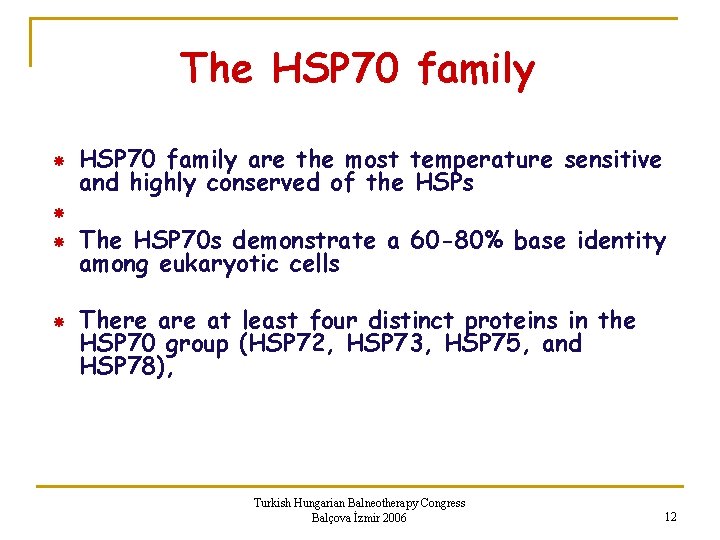
The HSP 70 family are the most temperature sensitive and highly conserved of the HSPs The HSP 70 s demonstrate a 60 -80% base identity among eukaryotic cells There at least four distinct proteins in the HSP 70 group (HSP 72, HSP 73, HSP 75, and HSP 78), Turkish Hungarian Balneotherapy Congress Balçova İzmir 2006 12
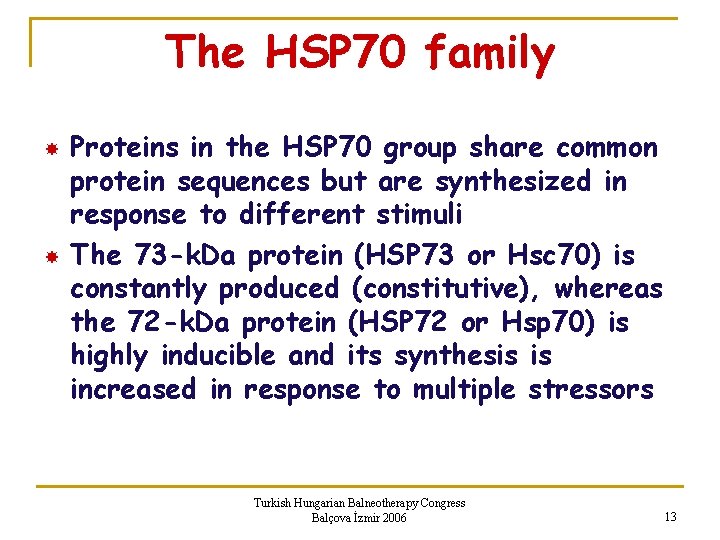
The HSP 70 family Proteins in the HSP 70 group share common protein sequences but are synthesized in response to different stimuli The 73 -k. Da protein (HSP 73 or Hsc 70) is constantly produced (constitutive), whereas the 72 -k. Da protein (HSP 72 or Hsp 70) is highly inducible and its synthesis is increased in response to multiple stressors Turkish Hungarian Balneotherapy Congress Balçova İzmir 2006 13
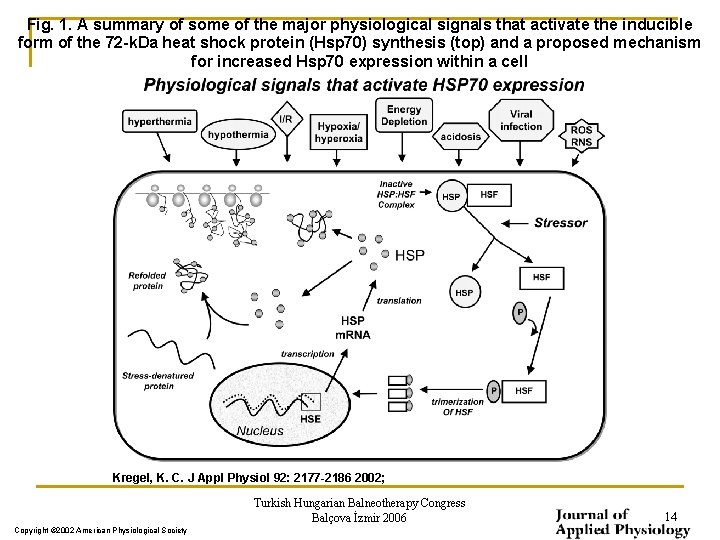
Fig. 1. A summary of some of the major physiological signals that activate the inducible form of the 72 -k. Da heat shock protein (Hsp 70) synthesis (top) and a proposed mechanism for increased Hsp 70 expression within a cell Kregel, K. C. J Appl Physiol 92: 2177 -2186 2002; Turkish Hungarian Balneotherapy Congress Balçova İzmir 2006 Copyright © 2002 American Physiological Society 14
Thermotolerance The first physiological function of the inducible Hsp 70 is “acquired thermotolerance” Which is defined as the ability of a cell or organism to become resistant to heat stress after a prior sublethal heat exposure Hsp 70 is associated with the development of tolerance to a variety of stresses, including hypoxia, ischemia, acidosis, energy depletion, cytokines such as TNF-α and ultraviolet radiation Turkish Hungarian Balneotherapy Congress Balçova İzmir 2006 15
Thermotolerance The phenomenon of acquired thermotolerance is transient in nature Depends primarily on the severity of the initial heat stress In general, the greater the initial heat dose, the greater the magnitude and duration of thermotolerance The expression of thermotolerance following heating will occur within several hours and last 3 -5 days in duration Turkish Hungarian Balneotherapy Congress Balçova İzmir 2006 16
Thermotolerance The gut and liver are the first organs to accumulate HSP 70 following whole body hyperthermia HSP synthesis is associated with protection against ischemia-reperfusion injury to the heart, liver, kidney, spinal cord, lungs and light-induced damage to the retina Studies of cardiac shock followed by resuscitation have revealed that hepatocytes synthesize members of the HSP 70 family early in the course of recovery HSP 70 accumulation could be utilized as a biomarker of cellular injury Turkish Hungarian Balneotherapy Congress Balçova İzmir 2006 17
Thermotolerance Proteins in the HSP 70 family are involved in preventing protein denaturation and/or processing denatured proteins and protein fragments that are produced by stressors such as hyperthermia Cells that were made thermotolerant also produce less HSP during a second challenge compared with previously unheated cells There is a regulation of HSP synthesis that is dependent on the levels of these proteins existing within the cell Turkish Hungarian Balneotherapy Congress Balçova İzmir 2006 18
Thermotolerance The variety of stressors used to condition cells will likely induce other important cellular defense proteins in addition to HSPs, such as antioxidant enzymes It should also be noted that thermotolerance can be generated in the absence of HSPs In some studies, thermotolerance was manifested under conditions of a chronic exposure to a lower temperature than is required for HSP accumulation Turkish Hungarian Balneotherapy Congress Balçova İzmir 2006 19
Functions associated with HSP 70 Interestingly, it has also been noted that HSPs can play a role in apoptosis. HSP 27, HSP 70, and HSP 90 proteins are predominantly antiapoptotic, whereas HSP 60 is proapoptotic HSPs serve as modulating signals for immune and inflammatory responses Elevations in intracellular HSP levels have been shown to improve cell tolerance to inflammatory cytokines such as TNF-α and interleukin-1 Turkish Hungarian Balneotherapy Congress Balçova İzmir 2006 20
Functions associated with HSP 70 HSP accumulation may contribute to a reduction in inflammatory cytokine production with cellular challenge Conversely, when HSPs are present on the surface of cells or released into the local extracellular environment during conditions such as necrotic cell death or viral infection, these proteins have an immune-stimulating response Hsp 70 is also known to facilitate antigen presentation in cells such as macrophages and dendrites When Hsp 70 is applied to the environment external to cells, macrophages and lymphocytes produce inflammatory cytokines Turkish Hungarian Balneotherapy Congress Balçova İzmir 2006 21
Functions associated with HSP 70 Studies have demonstrated the presence of Hsp 70 on the surface of tumor cells, potentially functioning as recognition molecules for natural killer (NK) cells HSPs are important modulators of antigen presentation, T-lymphocyte activation, cytokine production, and NK cell killing Hsp 70 response is markedly reduced with age Turkish Hungarian Balneotherapy Congress Balçova İzmir 2006 22
Summary and future directions Whenever a cell — any cell, in any organism — is stressed by heat, cold, ischemia or glucose or oxygen deprivation HSPs are induced The heat shock response provides thermotolerance to a cell or organism This response seems not only provide protection from heat, but can, by a mechanism called crosstolerance, protect against cell death from an entirely different lethal stress (e. g. endotoxin) Turkish Hungarian Balneotherapy Congress Balçova İzmir 2006 23
Summary and future directions Mild and nonlethal heat shock (i. e. , hyperthermia) is known to protect the myocardium, spinal cord, brain, lungs, pankreas and gut against ischemic injury Protect retina against photic injury Protect against infections and inflammatory diseases, aging? ? Do hyperthermic balneotherapeutic applications perform thermotolerance? ? ? And may this phenomen partly explain the general effects of balneotherapy? ? ? Turkish Hungarian Balneotherapy Congress Balçova İzmir 2006 24
References n n n Calderwood SK, Theriault JR, Gong J: How is the immune response affected by hyperthermia and heat shock proteins? Int J Hyperthermia. 2005 Dec; 21(8): 713 -6. Sakamoto N, Kokura S, Okuda T, Hattori T, Katada K, Isozaki Y, Nakabe N, Handa O, Takagi T, Ishikawa T, Naito Y, Yoshida N, Yoshikawa T: Heme oxygenase-1 (Hsp 32) is involved in the protection of small intestine by whole body mild hyperthermia from ischemia/reperfusion injury in rat. Int J Hyperthermia. 2005 Nov; 21(7): 603 -14. Evgen'ev MB, Garbuz DG, Zatsepina OG: [Heat shock proteins: functions and role in adaptation to hyperthermia] Ontogenez. 2005 Jul -Aug; 36(4): 265 -73. Jakubowicz-Gil J, Pawlikowska-Pawlega B, Piersiak T, Pawelec J, Gawron A: Quercetin suppresses heat shock-induced nuclear translocation of Hsp 72. Folia Histochem Cytobiol. 2005; 43(3): 123 -8. Milani V, Noessner E: Effects of thermal stress on tumor antigenicity and recognition by immune effector cells. Cancer Immunol Immunother. 2006 Mar; 55(3): 312 -9. Turkish Hungarian Balneotherapy Congress Balçova İzmir 2006 25
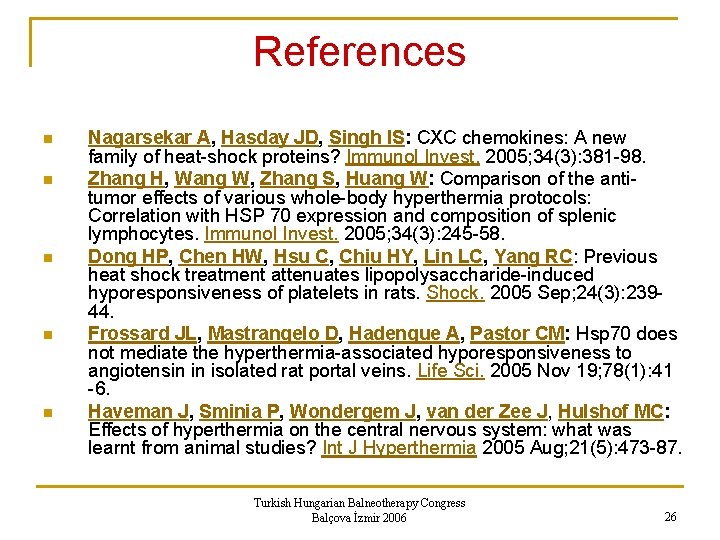
References n n n Nagarsekar A, Hasday JD, Singh IS: CXC chemokines: A new family of heat-shock proteins? Immunol Invest. 2005; 34(3): 381 -98. Zhang H, Wang W, Zhang S, Huang W: Comparison of the antitumor effects of various whole-body hyperthermia protocols: Correlation with HSP 70 expression and composition of splenic lymphocytes. Immunol Invest. 2005; 34(3): 245 -58. Dong HP, Chen HW, Hsu C, Chiu HY, Lin LC, Yang RC: Previous heat shock treatment attenuates lipopolysaccharide-induced hyporesponsiveness of platelets in rats. Shock. 2005 Sep; 24(3): 23944. Frossard JL, Mastrangelo D, Hadengue A, Pastor CM: Hsp 70 does not mediate the hyperthermia-associated hyporesponsiveness to angiotensin in isolated rat portal veins. Life Sci. 2005 Nov 19; 78(1): 41 -6. Haveman J, Sminia P, Wondergem J, van der Zee J, Hulshof MC: Effects of hyperthermia on the central nervous system: what was learnt from animal studies? Int J Hyperthermia 2005 Aug; 21(5): 473 -87. Turkish Hungarian Balneotherapy Congress Balçova İzmir 2006 26
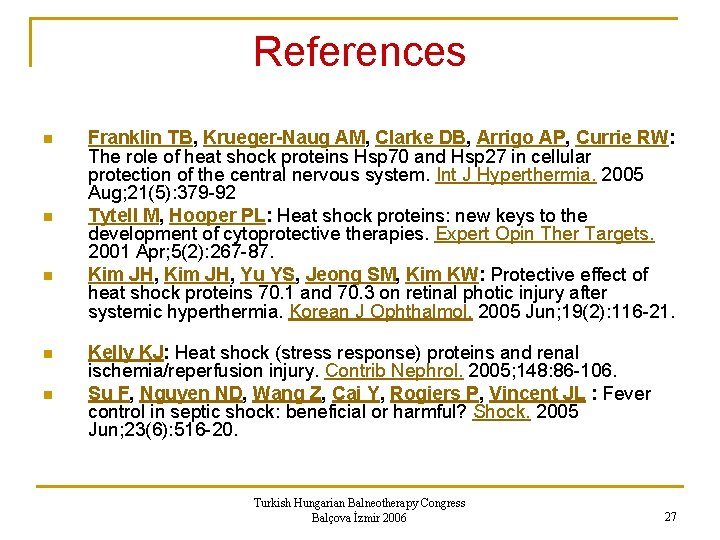
References n n n Franklin TB, Krueger-Naug AM, Clarke DB, Arrigo AP, Currie RW: The role of heat shock proteins Hsp 70 and Hsp 27 in cellular protection of the central nervous system. Int J Hyperthermia. 2005 Aug; 21(5): 379 -92 Tytell M, Hooper PL: Heat shock proteins: new keys to the development of cytoprotective therapies. Expert Opin Ther Targets. 2001 Apr; 5(2): 267 -87. Kim JH, Yu YS, Jeong SM, Kim KW: Protective effect of heat shock proteins 70. 1 and 70. 3 on retinal photic injury after systemic hyperthermia. Korean J Ophthalmol. 2005 Jun; 19(2): 116 -21. Kelly KJ: Heat shock (stress response) proteins and renal ischemia/reperfusion injury. Contrib Nephrol. 2005; 148: 86 -106. Su F, Nguyen ND, Wang Z, Cai Y, Rogiers P, Vincent JL : Fever control in septic shock: beneficial or harmful? Shock. 2005 Jun; 23(6): 516 -20. Turkish Hungarian Balneotherapy Congress Balçova İzmir 2006 27
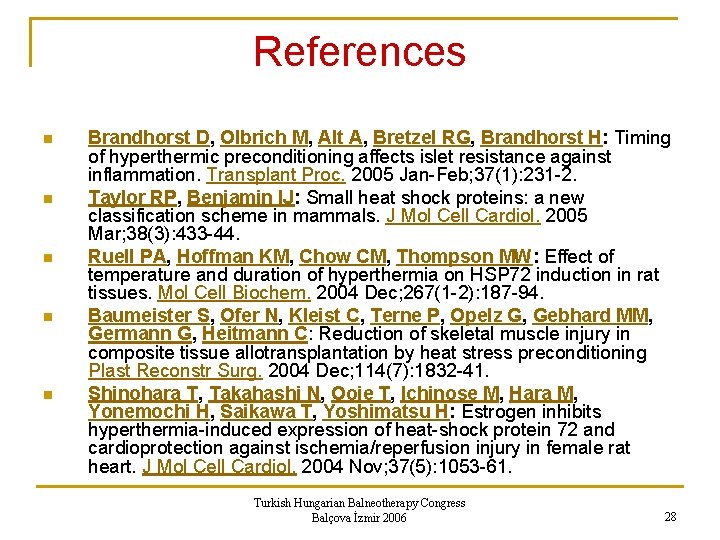
References n n n Brandhorst D, Olbrich M, Alt A, Bretzel RG, Brandhorst H: Timing of hyperthermic preconditioning affects islet resistance against inflammation. Transplant Proc. 2005 Jan-Feb; 37(1): 231 -2. Taylor RP, Benjamin IJ: Small heat shock proteins: a new classification scheme in mammals. J Mol Cell Cardiol. 2005 Mar; 38(3): 433 -44. Ruell PA, Hoffman KM, Chow CM, Thompson MW: Effect of temperature and duration of hyperthermia on HSP 72 induction in rat tissues. Mol Cell Biochem. 2004 Dec; 267(1 -2): 187 -94. Baumeister S, Ofer N, Kleist C, Terne P, Opelz G, Gebhard MM, Germann G, Heitmann C: Reduction of skeletal muscle injury in composite tissue allotransplantation by heat stress preconditioning Plast Reconstr Surg. 2004 Dec; 114(7): 1832 -41. Shinohara T, Takahashi N, Ooie T, Ichinose M, Hara M, Yonemochi H, Saikawa T, Yoshimatsu H: Estrogen inhibits hyperthermia-induced expression of heat-shock protein 72 and cardioprotection against ischemia/reperfusion injury in female rat heart. J Mol Cell Cardiol. 2004 Nov; 37(5): 1053 -61. Turkish Hungarian Balneotherapy Congress Balçova İzmir 2006 28
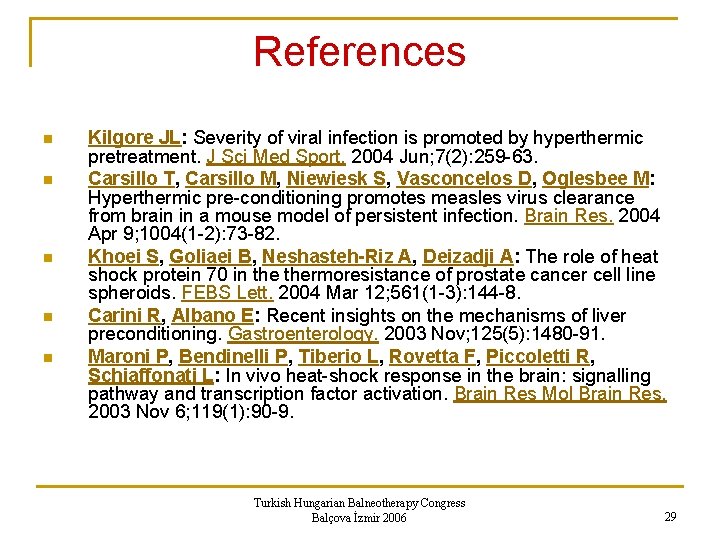
References n n n Kilgore JL: Severity of viral infection is promoted by hyperthermic pretreatment. J Sci Med Sport. 2004 Jun; 7(2): 259 -63. Carsillo T, Carsillo M, Niewiesk S, Vasconcelos D, Oglesbee M: Hyperthermic pre-conditioning promotes measles virus clearance from brain in a mouse model of persistent infection. Brain Res. 2004 Apr 9; 1004(1 -2): 73 -82. Khoei S, Goliaei B, Neshasteh-Riz A, Deizadji A: The role of heat shock protein 70 in thermoresistance of prostate cancer cell line spheroids. FEBS Lett. 2004 Mar 12; 561(1 -3): 144 -8. Carini R, Albano E: Recent insights on the mechanisms of liver preconditioning. Gastroenterology. 2003 Nov; 125(5): 1480 -91. Maroni P, Bendinelli P, Tiberio L, Rovetta F, Piccoletti R, Schiaffonati L: In vivo heat-shock response in the brain: signalling pathway and transcription factor activation. Brain Res Mol Brain Res. 2003 Nov 6; 119(1): 90 -9. Turkish Hungarian Balneotherapy Congress Balçova İzmir 2006 29
References n n Sasara T, Cizkova D, Mestril R, Galik J, Sugahara K, Marsala M : Spinal heat shock protein (70) expression: effect of spinal ischemia, hyperthermia (42 degrees C)/hypothermia (27 degrees C), NMDA receptor activation and potassium evoked depolarization on the induction. Neurochem Int. 2004 Jan; 44(1): 53 -64. Chen HW, Hsu C, Lu TS, Wang SJ, Yang RC: Heat shock pretreatment prevents cardiac mitochondrial dysfunction during sepsis. Shock. 2003 Sep; 20(3): 274 -9. Milani V, Noessner E, Ghose S, Kuppner M, Ahrens B, Scharner A, Gastpar R, Issels RD: Heat shock protein 70: role in antigen presentation and immune stimulation. Int J Hyperthermia. 2002 Nov-Dec; 18(6): 563 -75. Ivor J. Benjamin, , D. Randy Mc. Millan: Stress (Heat Shock) Proteins. Molecular Chaperones in Cardiovascular Biology and Disease. Circulation Research. 1998; 83: 117 -132 : Kevin C. Kregel: Molecular Biology of Thermoregulation Invited Review: Heat shock proteins: modifying factors in physiological stress responses and acquired thermotolerance. J Appl Physiol 92(5): 2177 -2186, 2002; n Turkish Hungarian Balneotherapy Congress Balçova İzmir 2006 30
References n Larry A. Sonna 1, 2, Stephen L. Gaffin 1, Richard E. Pratt 3, Michael L. Cullivan 1, Karen C. Angel 1, and Craig M. Lilly 2 : Molecular Biology of Thermoregulation. Selected Contribution: Effect of acute heat shock on gene expression by human peripheral blood mononuclear cells. J Appl Physiol 92(5): 2208 -2220, 2002. Turkish Hungarian Balneotherapy Congress Balçova İzmir 2006 31

Turkish Hungarian Balneotherapy Congress Balçova İzmir 2006 32

Turkish Hungarian Balneotherapy Congress Balçova İzmir 2006 33

Turkish Hungarian Balneotherapy Congress Balçova İzmir 2006 34

Turkish Hungarian Balneotherapy Congress Balçova İzmir 2006 35
Turkish Hungarian Balneotherapy Congress Balçova İzmir 2006 36
- Slides: 36