
Heat load review Summary table refrigeration requirement V
Heat load review Summary table / refrigeration requirement V. Gahier on behalf of WP 9 EDMS 2560557 https: //indico. cern. ch/event/1023016/ CERN, 27/04/2021
Outline 1. Introduction : HL- LHC Cryogenic upgrade 2. HL-LHC Cryogenic architecture § P 1/P 5 Cryogenic architecture § Refrigerator Scope of supply § From Users needs to Refrigerator supply 3. Distribution system § QXL (cryogenic distribution line) heat loads – Example of IP 5 § Service Module Heat loads 4. Cooling capacity at 60/80 K § § 5. Cooling capacity from Supercritical helium § § 6. Users requirements Cooling capacity for User Refrigerator design capacity and conclusions V. Gahier – Heat loads review – Refrigerator – 27/04/2021 2
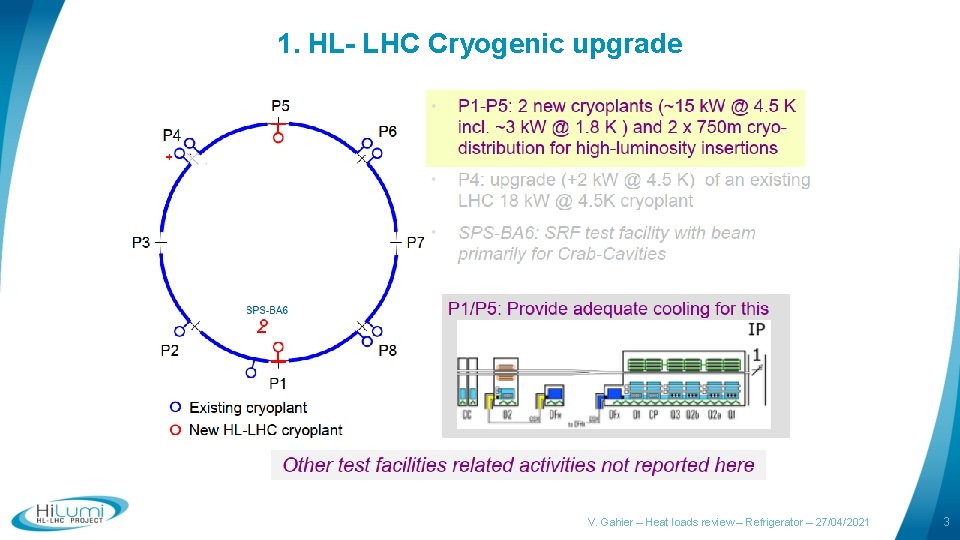
1. HL- LHC Cryogenic upgrade V. Gahier – Heat loads review – Refrigerator – 27/04/2021 3

Outline 1. Introduction : HL- LHC Cryogenic upgrade 2. HL-LHC Cryogenic architecture § P 1/P 5 Cryogenic architecture § Refrigerator Scope of supply § From Users needs to Refrigerator supply 3. Distribution system § QXL (cryogenic distribution line) heat loads – Example of IP 5 § Service Module Heat loads 4. Cooling capacity at 60/80 K § § 5. Cooling capacity from Supercritical helium § § 6. Users requirements Cooling capacity for User Refrigerator design capacity and conclusions V. Gahier – Heat loads review – Refrigerator – 27/04/2021 4
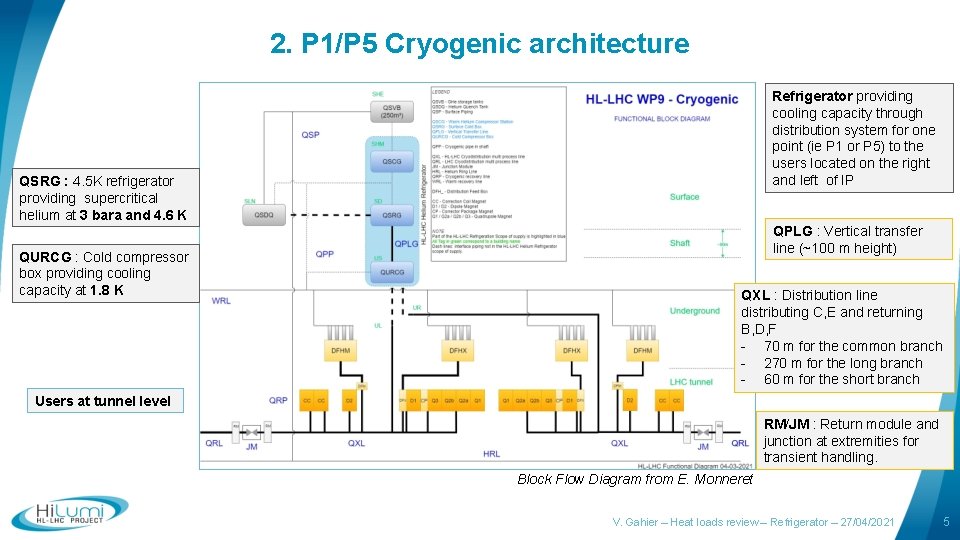
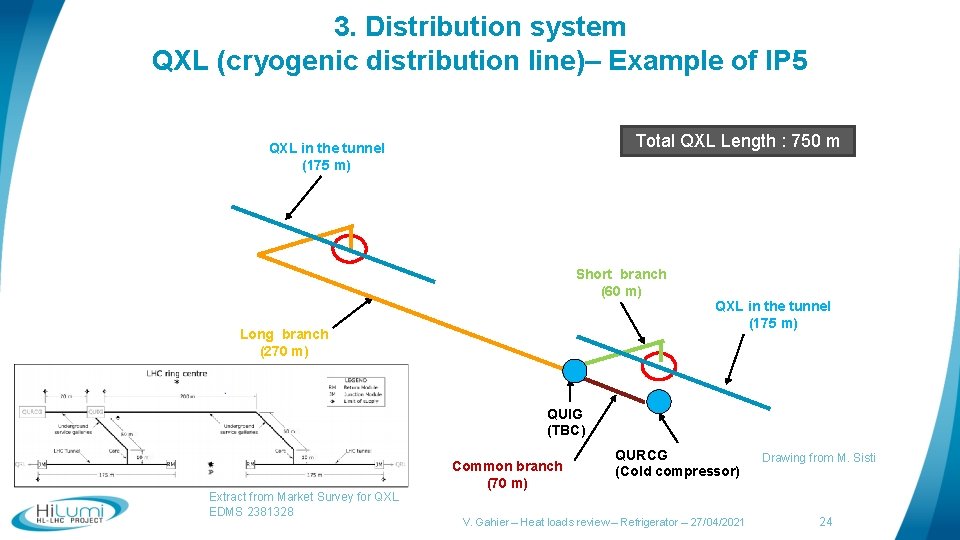
2. P 1/P 5 Cryogenic architecture Refrigerator providing cooling capacity through distribution system for one point (ie P 1 or P 5) to the users located on the right and left of IP QSRG : 4. 5 K refrigerator providing supercritical helium at 3 bara and 4. 6 K QURCG : Cold compressor box providing cooling capacity at 1. 8 K QPLG : Vertical transfer line (~100 m height) QXL : Distribution line distributing C, E and returning B, D, F - 70 m for the common branch - 270 m for the long branch - 60 m for the short branch Users at tunnel level RM/JM : Return module and junction at extremities for transient handling. Block Flow Diagram from E. Monneret V. Gahier – Heat loads review – Refrigerator – 27/04/2021 5
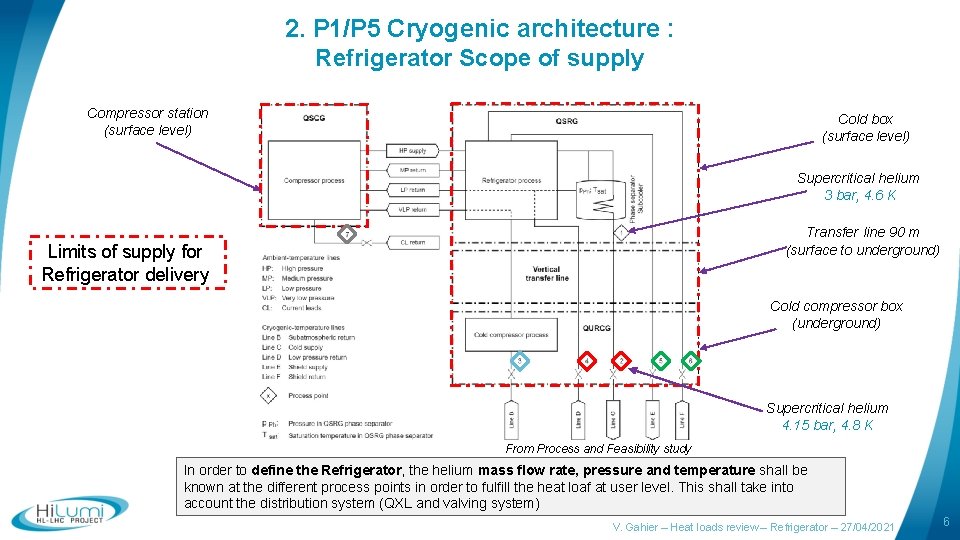
2. P 1/P 5 Cryogenic architecture : Refrigerator Scope of supply Compressor station (surface level) Cold box (surface level) Supercritical helium 3 bar, 4. 6 K Transfer line 90 m (surface to underground) Limits of supply for Refrigerator delivery Cold compressor box (underground) Supercritical helium 4. 15 bar, 4. 8 K From Process and Feasibility study In order to define the Refrigerator, the helium mass flow rate, pressure and temperature shall be known at the different process points in order to fulfill the heat loaf at user level. This shall take into account the distribution system (QXL and valving system) V. Gahier – Heat loads review – Refrigerator – 27/04/2021 6
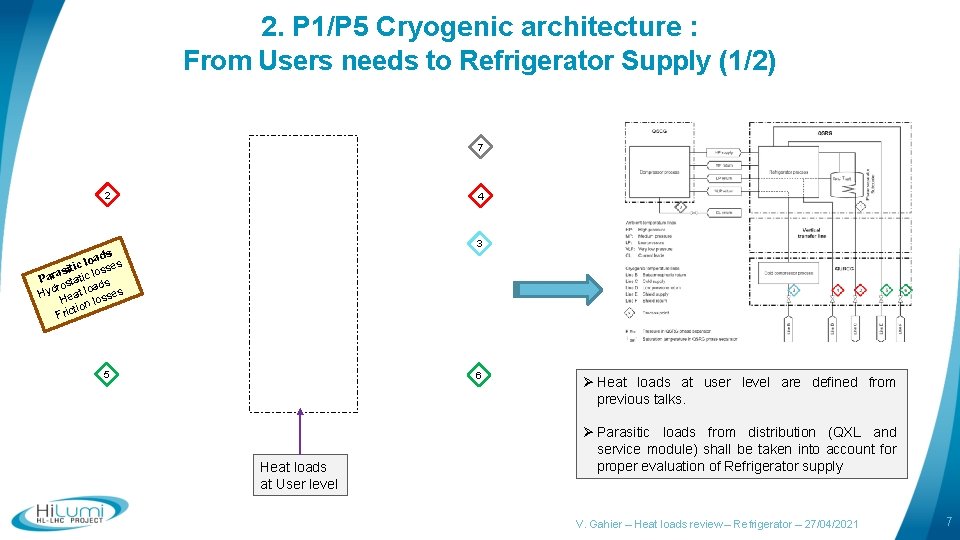
2. P 1/P 5 Cryogenic architecture : From Users needs to Refrigerator Supply (1/2) 7 2 4 3 ds loa es c i t loss asi Par static ds ro a Hyd eat lo sses H lo tion Fric 5 6 Heat loads at User level Ø Heat loads at user level are defined from previous talks. Ø Parasitic loads from distribution (QXL and service module) shall be taken into account for proper evaluation of Refrigerator supply V. Gahier – Heat loads review – Refrigerator – 27/04/2021 7
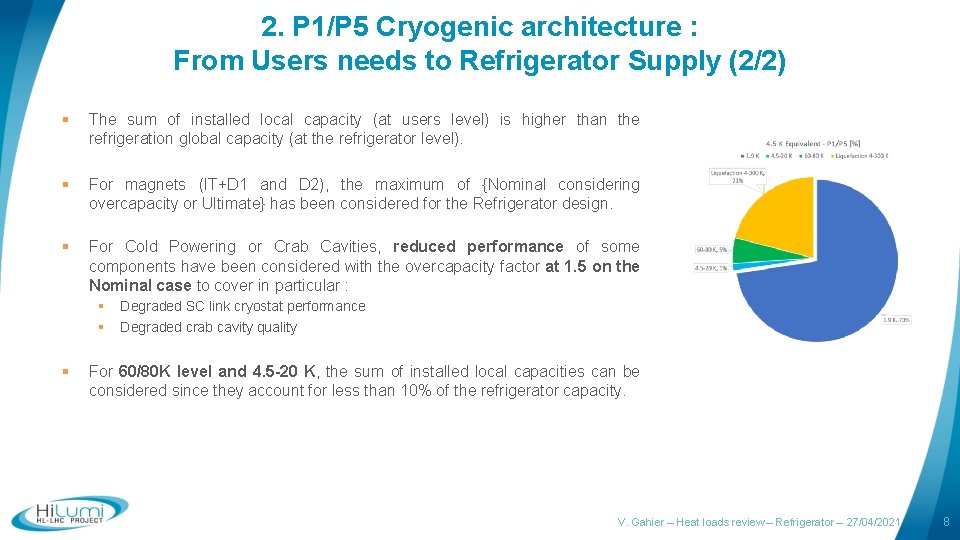
2. P 1/P 5 Cryogenic architecture : From Users needs to Refrigerator Supply (2/2) § The sum of installed local capacity (at users level) is higher than the refrigeration global capacity (at the refrigerator level). § For magnets (IT+D 1 and D 2), the maximum of {Nominal considering overcapacity or Ultimate} has been considered for the Refrigerator design. § For Cold Powering or Crab Cavities, reduced performance of some components have been considered with the overcapacity factor at 1. 5 on the Nominal case to cover in particular : § § § Degraded SC link cryostat performance Degraded crab cavity quality For 60/80 K level and 4. 5 -20 K, the sum of installed local capacities can be considered since they account for less than 10% of the refrigerator capacity. V. Gahier – Heat loads review – Refrigerator – 27/04/2021 8
Outline 1. Introduction : HL- LHC Cryogenic upgrade 2. HL-LHC Cryogenic architecture § P 1/P 5 Cryogenic architecture § Refrigerator Scope of supply § From Users needs to Refrigerator supply 3. Distribution system § QXL (cryogenic distribution line) heat loads – Example of IP 5 § Service Module Heat loads 4. Cooling capacity at 60/80 K § § 5. Cooling capacity from Supercritical helium § § 6. Users requirements Cooling capacity for User Refrigerator design capacity and conclusions V. Gahier – Heat loads review – Refrigerator – 27/04/2021 9
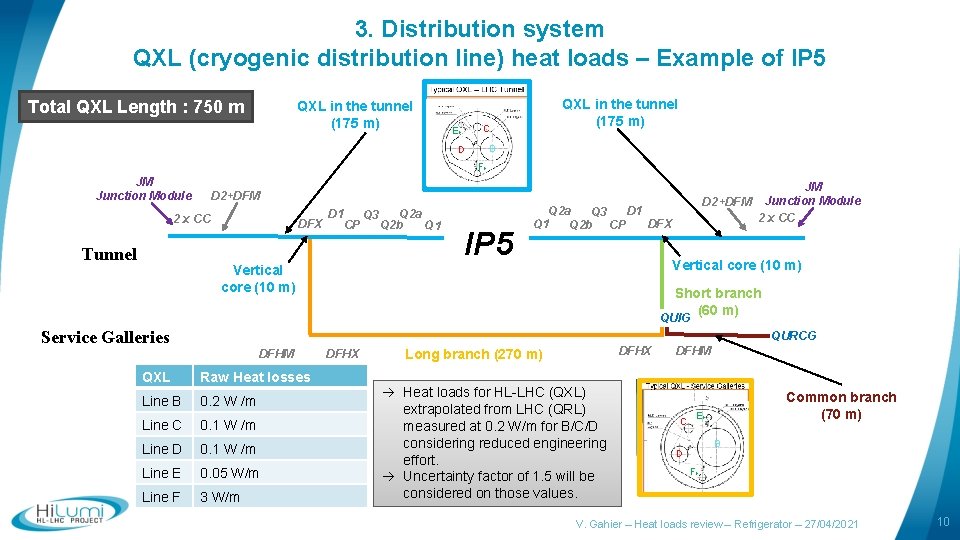
3. Distribution system QXL (cryogenic distribution line) heat loads – Example of IP 5 Total QXL Length : 750 m QXL in the tunnel (175 m) C E H B D F JM Junction Module H JM D 2+DFM Junction Module 2 x CC D 2+DFM 2 x CC Tunnel QXL in the tunnel (175 m) DFX D 1 Q 2 a Q 3 Q 1 CP Q 2 b IP 5 Q 2 a D 1 Q 3 DFX Q 1 Q 2 b CP Vertical core (10 m) Short branch (60 m) QUIG Service Galleries QURCG DFHM QXL Raw Heat losses Line B 0. 2 W /m Line C 0. 1 W /m Line D 0. 1 W /m Line E 0. 05 W/m Line F 3 W/m DFHX Long branch (270 m) Heat loads for HL-LHC (QXL) extrapolated from LHC (QRL) measured at 0. 2 W/m for B/C/D considering reduced engineering effort. Uncertainty factor of 1. 5 will be considered on those values. DFHM Common branch (70 m) E H C B D F H V. Gahier – Heat loads review – Refrigerator – 27/04/2021 10
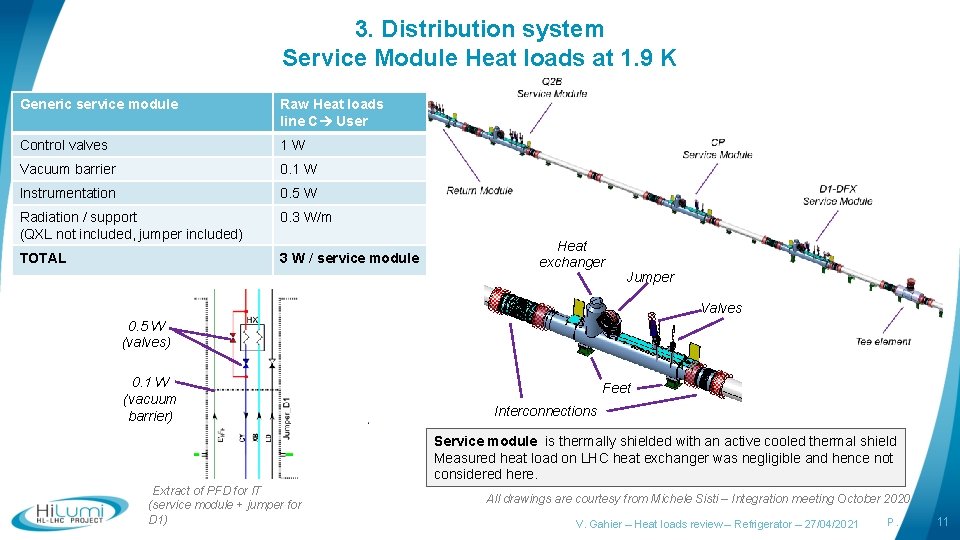
3. Distribution system Service Module Heat loads at 1. 9 K Generic service module Raw Heat loads line C User Control valves 1 W Vacuum barrier 0. 1 W Instrumentation 0. 5 W Radiation / support (QXL not included, jumper included) 0. 3 W/m TOTAL 3 W / service module Heat exchanger Jumper Valves 0. 5 W (valves) 0. 1 W (vacuum barrier) Feet Interconnections Service module is thermally shielded with an active cooled thermal shield Measured heat load on LHC heat exchanger was negligible and hence not considered here. Extract of PFD for IT (service module + jumper for D 1) All drawings are courtesy from Michele Sisti – Integration meeting October 2020 V. Gahier – Heat loads review – Refrigerator – 27/04/2021 P. 11
Outline 1. Introduction : HL- LHC Cryogenic upgrade 2. HL-LHC Cryogenic architecture § P 1/P 5 Cryogenic architecture § Refrigerator Scope of supply § From Users needs to Refrigerator supply 3. Distribution system § QXL (cryogenic distribution line) heat loads – Example of IP 5 § Service Module Heat loads 4. Cooling capacity at 60/80 K § § 5. Cooling capacity from Supercritical helium § § 6. Users requirements Cooling capacity for User Refrigerator design capacity and conclusions V. Gahier – Heat loads review – Refrigerator – 27/04/2021 12
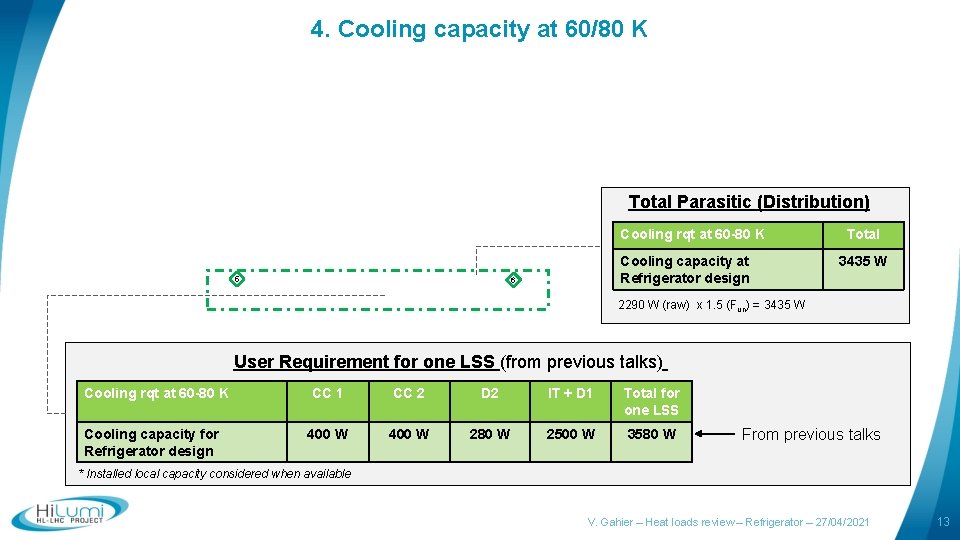
4. Cooling capacity at 60/80 K Total Parasitic (Distribution) Cooling rqt at 60 -80 K 5 Cooling capacity at Refrigerator design 6 Total 3435 W 2290 W (raw) x 1. 5 (Fun) = 3435 W User Requirement for one LSS (from previous talks) Cooling rqt at 60 -80 K Cooling capacity for Refrigerator design CC 1 CC 2 D 2 IT + D 1 Total for one LSS 400 W 280 W 2500 W 3580 W From previous talks * Installed local capacity considered when available V. Gahier – Heat loads review – Refrigerator – 27/04/2021 13
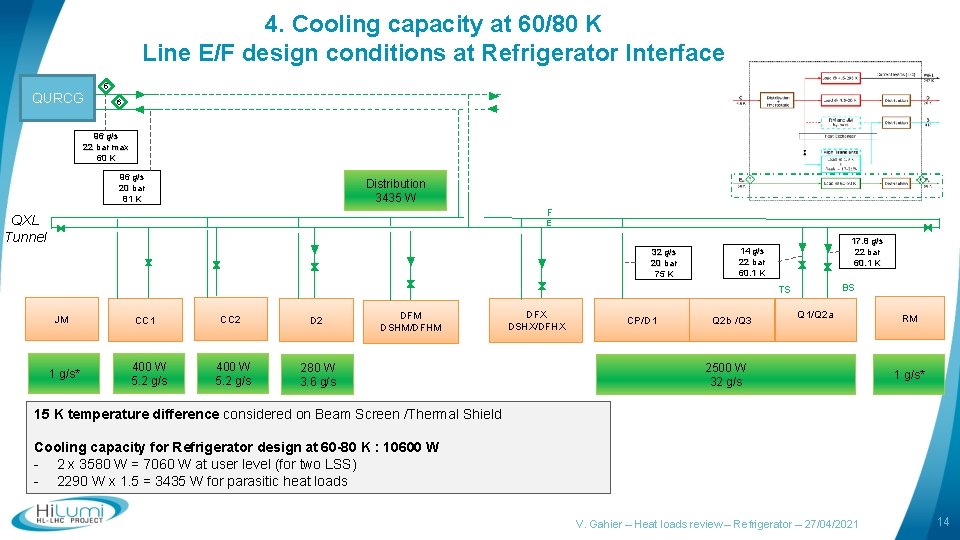
4. Cooling capacity at 60/80 K Line E/F design conditions at Refrigerator Interface QURCG 5 6 96 g/s 22 bar max 60 K 96 g/s 20 bar 81 K Distribution 3435 W F QXL Tunnel E 32 g/s 20 bar 75 K 17. 8 g/s 22 bar 60. 1 K 14 g/s 22 bar 60. 1 K BS TS JM 1 g/s* CC 1 400 W 5. 2 g/s CC 2 D 2 400 W 5. 2 g/s 280 W 3. 6 g/s DFM DSHM/DFHM DFX DSHX/DFHX CP/D 1 Q 2 b /Q 3 Q 1/Q 2 a 2500 W 32 g/s RM 1 g/s* 15 K temperature difference considered on Beam Screen /Thermal Shield Cooling capacity for Refrigerator design at 60 -80 K : 10600 W - 2 x 3580 W = 7060 W at user level (for two LSS) - 2290 W x 1. 5 = 3435 W for parasitic heat loads V. Gahier – Heat loads review – Refrigerator – 27/04/2021 14
Outline 1. Introduction : HL- LHC Cryogenic upgrade 2. HL-LHC Cryogenic architecture § P 1/P 5 Cryogenic architecture § Refrigerator Scope of supply § From Users needs to Refrigerator supply 3. Distribution system § QXL (cryogenic distribution line) heat loads – Example of IP 5 § Service Module Heat loads 4. Cooling capacity at 60/80 K § § 5. Cooling capacity from Supercritical helium § § 6. Users requirements Cooling capacity for User Refrigerator design capacity and conclusions V. Gahier – Heat loads review – Refrigerator – 27/04/2021 15
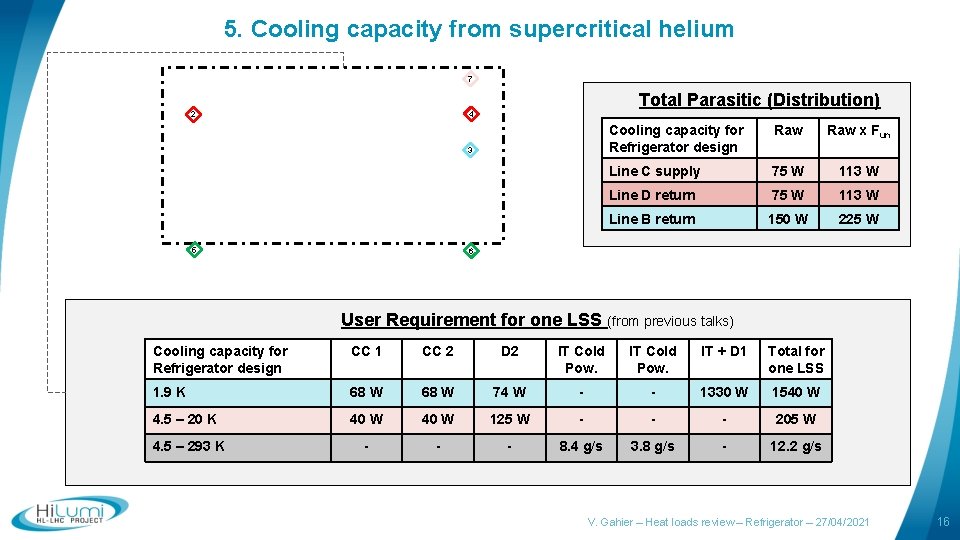
5. Cooling capacity from supercritical helium 7 Total Parasitic (Distribution) 4 2 3 5 Cooling capacity for Refrigerator design Raw x Fun Line C supply 75 W 113 W Line D return 75 W 113 W Line B return 150 W 225 W 6 User Requirement for one LSS (from previous talks) Cooling capacity for Refrigerator design CC 1 CC 2 D 2 IT Cold Pow. IT + D 1 Total for one LSS 1. 9 K 68 W 74 W - - 1330 W 1540 W 4. 5 – 20 K 40 W 125 W - - - 205 W 4. 5 – 293 K - - - 8. 4 g/s 3. 8 g/s - 12. 2 g/s V. Gahier – Heat loads review – Refrigerator – 27/04/2021 16
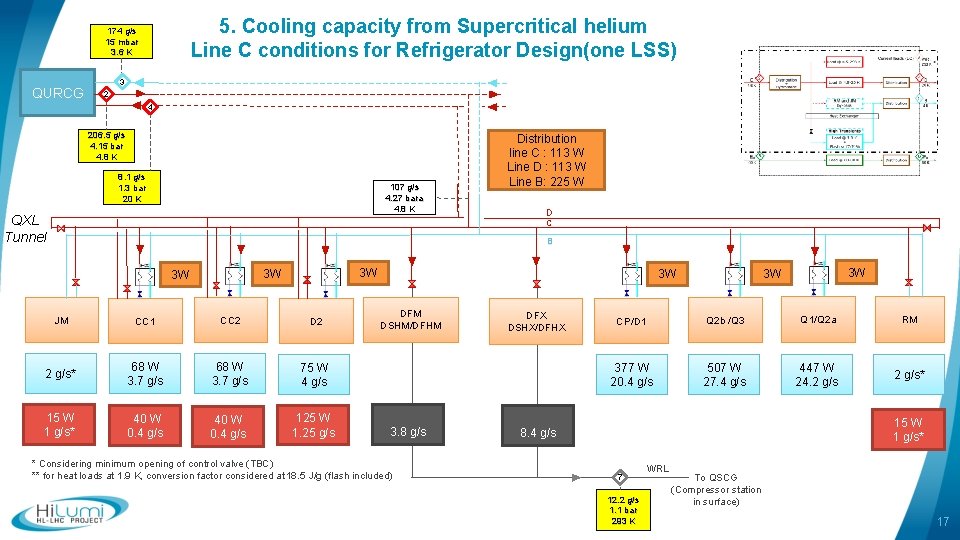
5. Cooling capacity from Supercritical helium Line C conditions for Refrigerator Design(one LSS) 174 g/s 15 mbar 3. 6 K QURCG 3 2 4 206. 5 g/s 4. 15 bar 4. 8 K 8. 1 g/s 1. 3 bar 20 K 107 g/s 4. 27 bara 4. 8 K QXL Tunnel Distribution line C : 113 W Line D : 113 W Line B: 225 W D C B 3 W 3 W 3 W JM CC 1 CC 2 D 2 2 g/s* 68 W 3. 7 g/s 75 W 4 g/s 15 W 1 g/s* 40 W 0. 4 g/s 125 W 1. 25 g/s DFM DSHM/DFHM 3. 8 g/s * Considering minimum opening of control valve (TBC) ** for heat loads at 1. 9 K, conversion factor considered at 18. 5 J/g (flash included) DFX DSHX/DFHX 3 W 3 W 3 W CP/D 1 Q 2 b /Q 3 Q 1/Q 2 a RM 377 W 20. 4 g/s 507 W 27. 4 g/s 447 W 24. 2 g/s* 15 W 1 g/s* 8. 4 g/s 7 12. 2 g/s 1. 1 bar 293 K WRL To QSCG (Compressor station in surface) 17
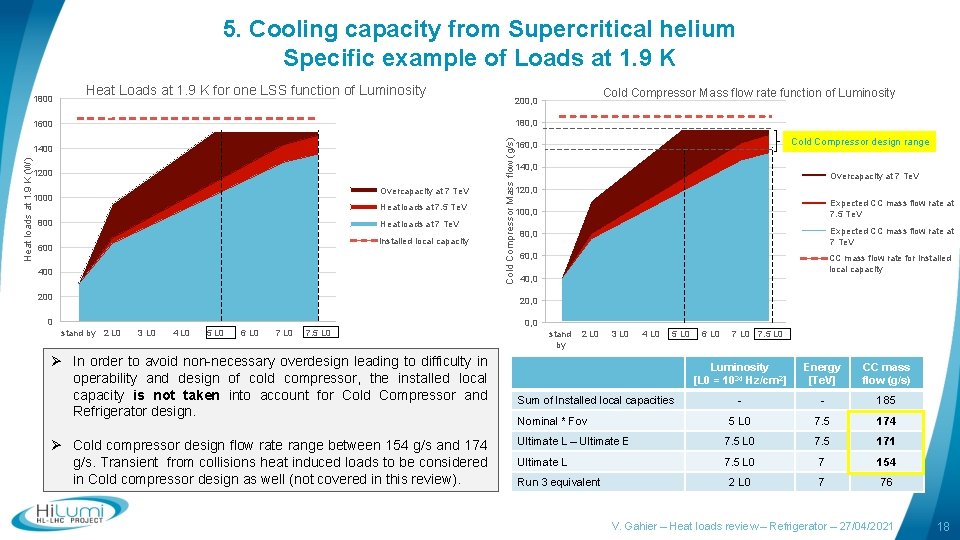
5. Cooling capacity from Supercritical helium Specific example of Loads at 1. 9 K 1800 Heat Loads at 1. 9 K for one LSS function of Luminosity 180, 0 1400 1200 Overcapacity at 7 Te. V 1000 Heat loads at 7. 5 Te. V 800 Heat loads at 7 Te. V Installed local capacity 600 400 200 Cold Compressor Mass flow (g/s) 1600 Heat loads at 1. 9 K (W) Cold Compressor Mass flow rate function of Luminosity 200, 0 Cold Compressor design range 160, 0 140, 0 Overcapacity at 7 Te. V 120, 0 100, 0 Expected CC mass flow rate at 7. 5 Te. V 80, 0 Expected CC mass flow rate at 7 Te. V 60, 0 CC mass flow rate for installed local capacity 40, 0 20, 0 0 stand by 2 L 0 3 L 0 4 L 0 5 L 0 6 L 0 7. 5 L 0 Ø In order to avoid non-necessary overdesign leading to difficulty in operability and design of cold compressor, the installed local capacity is not taken into account for Cold Compressor and Refrigerator design. Ø Cold compressor design flow rate range between 154 g/s and 174 g/s. Transient from collisions heat induced loads to be considered in Cold compressor design as well (not covered in this review). 0, 0 stand by 2 L 0 3 L 0 4 L 0 5 L 0 6 L 0 7. 5 L 0 Luminosity [L 0 = 1034 Hz/cm 2] Energy [Te. V] CC mass flow (g/s) - - 185 5 L 0 7. 5 174 Ultimate L – Ultimate E 7. 5 L 0 7. 5 171 Ultimate L 7. 5 L 0 7 154 2 L 0 7 76 Sum of Installed local capacities Nominal * Fov Run 3 equivalent V. Gahier – Heat loads review – Refrigerator – 27/04/2021 18
Outline 1. Introduction : HL- LHC Cryogenic upgrade 2. HL-LHC Cryogenic architecture § P 1/P 5 Cryogenic architecture § Refrigerator Scope of supply § From Users needs to Refrigerator supply 3. Distribution system § QXL (cryogenic distribution line) heat loads – Example of IP 5 § Service Module Heat loads 4. Cooling capacity at 60/80 K § § 5. Cooling capacity from Supercritical helium § § 6. Users requirements Cooling capacity for User Refrigerator design capacity and conclusions V. Gahier – Heat loads review – Refrigerator – 27/04/2021 19
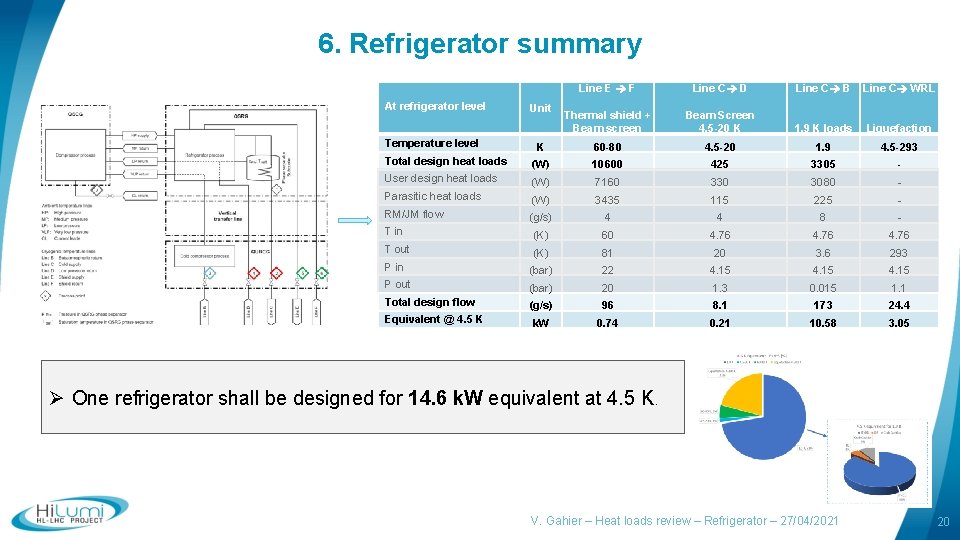
6. Refrigerator summary Line E F Line C D Line C B Line C WRL Thermal shield + Beam screen Beam Screen 4. 5 -20 K 1. 9 K loads Liquefaction K 60 -80 4. 5 -20 1. 9 4. 5 -293 Total design heat loads (W) 10600 425 3305 - User design heat loads (W) 7160 330 3080 - Parasitic heat loads (W) 3435 115 225 - RM/JM flow At refrigerator level Temperature level Unit (g/s) 4 4 8 - T in (K) 60 4. 76 T out (K) 81 20 3. 6 293 P in (bar) 22 4. 15 P out (bar) 20 1. 3 0. 015 1. 1 Total design flow (g/s) 96 8. 1 173 24. 4 k. W 0. 74 0. 21 10. 58 3. 05 Equivalent @ 4. 5 K Ø One refrigerator shall be designed for 14. 6 k. W equivalent at 4. 5 K. V. Gahier – Heat loads review – Refrigerator – 27/04/2021 20
6. Conclusion § Users heat loads requirements needs now to be frozen. § Refrigerator is mostly defined by the load at 1. 9 K for the IT+D 1. Detailed evaluation has been performed for IT static heat loads taking into account the maturity of design. § Margin considered for the refrigerator seems reasonable to us : § Ultimate luminosity and energy case is covered; § Nominal case with overcapacity factor of 150% is covered; § Potential performances degradation of material is considered. Based on the outcome of the review Final tuning of the required capacity for the refrigerator will be decided for Refrigerator IT. Thanks for your time and questions V. Gahier – Heat loads review – Refrigerator – 27/04/2021 21

Thanks for your time and questions P. Zijm, V. Gahier; TE - CRG 22
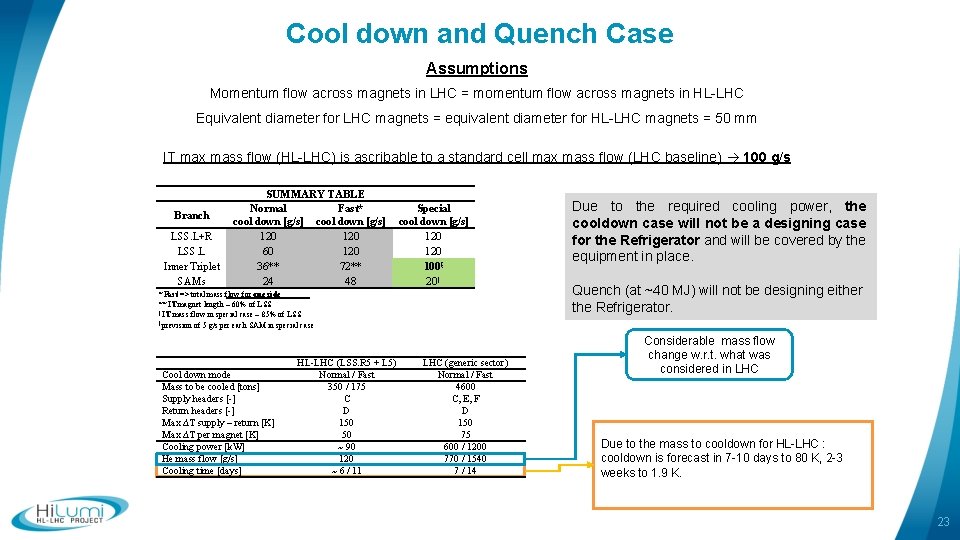
Cool down and Quench Case Assumptions Momentum flow across magnets in LHC = momentum flow across magnets in HL-LHC Equivalent diameter for LHC magnets = equivalent diameter for HL-LHC magnets = 50 mm IT max mass flow (HL-LHC) is ascribable to a standard cell max mass flow (LHC baseline) 100 g/s Branch LSS. L+R LSS. L Inner Triplet SAMs SUMMARY TABLE Normal Fast* cool down [g/s] 120 60 120 36** 72** 24 48 Special cool down [g/s] 120 100§ 20† * Fast => total mass flow for one side ** IT magnet length ~ 60% of LSS § IT mass flow in special case ~ 85% of LSS † prevision of 5 g/s per each SAM in special case Cool down mode Mass to be cooled [tons] Supply headers [-] Return headers [-] Max ΔT supply – return [K] Max ΔT per magnet [K] Cooling power [k. W] He mass flow [g/s] Cooling time [days] HL-LHC (LSS. R 5 + L 5) Normal / Fast 350 / 175 C D 150 50 ~ 90 120 ~ 6 / 11 LHC (generic sector) Normal / Fast 4600 C, E, F D 150 75 600 / 1200 770 / 1540 7 / 14 Due to the required cooling power, the cooldown case will not be a designing case for the Refrigerator and will be covered by the equipment in place. Quench (at ~40 MJ) will not be designing either the Refrigerator. Considerable mass flow change w. r. t. what was considered in LHC Due to the mass to cooldown for HL-LHC : cooldown is forecast in 7 -10 days to 80 K, 2 -3 weeks to 1. 9 K. 23
3. Distribution system QXL (cryogenic distribution line)– Example of IP 5 Total QXL Length : 750 m QXL in the tunnel (175 m) Short branch (60 m) Long branch (270 m) QXL in the tunnel (175 m) QUIG (TBC) Extract from Market Survey for QXL EDMS 2381328 Common branch (70 m) QURCG (Cold compressor) V. Gahier – Heat loads review – Refrigerator – 27/04/2021 Drawing from M. Sisti 24
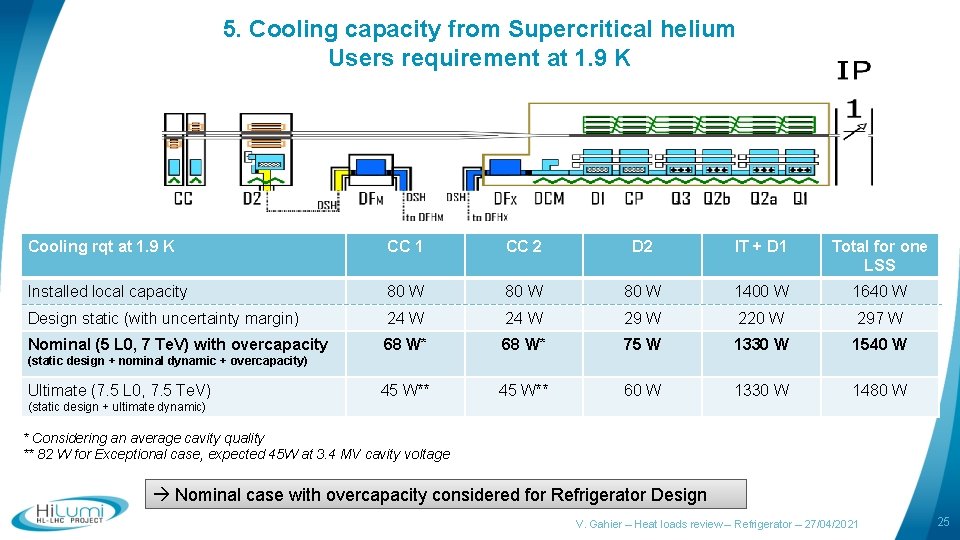
5. Cooling capacity from Supercritical helium Users requirement at 1. 9 K Cooling rqt at 1. 9 K CC 1 CC 2 D 2 IT + D 1 Total for one LSS Installed local capacity 80 W 1400 W 1640 W Design static (with uncertainty margin) 24 W 29 W 220 W 297 W Nominal (5 L 0, 7 Te. V) with overcapacity 68 W* 75 W 1330 W 1540 W 45 W** 60 W 1330 W 1480 W (static design + nominal dynamic + overcapacity) Ultimate (7. 5 L 0, 7. 5 Te. V) (static design + ultimate dynamic) * Considering an average cavity quality ** 82 W for Exceptional case, expected 45 W at 3. 4 MV cavity voltage Nominal case with overcapacity considered for Refrigerator Design V. Gahier – Heat loads review – Refrigerator – 27/04/2021 25
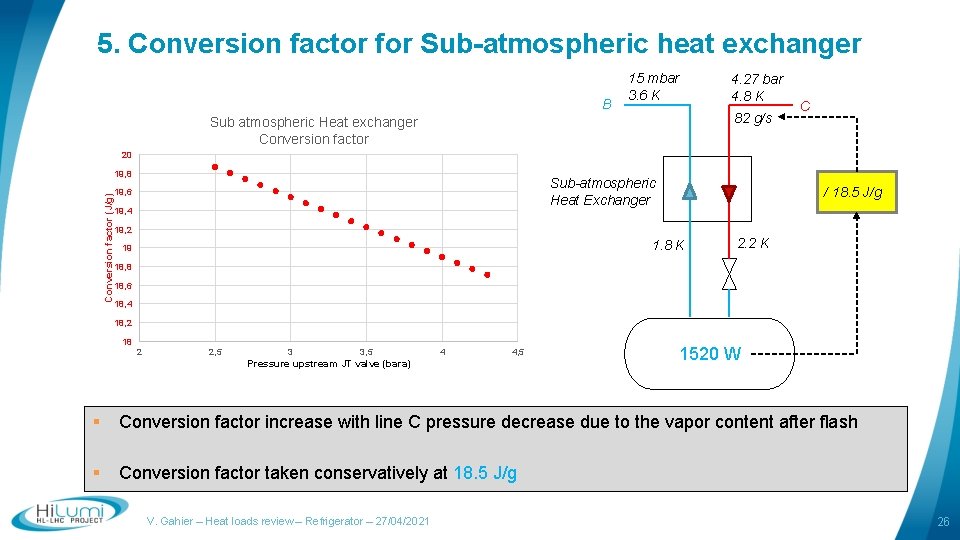
5. Conversion factor for Sub-atmospheric heat exchanger B 15 mbar 3. 6 K 4. 27 bar 4. 8 K 82 g/s Sub atmospheric Heat exchanger Conversion factor C 20 Conversion factor (J/g) 19, 8 Sub-atmospheric Heat Exchanger 19, 6 19, 4 / 18. 5 J/g 19, 2 1. 8 K 19 2. 2 K 18, 8 18, 6 18, 4 18, 2 18 2 2, 5 3 3, 5 4 4, 5 Pressure upstream JT valve (bara) 1520 W § Conversion factor increase with line C pressure decrease due to the vapor content after flash § Conversion factor taken conservatively at 18. 5 J/g V. Gahier – Heat loads review – Refrigerator – 27/04/2021 26
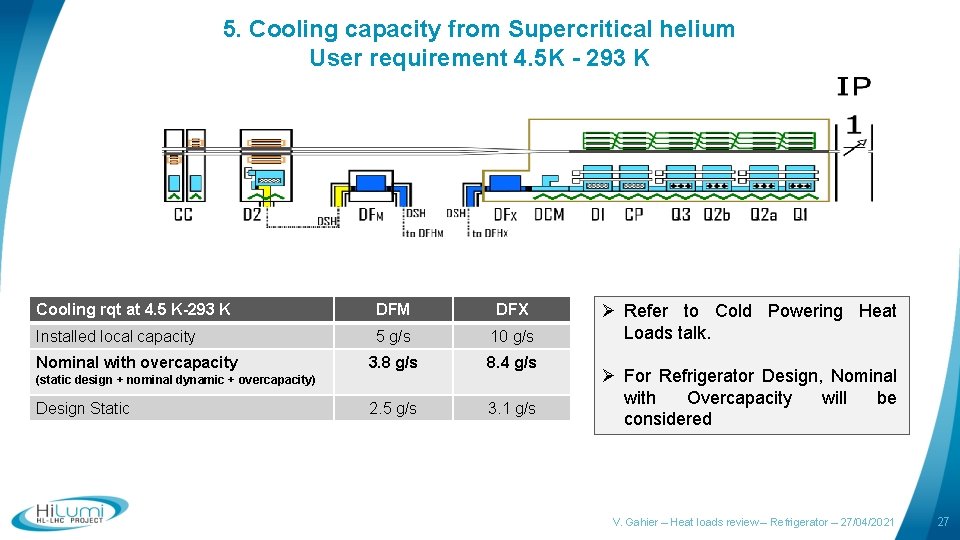
5. Cooling capacity from Supercritical helium User requirement 4. 5 K - 293 K Cooling rqt at 4. 5 K-293 K DFM DFX Installed local capacity 5 g/s 10 g/s 3. 8 g/s 8. 4 g/s 2. 5 g/s 3. 1 g/s Nominal with overcapacity (static design + nominal dynamic + overcapacity) Design Static Ø Refer to Cold Powering Heat Loads talk. Ø For Refrigerator Design, Nominal with Overcapacity will be considered V. Gahier – Heat loads review – Refrigerator – 27/04/2021 27
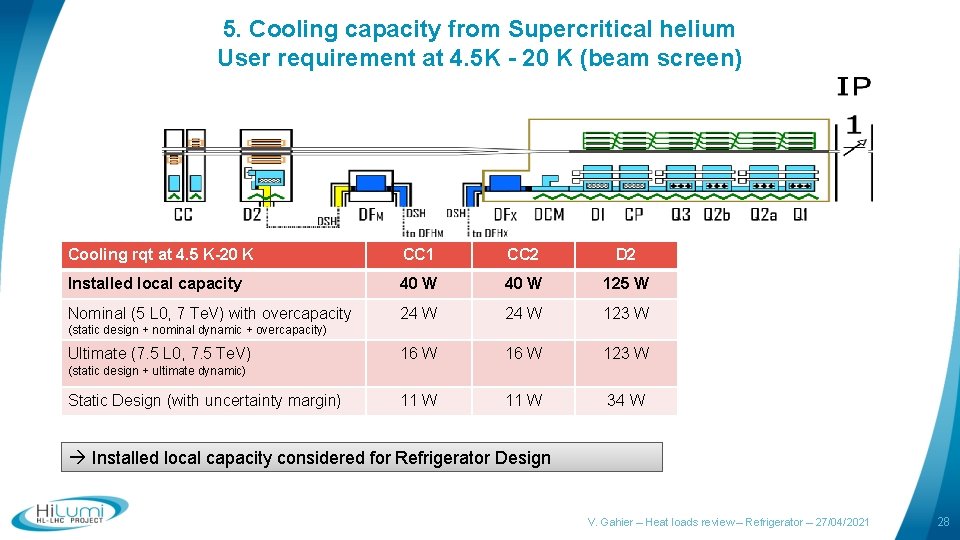
5. Cooling capacity from Supercritical helium User requirement at 4. 5 K - 20 K (beam screen) Cooling rqt at 4. 5 K-20 K CC 1 CC 2 D 2 Installed local capacity 40 W 125 W Nominal (5 L 0, 7 Te. V) with overcapacity 24 W 123 W 16 W 123 W 11 W 34 W (static design + nominal dynamic + overcapacity) Ultimate (7. 5 L 0, 7. 5 Te. V) (static design + ultimate dynamic) Static Design (with uncertainty margin) Installed local capacity considered for Refrigerator Design V. Gahier – Heat loads review – Refrigerator – 27/04/2021 28
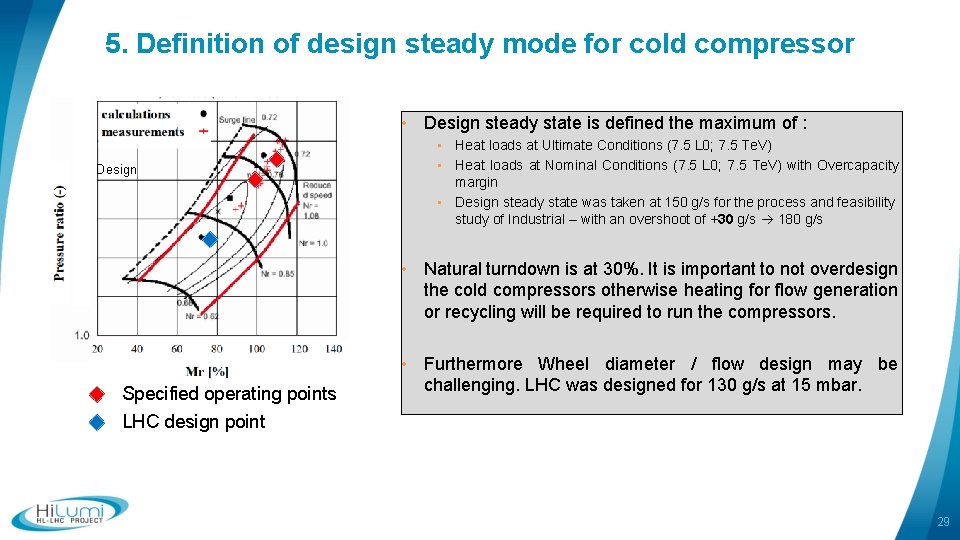
5. Definition of design steady mode for cold compressor • Design steady state is defined the maximum of : Design • Heat loads at Ultimate Conditions (7. 5 L 0; 7. 5 Te. V) • Heat loads at Nominal Conditions (7. 5 L 0; 7. 5 Te. V) with Overcapacity margin • Design steady state was taken at 150 g/s for the process and feasibility study of Industrial – with an overshoot of +30 g/s 180 g/s • Natural turndown is at 30%. It is important to not overdesign the cold compressors otherwise heating for flow generation or recycling will be required to run the compressors. Specified operating points • Furthermore Wheel diameter / flow design may be challenging. LHC was designed for 130 g/s at 15 mbar. LHC design point 29
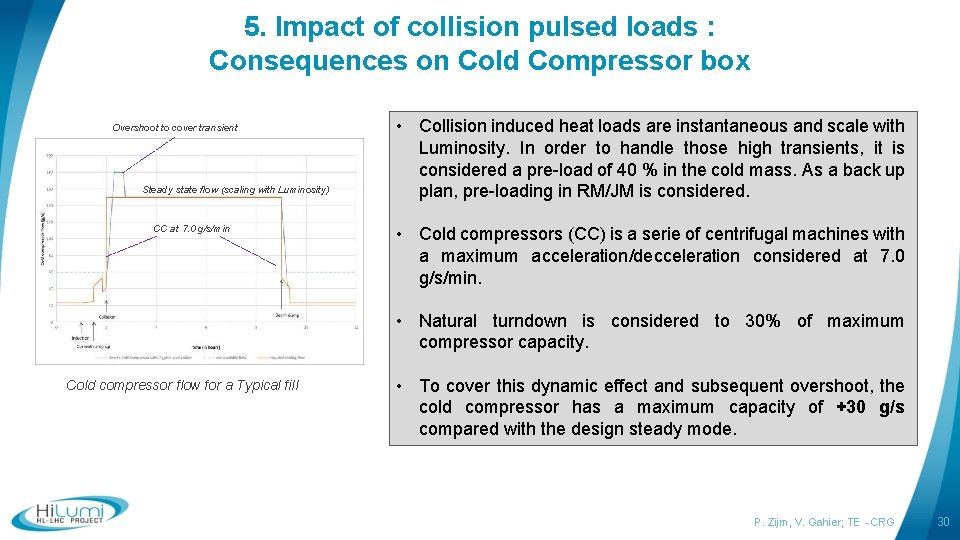
5. Impact of collision pulsed loads : Consequences on Cold Compressor box Overshoot to cover transient Steady state flow (scaling with Luminosity) CC at 7. 0 g/s/min • Collision induced heat loads are instantaneous and scale with Luminosity. In order to handle those high transients, it is considered a pre-load of 40 % in the cold mass. As a back up plan, pre-loading in RM/JM is considered. • Cold compressors (CC) is a serie of centrifugal machines with a maximum acceleration/decceleration considered at 7. 0 g/s/min. • Natural turndown is considered to 30% of maximum compressor capacity. Cold compressor flow for a Typical fill • To cover this dynamic effect and subsequent overshoot, the cold compressor has a maximum capacity of +30 g/s compared with the design steady mode. P. Zijm, V. Gahier; TE - CRG 30
- Slides: 30