
Heat Flux Measurement Adrian Sabau Metals and Ceramics
Heat Flux Measurement Adrian Sabau Metals and Ceramics Division Oak Ridge National Laboratory, Oak Ridge, TN 37831 Oak Ridge, TN August 29, 2006 OAK RIDGE NATIONAL LABORATORY U. S. DEPARTMENT OF ENERGY
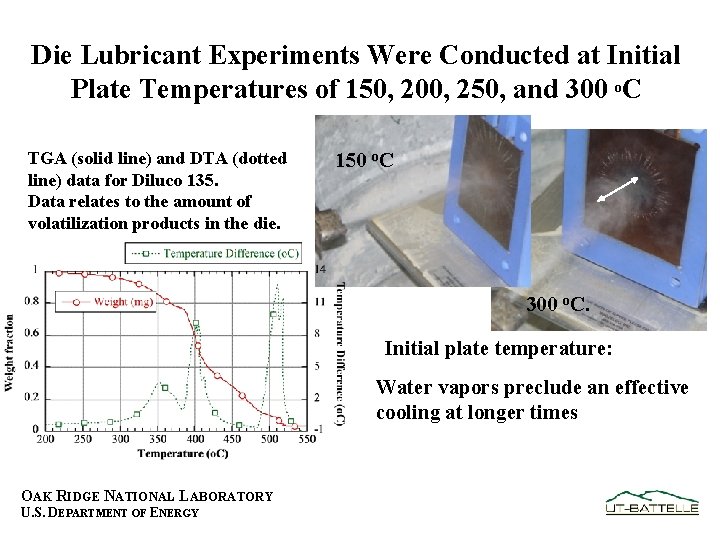
Die Lubricant Experiments Were Conducted at Initial Plate Temperatures of 150, 200, 250, and 300 o. C TGA (solid line) and DTA (dotted line) data for Diluco 135. Data relates to the amount of volatilization products in the die. 150 o. C 300 o. C. Initial plate temperature: Water vapors preclude an effective cooling at longer times OAK RIDGE NATIONAL LABORATORY U. S. DEPARTMENT OF ENERGY
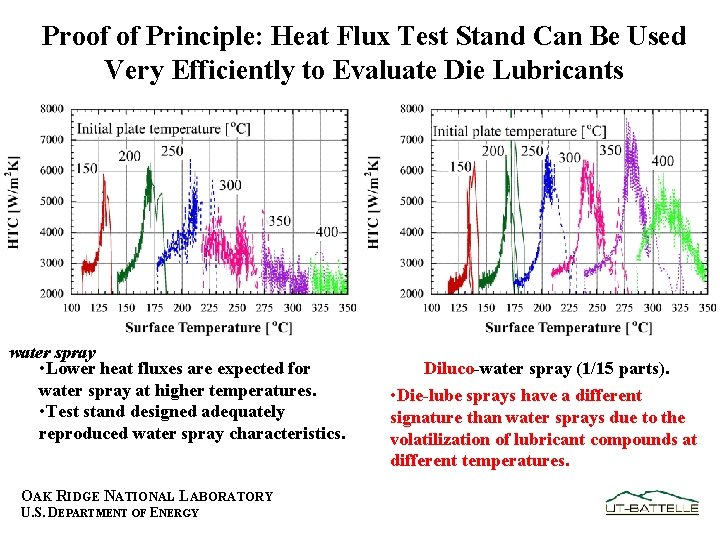
Proof of Principle: Heat Flux Test Stand Can Be Used Very Efficiently to Evaluate Die Lubricants water spray • Lower heat fluxes are expected for water spray at higher temperatures. • Test stand designed adequately reproduced water spray characteristics. OAK RIDGE NATIONAL LABORATORY U. S. DEPARTMENT OF ENERGY Diluco-water spray (1/15 parts). • Die-lube sprays have a different signature than water sprays due to the volatilization of lubricant compounds at different temperatures.
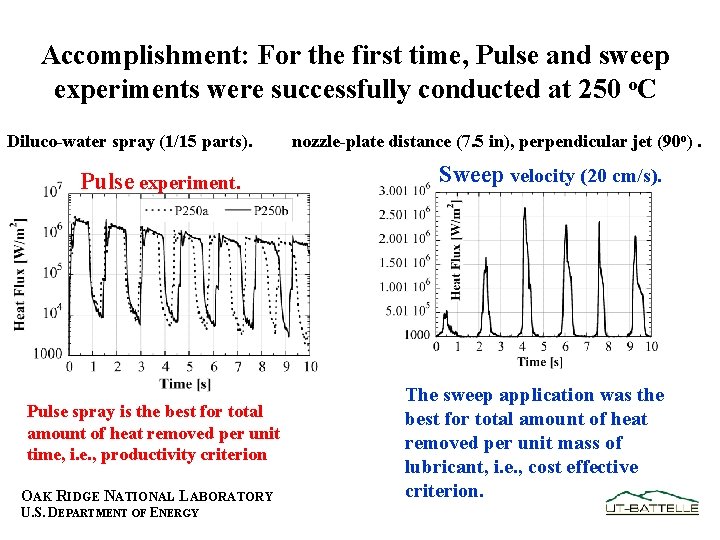
Accomplishment: For the first time, Pulse and sweep experiments were successfully conducted at 250 o. C Diluco-water spray (1/15 parts). Pulse experiment. Pulse spray is the best for total amount of heat removed per unit time, i. e. , productivity criterion OAK RIDGE NATIONAL LABORATORY U. S. DEPARTMENT OF ENERGY nozzle-plate distance (7. 5 in), perpendicular jet (90 o). Sweep velocity (20 cm/s). The sweep application was the best for total amount of heat removed per unit mass of lubricant, i. e. , cost effective criterion.
Industry Benefits due to the ORNL work on lubricant application process ·Validated test stand using heat flux sensors for die lubricants. ·Heat transfer coefficient was determined from heat flux measurements, ·More benefits: Heat flux measurements can be used to determine: · optimum nozzle distance, · desired application technique (sweeping or pulsing) · optimum timing of nozzle spray pulse, · optimum spray parameters (spray flow rate, water pressure, air pressure, time of spraying, nozzle velocity, or pulse duration) ·Two lubricant companies have expressed interest in using the ORNL approach. OAK RIDGE NATIONAL LABORATORY U. S. DEPARTMENT OF ENERGY
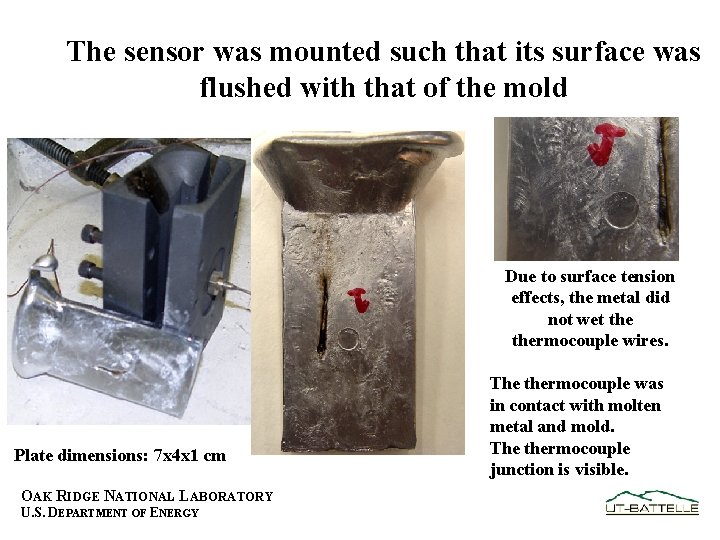
The sensor was mounted such that its surface was flushed with that of the mold Due to surface tension effects, the metal did not wet thermocouple wires. Plate dimensions: 7 x 4 x 1 cm OAK RIDGE NATIONAL LABORATORY U. S. DEPARTMENT OF ENERGY The thermocouple was in contact with molten metal and mold. The thermocouple junction is visible.
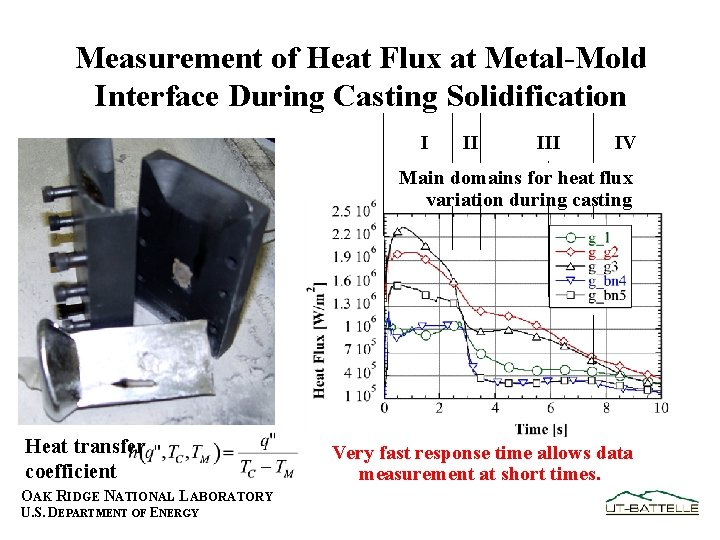
Measurement of Heat Flux at Metal-Mold Interface During Casting Solidification I II IV Main domains for heat flux variation during casting Heat transfer coefficient OAK RIDGE NATIONAL LABORATORY U. S. DEPARTMENT OF ENERGY Very fast response time allows data measurement at short times.
- Slides: 7