
Heat Exchanger Network Synthesis Part II Ref Seider

- Slides: 34
Heat Exchanger Network Synthesis, Part II Ref: Seider, Seader and Lewin (2004), Chapter 10 1
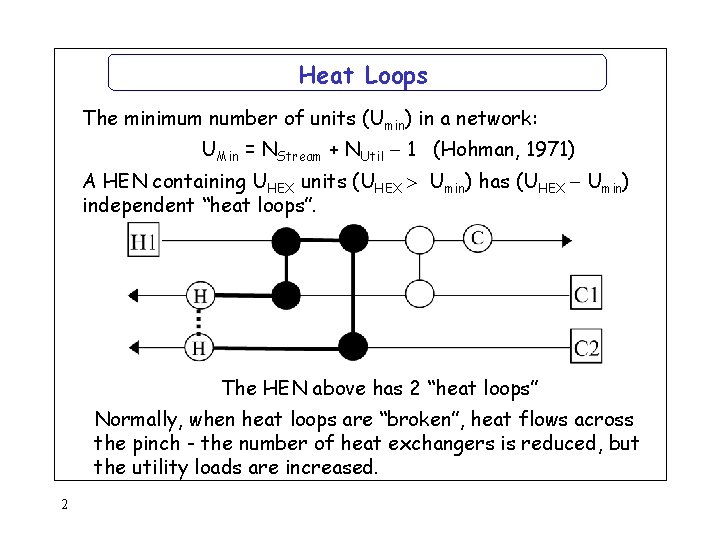
Heat Loops The minimum number of units (Umin) in a network: UMin = NStream + NUtil 1 (Hohman, 1971) A HEN containing UHEX units (UHEX Umin) has (UHEX Umin) independent “heat loops”. The HEN above has 2 “heat loops” Normally, when heat loops are “broken”, heat flows across the pinch - the number of heat exchangers is reduced, but the utility loads are increased. 2
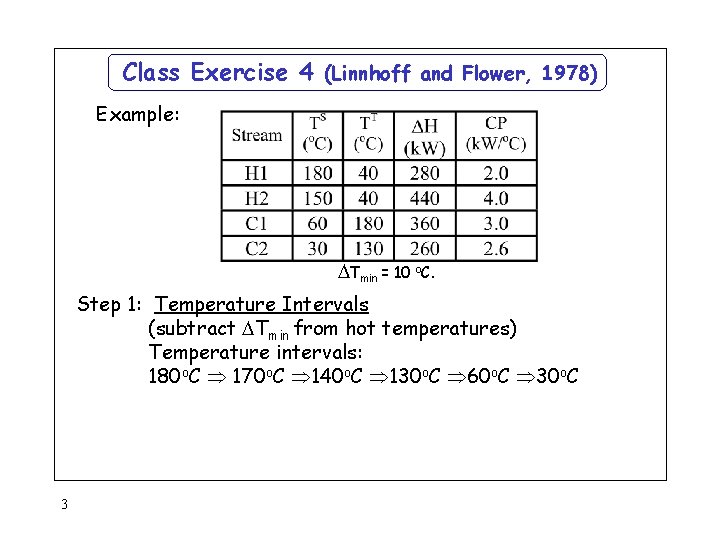
Class Exercise 4 (Linnhoff and Flower, 1978) Example: Tmin = 10 o. C. Step 1: Temperature Intervals (subtract Tmin from hot temperatures) Temperature intervals: 180 o. C 170 o. C 140 o. C 130 o. C 60 o. C 3
Class Exercise 4 (Cont’d) Step 2: Interval heat balances For each interval, compute: Hi = (Ti Ti+1) ( CPHot CPCold ) 4
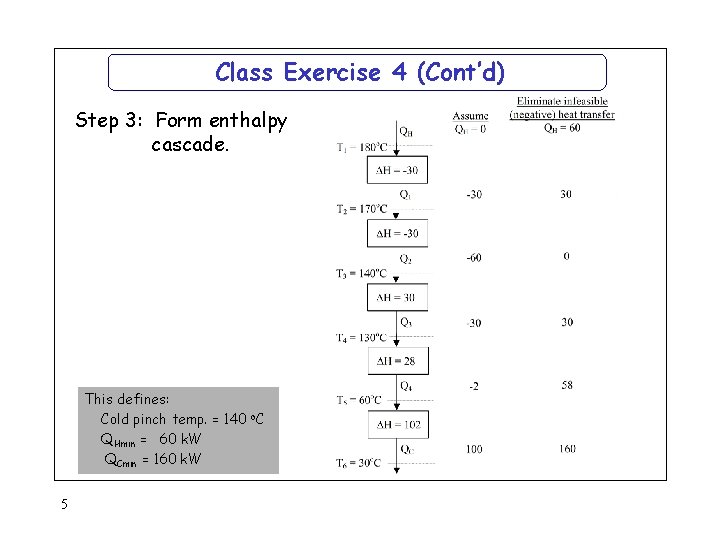
Class Exercise 4 (Cont’d) Step 3: Form enthalpy cascade. This defines: Cold pinch temp. = 140 o. C QHmin = 60 k. W QCmin = 160 k. W 5
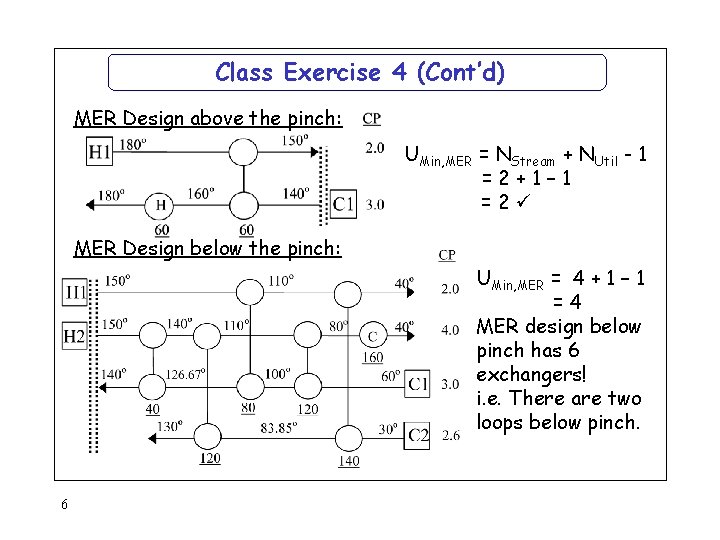
Class Exercise 4 (Cont’d) MER Design above the pinch: UMin, MER = NStream + NUtil - 1 =2+1– 1 =2 MER Design below the pinch: UMin, MER = 4 + 1 – 1 =4 MER design below pinch has 6 exchangers! i. e. There are two loops below pinch. 6
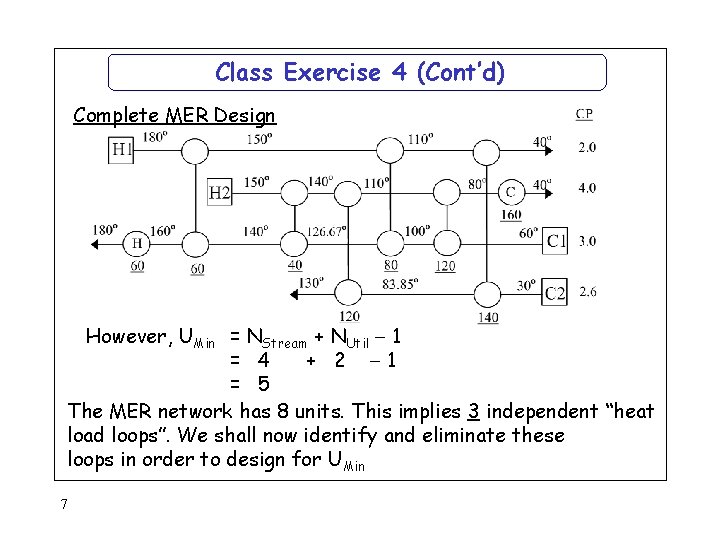
Class Exercise 4 (Cont’d) Complete MER Design However, UMin = NStream + NUtil 1 = 4 + 2 1 = 5 The MER network has 8 units. This implies 3 independent “heat load loops”. We shall now identify and eliminate these loops in order to design for UMin 7
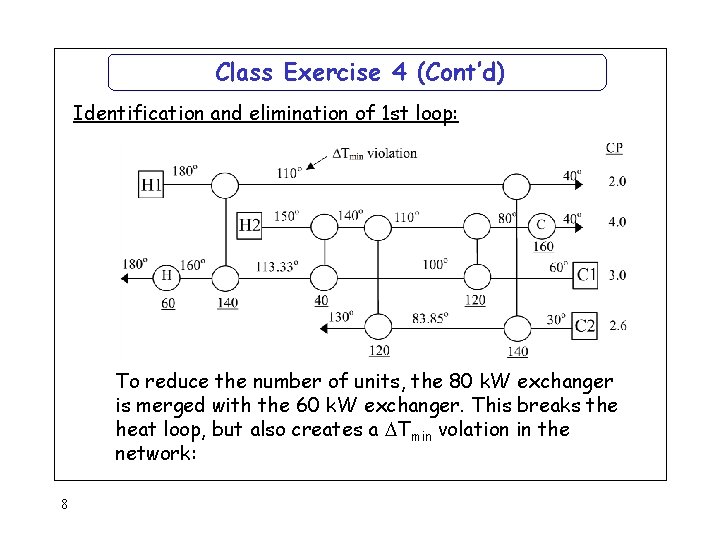
Class Exercise 4 (Cont’d) Identification and elimination of 1 st loop: To reduce the number of units, the 80 k. W exchanger is merged with the 60 k. W exchanger. This breaks the heat loop, but also creates a Tmin volation in the network: 8
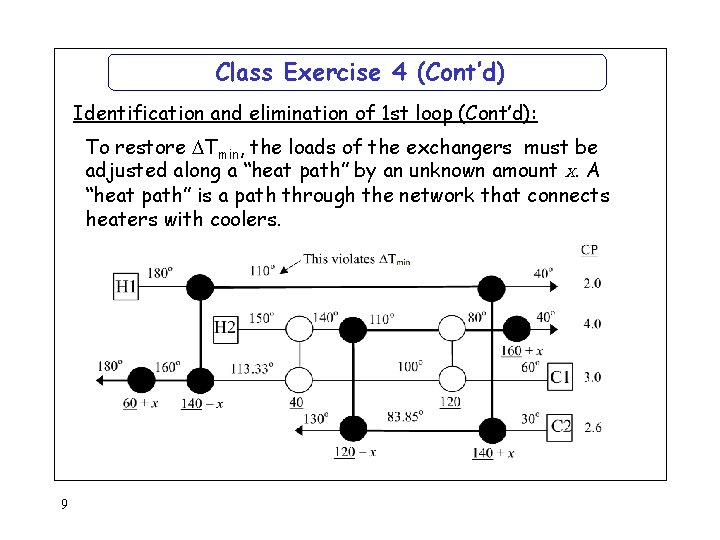
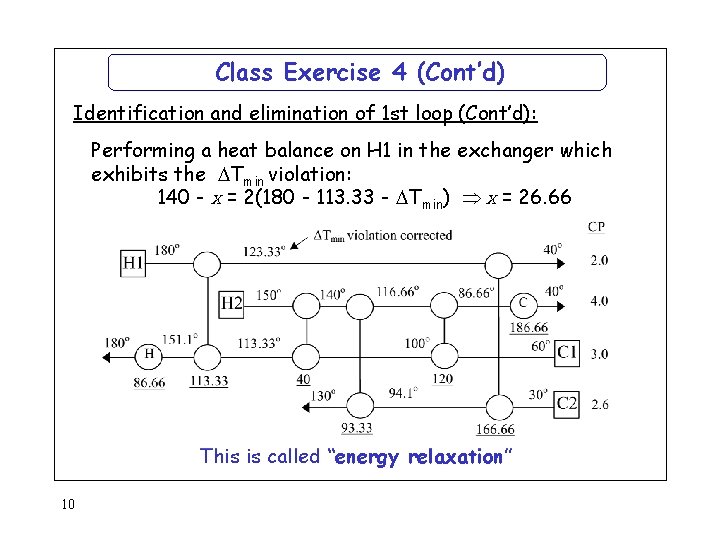
Class Exercise 4 (Cont’d) Identification and elimination of 1 st loop (Cont’d): To restore Tmin, the loads of the exchangers must be adjusted along a “heat path” by an unknown amount x. A “heat path” is a path through the network that connects heaters with coolers. 9
Class Exercise 4 (Cont’d) Identification and elimination of 1 st loop (Cont’d): Performing a heat balance on H 1 in the exchanger which exhibits the Tmin violation: 140 - x = 2(180 - 113. 33 - Tmin) x = 26. 66 This is called “energy relaxation” 10
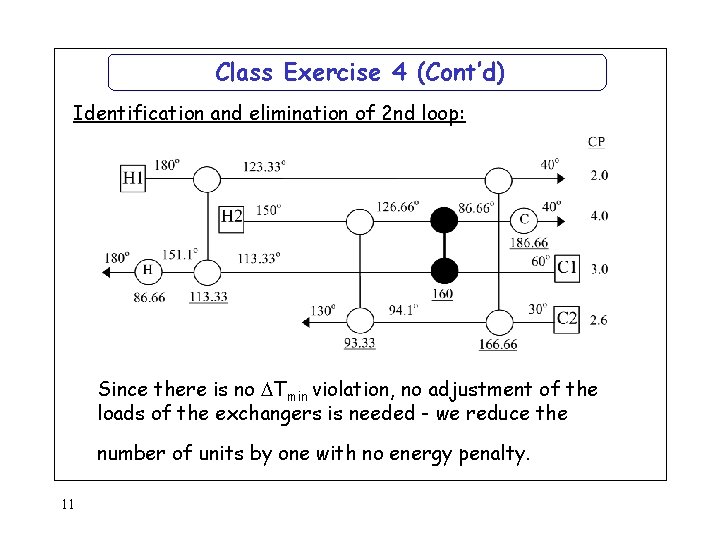
Class Exercise 4 (Cont’d) Identification and elimination of 2 nd loop: Since there is no Tmin violation, no adjustment of the loads of the exchangers is needed - we reduce the number of units by one with no energy penalty. 11
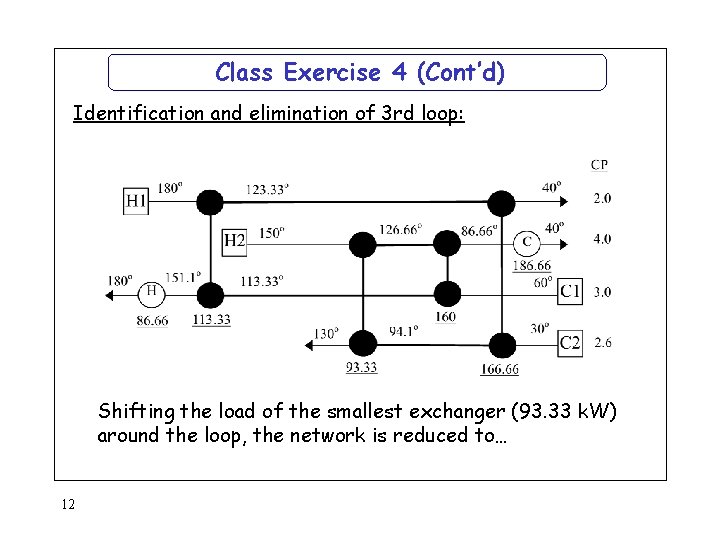
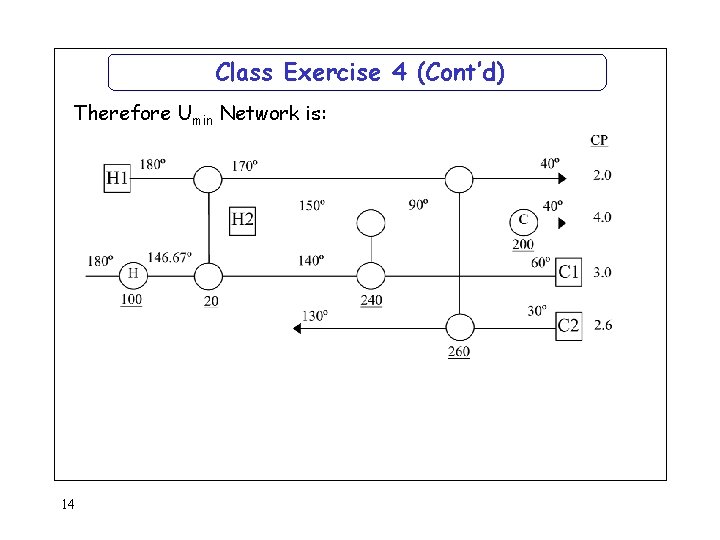
Class Exercise 4 (Cont’d) Identification and elimination of 3 rd loop: Shifting the load of the smallest exchanger (93. 33 k. W) around the loop, the network is reduced to… 12
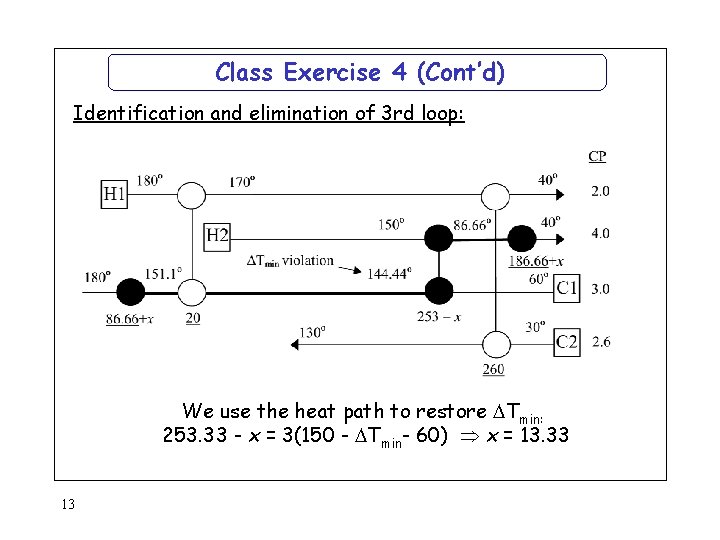
Class Exercise 4 (Cont’d) Identification and elimination of 3 rd loop: We use the heat path to restore Tmin: 253. 33 - x = 3(150 - Tmin- 60) x = 13. 33 13
Class Exercise 4 (Cont’d) Therefore Umin Network is: 14
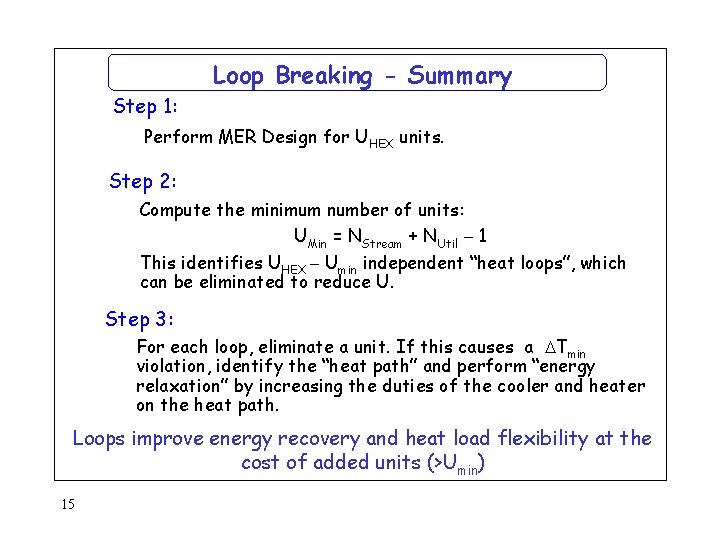
Loop Breaking - Summary Step 1: Perform MER Design for UHEX units. Step 2: Compute the minimum number of units: UMin = NStream + NUtil 1 This identifies UHEX Umin independent “heat loops”, which can be eliminated to reduce U. Step 3: For each loop, eliminate a unit. If this causes a Tmin violation, identify the “heat path” and perform “energy relaxation” by increasing the duties of the cooler and heater on the heat path. Loops improve energy recovery and heat load flexibility at the cost of added units (>Umin) 15
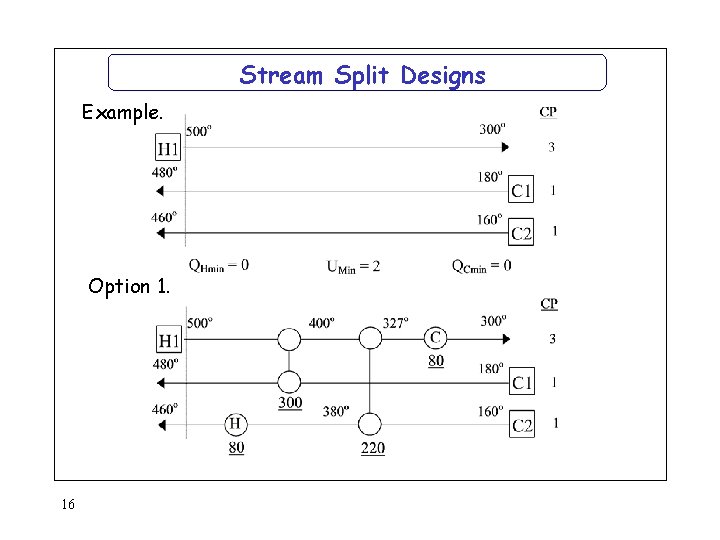
Stream Split Designs Example. Option 1. 16
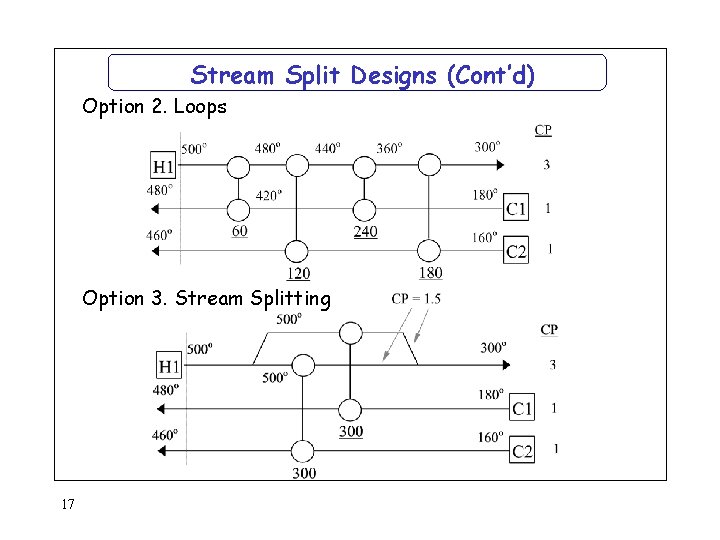
Stream Split Designs (Cont’d) Option 2. Loops Option 3. Stream Splitting 17
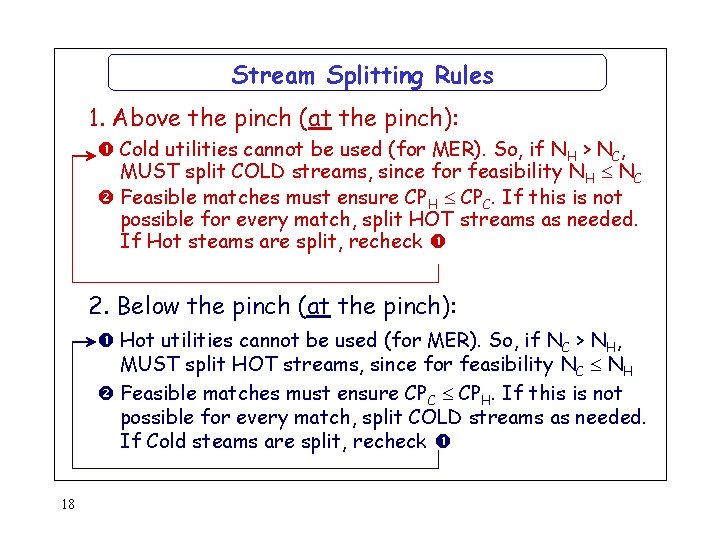
Stream Splitting Rules 1. Above the pinch (at the pinch): Cold utilities cannot be used (for MER). So, if NH > NC, MUST split COLD streams, since for feasibility N H NC Feasible matches must ensure CPH CPC. If this is not possible for every match, split HOT streams as needed. If Hot steams are split, recheck 2. Below the pinch (at the pinch): Hot utilities cannot be used (for MER). So, if NC > NH, MUST split HOT streams, since for feasibility NC NH Feasible matches must ensure CPC CPH. If this is not possible for every match, split COLD streams as needed. If Cold steams are split, recheck 18
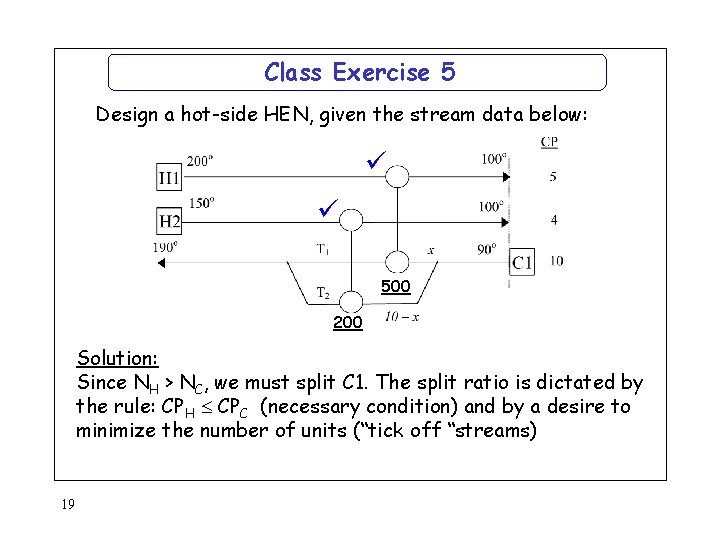
Class Exercise 5 Design a hot-side HEN, given the stream data below: 500 200 Solution: Since NH > NC, we must split C 1. The split ratio is dictated by the rule: CPH CPC (necessary condition) and by a desire to minimize the number of units (“tick off “streams) 19
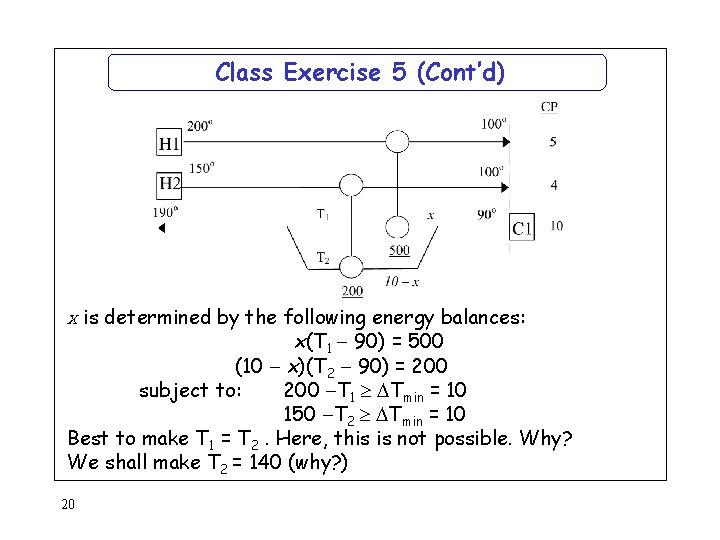
Class Exercise 5 (Cont’d) x is determined by the following energy balances: x(T 1 90) = 500 (10 x)(T 2 90) = 200 subject to: 200 T 1 Tmin = 10 150 T 2 Tmin = 10 Best to make T 1 = T 2. Here, this is not possible. Why? We shall make T 2 = 140 (why? ) 20
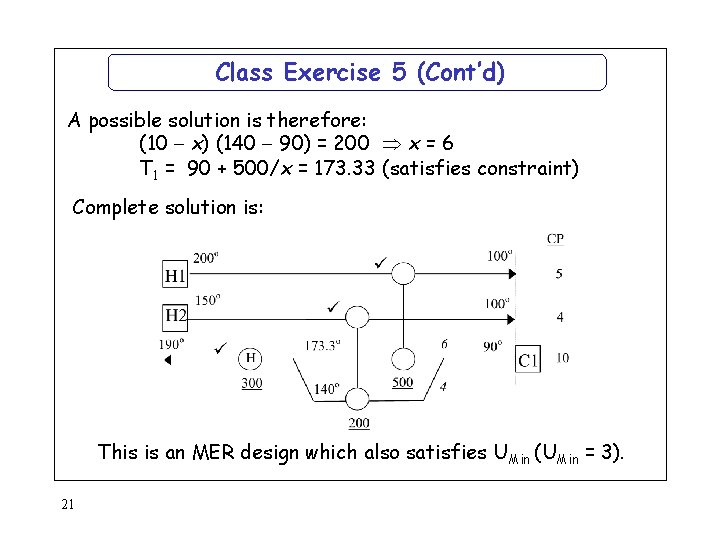
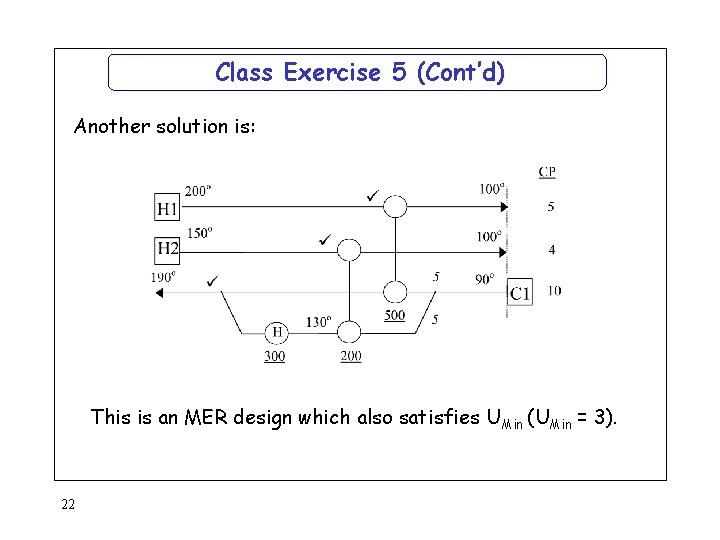
Class Exercise 5 (Cont’d) A possible solution is therefore: (10 x) (140 90) = 200 x = 6 T 1 = 90 + 500/x = 173. 33 (satisfies constraint) Complete solution is: This is an MER design which also satisfies UMin (UMin = 3). 21
Class Exercise 5 (Cont’d) Another solution is: This is an MER design which also satisfies UMin (UMin = 3). 22
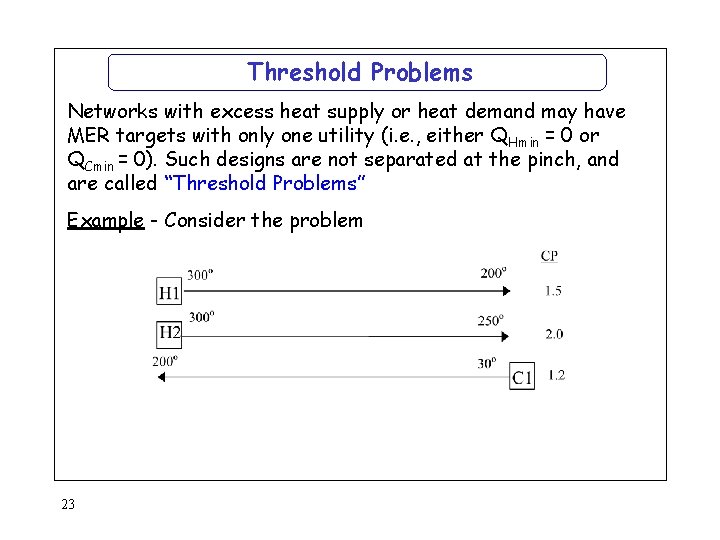
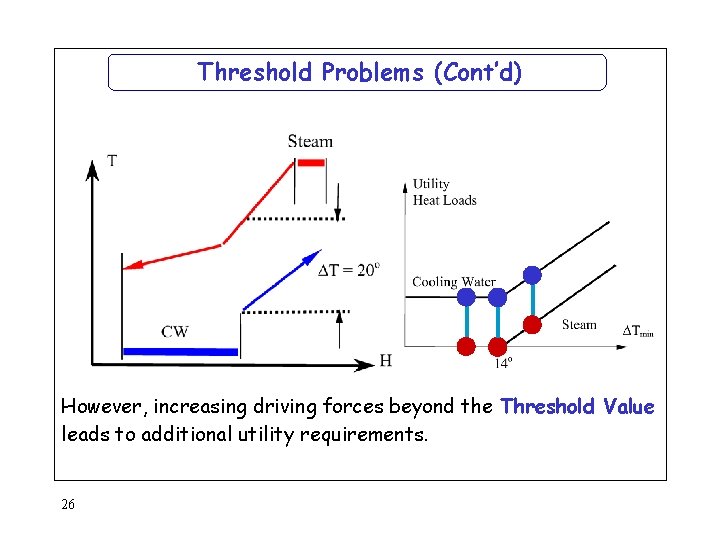
Threshold Problems Networks with excess heat supply or heat demand may have MER targets with only one utility (i. e. , either QHmin = 0 or QCmin = 0). Such designs are not separated at the pinch, and are called “Threshold Problems” Example - Consider the problem 23
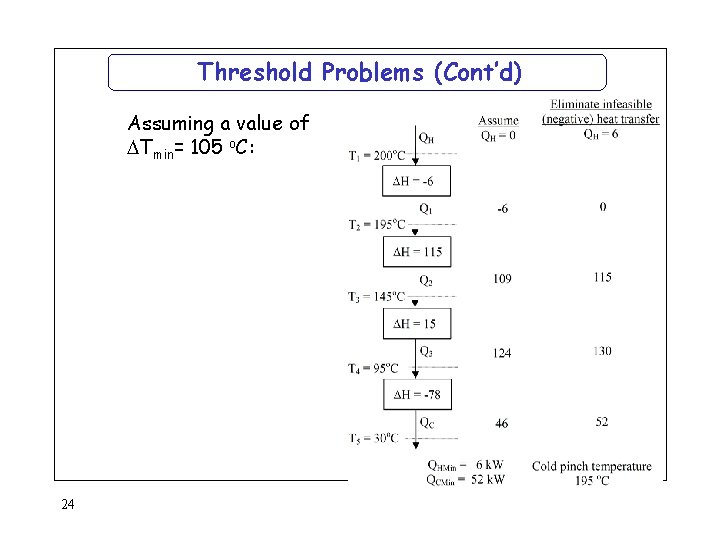
Threshold Problems (Cont’d) Assuming a value of o. C: Tmin= 105 10 o. C, the Problem Table gives the following result. 24
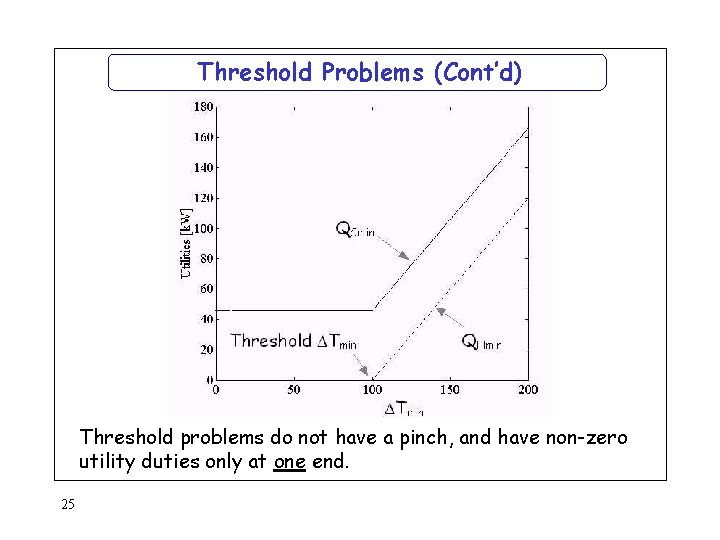
Threshold Problems (Cont’d) Threshold problems do not have a pinch, and have non-zero utility duties only at one end. 25
Threshold Problems (Cont’d) However, increasing driving forces beyond the Threshold Value leads to additional utility requirements. 26
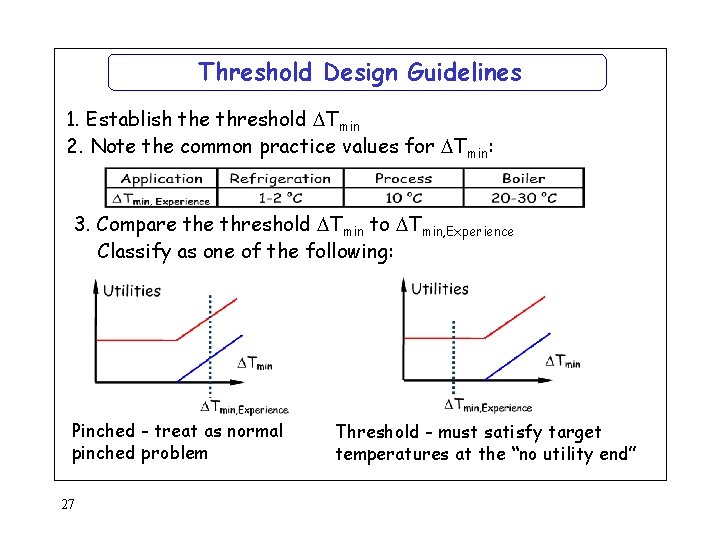
Threshold Design Guidelines 1. Establish the threshold Tmin 2. Note the common practice values for Tmin: 3. Compare threshold Tmin to Tmin, Experience Classify as one of the following: Pinched - treat as normal pinched problem 27 Threshold - must satisfy target temperatures at the “no utility end”
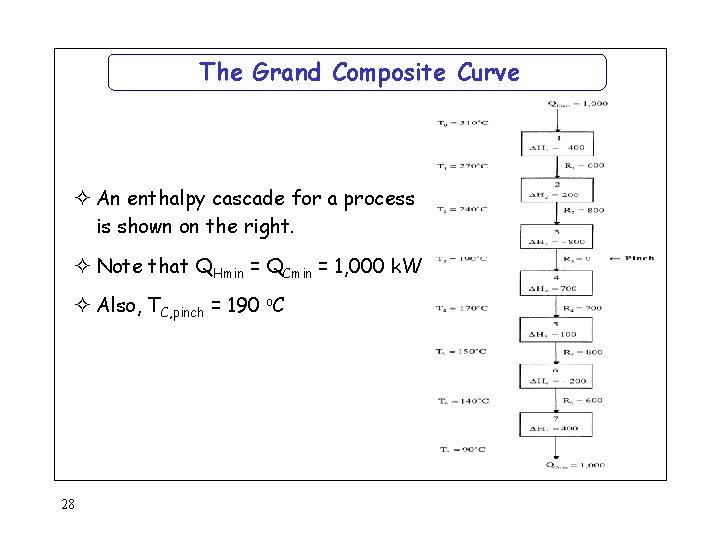
The Grand Composite Curve ² An enthalpy cascade for a process is shown on the right. ² Note that QHmin = QCmin = 1, 000 k. W ² Also, TC, pinch = 190 o. C 28
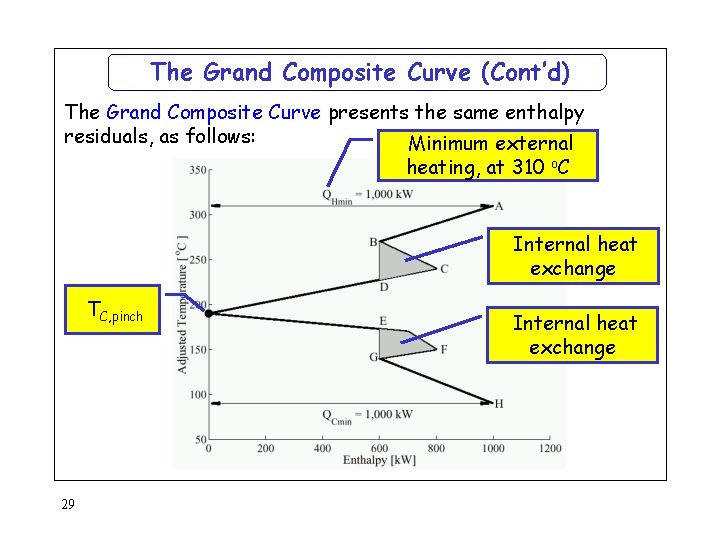
The Grand Composite Curve (Cont’d) The Grand Composite Curve presents the same enthalpy residuals, as follows: Minimum external heating, at 310 o. C Internal heat exchange TC, pinch 29 Internal heat exchange
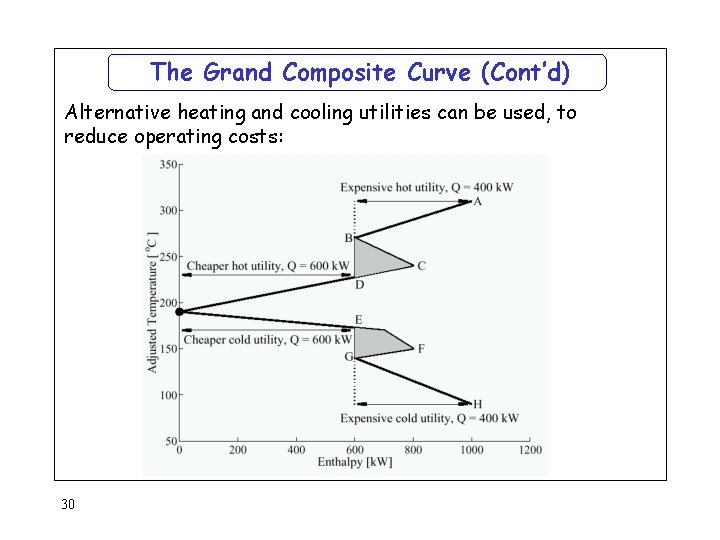
The Grand Composite Curve (Cont’d) Alternative heating and cooling utilities can be used, to reduce operating costs: 30
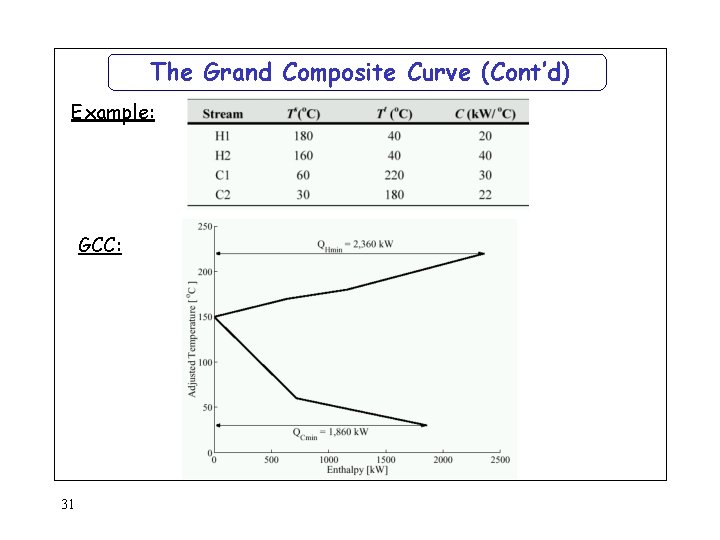
The Grand Composite Curve (Cont’d) Example: GCC: 31
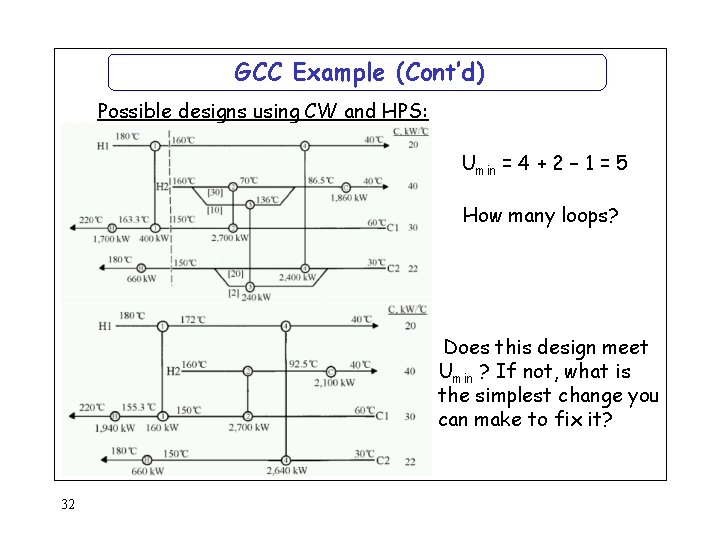
GCC Example (Cont’d) Possible designs using CW and HPS: Umin = 4 + 2 – 1 = 5 How many loops? Does this design meet Umin ? If not, what is the simplest change you can make to fix it? 32
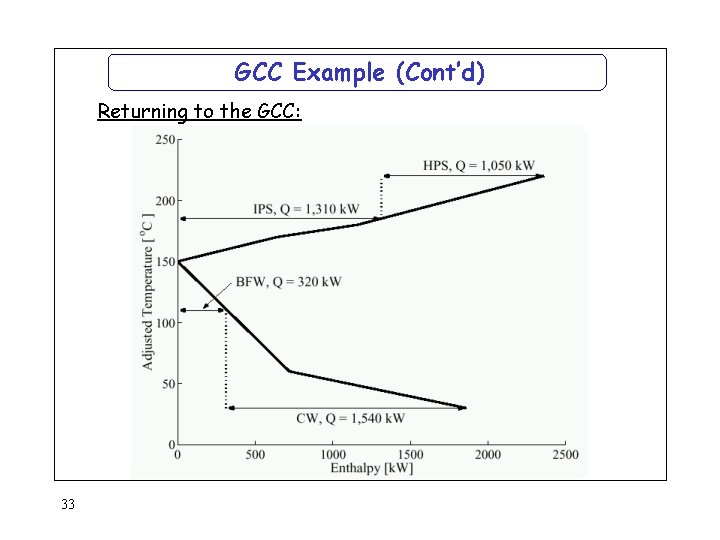
GCC Example (Cont’d) Returning to the GCC: 33
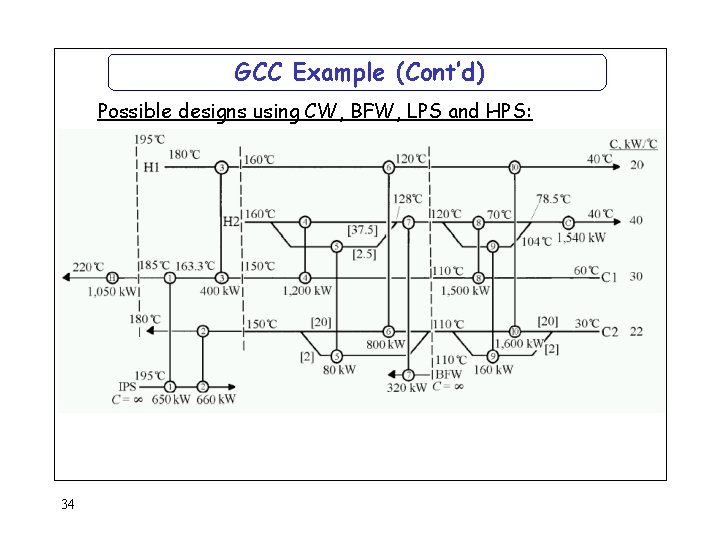
GCC Example (Cont’d) Possible designs using CW, BFW, LPS and HPS: 34