
Heat Energy and Phase Changes Energy is the
- Slides: 20
Heat Energy and Phase Changes Energy is the ability to do work. • Measured in Joules.
Georgia Performance Standards • SPS 7. Students will relate transformations and flow of energy within a system. – a. Identify energy transformations within a system (e. g. lighting of a match). – b. Investigate molecular motion as it relates to thermal energy changes in terms of conduction, convection, and radiation. – c. Determine the heat capacity of a substance using mass, specific heat, and temperature. – d. Explain the flow of energy in phase changes through the use of a phase diagram.
Georgia Performance Standards SPS 5. Students will compare and contrast the phases of matter as they relate to atomic and molecular motion. a. Compare and contrast the atomic/molecular motion of solids, liquids, gases and plasmas.
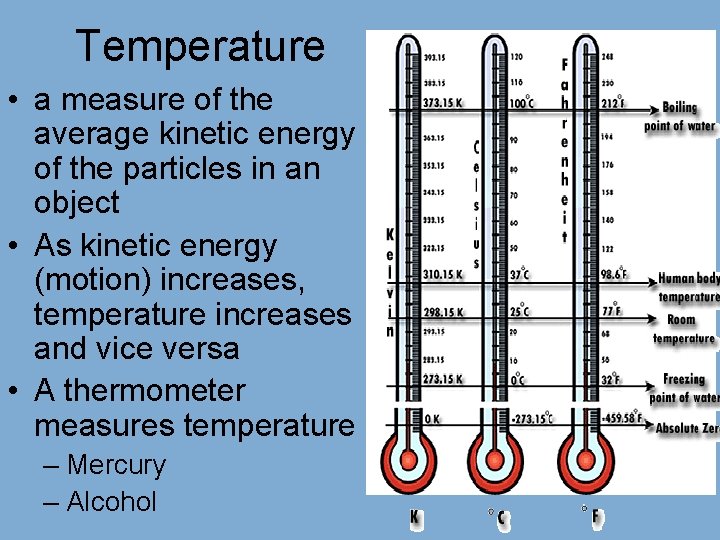
Temperature • a measure of the average kinetic energy of the particles in an object • As kinetic energy (motion) increases, temperature increases and vice versa • A thermometer measures temperature – Mercury – Alcohol
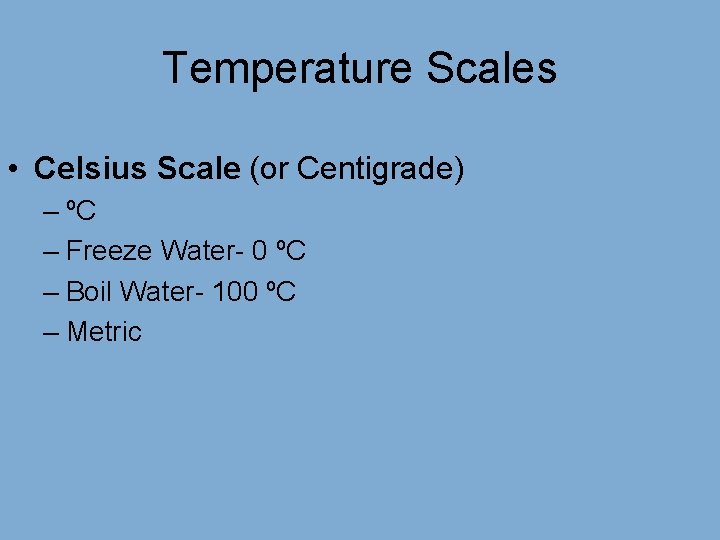
Temperature Scales • Celsius Scale (or Centigrade) – ºC – Freeze Water- 0 ºC – Boil Water- 100 ºC – Metric
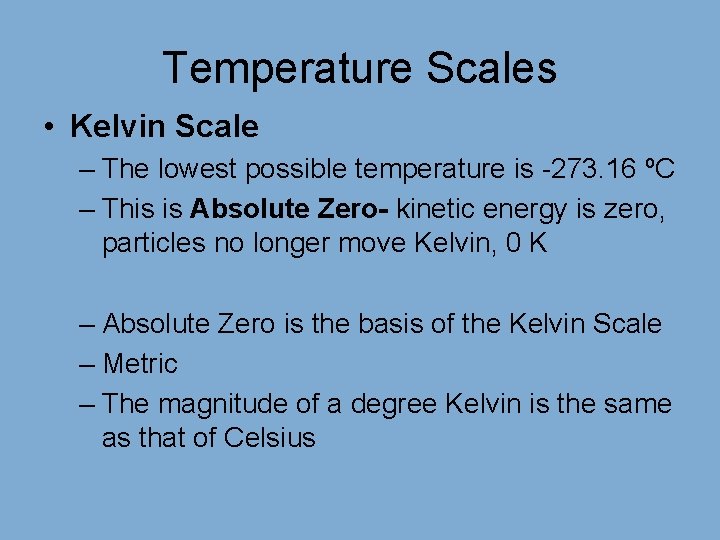
Temperature Scales • Kelvin Scale – The lowest possible temperature is -273. 16 ºC – This is Absolute Zero- kinetic energy is zero, particles no longer move Kelvin, 0 K – Absolute Zero is the basis of the Kelvin Scale – Metric – The magnitude of a degree Kelvin is the same as that of Celsius
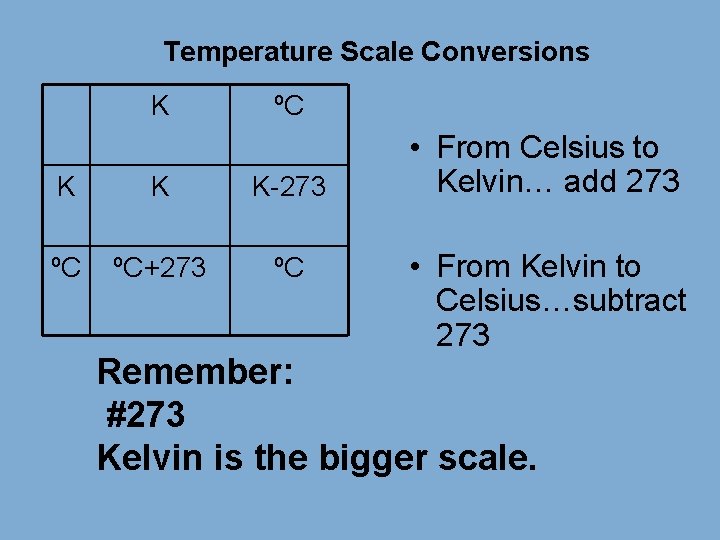
Temperature Scale Conversions K ºC K K K-273 ºC ºC+273 ºC • From Celsius to Kelvin… add 273 • From Kelvin to Celsius…subtract 273 Remember: #273 Kelvin is the bigger scale.
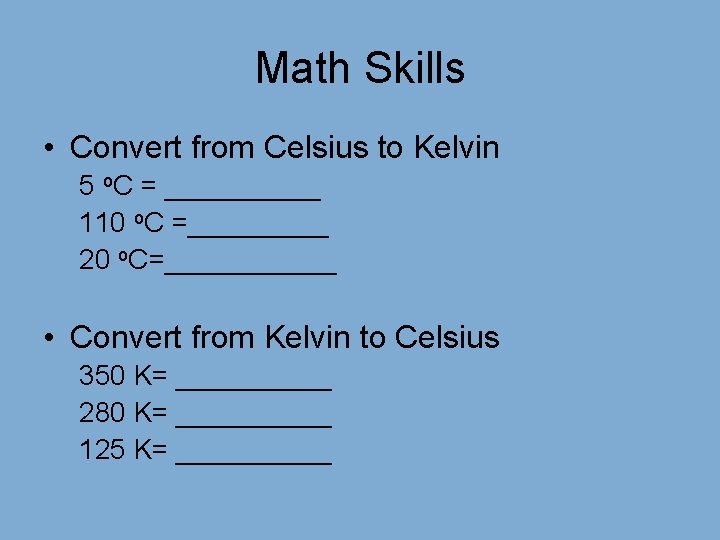
Math Skills • Convert from Celsius to Kelvin 5 o. C = _____ 110 o. C =_____ 20 o. C=______ • Convert from Kelvin to Celsius 350 K= _____ 280 K= _____ 125 K= _____
HEAT determined to be a form of energy BACKGROUND… people believed that heat was a colorless, odorless gas called Caloric… that would flow into objects and heat them up then flow out and cool down…NOT TRUE. (can read this in book) Count Rumford- concluded that heat was a form of energy – Motion can produce heat – Amount of heat depends upon the amount of motion – Heat is a form of energy caused by the internal motion of molecules of matter
Heat • Unlike temperature, heat depends on mass • Example: 50 g of water at 90 o. C has more heat energy than 5 g of water at 90 o. C • More heat energy = more severe burn
Energy Transfer • Temperature changes indicate energy transfer • Heat always moves from WARMER to COLDER • Energy transfers when particles collide
Energy Transfer • (1) Conduction- transfer of energy as heat through solid material – Examples: ironing, touching hot pan… • (2) Radiation- the energy that is transferred as electromagnetic waves – Needs no air – Example… microwave, fireplace, radiator. .
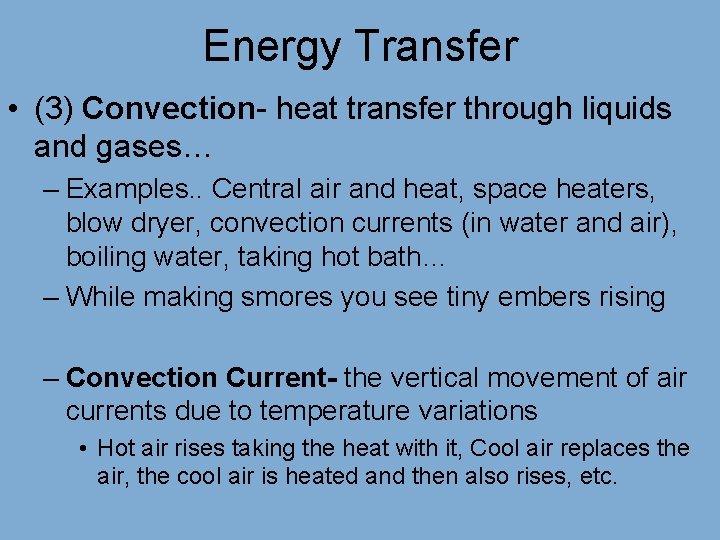
Energy Transfer • (3) Convection- heat transfer through liquids and gases… – Examples. . Central air and heat, space heaters, blow dryer, convection currents (in water and air), boiling water, taking hot bath… – While making smores you see tiny embers rising – Convection Current- the vertical movement of air currents due to temperature variations • Hot air rises taking the heat with it, Cool air replaces the air, the cool air is heated and then also rises, etc.
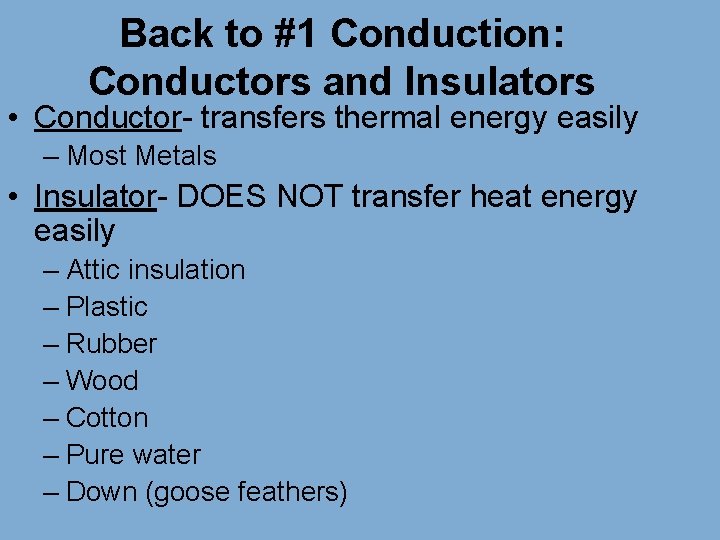
Back to #1 Conduction: Conductors and Insulators • Conductor- transfers thermal energy easily – Most Metals • Insulator- DOES NOT transfer heat energy easily – Attic insulation – Plastic – Rubber – Wood – Cotton – Pure water – Down (goose feathers)
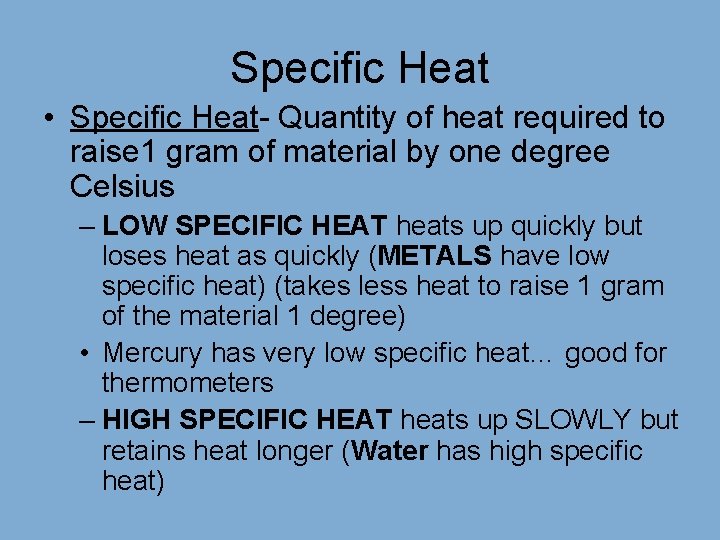
Specific Heat • Specific Heat- Quantity of heat required to raise 1 gram of material by one degree Celsius – LOW SPECIFIC HEAT heats up quickly but loses heat as quickly (METALS have low specific heat) (takes less heat to raise 1 gram of the material 1 degree) • Mercury has very low specific heat… good for thermometers – HIGH SPECIFIC HEAT heats up SLOWLY but retains heat longer (Water has high specific heat)
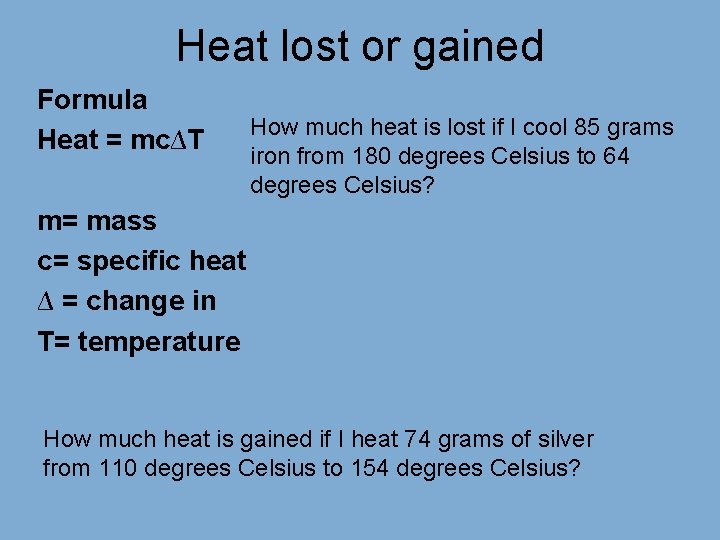
Heat lost or gained Formula Heat = mc∆T How much heat is lost if I cool 85 grams iron from 180 degrees Celsius to 64 degrees Celsius? m= mass c= specific heat ∆ = change in T= temperature How much heat is gained if I heat 74 grams of silver from 110 degrees Celsius to 154 degrees Celsius?
Heat and Phase Changes • Matter exists in 4 phases: solid, liquid, gas (and plasma) (plasma is high energy phase of matter found in stars and sun) • A change in thermal energy causes a phase change • Generally speaking… Least heat…SOLIDS LIQUIDS Gases … MOST heat
Phase changes Melting Freezing Vaporization (Boiling and Evaporation) Condensation Sublimation Freezing point- temp at which a liquid turns to solid Melting point- temperature at which solid turns to liquid Boiling point- temperature at which liquid phase turns to gas
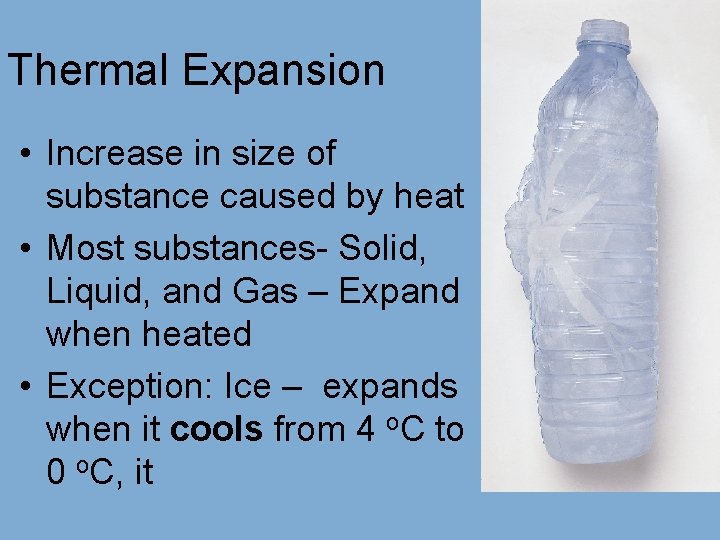
Thermal Expansion • Increase in size of substance caused by heat • Most substances- Solid, Liquid, and Gas – Expand when heated • Exception: Ice – expands when it cools from 4 o. C to 0 o. C, it
Math Skills • The highest atmospheric temperature ever recorded on earth was 57. 8 ºC. Express this temperature in degrees in Kelvins. How much heat is gained if I heat 92 grams of copper from 40 degrees Celsius to 98 degrees Celsius?