
HeartLung Machine Extracorporeal Circulation ECC or perfusion is

- Slides: 20
Heart–Lung Machine
Extracorporeal Circulation ECC or perfusion is defined as a procedure carried out with the aid of HLM In the early stages, cardiac surgery was mainly concerned with the treatment of congenital heart defects. Today, the main focus is on acquired heart defects. Access path to the operation area is kept as small as possible to reduce the patient’s surgical trauma this surgical technique usually has a direct influence on the configuration of the HLM and on the way the perfusion is carried out OPCAB (off-pump coronary artery bypass) refer to cardiac surgeries carried out without the support of an HLM The HLM can never be looked at in isolation additional components, mainly in the form of sterile disposables such as an oxygenator, heat exchanger, or reservoir, take on other important functions during ECC
Structure and Function of the Heart–Lung Machine The HLM is the basis of ECC and cover two important organ functions : 1. Pump function of the heart 2. Gas exchange function of the lungs It must ensure : Ø A sufficient perfusion volume that corresponds to the normal cardiac output of the patient under anesthetic Ø An adequate perfusion pressure (50– 90 mm. Hg) Ø It must also ensure sufficient oxygenation, elimination of CO 2, and control of the blood temperature The following components make up the basic equipment of the ECC that is used during modern cardiac surgery: 1. Blood pumps 2. Oxygenator 3. Tubing system with various tubing diameters 4. Blood filters with various functions 5. Cardiotomy reservoir 6. Cannulae and intracardiac suction tubes
Blood Pumps and Their Function Blood pumps can generally be categorized into two groups, depending on their function: 1. Roller pumps 2. Centrifugal pumps Ø Essentially, both pump types should meet certain criteria when used with the HLM: 1. Dosed delivery of liquids, with precise display of the actual flow rate and delivered volume 2. External control mechanism (e. g. monitoring functions) 3. Sufficient pressure or vacuum generation 5. Minimal blood damage 6. Adjustable occlusion settings (roller pumps only) 7. Pulsatile flow generation 8. High efficiency 9. High reliability and safety 10. Option for emergency operation (e. g. , manual operation)
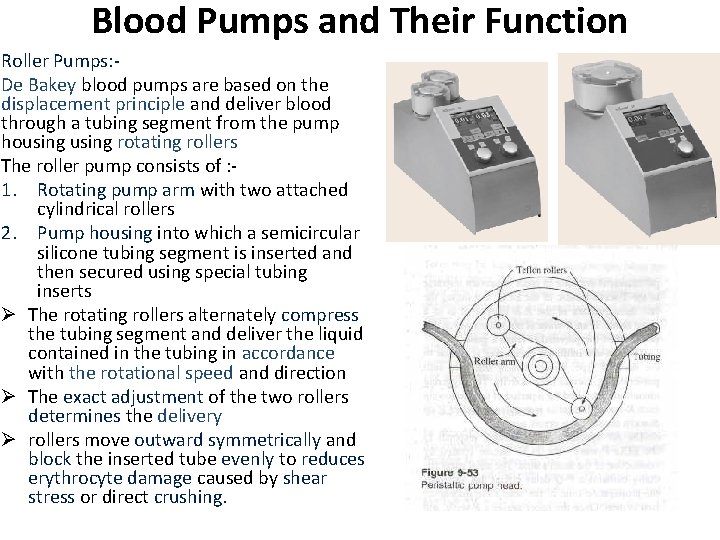
Blood Pumps and Their Function Roller Pumps: De Bakey blood pumps are based on the displacement principle and deliver blood through a tubing segment from the pump housing rotating rollers The roller pump consists of : 1. Rotating pump arm with two attached cylindrical rollers 2. Pump housing into which a semicircular silicone tubing segment is inserted and then secured using special tubing inserts Ø The rotating rollers alternately compress the tubing segment and deliver the liquid contained in the tubing in accordance with the rotational speed and direction Ø The exact adjustment of the two rollers determines the delivery Ø rollers move outward symmetrically and block the inserted tube evenly to reduces erythrocyte damage caused by shear stress or direct crushing.
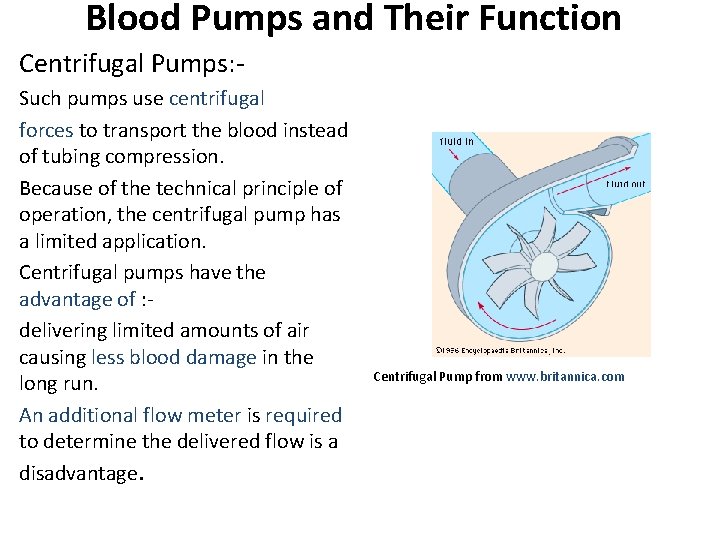
Blood Pumps and Their Function Centrifugal Pumps: Such pumps use centrifugal forces to transport the blood instead of tubing compression. Because of the technical principle of operation, the centrifugal pump has a limited application. Centrifugal pumps have the advantage of : delivering limited amounts of air causing less blood damage in the long run. An additional flow meter is required to determine the delivered flow is a disadvantage. Centrifugal Pump from www. britannica. com
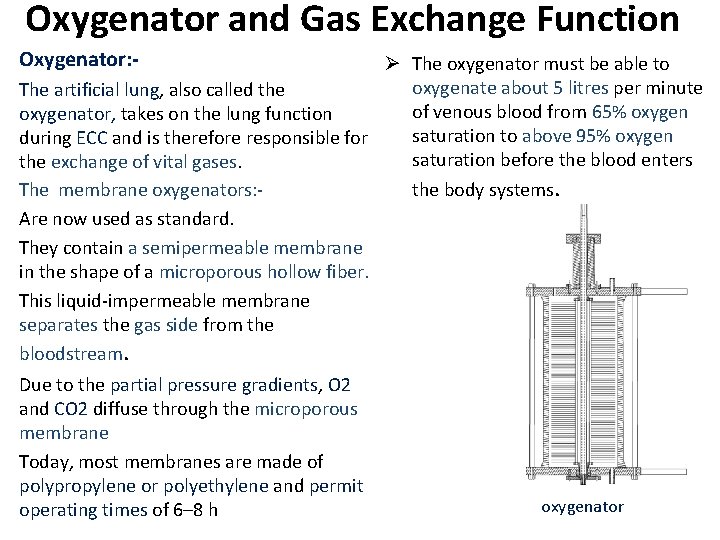
Oxygenator and Gas Exchange Function Oxygenator: - Ø The oxygenator must be able to oxygenate about 5 litres per minute The artificial lung, also called the of venous blood from 65% oxygenator, takes on the lung function saturation to above 95% oxygen during ECC and is therefore responsible for saturation before the blood enters the exchange of vital gases. the body systems. The membrane oxygenators: Are now used as standard. They contain a semipermeable membrane in the shape of a microporous hollow fiber. This liquid-impermeable membrane separates the gas side from the bloodstream. Due to the partial pressure gradients, O 2 and CO 2 diffuse through the microporous membrane Today, most membranes are made of polypropylene or polyethylene and permit oxygenator operating times of 6– 8 h
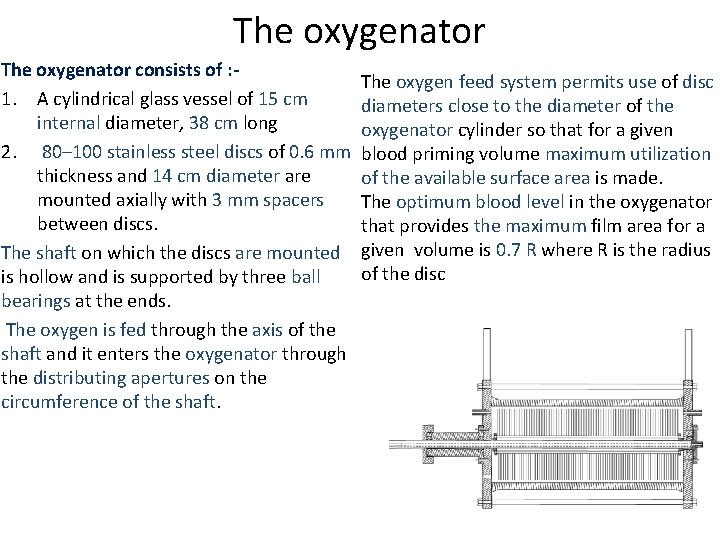
The oxygenator consists of : 1. A cylindrical glass vessel of 15 cm internal diameter, 38 cm long 2. 80– 100 stainless steel discs of 0. 6 mm thickness and 14 cm diameter are mounted axially with 3 mm spacers between discs. The shaft on which the discs are mounted is hollow and is supported by three ball bearings at the ends. The oxygen is fed through the axis of the shaft and it enters the oxygenator through the distributing apertures on the circumference of the shaft. The oxygen feed system permits use of disc diameters close to the diameter of the oxygenator cylinder so that for a given blood priming volume maximum utilization of the available surface area is made. The optimum blood level in the oxygenator that provides the maximum film area for a given volume is 0. 7 R where R is the radius of the disc
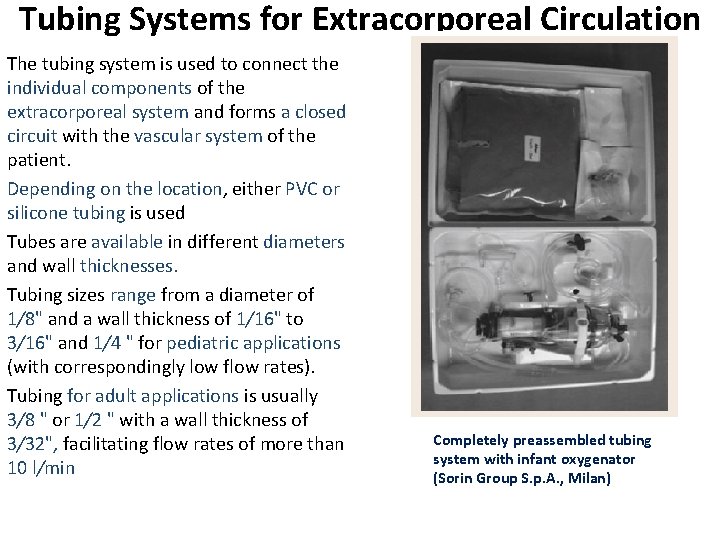
Tubing Systems for Extracorporeal Circulation The tubing system is used to connect the individual components of the extracorporeal system and forms a closed circuit with the vascular system of the patient. Depending on the location, either PVC or silicone tubing is used Tubes are available in different diameters and wall thicknesses. Tubing sizes range from a diameter of 1/8" and a wall thickness of 1/16" to 3/16" and 1/4 " for pediatric applications (with correspondingly low flow rates). Tubing for adult applications is usually 3/8 " or 1/2 " with a wall thickness of 3/32", facilitating flow rates of more than 10 l/min Completely preassembled tubing system with infant oxygenator (Sorin Group S. p. A. , Milan)
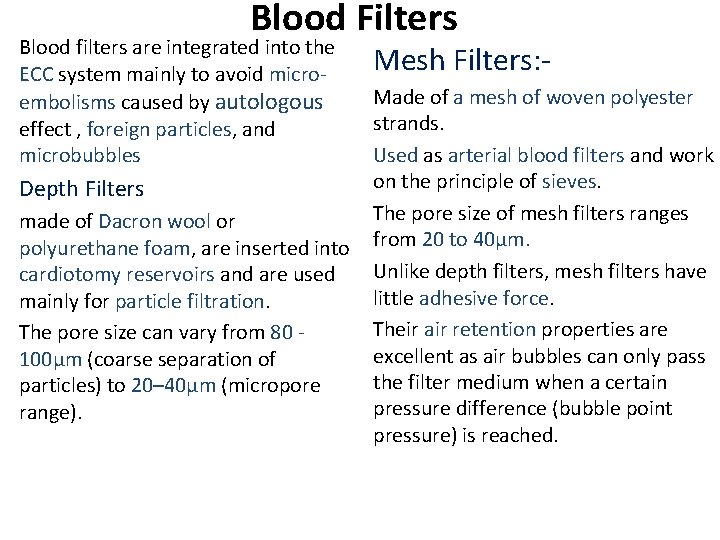
Blood Filters Blood filters are integrated into the ECC system mainly to avoid microembolisms caused by autologous effect , foreign particles, and microbubbles Depth Filters made of Dacron wool or polyurethane foam, are inserted into cardiotomy reservoirs and are used mainly for particle filtration. The pore size can vary from 80 100μm (coarse separation of particles) to 20– 40μm (micropore range). Mesh Filters: Made of a mesh of woven polyester strands. Used as arterial blood filters and work on the principle of sieves. The pore size of mesh filters ranges from 20 to 40μm. Unlike depth filters, mesh filters have little adhesive force. Their air retention properties are excellent as air bubbles can only pass the filter medium when a certain pressure difference (bubble point pressure) is reached.
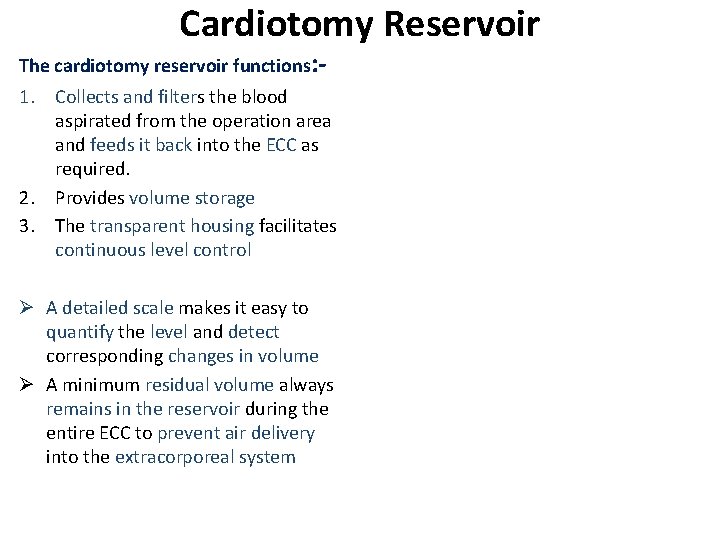
Cardiotomy Reservoir The cardiotomy reservoir functions: - 1. Collects and filters the blood aspirated from the operation area and feeds it back into the ECC as required. 2. Provides volume storage 3. The transparent housing facilitates continuous level control Ø A detailed scale makes it easy to quantify the level and detect corresponding changes in volume Ø A minimum residual volume always remains in the reservoir during the entire ECC to prevent air delivery into the extracorporeal system
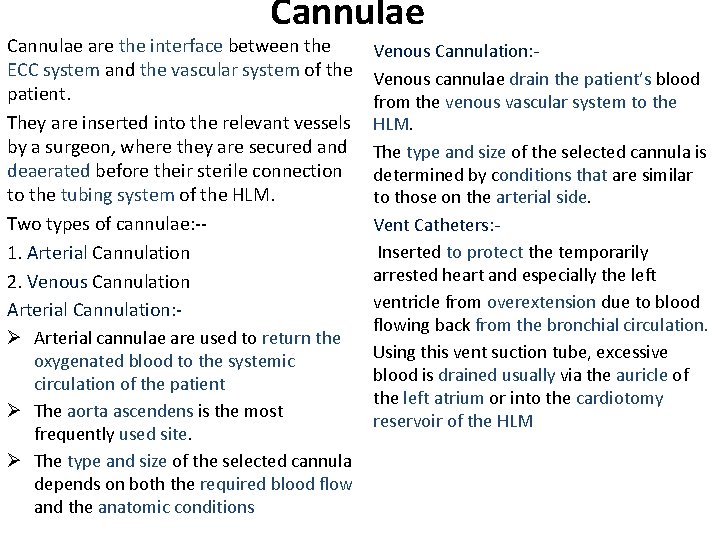
Cannulae are the interface between the ECC system and the vascular system of the patient. They are inserted into the relevant vessels by a surgeon, where they are secured and deaerated before their sterile connection to the tubing system of the HLM. Two types of cannulae: -1. Arterial Cannulation 2. Venous Cannulation Arterial Cannulation: Ø Arterial cannulae are used to return the oxygenated blood to the systemic circulation of the patient Ø The aorta ascendens is the most frequently used site. Ø The type and size of the selected cannula depends on both the required blood flow and the anatomic conditions Venous Cannulation: Venous cannulae drain the patient’s blood from the venous vascular system to the HLM. The type and size of the selected cannula is determined by conditions that are similar to those on the arterial side. Vent Catheters: Inserted to protect the temporarily arrested heart and especially the left ventricle from overextension due to blood flowing back from the bronchial circulation. Using this vent suction tube, excessive blood is drained usually via the auricle of the left atrium or into the cardiotomy reservoir of the HLM
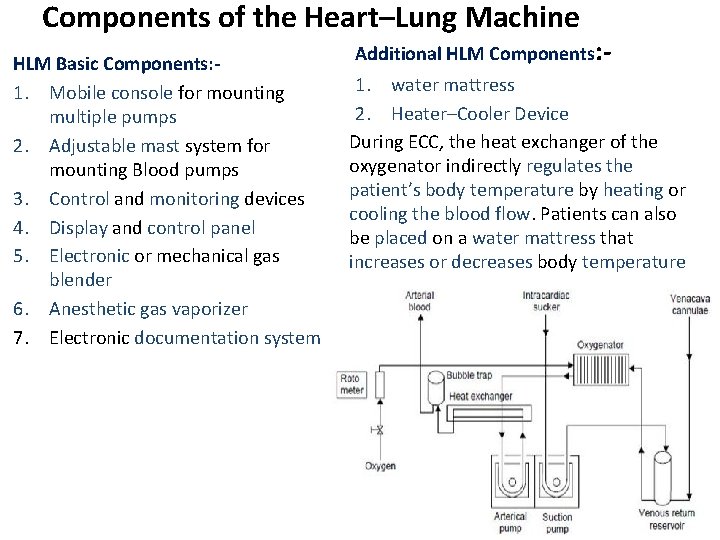
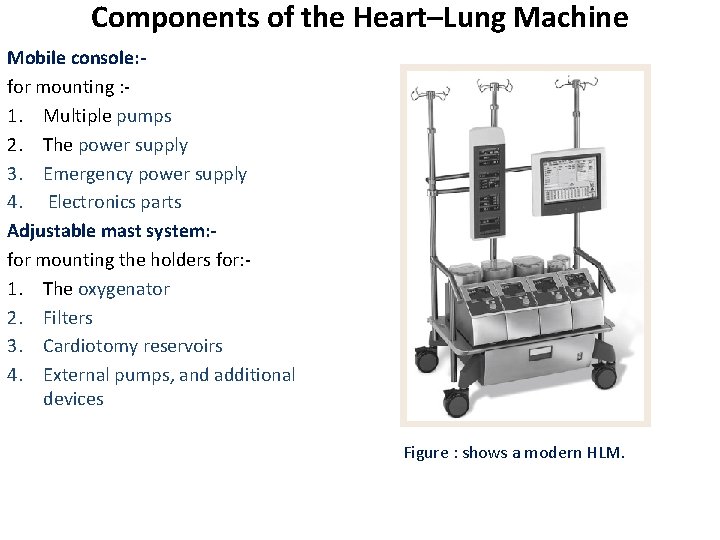
Components of the Heart–Lung Machine HLM Basic Components: 1. Mobile console for mounting multiple pumps 2. Adjustable mast system for mounting Blood pumps 3. Control and monitoring devices 4. Display and control panel 5. Electronic or mechanical gas blender 6. Anesthetic gas vaporizer 7. Electronic documentation system Additional HLM Components: - 1. water mattress 2. Heater–Cooler Device During ECC, the heat exchanger of the oxygenator indirectly regulates the patient’s body temperature by heating or cooling the blood flow. Patients can also be placed on a water mattress that increases or decreases body temperature
Components of the Heart–Lung Machine Mobile console: for mounting : 1. Multiple pumps 2. The power supply 3. Emergency power supply 4. Electronics parts Adjustable mast system: for mounting the holders for: 1. The oxygenator 2. Filters 3. Cardiotomy reservoirs 4. External pumps, and additional devices Figure : shows a modern HLM.
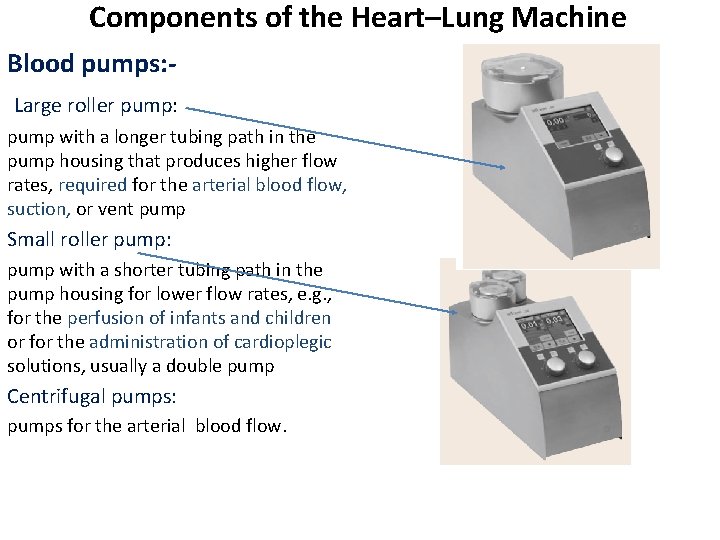
Components of the Heart–Lung Machine Blood pumps: Large roller pump: pump with a longer tubing path in the pump housing that produces higher flow rates, required for the arterial blood flow, suction, or vent pump Small roller pump: pump with a shorter tubing path in the pump housing for lower flow rates, e. g. , for the perfusion of infants and children or for the administration of cardioplegic solutions, usually a double pump Centrifugal pumps: pumps for the arterial blood flow.
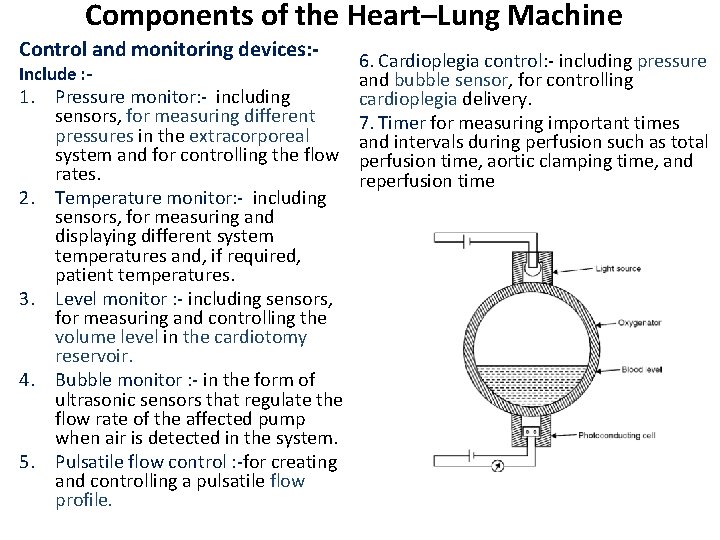
Components of the Heart–Lung Machine Control and monitoring devices: - 6. Cardioplegia control: - including pressure and bubble sensor, for controlling Pressure monitor: - including cardioplegia delivery. sensors, for measuring different 7. Timer for measuring important times pressures in the extracorporeal and intervals during perfusion such as total system and for controlling the flow perfusion time, aortic clamping time, and rates. reperfusion time Temperature monitor: - including sensors, for measuring and displaying different system temperatures and, if required, patient temperatures. Level monitor : - including sensors, for measuring and controlling the volume level in the cardiotomy reservoir. Bubble monitor : - in the form of ultrasonic sensors that regulate the flow rate of the affected pump when air is detected in the system. Pulsatile flow control : -for creating and controlling a pulsatile flow profile. Include : - 1. 2. 3. 4. 5.
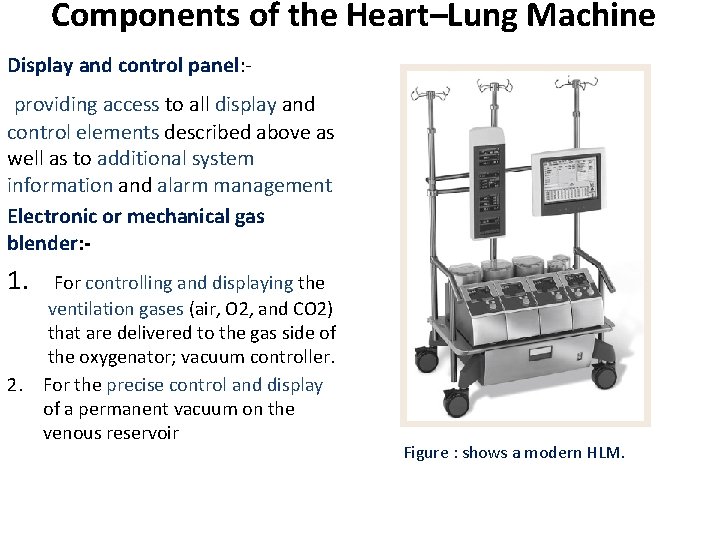
Components of the Heart–Lung Machine Display and control panel: providing access to all display and control elements described above as well as to additional system information and alarm management Electronic or mechanical gas blender: - 1. 2. For controlling and displaying the ventilation gases (air, O 2, and CO 2) that are delivered to the gas side of the oxygenator; vacuum controller. For the precise control and display of a permanent vacuum on the venous reservoir Figure : shows a modern HLM.
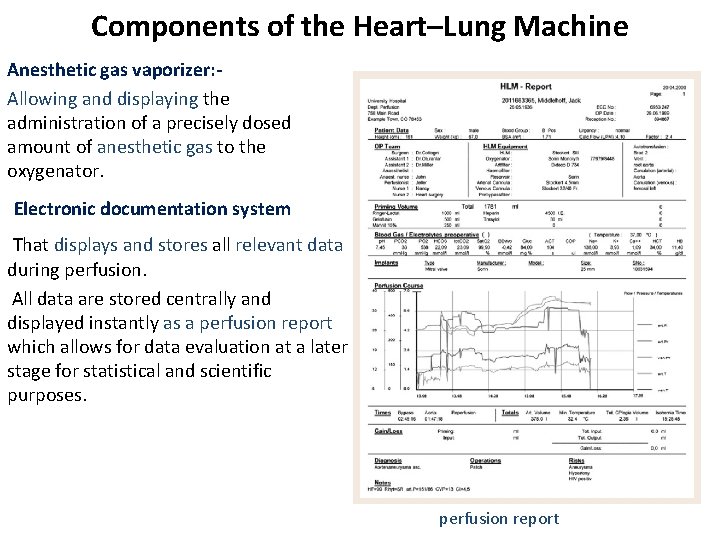
Components of the Heart–Lung Machine Anesthetic gas vaporizer: Allowing and displaying the administration of a precisely dosed amount of anesthetic gas to the oxygenator. Electronic documentation system That displays and stores all relevant data during perfusion. All data are stored centrally and displayed instantly as a perfusion report which allows for data evaluation at a later stage for statistical and scientific purposes. perfusion report
Components of the Heart–Lung Machine Heater–cooler devices have always presented a hygiene challenge because Heater–Cooler Device (Heat exchanger ): 1. The system parts that transport water The heater–cooler device delivers water with inevitably become contaminated by germs. a temperature ranging from 2 to 42°C. v Regular water changes and the use of The Heat exchanger contain: appropriate chemical cleaning agents are 1. Two chamber pumps ensure that the two most effective cleaning and delivered water does not cause a maintenance strategies. buildup of overpressure in the circuits. 2. Two circuits supply the oxygenator and the heating/cooling mattress 3. Third circuit is connected to the heat exchanger in the cardioplegia system. 4. Two independent tanks with different temperatures, which allows instant switching from cold to warm or vice versa Ø Modern heater–cooler devices feature several circuits with different temperatures Additional HLM Components: -
References Springer Handbook of Medical Technology Rüdiger Kramme, Klaus-Peter Hoffmann, Robert S. Pozos Springer-Verlag Berlin Heidelberg 2011