
Heart Rhythm Program What to expect around your



- Slides: 50
Heart Rhythm Program What to expect around your Atrial Fibrillation (AF) Catheter Ablation/ Pulmonary Vein Isolation (PVI) REGIONAL CARDIAC CARE PROGRAM
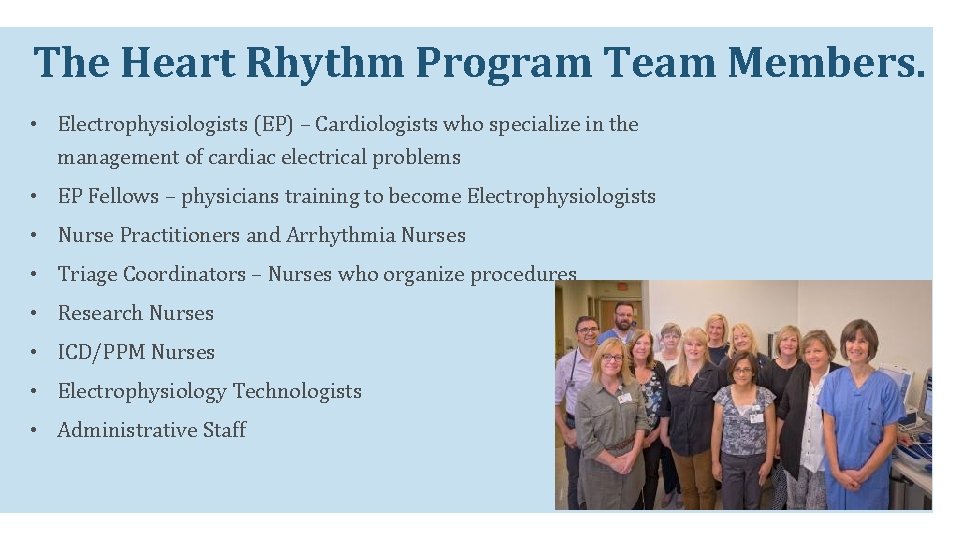
The Heart Rhythm Program Team Members. • Electrophysiologists (EP) – Cardiologists who specialize in the management of cardiac electrical problems • EP Fellows – physicians training to become Electrophysiologists • Nurse Practitioners and Arrhythmia Nurses • Triage Coordinators – Nurses who organize procedures • Research Nurses • ICD/PPM Nurses • Electrophysiology Technologists • Administrative Staff
Objectives of this Presentation Atrial Fibrillation (AF) • What is it? • How do you diagnose AF? • What treatment options are available and necessary? • Medications • Catheter ablation at Southlake Regional Health Centre Pre-procedure Post Procedure Follow up care Heart Rhythm Research • How can I help manage my symptoms and reduce risks? Stroke prevention Lifestyle management Controlling triggers and self management
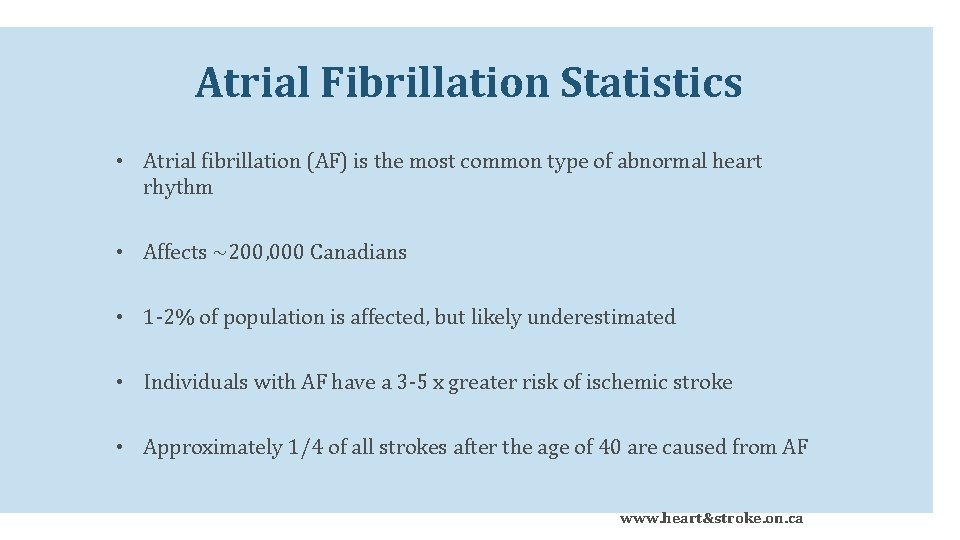
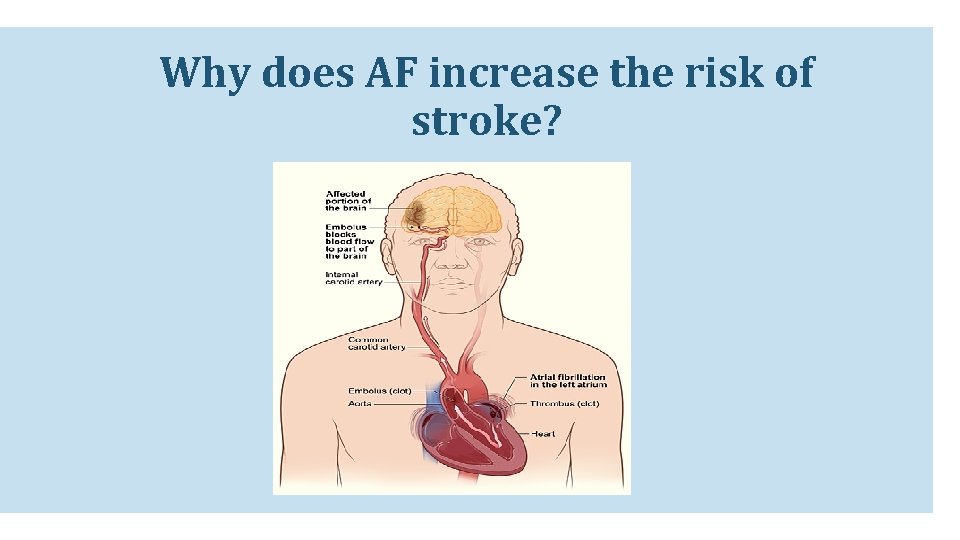
Atrial Fibrillation Statistics • Atrial fibrillation (AF) is the most common type of abnormal heart rhythm • Affects ~200, 000 Canadians • 1 -2% of population is affected, but likely underestimated • Individuals with AF have a 3 -5 x greater risk of ischemic stroke • Approximately 1/4 of all strokes after the age of 40 are caused from AF www. heart&stroke. on. ca
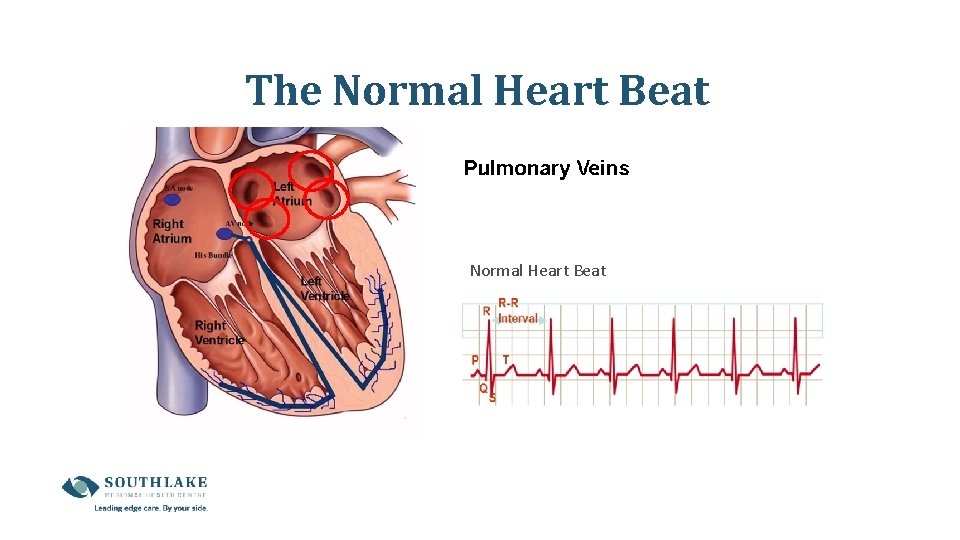
The Normal Heart Beat
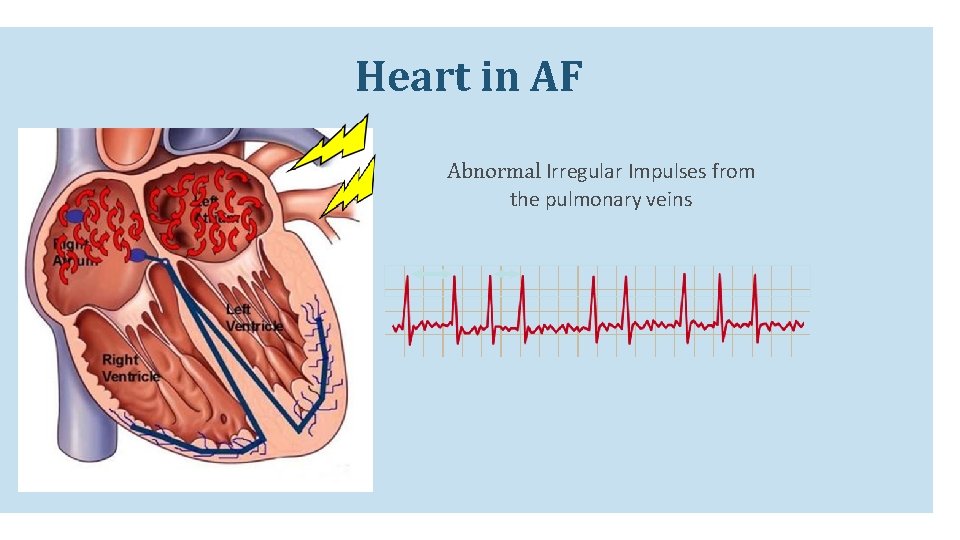
Heart in AF Abnormal Irregular Impulses from the pulmonary veins
Types of AF • Paroxysmal • Stops and starts on its own • Lasts seconds to 7 days at a time • Persistent • Requires intervention (electrical or medical Cardioversion) • Lasts > 7 days • Permanent • Patient has continuous AF that cannot be terminated for a clinically relevant period of time • Lasts > 1 year
Why do I have AF? Age • More common over the age of 50 but can occur at any age. Gender Heart Conditions • High blood pressure, Valve issues, heart failure or weak muscle, heart attack Lung Conditions • Lung disease (i. e. COPD) Others • Thyroid conditions, Stomach conditions, excessive alcohol, obesity, smoking, excessive Unknown cause – “lone AF” exercise, genetics, sleep apnea
Common symptoms of AF • Anxiety/Stress - feeling shaky, sweaty, dizzy or light headed • Fatigue – tired, weak or faint during or after the episode • Irregular heart beat – palpitations, chest tightness or heaviness, sensation of fluttering in the chest • Breathing problems - shortness of breath or activity intolerance
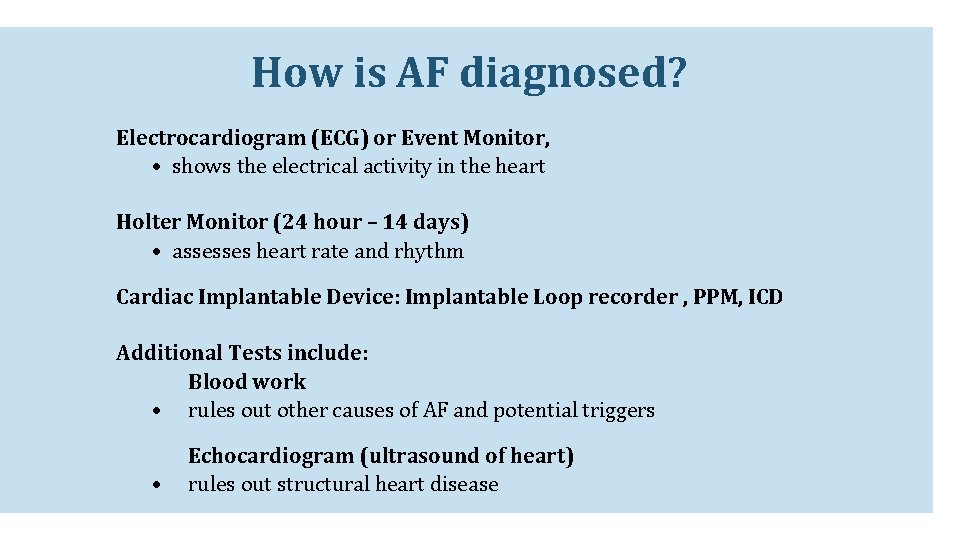
How is AF diagnosed? Electrocardiogram (ECG) or Event Monitor, • shows the electrical activity in the heart Holter Monitor (24 hour – 14 days) • assesses heart rate and rhythm Cardiac Implantable Device: Implantable Loop recorder , PPM, ICD Additional Tests include: Blood work • rules out other causes of AF and potential triggers • Echocardiogram (ultrasound of heart) rules out structural heart disease
Why do we treat AF? • • Decrease risk of stroke Decrease symptoms Decrease risk of heart failure Improve quality of life Your physician will work with you to develop an individualized treatment plan suited to your condition, symptoms and situation.
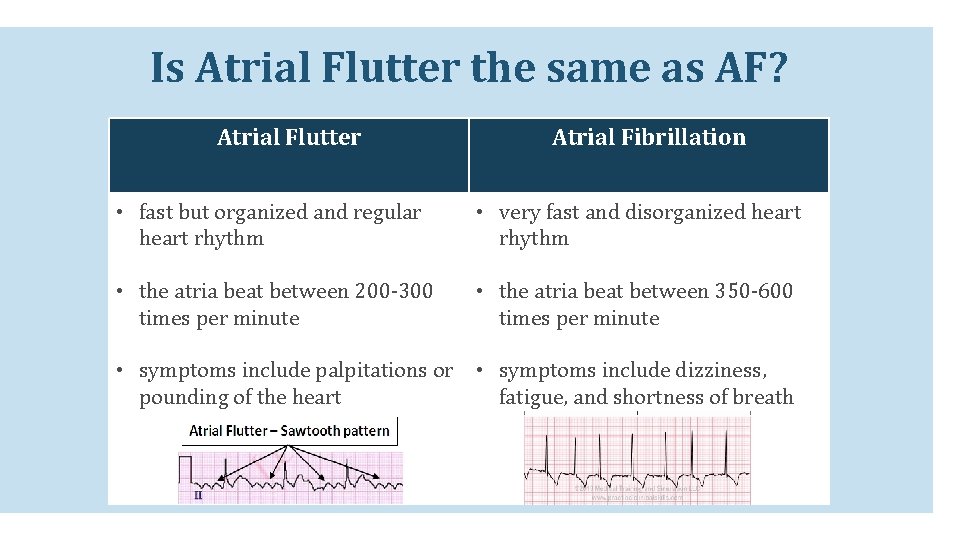
Is Atrial Flutter the same as AF? Atrial Flutter Atrial Fibrillation • fast but organized and regular heart rhythm • very fast and disorganized heart rhythm • the atria beat between 200 -300 times per minute • the atria beat between 350 -600 times per minute • symptoms include palpitations or pounding of the heart • symptoms include dizziness, fatigue, and shortness of breath
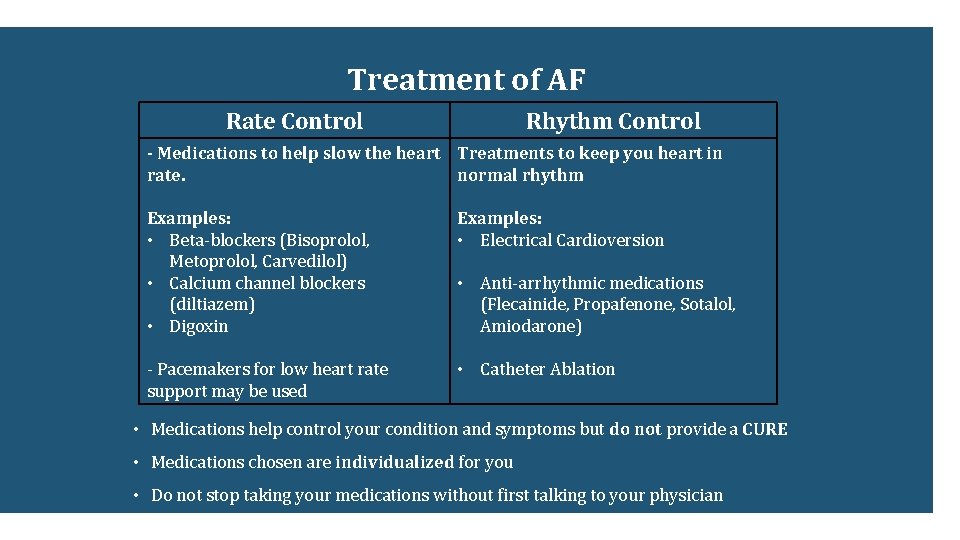
Treatment of AF Rate Control Rhythm Control - Medications to help slow the heart Treatments to keep you heart in rate. normal rhythm Examples: • Beta-blockers (Bisoprolol, Metoprolol, Carvedilol) • Calcium channel blockers (diltiazem) • Digoxin Examples: • Electrical Cardioversion - Pacemakers for low heart rate support may be used • Catheter Ablation • Anti-arrhythmic medications (Flecainide, Propafenone, Sotalol, Amiodarone) • Medications help control your condition and symptoms but do not provide a CURE • Medications chosen are individualized for you • Do not stop taking your medications without first talking to your physician
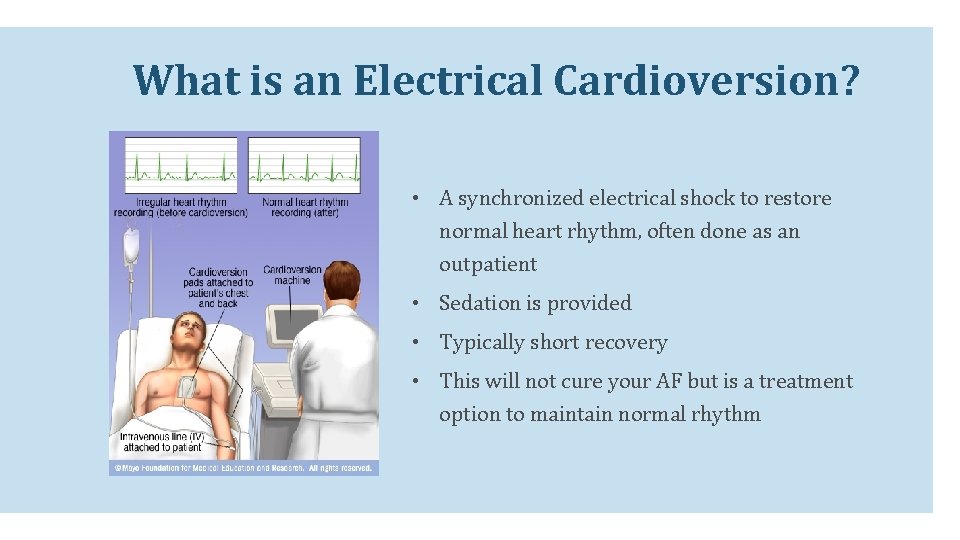
What is an Electrical Cardioversion? • A synchronized electrical shock to restore normal heart rhythm, often done as an outpatient • Sedation is provided • Typically short recovery • This will not cure your AF but is a treatment option to maintain normal rhythm
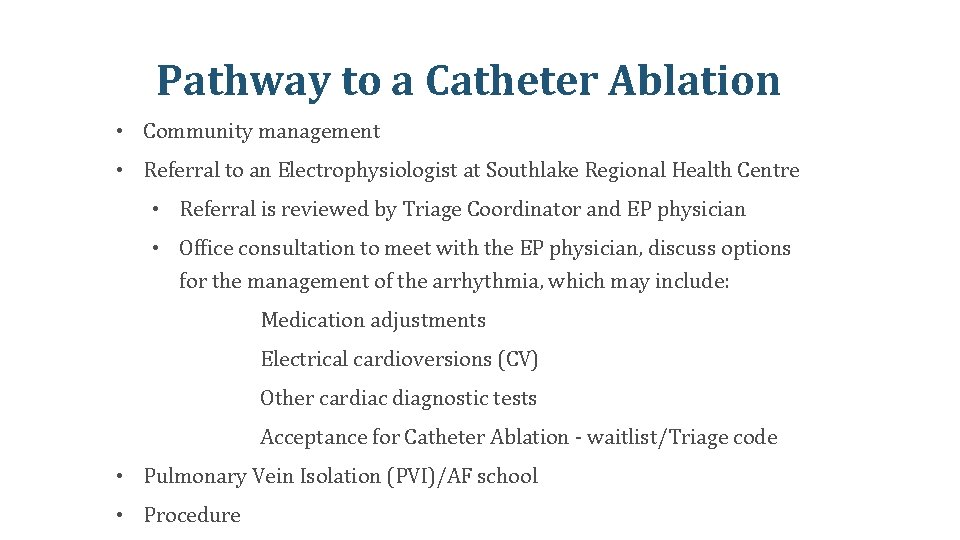
Pathway to a Catheter Ablation • Community management • Referral to an Electrophysiologist at Southlake Regional Health Centre • Referral is reviewed by Triage Coordinator and EP physician • Office consultation to meet with the EP physician, discuss options for the management of the arrhythmia, which may include: Medication adjustments Electrical cardioversions (CV) Other cardiac diagnostic tests Acceptance for Catheter Ablation - waitlist/Triage code • Pulmonary Vein Isolation (PVI)/AF school • Procedure
Why does AF increase the risk of stroke?
I have AF: What is my risk of stroke? CHADS 2 -65 Score C Congestive Heart Failure 1 H Hypertension 1 A Age > 65 1 D Diabetes 1 Stroke (or TIA) 2 S -2 www. ccs. ca/eguidelines
How do I decrease my risk of stroke? Medications which thin the blood and reduce risk of stroke in AF are called Anticoagulant Drugs. Dabigatran (Pradaxa®) Rivaroxaban (Xarelto®) Apixaban (Eliquis®) Endoxaban (Lixiana®) Warfarin (Coumadin®)
Anticoagulant Drugs and the risk of bleeding https: //www. healthchoicesfirst. com/videos/anticoagulants-complianceand-bleeding-when-should-patients-seek-medical-help
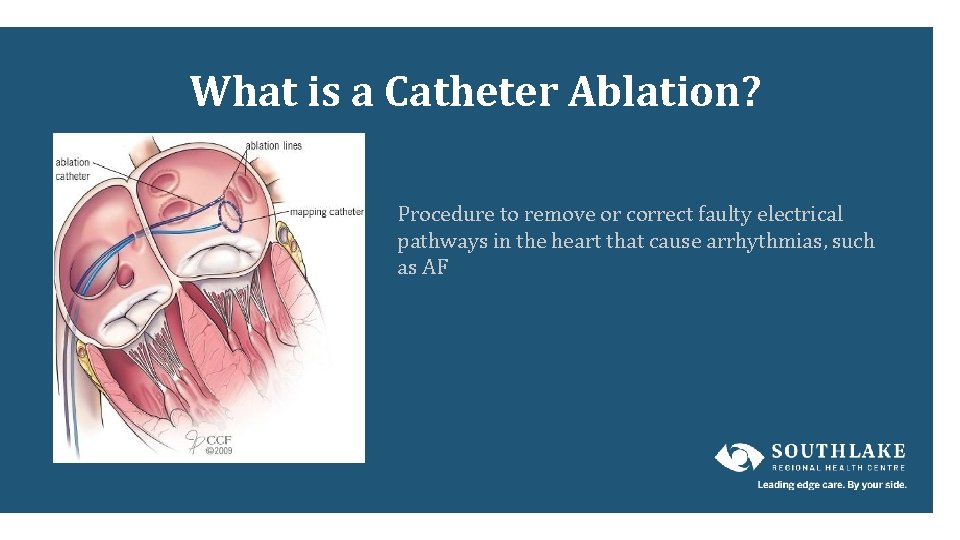
What is a Catheter Ablation? Procedure to remove or correct faulty electrical pathways in the heart that cause arrhythmias, such as AF
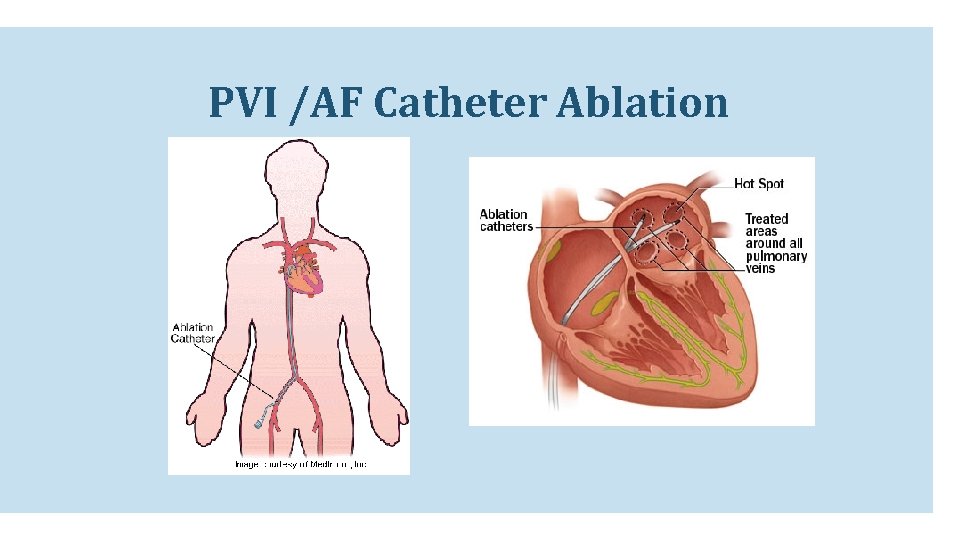
PVI /AF Catheter Ablation
What are the risks of a Catheter ablation? https: //www. healthchoicesfirst. com/videos/ablation-and-treatmentrisks
Risks of AF ablation • Stroke • Bleeding from the puncture sites • Perforation of the heart • Narrowing of the pulmonary veins • Damage to the esophagus Above risks are all under 1% with risk of death 0. 001% (<1: 1, 000)
How successful is an AF ablation? • The success of an AF ablation is dependent on • The type of AF you have (paroxysmal, persistent or permanent) • Your response to anti-arrhythmic medications • Your overall health and types of health conditions and presence of modifiable risks factors (diet, exercise, weight, alcohol intake, high blood pressure, sleep apnea) • Every individual is unique!!
What do I do to prepare for my AF ablation? MEDICATIONS 1. Oral Anticoagulation - needs to be taken for at least 1 month uninterrupted before your procedure date or as discussed with your EP physician/NP 2. Anti-arrhythmic medications - will be held before the ablation or as discussed with your EP physician/NP 3. Antacid Medication - You will receive a prescription for Pantoloc to start 1 week before and continue for 5 weeks following your procedure. This is protect the esophagus (food pipe) against irritation during and after the ablation Specific medication instructions will be given to you at the time of your booking
What do I do to prepare for my AF ablation? LIFE STYLE FACTORS 1. Blood work – to be done 1 -2 week before procedure. 2. Plan for someone to pick you up and stay with you after your procedure. 3. Avoid booking other procedures/surgeries around the time of your ablation. We want to avoid interruptions to blood thinning around the time of procedure. (1 mth before and 3 mth after procedure). 4. Book time off work 2 -4 weeks depending on the type of work that you do.
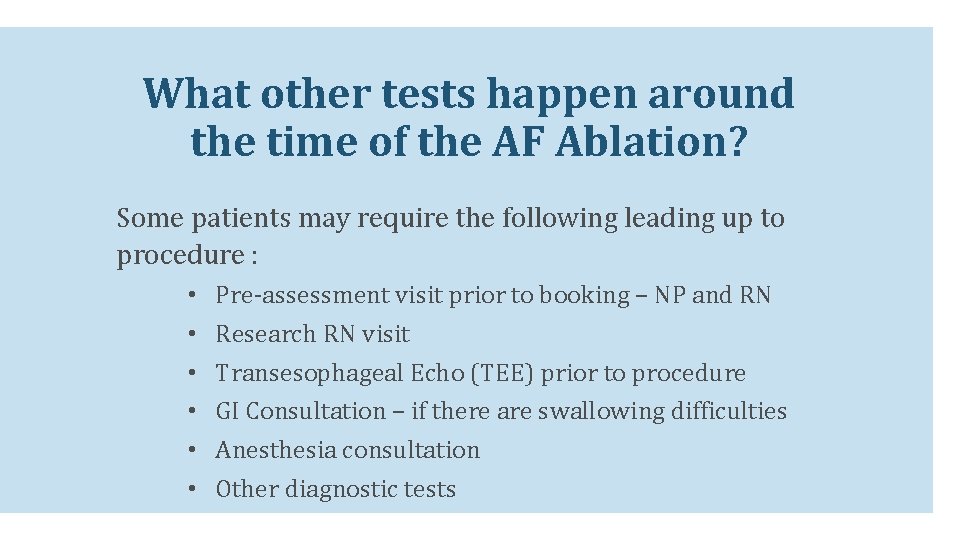
What other tests happen around the time of the AF Ablation? Some patients may require the following leading up to procedure : • • • Pre-assessment visit prior to booking – NP and RN Research RN visit Transesophageal Echo (TEE) prior to procedure GI Consultation – if there are swallowing difficulties Anesthesia consultation Other diagnostic tests
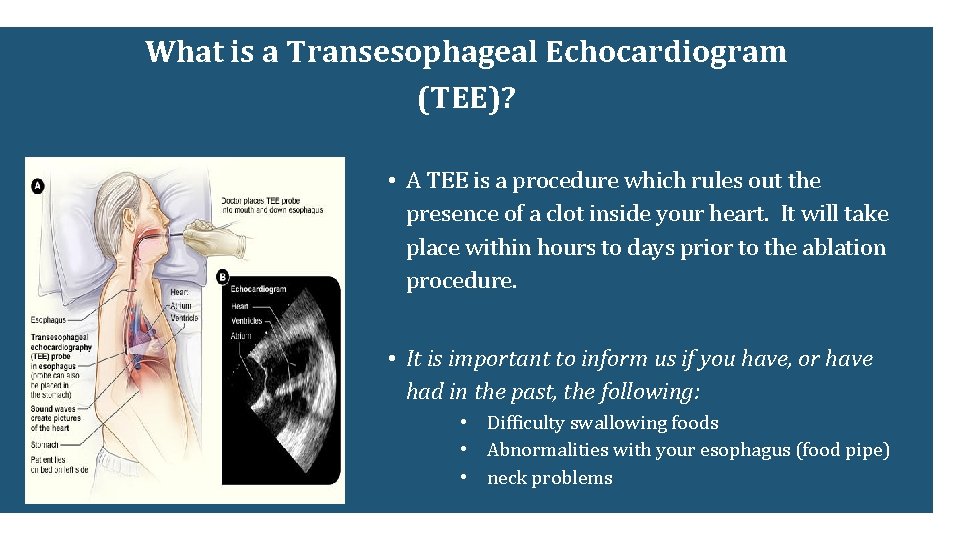
What is a Transesophageal Echocardiogram (TEE)? • A TEE is a procedure which rules out the presence of a clot inside your heart. It will take place within hours to days prior to the ablation procedure. • It is important to inform us if you have, or have had in the past, the following: • Difficulty swallowing foods • Abnormalities with your esophagus (food pipe) • neck problems
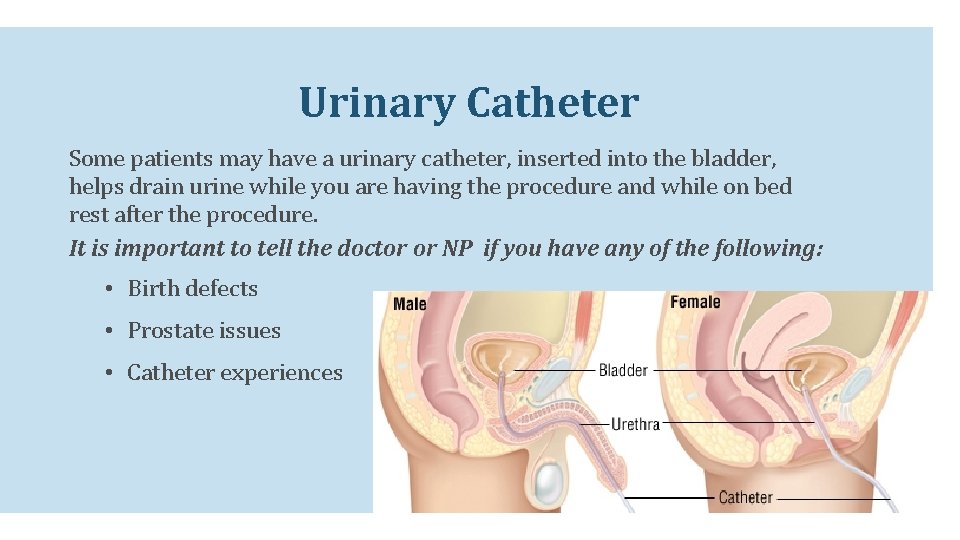
Urinary Catheter Some patients may have a urinary catheter, inserted into the bladder, helps drain urine while you are having the procedure and while on bed rest after the procedure. It is important to tell the doctor or NP if you have any of the following: • Birth defects • Prostate issues • Catheter experiences
Procedure Day • Register at the Welcome Centre (main floor) • Nurses in the Heart Rhythm Recovery Unit will get you ready for the procedure: ü Review your history and medications (bring all your medications) ü Start an intravenous (IV) to give you fluid and medication ü Insert a urinary catheter (to help drain your bladder during and post procedure) ü Clip prep (hair on your back, chest and groins may be clipped) ü While waiting for your procedure, the waiting room may be cool so bring a warm robe and slippers
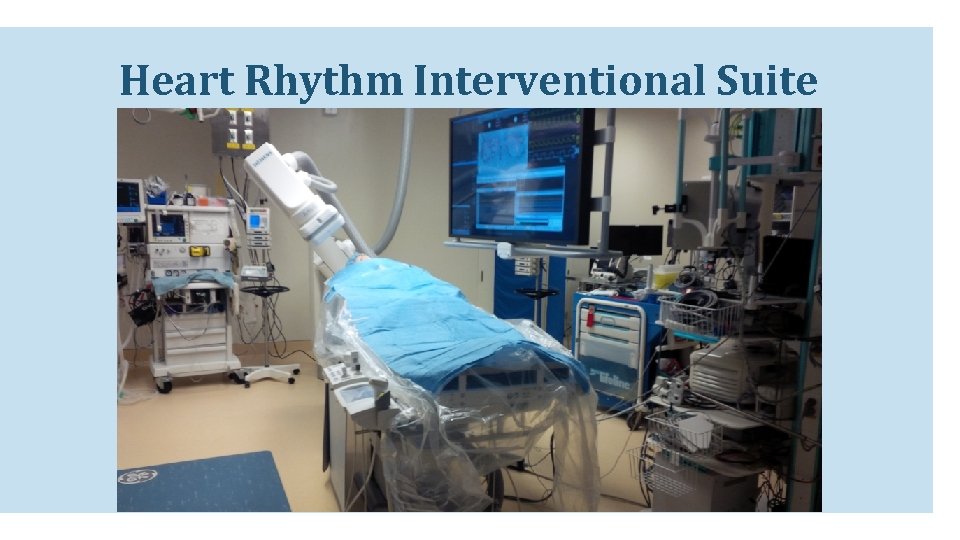
Heart Rhythm Interventional Suite
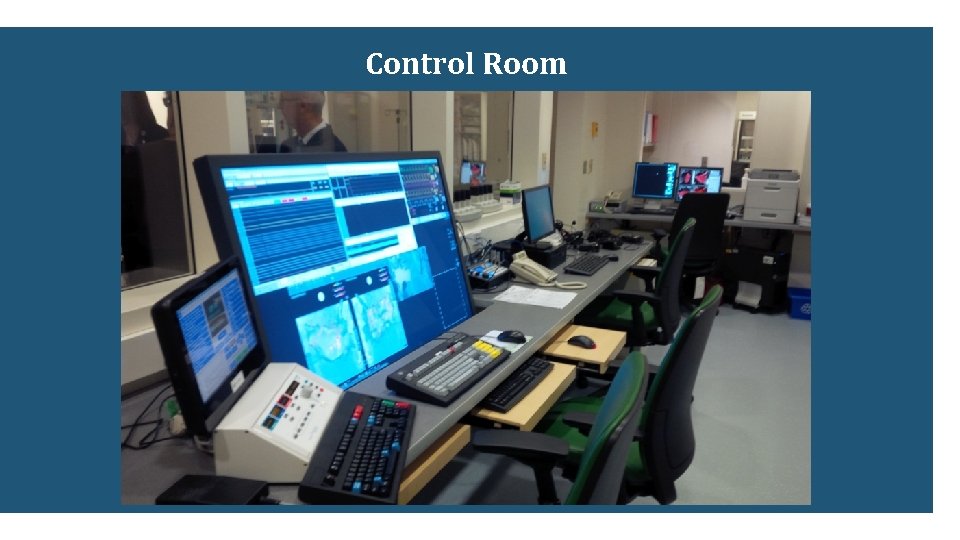
Control Room
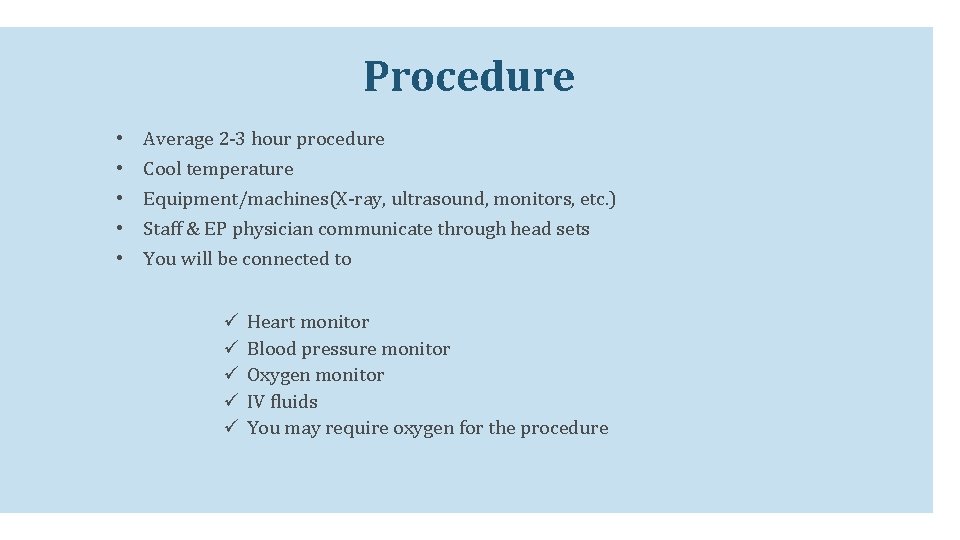
Procedure • • • Average 2 -3 hour procedure Cool temperature Equipment/machines(X-ray, ultrasound, monitors, etc. ) Staff & EP physician communicate through head sets You will be connected to ü ü ü Heart monitor Blood pressure monitor Oxygen monitor IV fluids You may require oxygen for the procedure
Procedure • Procedural antiseptic wash • Sterile drape will cover you from the chin to past your toes • The doctor will put freezing medications (may feel a sting and burning) and large IV’s into both groins (may feel pressure as IV’s go in) and sometimes right side of the neck • Ablation catheters will be used to deliver energy to burn or block the short circuits How will you feel during the procedure? ü Burning sensation ü Very warm sensation • If you feel pain or discomfort at any time, let the team know.
After your procedure • You will be brought to the recovery room on a stretcher • The Heart Rhythm Recovery nurses will remove the catheters and hold pressure to stop the bleeding • You will be on bed rest for 4 -6 hours after the procedure • You may go home the same day or D/C the next AM (this will be up to your physician) • After the procedure you may feel slightly nauseated, this is normal and there is medication ordered to help alleviate this • It is completely normal to feel tired for 24 -48 hours after the procedure
After your procedure • You cannot drive within 24 hours following your procedure • or as directed by your physician • It usually take 3 -5 days after ablation before you can start to resume normal activities ü You may shower or bathe 24 hours after your procedure and remove bandages at this time ü During this time, avoid heavy lifting (anything greater than 10 pounds) or strenuous exercise to allow your access sites to heal ü You may experience some bruising in the areas of access • You may return to work 2 -4 weeks after your procedure or as directed by your EP physician
After Procedure Complications Fever – a temperature above 38 o. C (100 o. F) • If you experience a fever in the first 4 -8 weeks after the ablation, contact the Heart Rhythm Program immediately • After hours (evenings, weekends and holidays), go to your nearest emergency department. • Take Tylenol Extra strength as needed but avoid non-steroidal anti-inflammatory drugs (NSAIDs) such as Ibuprofen, Advil or Aspirin
After Procedure Complications AF recurrence • AF recurrence may occur. • If you are staying out of rhythm beyond 24 hrs you may need a cardioversion and/or Optimization of your medication. Call the arrhythmia RN or present to you local ER with the “Dear Doctor Letter” given to you at the time of discharge. • For short episodes of AF (in and out), it is not necessary for you to be seen in the emergency room, unless you faint or have severe symptoms.
After Procedure Complications Chest Pain • In some cases mild to moderate chest discomfort is normal. • Not uncommon to have discomfort after procedure. • You may take Tylenol as needed. • Typically resolves in 3 -5 days
After Procedure Complications Bleeding from insertion site • If bleeding occurs once you are home follow the instructions given to you on discharge. If it does not resolve you may need to be seen in ER. If any of the following have occurred even if it has resolved please let our team know. 905 -895 -4521 x 2886
Medications After Procedure • Your physician may make some changes to your medications after procedure. • It is important to continue as prescribed until your follow-up in the office. • Do not stop or interrupt you blood thinning agents. • Pantoloc – it is important to complete your full prescription for the full 6 week ( 1 week before and 5 weeks after procedure).
Travelling after procedure • Recommendation is not to travel for at lease 1 month after your procedure. • Insurance – Many insurance companies will not supply travel insurance for at least 3 months after a procedure or medication changes. Talk to your insurance provider. 43
Follow-up after procedure • Follow up visits • Initial f/u 3 -6 months after procedure • Secondary follow-up 9 -12 mths after procedure • Follow up with your referring physician in 4 -8 weeks following your procedure. • Holter monitor 8 -12 weeks following procedure.
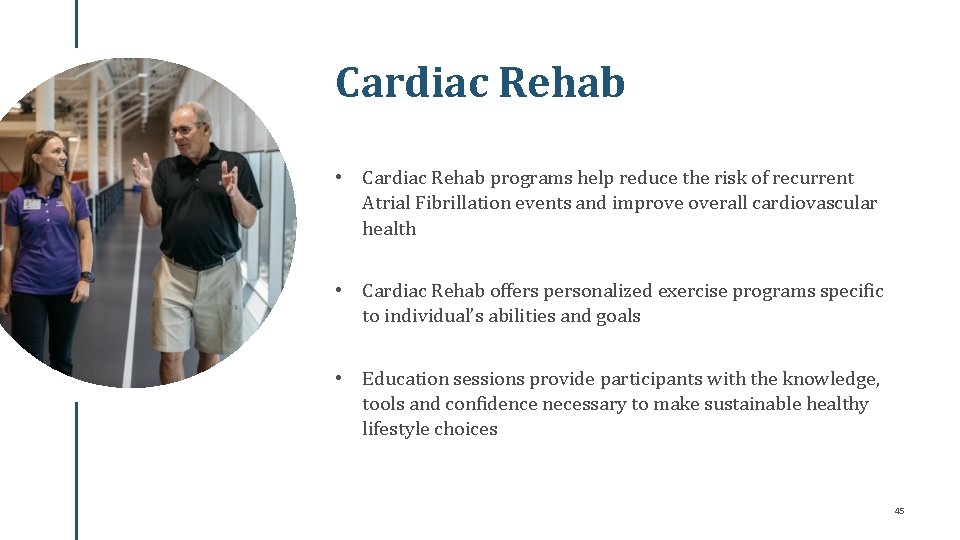
Cardiac Rehab • Cardiac Rehab programs help reduce the risk of recurrent Atrial Fibrillation events and improve overall cardiovascular health • Cardiac Rehab offers personalized exercise programs specific to individual’s abilities and goals • Education sessions provide participants with the knowledge, tools and confidence necessary to make sustainable healthy lifestyle choices 45
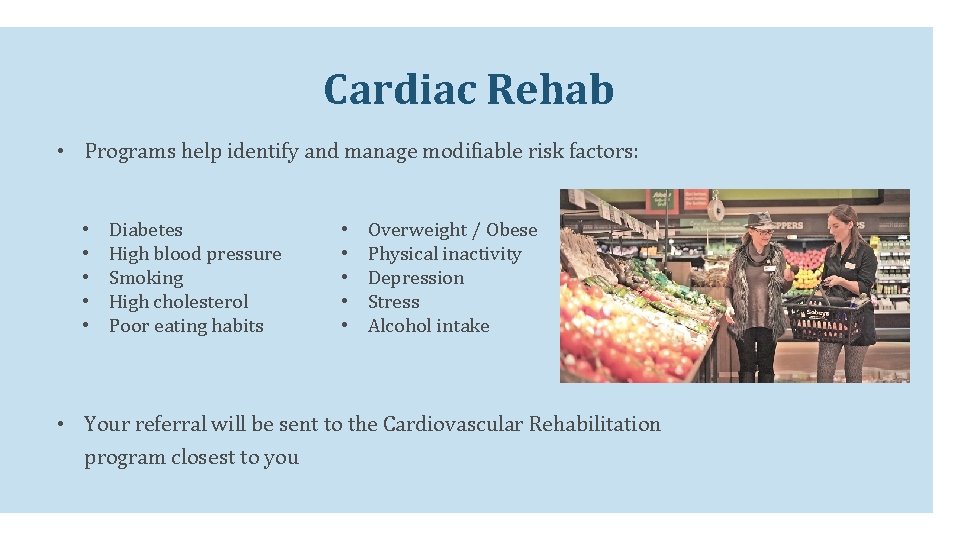
Cardiac Rehab • Programs help identify and manage modifiable risk factors: • • • Diabetes High blood pressure Smoking High cholesterol Poor eating habits • • • Overweight / Obese Physical inactivity Depression Stress Alcohol intake • Your referral will be sent to the Cardiovascular Rehabilitation program closest to you
Heart Rhythm Research • The electrophysiology research program began in 2004 with our first study called the RAFT trial • Today we participate in anywhere between 25 - 30 active research studies and always have new research on the horizon • We are dedicated to improving technology • Southlake Regional Health Center Website: Research Institute http: //www. southlakeregional. org/Default. aspx? cid=37&lang=1
Who to contact if you have questions? Southlake Regional Health Centre 905 -895 -4521 • Before your procedure: Heart Rhythm Triage Office - 2572 • After your procedure: Arrythmia RN – x 2886
Internet Resources • Heart and Stroke Foundation www. heartandstroke. ca/AFGuide • Canadian Cardiovascular Society www. ccsguidelineprograms. ca • Heart Rhythm Society www. hrsonline. org
Thank You HEART RHYTHM TRIAGE 905 -895 -4521 X 2572