
Heart rate response to exercise Cardiac control centre
- Slides: 7
Heart rate response to exercise Cardiac control centre Understand how exercise effects the heart rate Know what the cardiovascular drift is. Understand how the heart is controlled. AS PE Anatomy and Physiology
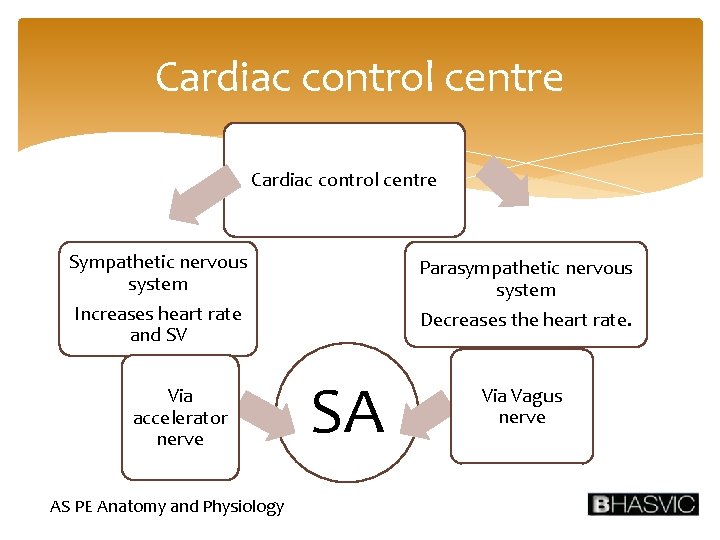
Cardiac control centre Sympathetic nervous system Increases heart rate and SV Via accelerator nerve AS PE Anatomy and Physiology Parasympathetic nervous system Decreases the heart rate. SA Via Vagus nerve
Heart regulation during exercise Rule of three two one. 3 Neural factors 2 Intrinsic factors 1 Hormonal AS PE Anatomy and Physiology
1 Hormonal Adrenalin From adrenal glands Stimulates the SA node directly via blood. This increases the heart rate as well as the stroke volume. AS PE Anatomy and Physiology
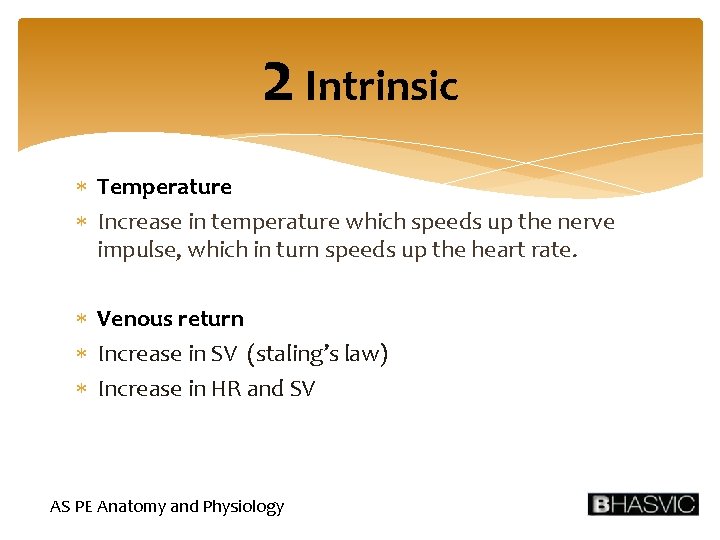
2 Intrinsic Temperature Increase in temperature which speeds up the nerve impulse, which in turn speeds up the heart rate. Venous return Increase in SV (staling’s law) Increase in HR and SV AS PE Anatomy and Physiology
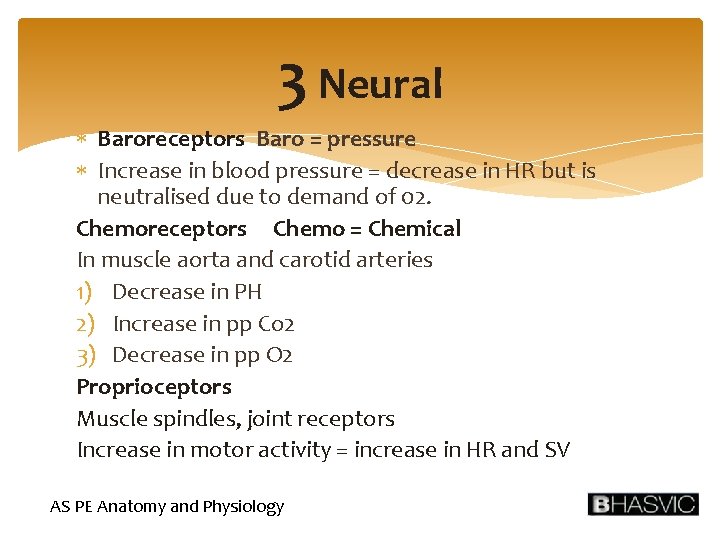
3 Neural Baroreceptors Baro = pressure Increase in blood pressure = decrease in HR but is neutralised due to demand of 02. Chemoreceptors Chemo = Chemical In muscle aorta and carotid arteries 1) Decrease in PH 2) Increase in pp Co 2 3) Decrease in pp O 2 Proprioceptors Muscle spindles, joint receptors Increase in motor activity = increase in HR and SV AS PE Anatomy and Physiology
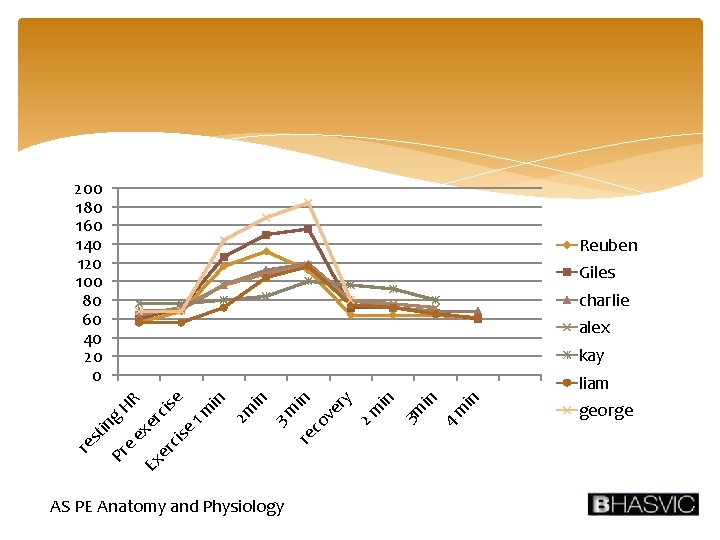
200 180 160 140 120 100 80 60 40 20 0 Reuben Giles charlie alex kay 2 m in 3 m in 4 m in co ve ry in AS PE Anatomy and Physiology re 3 m in 2 m in 1 m e e cis Ex er cis er ex Pr e re st in g HR liam george