
Heart Physiology Electrical Events Intrinsic cardiac conduction system

- Slides: 30
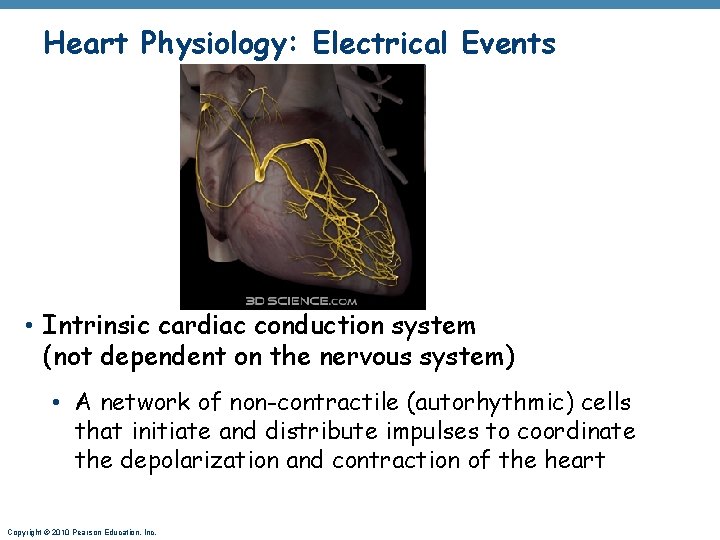
Heart Physiology: Electrical Events • Intrinsic cardiac conduction system (not dependent on the nervous system) • A network of non-contractile (autorhythmic) cells that initiate and distribute impulses to coordinate the depolarization and contraction of the heart Copyright © 2010 Pearson Education, Inc.
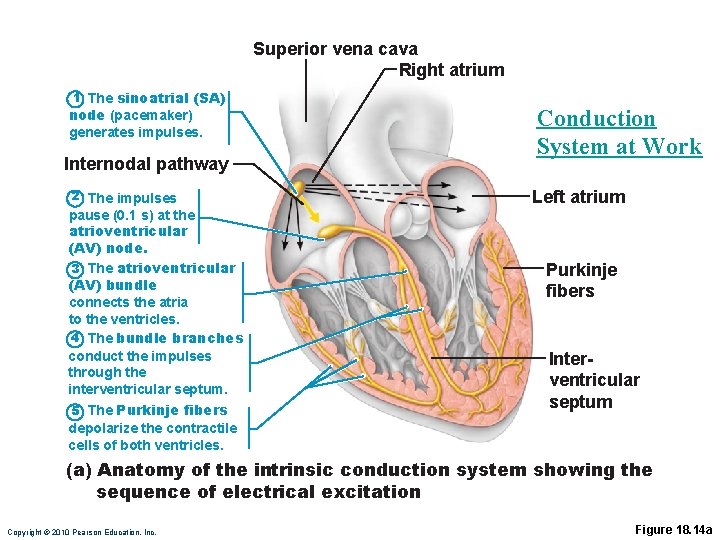
Main Components of the Cardiac Conduction System • Synoatrial Node (SA Node) • Atrioventrucular Node (AV Node) • Atrioventricular Bundle (AV Bundle/Bundle of His) • Right and Left Bundle Branches • Purkinje Fibers Copyright © 2010 Pearson Education, Inc.
Superior vena cava Right atrium 1 The sinoatrial (SA) node (pacemaker) generates impulses. Internodal pathway 2 The impulses pause (0. 1 s) at the atrioventricular (AV) node. 3 The atrioventricular (AV) bundle connects the atria to the ventricles. 4 The bundle branches conduct the impulses through the interventricular septum. 5 The Purkinje fibers Conduction System at Work Left atrium Purkinje fibers Interventricular septum depolarize the contractile cells of both ventricles. (a) Anatomy of the intrinsic conduction system showing the sequence of electrical excitation Copyright © 2010 Pearson Education, Inc. Figure 18. 14 a
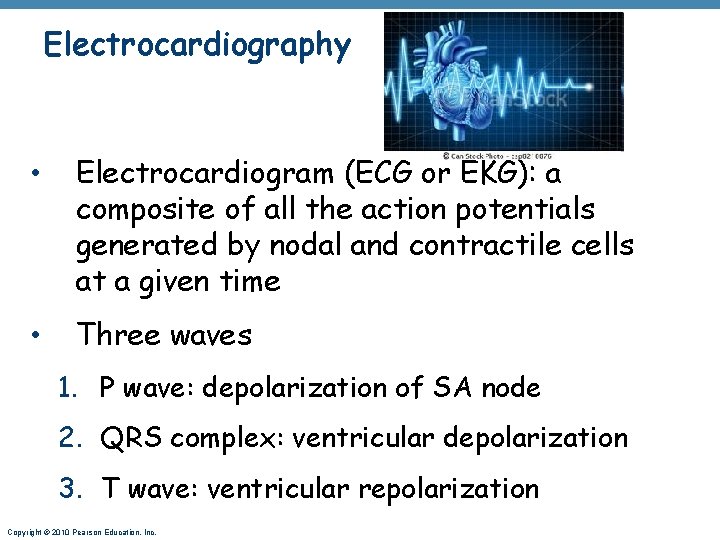
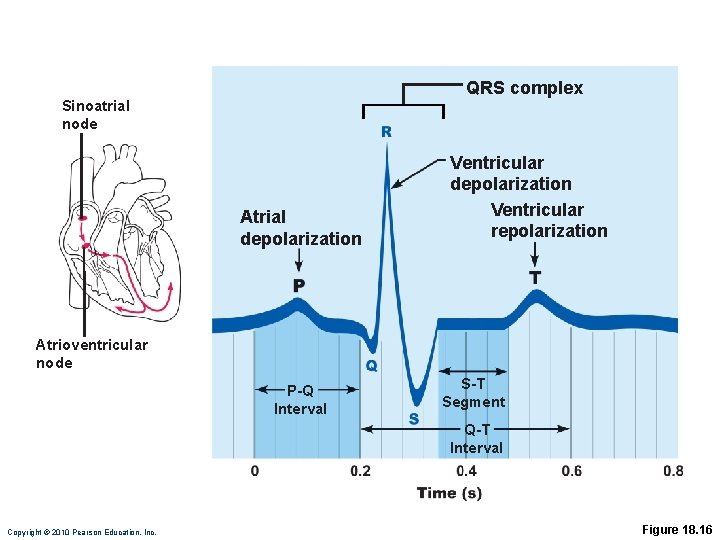
Electrocardiography • Electrocardiogram (ECG or EKG): a composite of all the action potentials generated by nodal and contractile cells at a given time • Three waves 1. P wave: depolarization of SA node 2. QRS complex: ventricular depolarization 3. T wave: ventricular repolarization Copyright © 2010 Pearson Education, Inc.
QRS complex Sinoatrial node Atrial depolarization Ventricular repolarization Atrioventricular node P-Q Interval S-T Segment Q-T Interval Copyright © 2010 Pearson Education, Inc. Figure 18. 16
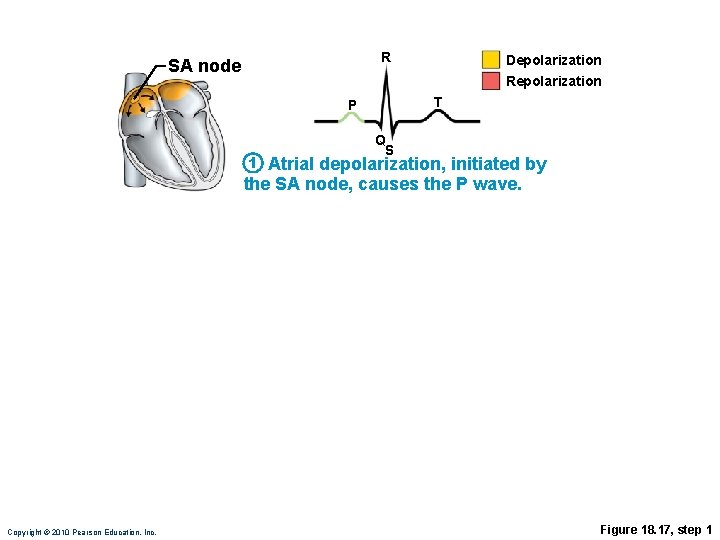
R SA node Depolarization Repolarization T P 1 Q S Atrial depolarization, initiated by the SA node, causes the P wave. Copyright © 2010 Pearson Education, Inc. Figure 18. 17, step 1
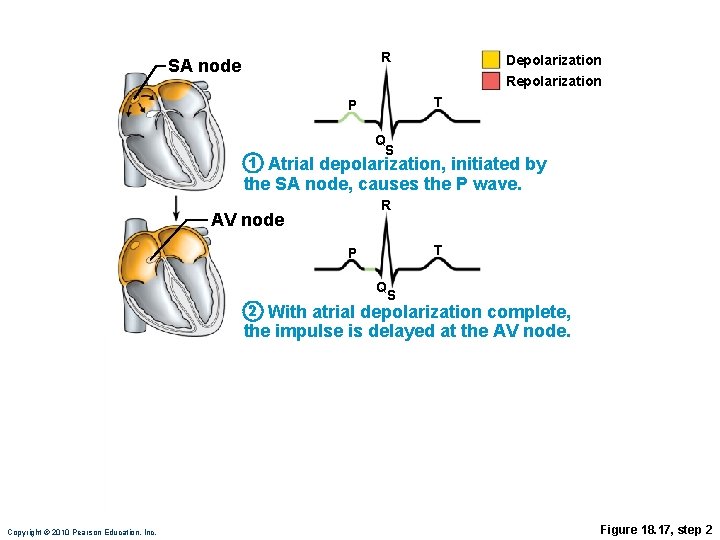
R SA node Depolarization Repolarization T P Q S 1 Atrial depolarization, initiated by the SA node, causes the P wave. R AV node T P Q 2 S With atrial depolarization complete, the impulse is delayed at the AV node. Copyright © 2010 Pearson Education, Inc. Figure 18. 17, step 2
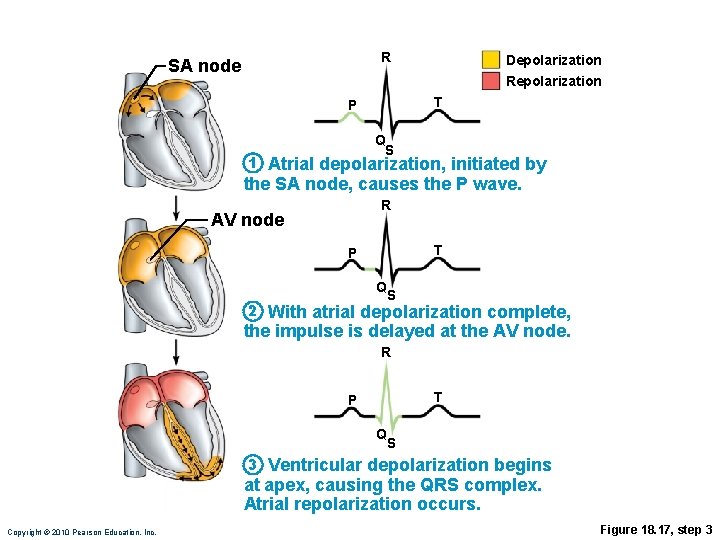
R SA node Depolarization Repolarization T P Q S 1 Atrial depolarization, initiated by the SA node, causes the P wave. R AV node T P Q 2 S With atrial depolarization complete, the impulse is delayed at the AV node. R T P Q S 3 Ventricular depolarization begins at apex, causing the QRS complex. Atrial repolarization occurs. Copyright © 2010 Pearson Education, Inc. Figure 18. 17, step 3
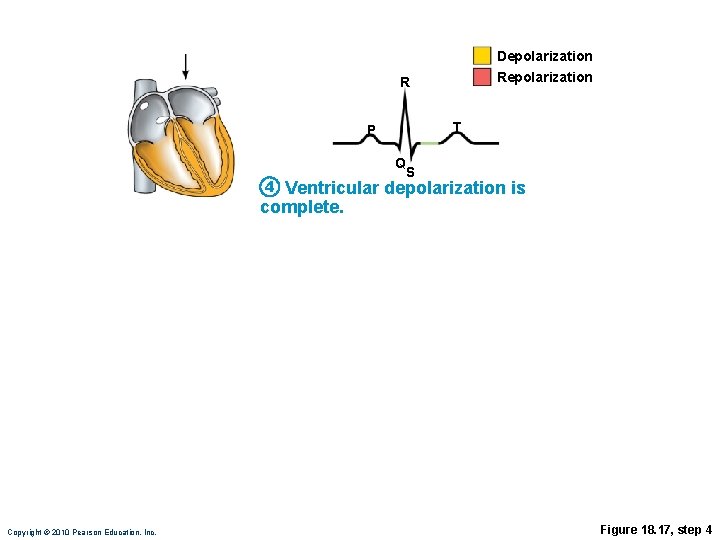
Depolarization R T P Q 4 S Ventricular depolarization is complete. Copyright © 2010 Pearson Education, Inc. Figure 18. 17, step 4
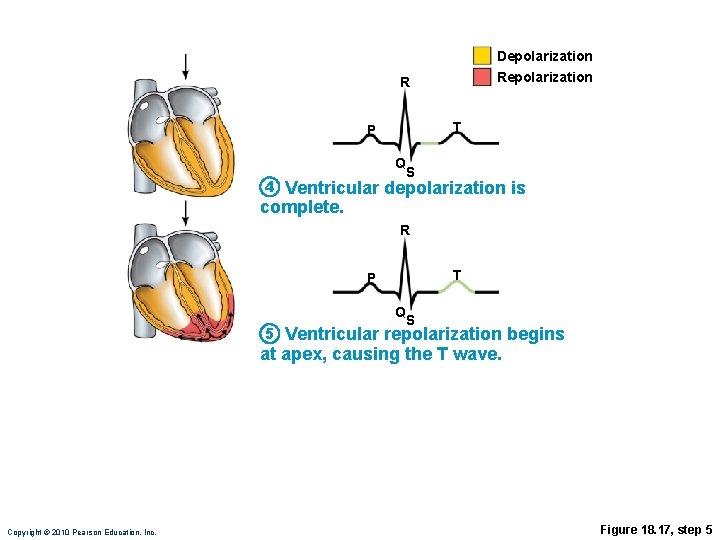
Depolarization R T P Q 4 S Ventricular depolarization is complete. R T P Q 5 S Ventricular repolarization begins at apex, causing the T wave. Copyright © 2010 Pearson Education, Inc. Figure 18. 17, step 5
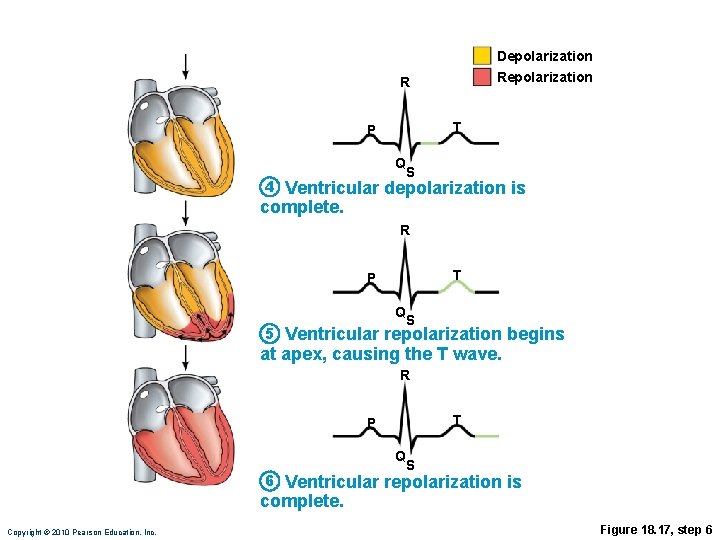
Depolarization R T P Q 4 S Ventricular depolarization is complete. R T P Q 5 S Ventricular repolarization begins at apex, causing the T wave. R T P Q 6 S Ventricular repolarization is complete. Copyright © 2010 Pearson Education, Inc. Figure 18. 17, step 6
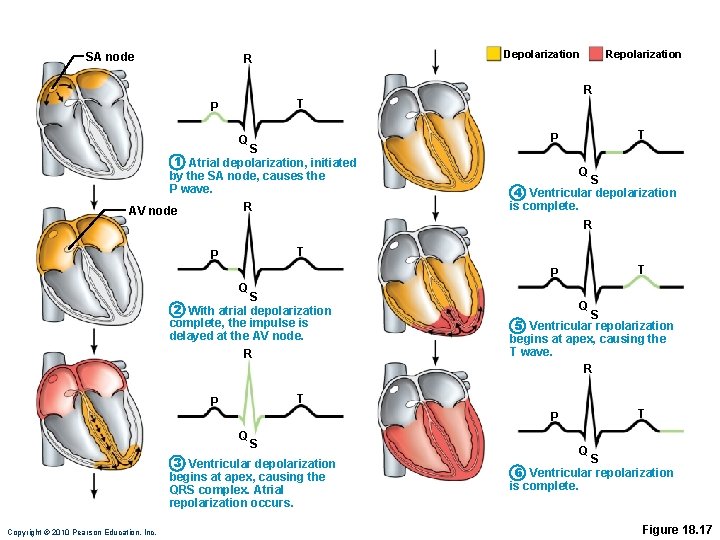
SA node Depolarization R Repolarization R T P Q S 1 Atrial depolarization, initiated by the SA node, causes the P wave. R AV node T P Q S 4 Ventricular depolarization is complete. R T P Q S 2 With atrial depolarization complete, the impulse is delayed at the AV node. R Q S 5 Ventricular repolarization begins at apex, causing the T wave. R T P Q S 3 Ventricular depolarization begins at apex, causing the QRS complex. Atrial repolarization occurs. Copyright © 2010 Pearson Education, Inc. Q S 6 Ventricular repolarization is complete. Figure 18. 17
Homeostatic Imbalances Defects in the intrinsic conduction system may result in: 1. Arrhythmias: irregular heart rhythms 2. Uncoordinated atrial and ventricular contractions 3. Fibrillation: rapid, irregular contractions; useless for pumping blood Copyright © 2010 Pearson Education, Inc.
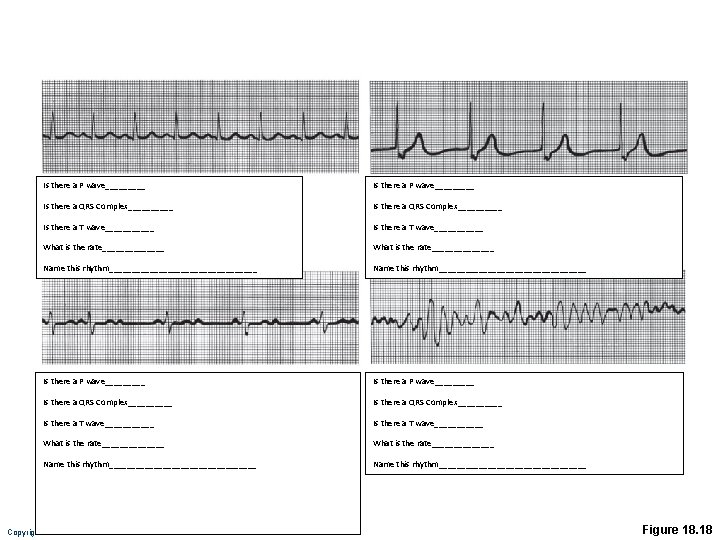
Homeostatic Imbalances • Defective SA node may result in • Ectopic focus: abnormal pacemaker takes over • If AV node takes over, there will be a junctional rhythm (40– 60 bpm) • Defective AV node may result in • Partial or total heart block • Few or no impulses from SA node reach the ventricles Copyright © 2010 Pearson Education, Inc.
(a) Normal sinus rhythm. Is there a P wave_____ Is there a QRS Complex_____ Is there a T wave______ What is the rate_______ Name this rhythm_________________ (b) Junctional rhythm. The SA Is there a QRS Complex_____ node is nonfunctional, P waves Is there a T wave______ are absent, and heart is paced by What is the rate_______ the AV node at 40 - 60 beats/min. Name this rhythm_________________ Is there a P wave_________ Is there a P wave_____ Ventricular fibrillation. These (c) Second-degree heart block. (d) Is there a QRS Complex__________ grossly irregular ECG Some P waves are not conducted Is therechaotic, Is there a T wave___________ deflections are seen in acute through the AV node; hence more What is the rate______________ heart attack and electrical shock. P than QRS waves are seen. In Name this rhythm_________________________________ this tracing, the ratio of P waves to QRS waves is mostly 2: 1. Copyright © 2010 Pearson Education, Inc. Figure 18. 18
Copyright © 2010 Pearson Education, Inc.
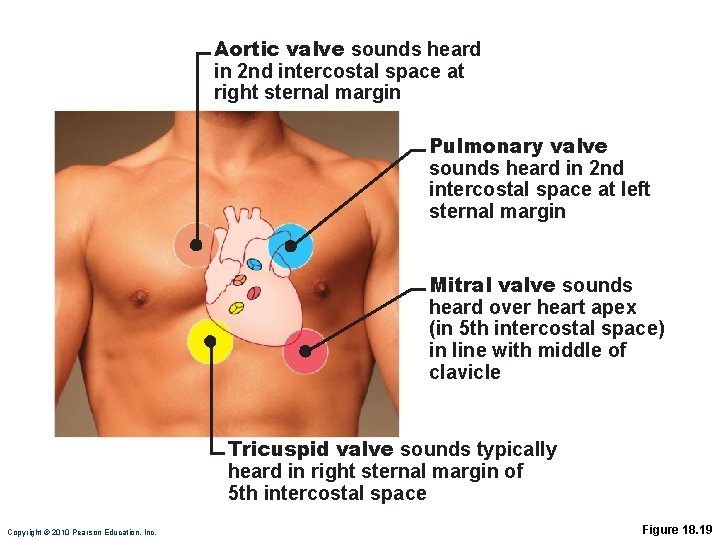
Heart Sounds • Two sounds (lub-dup) associated with closing of heart valves • First sound occurs as AV valves close and signifies beginning of systole • Second sound occurs when SL valves close at the beginning of ventricular diastole • Heart murmurs: abnormal heart sounds most often indicative of valve problems Copyright © 2010 Pearson Education, Inc.
Aortic valve sounds heard in 2 nd intercostal space at right sternal margin Pulmonary valve sounds heard in 2 nd intercostal space at left sternal margin Mitral valve sounds heard over heart apex (in 5 th intercostal space) in line with middle of clavicle Tricuspid valve sounds typically heard in right sternal margin of 5 th intercostal space Copyright © 2010 Pearson Education, Inc. Figure 18. 19
Mechanical Events: The Cardiac Cycle • Cardiac cycle: all events associated with blood flow through the heart during one complete heartbeat • Systole—contraction • Diastole—relaxation Copyright © 2010 Pearson Education, Inc.
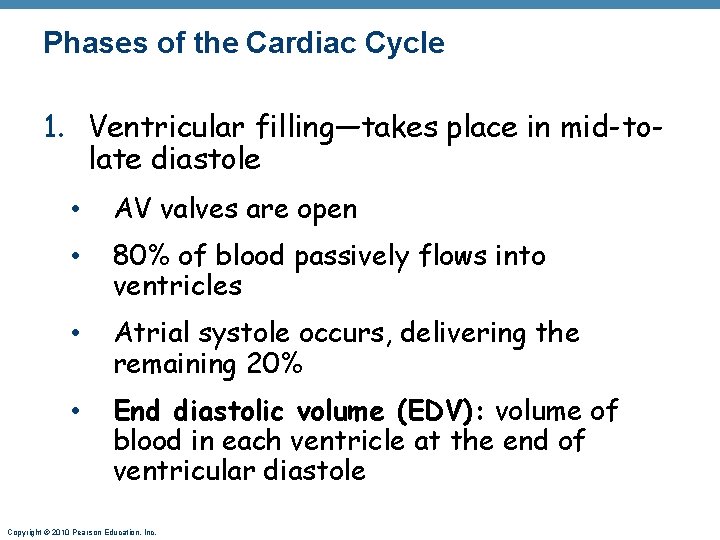
Phases of the Cardiac Cycle 1. Ventricular filling—takes place in mid-tolate diastole • AV valves are open • 80% of blood passively flows into ventricles • Atrial systole occurs, delivering the remaining 20% • End diastolic volume (EDV): volume of blood in each ventricle at the end of ventricular diastole Copyright © 2010 Pearson Education, Inc.
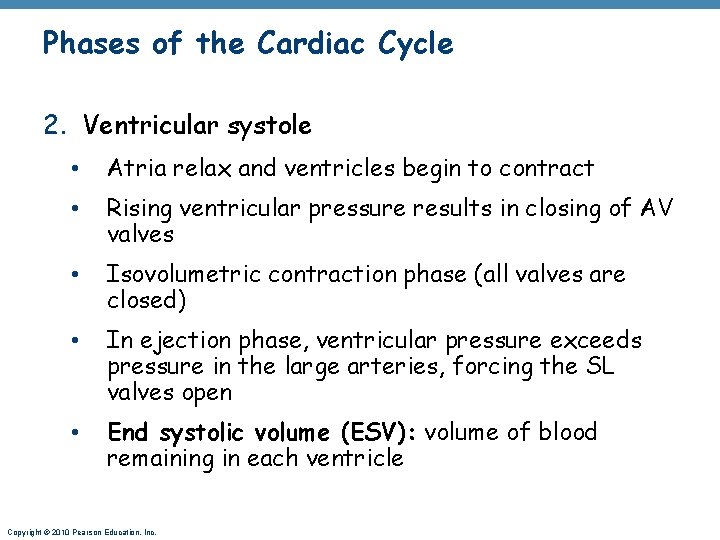
Phases of the Cardiac Cycle 2. Ventricular systole • Atria relax and ventricles begin to contract • Rising ventricular pressure results in closing of AV valves • Isovolumetric contraction phase (all valves are closed) • In ejection phase, ventricular pressure exceeds pressure in the large arteries, forcing the SL valves open • End systolic volume (ESV): volume of blood remaining in each ventricle Copyright © 2010 Pearson Education, Inc.
Phases of the Cardiac Cycle 3. Isovolumetric relaxation occurs in early diastole • Ventricles relax • Backflow of blood in aorta and pulmonary trunk closes SL valves Copyright © 2010 Pearson Education, Inc.
Cardiac Output (CO) • Volume of blood pumped by each ventricle in one minute • CO = heart rate (HR) x stroke volume (SV) • HR = number of beats per minute • SV = volume of blood pumped out by a ventricle with each beat Copyright © 2010 Pearson Education, Inc.
Cardiac Output (CO) • At rest • CO (ml/min) = HR (75 beats/min) SV (70 ml/beat) = 5. 25 L/min • Maximal CO is 4– 5 times resting CO in nonathletic people • Maximal CO may reach 35 L/min in trained athletes • Cardiac reserve: difference between resting and maximal CO Copyright © 2010 Pearson Education, Inc.
Autonomic Nervous System Regulation • Sympathetic nervous system is activated by emotional or physical stressors • Norepinephrine causes the pacemaker to fire more rapidly (and at the same time increases contractility) Copyright © 2010 Pearson Education, Inc.
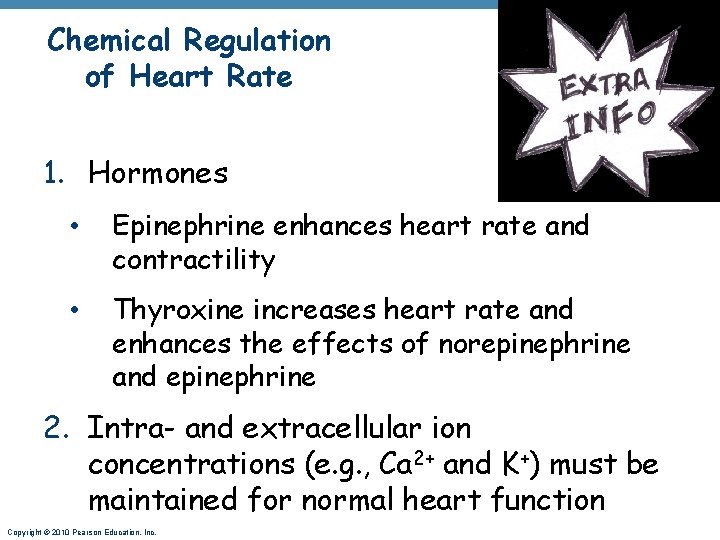
Chemical Regulation of Heart Rate 1. Hormones • Epinephrine enhances heart rate and contractility • Thyroxine increases heart rate and enhances the effects of norepinephrine and epinephrine 2. Intra- and extracellular ion concentrations (e. g. , Ca 2+ and K+) must be maintained for normal heart function Copyright © 2010 Pearson Education, Inc.
Factors that Influence Heart Rate • Age • Gender • Exercise • Body temperature Copyright © 2010 Pearson Education, Inc.
Homeostatic Imbalances • Tachycardia: abnormally fast heart rate (>100 bpm) • If persistent, may lead to fibrillation • Bradycardia: heart rate slower than 60 bpm • May result in grossly inadequate blood circulation • May be desirable result of endurance training Copyright © 2010 Pearson Education, Inc.
Congestive Heart Failure (CHF) • Progressive condition where the CO is so low that blood circulation is inadequate to meet tissue needs • Caused by • Coronary atherosclerosis • Persistent high blood pressure • Multiple myocardial infarcts • Dilated cardiomyopathy (DCM) Copyright © 2010 Pearson Education, Inc.
Age-Related Changes Affecting the Heart • Sclerosis and thickening of valve flaps • Decline in cardiac reserve • Fibrosis of cardiac muscle • Atherosclerosis Copyright © 2010 Pearson Education, Inc.