
Heart Failure CHF Brunner ch 30 pp 795
Heart Failure (CHF) Brunner, ch. 30, pp. 795 -812
Chronic Heart Failure n n n Has exacerbations and remissions. Acute phase is called acute decompensated heart failure. Most common hospital admission in pts over 65 Second most common office visit ER visits and readmissions are common. Prevention and early intervention are important health initiatives.
Pathophysiology n Impairment of ventricles from damage or overstretching (Starling’s Law) makes them unable to fill with and effectively pump blood. n Starling’s Law: The greater the stretch of cardiac muscle the greater the degree of shortening. Pg. 660. SV increases with increased bld V. filling heart n As a result, cardiac output falls (decreased ejection fraction), leading to decreased tissue perfusion, making the heart unable to meet the metabolic demands of the body.
Physiologic Compensatory Mechanisms n n Decreased CO stimulates SNS to release catecholamine's This increases HR, BP, peripheral resistance, and venous return This decreases ventricular filling time and decreases CO leading to decreased organ perfusion Results in increased myocardial workload and O 2 demand.
Cardiac Output CO = SV times HR n CO = total amt of blood ejected by one ventricle in L/min (4 -8 L) n SV= total amt of blood ejected by one ventricle per heartbeat (60 -130 ml) n HR= 60 -100/min n For Example: CO = 100 times 75 = 7500 ml or 7. 5 L n

Preload and Afterload
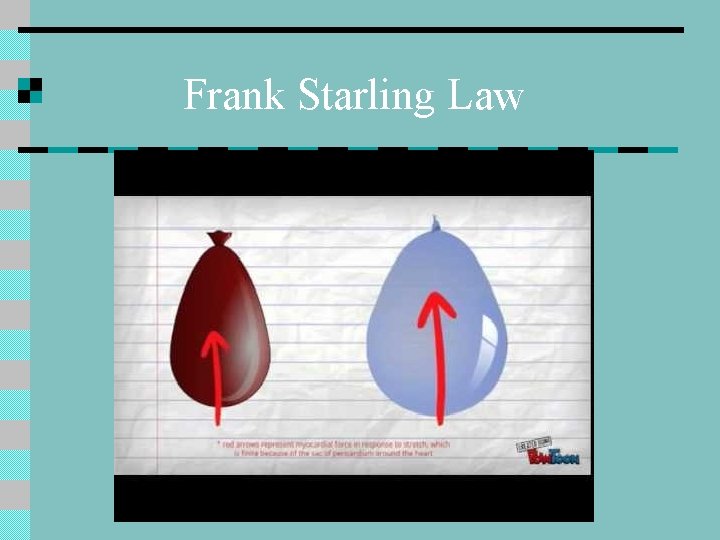
Frank Starling Law
Compensatory Mechanisms cont’d n Decreased CO and renal perfusion stimulates the Renin-Angiotensin-Aldosterone System creating a rock-slide effect (RAAS cascade) n n Angiotensin stimulates aldosterone Antidiuretic hormone is released leading to…………. .
Compensatory Mechanisms cont’d n n n Vasoconstriction Increased BP Salt and water retention Increased vascular volume Causing atrial natriuretic and b-type natriuretic peptides (ANP & BNP, heart hormones) and nitric oxide to kick in resulting in vasodilation and diuresis……. Compensation successful!
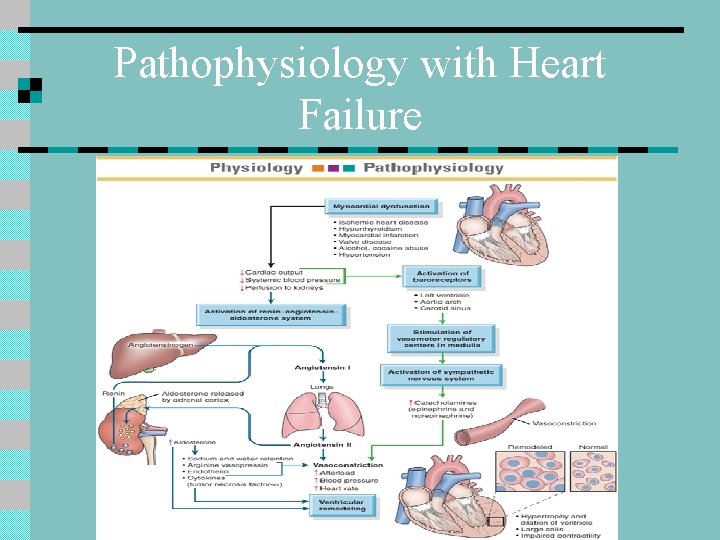
Pathophysiology with Heart Failure
Pathophysiology: Decompensation—ADHF n Occurs when these mechanisms become exhausted and fail to maintain the CO needed for adequate tissue perfusion. n Alveoli become filled with serosanguineous fluid from congestion and the fluid leaks into interstitial spaces. Lung tissue becomes less compliant and airways constrict (AKA: Pulmonary Edema)
S/S of ADHF; AKA: Pulmonary Edema n n n Severe dyspnea, tachypnea, orthopnea Dry hacking cough, audible wheezing and moist sounds, hemoptysis, Lungs with crackles, wheezes, rhonchi <SBP, >DBP, <PP, tachy, S 3 gallop rhythm Anxious, pale, cyanotic, dropping O 2 sat Cold, clammy skin
S/S of Chronic Heart Failure n n n n Wt gain, edema JVD Hepatomegaly Oliguria, nocturia DOE, PND, orthopnea Fatigue, anorexia Restlessness, confusion, decreased attn span Skin changes in extremities
Etiology of Heart Failure n Long standing CAD—creates prolonged ischemia n Previous MI—weakens muscle n HTN—increases afterload in great vessels, causes LV hypertrophy n Hx of pericarditis—scar tissue causes constriction n Dysrhythmias—affect pump action
Etiology cont’d n Anemia—increases HR n Thyroid disease—increases HR and BP n Lyte imbalances—affects regularity, contractility n COPD—increases afterload in PA n Diabetes—constricts small arteries n Valvular disorders—causes leakage
Classifications of Heart Failure: Right and Left n Right-sided n n n Congestion in right chambers Increase in CVP Increase in size of RV Backflow to vena cava Congestion in jugular veins, liver, lower extremities n Left-sided n n Congestion in left chambers Increase in size of LV Backflow to pulmonary veins Congestion in lungs
Systolic and Diastolic Heart Failure n Systolic failure: The left ventricle loses its ability to contract normally. The heart can't pump with enough force to push enough blood into circulation n Diastolic failure (also called diastolic dysfunction): The left ventricle loses its ability to relax normally (because the muscle has become stiff). The heart can't properly fill with blood during the resting period between each beat
Classifications: Forward and Backward n Systolic Failure (Forward Failure)—poor cardiac contraction results in poor CO and decreased EF. Kidneys suffer the most. n Diastolic Failure (Backward Failure)—ventricles are stiff and thick and will not relax enough during the resting phase to receive adequate amount of blood to maintain good CO. Also causes backflow into lungs and systemic circulation.
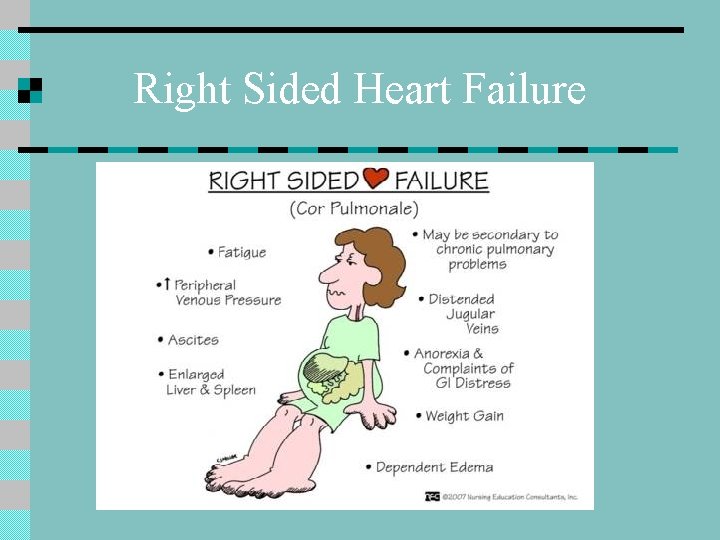
Right Sided Heart Failure
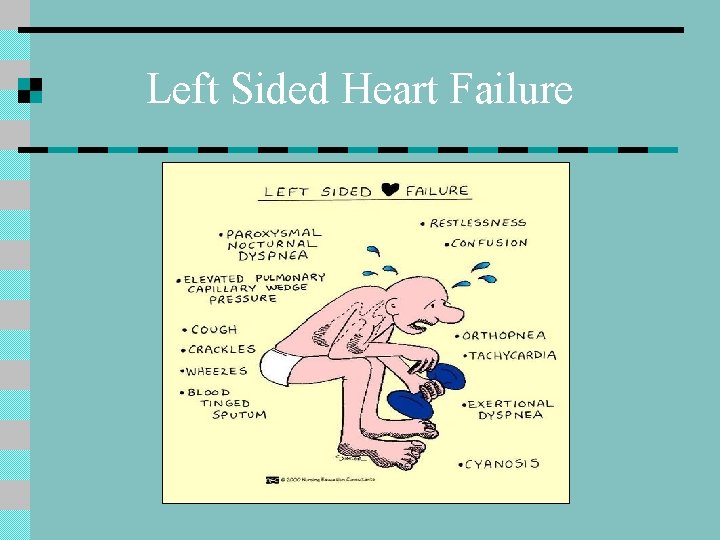
Left Sided Heart Failure
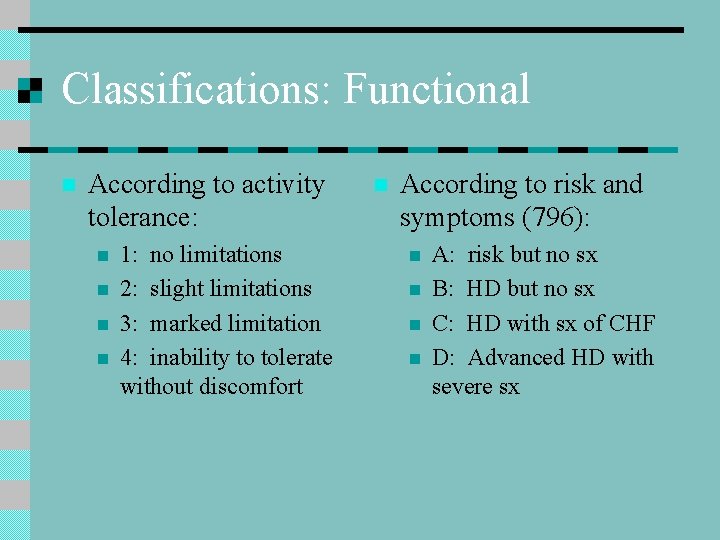
Classifications: Functional n According to activity tolerance: n n 1: no limitations 2: slight limitations 3: marked limitation 4: inability to tolerate without discomfort n According to risk and symptoms (796): n n A: risk but no sx B: HD but no sx C: HD with sx of CHF D: Advanced HD with severe sx
Classifications: Wet/Dry; Warm/Cold n Wet means the patient has fluid overload n Dry means the patient does not. n Warm means the patient has good perfusion n Cold means the patient does not.
Diagnostic Assessment CXR—fluid and heart enlargement n ECG—can reveal hx of heart problems n Echo or TEE—enlargement, valvular function, condition of great vessels, ejection fraction n ABGs, O 2 sat, cardiac markers, BMP n Liver functions, thyroid functions, BUN, creatinine, BNP n Stress testing n
Collaborative Management: Core Measures n n Discharge Instructions (see Pt Ed slide) Evaluation of Left Ventricular Systolic (LVS) Function (ejection fraction). Must be documented on the chart. ACEI or ARB for LVSD (ejection fraction less than 40%). Adult Smoking Cessation Advice
Admission Criteria Left-sided n n n O 2 sat < 89 BUN or creatinine 1½ times upper limits of normal Change in mental status Failed OP tx (2 vs/7 d) Sustained HR 100 -120 Right-sided n n n O 2 sat < 89 Weight gain > 3 lb/2 d Edema of extremities
Management of ADHF n n n n Hi-Fowlers O 2 mask or Bi. PAP. Intubation and mechanical ventilation is possible if needed VS, Pulse ox, UOP hourly Telemetry Daily wt Meds: diuretics (Lasix), vasodilators (NTG), inotropics (dobutamine), morphine, (brain (B-type) natriuretic peptide) Natrecor Hemodynamic monitoring—CVP, PAWP Circulatory assistive devices—VAD, IABP
Management of Chronic HF n Meds: n n n n Digoxin Lasix ACEIs (Vasotec) ARBs (Cozaar) Renin inhibitor (Tekturna) Beta-blockers (Lopressor) Nitrates (isosorbide initrate) Be mindful of potential dangerous side effects (837)
Ending Tell The Drug Calcium Channel Blockers = pine n Beta Blockers = lol n Angiotensin = pril n Angiotensin Receptor Blockers = tan n
Management cont’d n n n n 6 small meals of NAS diet with >calories, protein Fowler’s position O 2 by NC 3 -6 L/min Rest-activity schedule, stress reduction I&O, daily wts, possible fluid restriction Circulatory assistive device Long-term: cardiac transplantation
Complications n n n Pleural effusion from pulmonary congestion Dysrhythmias caused by stretching of the chambers particularly the atria (a-fib) and especially if EF < 35% LV thrombus from atrial fib and poor ventricular function. Need anticoagulant therapy. Liver dysfunction—can result in cirrhosis Renal failure from poor renal perfusion
Patient Education n n n n Disease process Meds—indications, SEs Balancing rest and activity Low Na diet; fluid restriction if indicated Monitoring of fluid status—daily wt—same time, same clothes S&S to report—chest pain, palpitations, DOE, PND, orthopnea, hemoptysis, wt gain (>3 lb/2 d or >5 lb/wk), increase in edema, fatigue, cough, anorexia Emotional support—high level of anxiety and depression Keep appts
- Slides: 31