
HEARLab training Harvey Dillon Bram Van Dun Lyndal
HEARLab training Harvey Dillon, Bram Van Dun, Lyndal Carter, Kirsty Gardner-Berry HEARing CRC National Acoustic Laboratories (NAL) With thanks to John Seymour, Suzanne Purdy, Maryanne Golding, Hsiuwen Chang, Barry Clinch, Lars Kirk 3 September 2010 - Version 1 www. hearingcrc. org NAL: Dillon, Van Dun, Carter,

INTRODUCTION NAL: Dillon, Van Dun, Carter,
The need for a new measurement tool NAL: Dillon, Van Dun, Carter,
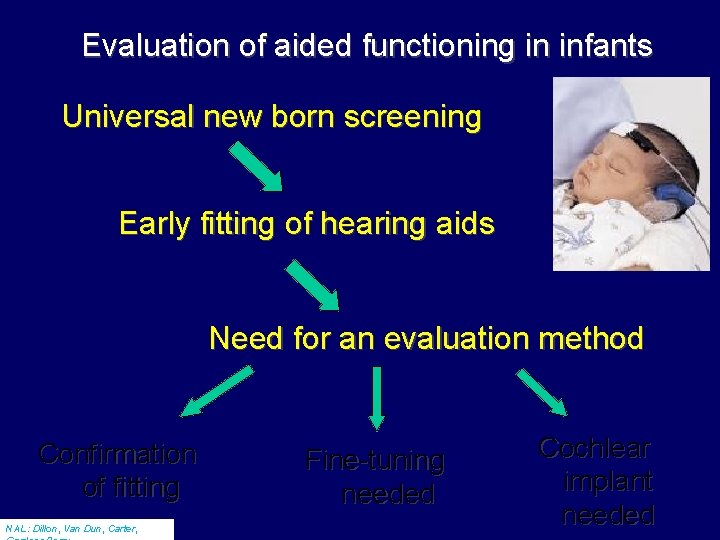
Evaluation of aided functioning in infants Universal new born screening Early fitting of hearing aids Need for an evaluation method Confirmation of fitting NAL: Dillon, Van Dun, Carter, Fine-tuning needed Cochlear implant needed
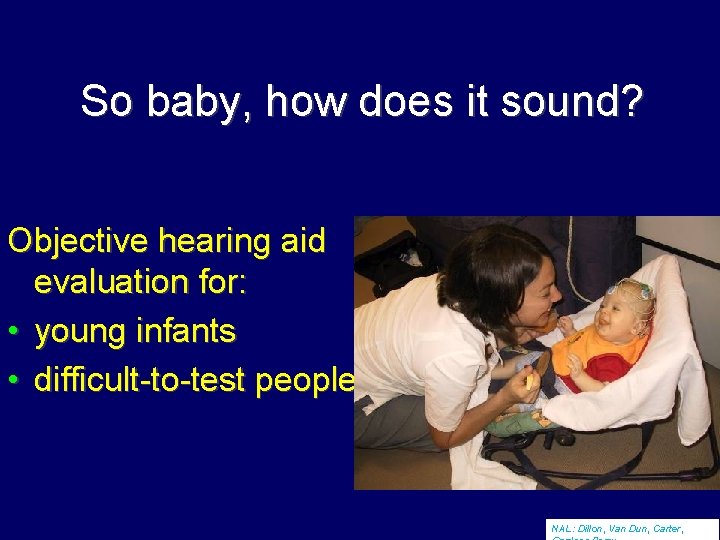
So baby, how does it sound? Objective hearing aid evaluation for: • young infants • difficult-to-test people NAL: Dillon, Van Dun, Carter,
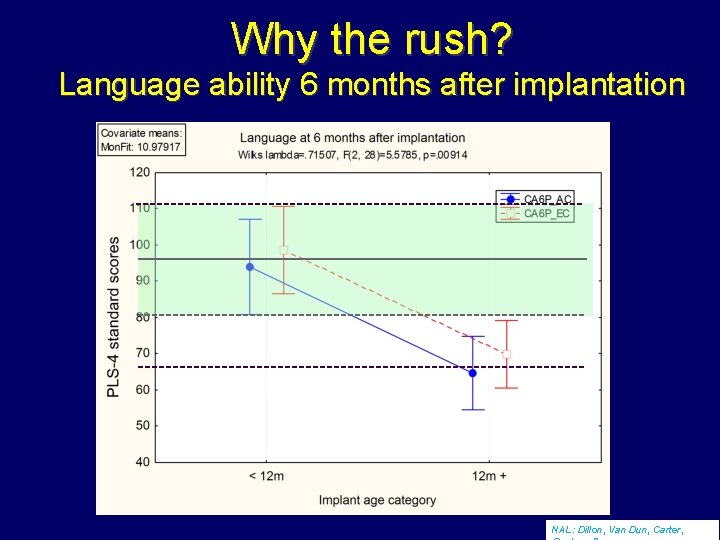
Why the rush? Language ability 6 months after implantation NAL: Dillon, Van Dun, Carter,
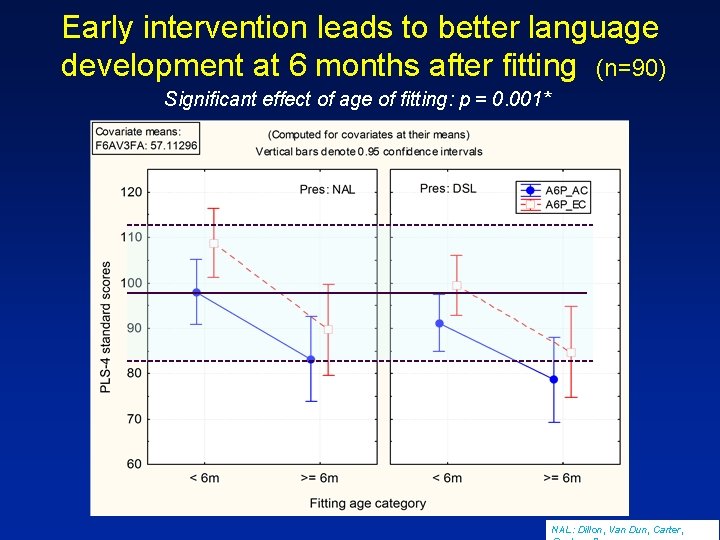
Early intervention leads to better language development at 6 months after fitting (n=90) Significant effect of age of fitting: p = 0. 001* NAL: Dillon, Van Dun, Carter,
Why use cortical responses? NAL: Dillon, Van Dun, Carter,
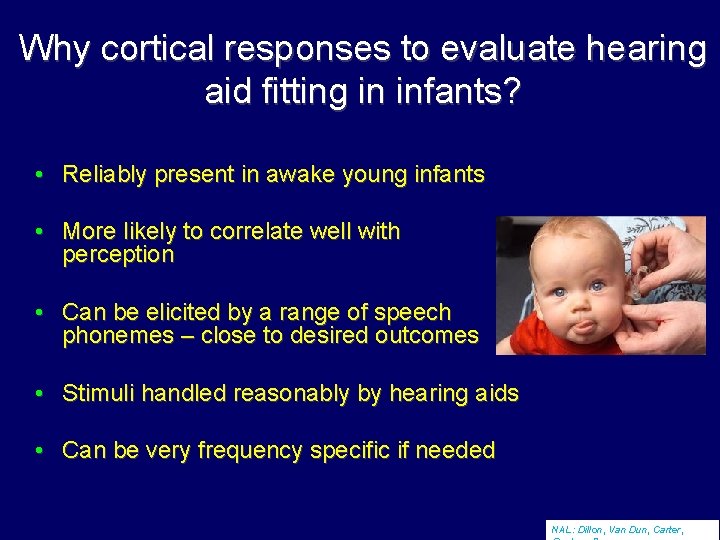
Why cortical responses to evaluate hearing aid fitting in infants? • Reliably present in awake young infants • More likely to correlate well with perception • Can be elicited by a range of speech phonemes – close to desired outcomes • Stimuli handled reasonably by hearing aids • Can be very frequency specific if needed NAL: Dillon, Van Dun, Carter,
FUNDAMENTALS OF CORTICAL RESPONSES NAL: Dillon, Van Dun, Carter,
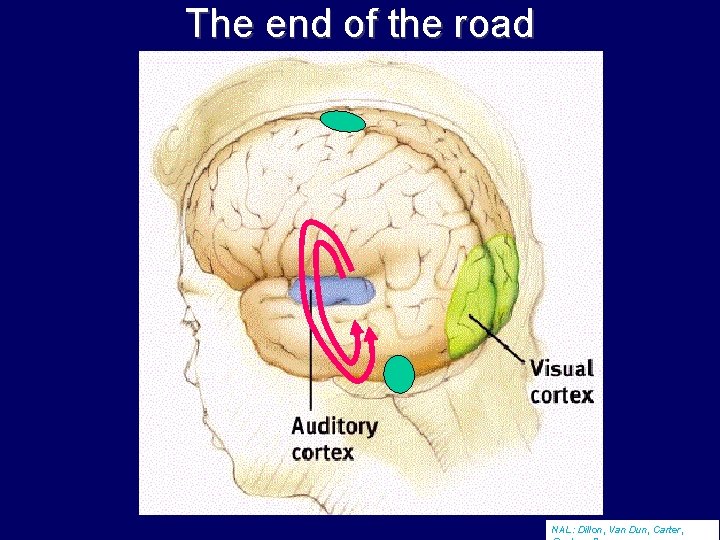
The end of the road NAL: Dillon, Van Dun, Carter,
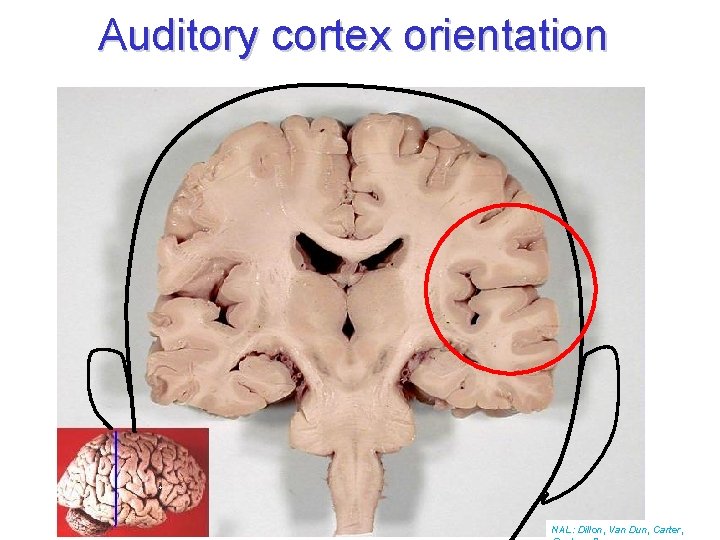
Auditory cortex orientation NAL: Dillon, Van Dun, Carter,
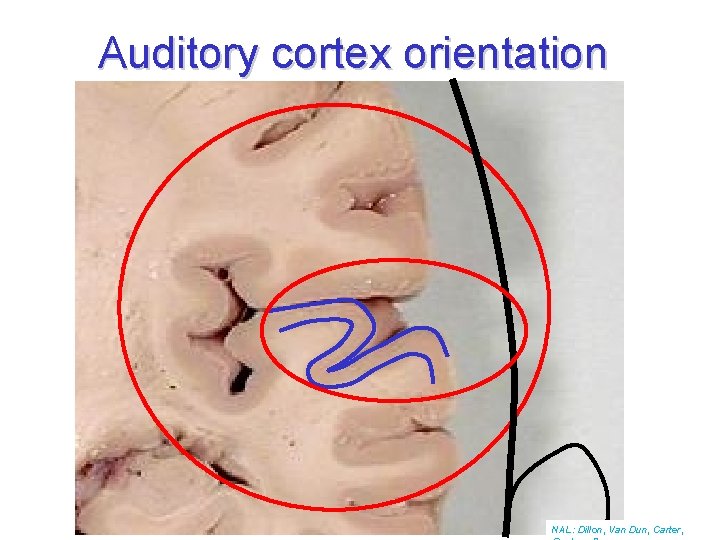
Auditory cortex orientation NAL: Dillon, Van Dun, Carter,
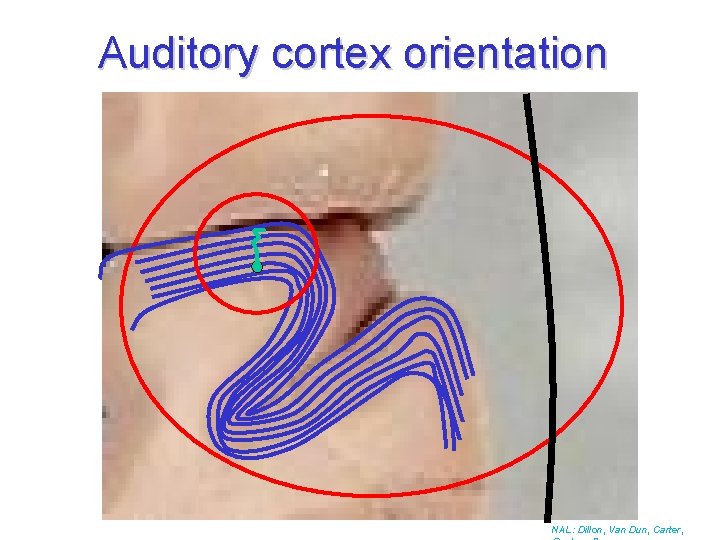
Auditory cortex orientation NAL: Dillon, Van Dun, Carter,
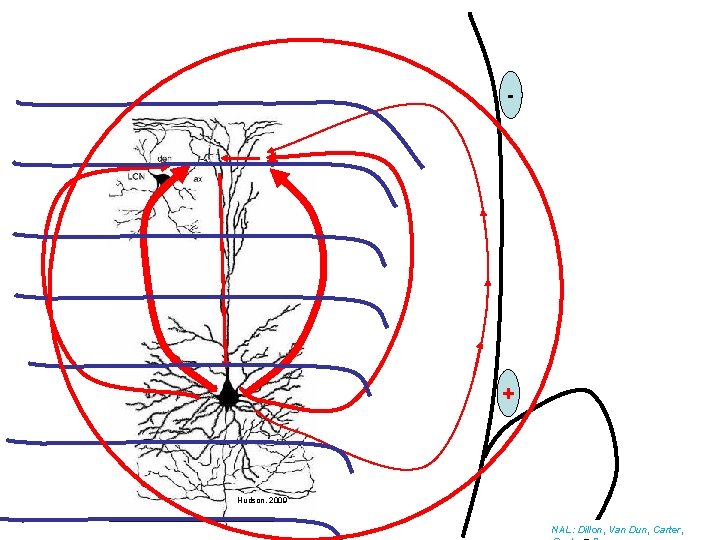
+ + Hudson, 2009 NAL: Dillon, Van Dun, Carter,
Cortical responses in adults with normal hearing NAL: Dillon, Van Dun, Carter,
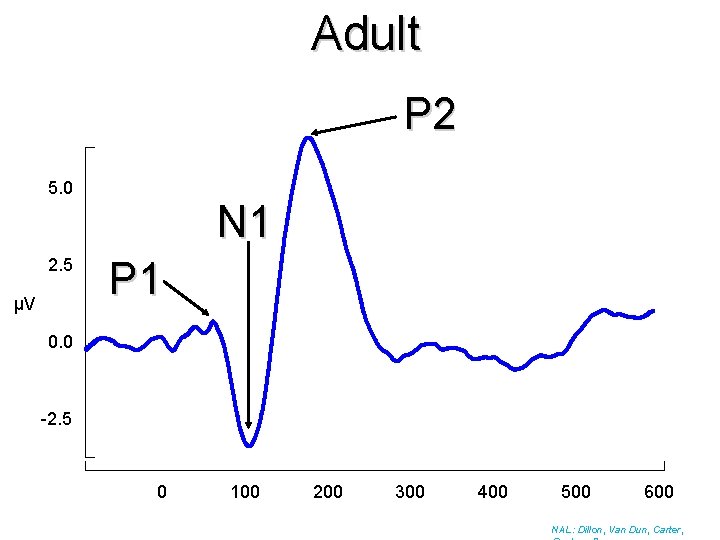
Adult P 2 5. 0 2. 5 µV N 1 P 1 0. 0 -2. 5 0 100 200 300 400 500 600 NAL: Dillon, Van Dun, Carter,
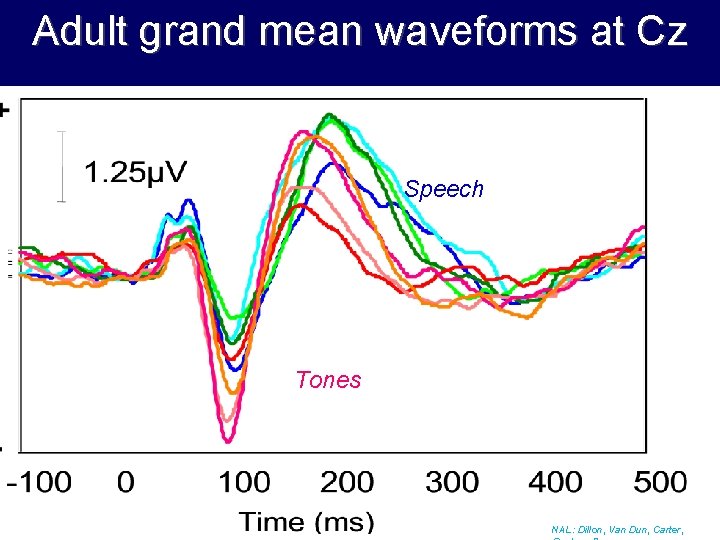
Adult grand mean waveforms at Cz Speech Tones NAL: Dillon, Van Dun, Carter,
Cortical responses in infants with normal hearing NAL: Dillon, Van Dun, Carter,
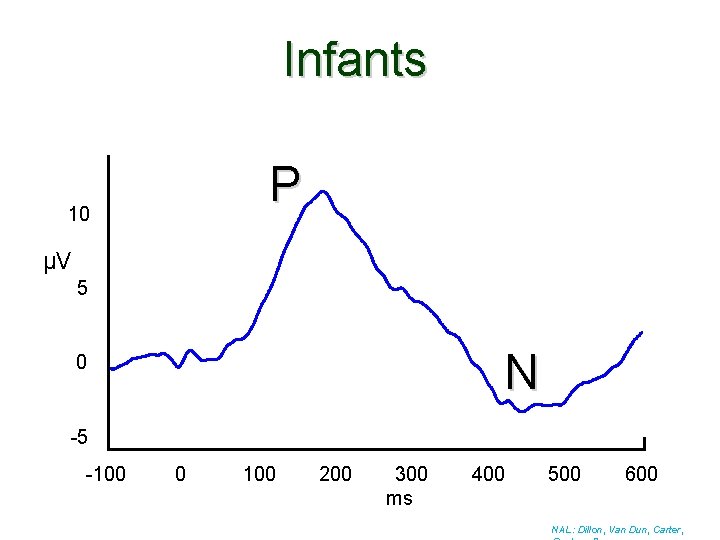
Infants P 10 µV 5 N 0 -5 -100 0 100 200 300 ms 400 500 600 NAL: Dillon, Van Dun, Carter,
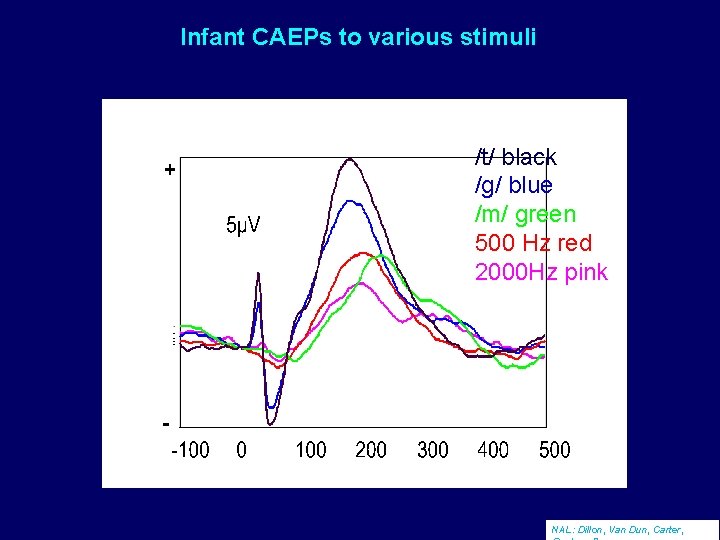
Infant CAEPs to various stimuli /t/ black /g/ blue /m/ green 500 Hz red 2000 Hz pink NAL: Dillon, Van Dun, Carter,
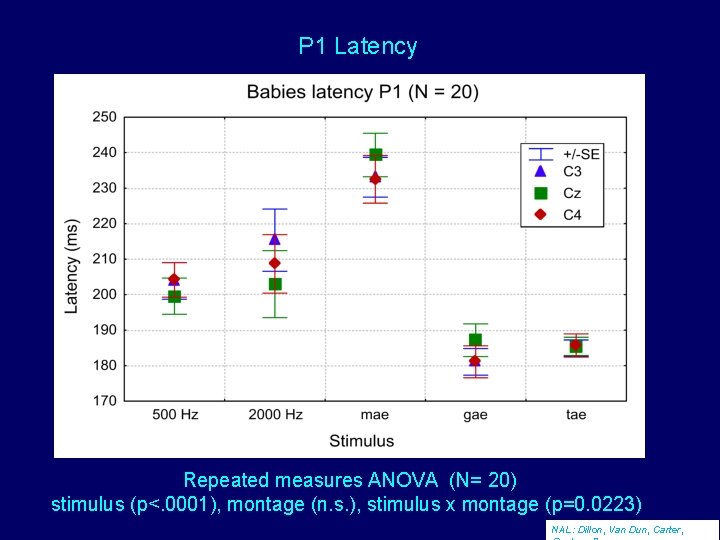
P 1 Latency Repeated measures ANOVA (N= 20) stimulus (p<. 0001), montage (n. s. ), stimulus x montage (p=0. 0223) NAL: Dillon, Van Dun, Carter,
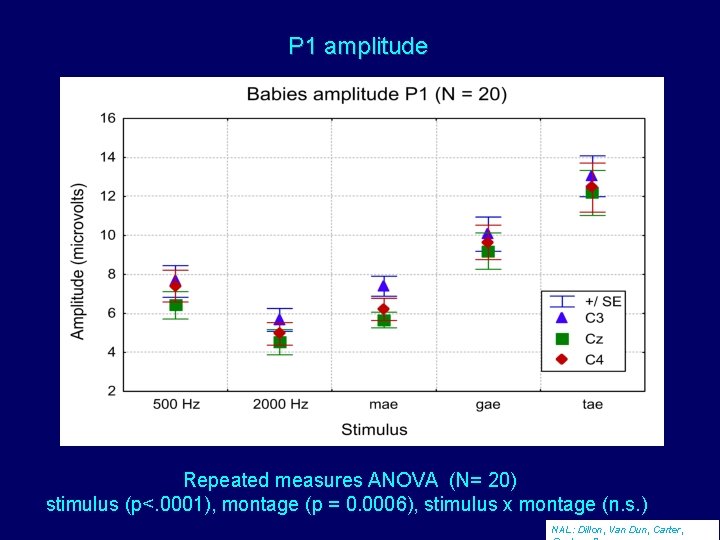
P 1 amplitude Repeated measures ANOVA (N= 20) stimulus (p<. 0001), montage (p = 0. 0006), stimulus x montage (n. s. ) NAL: Dillon, Van Dun, Carter,
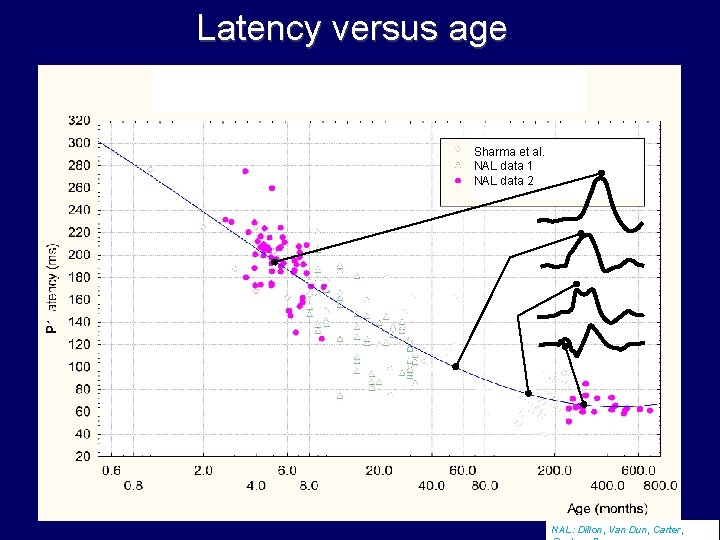
Latency versus age Sharma et al. NAL data 1 NAL data 2 NAL: Dillon, Van Dun, Carter,

HEARLAB: TECHNICAL OVERVIEW NAL: Dillon, Van Dun, Carter,
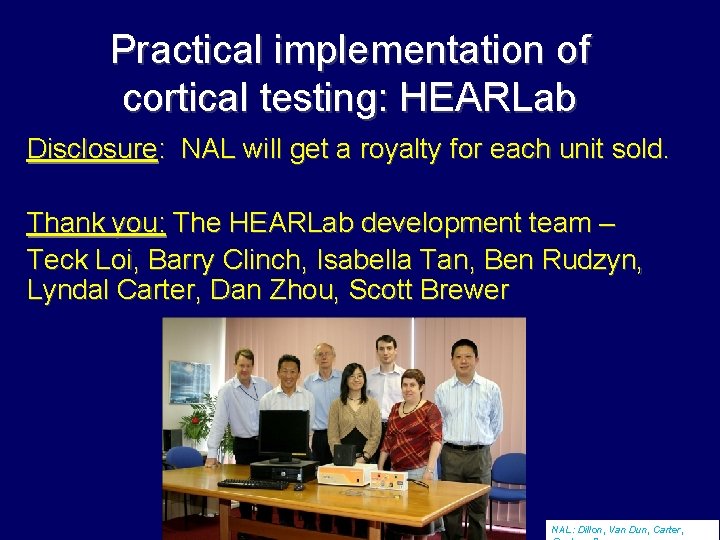
Practical implementation of cortical testing: HEARLab Disclosure: NAL will get a royalty for each unit sold. Thank you: The HEARLab development team – Teck Loi, Barry Clinch, Isabella Tan, Ben Rudzyn, Lyndal Carter, Dan Zhou, Scott Brewer NAL: Dillon, Van Dun, Carter,
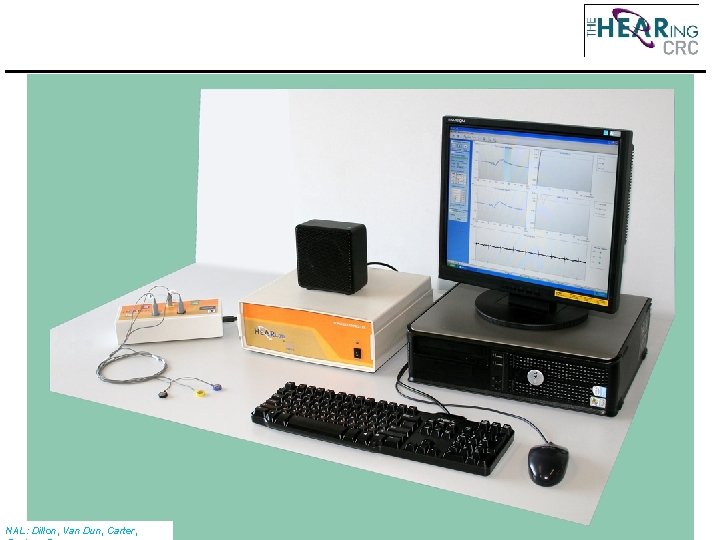
NAL: Dillon, Van Dun, Carter,
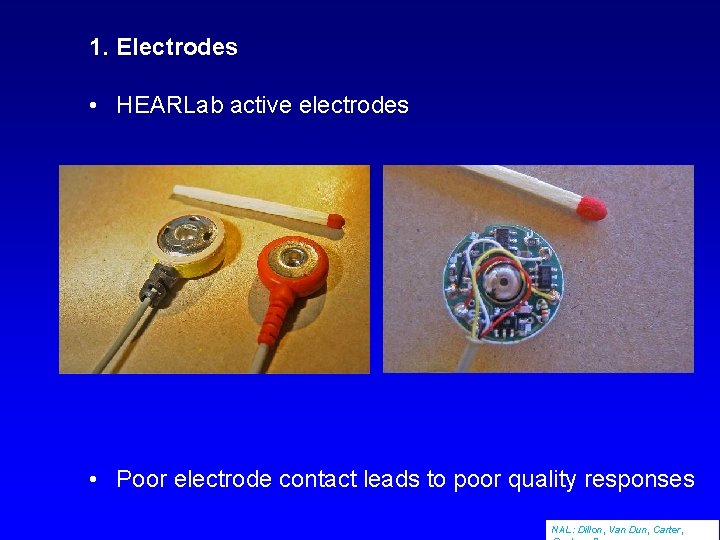
1. Electrodes • HEARLab active electrodes • Poor electrode contact leads to poor quality responses NAL: Dillon, Van Dun, Carter,
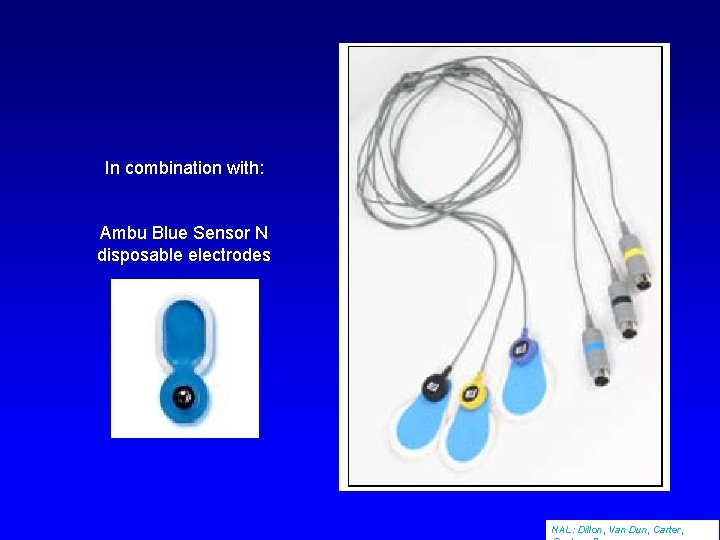
In combination with: Ambu Blue Sensor N disposable electrodes NAL: Dillon, Van Dun, Carter,
2. Differential Amplification • Two electrodes detect the “response (signal)” to varying degrees plus “noise”, with reference to a third electrode, • By inverting the electrical activity at one of the two main sites, and finding the difference between them, some noise cancellation occurs and the signal size is increased, • This improves the signal-to-noise ratio (SNR) to some degree. NAL: Dillon, Van Dun, Carter,
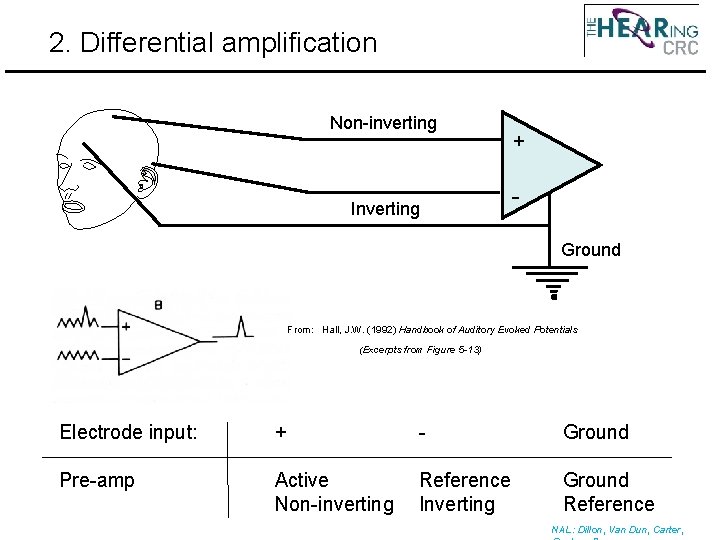
2. Differential amplification Non-inverting Inverting + Ground From: Hall, J. W. (1992) Handbook of Auditory Evoked Potentials (Excerpts from Figure 5 -13) Electrode input: + - Ground Pre-amp Active Non-inverting Reference Inverting Ground Reference NAL: Dillon, Van Dun, Carter,
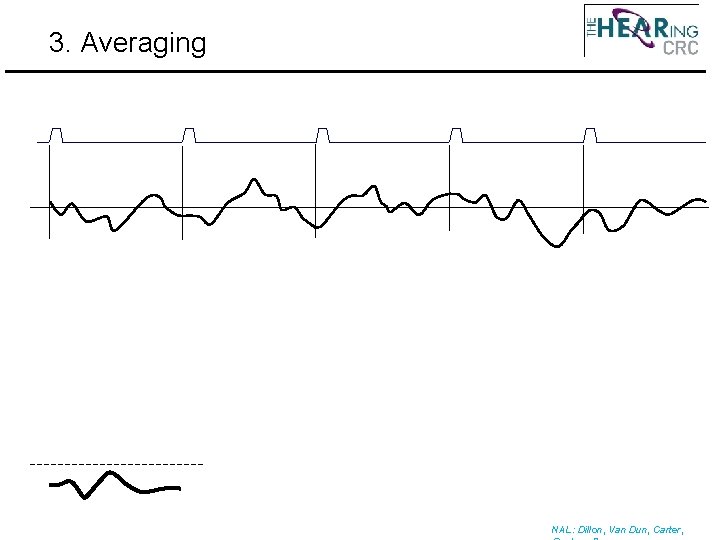
3. Averaging is the single most powerful technique for improving SNR For repeated auditory stimulation, the neurons of the auditory system will be activated in the same sequence, at the same point in time, We can say then that this neuronal activity is “time-locked” to the presentation of the stimulus. NAL: Dillon, Van Dun, Carter,
3. Averaging NAL: Dillon, Van Dun, Carter,
3. Averaging • Repeated stimulation with the same sound is required to view the auditory response (i. e. , to have an adequate signal-to-noise ratio), • The number of stimulations required depends on the size (i. e. , amplitude) of the response. NAL: Dillon, Van Dun, Carter,
4. Filters • A device which permits some frequencies through and not others, • High Pass (low freq) filters reject lower energy and Low Pass (high freq) reject energy above. The most appropriate filters are those which preserve the frequency region of the response and exclude others NAL: Dillon, Van Dun, Carter,
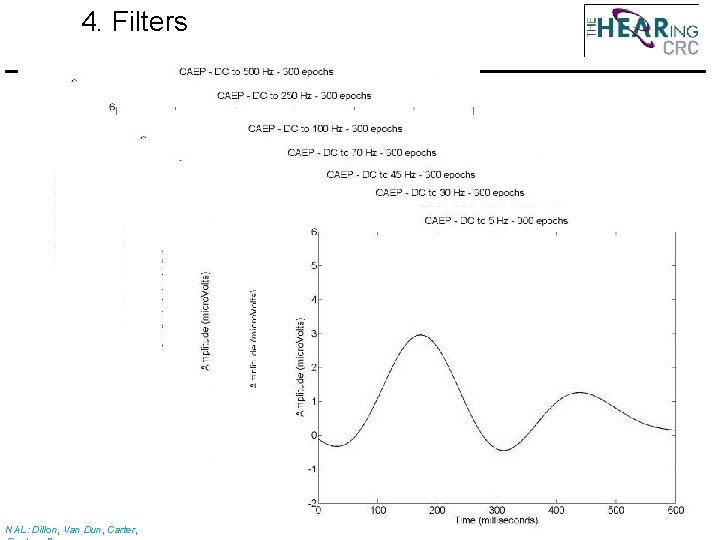
4. Filters NAL: Dillon, Van Dun, Carter,
5. Stimuli • Choice of stimulus depends on our clinical objective and from where in the auditory system we are recording. • Responses from the early parts of the auditory system are best generated using very brief stimuli such as a “click”. Responses from late in the auditory system can be generated using tones, speech sounds or clicks. • Stimuli may be delivered by headphone, insert earphone, bone conduction or loud speaker. NAL: Dillon, Van Dun, Carter,
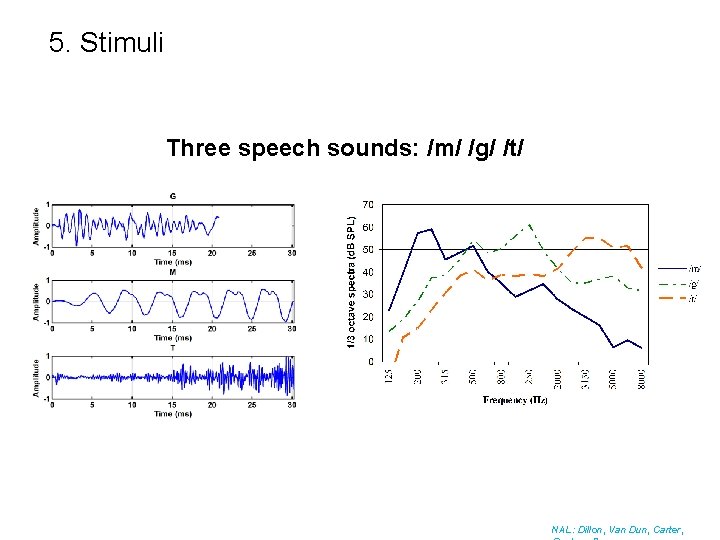
5. Stimuli Three speech sounds: /m/ /g/ /t/ NAL: Dillon, Van Dun, Carter,
Automatic detection of cortical responses NAL: Dillon, Van Dun, Carter,
Why automated method? • • • variable shape across ages variable shape with auditory experience variable shape from person to person variable shape from time to time (state of person, especially sleepiness) variable shape with stimulus Variable shape with inter-stimulus interval high skill level needed to read responses NAL: Dillon, Van Dun, Carter,
Desirable characteristics • No reliance on a template • Able to use information from contributing portions of waveform • Able to discount non-contributing portions of waveform Hotellings T 2 NAL: Dillon, Van Dun, Carter,
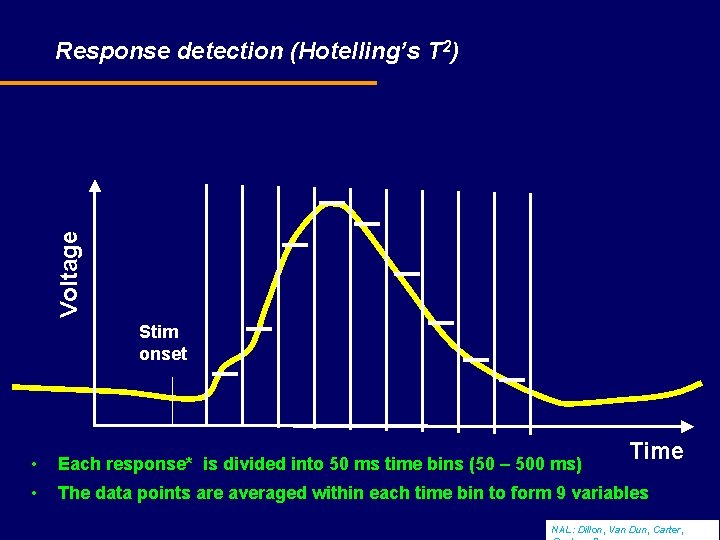
Voltage Response detection (Hotelling’s T 2) Stim onset • • Each response* is divided into 50 ms time bins (50 – 500 ms) Time The data points are averaged within each time bin to form 9 variables NAL: Dillon, Van Dun, Carter,
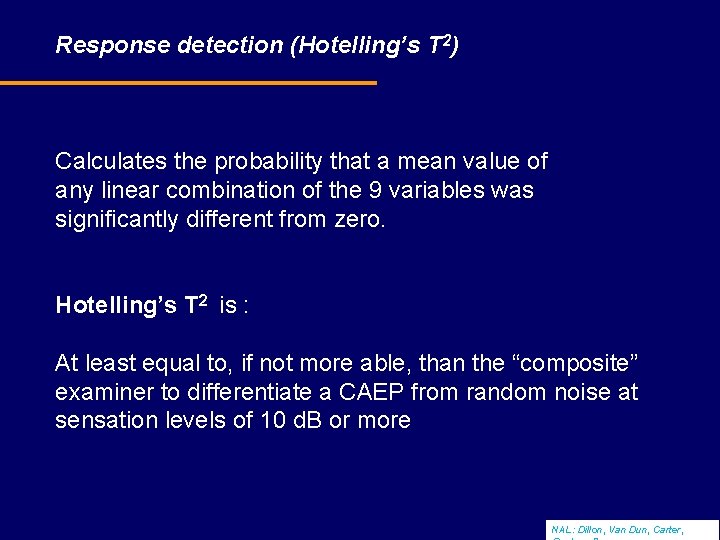
Response detection (Hotelling’s T 2) Calculates the probability that a mean value of any linear combination of the 9 variables was significantly different from zero. Hotelling’s T 2 is : At least equal to, if not more able, than the “composite” examiner to differentiate a CAEP from random noise at sensation levels of 10 d. B or more NAL: Dillon, Van Dun, Carter,
Effect of sensation level, hearing loss, and unrelated EEG or muscle noise NAL: Dillon, Van Dun, Carter,
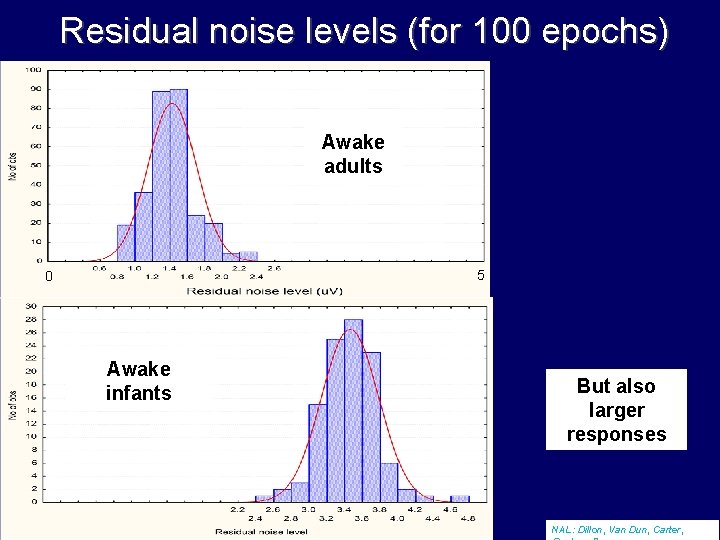
Residual noise levels (for 100 epochs) Awake adults 5 0 Awake infants But also larger responses NAL: Dillon, Van Dun, Carter,
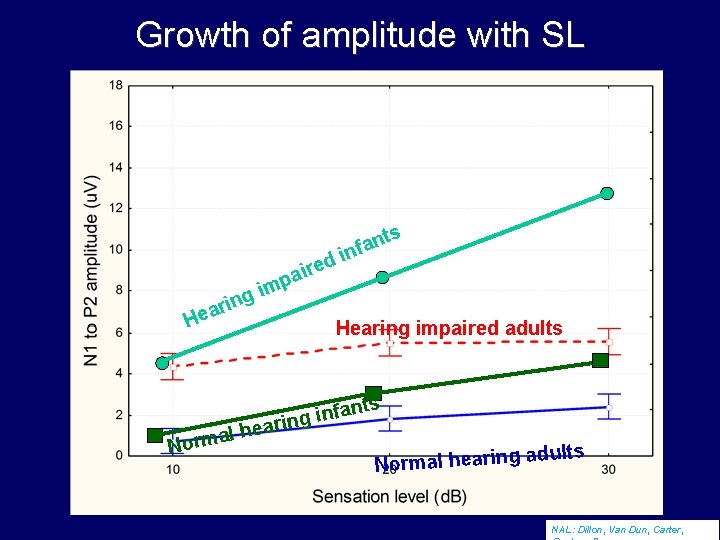
Growth of amplitude with SL ts aire p im g arin He d n infa Hearing impaired adults s ant f n i g rin ea al h m r o N dults a Normal hearing NAL: Dillon, Van Dun, Carter,
Conclusions: Detecting cortical response presence • Large responses are more easily detected • Response amplitude grows with sensation level • Response amplitude at low SL is larger for people with sensorineural hearing loss that for people with normal hearing • Responses are more easily detected when residual noise is low (<3. 4 µV for infants; < 1. 5 µV for adults) NAL: Dillon, Van Dun, Carter,
CLINICAL USE OF HEARLAB NAL: Dillon, Van Dun, Carter,
Equipment configuration and test environment NAL: Dillon, Van Dun, Carter,
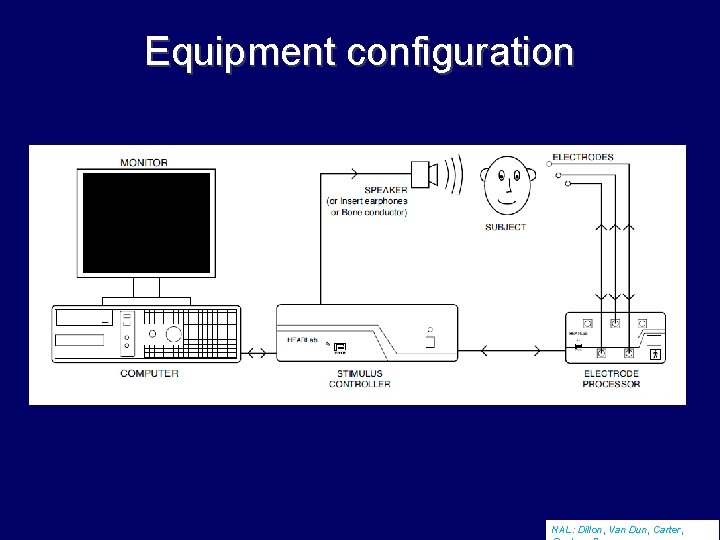
Equipment configuration NAL: Dillon, Van Dun, Carter,
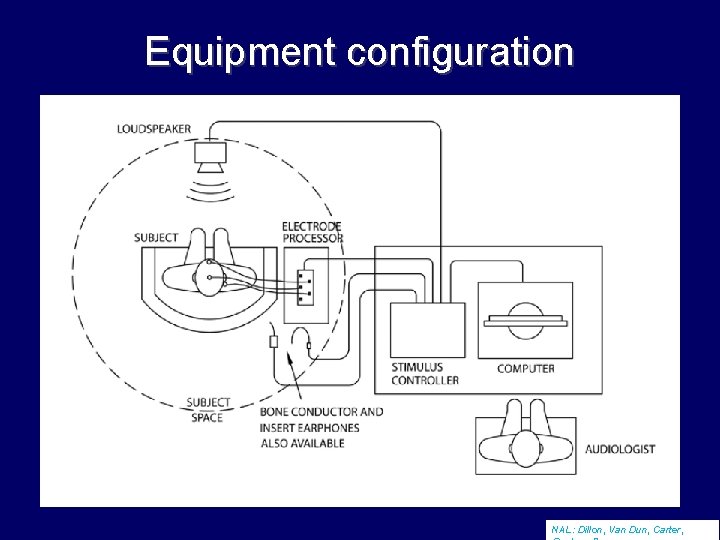
Equipment configuration NAL: Dillon, Van Dun, Carter,
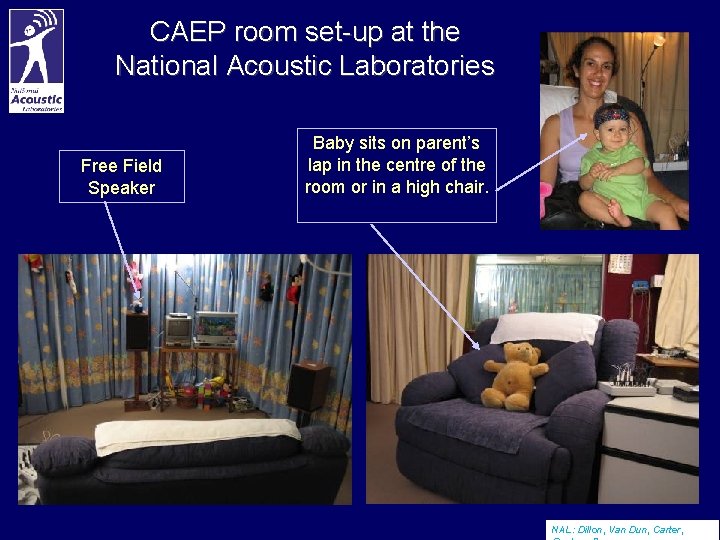
CAEP room set-up at the National Acoustic Laboratories Free Field Speaker Baby sits on parent’s lap in the centre of the room or in a high chair. NAL: Dillon, Van Dun, Carter,
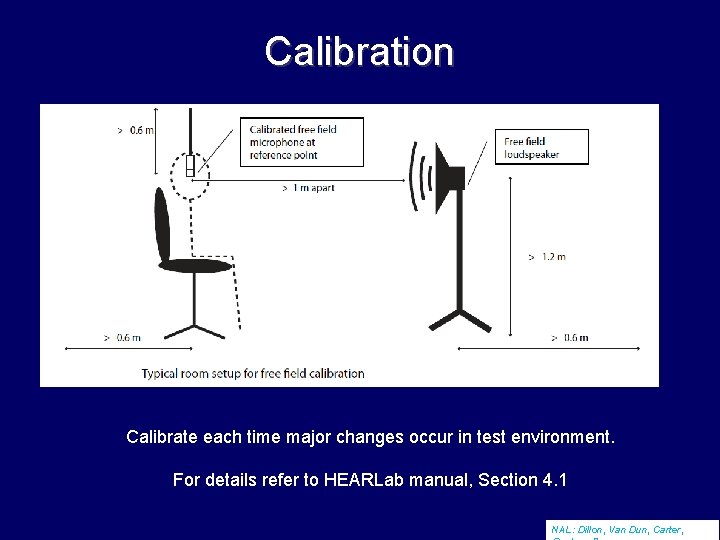
Calibration Calibrate each time major changes occur in test environment. For details refer to HEARLab manual, Section 4. 1 NAL: Dillon, Van Dun, Carter,
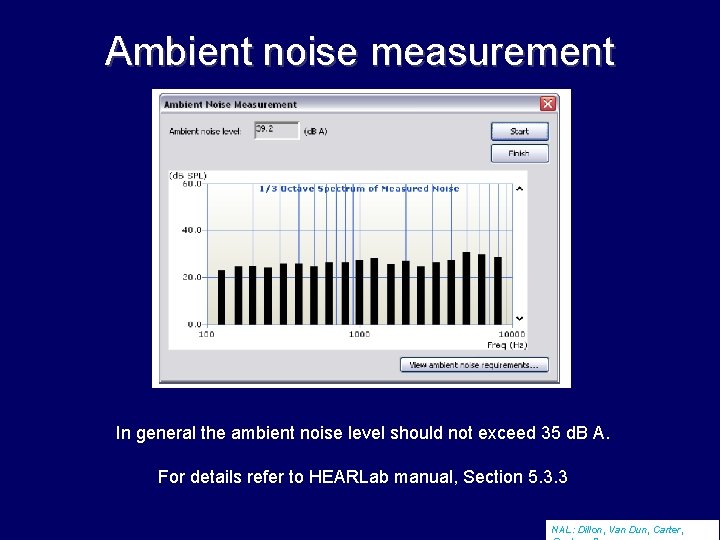
Ambient noise measurement In general the ambient noise level should not exceed 35 d. B A. For details refer to HEARLab manual, Section 5. 3. 3 NAL: Dillon, Van Dun, Carter,
Test environment (highlights from HEARLab manual, Appendix A: ‘Practical aspects of CAEP testing with infants’) • Make the test environment ‘child friendly’. • Provide a chair that is big enough for both parent and child. • Use washable covers/towels on the chair. • Have a separate container on hand to collect items that require cleaning. • Avoid fluorescent lighting, cell phones. • Do not place mains-powered devices close to the child. • Place floor markers indicating the position of equipment after calibration. NAL: Dillon, Van Dun, Carter,
Before the appointment NAL: Dillon, Van Dun, Carter,
Before the appointment (highlights from HEARLab manual, Appendix A: ‘Practical aspects of CAEP testing with infants’) • Provide parents with information. This will save time during the assessment. • Ask about the child’s sleeping routines. They should be awake during testing. • Dress the child with layers of clothing that can be easily removed. NAL: Dillon, Van Dun, Carter,
Preparation for testing NAL: Dillon, Van Dun, Carter,
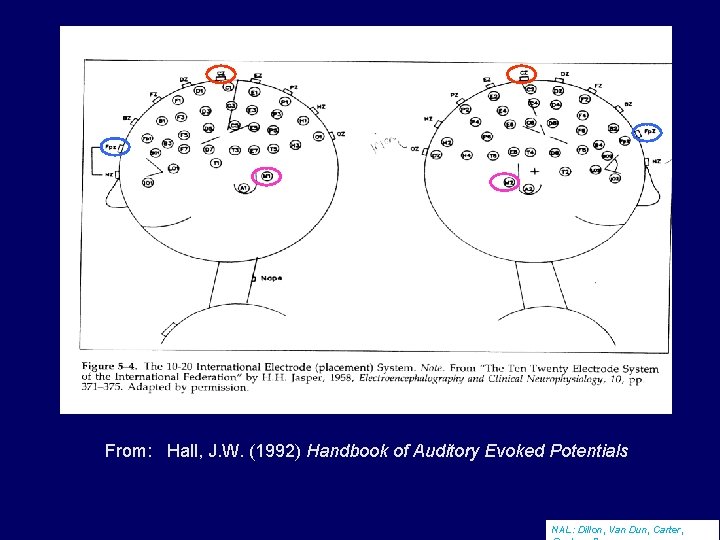
From: Hall, J. W. (1992) Handbook of Auditory Evoked Potentials NAL: Dillon, Van Dun, Carter,
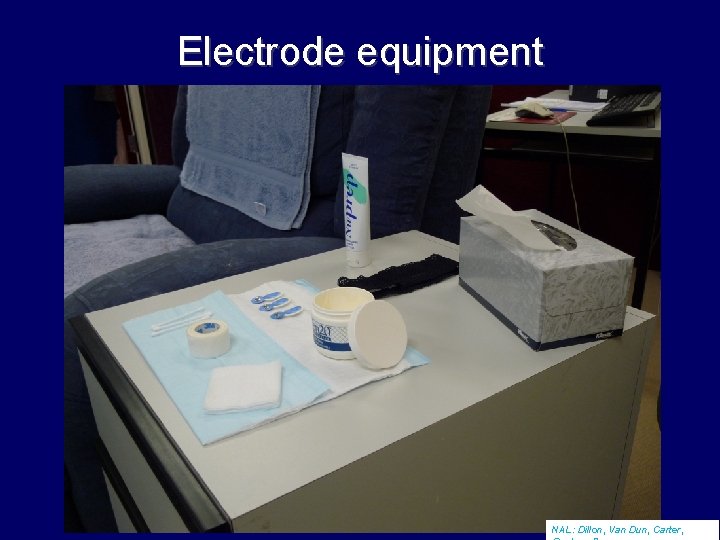
Electrode equipment NAL: Dillon, Van Dun, Carter,
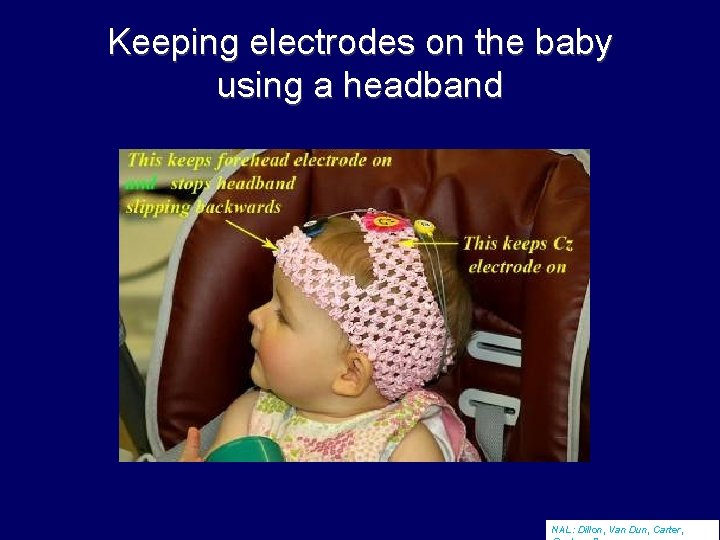
Keeping electrodes on the baby using a headband NAL: Dillon, Van Dun, Carter,
Preparation for testing (highlights from HEARLab manual, Appendix A: ‘Practical aspects of CAEP testing with infants’) • Have all equipment ready before the child arrives. • Change hearing aid batteries and check operation. • Ask parents to switch off mobile phones. • Connect to the child and don’t physically ‘stand over’ the child while doing skin prep. • Prepare the skin firmly but not too hard with cotton bud and medical gel. • Alcohol wipes is not needed and not recommended for delicate infant skins. • A headband can be very helpful for keeping electrodes in place. • Avoid contact of electrode cables with child as (s)he may pull them away. NAL: Dillon, Van Dun, Carter,
Conducting a measurement NAL: Dillon, Van Dun, Carter,
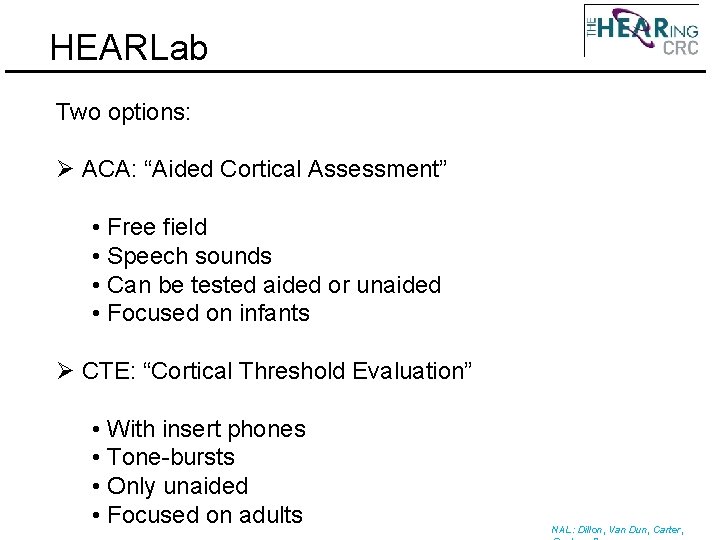
HEARLab Two options: Ø ACA: “Aided Cortical Assessment” • Free field • Speech sounds • Can be tested aided or unaided • Focused on infants Ø CTE: “Cortical Threshold Evaluation” • With insert phones • Tone-bursts • Only unaided • Focused on adults NAL: Dillon, Van Dun, Carter,
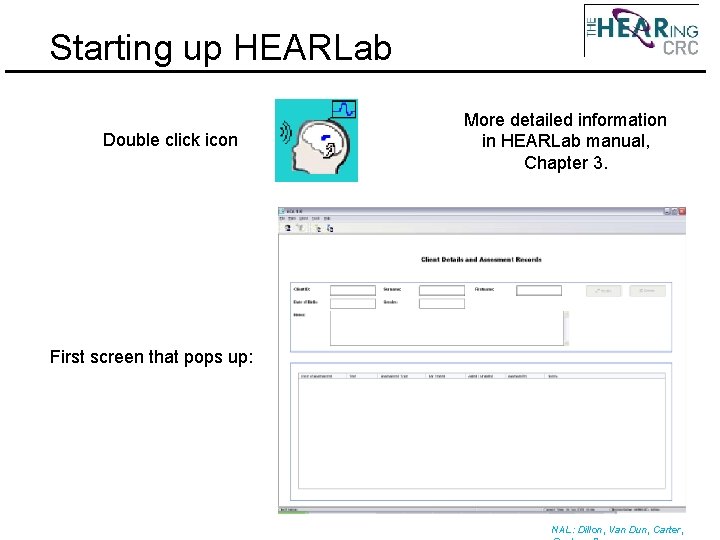
Starting up HEARLab Double click icon More detailed information in HEARLab manual, Chapter 3. First screen that pops up: NAL: Dillon, Van Dun, Carter,
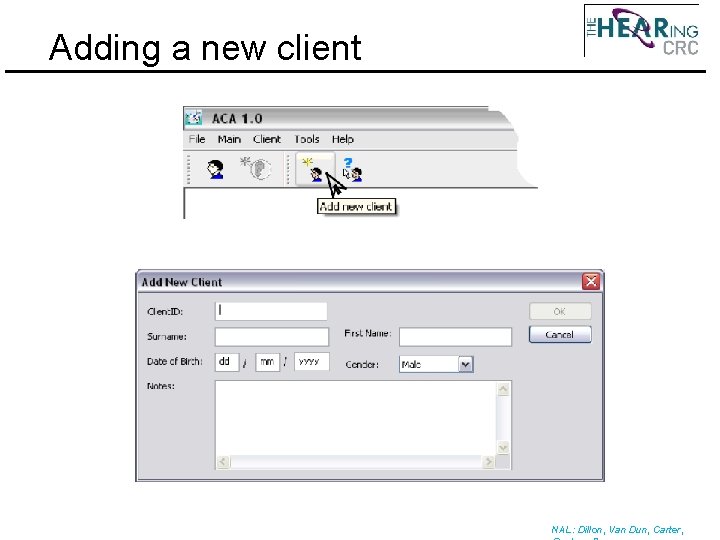
Adding a new client NAL: Dillon, Van Dun, Carter,
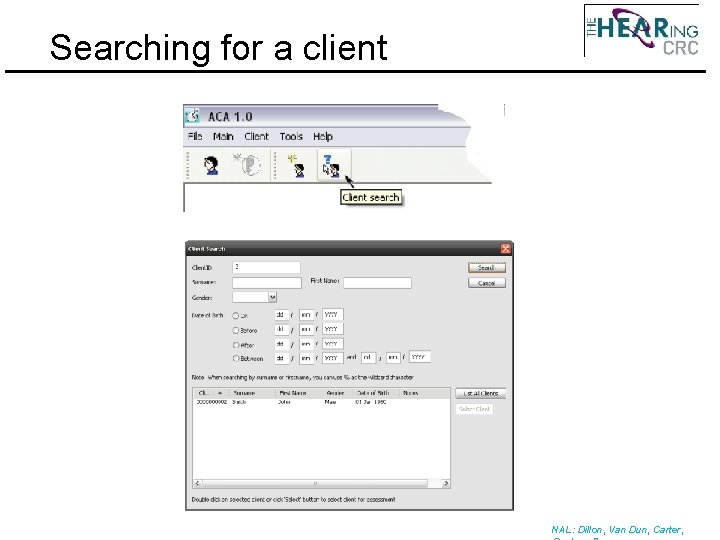
Searching for a client NAL: Dillon, Van Dun, Carter,
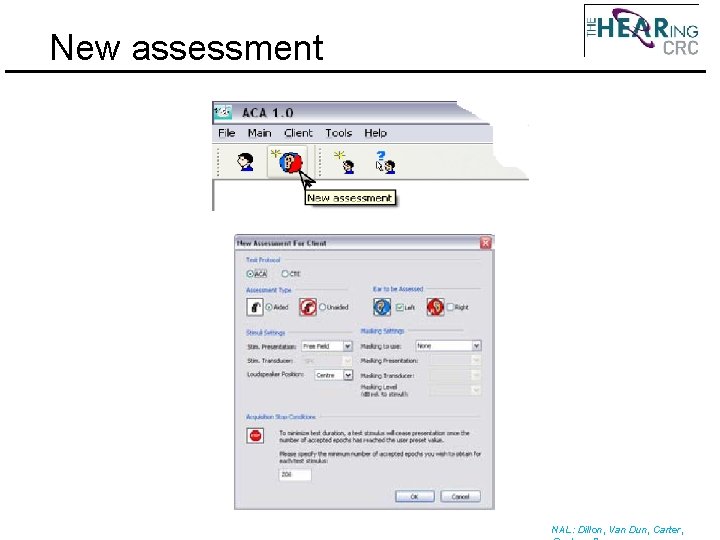
New assessment NAL: Dillon, Van Dun, Carter,
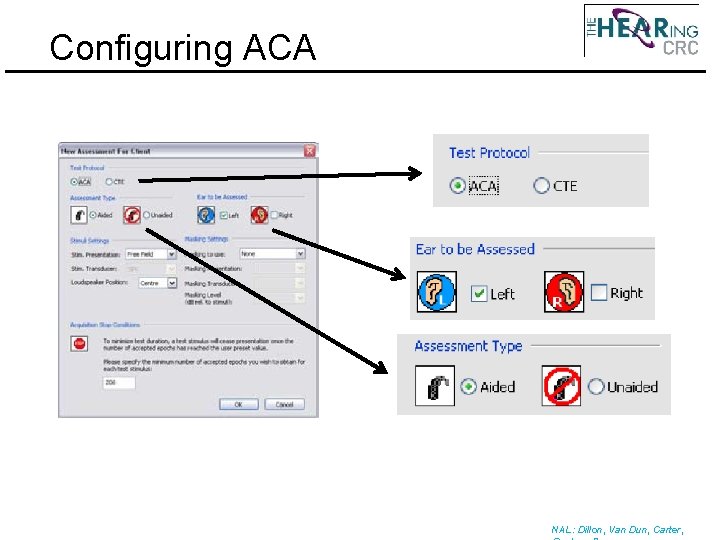
Configuring ACA NAL: Dillon, Van Dun, Carter,
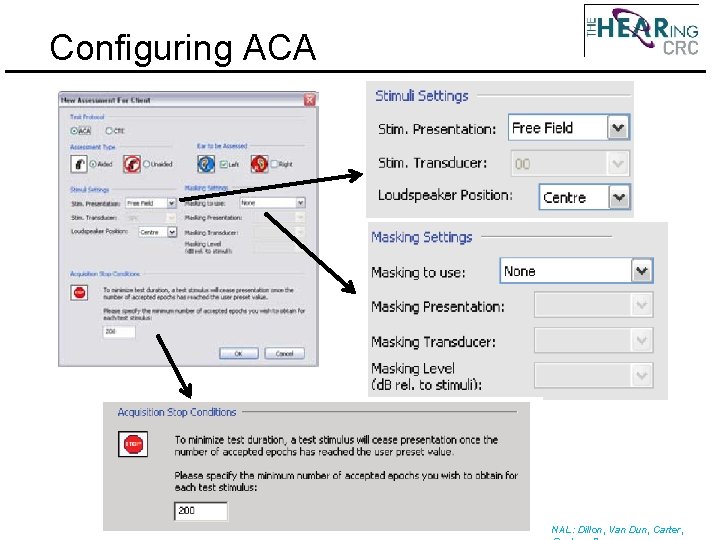
Configuring ACA NAL: Dillon, Van Dun, Carter,
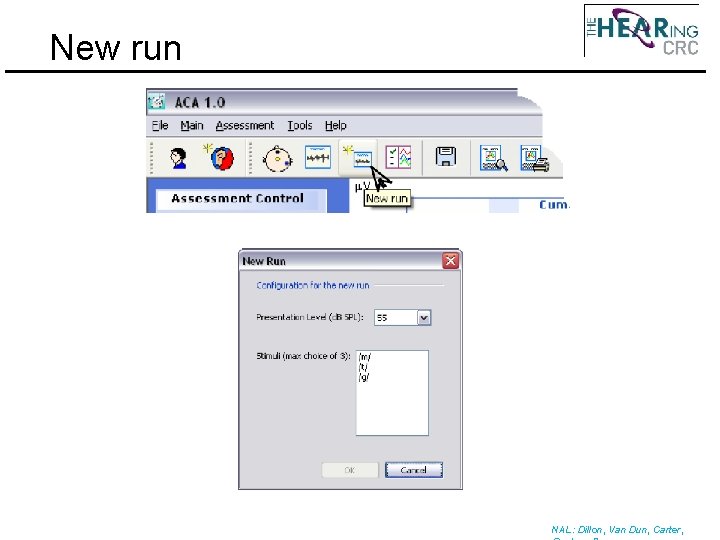
New run NAL: Dillon, Van Dun, Carter,
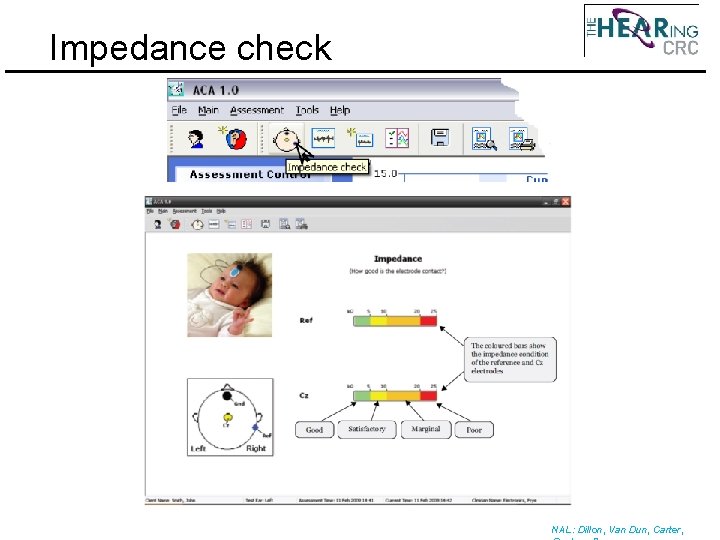
Impedance check NAL: Dillon, Van Dun, Carter,
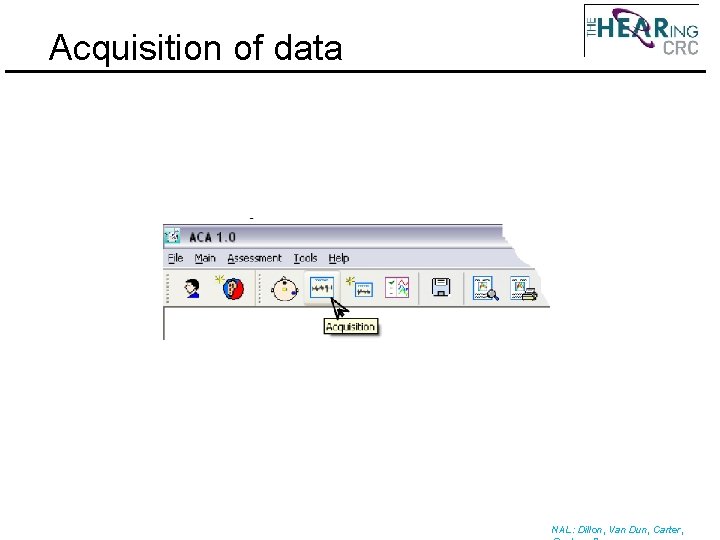
Acquisition of data NAL: Dillon, Van Dun, Carter,
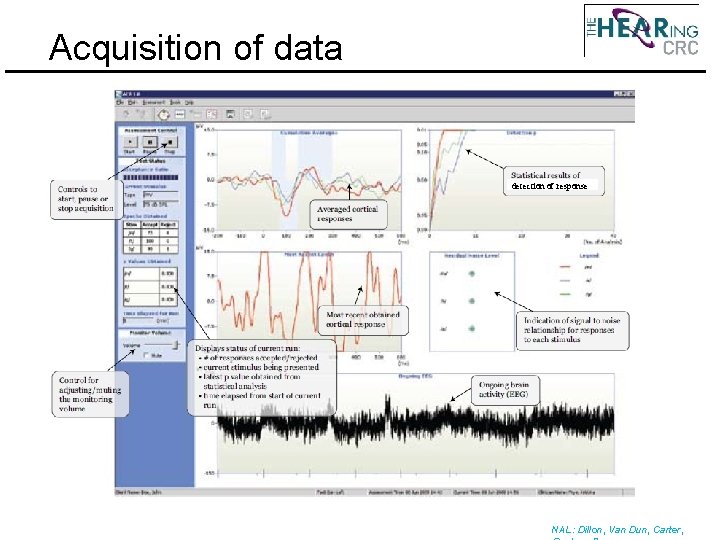
Acquisition of data detection of response NAL: Dillon, Van Dun, Carter,
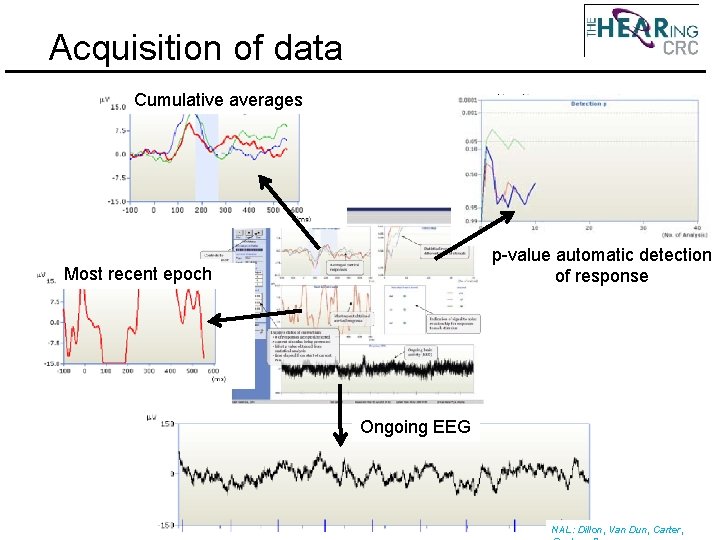
Acquisition of data Cumulative averages p-value automatic detection of response Most recent epoch Ongoing EEG NAL: Dillon, Van Dun, Carter,
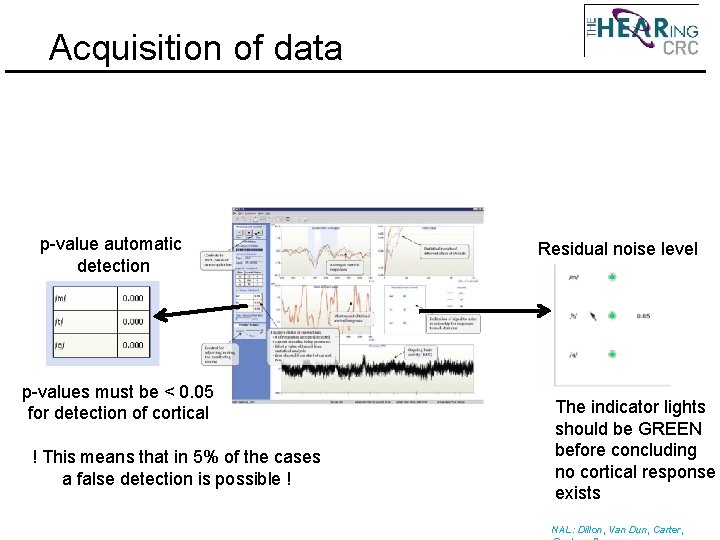
Acquisition of data p-value automatic detection p-values must be < 0. 05 for detection of cortical ! This means that in 5% of the cases a false detection is possible ! Residual noise level The indicator lights should be GREEN before concluding no cortical response exists NAL: Dillon, Van Dun, Carter,
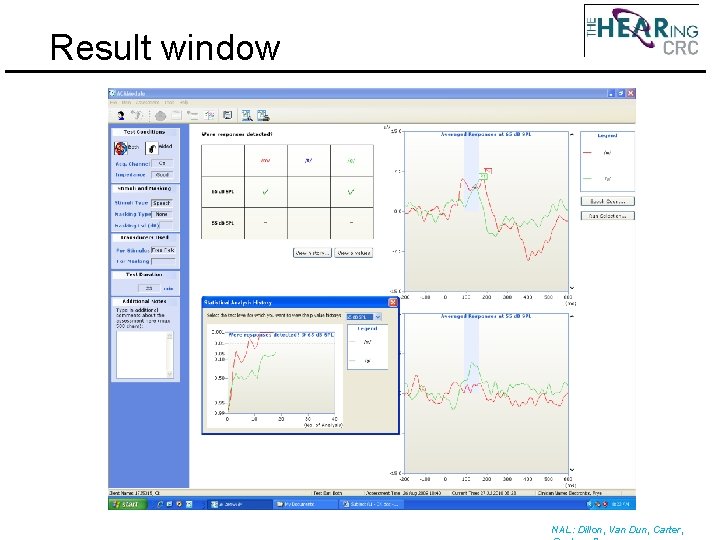
Result window NAL: Dillon, Van Dun, Carter,
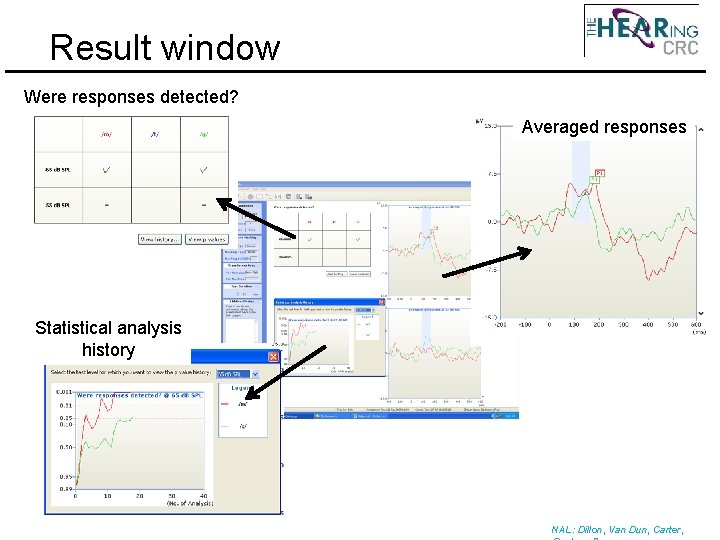
Result window Were responses detected? Averaged responses Statistical analysis history NAL: Dillon, Van Dun, Carter,
Distraction techniques (highlights from HEARLab manual, Appendix A: ‘Practical aspects of CAEP testing with infants’) • Do not obstruct the line of sight to the loudspeaker when testing free field. • Only use noiseless toys, appropriate to the age, and which are easily cleanable. • Try to keep children awake, but not too active. • DVDs on a screen! Bubbles! Following slides will show a lot of distraction items. • Eating and drinking is possible, including breast feeding. • If the child is quiet, the distractor can move out of sight. NAL: Dillon, Van Dun, Carter,
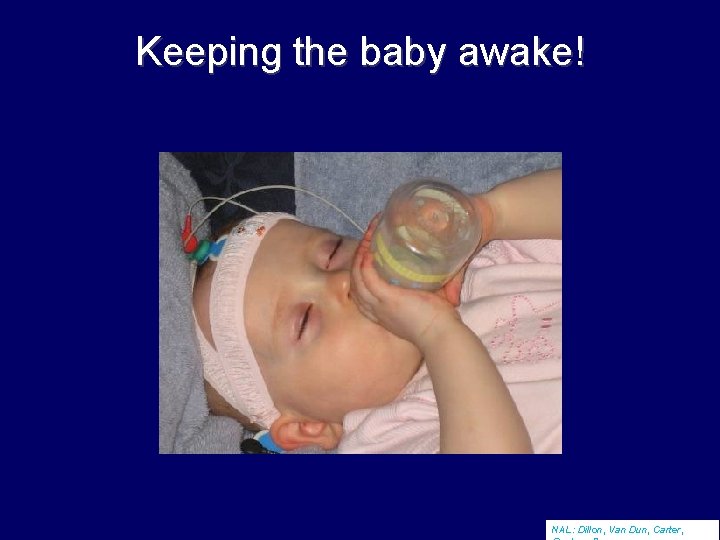
Keeping the baby awake! NAL: Dillon, Van Dun, Carter,
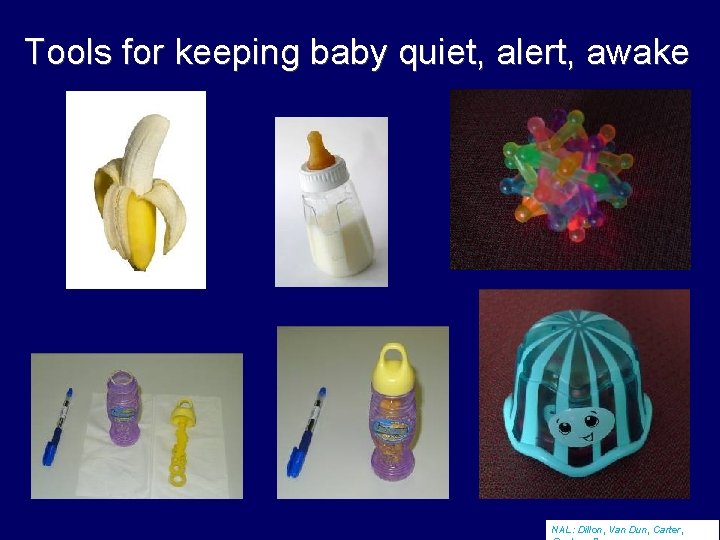
Tools for keeping baby quiet, alert, awake NAL: Dillon, Van Dun, Carter,
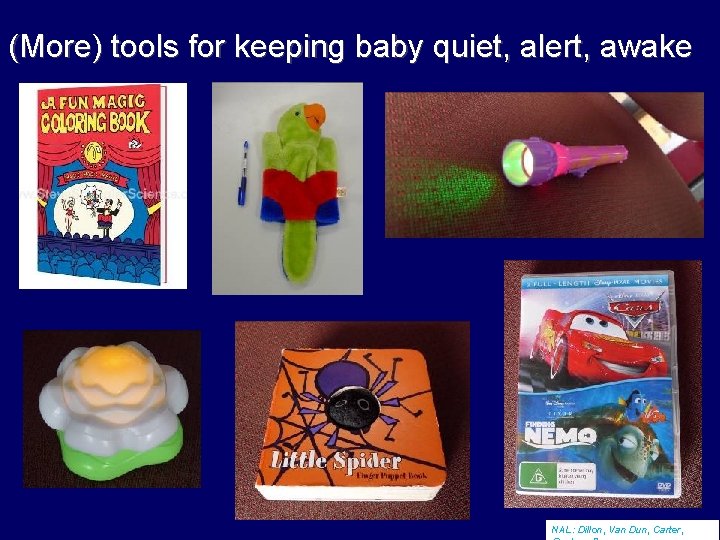
(More) tools for keeping baby quiet, alert, awake NAL: Dillon, Van Dun, Carter,
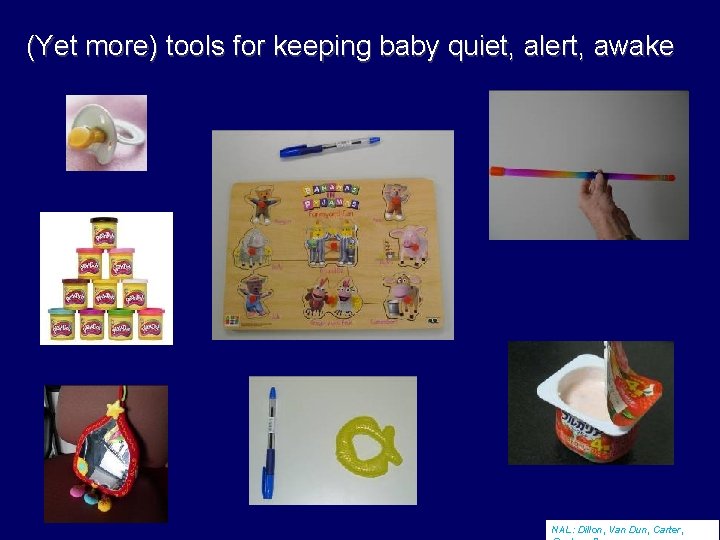
(Yet more) tools for keeping baby quiet, alert, awake NAL: Dillon, Van Dun, Carter,
Head support Yes!! NAL: Dillon, Van Dun, Carter,
Cortical threshold estimation - is very similar to ACA - has not been verified clinically with infants yet NAL: Dillon, Van Dun, Carter,

Finishing up NAL: Dillon, Van Dun, Carter,
Finishing up • Results can be printed. • Follow infection guidelines to wash or dispose of used equipment. NAL: Dillon, Van Dun, Carter,

INTERPRETATION OF THE RESULTS & CLINICAL APPLICATIONS NAL: Dillon, Van Dun, Carter,
Estimating hearing thresholds in non-responsive adults Elderly infirm – stroke, dementia Workers’ compensation NAL: Dillon, Van Dun, Carter,
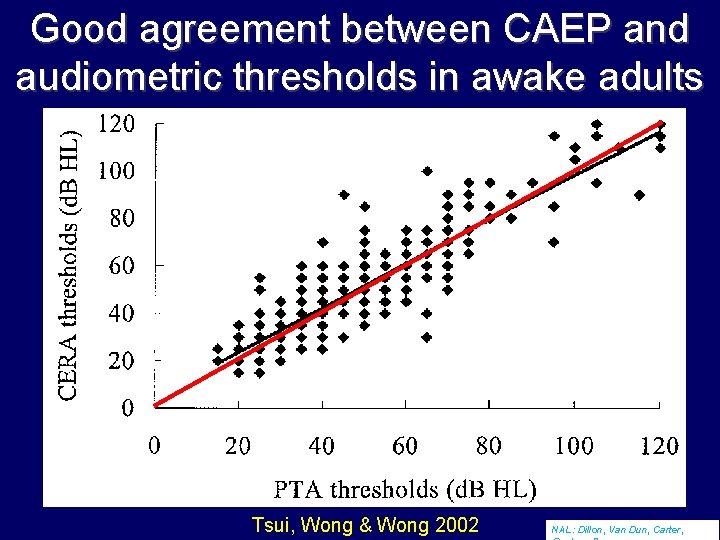
Good agreement between CAEP and audiometric thresholds in awake adults Tsui, Wong & Wong 2002 NAL: Dillon, Van Dun, Carter,
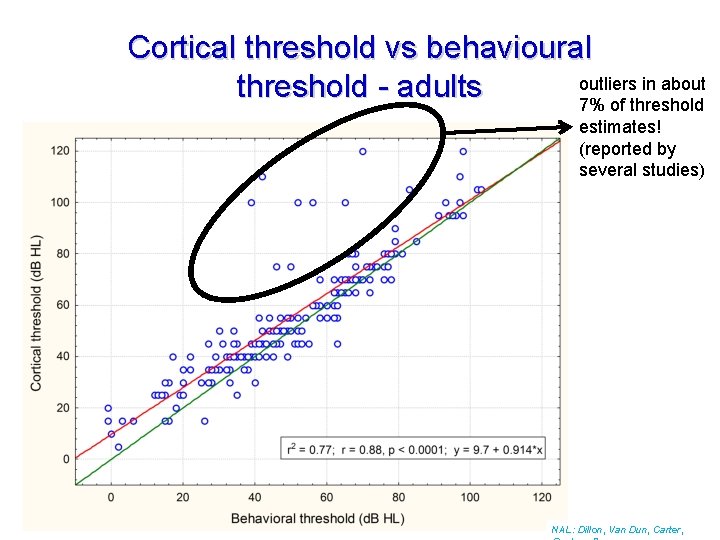
Cortical threshold vs behavioural outliers in about threshold - adults 7% of threshold estimates! (reported by several studies) NAL: Dillon, Van Dun, Carter,
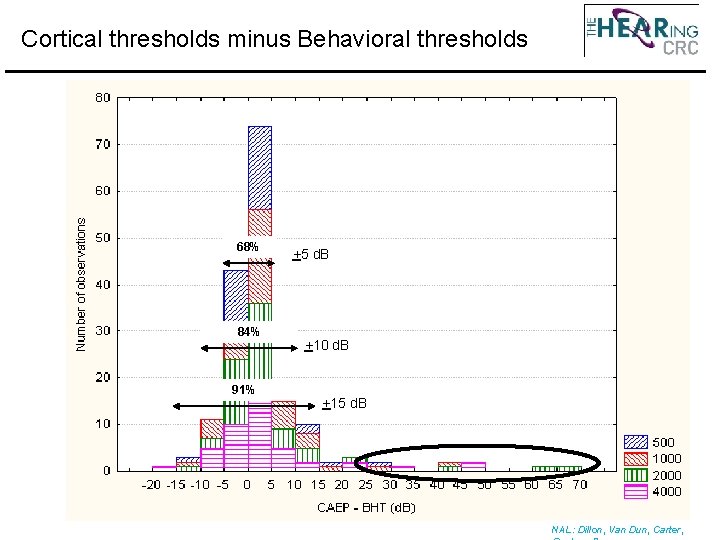
Cortical thresholds minus Behavioral thresholds 68% 84% 91% +5 d. B +10 d. B +15 d. B NAL: Dillon, Van Dun, Carter,
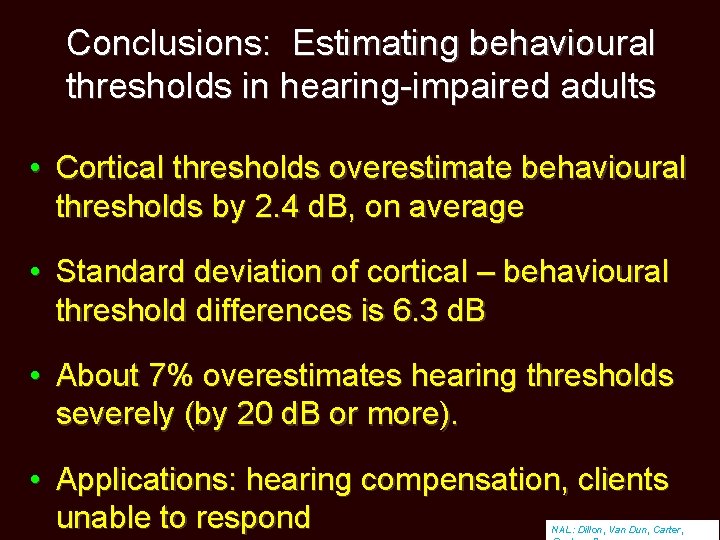
Conclusions: Estimating behavioural thresholds in hearing-impaired adults • Cortical thresholds overestimate behavioural thresholds by 2. 4 d. B, on average • Standard deviation of cortical – behavioural threshold differences is 6. 3 d. B • About 7% overestimates hearing thresholds severely (by 20 d. B or more). • Applications: hearing compensation, clients unable to respond NAL: Dillon, Van Dun, Carter,
Cortical potentials to assess speech audibility for infants NAL: Dillon, Van Dun, Carter,
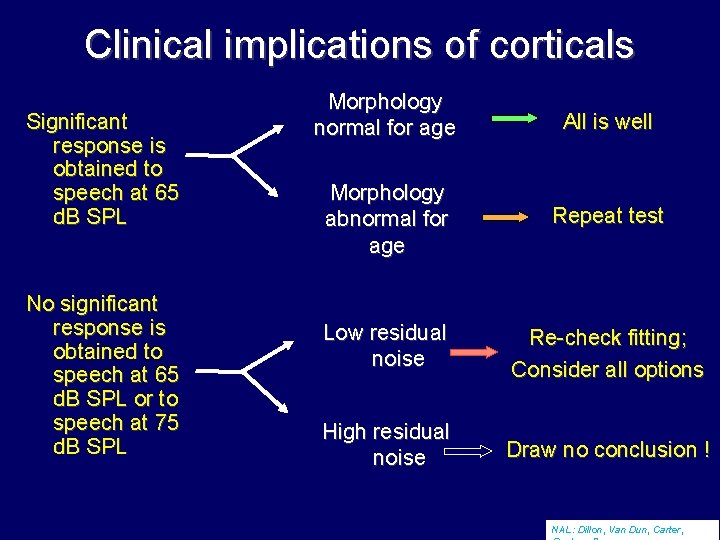
Clinical implications of corticals Significant response is obtained to speech at 65 d. B SPL No significant response is obtained to speech at 65 d. B SPL or to speech at 75 d. B SPL Morphology normal for age All is well Morphology abnormal for age Repeat test Low residual noise Re-check fitting; Consider all options High residual noise Draw no conclusion ! NAL: Dillon, Van Dun, Carter,
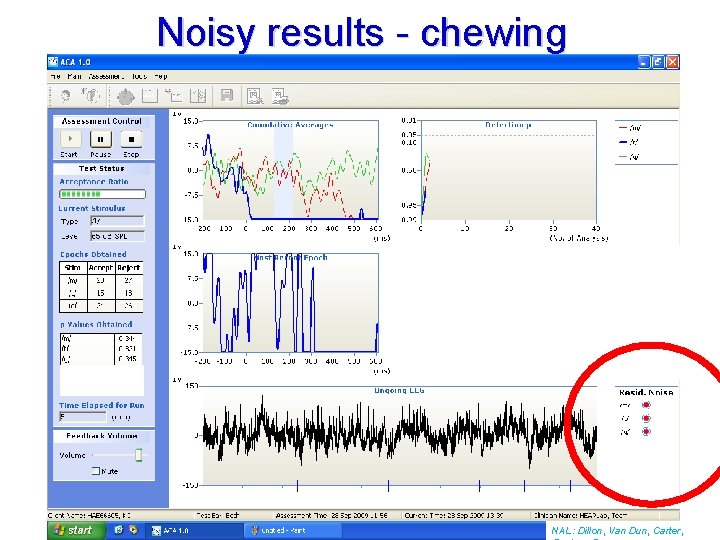
Noisy results - chewing NAL: Dillon, Van Dun, Carter,
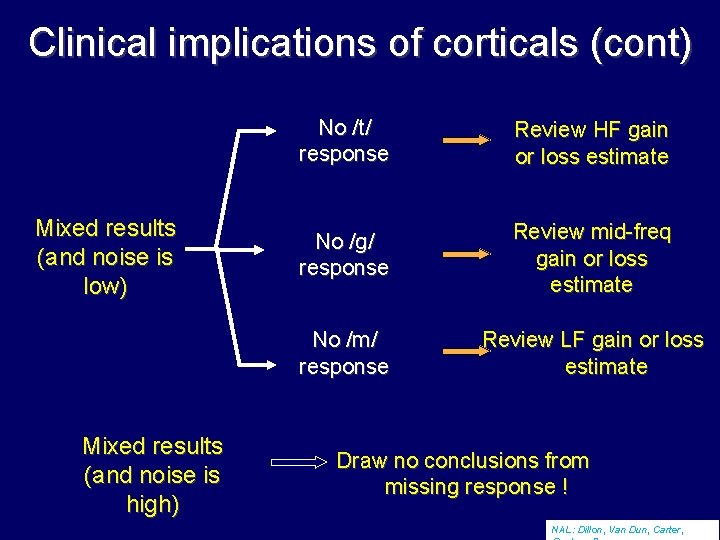
Clinical implications of corticals (cont) Mixed results (and noise is low) Mixed results (and noise is high) No /t/ response Review HF gain or loss estimate No /g/ response Review mid-freq gain or loss estimate No /m/ response Review LF gain or loss estimate Draw no conclusions from missing response ! NAL: Dillon, Van Dun, Carter,
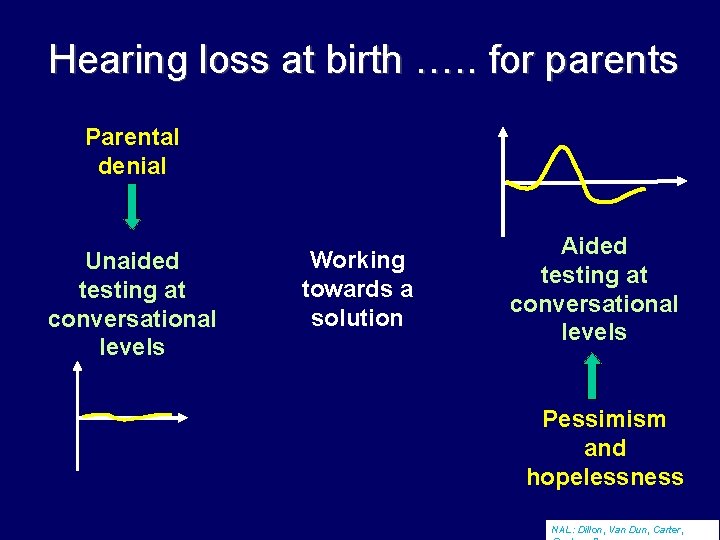
Hearing loss at birth …. . for parents Parental denial Unaided testing at conversational levels Working towards a solution Aided testing at conversational levels Pessimism and hopelessness NAL: Dillon, Van Dun, Carter,
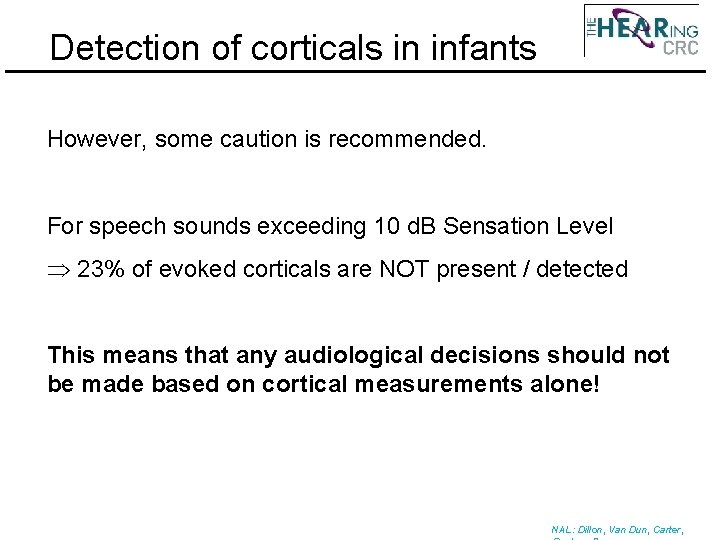
Detection of corticals in infants However, some caution is recommended. For speech sounds exceeding 10 d. B Sensation Level Þ 23% of evoked corticals are NOT present / detected This means that any audiological decisions should not be made based on cortical measurements alone! NAL: Dillon, Van Dun, Carter,

CASE STUDIES NAL: Dillon, Van Dun, Carter,
Case 1 No cortical responses, and the results helped the parents accept the need for cochlear implants • Age at aided cortical testing – Visit 1 6 weeks old (Initial hearing aid fitting day) – Visit 2 3 months old NAL: Dillon, Van Dun, Carter,
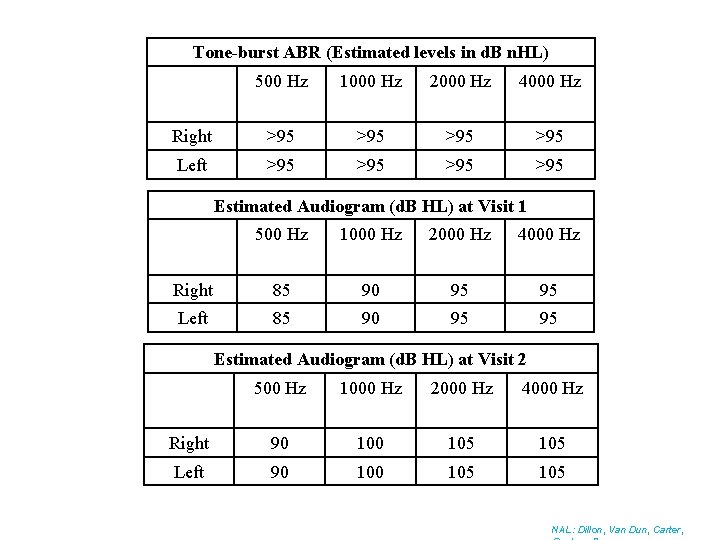
Tone-burst ABR (Estimated levels in d. B n. HL) 500 Hz 1000 Hz 2000 Hz 4000 Hz Right >95 >95 Left >95 >95 Estimated Audiogram (d. B HL) at Visit 1 500 Hz 1000 Hz 2000 Hz 4000 Hz Right 85 90 95 95 Left 85 90 95 95 Estimated Audiogram (d. B HL) at Visit 2 500 Hz 1000 Hz 2000 Hz 4000 Hz Right 90 105 105 Left 90 105 105 NAL: Dillon, Van Dun, Carter,
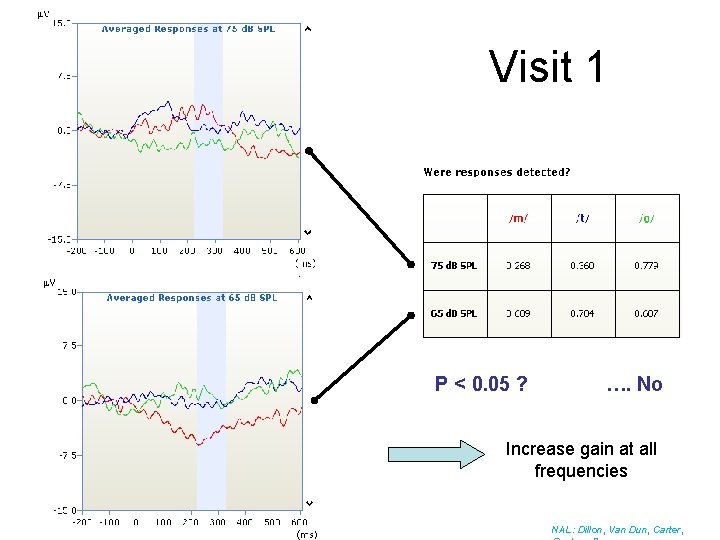
Visit 1 P < 0. 05 ? …. No Increase gain at all frequencies NAL: Dillon, Van Dun, Carter,
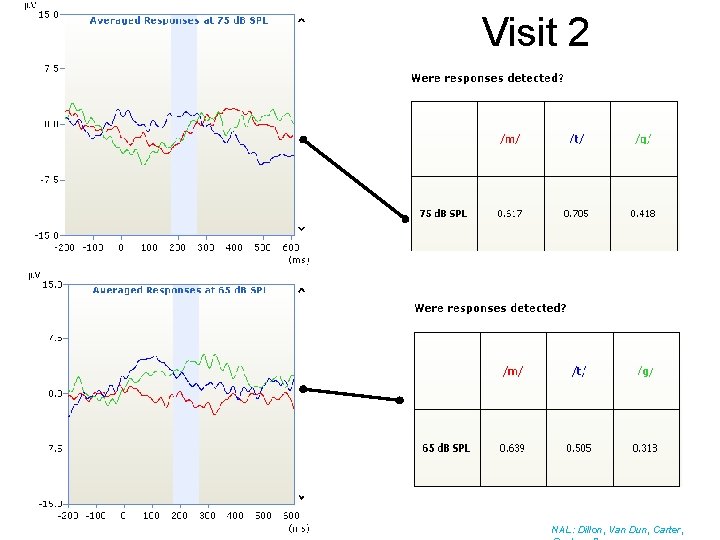
Visit 2 NAL: Dillon, Van Dun, Carter,
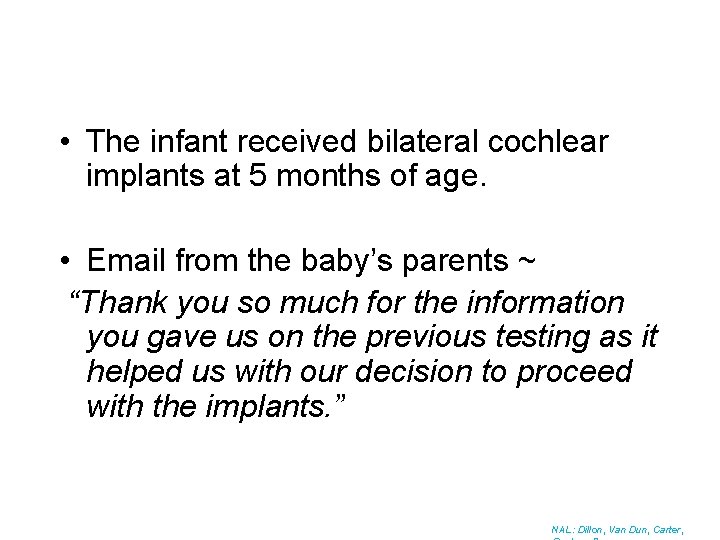
• The infant received bilateral cochlear implants at 5 months of age. • Email from the baby’s parents ~ “Thank you so much for the information you gave us on the previous testing as it helped us with our decision to proceed with the implants. ” NAL: Dillon, Van Dun, Carter,
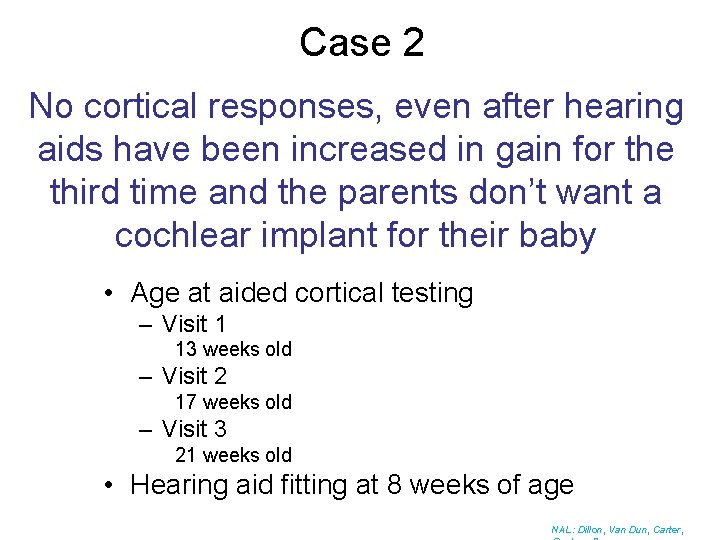
Case 2 No cortical responses, even after hearing aids have been increased in gain for the third time and the parents don’t want a cochlear implant for their baby • Age at aided cortical testing – Visit 1 13 weeks old – Visit 2 17 weeks old – Visit 3 21 weeks old • Hearing aid fitting at 8 weeks of age NAL: Dillon, Van Dun, Carter,
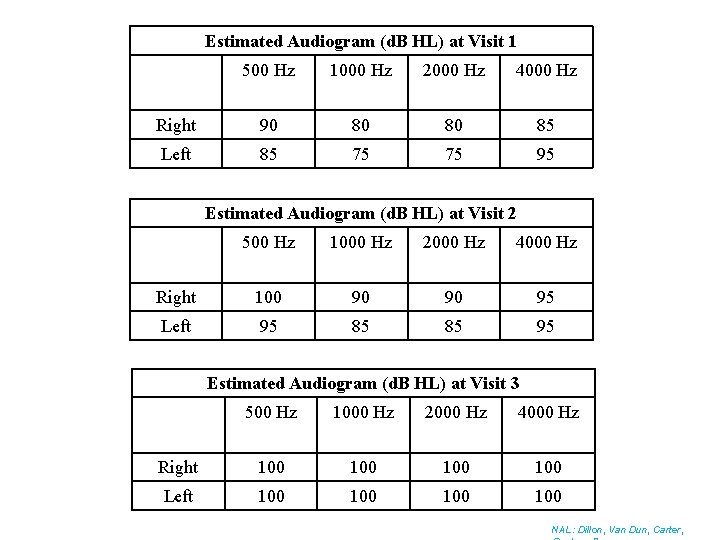
Estimated Audiogram (d. B HL) at Visit 1 500 Hz 1000 Hz 2000 Hz 4000 Hz Right 90 80 80 85 Left 85 75 75 95 Estimated Audiogram (d. B HL) at Visit 2 500 Hz 1000 Hz 2000 Hz 4000 Hz Right 100 90 90 95 Left 95 85 85 95 Estimated Audiogram (d. B HL) at Visit 3 500 Hz 1000 Hz 2000 Hz 4000 Hz Right 100 100 Left 100 100 NAL: Dillon, Van Dun, Carter,
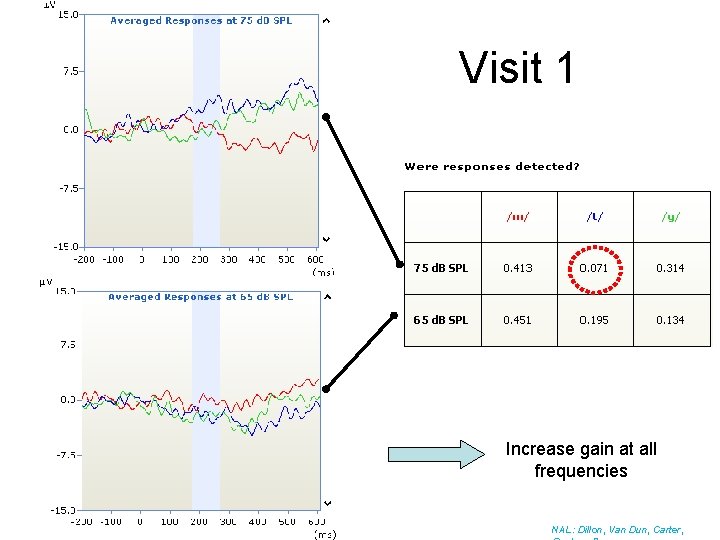
Visit 1 Increase gain at all frequencies NAL: Dillon, Van Dun, Carter,
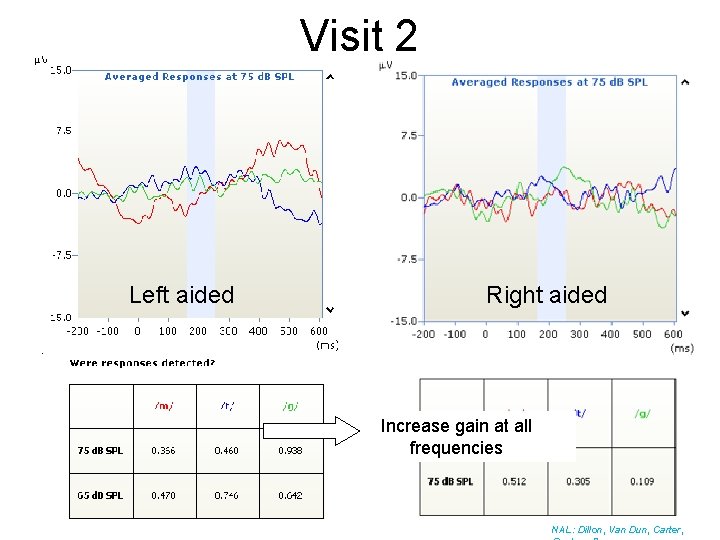
Visit 2 Left aided Right aided Increase gain at all frequencies NAL: Dillon, Van Dun, Carter,
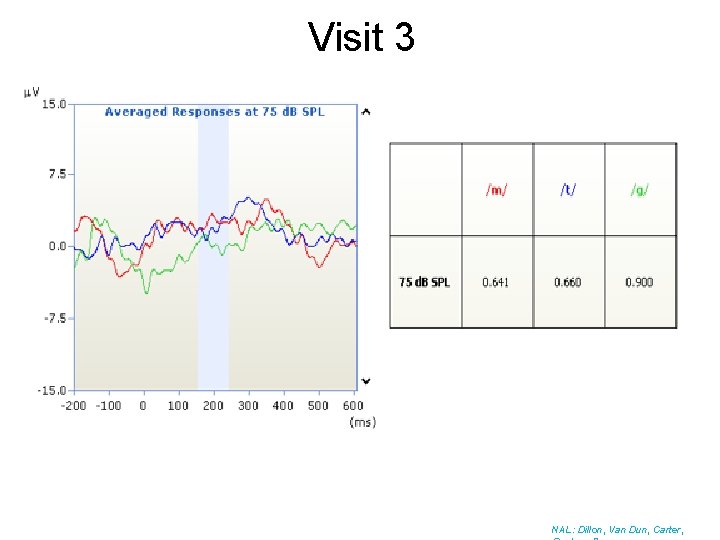
Visit 3 NAL: Dillon, Van Dun, Carter,
• The parents still believe that their baby boy can be oral by using hearing aids. • They are hoping to see that their baby can benefit from more powerful hearing aids. • The baby’s hearing aids were changed from Siemens Explorer 500 P to Phonak Una SP after Visit 3. NAL: Dillon, Van Dun, Carter,
Case 3 Corticals provided reassurance about the baby hearing well • Age at aided cortical testing – Visit 1 4. 5 months old – Visit 2 5. 5 months old • Hearing aid fitting at 5 weeks of age NAL: Dillon, Van Dun, Carter,
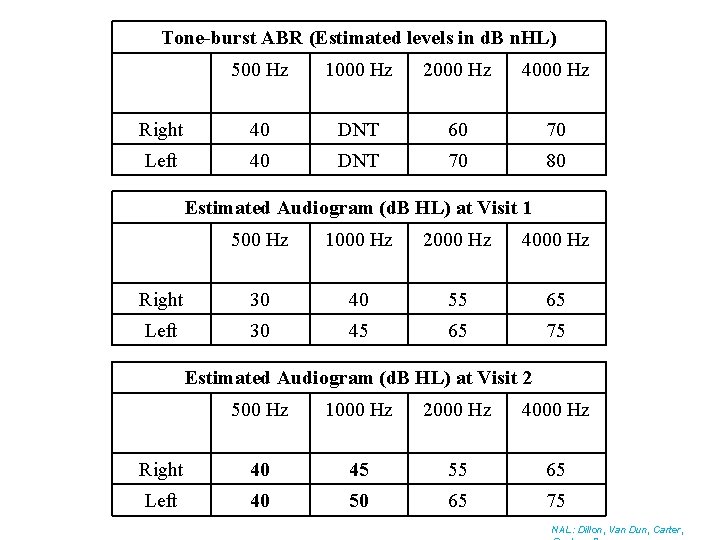
Tone-burst ABR (Estimated levels in d. B n. HL) 500 Hz 1000 Hz 2000 Hz 4000 Hz Right 40 DNT 60 70 Left 40 DNT 70 80 Estimated Audiogram (d. B HL) at Visit 1 500 Hz 1000 Hz 2000 Hz 4000 Hz Right 30 40 55 65 Left 30 45 65 75 Estimated Audiogram (d. B HL) at Visit 2 500 Hz 1000 Hz 2000 Hz 4000 Hz Right 40 45 55 65 Left 40 50 65 75 NAL: Dillon, Van Dun, Carter,
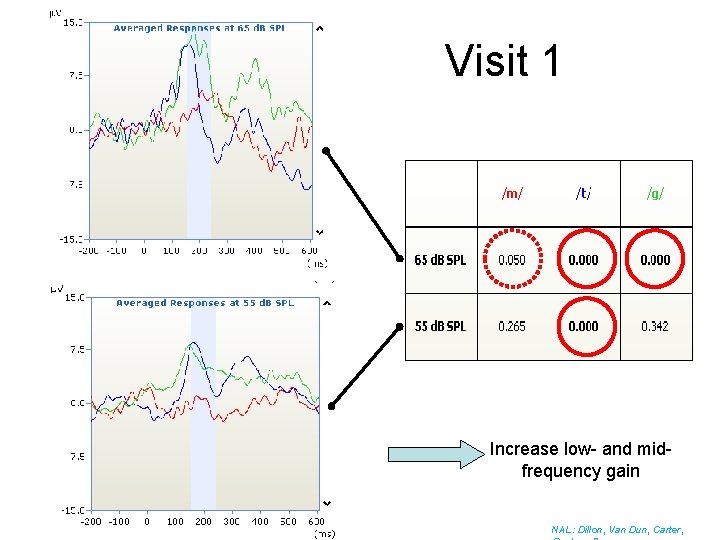
Visit 1 Increase low- and midfrequency gain NAL: Dillon, Van Dun, Carter,
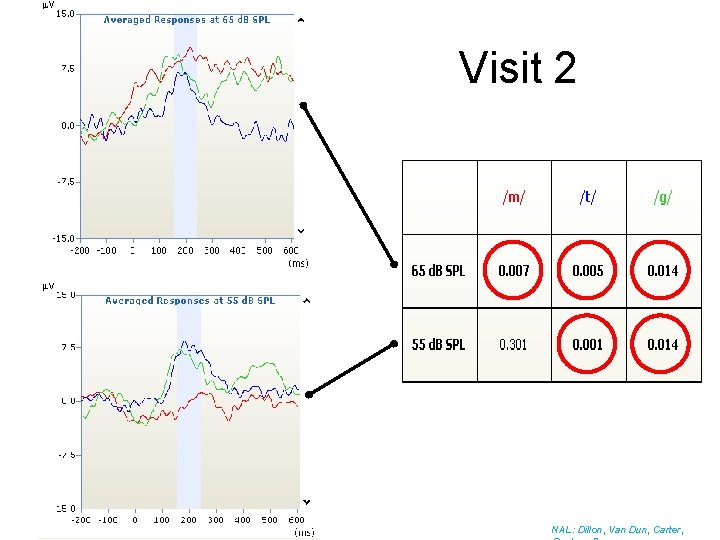
Visit 2 NAL: Dillon, Van Dun, Carter,
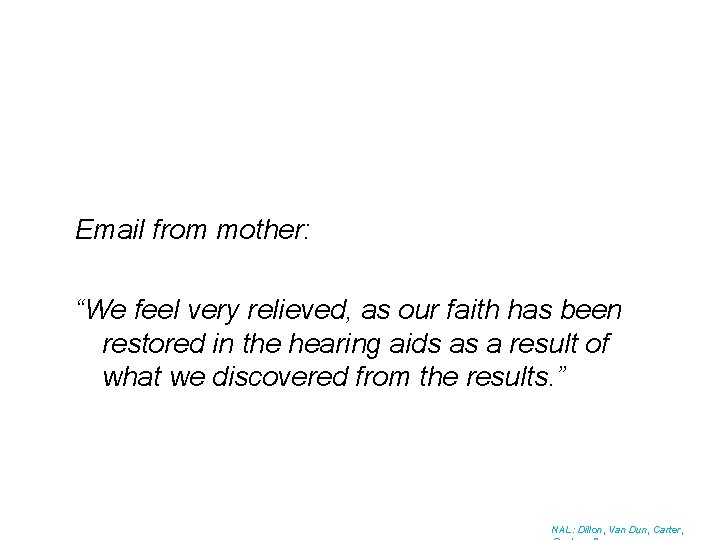
Email from mother: “We feel very relieved, as our faith has been restored in the hearing aids as a result of what we discovered from the results. ” NAL: Dillon, Van Dun, Carter,
Case 4 Too few significant cortical responses, and the aid gain was increased, resulting in more cortical responses • Age at aided cortical testing – Visit 1 8 months old – Visit 2 9 months old • Hearing aids have been increased in gain two weeks before the second visit. • Hearing aid fitting at 9 weeks of age NAL: Dillon, Van Dun, Carter, Gardner-Berry
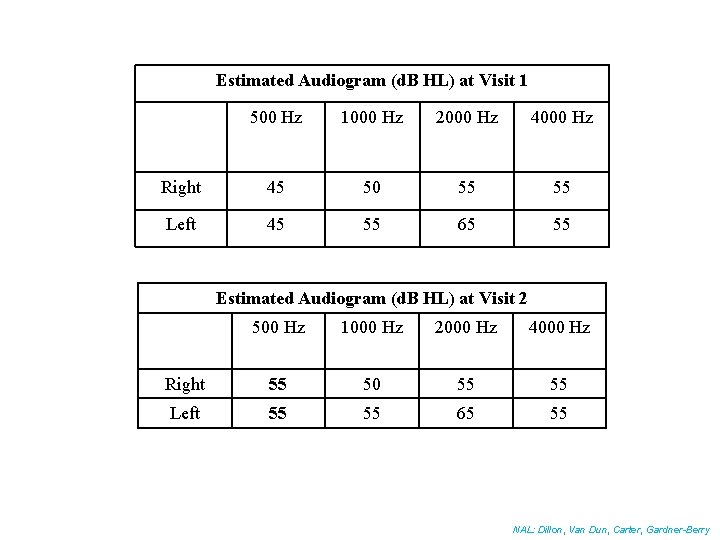
Estimated Audiogram (d. B HL) at Visit 1 500 Hz 1000 Hz 2000 Hz 4000 Hz Right 45 50 55 55 Left 45 55 65 55 Estimated Audiogram (d. B HL) at Visit 2 500 Hz 1000 Hz 2000 Hz 4000 Hz Right 55 50 55 55 Left 55 55 65 55 NAL: Dillon, Van Dun, Carter, Gardner-Berry
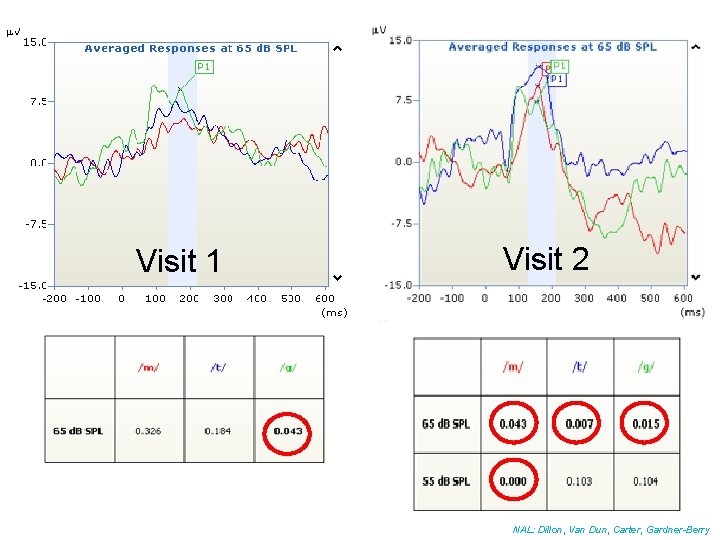
Visit 1 Visit 2 NAL: Dillon, Van Dun, Carter, Gardner-Berry
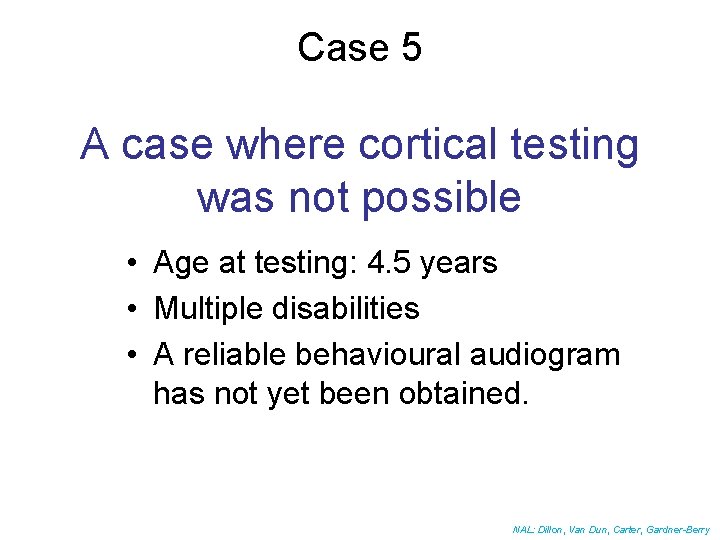
Case 5 A case where cortical testing was not possible • Age at testing: 4. 5 years • Multiple disabilities • A reliable behavioural audiogram has not yet been obtained. NAL: Dillon, Van Dun, Carter, Gardner-Berry
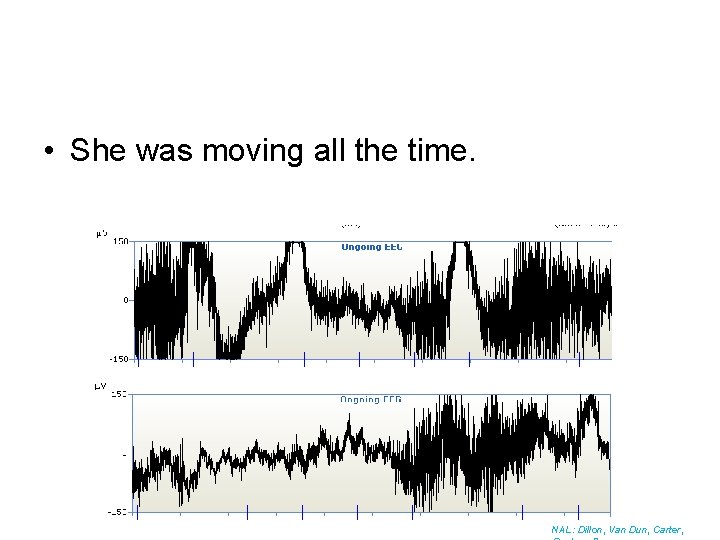
• She was moving all the time. NAL: Dillon, Van Dun, Carter,
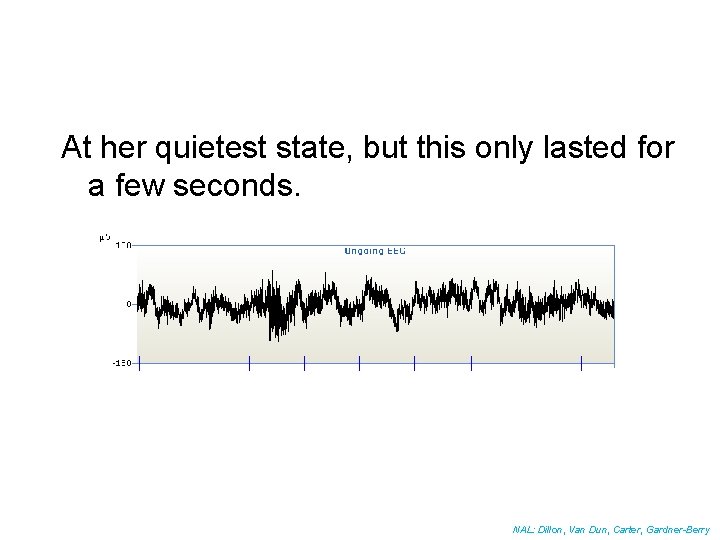
At her quietest state, but this only lasted for a few seconds. NAL: Dillon, Van Dun, Carter, Gardner-Berry
Case 6 A case where the unaided /m/ was present but the aided /m/ was absent. • Cortical testing at 8 months of age, nine days after the initial hearing aid fitting NAL: Dillon, Van Dun, Carter, Gardner-Berry
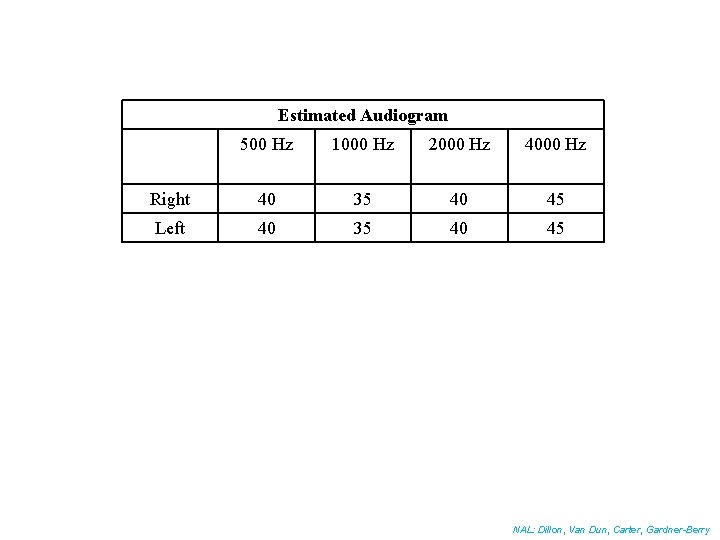
Estimated Audiogram 500 Hz 1000 Hz 2000 Hz 4000 Hz Right 40 35 40 45 Left 40 35 40 45 NAL: Dillon, Van Dun, Carter, Gardner-Berry
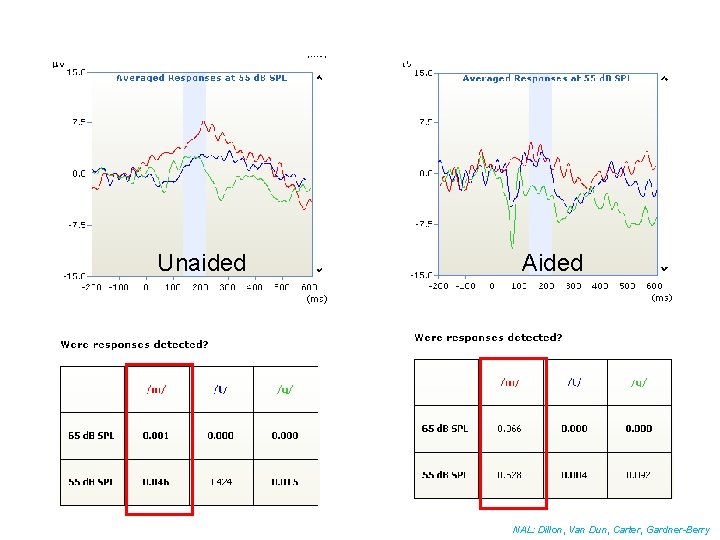
Unaided Aided NAL: Dillon, Van Dun, Carter, Gardner-Berry
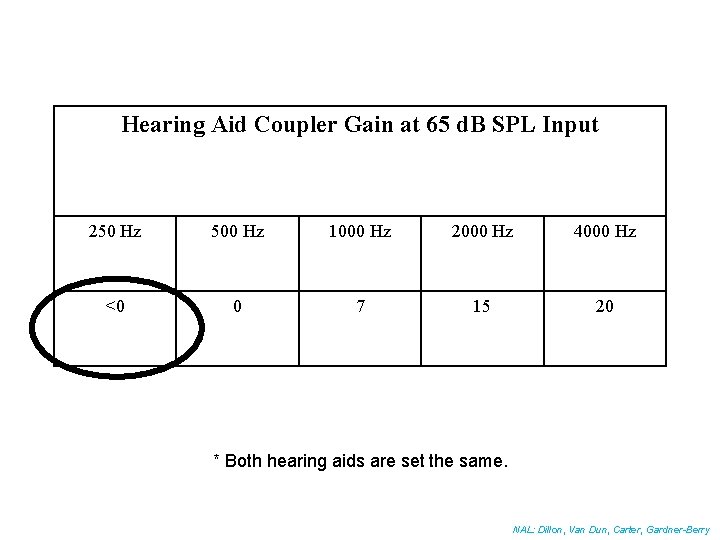
Hearing Aid Coupler Gain at 65 d. B SPL Input 250 Hz 500 Hz 1000 Hz 2000 Hz 4000 Hz <0 0 7 15 20 * Both hearing aids are set the same. NAL: Dillon, Van Dun, Carter, Gardner-Berry
Auditory neuropathy NAL: Dillon, Van Dun, Carter,
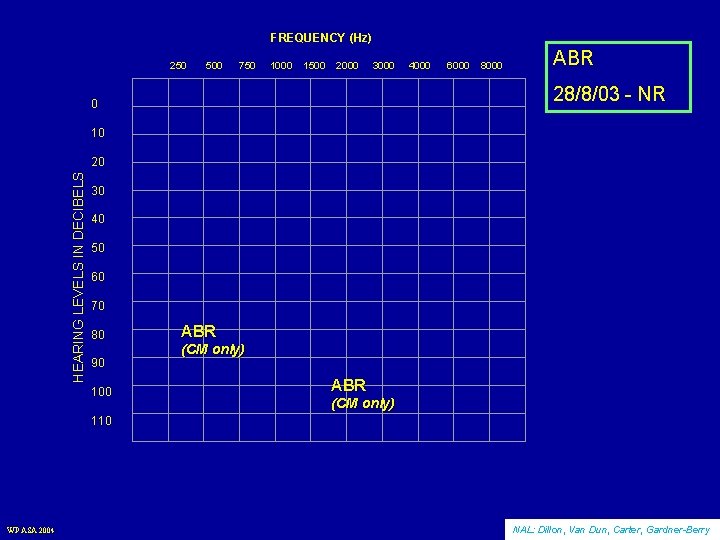
FREQUENCY (Hz) 250 500 750 1000 1500 2000 3000 4000 6000 8000 ABR 90 100 110 0 HEARING LEVELS IN DECIBELS 10 WP ASA 2004 20 30 40 50 60 70 80 (CM only) ABR 28/8/03 - NR NAL: Dillon, Van Dun, Carter, Gardner-Berry
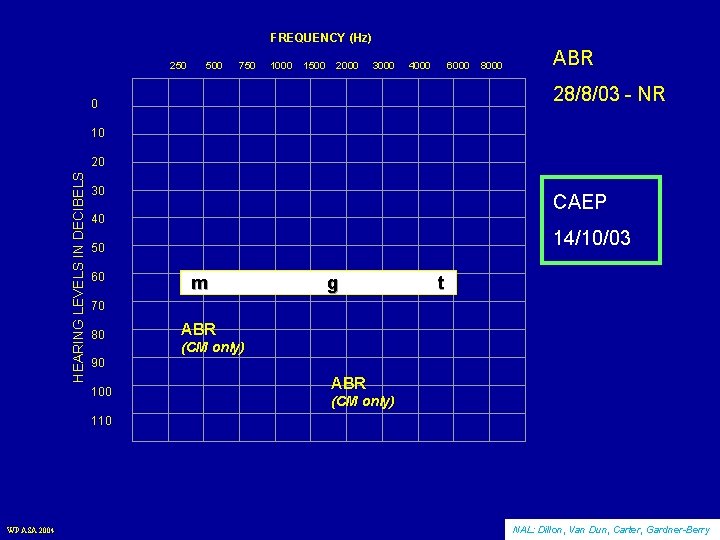
FREQUENCY (Hz) 250 500 750 1000 1500 2000 3000 4000 6000 8000 CAEP 14/10/03 g (CM only) 90 100 (CM only) 110 0 HEARING LEVELS IN DECIBELS 10 WP ASA 2004 ABR 20 30 40 50 60 70 80 m ABR t 28/8/03 - NR NAL: Dillon, Van Dun, Carter, Gardner-Berry
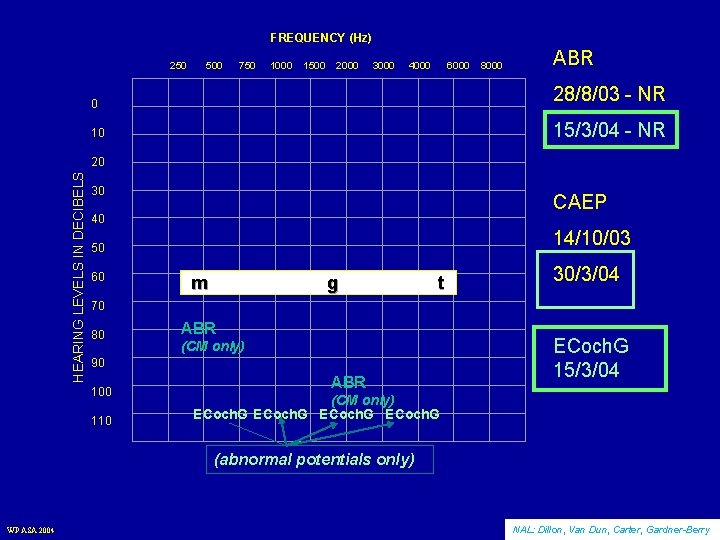
FREQUENCY (Hz) 250 500 750 1000 1500 2000 3000 4000 6000 8000 CAEP 14/10/03 g (CM only) 100 (CM only) 110 0 10 HEARING LEVELS IN DECIBELS ABR 20 30 40 50 60 70 80 90 m ABR (CM only) ABR t ECoch. G 28/8/03 - NR 15/3/04 - NR 30/3/04 ECoch. G 15/3/04 (abnormal potentials only) WP ASA 2004 NAL: Dillon, Van Dun, Carter, Gardner-Berry
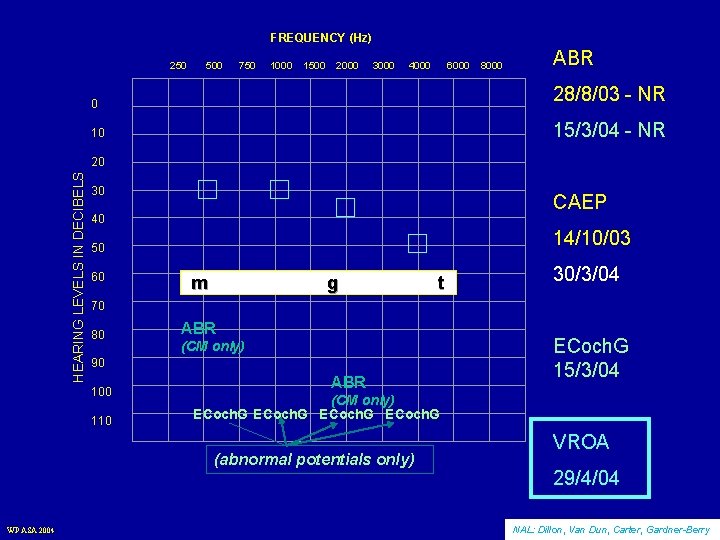
FREQUENCY (Hz) 250 500 750 1000 1500 2000 3000 4000 6000 8000 CAEP 14/10/03 g (CM only) 100 (CM only) 110 0 HEARING LEVELS IN DECIBELS 10 20 30 40 50 60 70 80 90 m ABR (CM only) ABR t ECoch. G (abnormal potentials only) WP ASA 2004 ABR 28/8/03 - NR 15/3/04 - NR 30/3/04 ECoch. G 15/3/04 VROA 29/4/04 NAL: Dillon, Van Dun, Carter, Gardner-Berry
The HEARing CRC Member Organisations This research was financially supported by the HEARing CRC established and supported under the Australian Government’s Cooperative Research Centres Program NAL: Dillon, Van Dun, Carter, Gardner-Berry
- Slides: 132