
Hearing loss in adults Done by Loulou Mahmoud
Hearing loss in adults Done by Lo’ulo’u Mahmoud Rawan Fayoumi

• Causes • Investigation • Treatment
• Hearing loss is a decrease in the ability to perceive sounds. • any degree of impairment of the ability to apprehend sou nd.
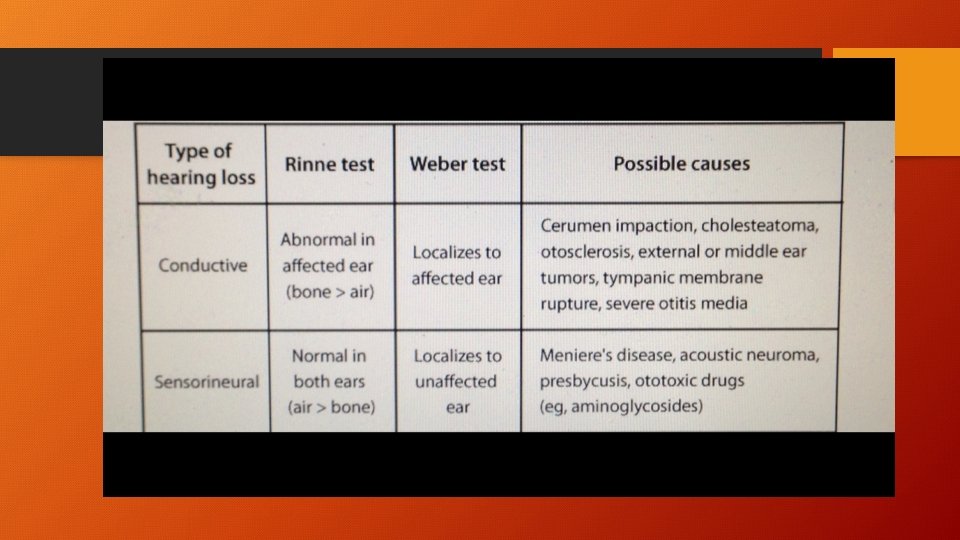
types • Conductive hearing loss (external ear / middle ear) -(AC < BC) - Lateralized to worse/affected ear (unilateral) • Sensorineural ( inner ear / nerve pathway from inner ear to the brain ) - AC>BC but both are depressed. -Lateralized to better/healthy ear (unilateral) • Mixed
Presbycusis. • This is a sensorineural age-related hearing loss. It is a category for the cumulative effects of aging on the ears such as degeneration of cochlea or CN 8 or central auditory system. Hearing loss usually begins after age 60. Both ears are affected. It is typically harder to hear high-pitched tones than low-pitched ones. Hearing loss usually occurs gradually over a period of years.
Noise-induced hearing loss • Loud sounds can injure delicate hair cells within the ear. This is a form of sensorineural hearing loss. Noise-induced hearing loss can happen because of a single brief burst of an extremely loud sound. It more often results from long-term exposure to loud sounds of slightly lower intensity. (temporary or permanent) • Degree of hearing loss depend on intensity , time exposure and frequency

The “ 4 P’s” • Painless • Progressive • Permanent • Preventable
Sudden sensorineural hearing loss • This is a medical emergency(sensorineural). A person loses hearing over a period of three days or less. In most cases, only one ear is affected. The most common cause is idiopathic. The underlying problem may be a viral infection.
Otosclerosis • This is a middle ear disease. The exact cause of otosclerosis is unknown. Measles virus infection may activate the gene responsible for otosclerosis. The abnormal formation of new bone in the middle ear that gradually immobilizes the stapes (stirrup bone) and prevents it from vibrating in response to sound, causing a progressive conductive loss of hearing. Otosclerosis usually affects both ears. It is a common disorder, especially among young women. Otosclerosis often runs in families.
Meniere's disease • It affect the membranous labyrinth of the inner ear. This typically causes dizziness, hearing loss , aural fullness and ringing in the ears (tinnitus) in one or both ears. The attacks every 20 min-24 h. People with Ménière's disease have a buildup of excess fluid within the inner ear(endolymphatic hydrops). The cause of Ménière's disease is not known. It usually starts in people between 30 and 50 years old. A person with this disease will often have sensorineural hearing loss in low frequency. Sensitivity to loud sounds may also happen. The hearing loss comes and goes, but over time some loss becomes permanent
Ototoxic medications. • There are some medicines damage the sensory cells used in hearing and balance in the inner ear (sensorineural). Some medicines that may impact hearing include the following: • Aminoglycoside antibiotics, such as streptomycin, neomycin, or kanamycin • Large amounts of aspirin • Loop diuretics • Some chemotherapy drugs • Treatment : stop the medication
Acoustic neuroma • This noncancerous tumor grows on part of the eighth cranial nerve (vestibulocochlear nerve). Acoustic neuroma often causes dizziness and equilibrium problems in addition to gradual hearing loss.
Middle ear disease • A bacterial infection of the middle ear can: 1. injure the eardrum 2. disrupt the middle-ear bones 3. cause fluid buildup
v. Diagnosis q. Physical exam. Your doctor will look in your ear for possible causes of your hearing loss, such as earwax or inflammation from an infection. Your doctor will also look for any structural causes of your hearing problems. q. General screening tests. Your doctor may use the whisper test, asking you to cover one ear at a time to see how well you hear words spoken at various volumes and how you respond to other sounds. Its accuracy can be limited. q. Tuning fork tests. Tuning forks are two-pronged, metal instruments that produce sounds when struck. Simple tests with tuning forks can help your doctor detect hearing loss. This evaluation may also reveal where in your ear the damage has occurred. q. Audiometer tests.
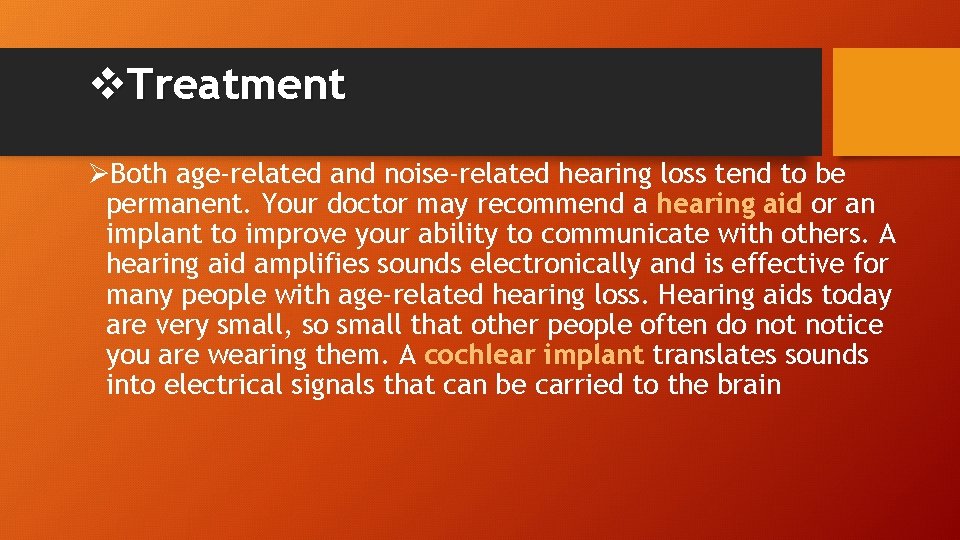
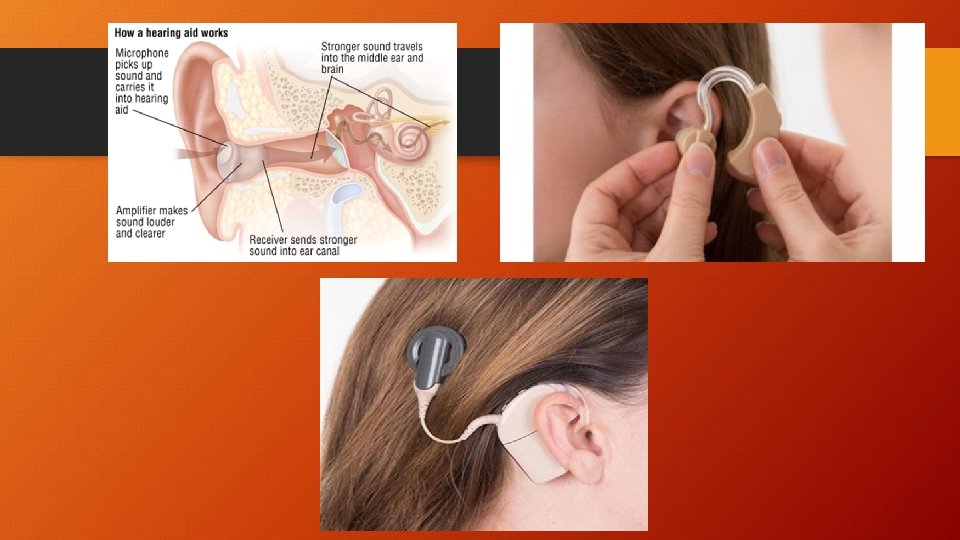
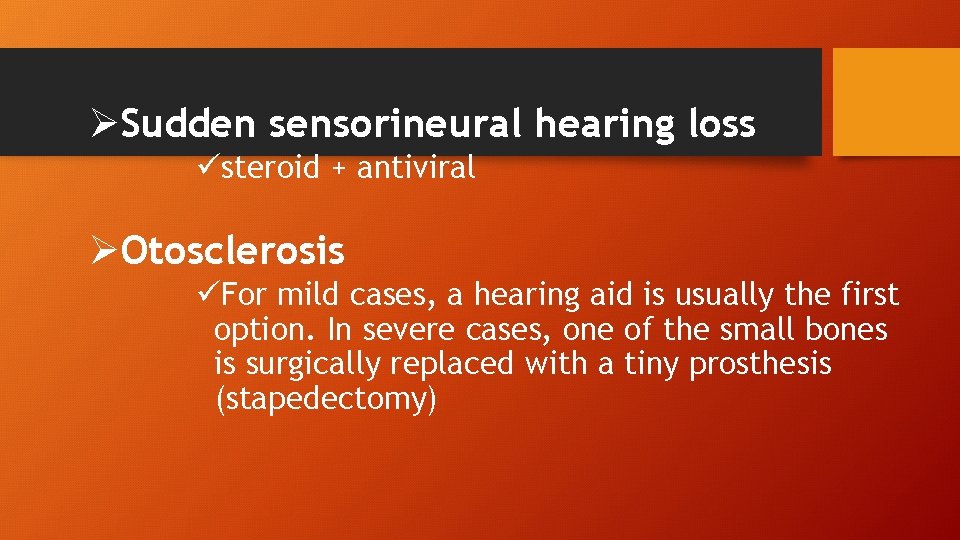
v. Treatment ØBoth age-related and noise-related hearing loss tend to be permanent. Your doctor may recommend a hearing aid or an implant to improve your ability to communicate with others. A hearing aid amplifies sounds electronically and is effective for many people with age-related hearing loss. Hearing aids today are very small, so small that other people often do notice you are wearing them. A cochlear implant translates sounds into electrical signals that can be carried to the brain
ØSudden sensorineural hearing loss üsteroid + antiviral ØOtosclerosis üFor mild cases, a hearing aid is usually the first option. In severe cases, one of the small bones is surgically replaced with a tiny prosthesis (stapedectomy)
v. Meniere's disease üThe goal of treatment is to relieve pressure in the ears to reduce symptoms. Some people improve by limiting intake of salt, caffeine or alcohol or quitting smoking. Medications to reduce fluid retention in the ear may help. In some cases, surgery may be considered (labrinthectomy or endolymphatic sac drainage) üBetahistine hydrochloride (anti vertigo)
v. Acoustic neuroma ümonitoring depending on the size of your tumor, hearing status and other factors. üSurgery : The goal of surgery is to remove the tumor, preserve the facial nerve to prevent facial paralysis and preserve hearing when possible. Surgery for an acoustic neuroma is performed under general anesthesia and involves removing the tumor through the inner ear or through a window in skull ü highly focused radiation therapy to stop the growth of tumor v. Middle ear disease üAntibiotics
- Slides: 20