
Hearing Conservation 29 CFR 1910 95 Hearing Loss
- Slides: 27
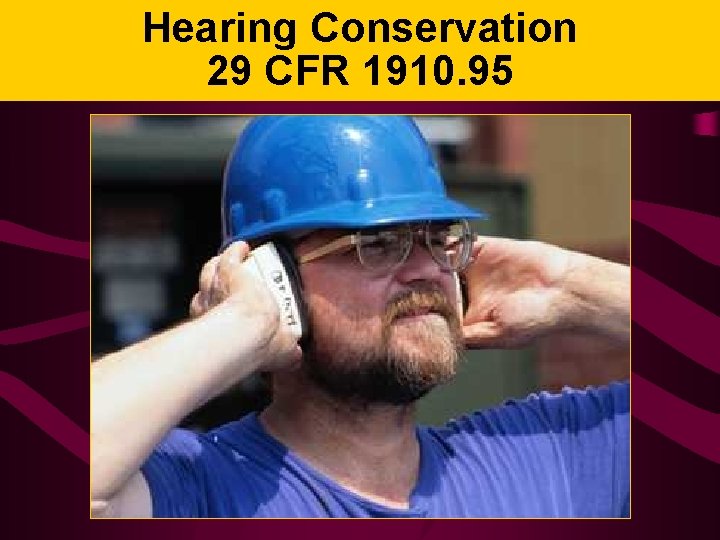
Hearing Conservation 29 CFR 1910. 95
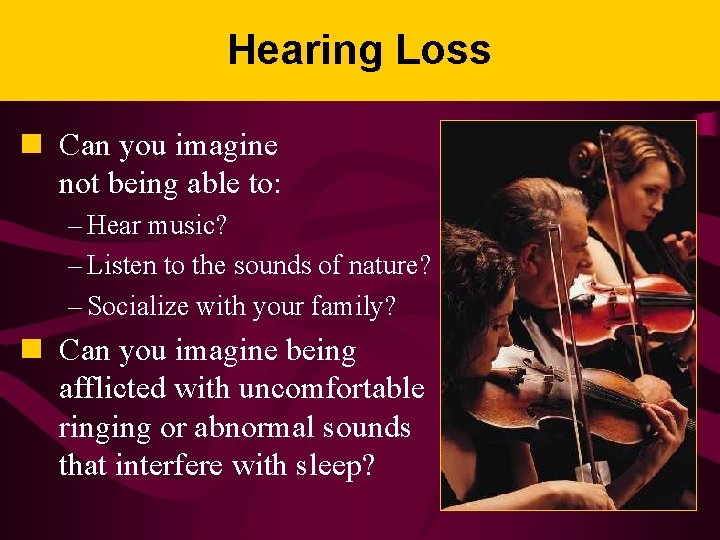
Hearing Loss n Can you imagine not being able to: – Hear music? – Listen to the sounds of nature? – Socialize with your family? n Can you imagine being afflicted with uncomfortable ringing or abnormal sounds that interfere with sleep?
Hearing Conservation Goals n Noise and hearing n Hearing Conservation Program n Quiz
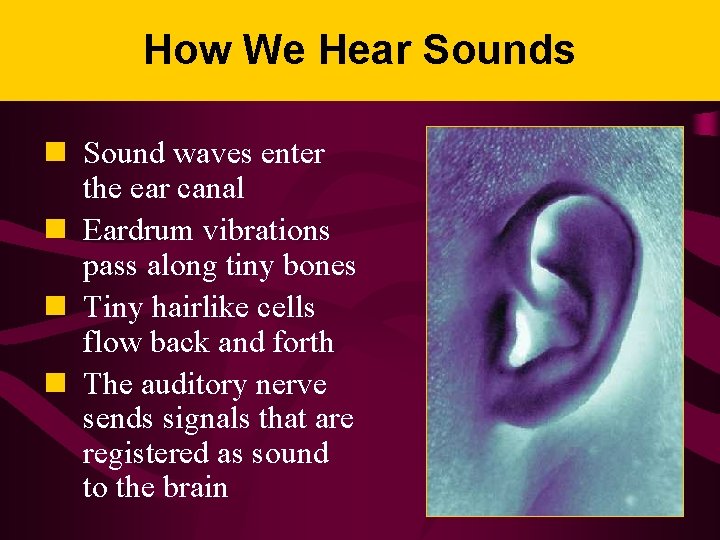
How We Hear Sounds n Sound waves enter the ear canal n Eardrum vibrations pass along tiny bones n Tiny hairlike cells flow back and forth n The auditory nerve sends signals that are registered as sound to the brain
How Hearing Is Damaged n Hearing ability consists of delicate parts n Hairlike cells are flattened n You do not get used to noise; you gradually lose your hearing n Once hearing is damaged, it cannot be repaired or replaced
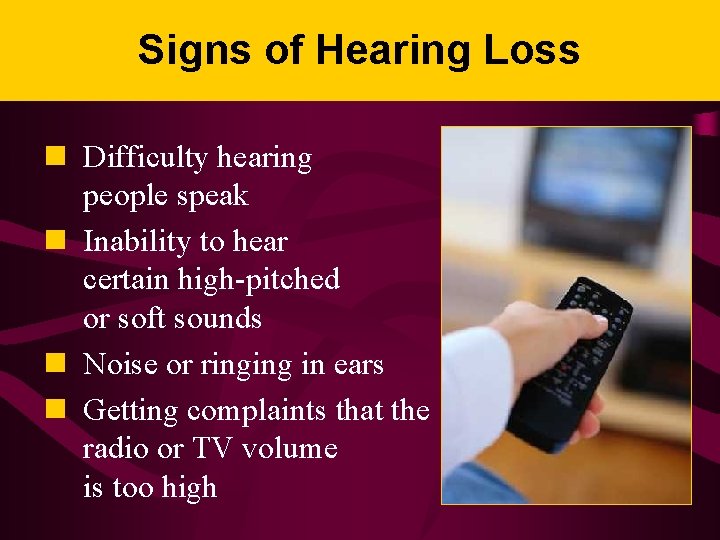
Signs of Hearing Loss n Difficulty hearing people speak n Inability to hear certain high-pitched or soft sounds n Noise or ringing in ears n Getting complaints that the radio or TV volume is too high
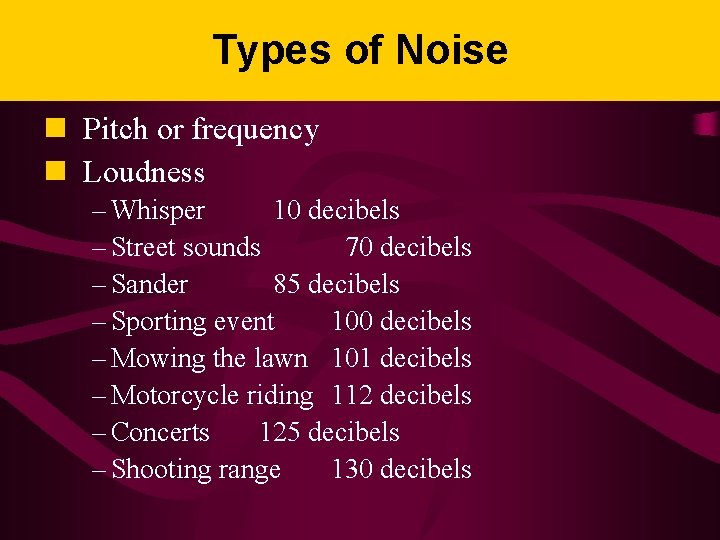
Types of Noise n Pitch or frequency n Loudness – Whisper 10 decibels – Street sounds 70 decibels – Sander 85 decibels – Sporting event 100 decibels – Mowing the lawn 101 decibels – Motorcycle riding 112 decibels – Concerts 125 decibels – Shooting range 130 decibels
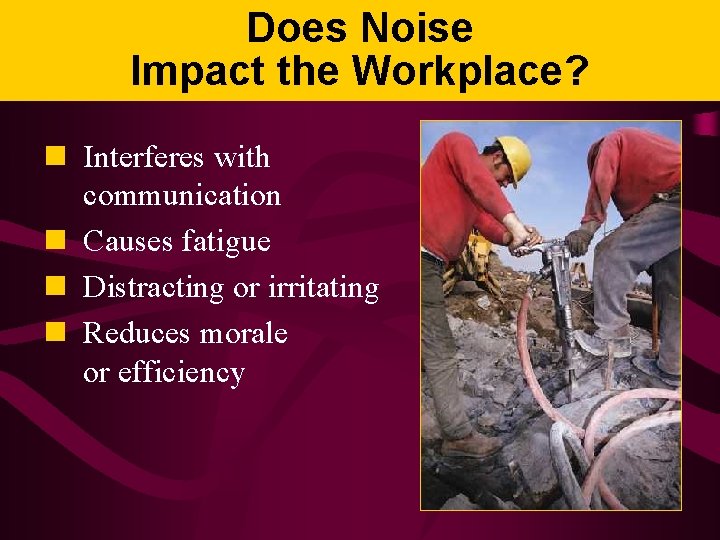
Does Noise Impact the Workplace? n Interferes with communication n Causes fatigue n Distracting or irritating n Reduces morale or efficiency
Hearing Conservation Goals n Noise and hearing n Hearing Conservation Program n Quiz
Noise Monitoring n n Monitoring program and strategy Sound level meters Noise dosimeters Repeat monitoring
Affected Employees n Each employee exposed to noise at or above the 8 -hour time-weighted average (TWA) of 85 decibels must be notified. n Affected employees must be included in the Hearing Conservation Program.
Hearing Tests n n Audiometric testing offered Conducted by qualified medical provider Baseline tests Annual testing
Standard Threshold Shift n Hearing ability changed by an average of 10 decibels n Employee notification within 21 days n Revised hearing protection required n Further medical evaluation
Noise Reduction Efforts n Engineering Controls – Reduce noise at the source – Interrupt the noise path – Reduce reverberation and structural vibration n Administrative – Operate noisy equipment on second or third shifts – Rotate employees through high-noise areas
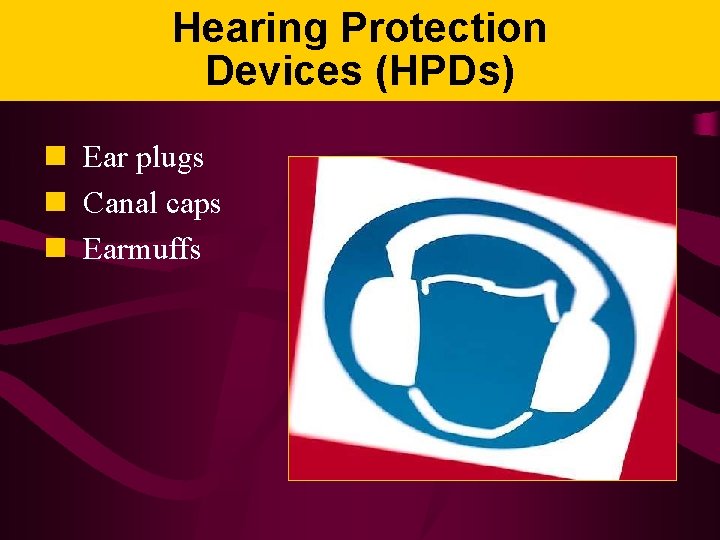
Hearing Protection Devices (HPDs) n Ear plugs n Canal caps n Earmuffs
HPD Noise Reduction n HPDs must reduce employee noise exposure below an 8 -hour TWA of 90 decibels n Employees with STS, noise exposure reduced below an 8 -hour TWA of 85 decibels n Noise reduction ratio (NRR) – Lab versus real world – Ear plugs: use 1/3 of NRR – Earmuffs: use 1/2 of NRR
Hearing Protection Use n Voluntary use – Exposed to an 8 -hour TWA of 85 decibels n Mandatory use – Exposed to an 8 -hour TWA of 90 decibels – Exposed to an 8 -hour TWA of 85 decibels but have not had a baseline hearing test – Employees who have suffered STS hearing loss and are exposed to an 8 -hour TWA of 85 decibels
Management Responsibility n n n Provide hearing protection devices Demonstrate commitment—wear HPDs Provide hearing protection training Enforce the use of HPDs Knowledgeable in HPD selection and use Encourage questions and solve problems
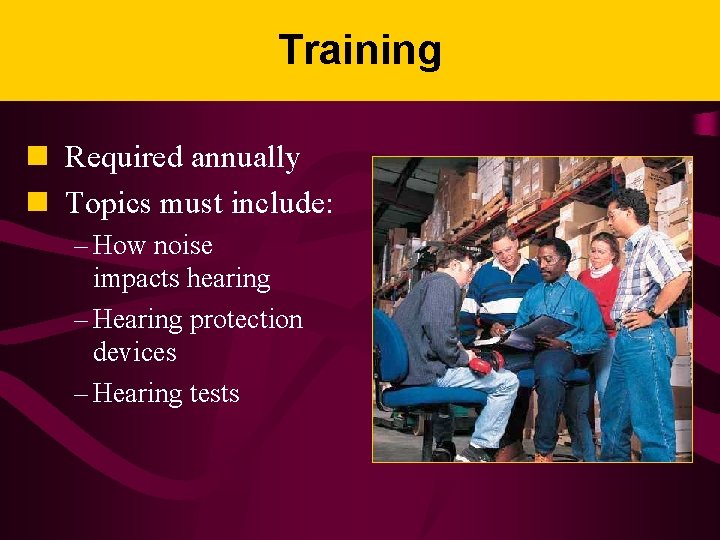
Training n Required annually n Topics must include: – How noise impacts hearing – Hearing protection devices – Hearing tests
Recordkeeping n n n Noise monitoring results Hearing test results Job assignments and noise exposure history Hearing protection devices used Records accessible
Employee Responsibility n Understand the need for Hearing Protection Devices (HPDs) n Wear HPDs and seek replacements n Encourage co-workers to wear HPDs n Communicate problems to supervisors
Hearing Conservation Goals n Noise and hearing n Hearing Conservation Program n Quiz
Summary n Constant exposure to noise over 85 decibels can cause hearing damage. n Hearing loss cannot be cured or repaired n Hearing tests are conducted annually n Hearing protection devices include ear plugs, earmuffs, and canal caps
Quiz 1. Employee participation in the Hearing Conservation Program is required when exposed to an 8 -hour TWA noise level of ____ decibels. 2. Hearing damage can easily be repaired with surgery. True or False 3. Describe a sign of hearing loss: __________. 4. Name two off-work activities that may expose you to high-noise levels: _______, ________. 5. Your company keeps records of noise monitoring and hearing tests. True or False
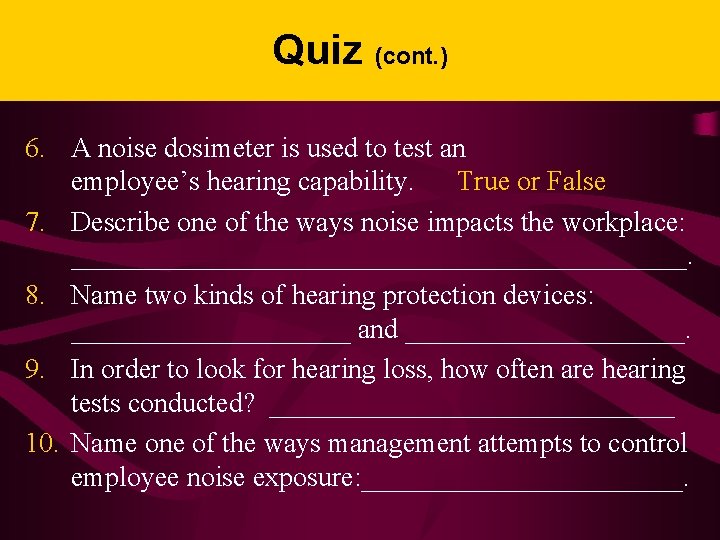
Quiz (cont. ) 6. A noise dosimeter is used to test an employee’s hearing capability. True or False 7. Describe one of the ways noise impacts the workplace: ______________________. 8. Name two kinds of hearing protection devices: __________ and __________. 9. In order to look for hearing loss, how often are hearing tests conducted? _______________ 10. Name one of the ways management attempts to control employee noise exposure: ____________.
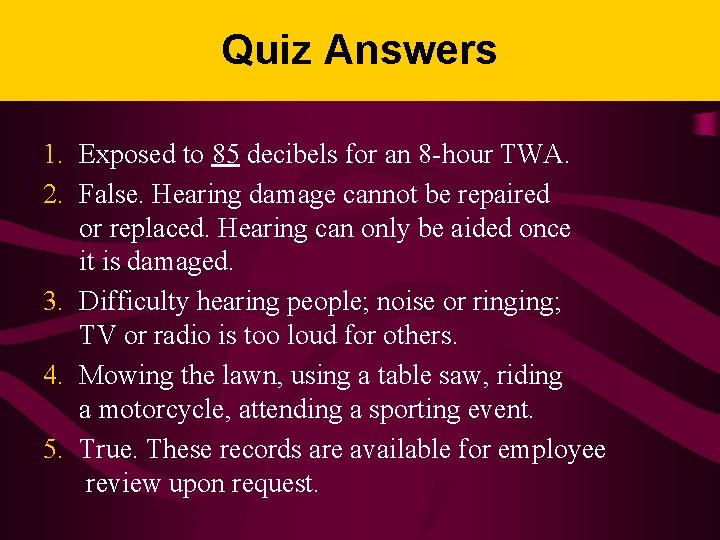
Quiz Answers 1. Exposed to 85 decibels for an 8 -hour TWA. 2. False. Hearing damage cannot be repaired or replaced. Hearing can only be aided once it is damaged. 3. Difficulty hearing people; noise or ringing; TV or radio is too loud for others. 4. Mowing the lawn, using a table saw, riding a motorcycle, attending a sporting event. 5. True. These records are available for employee review upon request.
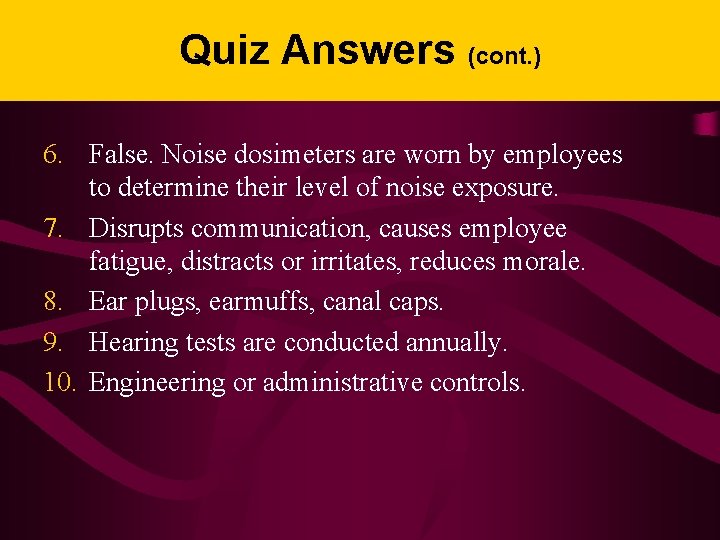
Quiz Answers (cont. ) 6. False. Noise dosimeters are worn by employees to determine their level of noise exposure. 7. Disrupts communication, causes employee fatigue, distracts or irritates, reduces morale. 8. Ear plugs, earmuffs, canal caps. 9. Hearing tests are conducted annually. 10. Engineering or administrative controls.