
Heaps p p Data Structures and Other Objects
Heaps p p Data Structures and Other Objects Using Java Chapter 10 has several programming projects, including a project that uses heaps. This presentation shows you what a heap is, and demonstrates two of the important heap algorithms.
Heaps A heap is a certain kind of complete binary tree.
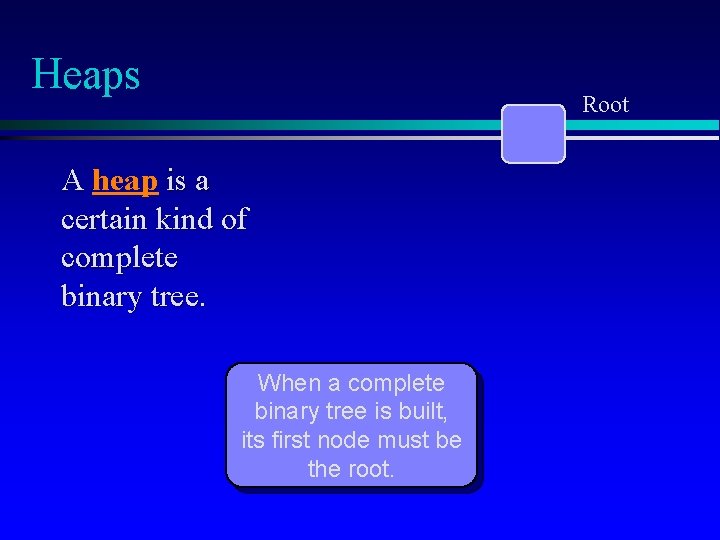
Heaps Root A heap is a certain kind of complete binary tree. When a complete binary tree is built, its first node must be the root.
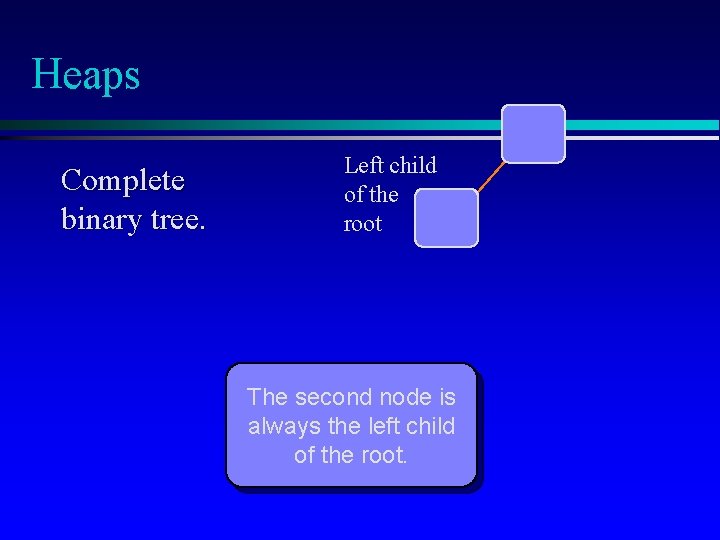
Heaps Complete binary tree. Left child of the root The second node is always the left child of the root.
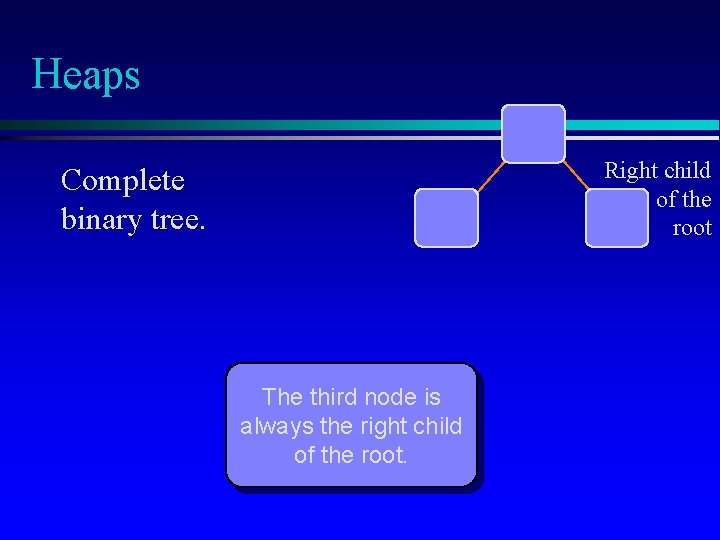
Heaps Right child of the root Complete binary tree. The third node is always the right child of the root.

Heaps Complete binary tree. The next nodes always fill the next level from left-to-right.
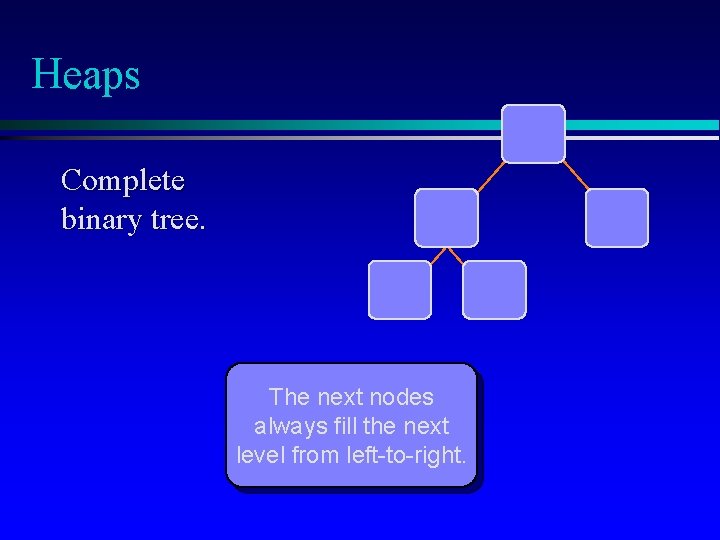
Heaps Complete binary tree. The next nodes always fill the next level from left-to-right.
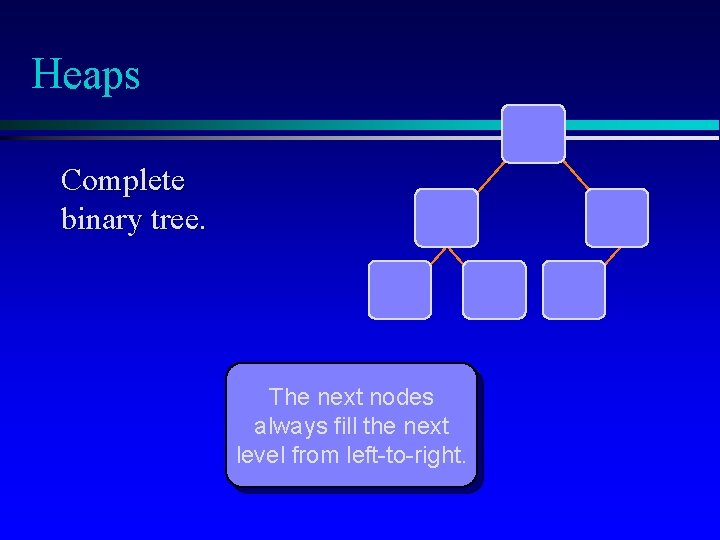
Heaps Complete binary tree. The next nodes always fill the next level from left-to-right.
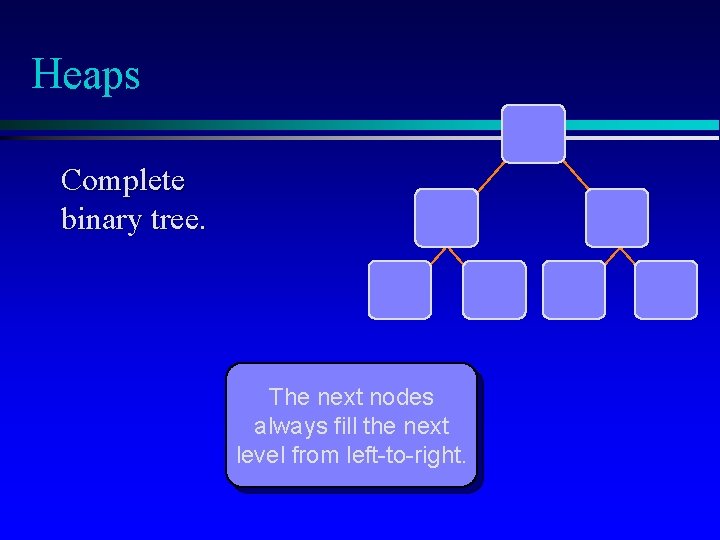
Heaps Complete binary tree. The next nodes always fill the next level from left-to-right.
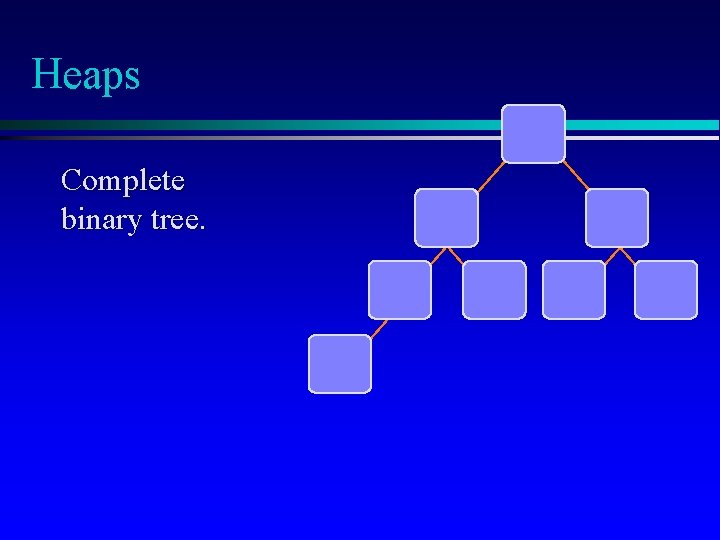
Heaps Complete binary tree.
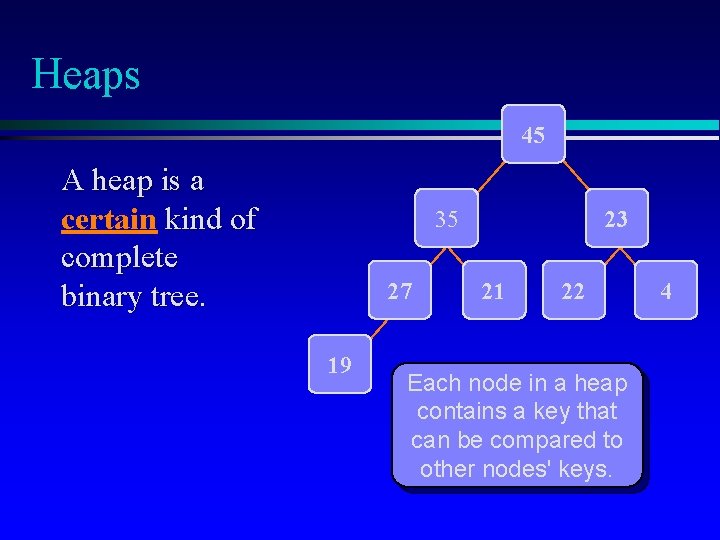
Heaps 45 A heap is a certain kind of complete binary tree. 35 27 19 23 21 22 Each node in a heap contains a key that can be compared to other nodes' keys. 4
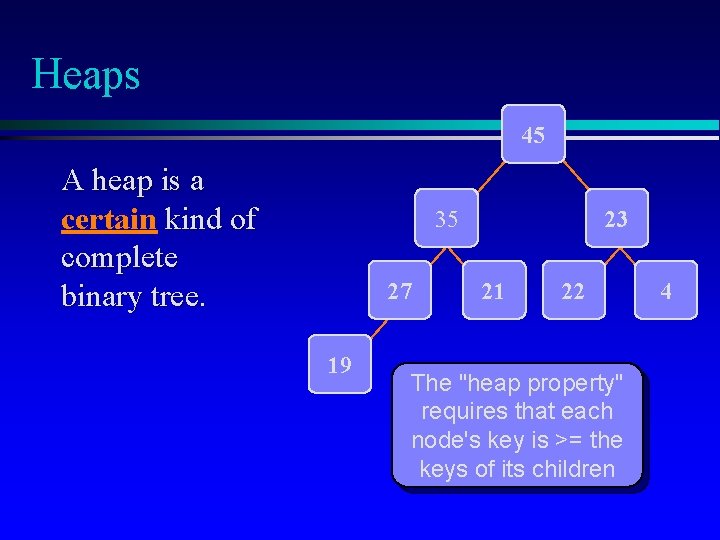
Heaps 45 A heap is a certain kind of complete binary tree. 35 27 19 23 21 22 The "heap property" requires that each node's key is >= the keys of its children 4
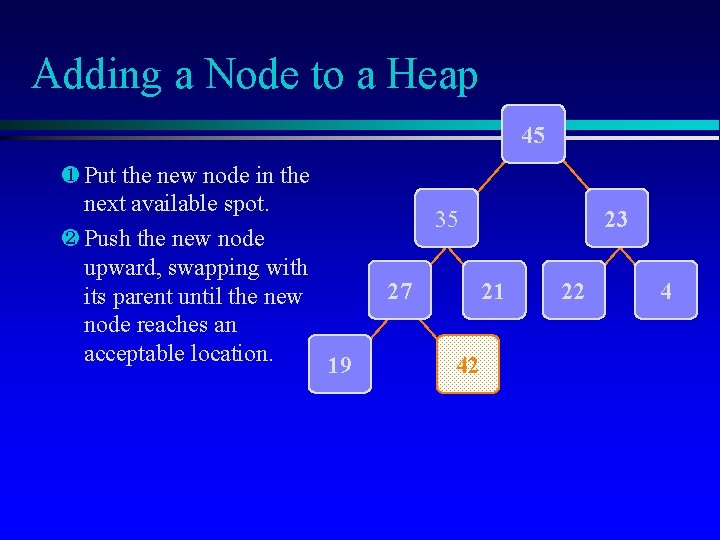
Adding a Node to a Heap 45 ¶ Put the new node in the next available spot. · Push the new node upward, swapping with its parent until the new node reaches an acceptable location. 19 35 27 23 21 42 22 4
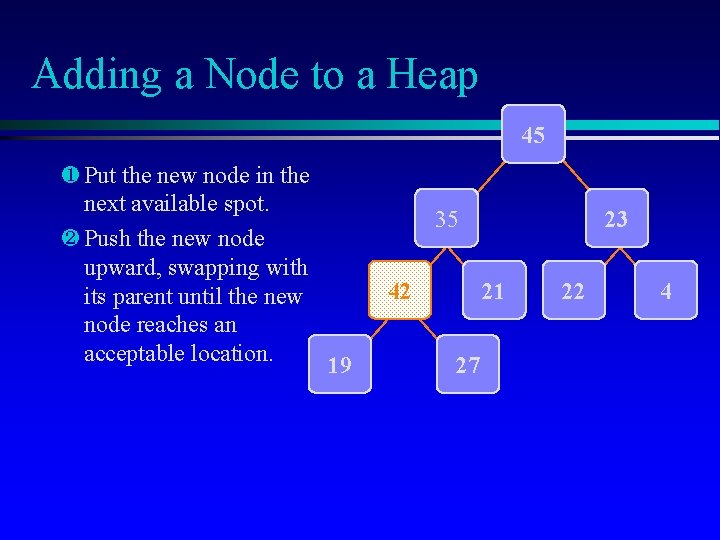
Adding a Node to a Heap 45 ¶ Put the new node in the next available spot. · Push the new node upward, swapping with its parent until the new node reaches an acceptable location. 19 35 42 23 21 27 22 4
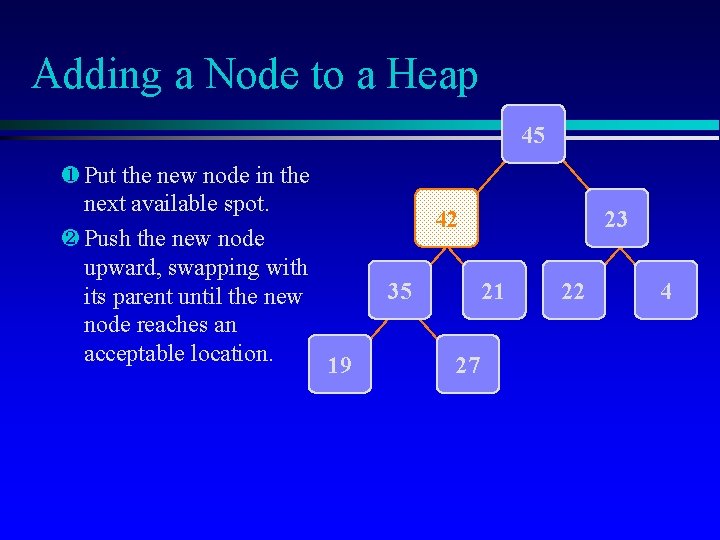
Adding a Node to a Heap 45 ¶ Put the new node in the next available spot. · Push the new node upward, swapping with its parent until the new node reaches an acceptable location. 19 42 35 23 21 27 22 4
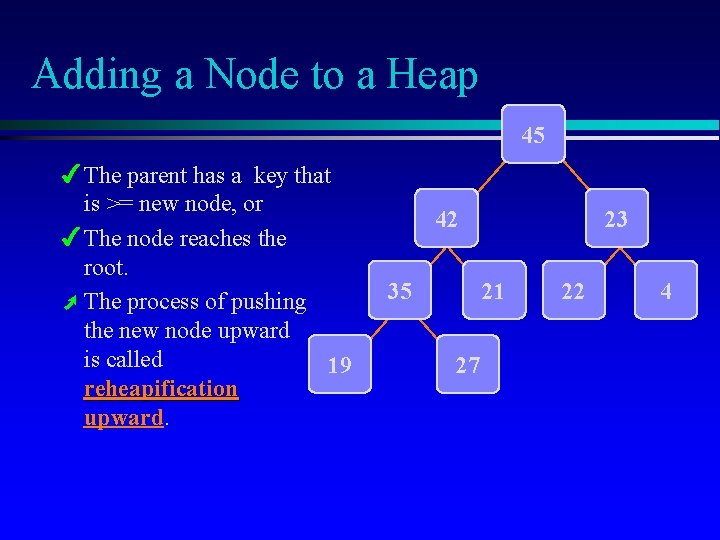
Adding a Node to a Heap 45 4 The parent has a key that is >= new node, or 4 The node reaches the root. Ú The process of pushing the new node upward is called 19 reheapification upward. 42 35 23 21 27 22 4
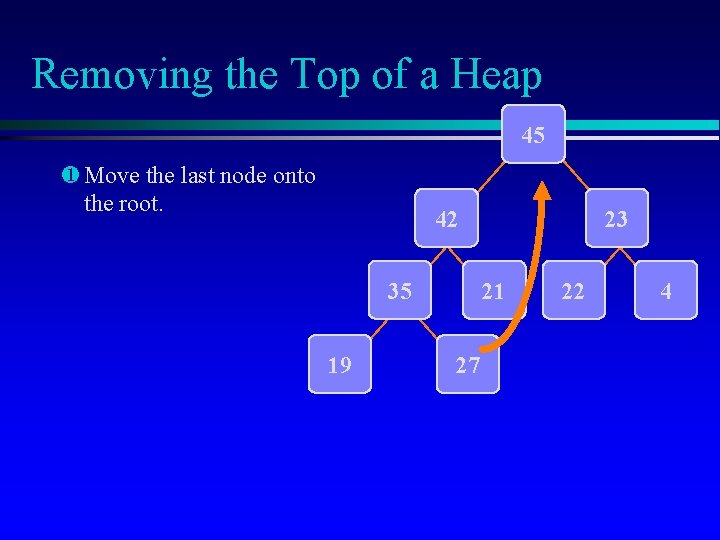
Removing the Top of a Heap 45 ¶ Move the last node onto the root. 42 35 19 23 21 27 22 4
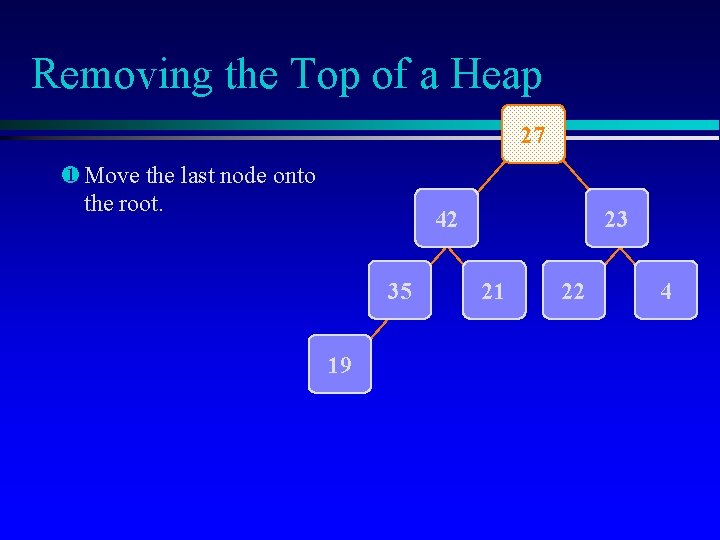
Removing the Top of a Heap 27 ¶ Move the last node onto the root. 42 35 19 23 21 22 4
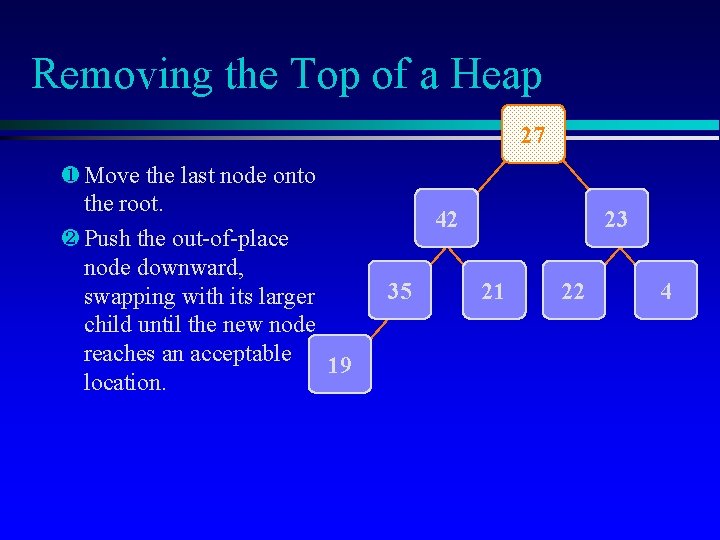
Removing the Top of a Heap 27 ¶ Move the last node onto the root. · Push the out-of-place node downward, swapping with its larger child until the new node reaches an acceptable 19 location. 42 35 23 21 22 4
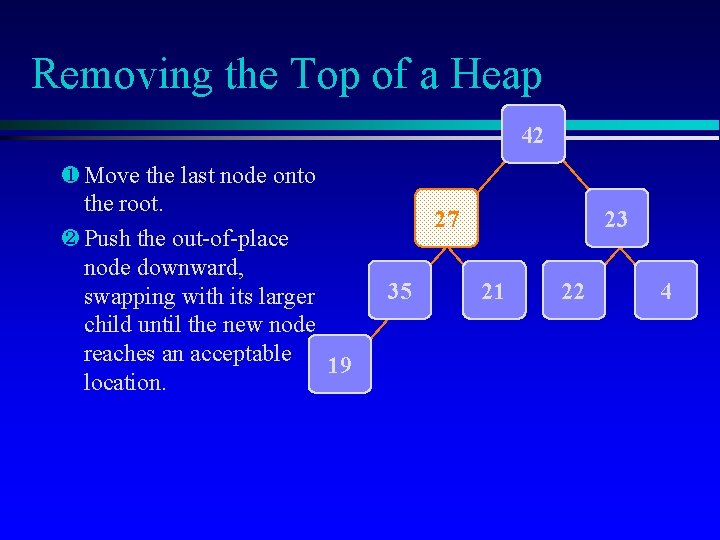
Removing the Top of a Heap 42 ¶ Move the last node onto the root. · Push the out-of-place node downward, swapping with its larger child until the new node reaches an acceptable 19 location. 27 35 23 21 22 4
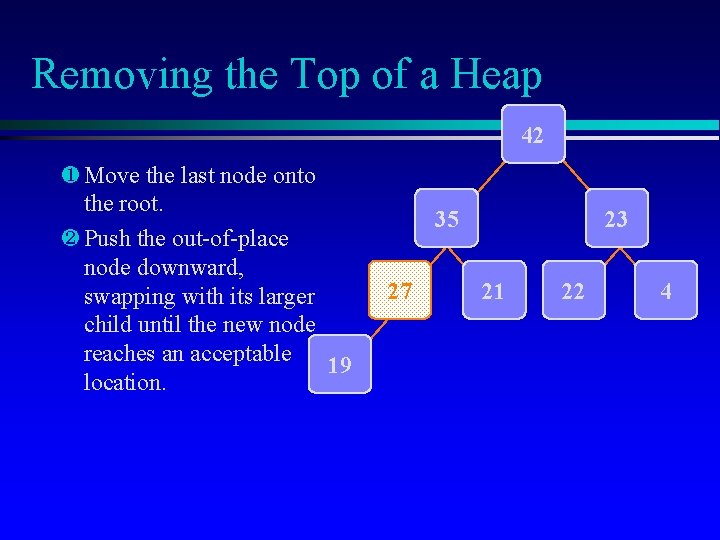
Removing the Top of a Heap 42 ¶ Move the last node onto the root. · Push the out-of-place node downward, swapping with its larger child until the new node reaches an acceptable 19 location. 35 27 23 21 22 4
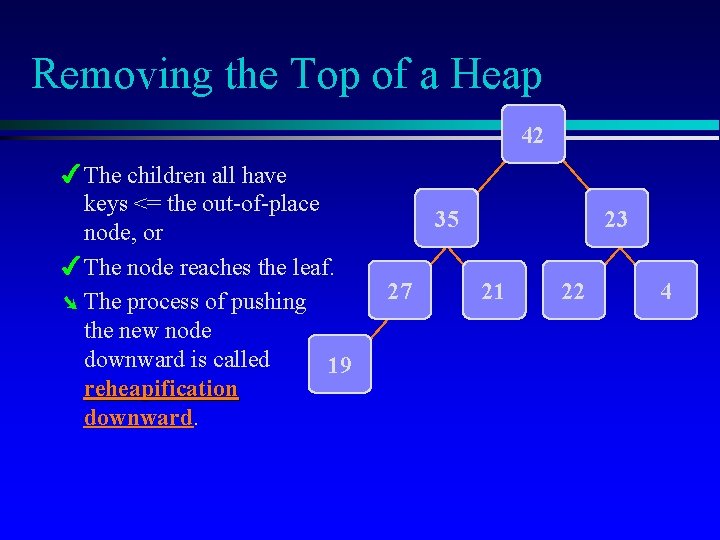
Removing the Top of a Heap 42 4 The children all have keys <= the out-of-place node, or 4 The node reaches the leaf. Ø The process of pushing the new node downward is called 19 reheapification downward. 35 27 23 21 22 4
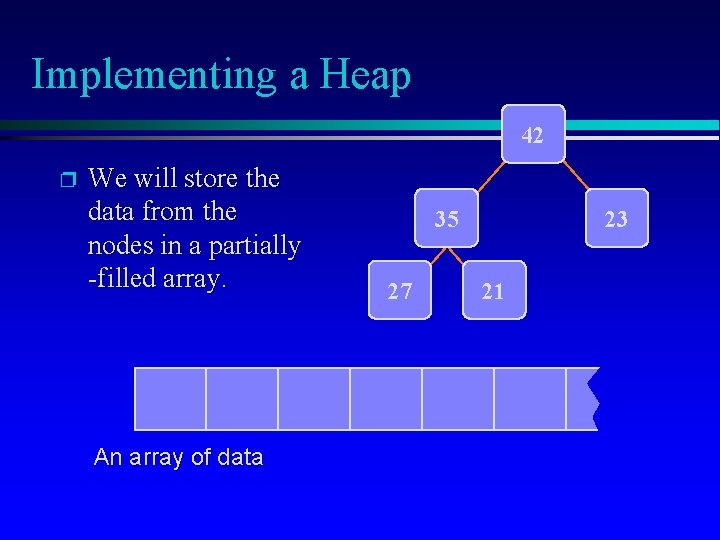
Implementing a Heap 42 p We will store the data from the nodes in a partially -filled array. An array of data 35 27 23 21
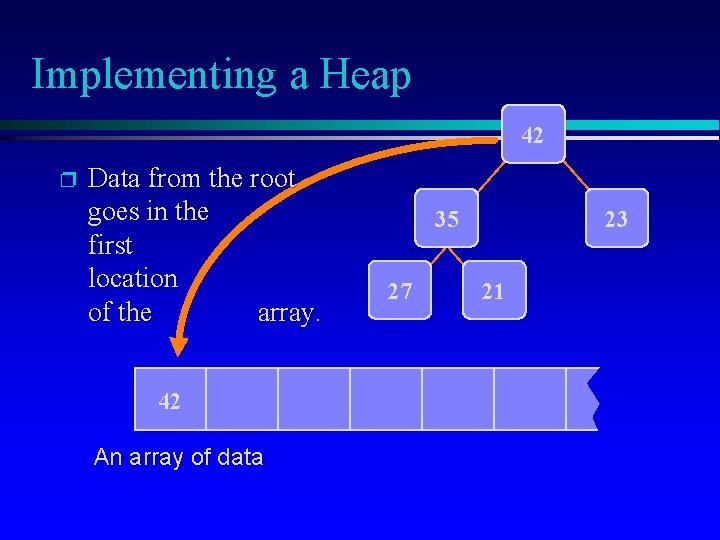
Implementing a Heap 42 p Data from the root goes in the first location of the array. 42 An array of data 35 27 23 21
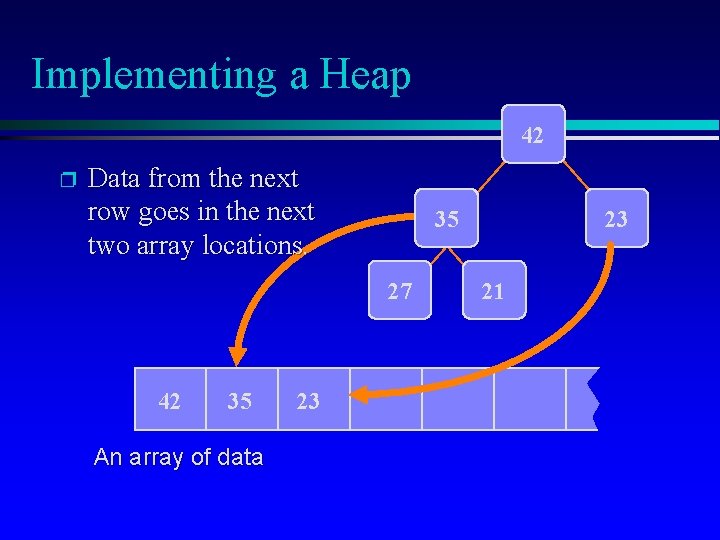
Implementing a Heap 42 p Data from the next row goes in the next two array locations. 35 27 42 35 An array of data 23 23 21
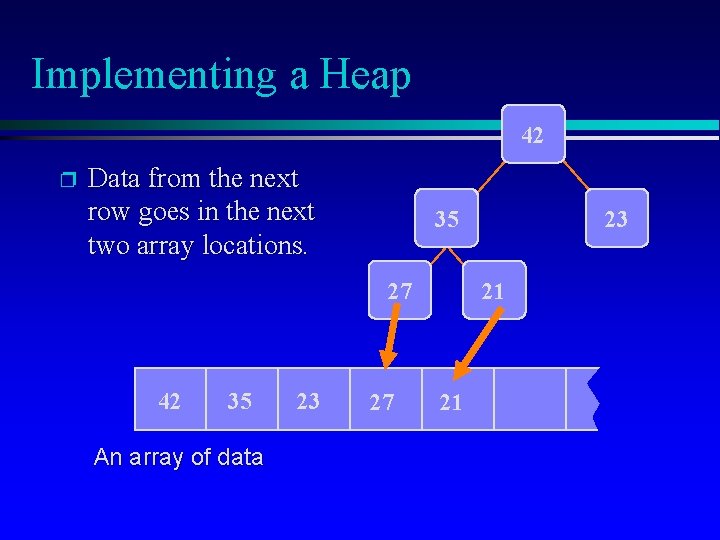
Implementing a Heap 42 p Data from the next row goes in the next two array locations. 35 27 42 35 An array of data 23 27 23 21 21
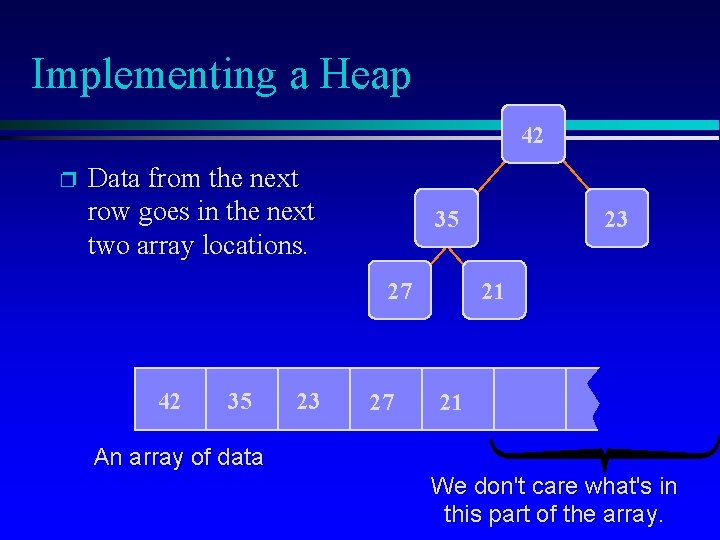
Implementing a Heap 42 p Data from the next row goes in the next two array locations. 35 27 42 35 23 27 23 21 21 An array of data We don't care what's in this part of the array.
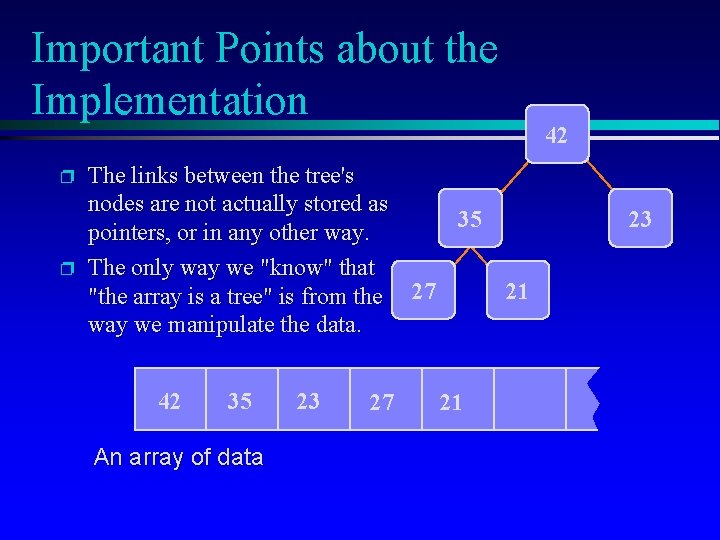
Important Points about the Implementation p p The links between the tree's nodes are not actually stored as 35 pointers, or in any other way. The only way we "know" that 21 "the array is a tree" is from the 27 way we manipulate the data. 42 35 An array of data 23 27 21 42 23
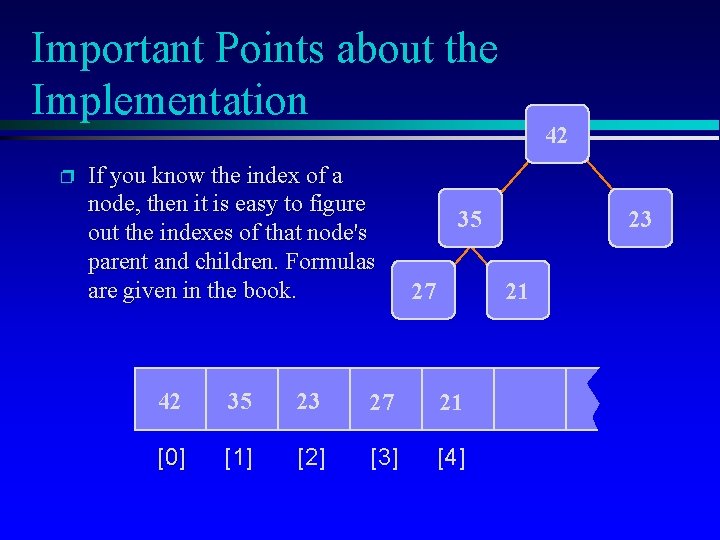
Important Points about the Implementation p If you know the index of a node, then it is easy to figure out the indexes of that node's parent and children. Formulas are given in the book. 42 35 27 23 21 42 35 23 27 21 [0] [1] [2] [3] [4]
Summary p p p A heap is a complete binary tree, where the entry at each node is greater than or equal to the entries in its children. To add an entry to a heap, place the new entry at the next available spot, and perform a reheapification upward. To remove the biggest entry, move the last node onto the root, and perform a reheapification downward.
Presentation copyright 1999 Addison Wesley Longman, For use with Data Structures and Other Objects Using Java by Michael Main. Some artwork in the presentation is used with permission from Presentation Task Force (copyright New Vision Technologies Inc) and Corel Gallery Clipart Catalog (copyright Corel Corporation, 3 G Graphics Inc, Archive Arts, Cartesia Software, Image Club Graphics Inc, One Mile Up Inc, Tech. Pool Studios, Totem Graphics Inc). Students and instructors who use Data Structures and Other Objects Using Java are welcome to use this presentation however they see fit, so long as this copyright notice remains intact. THE END
- Slides: 31