
HEAPS Introduction A heap is a specialized treebased
HEAPS
Introduction • A heap is a specialized tree-based data structure that satisfies the heap property which states that • If B is a child of A, then key(A) ≥ key(B). Or • If B is a child of A, then key(A) ≤ key(B). • This implies that the root node has the highest key value in the heap. Such a heap is commonly known as a max-heap. (Alternatively, if the root has the lowest key value, then the resultant heap is called a min-heap. )
BINARY HEAP A binary heap is a complete binary tree in which every node satisfies the heap property which states that • If B is a child of A, then key(A) ≥ key(B). Or • If B is a child of A, then key(A) ≤ key(B).
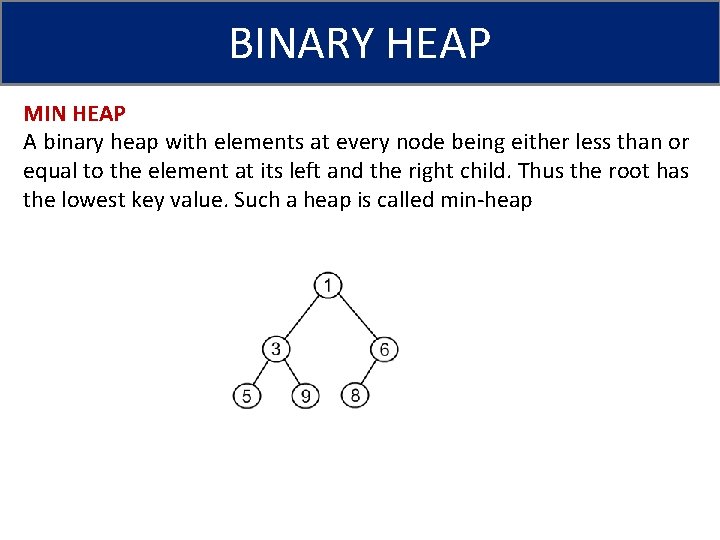
BINARY HEAP MIN HEAP A binary heap with elements at every node being either less than or equal to the element at its left and the right child. Thus the root has the lowest key value. Such a heap is called min-heap
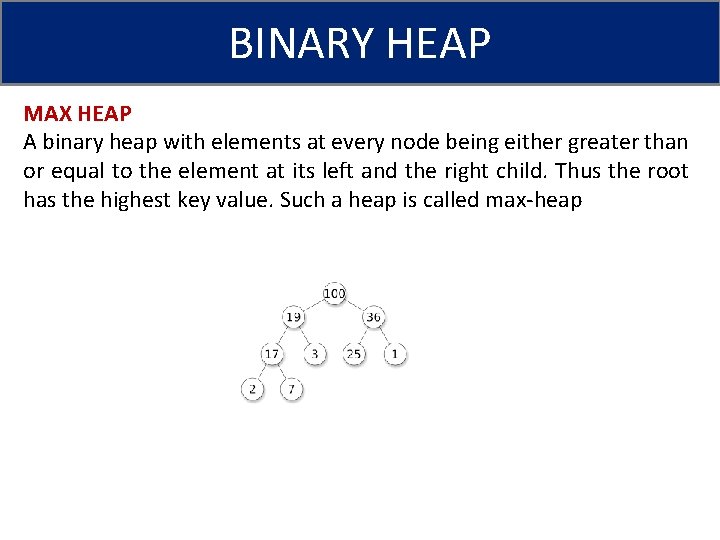
BINARY HEAP MAX HEAP A binary heap with elements at every node being either greater than or equal to the element at its left and the right child. Thus the root has the highest key value. Such a heap is called max-heap
Insertion in a Binary Heap • Consider a max heap H having n elements. Inserting a new value into the heap is done in two major steps. • Add the new value at the bottom of H in such a way that H is still a complete binary tree but not necessarily a heap. • Let the new value rise to its appropriate place in H so that H now becomes a heap as well. • To do this, compare the new value with its parent; to check if they are in the correct order. If they are in the correct order, then the procedure halts else, the new value and its parent’s value is swapped and step 2 is repeated.
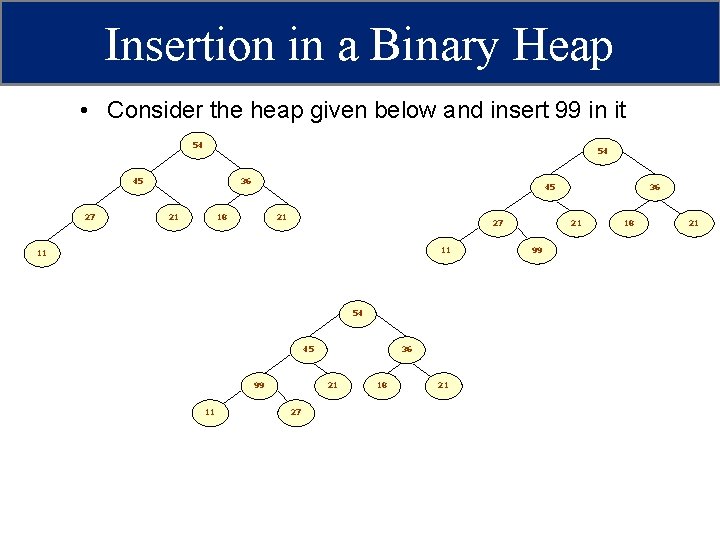
Insertion in a Binary Heap • Consider the heap given below and insert 99 in it 54 54 45 27 36 21 45 18 21 27 11 11 54 45 99 11 36 21 27 18 21 36 21 99 18 21
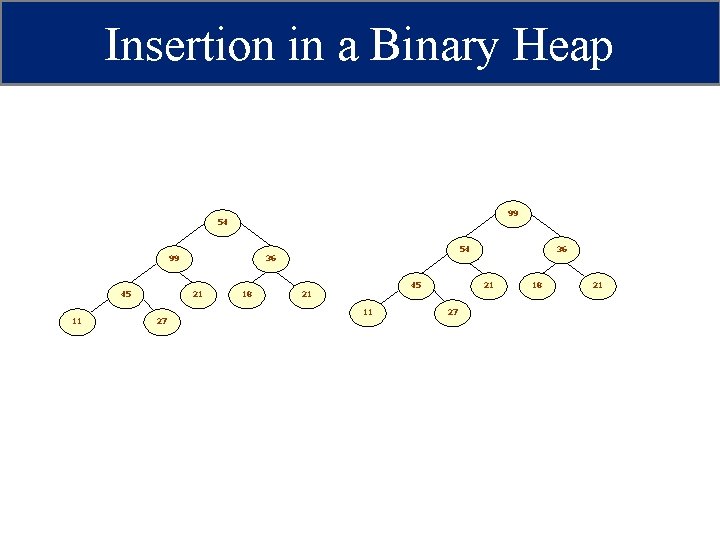
Insertion in a Binary Heap 99 54 99 45 11 21 27 54 36 18 45 21 11 36 21 27 18 21
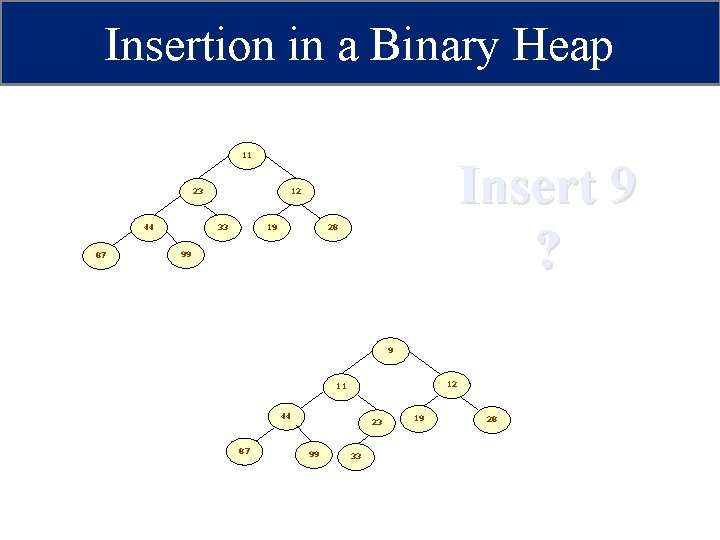
Insertion in a Binary Heap 11 23 44 87 Insert 9 ? 12 33 19 28 99 9 12 11 44 87 23 99 33 19 28
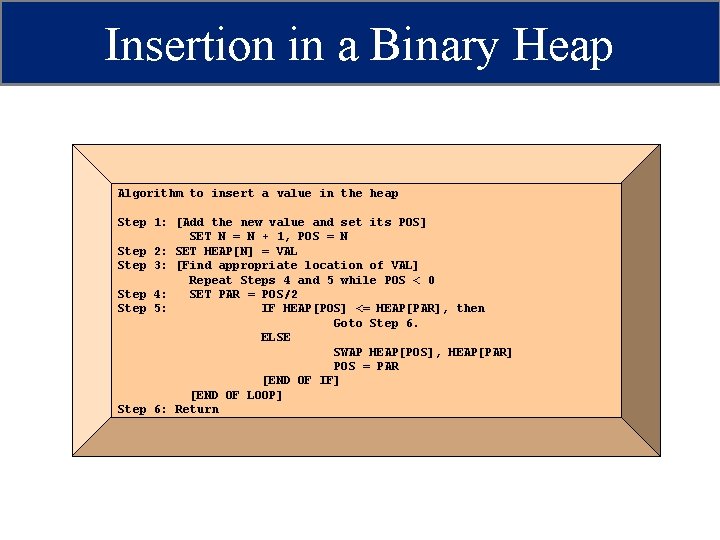
Insertion in a Binary Heap Algorithm to insert a value in the heap Step 1: [Add the new value and set its POS] SET N = N + 1, POS = N Step 2: SET HEAP[N] = VAL Step 3: [Find appropriate location of VAL] Repeat Steps 4 and 5 while POS < 0 Step 4: SET PAR = POS/2 Step 5: IF HEAP[POS] <= HEAP[PAR], then Goto Step 6. ELSE SWAP HEAP[POS], HEAP[PAR] POS = PAR [END OF IF] [END OF LOOP] Step 6: Return
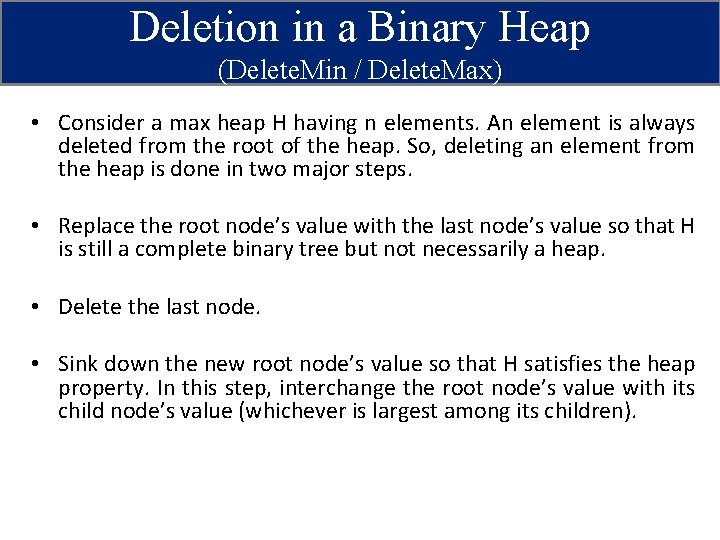
Deletion in a Binary Heap (Delete. Min / Delete. Max) • Consider a max heap H having n elements. An element is always deleted from the root of the heap. So, deleting an element from the heap is done in two major steps. • Replace the root node’s value with the last node’s value so that H is still a complete binary tree but not necessarily a heap. • Delete the last node. • Sink down the new root node’s value so that H satisfies the heap property. In this step, interchange the root node’s value with its child node’s value (whichever is largest among its children).
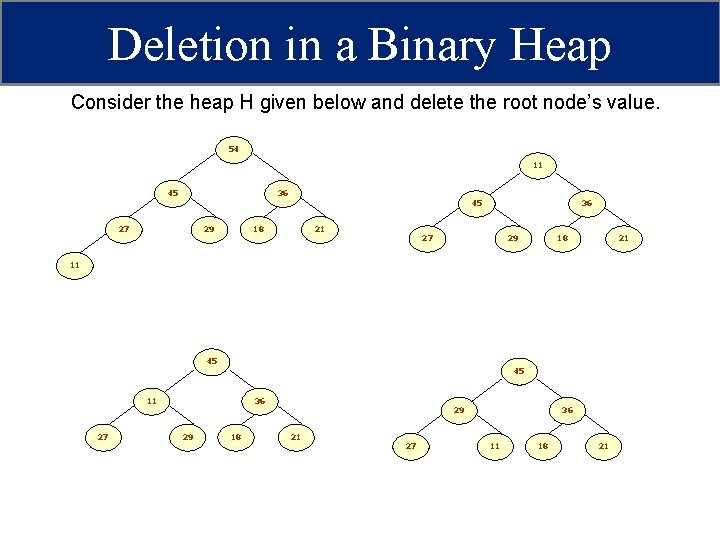
Deletion in a Binary Heap Consider the heap H given below and delete the root node’s value. 54 11 45 36 45 27 29 18 21 36 27 29 18 21 11 45 45 11 27 36 29 18 29 21 27 36 11 18 21
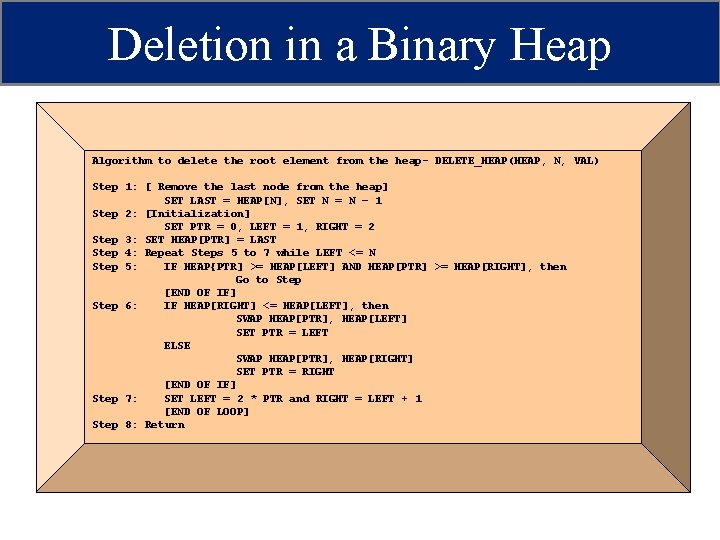
Deletion in a Binary Heap Algorithm to delete the root element from the heap- DELETE_HEAP(HEAP, N, VAL) Step 1: [ Remove the last node from the heap] SET LAST = HEAP[N], SET N = N – 1 Step 2: [Initialization] SET PTR = 0, LEFT = 1, RIGHT = 2 Step 3: SET HEAP[PTR] = LAST Step 4: Repeat Steps 5 to 7 while LEFT <= N Step 5: IF HEAP{PTR] >= HEAP[LEFT] AND HEAP[PTR] >= HEAP[RIGHT], then Go to Step [END OF IF] Step 6: IF HEAP[RIGHT] <= HEAP[LEFT], then SWAP HEAP[PTR], HEAP[LEFT] SET PTR = LEFT ELSE SWAP HEAP[PTR], HEAP[RIGHT] SET PTR = RIGHT [END OF IF] Step 7: SET LEFT = 2 * PTR and RIGHT = LEFT + 1 [END OF LOOP] Step 8: Return
- Slides: 15