
Healthy Eating in a Care Setting Outcomes of
- Slides: 16
Healthy Eating in a Care Setting
Outcomes of Unit • 1 - Explain how a balanced diet contributes to a persons health and wellbeing • 2 - Explain good practice in relation to purchasing, storing and preparing foods and its importance in a care setting
Outcomes of Unit • 3 - Investigate ways to meet and support the dietary needs of individual service users • 4 - Plan an appropriate one day menu for a selected service user
• Write down what you had for breakfast this morning
Food is essential to. . • Establish growth, repair and replacement of tissues • Provide energy and warmth • Help fight disease • Maintain proper functioning of body systems
A balanced diet…. • Gives you all the nutrients you need to grow and develop properly • Gives your body energy so you can live life to the full • Helps you fight infection
A balanced diet …. • Can help to protect you against long term illnesses such as heart disease, strokes and cancer • Can help improve concentration
A poor diet can result in … • Poor resistance to infection through lack of vitamins • Anaemia through lack of iron in diet • Tooth decay from eating too much sugar • Obesity or anorexia • Heart disease in later life
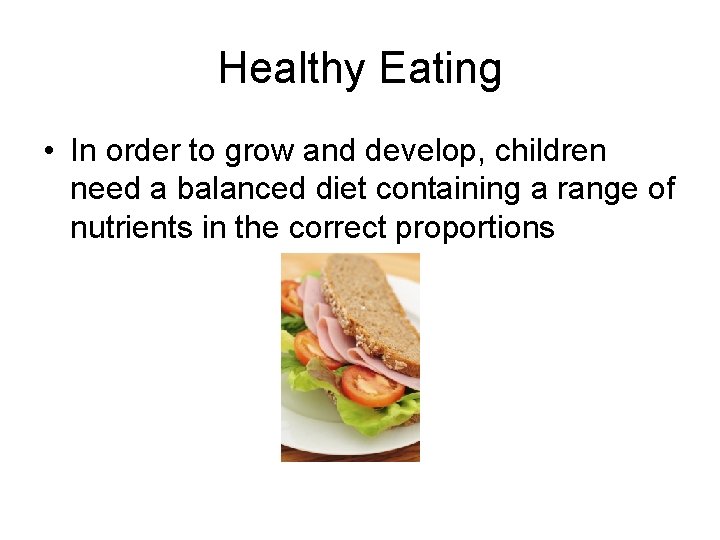
Healthy Eating • In order to grow and develop, children need a balanced diet containing a range of nutrients in the correct proportions
There are 5 main food groups • • • Group 1 – potatoes and cereals Group 2 – fruit and vegetables Group 3 – milk and milk products Group 4 – high protein foods Group 5 – fats and oils
Food Groups • Group 1 – high energy foods that contain vitamins and minerals. Major sources of energy for growth, body maintenance and activity • Group 2 – fruit and vegetables are full of vitamins, minerals and fibre. They are low in fat
Food Groups • Group 3 – children require 1 pint of milk each day to ensure an adequate intake of calcium • Group 4 – essential for growth and repair to the body • Group 5 – provide energy, contain essential vitamins and conserve body heat
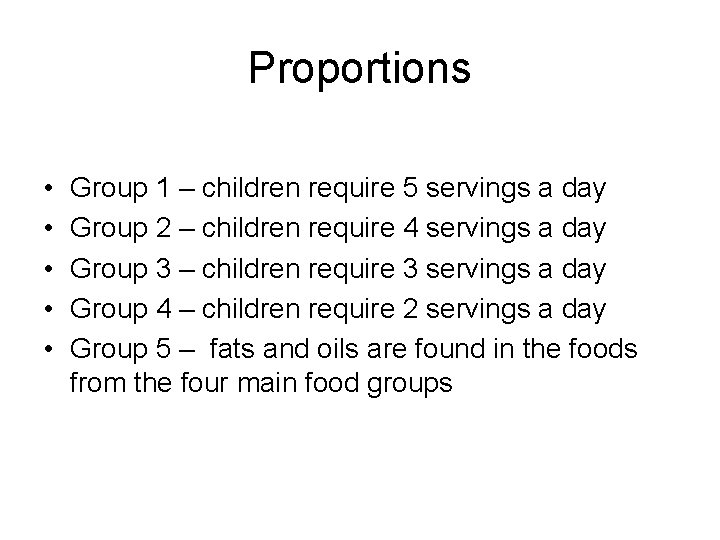
Proportions • • • Group 1 – children require 5 servings a day Group 2 – children require 4 servings a day Group 3 – children require 3 servings a day Group 4 – children require 2 servings a day Group 5 – fats and oils are found in the foods from the four main food groups
Group work • Plan a healthy nutritious diet for a day for one of the following • 2 year old • 7 year old • 10 year old • Remember to add in drinks too
Eating habits • • • Are established in early childhood Provide a variety of taste and textures Serve appropriate portion size Be a good role model Make mealtimes enjoyable Not just about eating. A key time for socialising and communicating • Sweets and snacks kept for after meals only
Problems • Girls, in particular, can become very body conscious…. . Problems? • Dietary restrictions…. . what does that mean? • Medical conditions? • Religious or cultural beliefs? • Work in pairs. Write a paragraph describing some dietary problems for the above suggestions