
Healthy Diet DIET THERAPY D Ali Abutiheen Consultant
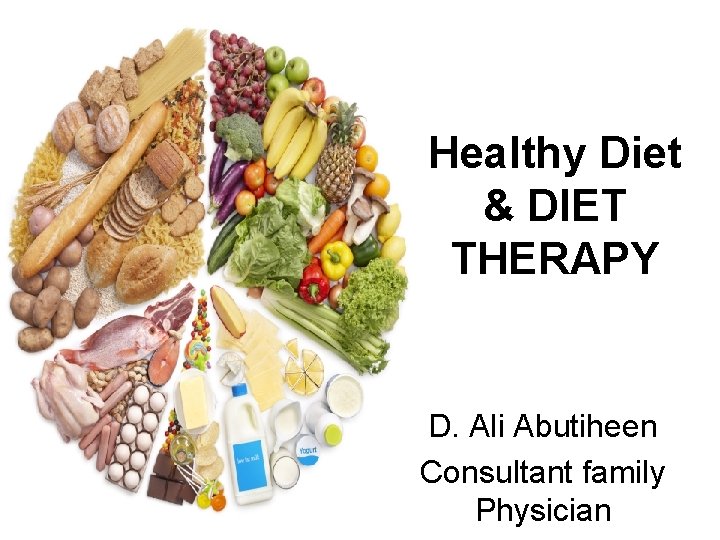
Healthy Diet & DIET THERAPY D. Ali Abutiheen Consultant family Physician
Objectives: • To identify principles of healthy diet and dieting • To understand the energy balance and estimate energy requirement
Healthy Diet • A healthy diet helps protect against malnutrition in all its forms, as well as noncommunicable diseases (NCDs), including diabetes, heart disease, stroke and cancer. • Healthy dietary practices start early in life – breastfeeding fosters healthy growth and improves cognitive development, and may have longer-term health benefits, like reducing the risk of becoming overweight or obese and developing NCDs later in life
• But the increased production of processed food, rapid urbanization and changing lifestyles have led to a shift in dietary patterns. • Unhealthy diet and lack of physical activity are leading global risks to health.
• Energy intake (calories) should be in balance with energy expenditure. Evidence indicates that total fat should not exceed 30% of total energy intake to avoid unhealthy weight gain, with a shift in fat consumption away from saturated fats to unsaturated fats, and towards the elimination of industrial trans fats
• Limiting intake of free sugars to < 10% of total energy intake is part of a healthy diet. A further reduction to < 5% of total energy intake is suggested for additional health benefits. • Keeping salt intake to < 5 gm per day helps prevent hypertension and reduces the risk of heart disease and stroke in the adult population
• People are now consuming more foods high in energy, fats, free sugars or salt/sodium, and many do not eat enough fruit, vegetables and dietary fibre. • The exact make-up of a diversified, balanced and healthy diet will vary depending on individual needs (e. g. age, gender, lifestyle, degree of physical activity), cultural context, locally available foods and dietary customs. • But basic principles of what constitute a healthy diet remain the same.
Adults healthy diet contains 1 - Fruits, vegetables, legumes (e. g. lentils, beans), nuts and whole grains (e. g. unprocessed maize, millet, oats, wheat, brown rice). • At least 400 g (5 portions) of fruits and vegetables a day. Potatoes, sweet potatoes, cassava and other starchy roots are not classified as fruits or vegetables.
In order to improve fruit and vegetable consumption you can: • Always include vegetables in your meals • Eat fresh fruits and raw vegetables as snacks • Eat fresh fruits and vegetables in season • Eat a variety of choices of fruits and vegetables.
2 - Reduce fat intake • Evidence indicates that total fat should not exceed 30% of total energy intake to avoid unhealthy weight gain. • Unsaturated fats (e. g. found in fish, avocado, nuts, sunflower, canola and olive oils) are preferable to saturated fats (e. g. found in fatty meat, butter, palm and coconut oil, cream, cheese, ghee and lard). • Industrial trans fats (found in processed food, fast food, snack food, fried food, frozen pizza, pies, cookies, margarines and spreads) are not part of a healthy diet.
Fat intake can be reduced by: • Changing how you cook – remove the fatty part of meat; use vegetable oil (not animal oil); and boil, steam or bake rather than fry; • Avoiding processed foods containing trans fats; and • limiting the consumption of foods containing high amounts of saturated fats (e. g. cheese, ice cream, fatty meat).
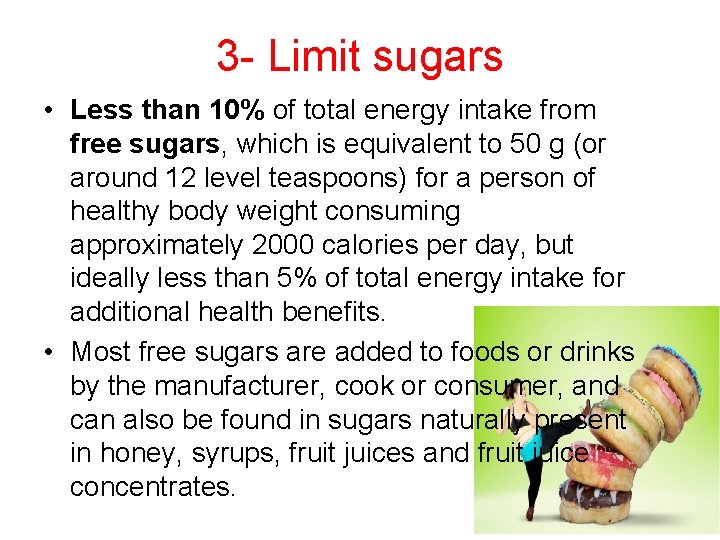
3 - Limit sugars • Less than 10% of total energy intake from free sugars, which is equivalent to 50 g (or around 12 level teaspoons) for a person of healthy body weight consuming approximately 2000 calories per day, but ideally less than 5% of total energy intake for additional health benefits. • Most free sugars are added to foods or drinks by the manufacturer, cook or consumer, and can also be found in sugars naturally present in honey, syrups, fruit juices and fruit juice concentrates.
Sugars intake can be reduced by: • limiting the consumption of foods and drinks containing high amounts of sugars (e. g. sugar-sweetened beverages, sugary snacks and candies); and • eating fresh fruits and raw vegetables as snacks instead of sugary snacks
4 - limit salts • Keeping salt intake to less than 5 gm per day helps prevent hypertension and reduces the risk of heart disease and stroke in the adult population. • WHO Member States have agreed to reduce the global population’s intake of salt by 30% and halt the rise in diabetes and obesity in adults and adolescents as well as in childhood overweight by 2025
You can reduce salt consumption by: • Not adding salt, soy sauce or fish sauce during the preparation of food • Not having salt on the table • Limiting the consumption of salty snacks • Choosing products with lower sodium content.
5 - Water and Fluids Take adequate quantity of fluids 2 -3 liters/ day Better to be away from meals
Energy balance • Balance between calorie intake and energy expenditure determines body weight. If a person consumes more calories than are burned, excess energy is stored as fat and weight is gained and vice versa.
For infants and young children • In the first 2 years of a child’s life, optimal nutrition fosters healthy growth and improves cognitive development. • It also reduces the risk of becoming overweight or obese and developing NCDs later in life. • Advice on a healthy diet for infants and children is similar to that for adults, but the following elements are also important.
Infants & young children (cont. ) q. Infants should be breastfed exclusively during the first 6 months of life. q. Infants should be breastfed continuously until 2 years of age and beyond. q. From 6 months of age, breast milk should be complemented with a variety of adequate, safe and nutrient dense complementary foods. Salt and sugars should not be added to complementary foods
q Regular physical activity helps maintain a healthy body • People should engage in adequate levels of physical activity throughout their lives. • At least 30 minutes of regular, moderateintensity physical activity on most days reduces the risk of cardiovascular disease, diabetes, colon cancer and breast cancer. • Muscle strengthening and balance training can reduce falls and improve mobility among older adults. More activity may be required for weight control
• WHO Global Strategy on Diet, Physical Activity and Health describes the actions needed to support healthy diets and regular physical activity.

DIET THERAPY • Diet can be defined as the NORMAL FOOD WE EAT. • ENERGY BALANCE • Energy balance means taking in (Eating) and using up (Through work, exercise etc) an equal number of calories or Kilocalories • Nutrition and health are directly related. • Effects of poor nutrition are cumulative
Total Energy requirement depends on 1. Basic metabolic rate (BMR) (Resting Energy Expenditure ): 2. Physical activity Factor 3. Thermic effect of food.
Basic metabolic rate (BMR) : • Is the least energy required by body, to continue its activities, its measured on: • Physical and mental rest • Non sleep (awake) • Fasting for 12 hrs • Hrs after exercises or physical activity • Normal weather temp. • Its measured :
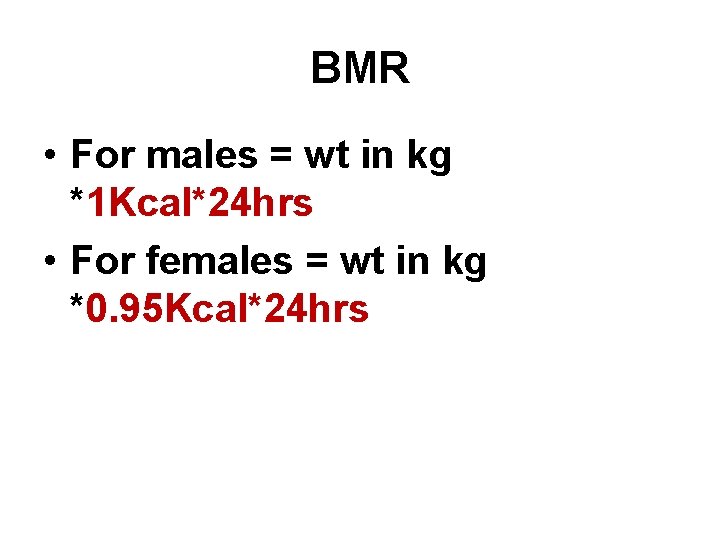
BMR • For males = wt in kg *1 Kcal*24 hrs • For females = wt in kg *0. 95 Kcal*24 hrs
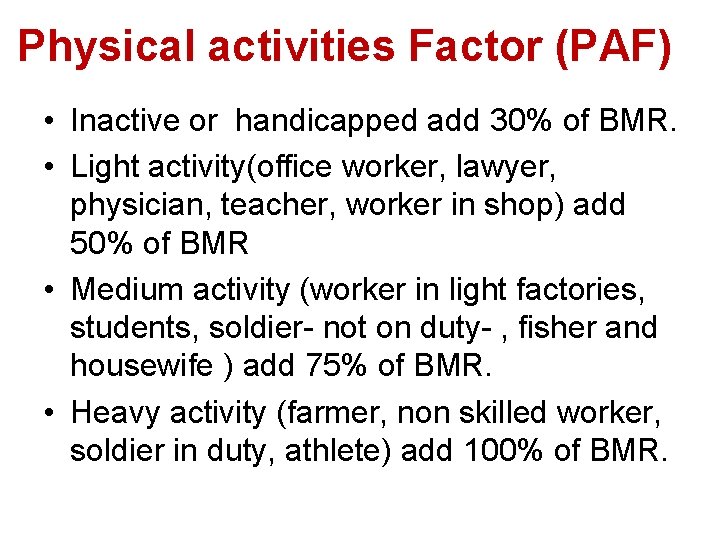
Physical activities Factor (PAF) • Inactive or handicapped add 30% of BMR. • Light activity(office worker, lawyer, physician, teacher, worker in shop) add 50% of BMR • Medium activity (worker in light factories, students, soldier- not on duty- , fisher and housewife ) add 75% of BMR. • Heavy activity (farmer, non skilled worker, soldier in duty, athlete) add 100% of BMR.
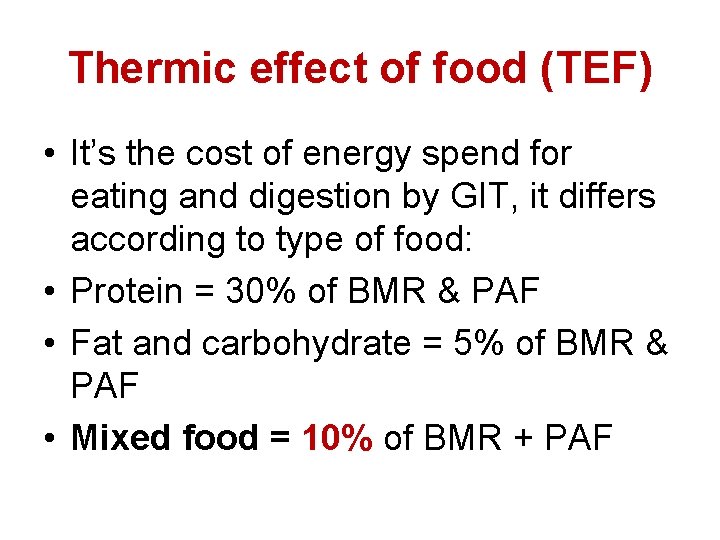
Thermic effect of food (TEF) • It’s the cost of energy spend for eating and digestion by GIT, it differs according to type of food: • Protein = 30% of BMR & PAF • Fat and carbohydrate = 5% of BMR & PAF • Mixed food = 10% of BMR + PAF
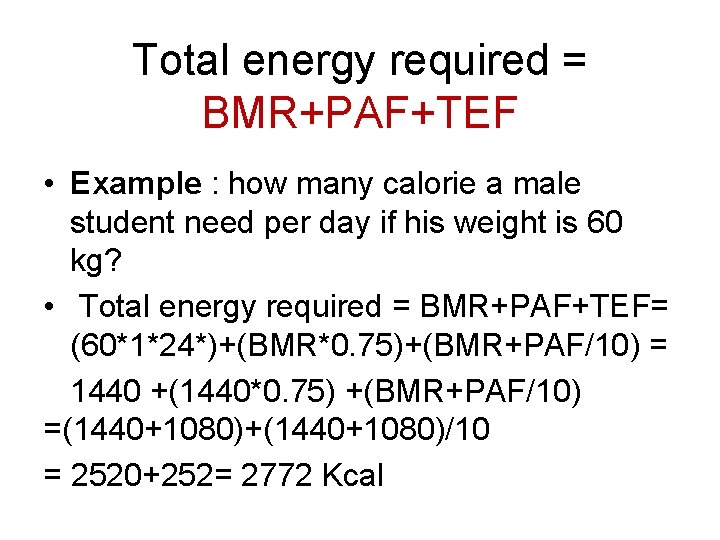
Total energy required = BMR+PAF+TEF • Example : how many calorie a male student need per day if his weight is 60 kg? • Total energy required = BMR+PAF+TEF= (60*1*24*)+(BMR*0. 75)+(BMR+PAF/10) = 1440 +(1440*0. 75) +(BMR+PAF/10) =(1440+1080)+(1440+1080)/10 = 2520+252= 2772 Kcal
• Daily calories requirements • For Male ≈ 2500 -800 Kcal • For Female ≈ 2000 - 2200 Kcal
For control of obesity or over weight • You should measure your energy requirement based on your ideal (expected or targeted) weight not your actual wt (if you are overweight or obese) • Try to decrease weight slowly (not more than 5 -6 kg/month) • You can decrease energy by (20 -50%) • Better to be associated with exercises or physical activity
• A low-calorie diet means you eat fewer calories. • This could mean eating smaller portions, and choosing foods with fewer calories. Men are usually advised to eat around 1, 200 to 1, 500 calories a day to lose weight. For women, the goal is usually 1, 000 to 1, 200 calories
• Doctors usually recommend people lose about 10 percent of their body weight over the first six months. • If your BMI is 30 to 35, this will mean losing between 0. 25 and 0. 5 kilograms each week. • If your BMI is above 35, you may need to lose between 0. 5 kilograms and 1 kilogram a week.
General advices ü Eat frequent small meals, not escape 1. ü Drink plenty of water ü Eat plenty of fruits and vegetables ü Eat slowly ü Do not drink tea after meal directly ü Reduce fat, salt and sugars ü Take fibres rich food ü Eat from all types of food groups. ü Be physically active
Examples for calories (Iraq) • • • 1 egg (50 gm) : 73 Kcal 1 bread (sammon) (100 gm) = 272 Kcal Rice (100 gm) = 364 Kcal Milk 1 cup (200 ml) = 128 Kcal Orange juice (200 ml) = 88 Kcal Fruits (200 gm) = 80 Kcal

• • Beverly Hills Diet Atkins diet (a low-carb diet) Keto diet Ketogenic diet Vegetarian diet
Other modalities • Medication • Surgery • Any question?

Thank you
- Slides: 38