
Healthiest Wisconsin 2020 Baseline and Health Disparities Report

Healthiest Wisconsin 2020 Baseline and Health Disparities Report Healthy Growth and Development Wisconsin Department of Health Services January 2014 P-00522 H
HEALTHY GROWTH AND DEVELOPMENT Chapter outline Chapter Outline Background • Overview of Healthiest Wisconsin 2020 Baseline and Health Disparities Report • Healthiest Wisconsin 2020 objectives and indicators • Rationale • Key points Data • Infant mortality and low birthweight • Risk factors • Health care access and utilization References Links to additional reports and resources Contacts 2
HEALTHY GROWTH AND DEVELOPMENT Report overview Report Overview • This chapter is part of a larger report created by the Wisconsin Department of Health Services to track progress on the objectives of Healthiest Wisconsin 2020 (HW 2020) and identify health disparities in the state. The full report is available at: http: //www. dhs. wisconsin. gov/publications/P 0/p 00522. pdf • The report is designed to address the Health Focus Areas in HW 2020. Where direct measures exist, data are presented; where direct measures are not available, related information may be included. • Information about populations experiencing health disparities is provided in the Health Focus Area chapters and is summarized in separate chapters devoted to specific populations. • Technical notes are available at: http: //www. dhs. wisconsin. gov/publications/P 0/p 00522 y. pdf 3
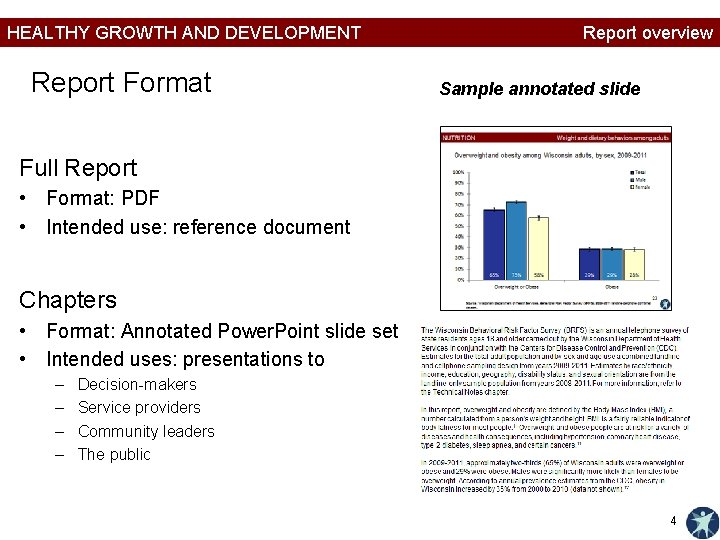
HEALTHY GROWTH AND DEVELOPMENT Report Format Report overview Sample annotated slide Full Report • Format: PDF • Intended use: reference document Chapters • Format: Annotated Power. Point slide set • Intended uses: presentations to – – Decision-makers Service providers Community leaders The public 4
HEALTHY GROWTH AND DEVELOPMENT Report overview Report Outline Executive Summary Section 1: Introduction Section 2: Demographic overview Section 3: Health focus areas Section 4: Infrastructure focus areas Section 5: Data summaries by population Section 6: Technical notes 5
HEALTHY GROWTH AND DEVELOPMENT Report overview Report Outline: Detail Section 3: Health focus areas • • • Alcohol and other drug use Chronic disease prevention and management Communicable diseases Environmental and occupational health Healthy growth and development Injury and violence Mental health Nutrition and healthy foods Oral health Physical activity Reproductive and sexual health Tobacco use and exposure Section 4: Infrastructure focus areas • Access to health care 6
HEALTHY GROWTH AND DEVELOPMENT Report overview Report Outline: Detail Section 5: Data summaries by population Racial/ethnic minority populations o American Indians o Asians o Blacks o Hispanics People of lower socioeconomic status People with disabilities Lesbian, gay, bisexual, and transgender populations Geography 7
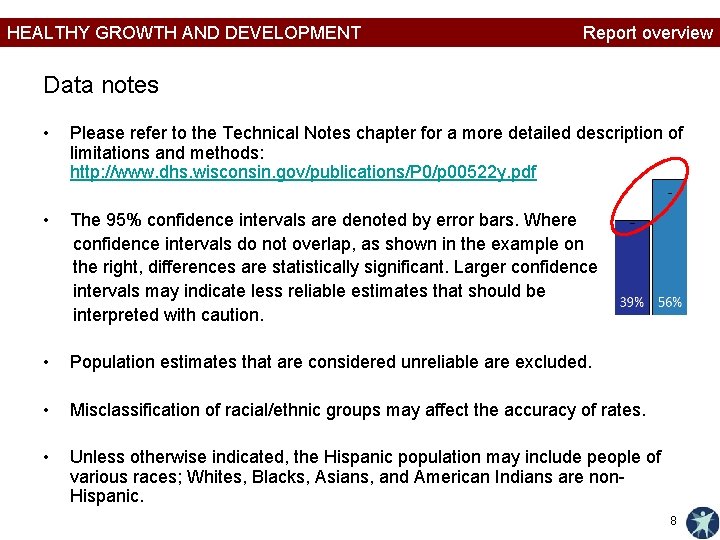
HEALTHY GROWTH AND DEVELOPMENT Report overview Data notes • Please refer to the Technical Notes chapter for a more detailed description of limitations and methods: http: //www. dhs. wisconsin. gov/publications/P 0/p 00522 y. pdf • The 95% confidence intervals are denoted by error bars. Where confidence intervals do not overlap, as shown in the example on the right, differences are statistically significant. Larger confidence intervals may indicate less reliable estimates that should be interpreted with caution. • Population estimates that are considered unreliable are excluded. • Misclassification of racial/ethnic groups may affect the accuracy of rates. • Unless otherwise indicated, the Hispanic population may include people of various races; Whites, Blacks, Asians, and American Indians are non. Hispanic. 8
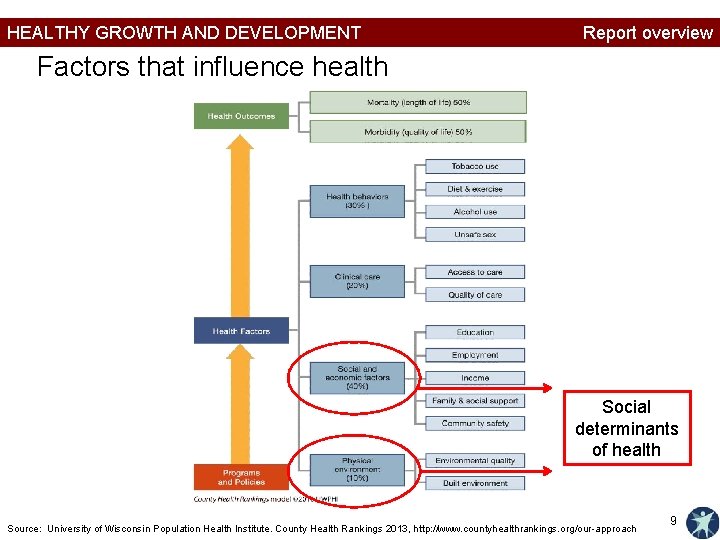
HEALTHY GROWTH AND DEVELOPMENT Report overview Factors that influence health Social determinants of health Source: University of Wisconsin Population Health Institute. County Health Rankings 2013, http: //www. countyhealthrankings. org/our-approach 9
HEALTHY GROWTH AND DEVELOPMENT HW 2020 objectives Healthiest Wisconsin 2020 objectives and indicators Objective 1 By 2020, increase the proportion of children who receive periodic developmental screening and individualized intervention. Objective 1 Indicators • Proportion of parents reporting that a health provider assessed their child’s learning, development, communication, or social behavior. • Number of children who received services from the Birth to Three program during the first year of life. Source: Wisconsin Department of Health Services, Healthiest Wisconsin 2020, Healthy Growth and Development Profile. 10
HEALTHY GROWTH AND DEVELOPMENT HW 2020 objectives Healthiest Wisconsin 2020 objectives and indicators Objective 2 By 2020, provide pre-conception and inter-conception care to Wisconsin women in population groups disproportionately affected by poor birth outcomes. Objective 2 Indicators • Rates of avoidable infant and fetal death. • Percentage of births to women with avoidable risks for poor birth outcomes. Source: Wisconsin Department of Health Services, Healthiest Wisconsin 2020, Healthy Growth and Development Profile. 11
HEALTHY GROWTH AND DEVELOPMENT HW 2020 objectives Healthiest Wisconsin 2020 objectives and indicators Objective 3 By 2020, reduce the racial and ethnic disparities in poor birth outcomes, including infant mortality. Objective 3 Indicators • Disparity ratios for infant mortality, low birthweight, prematurity, and timing of entry into the Women, Infants and Children (WIC) program. Source: Wisconsin Department of Health Services, Healthiest Wisconsin 2020, Healthy Growth and Development Profile. 12
HEALTHY GROWTH AND DEVELOPMENT Rationale • Healthy growth and development in early life have a profound effect on health across the life span. • Research demonstrates a link between early life events and adult chronic diseases. Babies born at lower birthweights have an increased risk of developing heart disease, diabetes, and high blood pressure in later life. • Infants with poor birth outcomes begin life with multiple risk factors that may prevent them from reaching their full health and development potential. Source: Wisconsin Department of Health Services, Healthiest Wisconsin 2020, Healthy Growth and Development Profile. 13
HEALTHY GROWTH AND DEVELOPMENT Key points • While Wisconsin’s infant mortality rate has declined over the past 10 years, notable racial disparities remain. In 2010, the Black infant mortality rate (13. 9 deaths per 1, 000 live births) was approximately three times greater than for Whites (4. 9 per 1, 000). • During 2009 -2010, nearly two out of three births to Black mothers in Wisconsin were the result of unintended pregnancy. • Smoking during pregnancy is much more common than drinking during pregnancy. An estimated one out of five Black women who recently gave birth smoked during pregnancy. • In more than one-third of Laotian/Hmong births, the mother did not receive first-trimester care, nearly three times the rate among White births. • Rates of drinking during pregnancy were similar by race/ethnicity. Among the racial and ethnic groups reported here, Hispanic women were the least likely to smoke or drink during a recent pregnancy. 14
HEALTHY GROWTH AND DEVELOPMENT Infant mortality and low birthweight 15
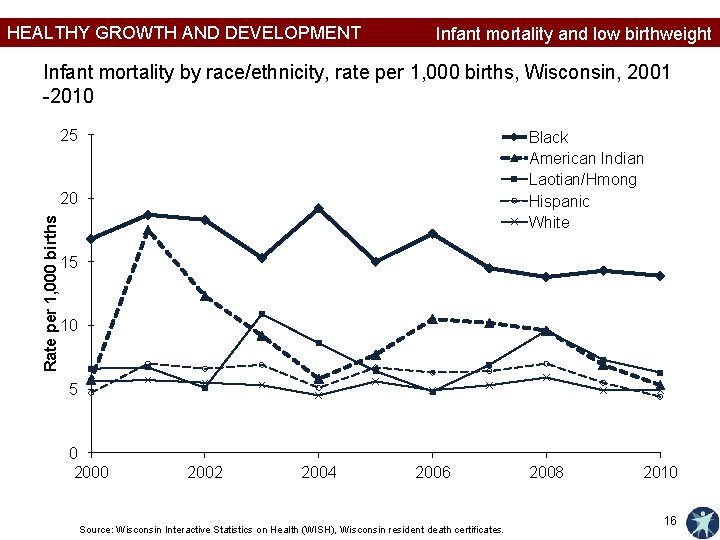
HEALTHY GROWTH AND DEVELOPMENT Infant mortality and low birthweight Infant mortality by race/ethnicity, rate per 1, 000 births, Wisconsin, 2001 -2010 25 Black American Indian Laotian/Hmong Hispanic White Rate per 1, 000 births 20 15 10 5 0 2002 2004 2006 Source: Wisconsin Interactive Statistics on Health (WISH), Wisconsin resident death certificates. 2008 2010 16
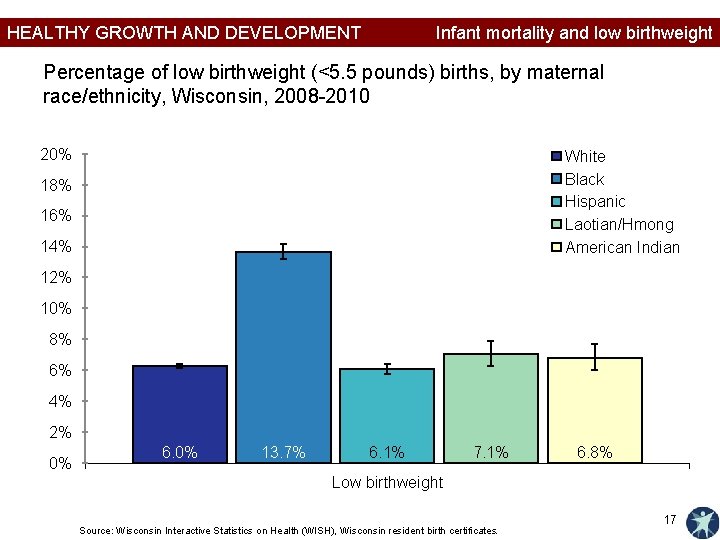
HEALTHY GROWTH AND DEVELOPMENT Infant mortality and low birthweight Percentage of low birthweight (<5. 5 pounds) births, by maternal race/ethnicity, Wisconsin, 2008 -2010 20% White Black Hispanic Laotian/Hmong American Indian 18% 16% 14% 12% 10% 8% 6% 4% 2% 0% 6. 0% 13. 7% 6. 1% 7. 1% 6. 8% Low birthweight Source: Wisconsin Interactive Statistics on Health (WISH), Wisconsin resident birth certificates. 17
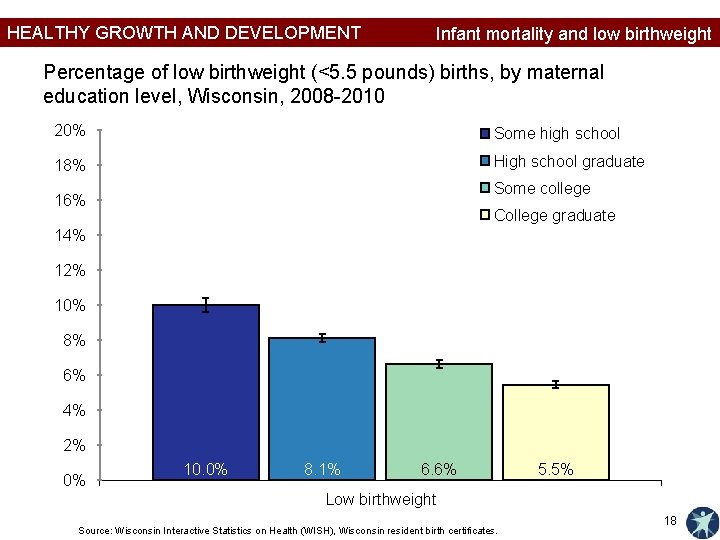
HEALTHY GROWTH AND DEVELOPMENT Infant mortality and low birthweight Percentage of low birthweight (<5. 5 pounds) births, by maternal education level, Wisconsin, 2008 -2010 20% Some high school 18% High school graduate Some college 16% College graduate 14% 12% 10% 8% 6% 4% 2% 0% 10. 0% 8. 1% 6. 6% 5. 5% Low birthweight Source: Wisconsin Interactive Statistics on Health (WISH), Wisconsin resident birth certificates. 18
HEALTHY GROWTH AND DEVELOPMENT Risk factors 19
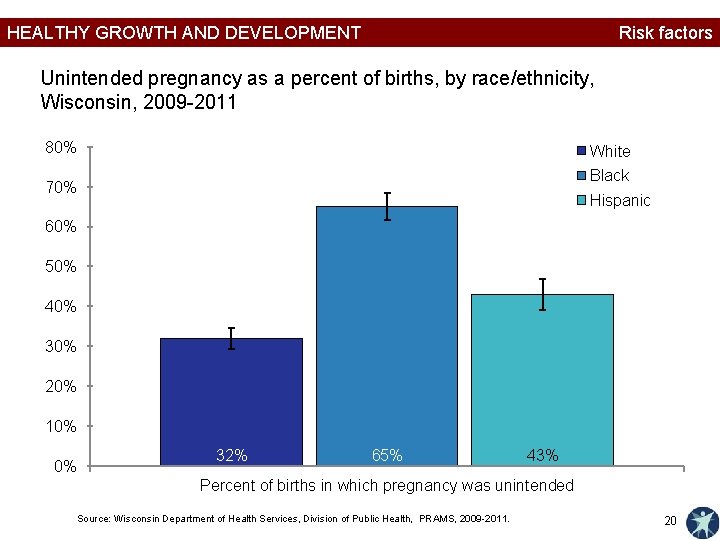
HEALTHY GROWTH AND DEVELOPMENT Risk factors Unintended pregnancy as a percent of births, by race/ethnicity, Wisconsin, 2009 -2011 80% White Black 70% Hispanic 60% 50% 40% 30% 20% 10% 0% 32% 65% 43% Percent of births in which pregnancy was unintended Source: Wisconsin Department of Health Services, Division of Public Health, PRAMS, 2009 -2011. 20
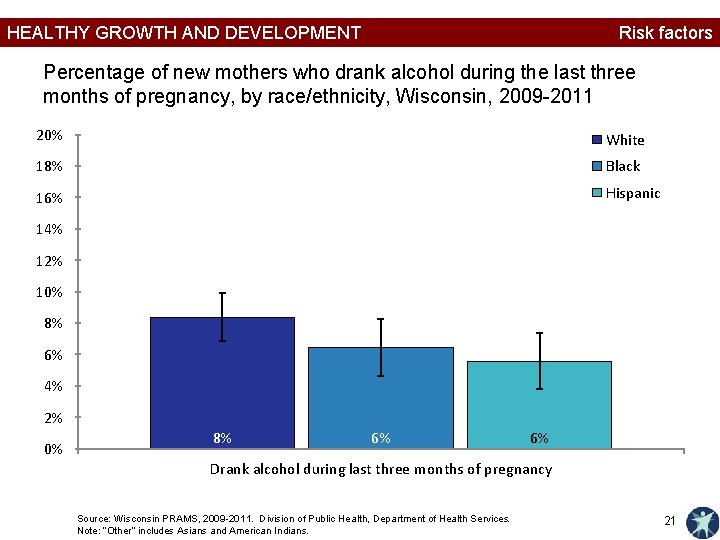
HEALTHY GROWTH AND DEVELOPMENT Risk factors Percentage of new mothers who drank alcohol during the last three months of pregnancy, by race/ethnicity, Wisconsin, 2009 -2011 20% White 18% Black 16% Hispanic 14% 12% 10% 8% 6% 4% 2% 0% 8% 6% 6% Drank alcohol during last three months of pregnancy Source: Wisconsin PRAMS, 2009 -2011. Division of Public Health, Department of Health Services. Note: “Other” includes Asians and American Indians. 21
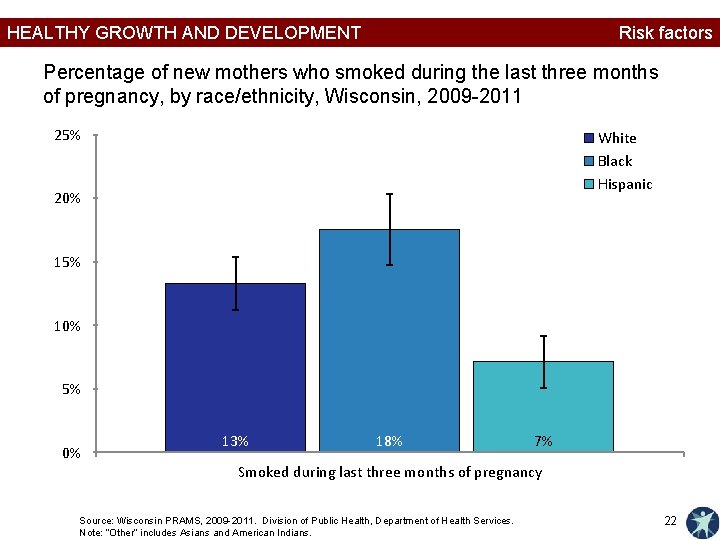
HEALTHY GROWTH AND DEVELOPMENT Risk factors Percentage of new mothers who smoked during the last three months of pregnancy, by race/ethnicity, Wisconsin, 2009 -2011 25% White Black Hispanic 20% 15% 10% 5% 0% 13% 18% 7% Smoked during last three months of pregnancy Source: Wisconsin PRAMS, 2009 -2011. Division of Public Health, Department of Health Services. Note: “Other” includes Asians and American Indians. 22
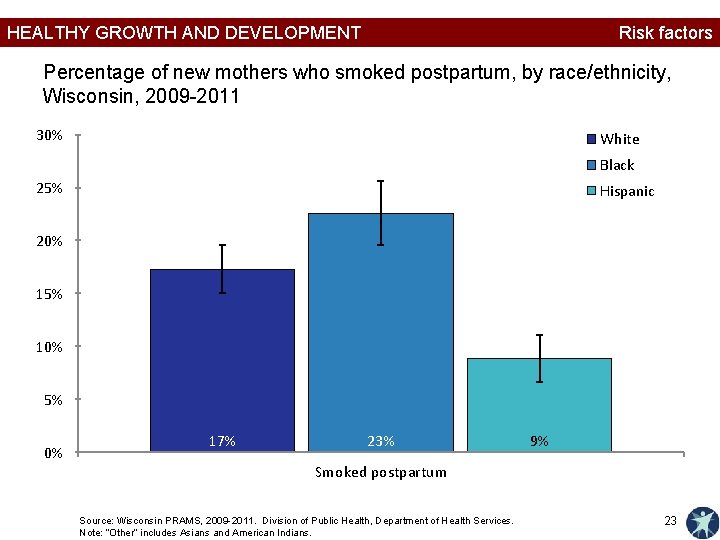
HEALTHY GROWTH AND DEVELOPMENT Risk factors Percentage of new mothers who smoked postpartum, by race/ethnicity, Wisconsin, 2009 -2011 30% White Black 25% Hispanic 20% 15% 10% 5% 0% 17% 23% 9% Smoked postpartum Source: Wisconsin PRAMS, 2009 -2011. Division of Public Health, Department of Health Services. Note: “Other” includes Asians and American Indians. 23
HEALTHY GROWTH AND DEVELOPMENT Health care access and utilization 24
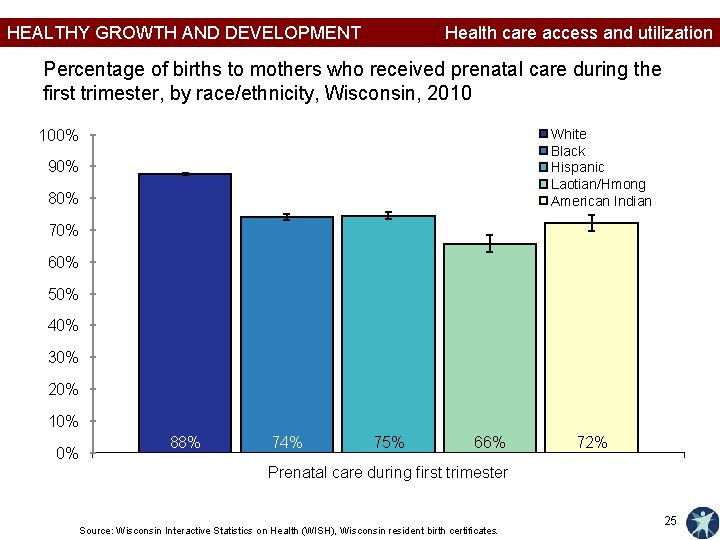
HEALTHY GROWTH AND DEVELOPMENT Health care access and utilization Percentage of births to mothers who received prenatal care during the first trimester, by race/ethnicity, Wisconsin, 2010 100% White Black Hispanic Laotian/Hmong American Indian 90% 80% 70% 60% 50% 40% 30% 20% 10% 0% 88% 74% 75% 66% 72% Prenatal care during first trimester Source: Wisconsin Interactive Statistics on Health (WISH), Wisconsin resident birth certificates. 25
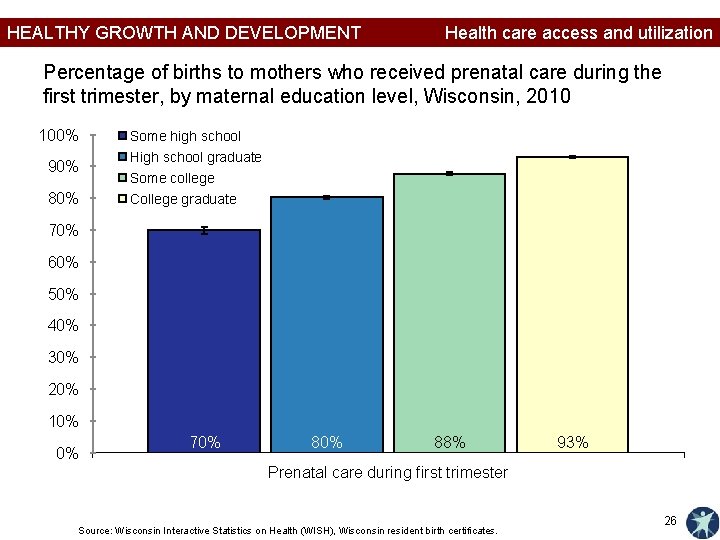
HEALTHY GROWTH AND DEVELOPMENT Health care access and utilization Percentage of births to mothers who received prenatal care during the first trimester, by maternal education level, Wisconsin, 2010 100% 90% 80% Some high school High school graduate Some college College graduate 70% 60% 50% 40% 30% 20% 10% 0% 70% 88% 93% Prenatal care during first trimester Source: Wisconsin Interactive Statistics on Health (WISH), Wisconsin resident birth certificates. 26
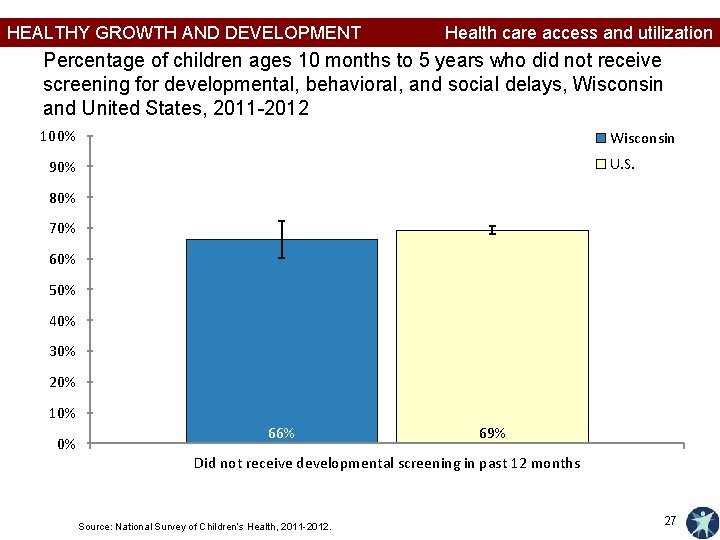
HEALTHY GROWTH AND DEVELOPMENT Health care access and utilization Percentage of children ages 10 months to 5 years who did not receive screening for developmental, behavioral, and social delays, Wisconsin and United States, 2011 -2012 100% Wisconsin U. S. 90% 80% 70% 60% 50% 40% 30% 20% 10% 0% 66% 69% Did not receive developmental screening in past 12 months Source: National Survey of Children’s Health, 2011 -2012. 27
HEALTHY GROWTH AND DEVELOPMENT References 1. University of Wisconsin Population Health Institute. County Health Rankings, 2013. http: //www. countyhealthrankings. org/our-approach 2. Center for Urban Population Health. Milwaukee Health Report, 2011. http: //www. cuph. org/mhr/2011 -milwaukee-health-report. pdf 3. La. Veist TA, Gaskin DA, Richard P (2009). The Economic Burden of Health Inequalities in the United States. Joint Center for Political and Economic Studies. http: //www. jointcenter. org/sites/default/files/upload/research/files/The%20 Economic% 20 Burden%20 of%20 Health%20 Inequalities%20 in%20 the%20 United%20 States. pdf 4. Thomas JC, Sage M, Dillenberg J, Guillory VJ (2002). A Code of Ethics for Public Health. Am Journal of Public Health. 92(7): 1057– 1059. http: //www. ncbi. nlm. nih. gov/pmc/articles/PMC 1447186/ 5. Wisconsin Department of Health Services (DHS). Healthiest Wisconsin 2020. http: //www. dhs. wisconsin. gov/publications/P 00187. pdf 6. National Survey for Health Statistics. National Vital Statistics Reports. Deaths: Preliminary Data for 2010. http: //www. cdc. gov/nchs/data/nvsr 60/nvsr 60_04. pdf 7. U. S. Department of Health and Human Services. Infant Mortality Fact Sheet. http: //www. hhs. gov/news/factsheet/infant. html 28
HEALTHY GROWTH AND DEVELOPMENT References 8. Centers for Disease Control and Prevention (CDC). Is low birthweight a health problem? http: //www. cdc. gov/pednss/how_to/interpret_data/case_studies/low_birthweight/what. htm 9. CDC. Unintended Pregnancies. http: //www. cdc. gov/reproductivehealth/Unintended. Pregnancy/ 10. CDC. PNSS Health Indicators. http: //www. cdc. gov/pednss/what_is/pnss_health_indicators. htm#Smoking/Drinking Indicators 11. CDC. Health Effects of Secondhand Smoke. http: //www. cdc. gov/tobacco/data_statistics/fact_sheets/secondhand_smoke/health_ef fects/ 12. CDC. During Prgnancy. http: //www. cdc. gov/pregnancy/during. html 13. American Academy of Pediatrics. Developmental Surveillance and Screening of Infants and Young Children. http: //pediatrics. aappublications. org/content/108/1/192. full 29
HEALTHY GROWTH AND DEVELOPMENT Links to additional reports and resources • Wisconsin Births and Infant Deaths, 2010: http: //www. dhs. wisconsin. gov/publications/P 45364 -10. pdf • Wisconsin Pregnancy Risk Assessment Monitoring System (PRAMS): http: //www. dhs. wisconsin. gov/births/prams/index. htm • Children and Youth with Special Health Care Needs Program: http: //www. dhs. wisconsin. gov/health/children/ 30
HEALTHY GROWTH AND DEVELOPMENT Contacts Contact Liz Oftedahl Epidemiologist Children and Youth with Special Health Care Needs (CYSHCN) Program / Maternal and Child Health Program Bureau of Community Health Promotion Division of Public Health Wisconsin Department of Health Services Email: Elizabeth. Oftedahl@dhs. wisconsin. gov 31
- Slides: 31